Blog Entries [1030 - 1039]Saturday, April 9, 2016
Candidate Analogies
I wanted to reply to this tweet by
Tom Carson, but no
way to unpack so much misunderstanding in 144 characters:
Bernie is the lefty Goldwater, Hils is the lefty Nixon. I suspect
I'll end up voting for Nixon, but I've seen this movie before.
First, very obvious point: left and right are never symmetric,
let alone mirror images of one another. Granted, the core issue
can be viewed as a continuum: people on the left believe that all
people are fundamentally decent, that everyone shares equal rights
and deserves respect and fairness, while people on the right hold
that for civilization to exist and survive society must be organized
as a hierarchy, with those favored by great wealth lording over the
hapless masses, using whatever force is needed to maintain order.
Unpack this a bit and you'll see that left and right are inhabited
by fundamentally different kinds of people. So when you say "X is
the lefty Y" the main thing you're saying is that X is so profoundly
different from Y that analogies can only be superficial.
Even so, the only linkage I can imagine Carson making between
Goldwater and Sanders is that he thinks Sanders, if nominated, will
lose as badly this year as Goldwater did in 1964. Leaving that for
the moment, it's hard to see much similarity -- even in the funhouse
mirror of centrist punditry. Most obviously, Goldwater was extremely
rigid in his adherence to principles -- most scandalously in his
opposition to using the federal government to secure civil rights
systematically denied by a dozen-plus state governments -- whereas
Sanders has always been flexible and pragmatic (e.g., in supporting
Obamacare even though he knew it wasn't the best, or even a very
good, solution). And Goldwater was so fanatic in his opposition to
Communism he couldn't be trusted not to start a thermonuclear war.
Sanders elicits no such fears -- which isn't to deny that neocon
warmongers fear him.
As for the Nixon-Clinton mashup, I reckon that the association
here is that both are unscrupulous opportunists willing to say and
do anything that seems to work to their personal advantage. No
doubt that both Clintons have been opportunistic at times, often
siding with rich and powerful interests against the very people
they depend on for votes. Nothing unusual about that, but you have
to question how far left they really are on the left-right line I
plotted above. I don't really consider them lefties at all.
Still, for all the times the Clintons have been slagged as liars --
Christopher Hitchens' book on them was titled No One Left to Lie
To: The Values of the Worst Family -- I'm hard pressed to recall
specific deceits (aside from the Lewinsky blow jobs, and blaming
Arafat for the Camp David failure, the latter a big one), as opposed
to grandstanding (like the Sista Souljah slam) or plain old bad policy
choices (like NAFTA, or repealing Glass-Steagall). I don't doubt that
the Clintons are greedy, ambitious, and vain -- willing to use office
to get rich, and to use their wealth to build a political machine to
seek further office. Still, the scandals that have dogged their rise
have been remarkably hollow.
On the other hand, Nixon holds a unique place in American history,
not just for bad policy and malign intentions but for actual crimes
against American democracy as well as egregious crimes against world
peace -- sure, the later have since become routinized and Nixon didn't
invent them all, but the scope of his crimes was breathtaking -- and
for a while shocking, although his obsession with winning at all costs
and his cynicism at manipulating people's fears has since become baked
into the American pie. If Carson wanted to pose a true conundrum, he
might have posed a choice between the real right-wingers Goldwater and
Nixon. I have no more answer there than I would have had if asked who
is the best (in the sense of least awful) of this election's crop of
Republican presidential aspirants.
Carson at least is right to place Nixon on the right, avoiding the
recent revisionism trying to rehabilitate him as some kind of closet
liberal. I suppose the main impetus behind this has been to show how
far the right has stooped since Nixon's time, but doing so forgets
(and forgives) the fact that the rotten impulses that have permeated
today's right owe more to Nixon's craven realpolitik than to Goldwater's
so-called principles.
If you do have to make predecessor analogies, you might try casting
Trump as Nixon and Cruz as Goldwater. With the latter pair you at least
know what you're up against and start organizing against it, although
the prospect of itchy trigger fingers is always a threat. But with the
Nixon-Trump pair, you don't know shit -- just that it's likely to be
pretty nauseating and the sickness they sow is likely to return again
as precedent, possibly for even worse.
I suspect that what worries Carson about Sanders has less to do with
Goldwater's 1964 loss than McGovern's in 1972, thanks in no small part
to Nixon's dirty tricks. McGovern wasn't fundamentally more liberal (let
alone lefty) many other Democratic candidates -- Hubert Humphrey in 1968,
Walter Mondale in 1984, Michael Dukakis in 1988, John Kerry in 2004,
Barack Obama in 2008 -- but he lost bad, due I think to a combination
of factors. One is that the media has always had it in for anyone who
might rock the boat (Roosevelt was the exception, but he came along
after the boat had already capsized, and Obama got something of a pass
for the same reasons). McGovern also ran afoul of the Democratic Party's
patronage-focused elites, especially their hawk faction, and also the
rump Wallace voters -- all of whom chose Nixon's dirty tricks over the
most decent and honest politician the Democrats ever nominated.
All those losses by self-avowed liberals -- a string that really starts
with Adlai Stevenson in 1952 and 1956 -- have left centrist pundits with
the stunted thought that Americans refuse to lean left. If Sanders is
further to the left than McGovern (or anyone else on that loser-laden
list) what's to stop the entire establishment banding together to stop
him? (Billionaire self-promoter Michael Bloomberg has already vowed to
run a spoiler third-party campaign if Sanders is nominated.) That seems
like a fair question, but I'm not sure the coincidences it is based on
really supports the conclusion. Several things have changed since, say,
McGovern won and lost:
The Cold War is not only over, it's rapidly becoming ancient
history. Before 1990 the ideological struggle between capitalism and
communism allowed the right to question the patriotism of anyone even
remotely on the left, and more often than not Democrats joined in on
the red baiting, often to their own detriment. Moreover, with continued
abuse the old slurs have lost their potency. The long period of post-WWII affluence left a large segment of
the middle class basically feeling satisfied with their lot and to be
hopeful of their future prospects, making it easier to identify with
the system. The shift toward increasing inequality after 1980, and the
subsequent hollowing out of the middle class, have finally reached a
point where the system is no longer viewed as fair or hopeful -- and
recognizing that loss of opportunity has finally become unavoidable
for young adults. The mass media of the post-WWII years, which did so much to
homogenize public discourse, has fragmented into more limited but
more partisan media, allowing each of us to customize our own bubble
of information. This both pulls many of us in a more partisan way
and leaves many others so poorly informed that they drop out of the
political system. Unlimited political spending has pushed the Republican Party
far to the right, so they pose a much greater threat to our liberties,
security, and well being than ever before. In fact, they threaten us
so severely that it's becoming increasingly hard for centrist Democrats
to break ranks, as many did against McGovern in 1972, not to mention
William Jennings Bryan in 1896-1908.
These point don't guarantee that Sanders can defeat a full bore
Republican assault, but they offer some reasons to think that he might
do much better than McGovern did. The similarity to McGovern that I
worry more about is Sanders' exceptional integrity and public spirit,
which at least in McGovern's case was overwhelmed by Nixon's dark
money and dirty tricks. The one thing we can be sure of is that in
this year's election the Republicans and their dark money sponsors
won't hesitate to go places Nixon only dreamed of. The voters could
very well reject such tactics, but the Republicans have had no small
measure of success thus far at manipulating people to vote against
their own interests and desires.
Hillary Clinton has relied heavily on arguments that she's much more
electable than Sanders is. The most common argument here is that she
can attract a broader slice of the left-right spectrum, allowing her to
pick up moderate/centrist voters Sanders can't reach while keeping the
left captive, if only as the lesser evil. There are several problems
with this formulation: most people don't fit comfortably, let alone
mechanically, on a left-right axis, but bring other factors into play,
including several where Clinton may compare poorly against Sanders --
for instance, integrity and credibility. Sanders has stood firm with
his principles much more consistently than Clinton, and a good part
of the reason for that is that he's much less tainted by association
with private interests -- e.g., he's never spoken to Goldman-Sachs,
much less for $650K. One thing that's clear from primary results so
far is that Sanders has done much better among (presumably centrist)
independents than Clinton has.
Indeed, in head-to-head polls Sanders regularly outperforms Clinton
against virtually any Republican candidate, suggesting that for whatever
reason Sanders is the more electable Democrat. Yet some Clinton supporters,
even ones who admit to being closer to Sanders on the issues, persist in
their belief that Clinton is more electable. Aside from ideology, the
other reason they commonly give is the claim that Clinton has already had
to face so many attacks from right-wingers that she has been thoroughly
vetted, whereas Sanders has yet to feel the full fury of the Republican
hate machine. That may be true but glosses over several things, including
that Clinton has more points on which she is compromised, and that she's
not exactly unscathed by all those attacks -- her unfavorability polls
are exceptionally high.
On the other hand, I think there is one area where Clinton does have
a substantial advantage over Sanders, and that is her ability to raise
dark money and use it to underwrite the same sort of vicious mudslinging
right-wingers can be counted on doing. So when the campaign gets dirty,
as it's sure to do, she's arguably in a much better position to fight
that kind of fight. Whether that's an argument in her favor is hard to
say, but it's certainly a reasonable position -- the counter is that if
Sanders could win without PACs and dark money that might help break the
grip big money has on the political system, and our democracy would be
much better for it.
Still, Clinton wooing big money donors and playing the dark money
game won't be enough to make her Nixon, even a hypothetical lefty
version. Nor will it make her a right-winger, even though it would
indebt her to people who are on right of center, at least in terms
of equality. And having done all of that, I wonder how much energy
or will she is going to be able to muster to start to reverse the
nation's long slide into oligarchy. At some point things get so bad
that lesser evils don't cut it. If Sanders' popularity shows anything
it's that many Democrats believe we've passed the point where yesterday's
palliatives are all it takes.
It's normal for people to reach for historical analogies when trying
to understand today's issues, but it can also lock you into illusions
and blind you to opportunities. And sometimes produce outright absurdities.
My original response to Carson's tweet just touched on one small aspect
of this post, which is that real people don't necessarily gravitate
toward the middle when faced with real choices:
Hell, even my George Wallace/George McGovern-voting mother knew one
key thing about politics: never vote for Nixon.
Continue reading . . .
Ask a question, or send a comment.
Monday, April 4, 2016
Music Week
Music: Current count 26446 [26420] rated (+26), 414 [410] unrated (+4).
Rated count up a bit this week, probably because I only spent one day
and a couple nights working on my sister's house. Also because I wrapped
up a
Rhapsody Streamnotes. Still, short of the 30-milestone that constitutes
a productive week. On the other hand, seasonal allergies hit with
force, and I barely sleepwalked my way through yesterday's abbreviated
Weekend Roundup.
But at least I had Jason Gubbels' unranked list of 40 recommendations,
New Music 2016: First Quarter, to start wading through. Thus far
everything I've checked out has been pretty good, although I've mostly
left them at B+(***) -- aside from the Margo Price find, the closest
of the HMs was the Heliocentrics album, where I talked myself out of
an A- by re-reading my review. (An edit of my Willie Nelson review
also resulted in downgrading Summertime. The Rihanna upgrade
occurred after at least five replays.)
Not much new jazz coming in, and not much good among what does show
up. I usually start the day with a CD from the queue, and several days
I haven't had anything to follow it up with. Only seven actual CDs in
the list below (and, OK, they're better than I remembered: 3 ***, 3 **,
1 *; as I recall, the previous week's CDs left a lot more to be desired,
and today's mail doesn't look very promising). One big disappointment
is that a month after I got the promo material by email I still haven't
received the March package from Clean Feed. Mail is often slow from
Portugal, but it would hugely bum me out if they drop me. (Not that I
wouldn't look up what I could on Rhapsody.)
I did get an invite to vote in Downbeat's annual Critics Poll
today. I've also gotten a record number of personal pleas to vote for
them, something I'm pretty good at forgetting instantly. (I mind less
when I get past-year lists from publicists because they help me identify
things that fell through the cracks -- I don't think I've gotten any of
them this year, but have in the past, and they're a regular year-end
ritual.) I'll take the time to vote later this week -- I've never managed
to plod through the ballot in just one day, so it's a big commitment --
and I'll publish an annotated ballot once I do. Aside from albums, which
follow that aggravating April-March annual skew, this year's should be
much like
last year's ballot. I'd argue that having an extra three months to
let the old calendar year (2015 in this case) settle down would be worth
more than pretending we're already on top of the first quarter of 2016.
(For that matter, the Readers Poll, which skews three months later, could
also benefit from a settling-down period.)
Well, one ballot change is that since last year's HOF pick, Lee Konitz,
finally won, George Russell will move up as my top pick. A second big
annoyance about the poll is the HOF bottleneck. Downbeat has 141
inductees into its Hall of Fame (starting with Louis Armstrong in 1952).
Compare this with the
Rock & Roll Hall of Fame, which has 312 inductees (749 people)
since 1986. Now, you can argue that that's too many, and make a pretty
good case by pointing to the 2016 crop (Cheap Trick, Chicago, Deep
Purple, Steve Miller, and NWA). But fewer than five of the names in
the Downbeat HOF (which basically expands at 2 per year, plus
they've recently added a Veterans Committee which helps a bit) raise
an eyebrow (rockers Frank Zappa and Jimi Hendrix, although I can't
begrudge the latter; some others I wouldn't have voted for but can
(sort of) understand -- Glenn Miller, Red Rodney, Maynard Ferguson,
Joe Zawinul, Chick Corea, Michael Brecker, Pat Metheny), maybe a
"veteran" who seems a bit obscure (Jimmy Blanton, Paul Chambers,
Baby Dodds). On the other hand, just working from last year's ballot,
the list of non-inductees includes: Han Bennink, Paul Bley, Anthony
Braxton, Jaki Byard, Don Byas, Don Cherry, Jack DeJohnette, Jimmy
Giuffre, Benny Golson, Grant Green, Dave Holland, Abdullah Ibrahim,
Illinois Jacquet, John McLauglin, Tito Puente, Sam Rivers, Pharoah
Sanders, Tomasz Stanko, Cedar Walton, Randy Weston, Phil Woods.
And that must mean that the following didn't even qualify for the
ballot (and this list could grow much longer): Rashied Ali, Henry "Red"
Allen, Mildred Bailey, Billy Bang, Chris Barber, Gato Barbieri, Chu
Berry, Carla Bley, Ruby Braff, Cab Calloway, Sid Catlett, June Christy,
Buck Clayton, Arnett Cobb, Cozy Cole, Vic Dickenson, Harry "Sweets"
Eddison, Art Farmer, Tommy Flanagan, Bud Freeman, Slim Gaillard, Herb
Geller, Lars Gullin, Al Haig, John Hicks, Budd Johnson, Leroy Jenkins,
Wynton Kelly, Louis Jordan, Sheila Jordan, Eddie Lang, George Lewis
(either/both), Albert Mangelsdorff, Misha Mengelberg, David Murray,
Herbie Nichols, Anita O'Day, Evan Parker, William Parker, Houston
Person, Louis Prima, Don Pullen, Don Redman, Charlie Rouse, Jimmy
Rushing, Luis Russell, Alex von Schlippenbach, Irène Schweizer, Bud
Shank, Sonny Sharrock, Archie Shepp, Stuff Smith, Horace Tapscott,
Lucky Thompson, Stanley Turrentine, Mal Waldron, David S. Ware,
Barney Wilen, Gerald Wilson. Just saying, a lot of (to use an old
Downbeat phrase) talent deserving wider recognition.
RIP: Argentine saxophonist Gato Barbieri (1934-2016), and Ethiopian
saxophonist Getatchew Mekurya (1935-2016).
New records rated this week:
- Ralph Alessi: Quiver (2014 [2016], ECM): [dl]: B+(***)
- Beauty School: Residual Ugly (2015, Humbler): [bc]: B+(*)
- Big Ups: Before a Million Universes (2016, Exploding/Tough Love): [r]: B+(***)
- Michael Blake: Fulfillment (2016, Songlines): [r]: B+(*)
- Bombino: Azel (2016, Partisan): [r]: B+(***)
- Jaimeo Brown Transcendence: Work Songs (2016, Motema): [r]: B+(***)
- The Ian Carey Quintet + 1: Interview Music (2015 [2016], Kabocha): [cd]: B+(***)
- Tim Daisy: Relucent: Music for Marimba, Radios and Turntables (2016, Relay): [bc]: B
- Stephen Davis/Ralph Alessi/Kris Davis: Sugar Blade (2015, Babel): [r]: B+(**)
- Eli Degibri: Cliff Hangin' (2014 [2016], Blujazz): [cd]: B+(*)
- Dressy Bessy: Kingsized (2016, Yep Roc): [r]: B+(**)
- Marty Elkins: Walkin' by the River (2014 [2016], Nagel Heyer): [cd]: B+(***)
- The Heliocentrics: From the Deep (2016, Now-Again): [r]: B+(***)
- Russ Johnson: Meeting Point (2014, Relay): [bc]: B+(**)
- La Sera: Music for Listening to Music To (2016, Polyvinyl): [r]: B+(**)
- Matt Lavelle's 12 Houses: Solidarity (2014 [2016], Unseen Rain): [cd]: B+(**)
- Steven Lugerner: Jacknife: The Music of Jackie McLean (2015 [2016], Primary): [cd]: B+(***)
- Iggy Pop: Post Pop Depression (2016, Loma Vista): [r]: B+(*)
- Margo Price: Midwest Farmer's Daughter (2016, Third Man): [r]: A-
- Rocco John Quartet: Embrace the Change (2015 [2016], Unseen Rain): [cd]: B+(**)
- Steel Bridge Trio: Different Clocks (2015, Relay): [bc]: B+(*)
- Gwen Stefani: This Is What the Truth Feels Like (2016, Interscope): [r]: A-
- Vox Arcana: Caro's Song (2014 [2015], Relay): [bc]: B+(*)
- Christopher Zuar Orchestra: Musings (2014 [2016], Sunnyside): [cd]: B+(**)
Recent reissues, compilations, and vault discoveries rated this week:
- Punk 45: Chaos in the City of Angels and Devils: Hollywood From X to Zero & Hardcore on the Beaches: Punk in Los Angeles 1977-81 (1977-81 [2016], Soul Jazz): [r]: B+(***)
Grade changes:
- Willie Nelson: Summertime: Willie Nelson Sings Gershwin (2016, Legacy): [r]: [was B+(*)] B
- Rihanna: Anti (2016, Roc Nation): [r]: [was B+(**)] A-
Unpacking: Found in the mail last week:
- Matt Cirscuolo: The Dialogue (Jazzeria): April 4
- The Jim Cullum Jazz Band/William Warfield: George Gershwin's Porgy and Bess Live (2016, Riverwalk Jazz, 2CD): June 1
- James Freeman: Echoes of Nature III (Edgetone)
- Roberto Magris: Need to Bring Out Love (JMood)
- Daniel Meron: Sky Begins (Rabbit Rabbit Rabbit): April 26
- Jane Monheit: The Songbook Sessions: Ella Fitzgerald (Emerald City)
- Noertker's Moxie & the Melancholics: Curious Worlds: The Art & Imagination of David Beck (Edgetone)
- Rent Romus/Teddy Rankin-Parker/Daniel Pearce: LiR (Edgetone)
- Ernie Watts Quartet: Wheel of Time (Flying Dolphin): April 15
Ask a question, or send a comment.
Sunday, April 3, 2016
Weekend Roundup
Started to work on this, then got so waylaid by allergies my brain
froze up. Of course, trying to write about whether Trump is a fascist
is a question that begs so much backtracking it's easy to get lost.
Worth noting here that the Wisconsin primary is Tuesday. Cruz has
long been favored over Trump and Kasich: the latest 538 poll averages
are 44.1-32.1-21.4%, and since it's mostly winner-take-all Trump is
likely to fall short of the delegate count to stay on track for a
first ballot win -- so expect some pundit talk about Trump stumbling,
but Trump is a lock for a big win in New York on April 19, and has
a good chance of scoring his first greater than 50% win there (538's
poll average is 52.1-24.0-21.8%, with Cruz second and Kasich third).
More interesting is the Democratic primary, which 538 still gives
to Clinton, but the poll averages have narrowed to 48.8-48.6%, with
Sanders leading in five of the seven most recent polls. At this point
I expect Sanders to win there, but it won't be a landslide. 538 is
still showing Clinton with a huge lead in New York, 61.0-37.0%, but
the last two polls there have Clinton +12 and +10, a far cry from the
71-23% outlier 538 still factors in. Clinton also has big leads in
the other April primaries (65.9-30.5% in Pennsylvania, 70.6-27.0% in
Maryland); also in California and New Jersey on June 7.
Some scattered links this week:
Steve Coll: Global Trump:
Trumpism is a posture, not a coherent platform.
[ . . . ]
Trump hasn't indicated that he would definitely pull out of treaty
commitments to Europe and Asia. He seems to think that his threats and
his pleas of poverty will soften up allies so that, once in the White
House, he can close some of those great deals he often talks about. For
"many, many years," he told the Times, the U.S. has been the "big stupid
bully and we were systematically ripped off by everybody," providing
military security without adequate compensation.
Like a hammer viewing everything as a nail, Trump desperately wants
to reconceive foreign relations as something that can be fixed by a
flamboyant and shrewd deal maker -- i.e., by himself. He reminds me
of a guy who was brought in to become CEO of a troubled company I used
to work for. The company had racked up massive losses over several
quarters, staving off bankruptcy only because they had sold a lot of
bonds a few years earlier -- they didn't need the bonds but sold them
"because they could" and just sat on the cash until they burned it all
up. Anyhow, this new CEO (I don't even remember the name now) had the
huge ego you get in jobs like that, so the first thing I decided to do
was to renegotiate all of the company's supplier contracts, just because
he figured he was a better negotiator than his predecessor. Turned out
that he never successfully renegotiated a thing: all he did was piss off
suppliers the company was already in arrears to, companies that no longer
saw us as viable long-term customers. America isn't in as bad shape as my
company was, but if Trump follows through and tries to shake down traditional
allies, he's not likely to net much other than bad will. (Japan, for instance,
pays us for defense because it's a pittance compared to our trade deficits.
Maybe they'll pay a bit more, but the US market isn't what it used to be,
nor is the US commitment to defend them.)
Coll has a pretty rosy view of American military spending abroad --
surprising for someone who's mostly covered the Middle East for the last
twenty-some years:
Trump also argues that reduced defense spending abroad would free up funds
for investment at home. We do need to rebuild bridges, airports, railways,
and telecommunications. But defense spending isn't stopping us from doing
so; the problem is the Republican anti-tax extremists in Congress, who
refuse to either raise revenues or take advantage of historically low
long-term interest rates. In all probability, the U.S. can afford its
global-defense commitments indefinitely, and an open economy, renewed by
immigration and innovation, should be able to continue to grow and to
share the cost of securing free societies. The main obstacle to realizing
this goal is not an exhausted imperial treasury. It is the collapse of the
once-internationalist Republican Party into demagoguery, paralysis, and
Trumpism.
That, of course, is pretty much the Clinton position, one that argues
that America is still great, has never been anything else. Such platitudes
are baked into the Belt Area foreign/security policy professional class.
They even seep into
Stephen M Walt: No, @realDonaldTrump Is Not a Realist.
Tierney Sneed: How Trump Ticked Off Anti-Abortion Groups by Trying to
Prove His Creed: So Trump commits this gaffe, realizes his error
(or more likely has it pointed out to him), and walks it back within
hours.
For months, the major concern the anti-abortion movement had with Donald
Trump was that he was too wobbly on the issue. But on Wednesday, Trump
staked out an abortion position so extreme that he blew up years of
abortion foes' careful messaging.
Trump's remark at an MSNBC town hall that an abortion ban should carry
a punishment for women who seek out the procedure sent anti-abortion
activists immediately scrambling to correct the damage.
"Mr. Trump's comment today is completely out of touch with the pro-life
movement and even more with women who have chosen such a sad thing as
abortion," Jeanne Mancini, the president of March for Life Education and
Defense Fund, said in a statement rushed out about an hour after Trump's
remarks were first broadcast. "No pro-lifer would ever want to punish a
woman who has chosen abortion. This is against the very nature of what we
are about."
In practical terms this should be treated as a wash -- like a muons
which appears in a high-energy burst then vanishes within microseconds --
except that I think it shows two things:
- Trump understands the logic of the anti-abortion movement, which is
about little more than punishing women (for sexual licentiousness, or
getting raped, or just being poor), much as he understands punishment
as the essential means of disciplining errant children and other rabble.
No doubt being a major league misogynist helped Trump on this score.
- The much alleged "political correctness" police on the left are pikers
compared to those who dictate orthodoxy on the right: the latter turned
Trump around in hours, whereas Trump held firm on his assertions that
"Mexicans are rapists" and his embrace of support from the KKK and
outright Fascists. Sure, one might argue that this proves that the
offenses he held firm on reflected deeply held beliefs, whereas his
anti-abortion stance was never more than pure political opportunism.
But I doubt he has any bedrock beliefs beyond his obsessions with
the media spotlight and making money off that.
Also see
Here's How a Republican Is Supposed to Answer That Abortion Question
Trump Flubbed, which shows how Ted Cruz handled the same question.
The summary:
See, Donald? That's how you do it. When someone asks you about abortion
penalties after the overturn of Roe, here's what you do:
You attack the questioner.
You attack the media.
You attack Barack Obama.
You tell them what a swell pro-life person you are.
You do everything except answer the question.
Olivia Ward: Is Donald Trump actually a fascist? I'll add that leftists
like myself are hypersensitive to fascist airs, and apply the label broadly
to any right-winger who threatens violence, glories in empire, and/or seeks
to reverse liberal progress (which they often decry as decadence and decay).
Trump loosely qualifies, but so does Cruz and Kasich and most Republican
activists, especially anyone who thinks America enjoyed a golden age under
Calvin Coolidge or William McKinley (or Jefferson Davis). What makes Trump
seem exceptional is the way he draws the sort of people who historically
have supported fascism: racists, xenophobes, ultra-nationalists, those
who want to use state power to enforce religious morality, those who hate
unions, those who are contemptous of democracy (and other people), those
who are prone to violence and hung up on patriarchy, those who feel the
need to follow a charismatic and forceful leader. So it's not so much that
Trump started out as a fascist as that by style and temperament he's been
anointed as the Führer of the fascists, a role he hasn't shirked.
Susan Sarandon Lives in a Very Small World: A not-very-smart critique
of the "scandal" caused when Sarandon said that some Sanders supporters
won't vote for Clinton against Trump, and that her own view was "I don't
know. I'm going to see what happens." I wrote more about this piece then
tore it up. Two points are that Sanders' popularity shows that there is
much more quasi-left in America than anyone gave us credit for, and that
transitioning from voting for one candidate who wants changes you want
to another one who wants to defend the status quo (or somewhat mitigate
the damage the goons on the other side are plotting) isn't likely to be
smooth or automatic: perhaps if Clinton wins the nomination she should
campaign for Sanders' supporters instead of veering to the right so to
come off as slightly saner than Trump or Cruz, assuming everyone else
will fall in line. At any rate, it's premature to worry about Sanders'
supporters breaking ranks. As for the ad hominem attacks about Sarandon
"living in a very small world," I think her political engagement is
admirable and far-sighted, showing much more awareness of other people
than is common in her tax bracket. Brief links:
Ask a question, or send a comment.
Wednesday, March 30, 2016
Rhapsody Streamnotes (March 2016)
Slowed down this month, but looking at the list I don't think I
have much to apologize for: 120 records is the fewest this year, and
the elapsed time is the longest between columns in quite some while,
but neither by much. Of the 91 new records, 73 are 2016 releases, so
80.2%. I don't think I ever consciously decided to move on, but I ran
out of 2015 CDs some time back (OK, I still have a cassette tape I
can't play, and that Kansas reunion album), and I've been keeping my
dwindling new jazz queue close to empty.
I'm still not doing any serious 2016 prospecting. I do have a
m2016 file but it's mostly tracking
what I've heard (or unpacked), with only a handful of unheard items
added to remind myself to look them up. This is a big cutback from the
m2015 file, which I updated every
week from AMG and other release sources, then added stragglers from
EOY lists (the lines difference is 7250 to 320). In the near future
I expect to add
Jason Gubbels's first quarter list, and maybe some other more/less
trusted sources (I have been listening to almost everything Robert
Christgau and Michael Tatum have recommended, aside from the Kanye
West mixtape that snuck past me).
The Old Music section continues to be haphazard, with most records
picked up as background when I was considering new (or in the case of
Larry Young new-old, which featured Nathan Davis) work. I suppose Horace
Parlan is an exception: my favorite Parlan album is the 1977 duo he did
with Archie Shepp, Goin' Home, and when I noticed it on Rhapsody
I had brief hopes that I might find more albums on the Steeplechase label.
That didn't really work out, but I did find a couple old Blue Notes I
wanted to check out.
Most of these are short notes/reviews based on streaming records
from Rhapsody (other sources are noted in brackets). They are snap
judgments based on one or two plays, accumulated since my last post
along these lines, back on February 25. Past reviews and more
information are available
here (7920 records).
Recent Releases
Raul Agraz: Between Brothers (2013-15 [2016], OA2):
Trumpet player, from Venezuela, first album, long list of musicians
but recorded over several sessions -- the song-by-song credits average
about nine per cut (not counting the extra strings). Latin big band,
doesn't strike me as special.
B [cd]
Melissa Aldana: Back Home (2015 [2016], Wommusic):
Tenor saxophonist, won a Monk prize which got her a record out on
Concord, well regarded in 2014 and not without merit. But I prefer
this fairly mainstream sax trio, with Pablo Menares on bass and
Jochen Rueckert on drums. Nothing especially fancy, four originals,
two pieces each from the band, Kurt Weill's "My Ship."
B+(***) [cdr]
Anderson .Paak: Malibu (2016, OBE/Steel Wool/ArtClub/Empire):
Brandon Paak Anderson, who previously did business as Breezy Lovejoy,
from Oxnard, CA. Second album, sings and raps, the beats skewed out
a bit stoned. Seems to have worked as a "marijuana farmer" some while
back, then did a stint as homeless, so he can do down and out and get
through it somehow.
A-
Ehud Asherie: Shuffle Along (2015 [2016], Blue Heron):
Pianist, born in Israel but moved to Italy when he was three, then to
New York at nine, where he hung around Smalls and took lessons from
Frank Hewitt. Career has moved from bop to swing, and takes a further
step back here with his "solo piano interpretations from [Eubie] Blake
and [Noble] Sissle's 1921 Broadway musical" -- best known for "I'm Just
Wild About Harry," given two treatments here.
B+(***) [cd]
Audio One: What Thomas Bernhard Saw (2014 [2015],
Audiographic): Ten-piece Ken Vandermark group, third album for this
project. With all the alumni, I'm tempted to describe this more of
a souped-up Vandermark 5 (Dave Rempis and Mars Williams join in on
reeds, Jeb Bishop returns on trombone, and Tim Daisy is the drummer)
than a big band project per se, The four Vandermark dedications are
tightly conceived even though they each expand to 15-20 minutes.
Band includes cornet (Josh Berman), another sax (Nick Mazzarella),
vibes (Jason Adasiewicz), viola (Jen Paulson), and bass (Nick Maori,
both acoustic and electric).
A- [bc]
Kenny Barron Trio: Book of Intuition (2015 [2016],
Impulse): Pianist, now in his 70s, has many dozens of albums since
1973, also a very distinguished career as an educator. Trio with
Kiyoshi Kitagawa (bass) and Johnathan Blake (drums).
B+(**)
Steve Barta: Symphonic Arrangement: Suite for Flute and Jazz
Piano Trio (2015 [2016], Steve Barta Music): Cover recalls
composer-pianist Claude Bolling's original 1975 album (headlined by
flautist Jean-Pierre Rampal). Barta rearranged, giving the leads to
Hubert Laws (flute) and Jeffrey Biegel (piano). Not something I care
enough to compare versions of, but it passed by pleasantly enough.
B [cd]
B.J. the Chicago Kid: In My Mind (2016, Motown):
AMG says "Contemporary R&B" -- means Bryan James Sledge sings in
a context more or less defined by hip-hop, although the son of church
choir directors and the former backup for Stevie Wonder also has much
fondness for the sweet ballad. Sprawling album, runs over an hour and
could use some editing, but if I listened to it enough to figure out
where I might forget why.
A-
Michael Blake: Fulfillment (2016, Songlines): Tenor
saxophonist (sometimes soprano), from Canada but based in New York,
recorded this "conceptual" project -- a suite based on "a tragic
immigration incident in Vancouver in 1914, when a Japanese freighter
carrying several hundred East Indian immigrants (almost all Sikh)
was turned away using exclusionist, racist laws." Recorded with a
Vancouver-based group -- JP Carter, Peggy Lee, Chris Gestrin, Ron
Samworth, André Lachance, Dylan van der Schyff -- the lyrics may
help detail the story but disrupt the flow, which can be quite
dramatic without them.
B+(*)
Cristina Braga & Brandenburger Symphoniker: Whisper
(2015 [2016], Enja): Brazilian harpist with the Orquesta Sinfónica do
Teatro Municipal do Rio de Janeiro, also sings, backed by Modern Samba
Quartet and a German symphony orchestra, with guitarist-vocalist Dado
Villa-Lobos as a "special guest." Brazilian pop with serious classical
airs, not a direction I'm inclined to favor.
B- [cd]
Renato Braz: Saudade (2005-15 [2016], Living Music):
Brazilian crooner, plays guitar but isn't credited with writing these
songs -- cue in the usual suspects -- but aside from the live "bonus
track" at the end they all sound like mopey ballads to me. Recorded
over a decade, guest spots for Dori Caymmi and Ivan Lins, various
bands including the Paul Winter Consort and the Dmitri Pokrovsky
Ensemble.
C [cd]
Andy Brown Quartet: Direct Call (2015 [2016], Delmark):
Guitarist from Chicago, had a solo album last year, follows it up with
piano trio-plus-guitar (no horns), Jeremy Kahn the pianist. Swing lines --
starts with "The Jeep Is Jumpin'" -- keep it nice and unthreatening.
B+(*) [cd]
Rich Brown: Abeng (2015 [2016], self-released):
Electric bassist, based in Toronto, album has a logo for Canada Council
for the Arts but no label ID. Luis Deniz shows impressive range on alto
sax, backed by Chris Donnelly or Robi Boros on piano, drums, extra
percussion, with phat bass tones everywhere.
B+(**) [cd]
Oguz Buyukberber/Tobias Klein: Reverse Camouflage (2015
[2016], TryTone): Clarinet duets, both musicians also switching off to
bass or contrabass clarinets. Both are based in the Netherlands, the
former born in Turkey, the latter in Germany and better known for ICP
Orchestra. Avant, tone can get on your nerves at points.
B+(**) [cd]
Rex Cadwallader/Mike Aseta/Arti Dixson/Tiffany Jackson: A Balm
in Gilead (2015 [2016], Stanza USA): Piano-bass-drums trio plus
soprano diva, intentional culture clash as the trio busts up mostly trad
ballads while the singer puts them into a shrill straitjacket. Title
song, "Deep River," "This Little Light of Mine," "Motherless Child,"
"Elijah Rock," "Every Time I Feel the Spirit," couple more, feathered
out a bit by five "Trialogue" pieces, where the singer shuts up while
the trio does something interesting. I can't stand opera, but get her
sense of flow. Not something I enjoy.
B- [cd]
Taylor Cook: The Cook Book (2015 [2016], self-released):
Saxophone player from British Columbia, based in Toronto, employs some
twenty musicians to spice up his schmaltz, not always to good effect.
Still, I always enjoy "On the Sunny Side of the Street."
B [cd]
Patrick Cornelius: While We're Still Young (2014
[2016], Whirlwind): Alto saxophonist (also soprano and flute), has
a handful of records since 2006, this one a rather fancy postbop
octet, mostly name players who do a lot of bobbing and weaving.
B+(*) [cd]
Cowboys & Frenchmen: Rodeo (2015, Outside In Music):
Postbop quintet, led by two saxophonists (Owen Broder and Ethan Helm),
with piano, bass, drums, the group named after a short film by David
Lynch.
B+(*) [cdr]
Tim Daisy: Relucent: Music for Marimba, Radios and Turntables
(2016, Relay): Chicago drummer, the last in the Vandermark 5 and a regular
in post-V5 groups with Vandermark and/or Dave Rempis. This is solo, a
tape collage of soft percussion and ambient sound. Not much, really.
B [bc]
Dawes: All Your Favorite Bands (2015, Hub): Well, don't
know about you, but all my favorite bands are much better than this Poco
wannabe. (What? You don't remember Poco?)
B-
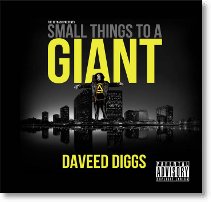
Daveed Diggs: Small Things to a Giant (2012 [2015],
Deathbomb Arc): Rapper from Oakland, came up in the underground group
Clipping; first album on his own, a real tour de force, smart and
snappy with rapidfire raps, the speed and dexterity which won him a
Grammy for the roles of Thomas Jefferson and Marquis de Lafayette in
Hamilton, but even more impressive as himself.
A- [bc]
The Dominican Jazz Project (2015 [2016], Summit):
Pianist Stephen Anderson seems to have been the catalyst if not the
leader here, connecting with various musicians on visits to the
Dominican Republic, like Guillo Carias (clavietta), Sandy Gabriel
(tenor/soprano sax), Guy Frömeta (drums), and Carlos Luis (vocals,
guitar). A mixed bag with multiple appeals.
B+(*) [cd]
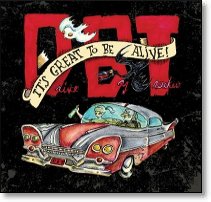
Drive-By Truckers: It's Great to Be Alive! (2014
[2015], ATO, 3CD): I put this off on the theory that 3:16:13 of anything
is too much to pay attention to streaming -- which didn't keep my ears
from perking up for the line that goes, "and all them politicians, they
all lyin' sacks of shit" (I was writing about Donald Trump at the moment,
although it could just as easily have been Marco Rubio, or Hillary Clinton).
A couple decades worth of songs, redundant if you've followed them, but
terrific as background noise, nicely unified by the live sound and
occasional patter. On separate discs I imagine the length will only
become more tolerable.
A-
Florian Egli Weird Beard: Everything Moves (2014
[2016], Intakt): Swiss quartet, has a previous album without the
leader-saxophonist's name on the cover. Egli is backed by guitar
(Dave Gisler), electric bass, and drums. Most compelling when they
put a litle rock muscle into the rhythm, but the first word in the
booklet is "Gelassenheit" -- serenity.
B+(***) [cdr]
Marty Elkins: Walkin' by the River (2014 [2016],
Nagel Heyer): Standards singer, from New Jersey, third album, with
guitarist Howard Alden swinging, both piano (Steve Ash) and organ
(Joel Diamond), and a stellar turn by Jon-Erik Kelso on trumpet.
B+(***) [cd]
Moppa Elliott: Still Up in the Air (2015 [2016],
Hot Cup): Solo bass album by the leader-composer behind Mostly
Other People Do the Killing, easily the most consistently awesome
jazz group of the past decade. The pieces are all called "Sequence"
and some number up to fourteen, but not the complete set.
B+(**) [cd]
Darren English: Imagine Nation (2014 [2016], Hot Shoe):
Trumpet player, first album, leads a hot boppish quartet with Kenny
Banks Jr. on piano, sometimes adding Greg Tardy on sax, switching up
on two tracks where Carmen Bradford sings standards ("What a Little
Moonlight Can Do" and "Skylark"). Brings two extra trumpets in for
the finale, a mad race through "Cherokee."
B+(*) [cd]
Piere Favre: DrumSights NOW (2015 [2016], Intakt):
Drummer, from Switzerland, will turn 80 next year, old enough to
have played with Albert Nicholas in the 1950s but best known (in
my household at least) for three superb duo albums with pianist
Irène Schweizer. His own discography has several albums with drum
quartets, so I imagine he sees DrumSights as a successor group to
his Singing Drums. Joined here by Chris Jaeger, Markus Lauterberg,
and Valeria Zangger, the group plays as one -- which makes this
seductive album slightly less than the sum of its parts.
B+(***) [cdr]
David Fiuczynski: Flam! Blam! Pan-Asian MicroJam
(2015 [2016], Rare Noise): Guitarist, nicknamed "The Fuze" as if
his music was fusion enough. Has close to ten albums since 2000,
including group efforts as Screaming Headless Torsos. Goes for
exotica here, including microtonal keyboards, a Chinese oboe and
percussion, and three cuts with alto saxophonist Rudresh Mahanthappa.
Should be interesting, but nothing quite works out right.
B [cdr]
Socrates Garcia Latin Jazz Orchestra: Back Home
(2015 [2016], Summit): Composer-arranger-guitarist, from Dominican
Republic, teaches at University of Northern Colorado, leads a big
band with the usual horns and extra guitar and percussion through
a set of originals, concluding with his three-part "Dominican Suite
for Jazz Orchestra."
B [cd]
Danny Green Trio: Altered Narratives (2015 [2016], OA2):
Pianist, from Southern California, fourth album since 2009, plays postbop
with classical touches and a little Latin tinge. Augments his trio here
with a string quartet for the middle cuts, expanding the sound so much
I initially suspected an orchestra. Not the sort of thing I'm disposed
to like much, but his sweep and flow is remarkable and the sensation
just overwhelms you.
B+(***) [cd]
Jeff Guthery: Black Paintings (2015 [2016], self-released):
Drummer, inspired by Goya paintings, backed by several jazz notables --
Kenny Werner, George Garzone, Bruno Råberg, David Fiuczynski -- and the
East Coast Scoring Orchestra giving it a distinctly euroclassical air,
maybe something Nutcracker-ish (at least when Garzone isn't soloing).
B- [cd]
Hanami: The Only Way to Float Free (2015 [2016],
Ears & Eyes): Chicago quartet, guitarist Andrew Trim wrote all
the pieces and effectively leads, flanked by two horns -- Jason
Stein on bass clarinet and Mai Sugimoto on alto sax and clarinet.
Charles Rumback is the drummer.
B+(***) [cdr]
Lafayette Harris Jr.: Hangin' With the Big Boys
(2013 [2016], Airmen): Pianist, mainstream guy with a soul and funk
background, nearly ten albums since 1993. Opens with two covers,
then six originals, one by his alto saxophonist Caleb Curtis, and
two more covers. The "big boys" include Houston Person -- tenor
sax on five cuts -- Antoine Drye on trumpet, and three vocals by
Jazzmeia Horn and/or Noël Simoné Whippler. Nice, relaxed, soulful
set -- Person's marvelous solo on "The Very Thought of You" bumped
this up a notch.
B+(**) [cd]
Julian Hartwell: The Julian Hartwell Project (2015,
self-released): Pianist, first album, hype sheet clearly attributes
the album to the titular group but I usually go with the name leader.
High octane octet: sax, trumpet, trombone, two basses, guitar, drums,
a lot of firepower for a high energy postbop set.
B+(**) [cd]
Joseph Howell: Time Made to Swing (2015 [2016], Summit):
Clarinetist, from California, second album, quartet with accordion (Cory
Pesaturo), bass, and drums. Standards, starts with "On the Sunny Side of
the Street" then veers into Parker ("Confirmation") and Monk ("Let's Cool
One"). High energy, the accordion beefs up the sound, the clarinet races.
B+(***) [cd]
The James Hughes/Jimmy Smith Quintet: Ever Up & Onward
(2015 [2016], self-released): Hughes (alto/tenor/soprano sax) and Smith
(trumpet, cornet, flugelhorn) lead a hard bop quintet with Phil Kelly on
piano, fifty-some years after the genre's heyday. Still can't call it
retro, since it's pretty much the baseline postbop is built on, just
without the cleverness that sometimes passes for innovation.
B+(*) [cd]
Vijay Iyer/Wadada Leo Smith: A Cosmic Rhythm With Each
Stroke (2015 [2016], ECM): Piano-trumpet duo, both major
figures, so you'd expect something big. What you get, though, is
pretty tepid, with the piano fading into the background as Smith
does his slow-solo thing -- similar to his solo albums, perhaps
toned down a bit with Manfred Eicher watching.
B+(**) [cdr]
Jazz at Lincoln Center Orchestra With Wynton Marsalis: The
Abyssinian Mass (2013 [2016], Blue Engine, 2CD): Featuring
Damien Sneed, organist and conductor of Chorale Le Chateau, a red-robed
vocal group which judging from the pictures outnumbers the big band by
about five-to-one. Marsalis composed the music, drawing liberally on
the gospel tradition and smattering the libretto with plagiarism from
The Bible, and the Reverend Dr. Calvin O. Butts III adds some
down home preaching. Where I grew up, mass meant something huge and
heavy, and I can't say as I've encountered music so massive before.
I try not to begrudge Christians their faith, but it can't be a good
thing when it's reduced to two-plus hours of gloria in excelsis
Deo, or in their down home vernacular, "glory to God in the
highest." Comes in oversized packaging with a thick booklet and a
DVD, all the better to remind you that in America generous donors
are always willing to pay for trivialized amenities -- especially
the kind that worship power.
C- [cd]
Krakauer's Ancestral Groove: Checkpoint (2015 [2016],
Table Pounding): Clarinetist David Krakauer, plays jazz with klezmer
roots and branches: the rhythm generating a lot of energy and the
clarinet threatening to screech. Band is built around electric guitar
(Sheryl Bailey) and bass (Jerome Harris), and employs a sampler,
plus a guest spot for Marc Ribot.
B+(***) [cd]
Kyle: Smyle (2015, Indie Pop): Yet another singer-rapper
from southern California, this one from Ventura. AMG lists this as his
only album, then refers to another one (Beautiful Loser) -- maybe
has something to do with also/previously calling himself Super Duper.
Funny enough some pieces almost qualify as standup.
B+(***)
Julian Lage: Arclight (2015 [2016], Mack Avenue):
Guitarist, regarded as a Wunderkind, subject of a documentary at
age 8, performed on the Grammy Awards at 13, joined the faculty at
Stanford at 15. Still in his twenties, has continued to receive
critical praise and plaudits although I'm not sure why. This is a
trio with Scott Colley and Kenny Wollesen, originals with four
covers, all nice stuff.
B+(*) [cd]
Kendrick Lamar: Untitled Unmastered (2013-16 [2016],
Top Dawg Entertainment): Eight tracks, no titles but recording dates,
34:06, presumably outtakes, sketches, throwaway experiments, released
online because, well, what the hell? As someone who's never really
got either of his widely accalimed studio masterpieces, I'm even more
lost here. But nothing here is going to disabuse you of the notion
he's a genius, even if it doesn't quite convince me.
B+(***)
Tom Lellis: The Flow (2015 [2016], Beamtime): Jazz
singer, AMG lists seven albums since 1979, plays keyboards but Dave
Kikoski is the primary pianist here, leading a trio plus Jeremy Steig
on flute and a long list of guests. Four originals, plus Lellis lyrics
to several others -- mostly jazz pianists and his Brazilian heroes.
Neither his voice nor his chops impress much as he slips and slides
around too tricky melodies.
C-
Charles Lloyd & the Marvels: I Long to See You
(20B-15 [2016], Blue Note): Tenor saxophonist (also plays some flute),
became very popular in the mid-1960s and continues to be one of the
most highly regarded jazz musicians. Group here features guitarist
Bill Frisell and steel guitarist Greg Leisz, along with Reuben Rogers
on bass and Eric Harland on drums -- "Shenandoah" is a near-textbook
example of Frisell's feel for Americana. Second half includes guest
vocals by Willie Nelson and Norah Jones. Feels to me like he's coasting,
but he does have entertaining friends.
B+(**)
Los Bonsáis: Nordeste (2015, Elefant, EP): Noise-pop duo
from Asturias in northwest Spain, soft shoegazey fuzz, attractive but not
very substantial, especially as they squeeze ten songs into 14:28.
B+(*)
Jon Lundbom & Big Five Chord: Make the Magic Happen
(2015 [2016], Hot Cup, EP): Guitarist, band includes two saxes -- Jon
Irabagon (alto) you know, Balto Exclamationpoint (tenor and his homemade
"balto! saxophone") I don't recognize (although previous member Bryan
Murray had also been credited with the less emphatic "balto saxophone") --
plus Moppa Elliott (bass) and Dan Monaghan (drums). Basically the same
avant brew Lundbom has been mixing up since 2009 -- my pick is still the
2CD Liverevil (2014) -- so what's new this year (aside from the
exclamation mark) is a marketing gimmick: the music is to be split up
into four 30-minute digital EPs, the first out now, the others in April,
June, and September. You can buy them "a la carte" or as part of a
subscription, or you can pre-order a "beautifully packaged" 4CD box
available September 30, which includes the downloads as they become
available.
B+(***) [cdr]
Jon Lundbom & Big Five Chord: Bring Their 'A' Game
(2015 [2016], Hot Cup, EP): The second of this year's four EPs, available
April 1 -- for promo purposes I got them both at the same time, popped
both into the changer, and can't tell them apart. Would make a fine
single album were they so inclined.
B+(***) [cdr]
Loretta Lynn: Full Circle (2016, Legacy): Now 83,
she hasn't produced albums with any regularity since the 1980s, with
her latest comeback the Jack White-produced Van Lear Rose
(2004). This one was organized by John Carter Cash and Patsy Lynn
Reynolds. As with Cash's father, they set Loretta down several years
ago to record the old songs, of which this is the first batch. She
doesn't have as iconic a voice as Cash, but she's sounding pretty
good here.
B+(**)
Kirk MacDonald: Symmetry (2013 [2016], Addo): Tenor
saxophonist, from Canada, not sure where but he has a dozen albums
since 1990, most recorded in Toronto. Hard bop quintet with trumpet
(Tom Harrell), piano (Brian Dickinson), bass (Neil Swainson), and
drums (Dennis Mackrel). Unexceptional except for the trumpet player,
who rewards whatever attention you can muster.
B+(*) [cd]
Gabriela Martina: No White Shoes (2015 [2016],
self-released): Singer-songwriter, born in Lucerne, Switzerland,
studied at Berklee, based in Boston, first album (after an EP).
All originals (except "A Night in Tunisia"), backed by
guitar-piano-bass-drums with a splash of soprano sax and a dash
of extra percussion.
B [cd]
Meridian Brothers: Los Suicidas (2015, Soundway, EP):
Colombian pseudo-group, principally Eldris Álvarez, here joined by
organ player Jaime Llano Gonzalez, who works "foreign rhythms such
as foxtrots or waltzes" into more traditional Colombian fare like
cumbias, bambucos, and pasillos -- although not without raising the
notion that it's all a bit odd. Eight cuts, 29:01.
B+(**)
Hendrik Meurkens: Harmonicus Rex (2010 [2016], Height
Advantage): Harmonica player, from Germany but mostly plays Latin jazz,
originally made his mark playing vibraphone. This is fairly mainstream --
Jimmy Cobb is the drummer, with Dado Moroni on piano, Marcus Panascia
on bass, and four spots each for Joe Magnarelli (trumpet/flugelhorn)
and Anders Bostrum (alto flute). Nice showcase for his instrument.
B+(*) [cd]
Dave Miller: Old Door Phantoms (2015 [2016], Ears &
Eyes): Guitarist, first album, fusion thing with Fender bass (Matt Ulery),
keyboards (Ben Boye), and drums (Quin Kirchner). The guitar is sometimes
snazzy, but more often than not they rely on volume to try to get their
point across (whatever it is).
B- [cd]
Naked Truth: Avian Thug (2013 [2016], Rare Noise):
Fusion quartet, not a "supergroup" but not unknowns either -- Graham
Haynes (electrified cornet), Lorenzo Feliciati (electric bass, guitars),
Roy Powell (organ, analog synths, prepared piano), and Pat Mastelotto
(acoustic & electric drums). Some interesting wrinkles, but doesn't
leave me thinking they've broken any ground.
B+(*) [cdr]
Willie Nelson: Summertime: Willie Nelson Sings Gershwin
(2016, Legacy): Generally a fine standards singer, mostly by sticking
to basics and shying away from melodrama. Still, he has trouble getting
the feel of these songs, his sly stutter far less pleasurable than,
say, the broad showboating of Louis Armstrong and Ella Fitzgerald --
their takes readily come to mind whenever I hear these songs, but I
can think of hundreds of versions I prefer, if only because unlike
Nelson's they swing. Duets with Cyndi Lauper and Sheryl Crow are low
points.
B
Angelika Niescier/Florian Weber: NYC Five (2015 [2016],
Intakt): Polish alto saxophonist, half-dozen albums since 2002, teamed
with the German pianist and a pick up band in New York: Ralph Alessi
(trumpet), Christopher Tordini (bass), and Tyshawn Sorey (drums).
Three tunes by each of the leaders, bursting with energy -- especially
strong showing by Alessi.
B+(***) [cdr]
Kat Parra: Songbook of the Americas (2016, JazzMa):
Vocalist, based in San Francisco, fifth album, mostly does Latin
standards, this albums mambos and cha-chas, boleros and tangos no
exception. Some guests, including Tuck & Patti, help out (if
you call their efforts help).
B [cd]
Christian Perez: Anima Mundi (2015 [2016], CPM):
Guitarist, from Argentina, mixes classical with Latin percussion
and bandoneon, decorated by flute or piccolo.
B [cd]
Roberta Piket: One for Marian: Celebrating Marian McPartland
(2015 [2016], Thirteenth Note): Jazz pianist, early albums (from 1997)
on mainstream labels, has more than a dozen. Makes sense she would take
McPartland as a hero. She gets ample support here for a lush tribute:
Steve Wilson (alto sax, flute), Virginia Mayhew (tenor sax, clarinet),
Bill Mobley (trumpet, flugelhorn), Harvie S (bass), Billy Mintz (drums),
with Karrin Allyson singing one tune.
B+(*) [cdr]
Leslie Pintchik: True North (2015 [2016], Pintch Hard):
Pianist, from Brooklyn, has a handful of albums since 2003, mainstream,
with the usual touchstones (notably Bill Evans). Trio work is quite nice
here, although most of it adds extra percussion from Satoshi Takeishi,
so it's trio only in spirit. Also, about half of the tracks add horns --
Steve Wilson (alto/soprano sax), Ron Horton (trumpet/flugelhorn -- and
they expand on the spirit.
B+(***) [cd]
Alberto Pinton Noi Siamo: Resiliency (2015 [2016],
Moserobie): Pinton's a multi-reed player from Venice, credited here
with baritone sax, clarinet, and bass clarinet. "Noi siamo" is just
Italian for "we are." Leads a quartet here with Niklas Barno (trumpet)
Torbjorn Zetterberg (bass), and Konrad Agnas (drums), recorded live
in Stockholm. A real barnburner.
A- [cd]
Richard Poole/Marilyn Crispell/Gary Peacock: In Motion
(2014 [2016], Intakt): Piano trio, drummer listed first for no reason
I've figured out other than that he usually gets listed last -- in my
database I find him so listed behind Patrick Battstone and Coat Cooke,
and his discography has a few more examples. Aside from a Peacock
standard, everything here is joint-credited, presumably improvised.
No complaints about the drummer, but the others are more famous for
good reasons, evident here even when they're not especially flashy.
B+(***) [cdr]
Iggy Pop: Post Pop Depression (2016, Loma Vista):
Band pictured and named on the cover, with Joshua Homme (Queens of
the Stone Age) listed first. Singer comes through loud and clear,
but everything else seems unsettled.
B+(*)
Pram Trio: Saga Thirteen (2015 [2016], self-released):
Piano trio: Jack Bodkin (piano), Mark Godfrey (bass), Eric West (drums).
Godfrey and Bodkin split six compositions, total 30:51. the sort of
thing that often gets marked EP these days.
B+(*) [cd]
Quantic: The Western Transient: A New Constellation
(2015, Tru Thoughts): British techno producer Will Holland, has a
substantial stack of records. This one is kept at arms length as
"Quantic Presents the Western Transient." Discogs lists this as
"smooth jazz," which is too prejudicial, but the record doesn't put
up much of a fight.
B
Quttinirpaaq: Dead September (2015, Rural Isolation
Project): Austin, TX noise group, name presumably derives from the
Canadian national park, located on the northern tip of Ellesmere Island,
as far north as you can go in Canada. Third album, sheets of guitar
playing "bleeding-noise industrial electronic rock . . . sounds like
punk rock thrown violently into a paper shredder with no fucks given."
I bailed out four cuts in, so cut it some grade slack.
C+
Bonnie Raitt: Dig In Deep (2016, Redwing): Her best
in quite some while -- my database nominates 1973's Takin' My Time
but I've missed things and reacted badly to Michael Tatum's nominee,
1991's Luck of the Draw. She hasn't aged in the manner of blues
singers, but there's nothing urgent here -- she's clear and articulate
and has learned to pace herself, making this seem so natural you'd think
she's been doing it so well all along.
A-
Ratatet: Arctic (2015 [2016], Ridgeway): Bay Area
group: Paul Hanson (bassoon), John Gove (trombone), Dillon Vado (vibes),
Greg Sankovich (keyboards), Jeff Denson (basses, vocals), Alan Hall
(drums), with Hall the leader/composer/arranger. Another postbop
variant, the instrumentation setting them apart.
B [cd]
Scott Reeves Jazz Orchestra: Portraits and Places (2015
[2016], Origin): Big band, leader plays alto flugelhorn but that's rather
beside the point. Steve Wilson gets a "featuring" credit on the cover,
and there are a handful of names I recognize in the band, like pianist
Jim Ridl and vocalist (2 cuts) Sara Serpa.
B- [cd]
Logan Richardson: Shift (2013 [2016], Blue Note):
Alto saxophonist, born in Kansas City but based in Paris, 2006 debut
(aptly named Cerebral Flow) impressed me, but this is only his
second album since -- a big label affair with big names in the band,
especially Jason Moran (piano) and Pat Metheny (guitar). So much talent
cannot be denied, but doesn't fit together all that well either. Cover
song from Bruno Mars.
B+(*)
Rihanna: Anti (2016, Roc Nation): Mostly crawl along,
not a good sign for dance-pop or even bump-and-grind, though often the
oblique rhythms suggest something interesting is lurking about, and
occasionally I get hooked -- "Love on the Brain" never fails.
A-
Alfredo Rodriguez: Tocororo (2015 [2016], Mack
Avenue/Qwest): Cuban pianist, based in US since 2009, third album,
co-produced by Quincy Jones. Many vocals, some pieces quite beguiling
in an almost childish way.
B+(**) [cd]
Sidestepper: Supernatural Love (2016, Real World):
British producer Richard Blair, learned to love Latin music living
in Colombia, and brought back that fondness for a more conventional
electronica treatment.
B+(*)
Sirius Quartet: Paths Become Lines (2015 [2016],
Autentico): String quartet, "blending the precision of classical
music and the energy of 'compromvisation,'" appeared on an album
with Ivo Perelman I liked, well, more than this. Mostly grates on
my ears, though some passages are interesting, and I don't doubt
their chops.
B+(*) [cd]
Gwen Stefani: This Is What the Truth Feels Like (2016,
Interscope): Blonde bombshell singer, a cover favorite of Blender
magazine back in the day, which included two 2000-02 albums fronting
No Doubt, and two 2004-06 solo albums. A decade later this is her third
album, done with four production teams and an average of four writers
per song, which for a pop album with hip-hop touches is about par for
the course. I can't say much for her old work, but pretty much every
song here clicks for me.
A-
Zhenya Strigalev: Never Group (2015 [2016], Whirlwind):
Alto saxophonist, based in London, don't know if he's native. Has a
couple previous albums, but this is the first I've heard of him, and
I botched the credit/title during unpacking. Core group is a trio with
Tim Lefebvre on bass and Eric Harland on drums, and several additional
musicians have guest spots.
B+(**) [cd]
Henry Threadgill Ensemble Double Up: Old Locks and Irregular
Verbs (2015 [2016], Pi): Not a Zooid album (an error I made
in unpacking). In fact, Threadgill doesn't play; he's only credited
with composition (four pieces, called "Part One" through "Part Four").
The ensemble does double up on piano (Jason Moran and David Virelles),
alto sax (Roman Filiu and Curtis MacDonald), and bass substitutes
(Christopher Hoffman on cello and Jose Davila on tuba), but only one
drummer (Craig Weinrib). Impressive group, way beyond the star pianists.
The composer gives them plenty to chew on, and they come up with one
surprise after another.
A- [cd]
The U.S. Army Blues: Live at Blues Alley (2015 [2016],
self-released): Aka The United States Army Band "Pershing's Own,"
commanded by Col. Thomas Rotondi, Jr. I suppose I should be more
generous to America's premier exemplar of state socialism, especially
when they do something that doesn't involve killing and mayhem, but
the lavish production grates at me as much as the mediocre music. A
full blown big band (actually overblown with a fifth trumpet). To
turn the late Robert Sherrill's book title around, military music is
to music as military justice is to justice.
C [cd]
Marcos Varela: San Ygnacio (2012 [2016], Origin):
Bassist, from Houston, first album, wrote two (of eleven) pieces,
picking up a few more from the veteran band: George Cables (piano)
and Billy Hart (drums) are the core, with other rotating in for a
few cuts -- Logan Richardson (alto sax), Dayna Stephens (tenor sax),
Clifton Anderson (trombone). Rowdy, upbeat postbop, caught me at a
bad time.
B [cd]
Vox Arcana: Caro's Song (2014 [2015], Relay): Chicago
trio, sort of an avant chamber group with clarinet (James Falzone) and
cello/electronics (Fred Lonberg-Holm) along with Tim Daisy forgoing his
drums his recent fascination with marimba and radio sampling.
B+(*) [bc]
Wildhoney: Sleep Through It (2015, Deranged):
Baltimore shoegaze group, Lauren Shusterich the singer, with two
guitarists (Joe Trainor, Marybeth Mareski), bass, and drums. LP
length, 10 cuts -- not easily differentiated but they do have a
coherent, shimmering sound -- 32:13.
B+(*)
Wildhoney: Your Face Sideways (2015, Topshelf, EP):
EP came out in October after their debut album in January, stretches
six cuts to 25:57, but that's mostly due to the 12:29 "noise drone"
at the end. Actually, my first thought was ethereal, but it's really
too glossy for that, strangely attractive. First five songs could be
one for all I could tell.
B+(*)
Jeff Williams: Outlier (2015 [2016], Whirlwind):
Drummer, British, has a half dozen albums since 1994. Quintet, with
tenor sax (Josh Arcoleo), guitar (Phil Robson), piano/keyboards (Kit
Downes), and bass (Sam Lasserson, both double and electric). I hear
a lot of mainstream postbop that is expert but uninteresting, but
this has some bite and resonance to it without breaking avant ground.
B+(***) [cd]
Wussy: Forever Sounds (2016, Shake It): Cincinnati
alt/indie band, active since 2005, leader Chuck Cleaver had a notable
earlier band called the Ass Ponys but picked up a dimension adding
Lisa Walker to the band. This comes off both denser and spacier than
their average album, which is reliably meaty -- though I can't say
as I'm picking up many lyrics this time. But then I've always been
slow getting them.
A-
Michiyo Yagi/Joe McPhee/Paal Nilssen-Love/Lasse Marhaug: Soul
Stream (2013 [2015], PNL): On the drummer's label, but the key
player is Yagi on Japanese instruments (an electric 21-string koto and
a 17-string bass koto). McPhee adds ballad tones on pocket trumpet, alto
and tenor sax, and Marhaug is responsible for electronics and "other
objects," while the drummer has a fairly easy day.
B+(*) [bc]
Michiyo Yagi/Lasse Marhaug/Paal Nilssen-Love: Angular Mass
(2011 [2015], PNL): As above, minus Joe McPhee, which is to say this is
like stripping off the human mask and revealing the wires and contraptions
underneath, not just raw but murky and inconclusive as well.
B [bc]
La Yegros: Magnetismo (2016, Soundway): Mariana Yegros,
from Argentina, based in Buenos Aires and France, a foudner of something
called "electro cumbia" -- evidently no longer a Colombian exclusive.
B+(***)
Youth Worship: LP1 (2015, Self Harm): Alt/indie group
from New York, first album, released between two EPs. Songs have a
certain snappiness to them, and they bring more than the usual noise
to the fore.
B+(***)
Tom Zé: Vira Lata Na Via Láctea (2014, self-released):
Brazilian singer-songwriter, well into his 70s, came to notice in the
US when David Byrne compiled his early work into two volumes in his
Brazil Classics series. I never warmed to those volumes, with
their disjointed rhythms and strange shape shifting, but I've enjoyed
his later (more moderate, I think) work starting with 1998's Com
Defeito de Fabricaçao, and this one continues in their vein,
catchy despite its improbability.
A-
Omri Ziegele Noisy Minority: Wrong Is Right (2015 [2016],
Intakt): Alto saxophonist, from Switzerland, sixth album since 2002,
his Zürich group Noisy Minority normally a trio with Jan Schlegel
(electric bass) and Dieter Ulrich (drums, bugle), joined here by
trombonist Ray Anderson -- adds another sonic layer, solo contrast,
and (I suspect) some funk to the uneven grooves. A bit of spoken
word early on suggests a direction they didn't take.
A- [cdr]
Recent Reissues, Compilations, Vault Discoveries
Cheryl Bentyne: Lost Love Songs (2003-11 [2016],
Summit): Standards singer, best known as part of Manhattan Transfer
but has fifteen albums on her own. This one collects songs from
three albums that only appeared in Japan: The Lights Still
Burn (2003), Moonlight Serenade (2003), Songs of
Our Time (2011). Torchy, gorgeous, "Will You Still Love Me
Tomorrow" sticks in your head long after the record ends.
B+(***) [cd]
Borah Bergman/Peter Brötzmann/Frode Gjerstad: Left
(1996 [2016], Not Two): A remarkable avant pianist whose recording
career spanned from 1975 nearly to his death in 2012, paired with
two avant saxophonists in one of those live matches -- this one from
the Molde International Jazz Festival -- that represent a typical
day's creation until years later, once he's gone, it gains an air
of poignancy.
B+(**) [bc]
DJ Katapila: Trotro (2009 [2016], Awesome Tapes From
Africa): DJ mixtape from Ghana, beats mostly from modern electronica
but hot enough to pass muster in a land reknowned for rhythm, the
vocals a bit on the squeaky side, which I suppose could mean they've
been jacked up like everything else.
B+(***)
William Hooker: Light: The Early Years 1975-1989 (1975-89
[2016], NoBusiness, 4CD): A trawl through the avant drummer's early oeuvre.
First disc starts with him solo, a failed soul singer backed only by his
own percussion. Then comes two monster pieces with saxophonists: a 26:48
trio with David Murray (1975), and a 19:27 duo with a young and even more
visceral David S. Ware. Second disc is more obscure, ending with a 16:07
trio with two saxophonists (Jameel Moondoc and Hasaan Dawkins). Third
jumps ahead to 1988, a previously unreleased trio with Roy Campbell on
trumpet and Booker T. Williams on tenor sax. Fourth gives you a set with
Lewis Barnes (trumpet) and Richard Keene (reeds) and a 16:18 drum solo.
All avant, very underground, and while the horns make a lot of noise,
there's very little filler -- I think just one cut with bass, no piano
or guitar -- so the drums always ring clear.
A- [cd]
Thad Jones/Mel Lewis Orchestra: All My Yesterdays
(1966 [2016], Resonance, 2CD): Jones was a veteran bebop trumpet
player, elder brother of Hank and Elvin, better known as a composer
than for his chops although his early records are remarkable. Lewis
was a big band drummer who came to prominence with Stan Kenton and
Woody Herman. In 1966 they put together a big band to play regular
gigs at New York's Village Vanguard, a band which survived leader
deaths in 1986 and 1990. This goes back to the band's first gigs,
and it's hard to exaggerate how vibrant they sound.
A- [cd]
Meridian Brothers: Devoción (Works 2005-2011)
(2005-11 [2013], Staubgold): Nominally a Colombian band, although
this collection of early sides seems to be the solo work of Eblis
Álvarez. It certainly doesn't sound like a group effort: the music
barely supports the idiosyncratic vocals in something more credible
as psychedelic than the stuff the Rough Guide folks uncover.
Reminds Christgau of Tom Zé, and I can hear that.
A-
The Rough Guide to Cumbia [Second Edition] (1975-2012
[2013], World Music Network, 2CD): Successor to the label's 2000
edition, a new batch of (mostly) old songs, the last two dating
from 2008-10, most of the others hard to pin down (two also show
up in compilations from 1960-76 and 1948-79, so they could be
older than I'm sure of). The cumbias have a marvelous bounce,
passed effortlessly from band to band. Also includes a "bonus CD":
The Rough Guide to Los Corraleros De Majagual, an important
cumbia group dating back to 1962.
B+(***)
The Rough Guide to Latin Disco (1975-2014 [2015],
World Music Network): At least these New York tracks are relatively
easy to locate: two-thirds date from the 1975-80 disco heyday, with
Joe Bataan and Salsoul Orchestra scoring two tracks each. The others
date from 2002 forward. The disco feint has a whiff of sellout to
it and never really scaled the heights of disco ecstasy, but not for
lack of energy, or chops.
B+(*)
The Rough Guide to Merengue Dance ([2009], World
Music Network, 2CD): The national style of Dominican music, closer
in feel to cumbia than to salsa -- the ubiquitous accordion has
something to do with that. The difference getween "merengue" and
"merengue dance" seems to be speed, though I can't imagine dancing
to any of these barnburners, even before I got old and decrepit.
No idea on dates: I decided to just kick back and enjoy this one.
Bonus disc is Mambeao by Carlitos Almonte, one of the accordion
wizards. Seems to be unavailable separately.
A-
The Rough Guide to Psychedelic Cumbia (1969-2014 [2015],
World Music Network): First few cuts seem to date from the 1970s or a
bit earlier but then there's a big jump to recent (although I only tracked
about half of the songs down, and even old ones are likely to have recent
youtube videos. Never clear what "psychedelic" means, but these are mostly
instrumental vamps with extra but not super fancy percussion.
B+(***)
The Rough Guide to the Best Arabic Music You've Never Heard
(2008-14 [2015], World Music Network): No artist names I recognize
(admittedly, not a very high hurdle), but all appear to be relatively
recent, and they range fairly widely over the Arabic-speaking world.
Still, easier to pick out "you've never heard" than "the best" -- not
least because it's hard to find a unifying theme here.
B
Larry Young: In Paris: The ORTF Recordings (1964-65
[2016], Resonance, 2CD): Organ player, broke out of the soul jazz
groove when he moved to Blue Note in 1965 -- his album Unity
(with Woody Shaw, Joe Henderson, and Elvin Jones) is a masterpiece,
one of those Penguin Guide crown recordings. These lavishly
documented, previously unreleased recordings are transitional, most
from a quartet led by tenor saxophonist Nathan Davis -- a Kansas
City native who moved to Paris in 1963 -- with Shaw, in blistering
form, and drummer Billy Brooks. Young keeps those cuts simmering,
but you don't wind up with a very good sense of how. Also includes
a couple earlier cuts with various French musicians, including one
with Young playing piano.
B+(***) [cd]
Old Music
Anderson .Paak: Venice (2014, OBE/Steel Wool): First
album for the Afro-Korean-Californian singer/rapper, sorts out his
sound on moderately interesting songs, mostly about sex.
B+(**)
Nathan Davis: Happy Girl (1965 [2006], MPS): First
album, basically the same group -- Woody Shaw (trumpet), Billy Brooks
(drums) -- as on Larry Young's In Paris but with Young playing
piano (less distinctively) and Jimmy Woode added at bass. Opens with
a flute piece ("The Flute in the Blues").
B+(*)
Drive-By Truckers: Gangstabilly (1998, Soul Dump):
First album, with Patterson Hood doing most of the writing, Mike
Cooley chipping in "Panties in Your Purse," both on guitar and vocals,
plus pedal steel, upright bass, and drums, "the most country of any
of our albums," although their attitude already cutting against the
grain -- on the one hand, the hip-hop allusion of the title, on the
other a song called "Demonic Possession" based on a Pat Buchanan
speech (perhaps the one Molly Ivins thought "might have sounded
better in the original German").
B+(***)
Drive-By Truckers: Alabama Ass Whuppin' (1999 [2000],
Second Heaven): Live album, recorded over several dates in Athens and
Atlanta, Georgia; repeats five songs from their debut, three from
Pizza Deliverance, adds three songs including a wicked tale
about "The Avon Lady" and a breakneck cover of Jim Carroll's "People
Who Died," also working a little Lynyrd Skynyrd into "Steve McQueen."
I had my doubts on the song with too much Jesus (too little sex),
but toward the end they aimed for "live and loud" and got there.
B+(***)
Drive-By Truckers: Ugly Buildings, Whores, and Politicians:
Greatest Hits 1998-2009 (1998-2009 [2011], New West): Not sure
that any of these songs qualify as hits, but the seven source albums
showed slow, steady progress up the charts, hitting 50 in 2006 and 37
in 2008 (figures topped by three later albums, the highest at 16).
Nor is the band so hit-and-miss you need a compilation (I have six of
those albums at A-, with Gangstabilly a very near miss). Nor
am I sure this improves on any of the six (or for that matter the odds
and sods collected as The Fine Print). But the songcraft is
very much there.
A-
Kendrick Lamar: Overly Dedicated (2010, Top Dawg
Entertainment): First mixtape, a year before Section.80 turned
enough ears to get him on my radar, but following four mixtapes as
K-Dot, an alias he still self-refers to here. Maybe half of this
seems generic to the craft, but the other half is so spry and bubbly
it bursts the seams.
A-
Horace Parlan: Movin' & Groovin' (1960, Blue Note):
Pianist, worked with Sonny Stitt and later Charles Mingus in the 1950s,
had a terrific run with Blue Note in the early 1960s, starting with this
trio -- Sam Jones on bass, Al Harewood on drums.
B+(**)
Horace Parlan: Up & Down (1961 [2009], Blue Note):
The pianist leads a hard bop quintet here with Booker Ervin (tenor sax),
Grant Green (guitar), George Tucker (bass), and Al Harewood (drums).
Opens with the guitarist in fine form, but Ervin tends to go with the
flow rather than blast out of it, as he would a couple years hence.
B+(***)
Bonnie Raitt: Bonnie Raitt (1971, Warner Brothers):
Had a show biz father and a pianist mother, raised a Quaker, went to
Radcliffe and majored in social relations and African studies, took
a semester off, was befriended by a blues promoter, learned to play
bottle-neck, and was discovered opening for Fred McDowell. First album,
two originals buried in the middle of a mess of blues although she led
off with a Stephen Stills song the label might have figured for a
single but didn't bother releasing.
B+(***)
Bonnie Raitt: Streetlights (1974, Warner Brothers):
Fourth album, Jerry Ragavoy producing, no original songs, no blues,
wonder whether she/they would have touched John Prine's "Angel From
Montgomery" had he not also been on WEA at the time (as were her
opening songwriters, Joni Mitchell and James Taylor).
B
Bonnie Raitt: The Glow (1979, Warner Brothers): Still
kicked around from producer to producer, this time landing with Peter
Asher -- not much of a roots/blues afficionado. Starts with two Isaac
Hayes songs, not a bad move.
B
Bonnie Raitt: Green Light (1982, Warner Brothers): I
buy that she's having more fun here, mostly due to upbeat rockers --
some suggesting she's been listening to Dave Edmunds.
B+(**)
Bonnie Raitt: Nine Lives (1986, Warner Brothers):
Her last album for Warners, one that sat on the shelf a couple years
before she recut half of it to make it more hit-worthy. Christgau,
who cares much more about her than I do, regards it as her worst
(runner up: 2002's Silver Lining). I find it perfectly
ordinary -- something she's done several times.
B-
Bonnie Raitt: Road Tested (1995, Capitol, 2CD):
Only two (of nine) of her Warners albums went gold, but her first
three albums for Capitol went platinum (2-7x) -- less familiar to
me with Longing in Their Hearts not even on Rhapsody --
leading to the profit-taking of this live double, reclaiming large
swathes of her early songbook. Strikes me as perfunctory, but does
make a whole out of the parts.
B+(**)
Bonnie Raitt: The Best of Bonnie Raitt on Capitol 1989-2003
(1989-2003 [2003], Capitol): First three albums went platinum, cashing
in on all the hard work the past decade while Warners paired her with
one ill-suited producer after another. I'm not a fan of those albums (at
least of the two better-regarded ones I've heard), but looking back I
have to admit that her Grammy-grabbing MOR move produced some exquisite
schmaltz. This collection goes down so easy you scarcely notice it --
beyond the warm feeling it leaves you with. What you do notice are the
Road Tested remakes of old blues.
A-
The Larry Young Trio: Testifying (1960 [1992], New
Jazz/OJC): Organ player, born in Newark, first album, cut when he was
still 19. Mostly trio with Thornel Schwartz (guitar) and Jimmie Smith
(drums), plus two cuts with Joe Holiday on tenor sax. Two original
pieces (plus Holiday's "Exercise for Chihuahuas"), standards and
blues, not his breakthrough sound but impressive for the genre.
B+(***)
Larry Young: Groove Street (1962 [1995], Prestige/OJC):
Third album, 21 now, expands his trio -- Thornel Schwartz on guitar and
Jimmie Smith on drums -- with Bill Leslie on tenor sax. Prestige was
notorious for quickly cutting slapdash albums and I figure this was one,
where the order of the day was "groove."
B+(**)
Additional Consumer News:
Previous grades on artists in the old music section.
- Nathan Davis: London by Night (1987, DIW): B
- Drive-By Truckers: Pizza Deliverance (1999, Ghost Meat): A-
- Drive-By Truckers: Southern Rock Opera (2001, SDR): A-
- Drive-By Truckers: Decoration Day (2003, New West): A-
- Drive-By Truckers: The Dirty South (2004, New West): A-
- Drive-By Truckers: A Blessing and a Curse (2006, New West): A-
- Drive-By Truckers: Brighter Than Creation's Dark (2007 [2008], New West): A-
- Drive-By Truckers: The Fine Print: A Collection of Oddities and Rarities 2003-2008 (2003-08 [2009], New West): A-
- Drive-By Truckers: The Big To-Do (2010, ATO): B+(***)
- Drive-By Truckers: Go-Go Boots (2009-10 [2011], ATO/Red): A-
- Drive-By Truckers: English Oceans (2014, ATO): B+(**)
- Kendrick Lamar: Section.80 (2011, Top Dawg Entertainment): B+(**)
- Kendrick Lamar: Good Kid, MAAD City (2012, Aftermath): A-
- Kendrick Lamar: To Pimp a Butterfly (2015, Top Dawg/Aftermath/Intgerscope): A-
- Horace Parlan: On the Spur of the Moment (1961 [1998], Blue Note): A-
- Horace Parlan: Happy Frame of Mind (1963 [1988], Blue Note): A-
- Horace Parlan: Blue Parlan (1978 [1979], Steeplechase): B+
- Horace Parlan: Glad I Found You (1984, Steeplechase): B+
- Bonnie Raitt: Give It Up (1972, Warner Brothers): A
- Bonnie Raitt: Takin' My Time (1973, Warner Brothers): A-
- Bonnie Raitt: Home Plate (1975, Warner Brothers): B+
- Bonnie Raitt: Sweet Forgiveness (1977, Warner Brothers): B
- Bonnie Raitt: The Bonnie Raitt Collection (1971-86 [1990], Warner Brothers): B+
- Bonnie Raitt: Nick of Time (1989, Capitol): B
- Bonnie Raitt: Luck of the Draw (1991, Capitol): B-
- Bonnie Raitt: Fundamental (1998, Capitol): B+
- Bonnie Raitt: Silver Lining (2002, Capitol): B
- Bonnie Raitt: Souls Allike (2004 [2005], Capitol): B
- Bonnie Raitt: Slipstream (2012, Redwing): B+(**)
- Archie Shepp/Horace Parlan: Goin' Home (1977 [1985], Steeplechase): A
- Archie Shepp/Horace Parlan: Trouble in Mind (1980, Steeplechase): A-
- Larry Young: Young Blues (1960 [1994], New Jazz/OJC): B+
- Larry Young: Into Something (1964 [1998], Blue Note): B+
- Larry Young: Unity (1965 [1999], Blue Note): A
- Larry Young: Of Love and Peace (1966 [2004], Blue Note): A-
- Larry Young: Mother Ship (1969 [2003], Blue Note): B+
- Larry Young: The Art of Larry Young (1964-69 [1992], Blue Note): B
Notes
Everything streamed from Rhapsody, except as noted in brackets
following the grade:
- [cd] based on physical cd
- [cdr] based on an advance or promo cd or cdr
- [bc] available at bandcamp.com
- [sc] available at soundcloud.com
- [os] some other stream source
- [dl] something I was able to download from the web; may be freely
available, may be a bootleg someone made available, or may be a publicist
promo
Ask a question, or send a comment.
Sunday, March 27, 2016
Music Week
Music: Current count 26420 [26400] rated (+20), 410 [411] unrated (-1).
Another short week, but at least I found a few recommendables this
week, thanks, I must admit, to slipstreaming other critics. You can
read more substantive reviews of Kendrick Lamar's 2010 mixtape and
Anderson Paak's new one (also HM Kyle) by
Robert Christgau, of Bonnie Raitt (and BJ the Chicago Kid -- a tip he
fed me a couple weeks ago) by
Michael Tatum, and Audio One by
Tim Niland. Tatum also has an excellent review of Hamilton
(a record he likes a lot and I rather admire, although I'll mention
that I was blown away by Daveed Diggs' Small Things to a Giant),
a Willie Nelson review I don't buy at all (his awkward avoidance of any
hint of swing couldn't keep other versions -- I've heard thousands --
from crowding my mind; above all Ella and Louis Again), and a
cursory HM for Lyrics Born's Real People, my (and Laura's)
favorite album of 2015.
I suppose I need to revisit Rihanna's Anti, which I gave two
stars to a couple weeks back, before Tatum's A- and
Christgau's A. (I had Erykah Badu's You Caint Use My Phone,
A- by Tatum and two stars by Christgau, as an A- back in December.
Tatum also reviews Archy Marshall's A New Place 2 Drown, an A-
for me in February.) Hopefully by the time I post Rhapsody Streamnotes,
no later than the end of the month.
Aside from two advances from the Swiss label Intakt, one of the
worst weeks for the new jazz queue ever. One problem is that the
queue got down to one record before I added in this week's haul.
(Audio One was sampled from
Bandcamp, as were the Borah Bergman and Paal Nilssen-Love albums.)
Got email from the publicist today that the Vijay Iyer-Wadada Leo Smith
album A Cosmic Rhythm With Each Stroke is "out NOW." Not a high
water mark in either catalog, but the only ECM record I've been able to
play in my CD player for several years now, so I suppose it's worth a
mention. Reminds me I have more ECM links to download -- most promising
is a new record by Nik Bärtsch.
Thought I'd go back and catch up on the old Bonnie Raitt records I had
missed (including three Christgau A-). Her debut was pretty good, but it
seemed somewhat less than several contemporary groups she evoked -- e.g.,
Delaney & Bonnie, Joy of Cooking -- and for that matter the two albums
she followed it with (Give It Up and Takin' My Time). I
didn't get much out of the others, although with Longing in Their
Hearts (1994) still missing I decided to give The Best of the
Capitol Years a chance, and it makes a pretty good case for her MOR
period.
I'm not sure why I've never cared much for Raitt, given how pivotal my
one brief encounter with her had been (this would have been in 1973, or
maybe 1972). Carl Boggs was a Poli Sci professor at Washington University,
a lefty and a big fan. He came up with the idea of hiring Raitt to do a
concert meant to be a benefit for paying down legal bills of one of the
guys arrested for burning down the Wash U ROTC building before I got there.
I was in a student group called Notes on Everyday Life -- we published a
very underground tabloid -- so he used us to get the concert staged
on campus. I had little to do with this other than filing the paper
work, and almost missed the concert: I hooked up with my first girl
the night before (or was it two?) and we only got out of bed to make
the show, so I was pretty dazed that night. But I'm pretty sure it
was the first concert I ever went to, not that I remember any of it.
We went to the the party at Boggs' house afterwards. I saw Raitt
there -- in fact, almost smashed into her -- but was far too shy to
even say hello. (She was probably the first celebrity I had ever
gotten that close to. What I remember was her looking very tired,
and short.) That may also have been the first time I smoked pot --
I was very late getting to any of these milestones. When the party
pooped out, we wound up getting breakfast with eight or ten others.
Then my girlfriend and I went back to her house, to bed. Had these
events played out in different order I might have credited Raitt
for turning me into a human being. As it was, she was at most a
distraction. I only listened to her albums much after the fact.
New records rated this week:
- Anderson .Paak: Malibu (2016, OBE/Steel Wool/ArtClub/Empire): [r]: A-
- Audio One: What Thomas Bernhard Saw (2014 [2015], Audiographic): [bc]: A-
- Cristina Braga & Brandenburger Symphoniker: Whisper (2015 [2016], Enja): [cd]: B-
- Rex Cadwallader/Mike Aseta/Arti Dixson/Tiffany Jackson: A Balm in Gilead (2015 [2016], Stanza USA): [cd]: B-
- Florian Egli Weird Beard: Everything Moves (2014 [2016], Intakt): [cdr]: B+(***)
- Darren English: Imagine Nation (2014 [2016], Hot Shoe): [cd]: B+(*)
- Piere Favre: DrumSights NOW (2015 [2016], Intakt): [cdr]: B+(***)
- Jeff Guthery: Black Paintings (2015 [2016], self-released): [cd]: B-
- The James Hughes/Jimmy Smith Quintet: Ever Up & Onward (2015 [2016], self-released): [cd]: B+(*)
- Kyle: Smyle (2015, Indie Pop): [r]: B+(***)
- Gabriela Martina: No White Shoes (2015 [2016], self-released): [cd]: B
- Naked Truth: Avian Thug (2015 [2016], Rare Noise): [cdr]: B+(*)
- Pram Trio: Saga Thirteen (2015 [2016], self-released): [cd]: B+(*)
- Bonnie Raitt: Dig In Deep (2016, Redwing): [r]: A-
- Marcos Varela: San Ygnacio (2012 [2016], Origin): [cd]: B
- Michiyo Yagi/Lasse Marhaug/Paal Nilssen-Love: Angular Mass (2011 [2015], PNL): [bc]: B
- Michiyo Yagi/Joe McPhee/Paal Nilssen-Love/Lasse Marhaug: Soul Stream (2013 [2015], PNL): [bc]: B+(*)
Recent reissues, compilations, and vault discoveries rated this week:
- Borah Bergman/Peter Brötzmann/Frode Gjerstad: Left (1996 [2016], Not Two): [bc]: B+(**)
Old music rated this week:
- Anderson .Paak: Venice (2014, OBE/Steel Wool): [r]: B+(**)
- Kendrick Lamar: Overly Dedicated (2010, Top Dawg Entertainment): [r]: A-
- Bonnie Raitt: Bonnie Raitt (1971, Warner Brothers): [r]: B+(***)
- Bonnie Raitt: Streetlights (1974, Warner Brothers): [r]: B
- Bonnie Raitt: The Glow (1979, Warner Brothers): [r]: B
- Bonnie Raitt: Green Light (1982, Warner Brothers): [r]: B+(**)
- Bonnie Raitt: Nine Lives (1986, Warner Brothers): [r]: B-
- Bonnie Raitt: Road Tested (1995, Capitol, 2CD): [r]: B+(**)
- Bonnie Raitt: The Best of Bonnie Raitt on Capitol 1989-2003 (1989-2003 [2003], Capitol): [r]: A-
Unpacking: Found in the mail last week:
- The Ian Carey Quintet + 1: Interview Music (Kabocha): April 8
- Eli Degibri: Cliff Hangin' (Blujazz)
- Matt Lavelle's 12 Houses: Solidarity (Unseen Rain): May 6
- Steven Lugerner: Jacknife: The Music of Jackie McLean (Primary): April 22
- Kat Parra: Songbook of the Americas (Jazzma): April 29
- Rocco John Quartet: Embrace the Change (Unseen Rain): May 6
- Sirius Quartet: Paths Become Lines (Autentico): April 13
- Steve Wiest and Phröntrange: The High Road (Blujazz)
- Christopher Zuar Orchestra: Musings (Sunnyside): April 1
Ask a question, or send a comment.
Saturday, March 26, 2016
Weekend Roundup
We finally got around to seeing the movie Spotlight (A-) on
Wednesday afternoon. When we came out of the theatre in west Wichita,
the sky to the west was extremely dark but mostly featureless, and
the wind was blowing hard from the south. Looked very ominous, but
not like the squall lines and thunderstorms we're used to seeing.
Turns out that what we were seeing was smoke from wildfires to our
southwest: at the time, about 72,000 acres had burned from the
Oklahoma border to near Medicine Lodge, and there were two smaller
fires to the northwest in Reno and Harvey counties. The next day
the wind turned around to the north, which cleared the smoke from
Wichita but expanded the wildfire to more than 400,000 acres (625
square miles). Here's a report on
Anderson Creek fire in Oklahoma and Kansas. The fire is still
burning as I write this, although reports are that it is no longer
expanding.
Winters are typically dry in south-central Kansas, and high winds
are common, so this is the prime season for grass fires. (A large
chunk of south-central Kansas was subject of a
red flag warning back on February 8.) Still, this
year has been dryer than normal, and much warmer, which set the stage
for what is already the largest wildfire in Kansas history. The area
is very sparsely populated, the farms more used to pasture cattle
than to grow wheat. No cause has been determined (although we can
rule out lightning). I've seen lots of reports about cattle (and deer)
but nothing yet about oil wells, which are fairly common in the most
heavily fracked (and recently most earthquake-prone) part of the
state. (Most wells collect oil in adjacent tanks, so I'd be surprised
if a few didn't contribute to the fire.)
I also ran across
this report on a 160-acre fire near Salina caused by gun nuts
shooting at exploding targets:
Exploding targets consist of two ingredients that when mixed by the end
user create an explosive when shot by a high-velocity projectile. They
have caused many fires since they became more popular in recent years,
have been banned in some areas, and caused the death of one person. In
June, 2013 a man attending a bachelor-bachelorette party in Minnesota
was killed after shrapnel from the device struck him in the abdomen
causing his death. The Missoulian reported that two years ago a woman
in Ohio had her hand nearly blown off while taking a cellphone video
of a man firing at an exploding target placed in a refrigerator about
150 feet away.
You'd think that natural selection would start to limit this kind of
stupidity, and evidently it works very slow.
Meanwhile, Governor Brownback declared two counties to be disaster
areas. That leaves him 103 counties short, but if he declared disasters
everywhere he has caused them he'd have to commit to fixing some of
the problems he's caused. That would cost money, and require that
someone in power care, so no chance of that.
Bernie Sanders won all three Democratic caucuses on Saturday, by
landslides, with 69.8% in Hawaii, 72.7% in Washington, and 81.6% in
Alaska. When Kansas voted back on March 5, Sanders' 67.7% share here
was his second largest total (after Vermont), but he has since done
better in Idaho (78.0%), Utah (79.3%), and yesterday's trio. Next up
is Wisconsin on April 5, Wyoming on April 9, and New York on April 19.
538's polling average favors Clinton in Wisconsin 55.6-42.1%, and
much more dubious polling has Clinton ahead in New York 67.4-24.3%
(only one poll in March, a 71-23% outlier; three previous polls had
Clinton +21, going back to September). Nothing on Wyoming, but Sanders
has won four (of four) abutting states (Montana and South Dakota haven't
voted yet).
If you care about such things, Cruz is heavily favored to win
Wisconsin (polling average 42.8-32.2-22.4%, Trump ahead of Kasich),
while Trump is ahead in New York (limited polling: 58.8-11.6-2.8%,
which would give him his first majority win, but Kasich's share
strikes me as way low). The Republicans have already done Wyoming,
with Cruz winning.
Not much time for this, but some quick scattered links this week:
Franklin Foer: Donald Trump Hates Women: E.g.:
Humiliating women by decrying their ugliness is an almost recreational
pastime for Trump. When the New York Times columnist Gail Collins
described him as a "financially embittered thousandaire," he sent her
a copy of the column with her picture circled. "The Face of a Dog!" he
scrawled over her visage. This is the tack he took with Carly Fiorina,
when he described her facial appearance as essentially disqualifying
her from the presidency. It's the method he's used to denounce Cher,
Bette Midler, Angelina Jolie, and Rosie O'Donnell -- "fat ass," "slob,"
"extremely unattractive," etc. -- when they had the temerity to criticize
him. The joy he takes in humiliating women is not something he even
bothers to disguise. He told the journalist Timothy L. O'Brien, "My
favorite part [of the movie Pulp Fiction] is when Sam has his
gun out in the diner and he tells the guy to tell his girlfriend to
shut up. Tell that bitch to be cool. Say: 'Bitch be cool.' I love those
lines." Or as he elegantly summed up his view to New York magazine
in the early '90s, "Women, you have to treat them like shit."
Also see:
Nancy LeTourneau: The Nexus of Trump's Racism/Sexism: Dominance.
She quotes Foer and various others, including Rebecca Traister, whose
summed up her reflections on Trump (and Cruz) as
The Election and the Death Throes of White Male Power. While I don't
disagree with the general point, pieces like this tempt me to point out
that Trumpism isn't the only common response to economic and/or social
decline by whites (even males). Said group also makes up a substantial
slice of support for Bernie Sanders' campaign -- and I doubt that any
white males who've backed Sanders have done so expecting him to restore
lost white/male privileges, or to deny the benefits he's campaigned for
to blacks, Latinos, and/or women.
Meanwhile, I suppose this is where I should file links like
Mary Elizabeth Williams: Donald Trump despises women: Mocking Heidi Cruz's
looks is a new low in this grotesque sausage-waving campaign and
Gary Legum: Trump vs. Cruz: How the National Enquirer became a battleground
in the GOP primary
David Kurtz: What Just Happened in North Carolina?: Quotes a reader,
who was more on the ball than TPM:
In a span of 12 hours, the GOP political leadership of this state [North
Carolina] called the General Assembly back to Raleigh for a special session,
introduced legislation written by leadership and not previously made
available to members or the public, held "hearings" on that legislation,
passed it through both chambers of the legislature, and it was signed by
the GOP Governor.
The special legislation was called, ostensibly, to prevent an ordinance
passed last month by the Charlotte City Council, from going into effect on
April 1. That ordinance would have expanded the city's LGBT anti-discrimination
ordinance, and would have allowed transgendered people to use public restrooms
that corresponds with their gender identity.
But the legislation introduced and passed into law by the General Assembly
yesterday didn't simply roll back that ordinance. It implemented a detailed
state-wide regulation of public restrooms, and limited a person's use of
those restrooms to only those restrooms that correspond with one's "biological
sex," defined in the new state law as the sex identified on one's birth
certificate. [ . . . ]
But wait, there's more. The legislation also expressly states that there
can be no statutory or common law private right of action to enforce the
state's anti-discrimination statutes in the state courts. So if a NC
resident is the victim of racial discrimination in housing or employment,
for example, that person is now entirely barred from going to state court
to get an injunction, or to get damages of any kind. The new law completely
defangs the state's anti-discrimination statute, rendering it entirely
unenforceable by the citizens of the state.
For more, see
Caitlin MacNeal: NC's Sweeping Anti-Gay Law Goes Way Beyond Targeting
LGBTs. The US prides itself on a unique system of "checks and
balances," but this is the clearest example yet of what can happen
when voters cede complete political control to one party, at least
if that party is of one mind -- in North Carolina that would be Art
Pope, who personally spent millions electing that legislative majority
and governor. (Of course, it's still possible that the courts will
throw this law out, but the Republicans are working that angle too.)
Also note two key things: the speed, intended to produce a fait
accompli before there could be any public discussion let alone
organized opposition; also how the bill's used the "emergency" to
push through extra measures that most likely couldn't have stood on
their own.
Also in the captured red state category:
Amanda Marcotte: Mike Pence's sadistic abortion law: Indiana passes
draconian anti-choice bill geared towards humiliating and bankrupting
women who have abortions.
Caitlin MacNeal: AIPAC Denounces Trump Criticism of Obama's Relationship
With Israel: Trump's actual speech to AIPAC contained nothing but
red meat for Israel's bloodthirsty right wing, yet somehow he managed to
offend at least one important faction in the lobby's leadership -- perhaps
the one that realizes that Obama is still president, and that while he
hasn't been the perfect lackey of their dreams, he has still treated
pretty generously. AIPAC's annual conference provided an opportunity for
all aspiring American politicians to show their colors and salute the
flag of the Jewish State. And once again pretty much everyone played
their assigned role as expected -- indeed, Hillary Clinton was second
to none in her obsequiousness, which may be why she has a fair number
of AIPAC's high rollers backing her. I doubt that they really minded
what Trump said in his speech -- I heard the thing, and he certainly
didn't lack for applause -- so their worries have more to do with what
he's said elsewhere. And even there it's probably not so much that he's
promised to be a "neutral" peacemaker (hard to take that seriously) or
that he doesn't think the US should spend so much on military aid to
the 4th (or 5th) largest military power on earth (more possible, but
still not likely) as in his slogan about "making America great again" --
as opposed to being a big country in thrall to its little "ally."
Some other AIPAC-related links:
You can also
Read the speech Bernie Sanders planned to give to AIPAC. Doesn't go
nearly as far as I'd like, but wouldn't have gone over well at AIPAC
(see the link above). Also see:
Richard Silverstein: Bernie Finally Addresses Israel-Palestine.
Eamon Murphy: 'Do we get to win this time?': Trump foreign policy appeal
based on revenge for Iraq War failure: The notion that the American
military's persistent failure to win wars -- in the sense of achieving
initial intentions; I'm more inclined to argue that all sides in war
invariably lose, so the concept of winning is excluded by definition --
is caused by civilian leaders holding the soldiers back is America's own
peculiar version of the Dolchstoßlegende (the stab-in-the-back myth).
Trump's embrace of this theory is one more thing he shares with past
generations of fascists, a minor one unless his own ego is so huge that
he thinks his leadership genius will turn the tide.
Though the public may feel burned by what was undeniably a wasteful war
launched on trumped-up pretexts, withdrawal is always unacceptable, on
patriotic grounds -- a sentiment at least as old as the overseas U.S.
empire. ("American valor has easily triumphed in both sea and land,"
declared Senator David Hill, an advocate of annexing the Philippines,
in 1898, "and the American flag floats over newly acquired territory --
never, as it is fondly hoped, to be lowered again.") The advent of ISIS
compounded this problem, mocking official claims that American arms had
achieved some measure of progress in Iraq. The resultant agony was
epitomized by a January 2014 New York Times story, "Falluja's Fall
Stuns Marines Who Fought There": completely ignoring Iraqi suffering,
the reporter rendered vividly the anguish of veterans at the city's
takeover by Sunni insurgents, which left them "transfixed, disbelieving
and appalled," and was "a gut punch to the morale of the Marine Corps
and painful for a lot of families who are saying, 'I thought my son died
for a reason.'"
So what is to be done? If invading Iraq was a costly mistake, how
can we keep fighting there? But if we paid so dearly for it, how can
we not?
Richard Silverstein: Identities of IDF Soldier Who Executed Unarmed
Palestinian -- and His Commanding Officer -- Exposed: You've
probably read about stabbing incidents in Israel/Palestine, where
typically Jewish victims receive light injuries, often treated at
the scene, and Palestinian assailants are usually shot dead. You
may be expected to think that the shooting was necessary to disarm
fanatic knife-wielders, but this is a case where the Palestinian
was executed after being disarmed, and this case is not unique or
all that exceptional (aside from the video).
The shooter later told investigators that he shot a-Sharif because
he was "moving," and was afraid he would detonate a suicide vest.
The victim is seen clearly on the video and he has no suicide vest.
Nor does his Shapira seem to sense danger as he stands near the
wounded man speaking on the telephone.
Let no one think of this is a one-off aberration. Palestinians
are executed in the same fashion virtually every day. Nor are these
summary executions a product of Israeli policy over the past few
months alone. Such murders go all the way back to the 2002 incident
I described above. The murderers are rewarded for their callousness
as Levy has been, by being a respected member of the Knesset.
Stephen M Walt: Monsters of Our Own Imaginings: A big news story
last week was the terror bombing in Brussels, which unlike other big
bombings last week (e.g., in Baghdad and Lahore) was meant to scare
us and/or was used to promote further reinforcement of the war against
ISIS (see
More US Combat Troops Headed to Iraq Soon -- no, we don't get any
say in the matter; how could we when Brussels is on TV 24/7?). Walt
says, sure, this is a serious problem, but let's not get hysterical,
and offers four key points. The fourth is the most important: "Terrorists
cannot deeat us; we can only defeat ourselves."
The bottom line: Terrorism is not really the problem; the problem is
how we respond to it. My first thought when I heard the news from
Brussels, I'm sorry to say, was "Brexit," meaning my worry that this
act of violence might irrationally bolster support for the United
Kingdom leaving the EU, thereby dealing that already-struggling
experiment another body blow. It might also boost the political
fortunes of xenophobes in other Western countries, further poisoning
the political climate in Europe. It is also worth noting that
presidential candidates Donald Trump and Ted Cruz have already
offered up idiotic proposals of their own (such as Cruz's call for
stepped-up police patrols in Muslim neighborhoods in the United
States), steps that would give the Islamic State a new propaganda
victory. But these developments would be entirely our own doing,
and we have no one to blame but ourselves if we try to fight
extremism by abandoning our own values and becoming more like them.
Does anyone really fail to understand that Brussels was attacked
because it's the headquarters of NATO and NATO is engaged in killing
Muslims in a broad swath from Afghanistan to Libya but especially in
the parts of Iraq and Syria ISIS is trying to govern? But who actually
says that? Hardly anyone, because doing so would imply that the most
effective way to safeguard Europe and America against terrorism would
be to withdraw from the fruitless wars the US and Europe (and proxies
like the Saudis who epitomize "Islamic extremism") have been waging.
Walt prays for leaders who understand the "value the calm resolution
in the face of danger or adversity" without noting that (a) that's a
fair description of Barack Obama, and (b) Obama still hasn't managed
to end the wars his predecessors started. Granted, replacing Obama
with Trump or Cruz could result in even more counterproductive acts --
their proposals to "police Muslim neighborhoods" (are there any?) and
otherwise harass Muslims seem deliberately designed to radicalize US
Muslims, even worse than their reckless escalation abroad.
Walt's exemplars are WWII heroes -- he even asks "what would
Churchill say?" which is like asking the proverbial stopped clock
for the time -- but his list includes one name who did successfully
face a colonial quagmire not unlike the present situation: Charles
DeGaulle, who stood up to enormous pressure and withdrew French
forces from Algeria.
Also see:
Tom Engelhardt: Don't Blame It All on Donald Trump, or "Entering
Uncharted Territory in Washington," which points out how far "grown ups"
like Obama have already veered toward creating a world where terrorism
will long be a fact of life. Engelhardt cites a news story from the
last week or two (I forget exactly), when the US "killed 150 more or
less nobodies (except to those who knew them) and maybe even a top
leader or two in a country most Americans couldn't locate on a map"
(Somalia):
The essential explanation offered for the Somali strike, for instance,
is that the U.S. had a small set of advisers stationed with African
Union forces in that country and it was just faintly possible that
those guerrilla graduates might soon prepare to attack some of those
forces (and hence U.S. military personnel). It seems that if the U.S.
puts advisers in place anywhere on the planet -- and any day of any
year they are now in scores of countries -- that's excuse enough to
validate acts of war based on the "imminent" threat of their attack.
[ . . . ]
When was it, by the way, that "the people" agreed that the president
could appoint himself assassin-in-chief, muster his legal beagles to
write new "law" that covered any future acts of his (including the
killing of American citizens), and year after year dispatch what
essentially is his own private fleet of killer drones to knock off
thousands of people across the Greater Middle East and parts of
Africa? Weirdly enough, after almost 14 years of this sort of behavior,
with ample evidence that such strikes don't suppress the movements
Washington loathes (and often only fan the flames of resentment and
revenge that help them spread), neither the current president and his
top officials, nor any of the candidates for his office have the
slightest intention of ever grounding those drones.
And when exactly did the people say that, within the country's vast
standing military, which now garrisons much of the planet, a force of
nearly 70,000 Special Operations personnel should be birthed, or that
it should conduct covert missions globally, essentially accountable
only to the president (if him)? And what I find strangest of all is
that few in our world find such developments strange at all.
Brief links:
William Astore: America's Post-Democratic Military
David Atkins: Republicans Don't Care What Works; whereas "moderate"
Democrats will drop any principle if the polls don't support it (and
some that actually do poll well), e.g.
On Marijuana, the American People Agree with the "Radical" Left, not the
So-Called Centrists.
Patrick Cockburn: How Politicians Duck the Blame for Terrorism
Branko Marcetic: Neocon War Hawks Want Hillary Clinton Over Donald Trump.
No Surprise -- They've Always Backed Her.
Adam Hochschild: The Oilman Who Loved Dictators: Cites Jane Mayer's
book Dark Money on how Fred Koch, sire of the dynasty that's
working so hard to undermine American democracy, got his start building
oil refineries for Hitler and Stalin, but Hochschild's main subject is
Torkild Rieber of Texaco, who blatantly broke America's neutrality laws
to ship oil to Francisco Franco during the Spanish Civil War. Adapted
from Hochschild's new book, Spain in Our Hearts: Americans in the
Spanish Civil War, 1936-1939.
Paul Krugman: Return of the Undeserving Poor -- a meme that's never
actually gone away among right-wing "thinkers" (Michael B Katz wrote an
important book on this in 1989 (revised in 2013), The Undeserving
Poor: America's Enduring Confrontation With Poverty, although
William Ryan had figured most of this out in his 1971 Blaming the
Victim -- and
Trump Didn't Put the Con in Conservatism.
No More Mr Nice Blog: Dear David Brooks: The "Post-Trump" GOP Will Be
Exactly Like the Pre-Trump GOP, Only Trumpier, and
Trump Will Lose, but I Don't See a GOP Crack-Up Coming:
Members of
the right-wing rank-and-file just want someone or something to hate, and
they're not picky: Show them a clip of George W. Bush standing on the
9/11 rubble with a bullhorn and they'll cheer. Show them a clip of
Trump denouncing W for lying about Iraq WMDs and they'll cheer. They
don't know what they believe. They just want enemies.
Sandy Vargas: A Successful Fight for Universal All-Day Kindergarten in
Minnesota: This is a far cry from free college, but shows that a
state government (legislature and governor) controlled by Democrats
can get something worthwhile (albeit modest) done -- as opposed to the
Republicans in states like North Carolina and Kansas.
Ask a question, or send a comment.
Monday, March 21, 2016
Music Week
Music: Current count 26400 [26384] rated (+16), 411 [411] unrated (-0).
Rated count continues to plummet: after averaging 39 in February,
March's totals are 24, 21, and now 16. Last week I made up for the
shortfall by finding seven A- records, but this week I didn't come up
with any (can't remember when the last time that happened was, other
than weeks I shut down for travel). Best I can do is six high HMs,
with Jeff Williams probably the closest call. Maybe Larry Young's
In Paris should get extra credit for its huge booklet?
Main reason for falling short is that I've been out of the house,
trying to help my sister fix up our late parents old house so she
can move in. That should give me something practical to do over the
next several weeks. Nonetheless, the incoming queue has slowed down
to the point where I'm still keeping pace. I do have some download
links I can tap into, but I don't count them before they hatch, and
I haven't felt much energy for dealing with the hassle.
I'll post a Rhapsody Streamnotes some time before the end of the
month, even though it's likely to be a short one -- only have 85
capsules at present.
New records rated this week:
- Raul Agraz: Between Brothers (2013-15 [2016], OA2): [cd]: B
- Ehud Asherie: Shuffle Along (2015 [2016], Blue Heron): [cd]: B+(***)
- Kenny Barron Trio: Book of Intuition (2015 [2016], Impulse): [r]: B+(**)
- Oguz Buyukberber/Tobias Klein: Reverse Camouflage (2015 [2016], TryTone): [cd]: B+(**)
- Taylor Cook: The Cook Book (2015 [2016], self-released): [cd]: B
- Hanami: The Only Way to Float Free (2015 [2016], Ears & Eyes): [cdr]: B+(***)
- Julian Hartwell: The Julian Hartwell Project (2015, self-released): [cd]: B+(**)
- Hendrik Meurkens: Harmonicus Rex (2010 [2016], Height Advantage): [cd]: B+(*)
- Willie Nelson: Summertime: Willie Nelson Sings Gershwin (2016, Legacy): [r]: B+(*)
- Ratatet: Arctic (2015 [2016], Ridgeway): [cd]: B
- Scott Reeves Jazz Orchestra: Portraits and Places (2015 [2016], Origin): [cd]: B-
- Rihanna: Anti (2016, Roc Nation): [r]: B+(**)
- Zhenya Strigalev: Never Group (2015 [2016], Whirlwind): [cd]: B+(**)
- Jeff Williams: Outlier (2015 [2016], Whirlwind): [cd]: B+(***)
- La Yegros: Magnetismo (2016, Soundway): [r]: B+(***)
Recent reissues, compilations, and vault discoveries rated this week:
- Larry Young: In Paris: The ORTF Recordings (1964-65 [2016], Resonance, 2CD): [cd]: B+(***)
Old music rated this week:
- Nathan Davis: Happy Girl (1965 [2006], MPS): [r]: B+(*)
- The Larry Young Trio: Testifying (1960 [1992], New Jazz/OJC): [r]: B+(***)
- Larry Young: Groove Street (1962 [1995], Prestige/OJC): [r]: B+(**)
Unpacking: Found in the mail last week:
- Ehud Asherie: Shuffle Along (Blue Heron): April 8
- Florian Egli Weird Beard: Everything Moves (Intakt): advance, April
- Marty Elkins: Walkin' by the River (Nagel Heyer)
- Darren English: Imagine Nation (Hot Shoe)
- Piere Favre: Drum Sights (Intakt): advance, April
- Jeff Guthery: Black Paintings (self-released): May 6
- The Hughes-Smith Quintet: Ever Up & Onward (self-released)
Ask a question, or send a comment.
Monday, March 14, 2016
Music Week
Music: Current count 26384 [26363] rated (+21), 411 [413] unrated (-2).
Rated count dropped further (was 24 last week). Next week will most
likely be lower still, at least if I manage to spend any substantial
amount of time working on my sister's house. Not sure what happened
last week. I suspect both interest and listening time were down as I'm
coming off my 2015 wrap up efforts but not paying much attention to
2016. Still, relatively high share of recommended records this week.
The Tom Zé was recommended by Christgau the previous week, but it took
me a while to find it on Rhapsody. (The other Zé record Christgau
liked, Tropicália Lixo Lógico, was an A- back in 2012.) BJ
the Chicago Kid and Wussy were tips from Michael Tatum (although
Christgau wasted no time certifying Wussy). Threadgill was the most
obvious prospect in the incoming queue, aside from vault discoveries
from Thad Jones/Mel Lewis and Larry Young (still pending).
Two HMs came close. The Kendrick Lamar dump is mostly up to snuff,
maybe even genius, but I kept stumbling on some dull stretches that
should have been edited out -- although doing so would have cut the
"album" well under 30 minutes. The Danny Green record grew on me
despite my usual disinterest in piano trios and dislike for string
quartets. I rarely fall for postbop jazz that lush, but it almost
became the exception -- indeed, might have had I stuck with it
longer.
I'll also note that the Loretta Lynn record is likely to
be much enjoyed by fans, although it doesn't really add much. The
concept there is to do for her what Rick Rubin did for Johnny Cash
in his final years: to capture his voice on a vast songbook that
may (or may not) enhance his legacy. That worked mostly because
Cash had such a unique voice. Lynn's voice isn't in that rarefied
league, although she's sounding remarkably good here, and she's
got a lot more production support than Cash had. John Carter Cash
co-produced, along with Lynn's daughter, and I hear they have 200+
songs recorded since 2007, so I expect we'll be hearing a lot more
from them -- perhaps part of the reason I managed to curb my initial
enthusiasm.
Also bothered to listen to five Rough Guide releases -- a
couple were Christgau HMs, but the best of the batch was a pick back
in 2009 (fun fact: I also have 2001's The Rough Guide to Merengue
and Bachata and 2006's The Rough Guide to Merengue at A-).
Most I tried to track down the source dates for, with the usual mixed
results. The label's compilers usually have good ears, but I've long
been irritated by their shoddy documentation -- wouldn't you think
that a company that publishes books would take that more seriously?
Working off Rhapsody is even more frustrating, as I can only imagine
how bad the booklets might be.
John Morthland, one of the finest rock critics to emerge in the
golden age of the art, died last week. It came as a complete shock
to me, partly because only a couple months ago he sought me out with
a Facebook friend request -- I was honored. I met him in the 1970s
when I moved to New York. He had recently moved to New York himself
from working at Creem in Michigan, along with Lester Bangs
and Georgia Christgau. I didn't run into him much, but after he
moved to Austin in the mid-1980s Georgia would occasionally mention
him, and I wound up corresponding with him a bit. Sometime around
2003 I even managed to drive through Austin, and looked him up and
had lunch. He asked if I was still strictly into rock, and I told
him that I had mostly moved on, much as he had -- in fact, his
The Best of Country Music guide book helped me out a lot
(although I grew up close enough to country music it wasn't much
of a leap; when it was cut out, I bought a stack of his book and
handed them out as presents; one thing I probed him on was doing a
website around his book, but he didn't have any interest in going
back there). He was a very kind and generous person, an encyclopedic
mind which he shared freely. His passing is a real loss.
I meant to collect more links, but for now I'll just go with his
Rockcritics.com interview. Also
Katy Vine's memoir, from Texas Monthly.
New records rated this week:
- B.J. the Chicago Kid: In My Mind (2016, Motown): [r]: A-
- Renato Braz: Saudade (2005-15 [2016], Living Music): [cd]: C
- Andy Brown Quartet: Direct Call (2015 [2016], Delmark): [cd]: B
- Patrick Cornelius: While We're Still Young (2014 [2016], Whirlwind): [cd]: B+(*)
- The Dominican Jazz Project: The Dominican Jazz Project (2015 [2016], Summit): [cd]: B+(*)
- Danny Green Trio: Altered Narratives (2015 [2016], OA2): [cd]: B+(***)
- Kendrick Lamar: Untitled Unmastered (2013-16 [2016], Top Dawg Entertainment): [r]: B+(***)
- Tom Lellis: The Flow (2015 [2016], Beamtime): [r]: C-
- Loretta Lynn: Full Circle (2016, Legacy): [r]: B+(**)
- Roberta Piket: One for Marian: Celebrating Marian McPartland (2015 [2016], Thirteenth Note): [cdr]: B+(*)
- Leslie Pintchik: True North (2015 [2016], Pintch Hard): [cd]: B+(***)
- Logan Richardson: Shift (2013 [2016], Blue Note): [r]: B+(*)
- Henry Threadgill Ensemble Double Up: Old Locks and Irregular Verbs (2015 [2016], Pi): [cd]: A-
- Wussy: Forever Sounds (2016, Shake It): [r]: A-
- Tom Zé: Vira Lata Na Via Láctea (2014, self-released): [r]: A-
Recent reissues, compilations, and vault discoveries rated this week:
- William Hooker: Light: The Early Years 1975-1989 (1975-89 [2016], NoBusiness, 4CD): [cd]: A-
- Thad Jones/Mel Lewis Orchestra: All My Yesterdays (1966 [2016], Resonance, 2CD): [cd]: A-
- The Rough Guide to Cumbia [Second Edition] (1975-2012 [2013], World Music Network): [r]: B+(***)
- The Rough Guide to Latin Disco (1975-2014 [2015], World Music Network): [r]: B+(*)
- The Rough Guide to Merengue Dance ([2009], World Music Network): [r]: A-
- The Rough Guide to Psychedelic Cumbia (1969-2014 [2015], World Music Network): [r]: B+(***)
- The Rough Guide to the Best Arabic Music You've Never Heard (2008-14 [2015], World Music Network): [r]: B
Unpacking: Found in the mail last week:
- Raul Agraz: Between Brothers (OA2): March 18
- Cristina Braga & Brandenburger Symphoniker: Whisper (Enja): May 6
- Oguz Buyukberber/Tobias Klein: Reverse Camouflage (TryTone)
- Julian Hartwell: The Julian Hartwell Project (self-released)
- Pram Trio: Saga Thirteen (self-released)
- Ratatet: Arctic (Ridgeway): March 11
- Scptt Reeves Jazz Orchestra: Portraits and Places (Origin): March 18
Ask a question, or send a comment.
Sunday, March 13, 2016
Weekend Roundup
Not much time for my usual weekly survey, but I did find a few pieces
on the Donald Trump/Fascism axis, and for your convenience I've added a
bit of forecasting for Tuesday's elections at the bottom.
Josh Marshall: Someone Will Die: Reflecting on recent incidents
at Trump rallies, violent and merely threatening or maybe just
disruptive:
For all the talk about Mussolini, let alone Hitler, George Wallace is
the best analog in the last century of American politics -- the mix of
class politics and racist incitement, the same sort of orchestrated
ratcheting up of conflict between supporters and protestors. As all
of this has unfolded over the course of the day there have been
numerous instances of Trump supporters calling for protestors to "go
back to Africa" and another on video calling on them to "go to fucking
Auschwitz."
Is the man invoking Nazi concentration camps in that video an
anti-Semite or just a ramped hater in a frenzy of provocation? I'm not
sure we know. And as I'll argue in a moment, in a climate of incitement
and crowd action, it doesn't necessarily matter.
It may sound like hyperbole. But this is the kind of climate of
agitation and violence where someone will end up getting severely
injured or killed. I do not say that lightly.
Actually, more than Wallace this reminds me of the Rolling Stones
at Altamont, hiring Hell's Angels for "security" then playing "Sympathy
for the Devil" as they killed a fan. That's the sort of thing that
happens when a cavalier attitude toward violence makes it cool.
I'll add that I don't particularly approve of protesting at Trump
events. That's partly because I don't regard him as in any way unique
in the Republican Party today -- he's certainly not the "worst of the
worst" policy-wise, although he does seem to be the most careless and
cavalier regarding the racist violence they all more or less pander
to. I do understand that the people who protest Trump are concerned
to nip his attitude in the bud, and to make it clear that his kind of
incivility will always be challenged in America today -- although I
also think it's hard to make that point in the heat of a rally. But
also I think there's a fuzzy line where protest becomes harrassment --
indeed, I think anti-abortion activists often cross that line -- and
I worry it might backfire. Marshall concludes:
The climate Trump is creating at his events is one that not only
disinhibits people who normally act within acceptable societal norms.
He is drawing in, like moths to a flame, those who most want to act
out on their animosities, drives and beliefs. It is the kind of
climate where someone will eventually get killed.
I'm reminded that one of the defining characteristics of fascism
is how readily, in the very early days in Italy and Germany, fascists
resorted to violence against people they regarded as enemies (which
is to say pretty much everyone).
David Atkins: Donald Trump is Merely the Symptom. The Republican Party
Itself is the Disease: We on the left have long had an acute sense
of the smell of fascism -- possibly the most basic definition is that
fascists are the people who want to kill you, so we're talking less
about political theory than existential anxiety. It's long been clear
to me that there are elements of fascism in the American right, but
I've been more focused on the anti-democratic manipulations of the
elites than on the swelling tide of hatred they've stirred up. Still,
interesting to read this:
We no longer have to speculate whether fascism, in Sinclair Lewis'
famous words, would come to America wrapped in the flag and carrying
a cross. We already know what its beginnings look like in the form of
Trump rallies, which are carrying an increasingly violent, overtly
racist, authoritarian aura strongly reminiscent of the 1930s in
Germany or Italy.
Those comparisons were once the province of liberal activists or
traffic-seeking headline writers. No longer. The incipient racist
violence has reached such a fever pitch that a Trump rally in Chicago
had to be canceled entirely. It's one thing to talk in theoretical
or strictly political terms about Trump's authoritarian behavior,
his effect on the Republican Party generally or the potential
feasibility of Trump's policy proposals. But the influence of
Trumpism on the country is already so obviously toxic and dangerous
that it must be called out and mitigated before people start getting
seriously hurt or killed.
That's not the fault of Donald Trump. It's the fault of the GOP itself,
for three main reasons.
First, the Republican Party abandoned the notion of shared truths
and shared reality. They set up an alternative media empire and convinced
their voters that every set of authorities from journalists to scientists
were eggheaded liberals not to be trusted. They peddled conspiracy theories
and contrafactual dogmas of all stripes -- from the notion that climate
scientists were all lying about global warming in order to get more grant
money, to the notion that tax cuts for the rich grow the economy and pay
for themselves. Their base became convinced that no one could be trusted
except for the loudest and angriest voices who told them exactly what they
wanted to hear. Fox News, talk radio and the Drudge Report became the only
trusted media sources. But at a certain point those outlets stopped becoming
the media arm of the Republican Party; instead, the Republican Party became
the legislative arm of those media outlets. It should come as no surprise
that when the Republican establishment seemed unable to deliver on its
promises to their voters, conspiracy theory peddlers new and old from
Breitbart to Drudge would turn on the establishment and convince the GOP
masses that Fox News was the new CNN, just another liberal arm of the media
not to be trusted.
Second is, of course, the Southern Strategy of exploiting racial
resentment. That worked just fine for Republicans while whites were the
dominant majority under no particular threat. It was a great way to win
elections in much of the country while discounting voters who couldn't
do them much damage. As long as the rhetoric remained, in Lee Atwater's
words, "abstract" enough, the tensions created wouldn't boil over into
anything much more damaging than the slow, quiet destruction of generations
of minority communities via legislatively enforced instituional racism.
But as whites have become a smaller and smaller part of the electorate,
that Southern Strategy has not only cost the GOP elections by throwing
away the minority vote; it has also heightened the fears and tensions of
the formerly dominant white voters it courts. What was once quiet and
comfortable racism has become a loud and violent cry of angst. That,
again, isn't Donald Trump's fault. It's the Republican Party's.
Third and most important is the effect of conservative economics. For
decades laissez-faire objectivism has hurt mostly the poorest and least
educated communities in America. Due mostly to institutional racism,
those have tended in the past to be communities of color. The deregulated
economy simply didn't need their labor so it tossed them aside, leaving
squalor and a host of social problems in its wake. This was convenient
for those peddling racist theories, as it laid the blame for drug and
family problems in those communities directly on the individuals involved --
and by extension on their racial background.
I would phrase these last two points slightly differently. Republicans
not only swept up white southerners who had grown up as the supposedly
top dogs in a racially segregated society. They also appealed to new
suburbanites in the north, again white, many Catholic, many moving up
the economic ladder, hoping (among other things) to escape what they
viewed as the decay of the (increasingly black) central cities. These
were the so-called Reagan Democrats, and they were recruited through
ploys as tinged with racism as the Southern Strategy.
I would also point out that Republican economic orthodoxy did more
to destroy the middle class than it did to pillage the already poor.
They used a two-prong strategy to slide their agenda past an unwary
and somewhat oblivious base: on the one hand, they convinced their
target voters that the were only for those other people and
that real Americans like themselves didn't need to be propped up by
the government -- indeed, they made it a point of pride that they
weren't; on the other, they made it possible for their audience to
live beyond their means by offering credit so things like education
and housing, previously "affordable" thanks to government programs,
could still be had. They realized that most people don't recognize
a declining standard of living until it smacks them in the face,
and even then they assured you that your misfortune was you own
damn fault -- not something government could (let alone should)
help you out with.
Tuned up a bit, this is pretty accurate, but still missing a key
fourth point: war. You may think that war's good for "absolutely
nothing," but it's proven very useful for Republicans. For one thing
it creates a false unity of us-against-them, which they can exploit
with God-and-country shtick; it undermines democracy, which they
fear and dread anyway; more importantly, it debases the value of
human life, elevating killing to a patriotic act, and tempting us
to think that the solution to all our problems is to kill supposed
enemies; needless to add, it also opens up incredible opportunities
for graft; it forestalls any pressure to collaboratively work on
worldwide problems, to shift from competition to cooperation. It
also turns out that it's been pretty easy to sucker Democrats into
supporting war, which both saddles them with insupportable costs
and alienates them from their base.
Michael Tomasky: The Dangerous Election: Written before "Super
Tuesday" this has some details that have been overtaken by events --
one certainly wouldn't write about Rubio's nomination path today --
but it's worth quoting his own three-item explanation for Trump's
domination of the Republican Party (it is both more succinct and
more narrowly political than Atkins'):
The fury that led to Trump's rise has three main sources. It begins
with talk radio, especially Rush Limbaugh, and all the conservative
media -- Fox News and, now, numerous blogs and websites and even hotly
followed Twitter and Instagram feeds -- that have for years served up
a steady series of stories aimed at riling up conservatives. It has
produced a campaign politics that is by now almost wholly one of
splenetic affect and gesture. If you've watched any of the debates,
you've seen it. The lines that get by far the biggest applause rarely
have anything to do with any vision for the country save military
strength and victory; they are execrations against what Barack Obama
has done to America and what Hillary Clinton plans to do to it.
A second important factor has been the post-Citizens United
elevation of megarich donors like the Koch brothers and Las Vegas's
Sheldon Adelson to the level of virtual party king-makers. The Kochs
downplay the extent of their political spending, but whether it's
$250 million or much more than that, it's an enormous sum, and they
and Adelson and the others exist almost as a third political party.
When one family and its allies control that much money, and those
running want it spent supporting them (although Trump has matched them),
what candidate is going to take a position counter to that family and
the network of which it is a part? The Kochs are known, for example,
to be implacably opposed to any recognition that man-made climate
change is a real danger. So no Republican candidate will buck that.
[ . . . ]
This fear of losing a primary from the right is the third factor
that has created today's GOP, and it is frequently overlooked in the
political media. [ . . . ]
Few Americans understand just how central this reality is to our
current dysfunction. All the pressure Republicans feel is from the
right, although they seldom say so -- no Republican fears a challenge
from the center, because there are few voters and no money there. And
this phenomenon has no antipode on the Democratic side, because there
exists no effective group of left-wing multimillionaires willing to
finance primary campaigns against Democrats who depart from doctrine.
Very few Democrats have to worry about such challenges. Republicans
everywhere do.
This creates an ethos of purity whose impact on the presidential
race is obvious. The clearest example concerns Rubio and his position
on immigration. He supported the bipartisan bill the Senate passed in
2013. He obviously did so because he calculated that the bill would
pass both houses and he would be seen as a great leader. But the base
rebelled against it, and so now Rubio has reversed himself on the
question of a path to citizenship for undocumented aliens and taken
a number of other positions that are designed to mollify the base but
would surely be hard to explain away in a general election were he to
become the nominee -- no rape and incest exceptions on abortion,
abolition of the federal minimum wage, and more.
Bob Dreyfuss: Will the Donald Rally the Militias and the Right-to-Carry
Movement?: OK, that makes three straight pieces on Donald Trump and
fascism, a subject we'll have to call "trending." This one consults
Richard J Evans' The Coming of the Third Reich -- premature
antifascist that I am, that occurred to me more than a decade ago,
but I have to admit I never got around to reading the book:
If you decide to read the book, try doing what I did: in two columns
in your head draw up a list of similarities and differences between
the United States today and Weimar Germany in the 1920s and early
1930s.
In this edgy moment in America, the similarities, of course, tend
to jump out at you. As Trump repeatedly pledges to restore American
greatness, so Hitler promised to avenge Germany's humiliation in World
War I. As Trump urges his followers, especially the white working class,
to blame their troubles on Mexican immigrants and Muslims, so Hitler
whipped up an anti-Semitic brew. As Trump -- ironically, for a
billionaire -- attacks Wall Street and corporate lobbyists for
rigging the economy and making puppets out of politicians, so Hitler
railed against Wall Street and the City of London, along with their
local allies in Germany, for burdening his country with a massive
post-World War I, Versailles Treaty-imposed reparations debt and for
backing the Weimar Republic's feckless center-right parties. (Think:
the Republican Party today.) As with Trump's China-bashing comments
and his threats to murder the relatives of Islamist terrorists while
taking over Iraq's oil reserves, Hitler too appealed to an atavistic,
reckless sort of ultra-nationalism.
He finds some differences too, but expects American fascism to be
uniquely American.
Corey Robin: This is why the right hates Donald Trump: He doesn't question
their core beliefs, but they still see the danger:
Trump hasn't dared touch a lot of the orthodoxy of the right, including
its penchant for tax cuts, which is the keystone of the conservative
counterrevolution, as everyone from Howard Jarvis to George W. Bush
understood. But without the fear of the left -- listening to the
Republican debates, you'd never know the candidates were even concerned
about their opposition, so focused is their fratricidal gaze -- Trump
is free to indulge the more luxurious hostilities of the right.
And this, in the end, may be why Trump is so dangerous. Without
the left, no one has any idea when his animus will take flight and
where it will land. While counterrevolutionaries have always made
established elites nervous, those elites could be assured that the
wild Quixotism of a Burke or a Pat Buchanan would serve their cause.
As today's Republicans and their allies in the media have made clear,
they have no idea if Trump won't turn on them, too. Like Joe McCarthy
in his senescence, Trump might try to gut the GOP. At least McCarthy
had a real left to battle; Trump doesn't.
Trump is dangerous, then, not because he is an aberration from
conservatism but because he is its emblem. He's a threat not because
the movement he aspires to lead is so strong but because the one he
will lead is so weak. It's weak not because it has failed but because
it has succeeded.
This doesn't make an obvious lot of sense, but we can unpack a few
things here. The best evidence of the weakness of the left is how much
politicians like Clinton and Obama remain in thrall to still hegemonic
parts of the conservative mindset, even as the so-called conservative
movement has moved on to even more dysfunctional hysteria. Or maybe
the best evidence is how alien Sanders' programs seem to the Clinton
(and Obama) worldview, even though they'd be little more than common
sense in any social democracy in western Europe. On the other hand,
the conservative movement has greatly weakened since Reagan, at least
in the sense that nothing they do works (unless you consider obstruction
and fraud forms of art). I've long assumed that the right hates Trump
because they fear that if given power he would abandon their batshit
theories for compromises that might at least muddle through, and that
that would undermine the hegemony of key ideas they've invested so
much money and effort in. Or to put it slightly differently, they
may just fear that he wouldn't follow orders like the political hacks
who've spearheaded the party for the last few decades. I suspect in
this they're giving him too much credit.
Bill Clinton's odious presidency: Thomas Frank on the real history
of the '90s: The history should be familiar. The conclusion:
Some got bailouts, others got "zero tolerance." There was really no
contradiction between these things. Lenience and forgiveness and
joyous creativity for Wall Street bankers while another group gets
a biblical-style beatdown -- these things actually fit together
quite nicely. Indeed, the ascendance of the first group requires
that the second be lowered gradually into hell. When you take
Clintonism all together, it makes sense, and the sense it makes
has to do with social class. What the poor get is discipline; what
the professionals get is endless indulgence.
I don't necessarily agree with the argument that financialization
requires dismantling the safety net, although history does show us
that once the bankers got their bailout, they weren't bothered that
nobody else did. The bigger point, I think, is that the Clintons
went to elite colleges and spent all their lives rubbing shoulders
with the rich and super-rich and that rubbed off on them. Whereas
in politics they were ready to do whatever was expedient, in their
personal lives they always yearned to be one with the rich, and
they were pretty successful at that. I also think the same can be
said for Obama, which is a big part of why he worked so hard to
avoid upsetting the status quo.
By the way, here are the latest poll projections at 538, for Tuesday's
primaries. First, Democrats:
- Florida: Clinton 67.6%, Sanders 29.4%. Best Sanders poll 34%.
- Illinois: Clinton 56.2%, Sanders 40.8%. Latest polls show Sanders
+2 (YouGov, 3/9-11) and Clinton +6 (3/4-10), so this has tightened up a lot;
all earlier polls Clinton +19 or more (two early March polls have Clinton
+37 and +42). Nonetheless, 538 gives Clinton a 95% chance of winning.
- North Carolina: Clinton 63.0%, Sanders 33.7%. Best Sanders poll
37%.
- Ohio: Clinton 58.9%, Sanders 38.4%. Latest polls are +9 and +20
for Clinton; Sanders led one poll in February, but his best recent poll is
43%.
Clinton is likely to sweep, but Sanders has a real upset chance in
Illinois, and a more remote one in Ohio. I wouldn't be surprised if
Sanders beats his polling averages in all four states.
For Republicans:
- Florida: Trump 39.9%, Rubio 30.6%, Cruz 17.2%, Kasich 10.1%.
Rubio's best poll is 32%, but other recent polls give him 22% and 20%.
538 gives Trump a 85% chance of winning.
- Illinois: Trump 32.1%, Rubio 27.1%, Cruz 21.1%, Kasich 17.4%.
Trump has led every poll there since last July, when Walker was the
front runner, but 538 doesn't give any of the polls much weight.
- North Carolina: Trump 36.4%, Cruz 28.8%, Rubio 20.3%, Kasich
12.5%. Latest, highly weighted poll shows Trump over Cruz 41-27%.
- Ohio: Kasich 37.8%, Trump 31.8%, Cruz 20.9%, Rubio 7.7%.
Latest poll shows a Kasich-Trump tie at 33%, with Cruz at his highest
polling number ever, 27%. Two previous polls show Kasich +6 and +5
leads, but everything before that favored Trump.
Florida and Ohio are "winner take all" states, so the stop Trump
effort has to stop him there. Kasich is done if he loses Ohio, and
Rubio is done if he loses Florida. Cruz isn't likely to have much
good news, but he can rationalize away his losses -- especially if
Rubio is eliminated.
Ask a question, or send a comment.
Thursday, March 10, 2016
The Day That Was
The Wichita Eagle was a veritable catalog of horrors yesterday.
I'm working off hard copy, but if you hurry you might find the URIs
online at
Kansas.com. Here are some of the
things that caught my eye (or nose, as the case may be).
Page 1: Wichita school district officials will consider staff
cuts. This story has gone around the block several times before. When
Sam Brownback was elected governor in 2010, he passed a state income tax
cut, promising it would act as "a shot of adrenaline" straight into the
heart of the Kansas economy. (To reduce his credibility, he even hired
Arthur Laffer to study and recommend the cut.) The most notable thing
about the cut wasn't that it favored the already rich: it zeroed out
all income taxes on "small business owners," i.e., those with "Chapter
S" businesses, e.g., Wichita billionaires Charles Koch and Phil Ruffin.
The result was that tax revenues fell far short of spending, so Brownback
tried balancing the books with spending cuts, while the state legislature
raised taxes on sales and "sins" (like tobacco) -- Kansas now has the
highest sales tax on food in the country, and it's even higher in many
counties since they've been encouraged to levy their own sales taxes
(as opposed to, say, property taxes). So state and local government
have been severely pinched for five years now.
To complicate matters, there's a clause in the Kansas state constitution
which says that the state government has a responsibility to provide
adequate funding for local school districts. Many school districts have
repeatedly sued the state for failing to honor the constitution, and
the Kansas Supreme Court has repeatedly sided with them, ordering the
state to pony up more money. A couple years back the legislature came
up with what they called a "block funding" scheme to satisfy a court
order, which promptly was challenged and ruled unconstitutional. This
year the legislature is considering various bills to replace the sitting
Supreme Court with one more to their liking. (To be fair, the Justices
have been remiss in dying, like Antonin Scalia had the decency to do,
so Brownback hasn't had much opportunity to leave his mark, as he has
done to virtually every corner of the state.) Page 1: Westar seeking rate hike for homes, cuts for businesses:
Wester is the local electric company, formerly known as Kansas Gas &
Electric before it got conglomerated. Like most electric companies, they
are a natural monopoly, and as such are regulated by a state utility
board. Every year Westar asks for ridiculous rate increases, and every
year they get beat down to something slightly less ridiculous. However,
Brownback has managed to restaff that board with crony appointments,
and sometime last year then decided to fire the staff that reviews the
rate proposals and rededicate themselves to fighting against federal
government regulation of utilities, leaving those utilities free to
gouge Kansas consumers. Well, it turns out that Westar is taking full
advantage of this "regulatory capture" and proposing a 31% increase
in residential electric rates. They're willing to give some of this
increase back in the form of rate cuts to large business users --
after all, you can't be too grateful to "job creators" in Kansas --
but that looks pretty paltry by comparison. Like I said, normally
when you read about rate increase proposals, you know it's a game
and most of the hit will be knocked down, but this time it's
different: the "regulators" having surrendered, there is no one
to stand up for Kansas consumers, so the predators will feast. Page 2: Police: Hutch students planned to detonate pipe
bombs in school: Juveniles, ages 14 and 15, no names released. Page 2: Hesston police chief: 'I am not a hero':
There was a mass shooting at the Excel factory in Hesston (a small,
mostly Mennonite, town less than an hour north of Wichita) a week or
two ago. The shooter killed three and wounded more than a dozen,
before the police chief fatally wounded the shooter. Needless to
say, another triumph for gun rights in Kansas. Page 5: Kansas bills seek to reduce early-term birth costs:
Kansas has its own privatized Medicaid service ("KanCare"), which costs
the state a lot of money. The legislature has been looking for ways to
trim costs, so they hired someone to study the situation, and they've
come up with long lists of ways to reduce costs by denying services they
regard as inessential. One of these is to outlaw cesarean deliveries of
premature babies (any under 39 weeks). Presumably there is still some
way to establish a medical necessity, but this adds a whole new layer of
legal interference with women's reproductive care. (Of course, a more
effective way to save money would be to allow, or even encourage, covered
women to opt for abortions, but it's taboo to even mention that in the
state legislature.) Another proposed law would "require physicians to
offer birth risk factor screenings for women in the first trimester to
determine whether a pregnant woman uses tobacco, consumers alcohol,
abuses substances, suffers from depression or is a victim of domestic
violence." (No info on what happens if she does.) Page 6: Old Town shooting a test of new chief's approach to
policing: Another mass shooting, the first since Wichita got a new
Chief of Police a few weeks ago. Page 6: 4 people shot to death in KCK; fifth killing in
mid-Missouri may be linked: Kansas City, Kansas. Shooting deaths
there hardly ever get reported here, so I guess 4 must be the magic
number. Page 6: Trump wins Mich., Miss.; Democrats split states:
So, Tuesday's presidential primary election results get buried deep
in the paper, a single column about eight inches long, under a head
no larger than "Prepaid card users, under scrutiny, find tax refunds
frozen" and "Drug in Sharapova case used by Soviet troops in 1980s."
The night's big story, barely mentioned, was Bernie Sanders' surprise
upset of Hillary Clinton in Michigan (a state 538 gave her a 21-point
poll advantage and a 99% chance of winning). On the other hand, they
make no mention of Trump's third win in Hawaii, or Cruz's solo win in
Idaho, or that Marco Rubio got zero delegates from those states. Page 12: Sports Authority default ripples through sporting-goods
industry: One store in Wichita, now shuttered, employees sacked.
Another overleveraged chain bites the dust. Page 13: Two Sedgwick County officials back measure that would
restrict property tax increases: Not enough for Sedgwick County
Commissioners Jim Howell and Karl Peterjohn to not pass property tax
increases, they want to use their limited time in office to lobby the
state legislature to prohibit future tax increases -- otherwise, like,
future county commissioners might try to use county and local government
to, like, do things for people. Page 13 (Opinion): Cal Thomas: Culture beast to blame for
Trump's rise: Nearly everything in this column is absurdly wrong,
but my eyes were drawn to this paragraph:
On the other side of the political fence, Bernie Sanders and Hillary
Clinton feed into the entitlement mentality that the government exists
to give you stuff and take care of you. Democrats have exploited race
and class for political advantage, deepening the divide between whites
and blacks (and increasingly Hispanics), as well as the three classes --
poor, middle class and wealthy. If the left really cared about
African-Americans, wouldn't that core Democratic constituency be
better off now than they have ever been, given the amount of money
spent on social programs supposedly created to improve their lot in life?
First point: the United States government does exist to "give
us stuff" (the wording in the US Constitution is "promote the general
welfare, and secure the Blessings of Liberty"). What Thomas calls an
"entitlement mentality" is what most of us think of as the basic rights
of citizenship -- one of which is that we elect, and therefore effectively
own, the government. If the government is ours, why shouldn't we use it
for our own benefit? Where Sanders and (even) Clinton run afoul of Thomas
is that they encourage us to take advantage of our own citizenship and
use our votes to increase "the general welfare." On the surface, it's
hard to understand how people like Thomas can even write this nonsense,
but that they can gives you an idea of how completely they are enclosed
in the right-wing media bubble.
Second point: Thomas remains a captive of one of the right wing's
oldest and deepest cons: the notion that helping people hurts them.
Conservatives love this con because they hate sharing: it makes them
feel especially virtuous, and if the disadvantaged fall for it they
might go away blaming themselves for a system that is rigged against
them. A corollary to this point is the belief that liberal efforts to
improve the general welfare of Afro-Americans have only hurt them (and
that the Democrats are hypocrites or just plain cruel for pursuing
such policies). The problem with this point and corollary is not just
that they're cynical and self-serving: it's that they're flat out
falsehoods. The fact is that most Afro-Americans are much better off
now than they were before the Great Society programs, before the Civil
Rights laws, before the New Deal. It's certainly true that much more
could be done, that there is much room for improvement, but you can't
begin to justify an argument that those programs haven't helped. (As
I'm writing this, one example of this is the full-color Berkshire
Hathaway ad on the opposite page, showing showing a prosperous-looking
black couple talking to a real estate agent in front of some rather
upscale suburban housing. Ads like that didn't exist when I was a
child. You can readily find examples elsewhere. For example, this
piece was written to dispell misconceptions Sanders' supporters
may have about blacks, but could enlighten Thomas as well.)
Third point: blaming the Democrats for exploiting "race and class
for political advantage" and "deepening the divide between whites and
blacks (and increasingly Hispanics)" is, well, obscene. Class exists
because one group owns property and makes its income from rents and
profits, and another only makes a living by selling its labor, and
that difference puts those two classes in conflict with one another.
Political parties didn't invent capitalism; they arose because of it.
What Thomas is really saying is that it would be good for his side if
the other side never talked about class conflict. Race complicates
this only a little bit: most Afro-Americans came to America as
slaves, were held as such until 1865, and even after emancipation
were discriminated against in ways designed to maintain them as a
low-wage labor pool. Slaveholders, in turn, used the ever-present
threat of slave revolts to organize poor white militias, a division
that persists to this day, undermining class solidarity which could
improve the lot of both black and white working classes. Similar
divisions have long existed between native and immigrant workers --
again something that owners have often exploited to increase their
advantages in class struggle.
Thomas is not objecting to class, racial, or ethnic divisions --
indeed, he views them as immutable, the very foundation of his ideal
conservative order. What he objects to is any possibility that the
people not favored by his ideal hierarchy should become conscious
and realize that change is possible -- that the general welfare can,
in fact, becomg more general. Page 13: Letters to the Editor: One letter points out
the value of burying electrical lines rather than the cheaper (and
much more outage-prone) stringing of lines from poles -- perhaps
something that could be added to Sanders' infrasructure program,
but that's hard to do when the power grid is trusted to predators
like Westar. One letter touted Sanders' supporters, and two more
had praise for Ted Cruz. Consider this paragraph:
Beck opined that unless Republicans quit their infighting and unite
behind a principled Republican conservative such as Sen. Ted Cruz,
R-Texas, they will lose the election to an unworthy Democrat, who
will follow President Obama's job-killing policies.
It still shocks me when I find people so totally ignorant of the
facts. GW Bush was the job killer, winding up with negative job growth
after eight years after his short-term housing bubble gains were wiped
out when the bubble burst. Obama, on the other hand, has seen America
steadily add jobs after an initial dip bequeathed by Bush, and the net
result as been sharply positive (despite a loss in public sector jobs
thanks to Republican slagging on government spending, especially at
the state and local level -- remember Brownback?). In fact, ever since
WWII Democratic presidents have average over twice the growth rates of
Republicans (despite huge increases in deficit spending by Reagan and
the Bushes). I'll leave it to you to look up the numbers, but believe
me, the differences are huge.
There is also a letter on Trump:
Trump is what the base of the Republican Party has been clamoring for --
nay, demanding -- for decades and has given an outlet to racists, bigots
and misogynists who blame political correctness on their inability to
practice these openly. So why is the party surprised?
Well, because Republicans' capacity for self-delusion is boundless --
almost as great as their knack for passing the buck (for example, see
Bobby Jindal Blames President Obama for Donald Trump's Rise; it's
really pretty galling how easily Republicans fling about "job-killing,"
especially with "Obamacare" -- but never with job-massacres like NAFTA
or TPP). Leaving
Trump aside for the moment, I've seen Ted Cruz talk passionately about
stagnating wages, and then in the next breath proposing to abolish the
IRS to solve the problem. How is that supposed to work? If the federal
government has no facility for collecting taxes, how can it afford to
do anything, much less encircle the globe in military bases armed to
the hilt with state-of-the-art weapons systems? Without future tax
income the federal government won't even be able to borrow money.
Printing more money doesn't begin to solve the problem. And then what
happens to the 20-25% of the workforce who lose their government jobs?
And the millions more who lose Social Security and Medicare? You know,
I hate taxes too, but I can't pretend nothing bad will happen if you
abolish the IRS.
As for Trump, Republicans have plenty of reason to be embarrassed
by him, but the actual complaints coming from people like Thomas and
Jindal and everyone from Glenn Beck and Bill Kristol to David Brooks
and Mitt Romney boil down to two points: one is that Trump deviates
from (and is not seen as a true believer in) the conservative dogma
that right-wingers have spent millions (possibly billions) of dollars
drumming into the movement, and the other is that Trump isn't wholly
dependent on said right-wingers -- so they fear he's liable to go off
script.
For many years we suffered bad politicians with bad ideas and somehow
muddled through. Even now, people my age are more likely to die quietly
than to see their world descend into dystopia. But I have little faith
now that young people today will be able to muddle through even as we
did. Throughout much of my lifetime the left tried to organize on the
basis of helping other people -- something noble but when push came to
shove not exactly dependable. But with the Sanders campaign what I see
is young people mobilizing to defend themselves against a future full
of peril. Meanwhile, when you look at newsdays like the above, that
peril appears not just as something looming like global warming but as
something frightfully urgent.
A couple quick links on the election:
-
FiveThirtyEight: What Went Down in the March 8 Presidential Primaries:
Live blog from the night, closed out before anything from Hawaii reported,
so not really the whole night. They spent a lot of time patting themselves
on the back for nailing the Republican contests, and more time complaining
about the bad polling data that screwed up their 99% prediction of a
Clinton win in Michigan. For more of the latter, their Carl Bialik
added a post-mortem,
Why the Polls Missed Bernie Sanders's Michigan Upset. The reason
that makes the most sense to me was that Sanders really hit the right
notes with the Flint debate and the Detroit town hall events, although
that's too subjective for these guys (they complain about not having
any post-event polls, an excuse they also used with Cruz in Iowa). The
one I don't believe at all is that over-confident Clinton supporters
switched to the Republican primary to stop Trump. That doesn't make
sense on any level, and exit polls tell us that only 4% of identified
Democrats crossed over anyway so it couldn't have been much of an
effect (sure, 4% would have tilted the election to Clinton, but I
really suspect that most of that 4% crossed to vote for Trump, not
against him, and I doubt that Trump-leaning Democrats would have
preferred Clinton over Sanders -- unless they were super hawkish).
Nate Silver: Marco Rubio Never Had a Base: Rubio finished below
the delegate threshold in all four Republican primaries on Tuesday,
so he wound up with zero delegates. He trailed Kasich (and Cruz) in
Michigan, so wound up fourth there. He significantly underperformed
expectations in all four states. He's trailing in 538's poll average
in his home state of Florida to Trump 30.6-39.9% (or 24.7-40.2%,
depending on which chart you use; his best recent polls are 30-38%
and 32-42%, but others are 22-42%, 20-43%, and 22-45%). He's dropped
from 2nd to 3rd in all recent polls in North Carolina. He's still a
bit better in Illinois (20.4%), but that reflects more on Trump
(33.0%) and Cruz (19.5%). Silver has some ideas on why Rubio hasn't
done well, but they don't go far toward explaining why he's tanked
so much lately. I'd say it's basically because he's a placeholder --
a way of saying "none of the above." Let's face it, no one really
likes him, even if they think they should. Silver trots out one
revealing bit of data: Rubio's best districts so far are all very
Democratic. Good chance what those voters like about Rubio is that
they see him as someone they may be able to slip him past a more
liberal electorate. Sure, he's a phony, but their phony, and no
one doubts that if he wins he'll do as he's told.
This is probably as good a place as any to mention two popular
memes that came out of Super Tuesday and intensified this week.
One is the proposition that if conservatives really want to stop
Trump, the only choice they have left is to back Cruz. Sure, he's
possibly the most toxic politician in America right now, but with
him you get the whole package: a doctrinaire conservative even
more principled (i.e., extreme) than Rubio and Kasich, and a guy
who appeals to the basest instincts of the party base (much like
Trump minus the flim flam). The second is that Rubio should cut
a deal where he withdraws, throws his support to Cruz, and joins
the ticket as Cruz's vice president. It's amusing to think that
Rubio thinks he has supporters so loyal that now they would
follow him into Cruz's arms when it was Cruz (and Trump) that drove
them to Rubio in the first place. He's a politician with no intrinsic
appeal, and it's good that's becoming obvious to everyone.
If you want to read more, there's
Gary Legum: The Marco Rubio post-mortem: How a supposedly ready-made
GOP nominee crashed and burned.
Bill Curry: It should be over for Hillary: Party elites and MSNBC can't
proper her up after Bernie's Michigan miracle: Few people remember
this but when Eugene McCarthy ran against Lyndon Johnson in 1968,
McCarthy actually lost to Johnson in New Hampshire. Nonetheless, that
he came as close as he did rattled Johnson so severely that he dropped
out of the race almost immediately. He could see that McCarthy would
keep gaining traction, and while he could almost certainly have still
won at the convention -- Hubert Humphrey in fact did without running
in a single Democratic primary -- he didn't want to go out like that.
I think of this not only because it was one of my formative political
experiences but because Hillary Clinton started this campaign in every
bit as dominant a perch as Johnson had in 1968. Her nomination was so
pre-ordained that virtually no mainstream Democrat even considered a
run against her. (Martin O'Malley ran a very half-hearted campaign,
having positioned himself as Hillary's backup plan. Sanders and Lincoln
Chafee weren't even Democrats, and Jim Webb wasn't much of one.) So
why does Clinton, unlike Johnson, truck on after repeated primaries --
both in 2008 where she kept her losing campaign going all the way to
the convention, and so far in 2016 -- reveal her to be a flawed and
vulnerable candidate? Could just be hunger, but could also be a sense
of entitlement. One thing it certainly involves is a willingness to
win ugly, especially if that's the only way she can do it. Curry points
out some of the obvious problems. A couple paragraphs, the first from
a section headed "The old politics is over," the second from the end:
I often talk to Democrats who don't know Obama chose not to raise the
minimum wage as president even though he had the votes for it; that he
was willing to cut Medicare and Social Security and chose not to
prosecute Wall Street crimes or pursue ethics reforms in government.
They don't know he dropped the public option or the aid he promised
homeowners victimized by mortgage lenders. They don't know and don't
want to know. Their affection for Bill and Barack -- and their fear
of Republicans -- run too deep. [ . . . ]
In the end, thinking only tactically makes you a bad tactician.
When revolution's in the air polls, money and ads mean far less.
Reporters who know nothing else can't conceive how voters choosing
among a democratic socialist, a pay-to-play politician and a fascist
might pick door number one. They bought Hillary's myth of inevitability,
but as Lawrence of Arabia told Prince Ali in the desert, nothing is
written. If Democratic voters really use their heads, they'll see
through the tactical arguments just like the voters of Michigan did --
and then walk into voting booths all over America and vote their hearts.
Then there will be change.
The first paragraph reminds me of disappointment: that voting for
Obama in 2008 was a vote for change, but in fact what we got was a
president and administration that was dedicated to preserving the
liberal-conservative tradition in America, to not rocking the boat
and not changing anything -- in short, the sort of business-as-usual
administration we expected from Clinton. Looking back, it's easy to
see that we could have done much worse, but we also could have done
better. Now we're being offered the same-old, same-old we rejected
in 2008, and we're being told first that it's inevitable -- that one
is proving flimsy -- and that Clinton is the only one able to stave
off the barbarian hordes. I saw David Corn on TV last night arguing
that Hillary's been "tested by fire" over thirty years, while Sanders
has never had to face the sort of assaults the Republicans will surely
bring against him if he's the nominee. Still, it's not as if Hillary
hasn't been burnt a few times along the way, and he overlooks that
Sanders has actually held elective office for thirty-some years,
whereas Hillary only served one unfinished Senate term, one that
was gift-wrapped for her in a safe state. Maybe Sanders is tougher
than the pundits think. Maybe he just has less unsavory laundry to
air out.
Curry also wrote
Hillary's inevitability lie: Why the media and party elites are
rushing to nominate the weakest candidate.
Andy Schmookler: Who Is the Better Bet to Beat Trump, Hillary or
Bernie?: Doesn't offer a clear cut argument for Sanders, but
the argument for Hillary isn't very clear cut either. (Curry, by
the way, subtitled the piece above "She's the one Dem even Trump
beats.")
Charles Pierce: Why Bernie Won Michigan: One reason was that Clinton
tried to claim Sanders' vote against the TARP fund bank bailout bill was
a vote against the later auto industry bailout that Obama worked out
using TARP funds:
But, as I talked to more and more people around Flint, I got the sense
that the resonance of the exchange was not what HRC and her campaign
thought it would be. The UAW members I talked to clearly considered
HRC's use of the auto bailout against Sanders to be at best a half-truth,
and a cynical attempt to win their support, and they were offended by
what they saw as a glib attempt to turn the state's economic devastation
into a campaign weapon. These were people who watched the auto industry
flee this city and this state, and they knew full well how close the
country's remaining auto industry came to falling apart completely in
2008 and 2009. They knew this issue because they'd lived it, and they
saw through what the HRC campaign was trying to do with the issue.
Pierce also has a piece about Clinton trying to red bait Sanders
over old comments he made about Cuba and Nicaragua:
Bernie Sanders Said Something We Weren't Ready to Hear Last Night:
The pundits are right that Sanders' statements back in the 1980s are
fertile ground for conservative ratfcking -- look how easy it was for
HRC to turn them around on him -- and likely would be used to make a
meal out of him in a general election. The biggest problem that Sanders
has here, though, is that he told a truth that we're still not prepared
to hear. That Elliott Abrams has not been fitted with a leper's bell
yet is proof enough of that.
Still, I can't help but think that Obama has painted himself red,
white and blue in patriotic homilies, fervently striving to steer any
attention away from the fact that as a black American he might have
had a somewhat more nuanced view of this country's legacy in the world.
Note that I'm not saying he does, but no matter what he's said or done
it hasn't cut any mustard with the rabid right, who have spent the last
eight years frantically trying to deny that he's even a real American.
So what crime is Sanders committing here by admitting the truth, and
offering lessons from history as a guide for future policy? Merely
that he will be attacked for not parroting common myths. But isn't
the fact that he hasn't been pilloried yet for embracing Socialism
at least a suggestion that the sanctities of the high priests are
slipping? What ultimately undermines Obama and Clinton here is the
widespread (and I'm pretty sure unfounded) belief that they are not
sincere. But by not falling for the homilies, Sanders is showing that
he is sincere, honest, truthful, and trustworthy -- and when he doesn't
get hurt by doing so, that starts to free us from the dead weight of
retrograde ideas. I have to admit, I myself always cringe when I hear
Sanders' line about "a political revolution." I consider myself well to
his left, and I would never use the r-word, partly to be circumspect but
mostly because I don't consider it a real or even particularly desirable
possibility. But then a funny thing happens every time I hear the line:
applause. And I have to admit, I'm not the sort of political purist who
makes a fuss against something worthwhile that seems to be working.
Sarah Leonard: Which Women Support Hillary (and Which Women Can't
Afford To): I saw this piece a while back (posted Feb. 17), and
the title resonated through the Kansas caucuses and into Michigan.
Could go on much longer, but let's close with a Matt Taibbi tweet:
Struggling to find the comp for that Trump victory speech. Ron Jeremy
meets Stalin?
If anyone out there is too culturally illiterate to get the point,
Ron Jeremy is a pudgy porn actor with modest skills as a comic, perhaps
best known for waging swordfights with his erect penis. Stalin was head
of the Soviet Union from 1929-1953, during which time he had nearly all
of his political opponents killed off, some after elaborate show trials,
at least one by an icepick-wielding assassin. He was famed for giving
marathon speeches, frequently interrupted by long stretches of applause.
It's been observed that the reason the applause lasted so long was that
no one wanted to be seen as the first person to stop clapping. Sorry
if you flash on both images next time you hear Trump speak, but I know
I will.
Ask a question, or send a comment.
prev -- next
|