Blog Entries [1080 - 1089]Sunday, November 1, 2015
Weekend Roundup
Some scattered links this week:
Gary Legum: Sam Brownback is a harbinger of national doom: Bleeding
Kansas' scary lesson for America: Brownback's approval ratings
are down to 18%, about where Bush's were when his presidency ended.
Crowson put it like this:

Of course, Brownback wasn't much more popular when he was reëlected
governor in 2014, but the trick there is to play up the fear of the
unknown Democrat -- that plus a mysterious shift where Republicans
across the board ran about five points higher than the polls predicted.
Brownback's income tax cuts, including a free ride for business owners,
passed early in his first term, and immediately blew a $600 billion
hole in the state budget, leading to massive spending cuts and tax
increases (both state and local, all regressive) to keep government
marginally functional. Kansas had gotten through the early stages
of the Great Recession relatively well, mostly because there was
relatively little real estate bubble to pop, but since Brownback
became governor economic growth has lagged in every comparison.
This should be no surprise to anyone who knows the first thing
about macroeconomics: just as more government spending stimulates
more economic growth, less undermines growth (or worse). What's
harder to calculate is how much long-term damage this level of
economic strangulation will cause -- especially the hardships to
be inflicted on a whole generation of students -- but there can
be no doubt that harm is being done.
Legum properly sees Kansas
as a warning to the nation of what happens when Republicans get
too much (or actually any -- his other example is Wisconsin)
power, especially when led by an ambitious ideologue. Legum
quips: "The biggest mystery about Brownback at this point is
that he has been such an awful governor, it's a wonder he's not
running for president." Brownback did run for president in 2008
and quit after he couldn't top 2% in Iowa polls. He then decided
to give up his Senate seat and run for governor to prove himself
as an executive and, well, he simply hasn't done that yet -- in
fact, his unwillingness to compromise on rolling back some of his
income tax cuts last year shows he's still convinced that they'll
pan out eventually. Besides, the early field for governors with
hideous records was already overfull with Scott Walker and Bobby
Jindal (whose approval rates in Louisiana are even worse), plus
his Bible buddy Rick Perry was running -- sure, that niche has
opened up with Perry and Walker the first dropouts, but nothing
suggests that Brownback would do any better.
Paul Krugman: The Hamptons Hyperinflation Endorsement:
As a public service, some background to Marco Rubio's latest campaign
coup. As the Times reports, Paul Singer -- a huge contributor to
Republican causes -- has thrown his support behind Rubio.
What it doesn't mention are two facts about Paul Singer that are,
I think, relevant.
First, he's most famous for his practice of buying up distressed
debt of Third World governments, then suing to demand full repayment.
Second, he's an inflation truther -- with an unusual twist.
[ . . . ] But Singer has taken a different tack:
he knows, just knows, that inflation is running away because of what
it's doing to the prices of the things he cares about:
Check out London, Manhattan, Aspen and East Hampton real estate prices,
as well as high-end art prices, to see what the leading edge of
hyperinflation could look like.
Even if you only know one thing about economics, it's probably
that prices rise on fixed goods when buyers have more money to
spend. If the price of Aspen real estate is going up faster than
the general rate of inflation, it's because the people who are
in the market to buy that real estate are bidding each other up,
and what makes that possible is that they have more money to
spend. That would be obvious for a commodity, but real estate
and fine art are also thought of as assets, so it's easy for
buyers to fool themselves into thinking they're worth all they
paid. One sign of increasing inequality is asset inflation,
and the more the merrier.
Also see Richard Silverstein on Singer:
Pro-Israel Hedge Fund Billionaire, Paul Singer, Buys Large Stake
in Rubio Inc..
Rubio also appears in
Policy and Character, but more importantly Krugman gets to
remind you of how prescient he's been in the past, and it's a
case worth repeating:
My view here is strongly influenced by the story of George W. Bush.
Younger readers may not know or remember how it was back in 2000,
but back then the universal view of the commentariat was that W was
a moderate, amiable, bluff and honest guy. I was pretty much alone
taking his economic proposals -- on taxes and Social Security --
seriously. And what I saw was a level of dishonesty and irresponsibility,
plus radicalism, that was unprecedented in a major-party presidential
candidate. So I was out there warning that Bush was a bad, dangerous
guy no matter how amiable he seemed. [ . . . ]
And proposing wildly unaffordable stuff is itself a declaration of
priorities: Rubio is saying that keeping the Hair Club for Growth happy
is more important to him than even a pretense of fiscal responsibility.
Or if you like, what we've seen is a willingness to pander without
constraint or embarrassment.
Tom Engelhardt: Campaign 2016 as a Demobilizing Spectacle: No
less than a short history of post-WWII America pivoting around the
question of when and where the American public is actively engaged
("mobilized") in public affairs, or not. For instance, he quotes
Bernie Sanders: "We need to mobilize tens of millions of people to
begin to stand up and fight back and to reclaim the government,
which is now owned by big money." He ten adds a telling example:
"We do, of course, have one recent example of a mobilization in an
election season. In the 2008 election, the charismatic Barack Obama
created a youthful, grassroots movement, a kind of cult of personality
that helped sweep him to victory, only to demobilize it as soon as
he entered the Oval Office." He doesn't mention the Tea Party, but
that's another reflection of the sense that the government has turned
into an alien entity that needs to be "taken back" (perhaps because
they view it as something to be destroyed rather than restored as an
instrument of the public interest).
The desire to take the American public out of the "of the people, by
the people, for the people" business can minimally be traced back to
the Vietnam War, to the moment when a citizen's army began voting with
its feet and antiwar sentiment grew to startling proportions not just
on the home front, but inside a military in the field. It was then
that the high command began to fear the actual disintegration of the
U.S. Army.
Not surprisingly, there was a deep desire never to repeat such an
experience. (No more Vietnams! No more antiwar movements!) As a result,
on January 27, 1973, with a stroke of the pen, President Richard Nixon
abolished the draft, and so the citizen's army. With it went the sense
that Americans had an obligation to serve their country in time of war
(and peace).
From that moment on, the urge to demobilize the American people and
send them to Disney World would only grow. First, they were to be removed
from all imaginable aspects of war making. Later, the same principle
would be applied to the processes of government and to democracy itself.
In this context, for instance, you could write a history of the monstrous
growth of secrecy and surveillance as twin deities of the American state:
the urge to keep ever more information from the citizenry and to see ever
more of what those citizens were doing in their own private time. Both
should be considered demobilizing trends.
The line that stands out there is "No more antiwar movements!" --
most likely because antiwar movements question not just the strategy
of a particular war but the material basis that makes it possible to
fight wars, and the very morality of starting wars. Also, in the case
of the United States, it is very easy to uncover a long list of dubious
choices that led to war -- many taken in secret and covered up by the
self-perpetuating security state.
Robert Parry: A Glimmer of Hope for Syria: For many years one of
the best sources on the Middle East has been Paul Woodward's
War in Context blog, but
something unfunny happened a few years back when he started giving
half or more of his blog to articles that seemed to be promoting
western intervention in the Syrian Civil War. That didn't render
the blog worthless, but it gave it an off odor. (An example today is
Syria's horror shows the tragic price of Western inaction. I
wouldn't call any of these things inaction: Obama's speech telling
Assad he had to step down, the CIA's many attempts to train and arm
"moderate" opposition groups, the "red line" ultimatum on chemical
weapons, the arming of Kurdish troops operating in Syria, the bombing
of all things ISIS, last week's insertion of Special Forces into
Syria. And while I'm not sure what Woodward means by "Western" the
US, at least, is at least partly complicit in the acts of its allies
like Israel, Turkey (above and beyond NATO), Jordan, Saudi Arabia,
and Qatar -- the first three have bombed Syria, and the latter two
have at least shipped arms and money into the war. If anything there's
been way too much action -- a charge I don't exempt Russia, Iran, and
Hezbollah from.) Woodward doesn't flinch from the human tragedy the
war has wrought, but the notion that some "action" is what's needed
to bring the war to a just (or merely sane) close is magical thinking
of the most fantastical sort. The only thing that can work is some
form of agreement where all sides give up the war. Parry's article
gives you some background, and a bit of hope. (The part I don't see
as hopeful is that while he posits that Russia and Iran may press
Assad to compromise, which is indeed essential, I don't see any
comparable pressure to get the US to step down. Indeed, it seems
to be a common hope that an agreement on Damascus will make it
possible for the US, Russia, and Iran to join forces in demolishing
ISIS, which is to say in not ending the war.) Also worth reading
along these lines is
Jimmy Carter: A Five-Nation Plan to End the Syrian Crisis. Still,
even Carter's endgame leaves ISIS fighting:
Mr. Assad's governing authority could then be ended in an orderly
process, an acceptable government established in Syria, and a concerted
effort could then be made to stamp out the threat of the Islamic State.
Scaling the civil war back to just ISIS vs. the world would be
preferable to the status quo, but certainly isn't optimal.
The US Spends $35 Billion Helping Out the World . . . But Where Does All
This Money Really Go?: Well, the graphic says it all:
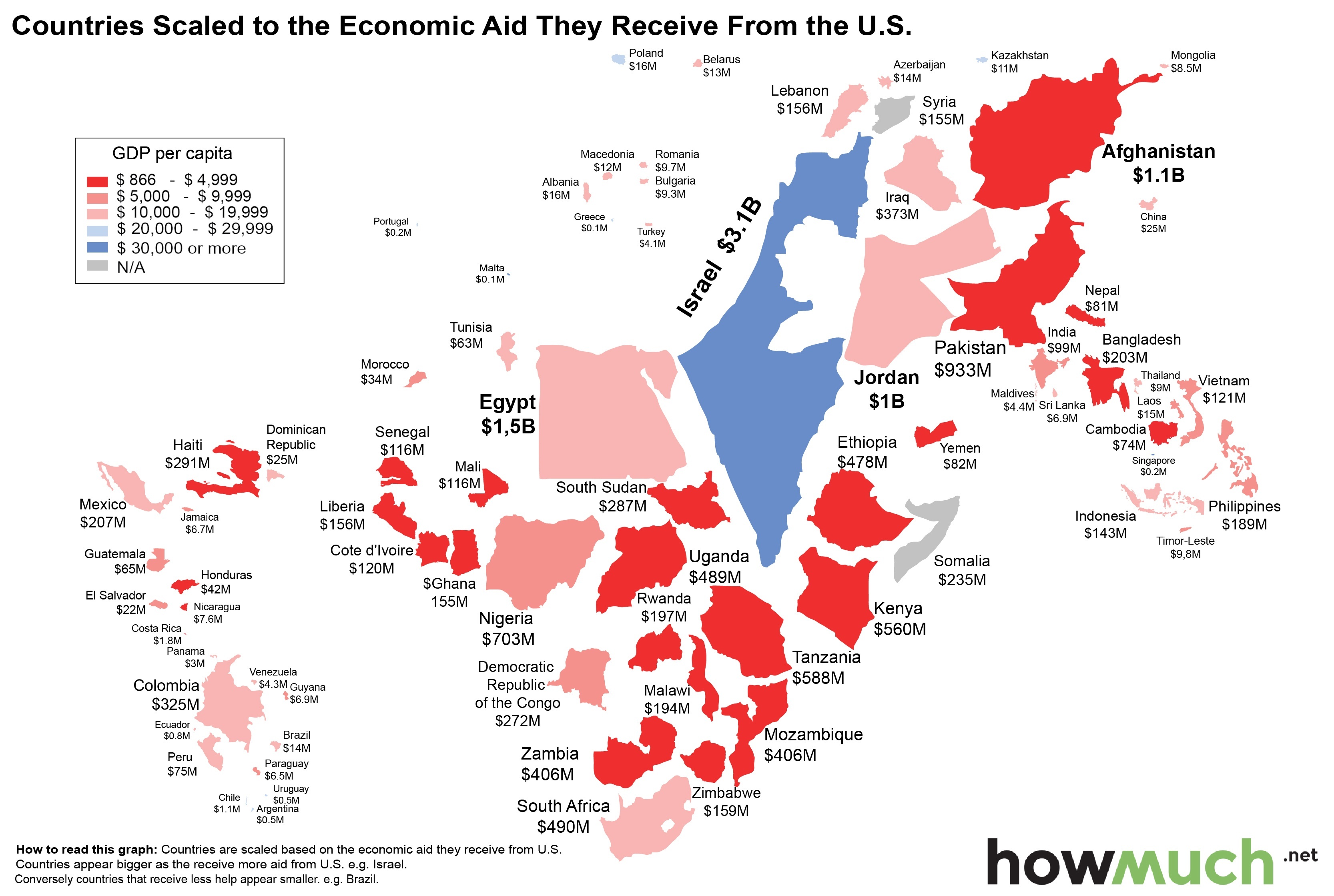
I doubt this factors in the money the Defense Department and the
CIA spend -- Afghanistan would be much larger -- but it does seem to
count some money not destined for established governments (e.g., Syria,
but where is Libya?). Of course, Israel you know about, and its two
neighboring dictatorships, primarily tasked with keeping Palestinians
pent up on their reservations in Gaza and the West Bank. One thing
this shows is the extent to which "economic aid" has been reduced to
a slush fund for America's imperial ventures. Another is that the US
is becoming increasingly entangled in Africa.
DR Tucker: The Dawn of Darkness:
This Wednesday marks the thirty-fifth anniversary of one of the great
tragedies in American history, a moment of indelible shame, a choice
that harmed so many in this country and around the world: the defeat
of President Jimmy Carter at the hands of right-wing former California
Governor Ronald Reagan. [ . . . ]
Reagan's economic agenda literally took from the poor and gave to
the rich. His race-baiting on the 1980 campaign trail and his demonization
of civil rights as president laid the foundation for reckless Republican
rhetoric on race during the Obama era. His illegal wars in Central America
and his irresponsible invasion of Grenada served as the model for George
W. Bush's Iraq misadventure. His scorn of environmental concerns put us
on the painful path to a climate crisis.
Amen. I'll add that while the full horror of those points only became
clear over time, even back when Reagan was president I frequently noted
that under him the only growth industry in America is fraud.
David Atkins: Will the Press Recognize the Existential Threat and Fight
Back, or Buckle Under?:
It should astonish even the jaded that Republicans are calling CNBC,
that stodgy home of supply-side Wall Street cheerleading, an agent of
the left.
Still apoplectic at being asked some basic questions at the debate,
Republican candidates are doubling down on their freakout.
Ted Cruz is flat-out calling CNBC debate moderators "left-wing
operatives" and demanding that right-wing radio hosts moderate their
debates, instead.
Donald Trump, who openly lied during the debate about what is on
his own website, called debate moderator John Harwood a "dope" and
a "fool."
All of this after Republican candidates spewed forth one of the
most embarrassing explosion of lies ever witnessed during a television
presidential debate.
The press is facing an existential threat. With Republicans
increasingly unashamed to tell grandiose lies and respond to any
press criticism with derogatory insults and whines about media bias
as well as blackmail threats to cancel appearances if the questions
are too tough, the press must decide how to respond on two fronts.
First, it must decide how to present an objective face while
acknowledging that both sides do not, in fact, behave equally
badly. Second, it must determine whether it will continue to ask
the tough questions that need answers regardless of the threats
made by the GOP, or whether it will meekly submit to the demands
for kid-glove treatment.
Atkins also argues that
Debate Questions Naturally Lean Left Because Mainstream Voters and
Reality Do. One piece of evidence here is how often the right
starts to dissemble when they plan on doing something unpopular --
like when Bush dubbed his giveaway bill to the timber industry the
"health forests initiative." Brownback moved heaven and earth in
2014 to try to convince Kansans that he was the education governor,
after years of underfunding schools and attacking teacher rights.
This doesn't necessarily mean that voters lean that far left --
all they need to do is come in left of the Republicans, which isn't
hard to do: a little decency and integrity suffices.
The fact that Republicans have more unpopular positions and a weaker
track record of success isn't the fault of debate moderators. It's
the fault of Republican candidates and their ideology.
Israel links:
Also, a few links for further study (briefly noted):
Rebecca Gordon: How the US Created Middle East Mayhem: Provides an
explanation why Tunisia alone among the "Arab Spring" countries seems
to have developed into a viable democracy -- while there are some local
factors of note, one big one is that the US hadn't had much involvement
or interest in Tunisia, especially its military. Gordon goes on to report
on the region's "Arab Spring" failures: Egypt, Libya, Yemen, Bahrain, and
Syria -- each of those are nations the US and/or its so-called allies
have repeatedly interfered in. Supposedly these are all nations the US
state and defense departments regard as "vital national interests" --
yet somehow stability, popular democratic rights, and social justice
aren't reckoned as things that matter.
James George Jatras: Benghazi: What Neither Hillary Nor the Republicans
Want to Talk About: I'm afraid I'm not following all of this, but
it is clear that the ending of the Gaddafi regime put a large amount of
weapons into circulation, and it seems not unlikely that the CIA was in
Benghazi to help direct some of those weapons to supposed allies/clients
in Syria and possibly elsewhere.
Dylan Matthews: Ben Carson accidentally stumbled on a great idea for
improving education: James Hamblin quotes Carson: "Wouldn't it
make more sense to put the money in a pot and redistribute it throughout
the country so that public schools are equal, whether you're in a poor
area or a wealthy area?" Carson eventually walked part of that back, but
he stumbled onto a basic truth: the federal government has much stronger
tax authority than state/local government, plus has the ability to run
deficits, but most government spending, especially on things that (unlike
the military) directly affect Americans, is done at the state and local
level. Figuring out a scheme to redistribute tax receipts from the federal
level down would eliminate a lot of inequities -- especially the current
race-to-the-bottom of giving tax subsidies to businesses -- and provide
more robust support for essential government spending.
George Monbiot: Indonesia is burning. So why is the world looking
away? Massive forest fires in the US have been a news staple,
but this one is new to me:
A great tract of Earth is on fire. It looks as you might imagine hell
to be. The air has turned ochre: visibility in some cities has been
reduced to 30 metres. Children are being prepared for evacuation in
warships; already some have choked to death. Species are going up in
smoke at an untold rate. It is almost certainly the greatest environmental
disaster of the 21st century -- so far.
Well, it is far away from here, but it's still the same planet, and
ultimately the same atmosphere:
Fire is raging across the 5,000km length of Indonesia. It is surely, on
any objective assessment, more important than anything else taking place
today. And it shouldn't require a columnist, writing in the middle of a
newspaper, to say so. It should be on everyone's front page. It is hard
to convey the scale of this inferno, but here's a comparison that might
help: it is currently producing more carbon dioxide than the US economy.
And in three weeks the fires have released more CO2 than the annual
emissions of Germany. [ . . . ]
It's not just the trees that are burning. It is the land itself.
Much of the forest sits on great domes of peat. When the fires penetrate
the earth, they smoulder for weeks, sometimes months, releasing clouds
of methane, carbon monoxide, ozone and exotic gases such as ammonium
cyanide. The plumes extend for hundreds of miles, causing diplomatic
conflicts with neighbouring countries.
Thomas Schaller: 55-45 Politics in a 50-50 Country: This looks into
various areas where the Republicans have built-in advantages which skew
power in their favor -- something which includes but extends beyond the
gerrymandered House districts. Then there's also the peculiarity that
Republicans ("the party of no") are more often satisfied simply to
obstruct Democratic initiatives -- a task that the system's numerous
checks and balances favors, as do historical quirks like the Senate
filibuster.
Ask a question, or send a comment.
Saturday, October 31, 2015
Beneath Debate
My patience for political debates gave out long ago. I think the
clincher was a 1984 encounter which somehow favored Ronald Reagan
despite the clear fact that Walter Mondale out-hustled him on every
single question. (I was rather annoyed with Mondale because so many
of those tussles revealed him to be the more aggressive and tenacious
cold warrior.) It was almost a replay of my first debate experience,
Kennedy-Nixon, except where Kennedy appealed to a hopeful future,
that future had passed by 1984 and America was ready to be led into
senility -- at least they sure picked the guy to do it.
However, some bloggers I follow still take these things seriously,
so I figured I'd cite a few of their comments. After all, watching
ten right-wing jerks fumble their way through a set of questions and
spinning them into their fantasies does offer some opportunity to
examine the psychosis that afflicts so-called conservatives today.
Whereas Reagan had a knack for amalgamating an imagined past with a
fantasy future, at least he was pretty sure it would be a positive
future. But today's Republican standard-bearers are united in their
conviction that the nation stands on the brink of a catastrophe that
only their kind of determined leadership can stave off, even though
the scenarios most likely to push the country off the deep end are
the very ones that adopt their policy proposals.
Some links:
Gail Collins: Oh, Those Debating Republicans:
But about Wednesday night's debate -- the topic was economics, and the
big takeaway was probably that when there are 10 people onstage, nobody
is going to have to explain how that flat tax plan adds up. When in doubt,
complain about government regulations.
Carson appears to have a particular genius on this front. Asked what
to do about the pharmaceutical industry's outrageous pricing policies,
he mildly said: "No question that some people go overboard when it comes
to trying to make profits," and then he careened off to the cost of
government rules on "the average small manufacturer."
Every seasoned politician is good at answering a difficult question
with the answer to something entirely different. But Carson -- who isn't
supposed to be a politician at all -- was possibly the champ. Where do
you think he picked that up? It's a little unnerving to think this kind
of talent is useful in the operating room.
Because Carson's voice always sounds so moderate, responses that make
no sense whatsoever can sound sort of thoughtful until you replay them
in your head. Asked why, as an opponent of gay marriage, he serves on
the board of a company that offers domestic partner benefits, Carson
said that he believed "marriage is between one man and one woman and
there is no reason that you can't be perfectly fair to the gay community."
He then proposed, in his measured tones, that "the P.C. culture . . . it's
destroying this nation."
Ezra Klein: Ted Cruz's best moment of the Republican debate was also
completely wrong:
"The questions that have been asked so far in this debate illustrate
why the American people don't trust the media," Ted Cruz said with
considerable disgust. "This is not a cage match."
Cruz ticked off the insults the CNBC moderators had lobbed Wednesday
night at the assembled Republicans. "Donald Trump, are you a comic book
villain? Ben Carson, can you do math? John Kasich, will you insult two
people over here? Marco Rubio, why don't you resign? Jeb Bush, why have
your numbers fallen? How about talking about the substantive issues?"
The crowd roared. Republican pollster Frank Luntz reported with some
awe that his focus group gave Cruz's riff a 98. "That's the highest score
we've ever measured," Luntz tweeted. "EVER."
Cruz's attack on the moderators was smart politics -- but it was almost
precisely backwards. The questions in the CNBC debate, though relentlessly
tough, were easily the most substantive of the debates so far. And the
problem for Republicans is that substantive questions about their policy
proposals end up sounding like hostile attacks -- but that's because the
policy proposals are ridiculous, not because the questions are actually
unfair.
Klein goes on to quote some of the questions that Cruz caricatured:
Moderator John Harwood asked, "Mr. Trump, you have done very well in
this campaign so far by promising to build another wall and make another
country pay for it. Send 11 million people out of the country. Cut taxes
$10 trillion without increasing the deficit."
[ . . . ]
Similarly, Ben Carson wasn't asked whether he could do math. He was
asked whether his tax plan's math added up.
"You have a flat tax plan of 10 percent flat taxes," said moderator
Becky Quick. "This is something that is very appealing to a lot of voters,
but I've had a really tough time trying to make the math work on this.
If you were to take a 10 percent tax, with the numbers right now in
total personal income, you're gonna bring in $1.5 trillion. That is
less than half of what we bring in right now. And by the way, it's
gonna leave us in a $2 trillion hole. So what analysis got you to the
point where you think this will work?" [ . . . ]
Meanwhile, Cruz himself was also asked a substantive question. The
moderators asked why he was opposing a bipartisan budget deal that
would avert a debt ceiling crisis, a Medicare crisis, and a Social
Security Disability Insurance crisis. Rather than answer that question,
he attacked the moderators for refusing to ask substantive questions,
during which he pretended a slew of unusually substantive questions
were trivial political attacks.
Cruz's whine was so popular that the RNC decided to act on it and
break an agreement they had with NBC to host a debate in February. See:
Jack Mirkinson: The GOP's media warfare goes nuclear: How the RNC is
trying to hold journalism hostage. One more example how firmly
GOP leadership can act to get things done (or, actually, undone).
Although Klein has some piece of a point -- the candidates certainly
did manage to avoid answering anything substantial in the questions,
more than a few came off as snarky and their opening shot, as
Stephen Colbert justly complains, was the worst question ever.
Rick Perlstein: Sociopaths on a Merry-Go-Round:
I sure hope you didn't bother to watch the absurd Republican debate
on CNBC Wednesday night. That's what you have me for. Here are two
takeaways: Ben Carson said "crap." (Specifically, that "the government
picking winners and losers" is "a bunch of crap.") And, remember that
time a few years ago when I wrote that getting anointed a star among
the Republican elite "is mainly a question of riding out the lie:
showing that you have the skill and the stones to brazen it out, and
the savvy to ratchet up the stakes higher and higher"? I worry I
understated the case. [ . . . ]
Something you will not learn consuming accounts of the debate
from all those talking heads, the poor saps, forced by the professional
canons of "objectivity" to grit their teeth and pretend what went on
on that stage in Boulder was legitimate political discussion. No. This
was two straight hours of sociopathy.
Perlstein details examples from Carson, Fiorina, and Rubio, but
he could go on and on.
Heather Digby Parton: The medical miracles of Mike Huckabee: Inside the
absurd, dangerous & contradictory health care plans of the GOP
candidates: Parton also looks at Carson, who has a history of
promoting a fraudulent supplement as a miracle cure for Alzheimer's
and cancer. Huckabee, who's made a career out of opposing medical
research based on fetal tissue, has suddenly found the solution to
America's health care woes: "let's cure the four big cost-driving
diseases . . . diabetes, heart disease, cancer and Alzheimer's."
Not clear how he'll do all that -- maybe he's bought into Carson's
snake oil? More likely it's just that old standby of the religious
right: miracles. Huckabee's a big "flat tax" promoter too, if you
want another example of magical thinking. Parton concludes:
So here we have two Republican candidates for president. One has
offered an incomprehensible health care plan that he cannot explain
to the public. The other proposes that the correct approach is to
"pass real reform that will actually lower costs, while focusing
on cures and prevention rather than intervention.") Both of them
oppose fetal tissue research that promise advances in actually
curing diseases while endorsing ludicrous scams that don't work.
Every Republican promises to vote to repeal Obamacare. It's a
litmus test right up there with tax cuts and abortion. Carson says
it's the worst thing since slavery, Huckabee calls it a "nightmare."
It looks like magical snake oil cures are now what passes for serious
health care policy to replace it.
Parton also unloaded on Jeb Bush's performance:
Jeb Bush's stunning, televised implosion: How the former GOP frontrunner
became a sad, pathetic joke.
Jesse Berney: These Republicans are petulant children: What's really
behind their whining about the big, bad media:
But of course the complaints about the media aren't really about
getting easier questions at debates; they're much more pernicious
than that.
Republicans are working the refs. They don't care what questions
they're asked; what they care about is destroying the credibility
of anyone who might criticize their policies or their rhetoric. When
Quick asked Carson about the $1.1 trillion in new deficits his tax
plan would create, Carson simply replied "That's not true" -- an
assertion he could make confidently because he knows Republican
primary audiences are much more likely to trust Ben Carson than a
member of the media.
Of course his tax plan would be a disaster -- it would involve
huge cuts for the richest Americans and drain the treasury, pushing
America even deeper into debt. But facts, even obvious facts, don't
matter if you can convince people the arbiters of those facts are liars.
Ed Kilgore: Stand With Rand . . . for Nineteen Minutes!: Rand Paul's
big moment in the debate was his announcement that he would fillibuster
the much-hated Bipartisan Budget Deal (at least much-hated by the faction
who'd seize any excuse to shut down the government). Turns out that when
he did take the Senate floor to oppose the bill, he spoke against it all
of 19 minutes. Ted Cruz can't even read Green Eggs & Ham that
fast.
Charles Pierce: I Have Come to the Conclusion That It's Very Easy to Be
a Republican Candidate:
Here at the shebeen, we have been talking almost since our grand opening
in 2011 about how the institutional Republican party is nothing more than
a sham of a mockery of a façade of a shell of its former self. Now, it
seems, the candidates may be forming a creepy little cabal aimed at taking
even the debate process away from obvious anagram Reince Priebus, the
emptiest suit in American politics.
"I think the bigger frustration you saw is that all those candidates
onstage had prepared for a substantive debate. Everyone was ready to
talk about trade policy and the debt and tax policies," Rubio said on
Fox News. "And we're ready for that, everybody was. And then, you got
questions that everyone got, which were clearly designed to get us to
fight against each other or get us to say something embarrassing about
us and then get us to react."
Again, bullshit, all the way down. Rubio was asked a very substantive
question about the lunatic tongue-bath to the wealthy that he calls a
tax plan. John Harwood cited the conservative Tax Foundation's assessment
that his highly redistributive notion of where all the money should end
up would balloon the deficit and be an unprecedented windfall for the
likes of Norman Braman and (shh!) Sheldon Adelson. If Rubio was
"embarrassed" by that question, he should have been.
But nobody is so unencumbered by facts, and nobody is so utterly
unburdened by honesty, as the Tailgunner [Ted Cruz], who has proposed
a debate moderated by the superstars of conservative talk-radio.
"How about a debate moderated by Sean Hannity, Mark Levin, and Rush
Limbaugh? Now that would be a debate." Hannity replied with enthusiasm:
"I'm in!"
By all means, senator. Let's do that.
I'm not sold on Limbaugh, who has a history of massive flop-sweat
attacks whenever he appears on television, or anywhere else outside the
cocoon of his studio. And Hannity, I think, still wants too much to be
a player in mainstream conservative politics to be very entertaining.
But Mark Levin? Abso-freaking-lutely. Mark Levin thinks Paul Ryan is a
squish. Mark Levin wants the Constitution rewritten to eliminate the
popular election of senators and so that states can nullify federal
laws. Let Levin moderate a debate and he'll push these clowns so far
to the right that they'll end up in Kazakhstan.
Josh Marshall: Some More Thoughts on the Debate: If you dig through
the archives you can probably find his "live blogging" -- which I did
read but have largely forgotten by now. Here he points out that Carly
Fiorina got more time than anyone else (funny no one has tabbed her as
winning or even gaining this time, like they did last debate), and Jeb
Bush "got the least by a significant margin" (although lots of people
have commented on how "sad" or "pathetic" Bush seemed). Plus this:
But as I reflect on the debate a bit more I think a big reason the
debate was so weird was that so many of the questions were based on
obscurantist and myopic CNBC nonsense -- which is not only far-right
and identified with great wealth but specifically owned by the bubble
of Wall Street. That led to a lot of odd questions -- like Jim Cramer's
saying why aren't GM execs going to jail, Santelli's wild questions or
that question about fantasy football. Lots of people are into fantasy
football. But whether it's betting and whether it should be regulated,
that's a Wall Streeter question -- in the same way huge amounts of the
money that gets pushed through political betting sites comes off Wall
Street. It's hard for Republicans to say this. But I think this is a
significant reason why the debate seemed so odd. And it made it kind
of odd to hear anti-liberal bias attacks on the moderators when they
were asking questions like shouldn't the Fed be forced to take us back
to the gold standard.
I should never miss the opportunity to say that the stupidest thing
any political figure can possibly say is that we should go back to the
gold standard.
OK, here are the live blog links:
#1,
#2,
#3,
#57 (who knows)?,
Why is this debate so bad?,
Some initial thoughts. For a much longer live blog -- one that will
take you longer to read than it would have taken to watch the damn thing --
go to
538. Some side-excursions too. One that I found
interesting is that Trump's support is pretty even across the ideological
spectrum (23-28%, plus a blip at 30% for Tea Party), where Carson is
strictly conservative (with a 27% peak for White Evangelical -- a group
that raises Huckabee from 4% to 7% and drops Fiorina from 7% to 2%).
William Greider: Why Today's GOP Crackup Is the Final Unraveling of
Nixon's 'Southern Strategy': Not on the debates -- I assume this
piece was a response to the House's GOP leadership squabble. The key
point is that the pluralism that Ronald Reagan promoted with his
"11th commandment" has given way to a hard-core purism that sees
every issue as a litmus test and labels any deviant as a RINO.
A Republican lobbyist of my acquaintance whose corporate client has
been caught in the middle of the political disturbances shared a
provocative insight. "I finally figured it out," he told me. "Obama
created the Tea Party." I laughed at first, but he explained what he
meant. "We told people that Obama was a dangerous socialist who was
going to wreck America and he had to be stopped, when really we knew
he was a moderate Democrat, not all that radical," the lobbyist said.
"But they believed us."
In other words, the extremist assaults on the black president,
combined with the economic failures, were deeply alarming for ordinary
people and generated a sense of terminal crisis that was wildly
exaggerated. But it generated popular expectations that Republicans
must stand up to this threat with strong countermeasures -- to win
back political control and save the country.
Greider posits an "odd couple" alliance forged by the Nixon and
Reagan "southern strategy" -- a cynical decision by the Republican
establishment to broaden their voting base by catering to the racism
of southern (and let's not forget many northern) whites. I hardly
regard this as so odd: the rich never have the numbers to win in a
democracy, so they always have to wrap their naked self interests
in a cloak of something that might enjoy broader appeal. Since WWII
that was mainly cold war propaganda, with its adulation of capitalism,
defense of religion (against "godless communism"), and the growth of
a military caste with all the patriotic trappings, including a lot of
jingo about "freedom." Admittedly it took a while for Republicans to
appropriate those myths as wholly their own, but Barry Goldwater had
put it together in terms so stark it could be used to tar liberals as
traitors, and Nixon and Reagan only made Goldwater's synthesis more
palatable. (What made Nixon appear to be more moderate was that he
was generally respectful of unions, albeit more due to pragmatism
than to ideology, while Goldwater and Reagan seethed contempt.) If
adding a bit of "dogwhistle racism" adds to the vote total, how much
of an "odd couple" sacrifice is that really to the Republican rich?
There are exceptions, for sure, but the elite country clubs have
never lacked for prejudice or snobbery -- why else refer to them as
"exclusive"?
I don't see Greider's evidence that the contradictions at the root
of the "odd couple" strategy are coming apart -- for one thing, the
appetite of Americans for hypocrisy has never been greater, but also
the rich have gotten so rich they've become oblivious to the damage
and decay the rest of the world have to live in -- but
Republicans do have problems keeping their shit together. The first
big thing is that the Bush administration from 2001-09 was an utter
clusterfuck: so much so that nearly every substantive policy that
any Republican can think of today has been tried out and proven to
be disastrous. Bush ended his term with approval ratings way below
the Mendoza Line (and Cheney's was in single digits, about half of
Bush's). The initial response of sentient Republicans to that debacle
was to crawl into a hole somewhere, but all that did was to let the
crazies loose, and when they seemed to be having some success, the
rest of the party, lacking any better ideas or principles, lined up
behind them. The only reason they've been able to survive by doubling
down on disaster has been their ability to get people to blame the
adverse effects of their policies on the Democrats. (Obama and the
Democrats abetted this not only by continuing many Bush policies,
like the wars in the Middle East and the bank bailouts, but by not
squarely placing blame where it belonged, and by not pushing reforms
that would make a real difference.)
The reason the Tea Party exploded in 2009 was that the Republican
propaganda machine, after eight years of lamely recycling pro-Bush
talking points, got a chance to go on the offensive, and they did so
with a vengeance. They did so by characterizing Obama as a devious
monster "out to wreck America," and they clearly equated America not
with the majority who had voted for Obama but with the small minority
who listened to the likes of Rush Limbaugh and Glenn Beck -- a group
that flattered themselves as the only true Americans, the vanguard
to "take America back." They may even be right that "their America"
is slipping away, but they're also letting themselves be used.
I could probably spend several pages just unpacking that last
sentence: there are obvious cons like Beck's gold racket, and there
are broader problems embedded in dozens of policy proposals, and
there are deeper and subtler problems when a society devolves into
nothing but rapacious individuals each out for number one. It seems
like a premise of the debates is that all Republicans think alike,
so the only thing to decide is the character and tone you want in
a leader (ranging from a blowhard like Trump to a soft sell like
Carson).
For more along these lines, see
Jacob Hacker/Paul Person: No Cost for Extremism. Subhed: "Why
the GOP hasn't (yet) paid for its march to the right."
Ask a question, or send a comment.
Monday, October 26, 2015
Music Week
Music: Current count 25653 [25626] rated (+27), 447 [449] unrated (-2).
Rated count slipped a bit, mostly because I lost a day-plus cooking
up another chapter in my birthday dinner series. Tried my hand at Cuban
cuisine this time, something I've sampled in restaurants not much more
than a half-dozen times (mostly one in Royal Oak, MI, although we lucked
into a very good place southwest of Miami). I've done a lot of Spanish
(and Basque and Catallan and Portuguese, so should I say Iberian?) dishes,
but very little from south of the border (aside from a massive feijoada
one birthday). As with Spanish, Cubans use a lot of garlic but not much
in the way of chilis. I've never liked the peppers that dominate Mexican
cuisine, although I should figure out my way around them (as I've done
with Indian, Thai, and Indonesian) given that the hardest part of any
exotic cuisine is the shopping, and there are countless Mexican stores
in these parts. (Actually, for this dinner I picked up most of the less
conventional ingredients not from the bilingual Kroger but from a large
Vietnamese grocer I frequent -- among other things, the only place in
town I can get salt cod.)
More details on the dinner in the notebook. Suffice it to say that
despite some very poor planning and last-minute panicking pretty much
everything came out splendid. Good company too, although by the time
I was finished I was a bit too frazzled to get into it. Much on my
mind was the thought that I'm getting too old for this sort of thing.
No one thought to take pictures. Where's Max Stewart when you really
need him? Also nostalgic for so many previous guests, especially Liz
Jones, who inspired the first few dinners (and has long since lost
touch), and the late Liz Fink -- people who really appreciated good
food. (Liz, of course, was represented by her dog Sadie, who earned
the title sous-chef by always being under my feet.)
While cooking, I suspended my usual listening work and played
oldies, starting with the Beatles and winding up with Atlantic R&B.
The former hadn't happened in many years, but when I went out to shop
for the meal, before I could pop a CD in -- I had picked out Rumba
en el Patio by Conjunto Kubavana (1944-47) -- a song came on which
struck me as the most completely marvelous thing I've ever heard: "All
My Loving." I probably hadn't heard it since shortly after I bought
the With the Beatles CD, but I found myself intimately familiar
with every note and harmony. It was followed by Elvis Presley singing
"All Shook Up," by comparison merely great, then something else I only
vaguely recognized and didn't care for.
Most of this week's list already appeared in October's
Rhapsody Streamnotes.
I noted there how many of my jazz picks were by (or featured)
saxophonists, so maybe I'm compensating a bit for that here. My two
top HMs this week -- Rich Halley's Eleven and Scott Hamilton's
Live in Bern -- are by long-time personal favorites who have
already scored A- records this year (Creating Structure and
Plays Jule Styne). I have minor quibbles about both, but I
haven't been conscientious enough to do the A:B comparisons to see
which is really the better record. I will say that there is some
terrific music on both. Instead, I went with another long-time
favorite saxophonist, Rodrigo Amado. I suppose one could quibble
there too, but Joe McPhee (who has another A- record this year)
adds extra bite to some of the year's most impressive sax runs.
The best post-RS record on the list is Marty Grosz's debut. I
noticed that Rhapsody added some old Grosz Jazzology titles, and
worked my way back. I mostly listen to avant-jazz these days, but
I still hold to the idea that the old jazz is the real jazz, so
guys like Grosz are always on my radar. Grosz was born a year
before Bix Beiderbecke died, and well into his 80s he's still
active -- his Fat Babies album Diga Diga Doo is also on
this year's
A-list.
No comments so far on my question whether it'd be worthile to do
another Turkey Shoot/Black Friday Special this year. I dropped the
ball last year and no one picked it up -- I had hopes for Odyshape,
but they crashed shortly before. I don't want to do the heavy lifting
this year -- soliciting and editing entries -- but would be willing
to format and post it and might even contribute something. So let
me know if you want to volunteer. Time is running out. I'm not going
to bring this up again.
New records rated this week:
- Dave Alvin and Phil Alvin: Lost Time (2015, Yep Roc): [r]: B+(*)
- Rodrigo Amado: This Is Our Language (2012 [2015], Not Two): [cd]: A-
- Randy Brecker: Randy Pop: Live (2015, Piloo): [cd]: B
- Art "Turk" Burton and Congo Square: Spirits: Then & Now (1983-2015 [2015], ATB): [cd]: B+(**)
- Marnix Busstra: Firm Fragile Fun (2015, Buzz Music): [cd]: B+(*)
- Rich Halley 4: Eleven (2014 [2015], Pine Eagle): [cd]: B+(***)
- Scott Hamilton & Jeff Hamilton Trio: Live in Bern (2014 [2015], Capri): [cd]: B+(***)
- Alfred 23 Harth/Jörg Fischer/Marcel Daemgen: Confucius Tarif Reduit (2014 [2015], Spore Point): [cd]: B+(**)
- Dale Head: Swing Straight Up (2015, Blujazz): [cd]: B
- Carlos Henriquez: The Bronx Pyramid (2015, Blue Engine): [r]: B+(**)
- Innerroute: Fourmation (2015, self-released): [cd]: B+(**)
- Bill Kirchner: An Evening of Indigos (2014 [2015], Jazzheads, 2CD): [cd]: B+(**)
- Frank Kohl Quartet: Invisible Man (2013 [2015], Pony Boy): [cd]: B+(*)
- John Kruth: The Drunken Wind of Life: The Poem/Songs of Tin Ujevic (2015, Smiling Fez): [bc]: A-
- Amy LaVere and Will Sexton: Hallelujah I'm a Dreamer (2015, Archer): [r]: A-
- Russ Lossing: Eclipse (2012 [2015], Aqua Piazza): [cd]: B+(**)
- Hans Luchs: Time Never Pauses (2015, OA2): [cd]: B+(*)
- Whitney Marchelle: Dig Dis (2015, Blujazz): [cd]: B+(*)
- Matt Mitchell: Vista Accumulation (2015, Pi, 2CD): [cd]: B+(**)
- Ben Patterson: For Once in My Life (2015, Origin): [cd]: B+(*)
- Scottish National Jazz Orchestra/Makoto Ozone: Jeunehomme: Mozart Piano Concerto No 9 K-271 (2014 [2015], Spartacus): [cdr]: B+(*)
- Voicehandler: Song Cycle (2013-14 [2015], Humbler): [cd]: B+(*)
- Lou Volpe: Tremembering Ol' Blue Eyes (Songs of Sinatra) (2015, Jazz Guitar): [cd]: B+(**)
- Bastian Weinhold: Cityscape (2014 [2015], Frame Music): [cd]: B+(*)
- Galen Weston: Plugged In (2015, Blujazz): [cd]: B-
Recent reissues, compilations, and vault discoveries rated this week:
- Willem Breuker Kollektief: Angoulême 18 Mai 1980 (1980 [2015], Fou, 2CD): [cd]: A-
Old music rated this week:
- Marty Grosz and His Honoris Causa Jazz Band: Hooray for Bix! (1957 [1958], Good Time Jazz): [r]: A-
- Marty Grosz with Destiny's Tots: Sings of Love and Other Matters (1986, Jazzology): [r]: A-
- Marty Grosz: Songs I Learned at My Mother's Knee & Other Low Joints (1992 [1994], Jazzology): [r]: B+(**)
- Marty Grosz: Keep a Song in Your Soul (1994, Jazzology): [r]: B+(***)
- The Bill Kirchner Nonet: One Starry Night (1987 [2011], Jazzheads): [r]: B+(**)
Unpacking: Found in the mail last week:
- June Bisantz: It's Always You: June Bisantz Sings Chet Baker Vol. 2 (self-released)
- Bizingas: Eggs Up High (NCM East): November 6
- Bobby Bradford-Frode Gjerstad Quartet: The Delaware River (NoBusiness): CDR of LP-only
- The Katie Bull Group Project: All Hot Bodies Radiate (Ashokan Indie): November 10
- John Carter: Echoes From Rudolph's (1977, NoBusiness, 2CD)
- Agedoke Steve Colson: Tones for Harriet Tubman/Sojourner Truth/Frederick Douglass (Silver Sphinx, 2CD)
- Joseph Daley/Warren Smith/Scott Robinson: The Tuba Trio Chronicles (JoDa Locust Street Music): January 1
- Giovanni Di Domenico/Peter Jacquemyn/Chris Corsano: A Little Off the Top (NoBusiness): CDR of LP-only
- Free Jazz Group Wiesbaden: Frictions/Frictions Now (NoBusiness)
- Amina Figarova: Blue Whisper (In + Out)
- Jazz at Lincoln Center Orchestra with Wynton Marsalis: Big Band Holidays (Blue Engine): October 30
- Martin Küchen/Jon Rune Strøm/Tollef Østvang: Melted Snow (NoBusiness): CDR of LP-only
- Martin Küchen/Johan Berthling/Steve Noble: Night in Europe (NoBusiness)
- Ingrid Laubrock: Ubatuba (Firehouse 12): November 6
- Jon Lindberg/Anil Eraslan: Juggling Kukla (NoBusiness): CDR of LP-only
- Roy McGrath Quartet: Martha (JL Music): November 6
- Rova: Channeling Coltrane: Electric Ascension / Cleaning the Mirror (RogueArt, 2DVD): January 7
- Ramana Veiera: Fado Da Vida (Fate of Life)
Ask a question, or send a comment.
Sunday, October 25, 2015
Weekend Roundup
No real time to write this week's roundup -- it's my birthday
and I'm busy cooking (see the notebook for the menu). But I do
have a bunch of links open in various tabs and I thought I might
share them before they become stale. In no particular order:
Uri Avinery: The Settler's Prussia: In the 19th century, Germany
was, fatefully, taken over by a marginal state on its far northeastern
border, Prussia. Avinery sees the settler movement doing something like
that in Israel. Also see Avinery's
Weep, Beloved Country.
Andrew J Bacevich: Yes, the US can leave Afghanistan:
What we have here is temporizing dressed up in policy drag. It is a
gesture designed to convey an appearance of purposefulness to an
enterprise whose actual purpose has long since vanished in the mists
of time.
Having inherited from his predecessor two wars begun in 2001 and
2003, respectively, Obama will bequeath those same two wars to the
person who will succeed him as president in 2017. It is incumbent
upon Americans to contemplate the implications of this disturbing
fact. By their very endlessness, the conflicts in Afghanistan and
Iraq constitute a judgment on American statecraft, one further
compounded by the chaos now enveloping large swaths of the Islamic
world. Here are the consequences that stem from misunderstanding
military power and misusing a military instrument once deemed
unstoppable.
Only by owning up to the mindless failure of U.S. military efforts
since 9/11 does it become possible to restore real choice. Alternatives
to open-ended war waged on the other side of the globe do exist.
Contrary to Carter's lame insistence, the United States can leave
Afghanistan. Protecting Americans from the relatively modest threat
posed by the Taliban or Al Qaeda or Islamic State -- or all three
combined for that matter -- does not require the permanent stationing
of U.S. forces in the Islamic world, especially given the evidence
that the presence of American troops there serves less to pacify
than to provoke.
Bacevich also wrote a more substantial piece at TomDispatch,
On Building Armies (and Watching Them Fail).
Peter Beinart: Trump Is Right About 9/11: As was well known if
not at the time then shortly after, there were a number of concrete
things the Bush administration could have done that might have kept
9/11 from happening. Terrorism "czar" Richard Clarke was especially
unhappy about how Bush's neocons dropped the ball on Al-Qaeda, and
Beinart dredges up all that story -- one that few in the press seem
to recall, but which makes Trump's reminder that 9/11 happened
during Bush's presidency appear to have more weight. Beinart
could have made an even stronger case had he pointed out some of
the things Bush did to aggravate tensions in the Middle East, such
as his Clinton-esque bombing of Iraq and his support for Sharon's
Counter-Intifada in Palestine. One might counter that Trump has
unrealistic notions about what presidents can do, but that's a big
part of his charm (or absurdity).
Tom Carson: 'Spies' Like Us: Steven Spielberg and the Cold War's
Forgotten Battles: Review of Bridge of Spies and the
Cold War it illuminates, for once.
Kathleen Frydl: Donald Trump and the Know-Nothings: More useful
as an historical excursion into the short-lived 1850s nativist party
than as an analysis of Trump himself, but that's because the "Know
Nothings" were more colorful and their ignorance was more florid.
One of history's great truisms: stupid people in the past could be
interesting, but stupid people today are just tiresome.
Assaf Gavron: Confessions of an Israeli traitor:
The internal discussion in Israel is more militant, threatening and
intolerant than it has ever been. Talk has trended toward fundamentalism
ever since the Israeli operation in Gaza in late 2008, but it has recently
gone from bad to worse. There seems to be only one acceptable voice,
orchestrated by the government and its spokespeople, and beamed to all
corners of the country by a clan of loyal media outlets drowning out all
the others. Those few dissenters who attempt to contradict it -- to ask
questions, to protest, to represent a different color from this artificial
consensus -- are ridiculed and patronized at best, threatened, vilified
and physically attacked at worst. Israelis not "supporting our troops" are
seen as traitors, and newspapers asking questions about the government's
policies and actions are seen as demoralizing.
[ . . . ]
The cumulative effect of this recent mindless violence is hugely
disturbing. We seem to be in a fast and alarming downward swirl into a
savage, unrepairable society. There is only one way to respond to what's
happening in Israel today: We must stop the occupation. Not for peace
with the Palestinians or for their sake (though they have surely suffered
at our hands for too long). Not for some vision of an idyllic Middle
East -- those arguments will never end, because neither side will ever
budge, or ever be proved wrong by anything. No, we must stop the
occupation for ourselves. So that we can look ourselves in the eyes.
So that we can legitimately ask for, and receive, support from the
world. So that we can return to being human.
Ed Kilgore: The Cult of the Second Amendment:
And to a remarkable extent, the default position of conservatives has
less and less to do with arguments about the efficacy of gun regulation
or the need for guns to deter or respond to crime. Instead, it's based
on the idea that the main purpose of the Second Amendment is to keep
open the possibility of revolutionary violence against the U.S.
government.
This was once an exotic, minority view even among gun enthusiasts
who tended to view the Second Amendment as protecting an individual
right to gun ownership not to overthrow the government but to supplement
the government's use of lethal force against criminals.
[ . . . ]
Nowadays this revolutionary rationale for gun rights is becoming
the rule rather than the exception for conservative politicians and
advocates. Mike Huckabee, a sunny and irenic candidate for president
in 2008, all but threatened revolutionary violence in his recent
campaign book for the 2016 cycle, God, Guns, Grits and Gravy:
If the Founders who gave up so much to create liberty for us could see
how our government has morphed into a ham-fisted, hypercontrolling
"Sugar Daddy," I believe those same patriots who launched a revolution
would launch another one. Too many Americans have grown used to Big
Government's overreach. They've been conditioned to just bend over and
take it like a prisoner [!]. But in Bubba-ville, the days of bending
are just about over. People are ready to start standing up for freedom
and refusing to take it anymore.
Dr. Ben Carson, another candidate thought to be a mild-mannered
Christian gentleman, recently disclosed that he used to favor modest
gun control measures until he came to realize the importance of
widespread gun ownership as a safeguard against "tyranny."
"When you look at tyranny and how it occurs, the pattern is so
consistent: Get rid of the guns," Carson told USA Today.
[ . . . ]
Indeed, a lot of Second Amendment ultras appear to think the right
to revolution is entirely up to the individual revolutionary.
My own view is that the second amendment was meant to ensure
that state militias would be able to fight the Civil War, although
the other obvious reading had to do with fighting Indians. Both
meanings had become obsolete by 1900, and civilians have never
had a significant role in fighting against criminals. The second
amendment wasn't repealed then because it didn't seem to be all
that harmful -- no least because the courts consistently ruled
against an individual right to guns. That's only changed recently,
and the full impact has yet to be felt, but what's disturbing
about it isn't just the increase in the number of guns out there
and the number of (often incompetent) people carrying them, but
the sheer nonsense gun advocates wind up spouting. One stupid
idea is that if everyone was armed we'd all wind up treating
each other with more proper respect. A deeper one is that we're
shifting responsibility for managing conflict from law and the
courts to the streets. Then there's the notion Kilgore dwells
on, that because individuals have a right to own guns they have
a right to use them to oppose the rule of law when they (alone)
find it unjust. The latter is often used not just to rationalize
gun ownership but to permit individuals to own ever more powerful
firearms because that's what it would take to neutralize the
power of the state. The problem here is not just practical --
after all, we're talking about a state that owns AC-130 gunships
that can fire thousands of rounds of depleted uranium per minute,
and that's not even the scariest example. The real problem is
that it gives up on making sure the state is responsible to the
public in a fair and equitable way.
Nancy LeTourneau: What I Learned From Watching the Benghazi Hearing:
Mostly, that Clinton kept her cool through eleven hours of idiots
trying to rile her. But also it has something to do with the word
preferences between Republicans and the administration, not that
I get all the nuances there. For example, I tire of hearing the word
"terrorist" used so indiscriminately: partly because it seems to be
all it takes to gain license to kill someone (and perhaps a few others
in the vicinity), partly because it seems like much (if not most) of
the real terror is perpetrated by the so-called anti-terrorists.
Still, lest the Republicans turn Clinton into some sort of heroic
figure, see
Jason Ditz: Bizarre Revisionism: Hillary Claims Libya Shows Consequences
of US Military Withdrawals.
Mark LeVine: The tide is turning against Zionist extremism:
As the inherent contradiction between Israel's self-image as a modern,
democratic and progressive country and the reality of a half-century-long
brutal occupation become clear to all, the erosion of support for Israel
by the emerging generation of American Jews will continue and likely
increase, with profound consequences not just for Israel but also for
the future of the American Jewish community.
For an example LeVine didn't cite, see
Two establishment Jews (Harvard and Microsoft) endorse boycott of
Israel and 'single state' in Washington Post.
Josh Marshall: Netanyahu Reduced to Defending Hitler, Really . . .:
This is the first piece I saw on Netanyahu's speech to the World Zionist
Congress, where he argued that Hitler "just wanted to deport the Jews"
until he met exiled Palestinian Mufti Haj Amin al-Husseini, whose answer
to Hitler's "So what should I do with them?" was "Burn them." With the
Palestinian Revolt of 1937-39 failed, al-Husseini went into exile and
spent WWII in Nazi Germany. It is known that he met with Hitler once,
in 1941, and Israelis have been trying to make mountains out of that
mole hill ever since. Still, it seems bizarre that any Israeli, much
less the Prime Minister, would try to make Hitler seem less horrific
just to blame some Palestinian -- anything, I guess, to distract from
all of Israel's self-inflicted problems. More links on this:
Gareth Porter: Why the US Owns the Rise of Islamic State and the Syria
Disaster:
The causal chain begins with the role of the U.S. in creating a mujahedeen
force to fight the Soviets in Afghanistan in the 1980s. Osama bin Laden
was a key facilitator in training that force in Afghanistan. Without that
reckless U.S. policy, the blowback of the later creation of al-Qaida would
very likely not have occurred. But it was the U.S. invasion and occupation
of Iraq that made al-Qaida a significant political-military force for the
first time. The war drew Islamists to Iraq from all over the Middle East,
and their war of terrorism against Iraqi Shiites was a precursor to the
sectarian wars to follow.
The actual creation of Islamic State is also directly linked to the
Iraq War. The former U.S. commander at Camp Bucca in Iraq has acknowledged
that the detention of 24,000 prisoners, including hard-core al-Qaida
cadres, Baathist officers and innocent civilians, created a "pressure
cooker for extremism." It was during their confinement in that camp
during the U.S. troop surge in Iraq 2007 and 2008 that nine senior
al-Qaida military cadres planned the details of how they would create
Islamic State.
Gareth Porter: The US Could End Saudi War Crimes in Yemen -- It Just
Doesn't Want To:
According to a joint report by the UN Office for the Coordination of
Humanitarian Affairs, 2,682 civilian deaths and injuries resulted from
air bombardment in Yemen from late March to the end of July 2015 --
more than anywhere else in the world during the first seven months of
the year.
The Saudis have also imposed a tight blockade on Yemen by air, land
and water, to prevent not only weapons, but also food, fuel and medicine
from reaching millions of Yemenis, creating a humanitarian disaster.
Doctors Without Borders declared in July that the Saudi blockade was
killing as many people in Yemen as the bombing. US Navy ships have
been patrolling alongside Saudi ships to prevent arms from entering
Yemen, while disclaiming any involvement in the Saudi-led blockade
of food, fuel and medical supplies.
The Amnesty report points out that the United States has a legal
obligation under the Arms Trade Treaty not to provide weaponry it
knows will be used in the indiscriminate bombing of Yemen. Article
6 of that treaty, which entered into force in October 2014, forbids
the transfer of arms and munitions to a party to an armed conflict
if it has knowledge that the weaponry will be used for "attacks
directed against civilian objects or civilians protected as such,
or other war crimes as defined by international agreements to which
it is a party."
I suspect one reason for Obama's reluctance to criticize Saudi
Arabia for killing civilians in Yemen is that the US had been doing
exactly that through its drone program for many years now. Some
details of that (plus much more) appear in
Cora Currie: The Kill Chain: The Lethal Bureaucracy Behind Obama's
Drone War.
Jon Schwarz: A Short History of US Bombing of Civilian Facilities, and
Tom Engelhardt: The US Has Bombed at Least Eight Wedding Parties Since
2001: Two immediate (and rather obvious) responses to the US bombing
of a Médicins Sans Frontières hospital in Afghanistan. The Schwarz
piece includes a cartoon with a quote from Obama's then-latest mass
shooting speech (the one in Oregon).
Nathan Thrall: The End of the Abbas Era:
For Abbas, political survival depended on making significant gains
before any of this occurred. His strategy entailed several gambles.
First, that providing Israel with security, informing on fellow
Palestinians, and suppressing opposition to the occupation would
convince Israel's government that Palestinians could be trusted
with independence. Second, that after Palestinians had met US
demands to abandon violence, build institutions and hold democratic
elections, the US would put pressure on Israel to make the concessions
necessary to establish a Palestinian state. Third, that after being
invited to participate in legislative elections, Hamas would win
enough seats to be co-opted but too few to take over. Fourth, that
by improving the Palestinian Authority economy and rebuilding its
institutions, Abbas would buy enough time to achieve Palestinian
statehood.
In all four respects, he came up short. Israel took his security
co-operation for granted and the Israeli public did not demand that
its government reward Abbas for his peaceful strategy. The US did not
apply the necessary pressure to extract significant concessions from
Israel. Hamas won the legislative elections, took over Gaza, and
refused to adopt Abbas's political programme (though Hamas's victory
also strengthened international support for Abbas, as the international
community shifted from democracy promotion to democracy prevention).
And West Bankers, though dependent on the jobs and economic infrastructure
provided by the PA, also resent it, and have lost whatever faith they
once had that Abbas's strategy could succeed. According to an opinion
poll taken last month, two-thirds of West Bankers and Gazans want him
to resign.
Ask a question, or send a comment.
Saturday, October 24, 2015
Rhapsody Streamnotes (October 2015)
A little more than a month since the last one, the extra time making
up for our ten-day dog rescue excursion to yield a typical month's
worth of triage. The new records are mostly jazz (65%) because I've
been trying to make a dent in my backlog. Of the non-jazz picks,
three were recommended by Robert Christgau (John Kruth, Amy LaVere,
Donnie Trumpet), two more by Michael Tatum (Ezra Furman, Giorgio
Moroder). The other two (Metric, New Order) are records I looked up
based on prior reputation. My working EOY list for
non-jazz is still
way underdeveloped compared to the
jazz list (35 records
to 53). The year-end lists should help even this out, but even the
premature British lists are still a month away. Maybe we should
revive the Turkey Shoot/Black Friday Special this year?
The old music is more eclectic than it's been in quite a while.
I took a break from the Hatology orgy last month, although I'm far
from done with that label. Some records came out of a
Pitchfork Top Albums of the
1970s list. I think I had 85 of 100 before I started searching
out the stragglers (a little heavy on krautrock). Other old music
followed new music -- Bottle Rockets, Ulrich Gumpert, I found a
Bill Kirchner record with Sheila Jordan on it.
The Notes section has previous grades of albums by artists in
the Old Music section. I started this a few months back when it
made more sense -- at the time I was filling in holes in various
artist lists, mostly by chasing down top-whatever lists. I made
a change last month when my Hatology research glanced into some
artists it would have been exhausting to list out (like Anthony
Braxton and Steve Lacy). This month it's less clear what to do,
so I'm winging it. I've included albums by Armstrong and Bechet
that have some of the same material as the ones reviewed, then
counted up the rest. I listed out Ulrich Gumpert since most of
what I've heard was reviewed this month, but merely counted
Pandelis Karayorgis. I imagine both pianists are about equally
obscure even to American jazz fans, which is a shame. The best
place to start on Karayorgis is an album credited to Mi3, Free
Advice (2004 [2007], Clean Feed) -- a Jazz CG Pick Hit when
it came out.
Total rated count for this column sailed past 7000 this month.
Most of these are short notes/reviews based on streaming records
from Rhapsody. They are snap judgments based on one or two plays,
accumulated since my last post along these lines, back on September 16.
Past reviews and more information are available
here (7100 records).
Recent Releases
Bob Albanese: Time Remembered (2012 [2015], Mayimba):
Pianist, second album (as far as I can tell), leads a trio with Eddie
Gomez on bass and Willard Dyson on drums, and extra percussion on one
track. And someone sings some at the end, presumably the artist, with
a vocalese air, fitting for all the brisk boppishness.
B+(*) [cd]
The Gabriel Alegria Afro-Peruvian Sextet: 10 (2015,
Zoho): Trumpeter, from Peru, based in New York, celebrates ten years
since founding his sextet. One trad piece, jazz standards like "Caravan"
and "Lonely Woman" and "My Favorite Things" -- also a take of "Star
Spangled Banner" I don't mind too much.
B+(***) [cd]
Gonçalo Almeida/Martin van Duynhoven/Tobias Klein: Vibrate
in Sympathy (2015, Clean Feed): Credits should be reordered
to put Klein up front, making this a sax-bass-drums trio, all original
pieces by Klein, who is very clear-headed on alto sax, bass clarinet,
and contrabass clarinet.
B+(***) [cd]
Dave Alvin and Phil Alvin: Lost Time (2015, Yep Roc):
The ex-Blasters' previous reunion album, 2014's Common Ground,
had the thematic coherence of a tribute album, not to mention one of
the most underappreciated of all blues songbooks, Big Bill Broonzy.
On the other hand, this quickie rarely rises above the level of a
family singalong. Some songs, of course, are nice to hear, and there's
a certain novelty value in hearing Phil try on "Please Please Please."
B+(*)
Rodrigo Amado: This Is Our Language (2012 [2015],
Not Two): Tenor saxophonist, from Portugal, should be considered a
major figure on the instrument. He is spectacular here, not that he
doesn't get help from Joe McPhee (pocket trumpet, alto sax) working
around his edges. With Kent Kessler on bass and Chris Corsano on
drums.
A- [cd]
Laurie Antonioli & Richie Beirach: Varuna (2006-15
[2015], Origin): Vocalist and pianist, mostly recorded in two sessions
from 2006 and 2012, plus some more recent touch up. Bassist Pepe Berns
joins for the jointly-credited three-part "Resolution Suite." Four more
originals, plus standards concepts like opening "My Funny Valentine"
with Scriabin's "Prelude in E-flat Minor."
B- [cd]
The Bottle Rockets: South Broadway Athletic Club
(2015, Bloodshot): Country-ish rock band, dates back to 1993 with
over a dozen albums, led by Brian Henneman, whose songs are clear
and empathetic as ever.
B+(***)
Randy Brecker: Randy Pop: Live (2015, Piloo): As
pointed out in the liner notes, the trumpeter turns 70 in November,
so time, perhaps, for a little nostalgia. Brecker and his saxophonist
brother "Mike" ran a successful fusion group in the 1970s but also
did tons of studio work, so Kenny Werner got the idea of taking songs
the Breckers played bit parts on and turning them into a retrospective:
Donald Fagen's jazz-ready "New Frontier," BS&T, Todd Rundgren, a
pair of James Browns segueing into Bruce Springsteen and Paul Simon.
Werner forgets the part about pop being fun but avoids the worst skunk
funk, and Brecker's deadpan intros add to the museum effect.
B [cd]
A Bu Trio: 88 Tones of Black and White (2014 [2015],
Blujazz, CD+DVD): Pianist, from Beijing, accepted at age 9 to the
Conservatory of Music, "studied under renowned jazz pianist professor
Kong Hongwei," attended sumer camps in Kansas City and San Francisco,
joined the Beijing Jungle Big Band in 2012. Debut is a trio with Ma
Kai on bass and Shao Ha Ha on drums. The thirteen cuts are all covers,
the J.S. Bach sounding odder to me than the Monk.
B+(*) [cd]
Art "Turk" Burton and Congo Square: Spirits: Then &
Now (1983-2015 [2015], ATB): Conga player from Chicago,
joined AACM in 1973, was elected chairman in 2011. This is the
only album I've been able to find, built from 2 cuts from a 1983
live shot, 6 more from a recent studio date -- bassist Harrison
Bankhead spans both sets. The early cuts have that loose swing
one associates with Sun Ra, especially the one joined by Douglass
Ewart and Donald Rafael Garrett. The new ones take a while to
click -- roughly until the percussion leads the way.
B+(**) [cd]
Marnix Busstra: Firm Fragile Fun (2015, Buzz Music):
Guitarist, postbop fusion, has several previous albums. This is a
quartet with piano-bass-drums, the leader playing bouzouki and electric
sitar as well as guitar. All original material. Flows easy.
B+(*) [cd]
De Beren Gieren: One Mirrors Many (2015, Clean Feed):
Piano trio: Fulco Ottervanger (piano), Lieven Van Pée (bass), Simon
Segers (drums). Fifth album since 2010, a nice mix of postbop and
avant, dense but nothing untoward.
B+(**) [cd]
Benoit Delbecq/Miles Perkin/Emile Biayenda: Ink
(2014 [2015], Clean Feed): French pianist, twenty-some albums since
1992, this a trio with bass and drums. I'm struck especially by his
rhythmic control.
B+(***) [cd]
East West Quintet: Anthem (2011 [2015], self-released):
Based in Brooklyn, which I guess makes them more east than west these
days. Also I count a sextet's worth of credits: Dylan Heaney (alto/tenor
sax), Phil Rodriguez (trumpet), Simon Kafka (guitar), Mike Cassidy (piano,
keyboards), Benjamin Campbell (electric and upright bass), Jordan
Perlson (drums). Third album, self-described as "genre-bending" and
"more likely to rock than to swing" -- actually, odds of either are
pretty slim, nor does it help that "anthem" seems to mean slow.
B- [cd]
Eskmo: Sol (2015, Apollo): Brendan Angelides' second
album, a mix of bent pop and electronics that grows on you, somewhat.
B+(**)
EZTV: Calling Out (2015, Captured Tracks): Guitar-driven
power pop, just not much power, even less pop.
B
John Fedchock New York Big Band: Like It Is (2014
[2015], MAMA): Trombonist, his first New York Big Band album
dates back to 1992, a crack outfit -- reed section: Charles Pillow,
Mark Vinci, Rich Perry, Walt Weiskopf, Gary Smulyan/Scott Robinson --
not that this breaks new ground.
B+(**) [cd]
Ezra Furman: Perpetual Motion People (2015, Bella Union):
A singer-songwriter who's able to accent his writerly preoccupations --
whatever they may be, one line being "lose yourself completely, but stay
alive" -- by reviving ancient rock archetypes, some doo-wop here, some
glam rock there, some honking sax.
A-
Gerry Gibbs Thrasher Dream Trio: Live in Studio
(2015, Whaling City Sound): Third group album, impossible to fault the
drummer's dream team -- pianist Kenny Barron and bassist Ron Carter.
All standards, most given a delightful lift with the pianist's light
touch. Also, four guest spots for Roy Hargrove, and three for Cassandra
Wilson.
B+(**) [cd]
Ulrich Gumpert Quartett: A New One (2014 [2015],
Intakt): Pianist-led sax quartet, with Jürg Wickihalder the saxophonist,
Jan Roder on bass and Michael Griener on drums. B. 1945 in Jena, Gumpert
grew up in East Berlin, interested in Satie and free jazz. From 1974 on,
he recorded several FMP albums with Günter Sommer, joined Conny Bauer's
Zentralquartett (still an important group), recorded a duo with Steve Lacy
in 1987 (and was later one of the pianists on Lacy's Five Facings).
A- [cd]
Scott Hamilton & Jeff Hamilton Trio: Live in Bern
(2014 [2015], Capri): No relation, although drummer Jeff comes from a
famous jazz family, which put him in front of what otherwise might be
Tamir Hendelman's piano trio. I thought the pianist was a bit obtrusive
at first, but the second spin was all smooth sailing for the tenor.
B+(***) [cd]
Miho Hazama: Time River (2015, Sunnyside): Pianist,
composer, arranger, spends more time conducting on her second album
than at the piano. Band is officially 13-piece although I see more
credits here, including a full cast of strings, and a guest slot for
Joshua Redman.
B+(**) [cdr]
Dale Head: Swing Straight Up (2015, Blujazz):
Saloon singer, plays some trumpet, is backed by Rory Snyder's
Night Jazz Band on a dozen standards (although "Blue Rondo a
La Turk" is a vocalese lark).
B [cd]
Julia Holter: Have You in My Wilderness (2015, Domino):
From Los Angeles, a singer-songwriter who looks to literature for
inspiration -- Colette and Isherwood this time -- and wraps stories
up in thick sheets of electronics.
B
Innerroute: Fourmation (2011 [2015], self-released):
Quartet -- Michael D'Agostino (drums), Rick Savage (trumpet/flugelhorn),
Joe Vincent Tranchina (keyboard), Bill McCrossen (acoustic & electric
fretless basses) -- second album, the electric ride neither postbop nor
fusion, not that there isn't a whole tradition around trumpet slicing
through electronics.
B+(**) [cd]
Jason Isbell: Something More Than Free (2015,
Southeastern): Singer-songwriter, left the Drive-By Truckers in 2007
for a solo career which has never amounted to much. Some attractive
songs here. Most seem too understated, but when he pumps one up that
doesn't help either.
B+(*)
Ivan & Alyosha: It's All Just Pretend (2015,
Dualtone): Seattle band, named after The Borthers Karamazov,
third album, a pleasant alt-rock group.
B
Jazz at Lincoln Center Orchestra with Wynton Marsalis: Live
in Cuba (2010 [2015], Blue Engine, 2CD): A first-rate, even if
relatively conventional, big band. Bronx-born bassist Carlos Henriquez
serves as musical director, stocking the band with Latin standards
without suggesting they know better how to play the local music.
On the other hand, they do know how to run a rousing brass section.
B+(**)
Ochion Jewell Quartet: Volk (2015, self-released):
Tenor saxophonist, based in New York, second album (as far as I can
tell), quartet includes bassist Sam Minaie and two-thirds of Dawn of
Midi: pianist Amino Belyamani and drummer Qasim Naqvi. The sax doesn't
blow me away, but the rhythm section is far from ordinary. Two tracks
add Lionel Loueke.
A- [cd]
Bill Kirchner: An Evening of Indigos (2014 [2015],
Jazzheads, 2CD): Soprano saxophonist and sometime jazz historian (he
edited The Oxford Companion to Jazz, organized a nonet for
his 1983 debut and that seems to be his favorite vehicle. This is
more intimate, a long, relaxed set with Carlton Holmes on piano, Jim
Ferguson on bass, and smoky vocals by Holli Ross.
B+(**) [cd]
Frank Kohl Quartet: Invisible Man (2013 [2015],
Pony Boy): Another mild-mannered guitar album, backed by Tom Kohl
on piano, Steve LaSpina on bass, and Jon Doty on drums.
B+(*) [cd]
John Kruth: The Drunken Wind of Life: The Poem/Songs of Tin
Ujevic (2015, Smiling Fez): Ujevic (1891-1955) was a Croatian
poet and essayist; he studied in Split, lived mostly in Belgrade (after
some time in France) but died in Zagreb. Wikipedia tells us that "in
2008, a total of 122 streets in Croatia were named after Ujevic, making
him the ninth most common person for whom streets were named in Croatia."
Nine (of thirteen) songs here are built around Ujevic lyrics, three
others Kurth originals "inspired by Ujevic and Croatia," plus a trad
folk dance for local flavor. Actually, the music doesn't sound that
Balkan, and the lyrics are all standard English translations, accorded
the sort of veneration that comes naturally to folkies.
A-
Amy LaVere and Will Sexton: Hallelujah I'm a Dreamer
(2015, Archer): A country singer who prefers Memphis, and one of those
singer-songwriter who having established her own career decided to give
her husband some billing -- Amy Rigby, Kelly Chambers, and Kelly Willis
are others (although the latter's mate is probably as well known).
This was cut cheap, minimal arrangements, recycling some old songs
which stand on their own. Still very much her album, although he
sings one and does a nice job.
A-
Left Exit Mr K: Featuring Michael Duch & Klaus Holm
(2013 [2015], Clean Feed): My original parsing had Left Exit as the
group name, Mr K as the album title, and the rest as fluff.
Some further diggins suggests the above, with some sources marking
the transition from white to black print with a comma (and an equally
invisible dot): Left Exit, Mr. K. At any rate, the group proper is a
duo of Karl Hjalmar Nyberg (saxes) and Andreas Skår Winther (drums,
strings), so Duch (double bass) and Holm (sax, clarinet) are guests.
Improv that aims at the dark side of ambient, nothing quite so clear
as drone.
B+(**) [cd]
The Liberation Music Collective: Siglo XXI (2015,
self-released): Big band from Bloomington, IN, co-founded and (more
or less) led by Hannah Fidler (bass) and Matt Riggen (trumpet),
the instrumental stretches cut with interviews, spoken word samples,
a "Herstory" rap by Fiddler. May strike you as a bit preachy, but
someone in the trombone section has a sense of humor (and so does
Fidler -- best presumably assumed name since Joe Strummer).
B+(**) [cd]
Expansions: The Dave Liebman Group: The Puzzle (2015,
Whaling City Sound): The saxophonist has many groups, well over 100
albums, but this one almost deserves the pretentious name. Liebman
plays soprano and wooden recorder -- not something I've been all that
fond of in the past, but he mixes well with Matt Vashlishan (clarinet,
flute, alto sax, straw, EWI). Bobby Avey is a terrific pianist, and
Tony Marino and Alex Ritz are fine on bass and drums.
B+(***) [cd]
Russ Lossing: Eclipse (2012 [2015], Aqua Piazza):
One of the most impressive jazz pianists to have emerge since 2000.
This one is solo, often quite impressive.
B+(**) [cd]
Hans Luchs: Time Never Pauses (2015, OA2): Guitarist,
based in Chicago, first album, bright tone, some swing, wrote eight
originals and covers Ellington and Porter.
B+(*) [cd]
Maddie & Tae: Start Here (2015, Dot): The phrase
they hint at but can't bring themselves to say (pardon that "French")
is "karma is a bitch." Note that Taylor Dye and Maddie Marlow are
credited on all songs, but never without help. Feels like too much
help, and with their voices locked it's hard to find an individual
in the duo.
B+(*)
Whitney Marchelle: Dig Dis (2015, Blujazz): Singer,
last name Jackson, second album. Plays some piano, moves a lot of
musicians in and out -- the late Clark Terry's cut suggests this was
recorded earlier but I have no dates. She digs bebop, and this works
best when it flies, as on the opening "In Walked Bud."
B+(*) [cd]
Josh Maxey: Celebration of Soul (2015, Miles High):
Guitarist, tenth album he's recorded in last three years, all original
pieces mostly done in a soul jazz mode with Brian Charette on organ
and Jeremy Noller on drums, some adding Rodney Jones for a second
guitar, more often Chase Baird on sax, or others who didn't make
the front cover.
B [cd]
Joe McPhee/Jamie Saft/Joe Morris/Charles Downs: Ticonderoga
(2014 [2015], Clean Feed): Avant sax quartet, McPhee plays tenor (mostly)
and soprano and doesn't push it too hard. Saft plays piano, getting a bit
more brittle sound than on his usual electric keybs, and adding measurably
to the rhythmic complexity, which is not to say groove. Morris plays bass
here, and is superb. [PS: There is an alternate cover, shown on the label's
website, which suggests Saft is the leader. My copy lists the four names
in the credit order above. The spine only lists Ticonderoga, which the
label's website lists as the artist name.]
A- [cd]
Bob Merrill: Cheerin' Up the Universe (2013 [2015],
Accurate): Trumpet player, crooner, don't know if he's related to
the famous songwriter of the same name (1921-98), but is clearly
much younger and still living. (AMG errnoeously lists his records
under the elder Merrill's discography.) Band includes John Medeski,
Russ Gershon, Nicki Parrott, and George Schuller, and Harry Allen
and Roswell Rudd drop in for a cut apiece. His standards are mostly
pop songs from the '60s and '70s -- "What the World Needs Now,"
"Compared to What," "Imagine," "Feelin' Groovy," "The Creator Has
a Master Plan," "Let's Drop the Big One" -- some of those work
and some don't, but the final three are pleasant surprises: "Happy,"
"IGY (What a Beautiful World)," and "I'm So Tired."
B+(**) [cd]
Metric: Pagans in Vegas (2015, Metric): Synth-pop
group from Toronto, lead singer Emily Haynes, been around since the
turn of the century but took a big step forward with 2009's
Fantasies. This is about as good, mature songs built on
solid melodies, nothing too chirpy or flashy.
A-
Mark Christian Miller: Crazy Moon (2015, Sliding Jazz
Door Productions): Standards singer, has a previous album as Mark Miller
(Dreamer With a Penny), draws on local talent for his band --
notably Josh Nelson (piano), Larry Koonse (guitar), Bob Sheppard (bass
clarinet). Not a classic crooner but agreeable enough, especially if
you feed him an undeniable classic.
B+(*) [cd]
Ben Monder: Amorphae (2010-13 [2015], ECM): Guitarist,
very prolific sideman with 130 albums since 1992, the go-to guy for
New York postboppers. Two duos with Paul Motian, two more with Andrew
Cyrille, plus trio tracks where synth-player Pete Rende joins Cyrille.
Ambient, nearly featureless, aside from some fumbles that could just
be artifacts of a defective streaming process.
B [dl]
Giorgio Moroder: Deja-Vu (2015, RCA): Best known as
Donna Summer's producer (1975-80), Moroder lent his disco touch to
dozens of artists in the early 1980s. His own albums start with a
1969 collection of bubble gum covers, proceed through disco versions
of the Moody Blues and the soundtrack for Midnight Express,
but end in 1985. He's done hack work since then (TV, video games),
but this is his first album in 30 years. His disco shtick hasn't
evolved much but still gleams -- at one point his disembodied voice
tells us "74 is the new 24," but he usually leaves the words to still
young pop stars like Sia, Charli XCX, Kylie Minogue, Britney Spears,
and Kelis. And he shows us that "Tom's Diner" gets even better with
more remix.
A-
Mostly Other People Do the Killing: Mauch Chunk
(2015, Hot Cup): Some turnover in the lineup of bassist Moppa
Elliott's group as it moves into its second decade: Ron Stabinsky,
who joined the group when they attempted to clone Kind of Blue,
remains on piano, while Peter Evans (trumpet) is gone. The loss of
front-line fire power should hurt, but saxophonist Jon Irabagon goes
to Herculean lengths to make up the deficit. Not quite up to their
best albums of the past decade, but the bear on the cover reminds
me they don't have to outrun time, just the competition.
A- [cd]
New Order: Music Complete (2015, Mute): First real
album in a decade -- seems to be a lot of that going on recently --
the lapse taking one casualty: bassist Peter Hook is gone (but how
hard is it to replace a bassist?), original keyboardist Gillian
Gilbert has returned, and they've added some guests and strings,
none of which makes much difference: long-term fans will instantly
recognize the band, and newbies will be, well, amazed.
A-
Oddisee: The Good Fight (2015, Mello Music Group):
Underground rapper, born in DC as Amir Mohammed el Khalifa, father
originally from Sudan, tenth album since 2009 plus a bunch of EPs
and mixtapes. Spoken word bit at the end explains that Oddisee and
Blu are two rappers who refuse to "dumb down" to make themselves
more accessible. Can't argue against this, given that most of this
record just sailed right past me.
B+(*)
Caili O'Doherty: Padme (2015, Odo): Pianist, first
album, all originals, backed by bass and drums plus many guests --
saxophonists Ben Flocks (tenor) and Caroline Davis (alto) make the
best impression, mostly by going with the flow.
B+(**) [cd]
Ought: Sun Coming Down (2015, Constellation):
Post-punk quartet from Montreal with a heavy metallic klang that
reminds me of some of those UK groups that came along after Gang
of Four (e.g., Red Lorry Yellow Lorry, less so The Three Johns),
an imposing sound when it coheres (as it mostly did on the 2014
debut More Than Any Other Day), although here they fall
down repeatedly, and the effect is far more annoying than my
hopefully hedged grade.
B+(*)
Charlie Parr: Stumpjumper (2015, Red House): From
Minnesota, guitarist-singer billed as "country blues" but I'm more
inclined to view him as a folk artist -- even if virtually all of
the songs are originals the style is as old as the hills. Helps
here that he gets some backing vocals -- wife and kids, I gather.
B+(**)
Ben Patterson: For Once in My Life (2015, Origin):
Organ trio, with Peter Bernstein on guitar and George Fludas on drums.
Conventional, almost classic, soul jazz, neatly done. Leader has
several previous albums as a pianist.
B+(*) [cd]
Pere Ubu: Carnival of Souls (2014, Fire): One of the
most brilliant avant-punk groups to come out of the late 1970s --
newbies might consider their new vinyl-only box, Elitism for the
People 1975-1978 (Fire, 4LP), but I probably have it all, and
having been slow to give up vinyl, I'm even less inclined to retrace
my steps. David Thomas, at least, has kept the band name going, his
voice unique, and the sonic palette still distinc after all these
years.
B+(***)
The Pop Group: Citizen Zombie (2015, Freaks R Us):
An obscure avant-punk group from 1978-80, their album Y having
become a cult item, regroups after thirty-some years (vocalist Mark
Stewart, guitarist Gareth Sager, and drummer Bruce Smith, anyway,
with a new bassist). More structured than the original group, which
is not necessarily a plus.
B+(*)
Noah Preminger: Pivot: Live at the 55 Bar (2015,
self-released): Tenor saxophonist, won the debut category in the
2008 Jazz Critics Poll, and has only gotten better. Live quartet
with Jason Palmer on trumpet, Kim Cass on bass, and Ian Froman
on drums -- names I didn't recognize and shouldn't forget. Two
30+ minute jams, an old-fashioned cutting contest.
A- [cd]
Tom Rainey Trio: Motel Grief (2015, Intakt): Drummer,
I first noticed him with Tim Berne in the 1990s, but it took a while
before he started moving his name up front. Third album with this
particular group, with Ingrid Laubrock on sax and Mary Halvorson,
slippery as ever, on guitar.
B+(**) [cd]
Keith Richards: Crosseyed Heart (2015, Mindless/Virgin):
First solo album since 1992. Maybe he figured the title tune was good
enough, and maybe it is, but Steve Jordan isn't the writing partner he
needs, so the filler falls off pretty bad -- especially when you consider
he has a knack for making knock offs work (cf. "Goodnight Irene").
B
Daniel Romano: If I've Only One Time Askin' (2015,
New West): Canadian country singer, second album.
B+(*)
Cecile McLorin Salvant: For One to Love (2015, Mack
Avenue): Jazz singer, born in Miami, mother French, father Haitian,
studied in France. Her second swept the critics polls and picked up
a Grammy nomination. I doubt this would have broken through like
that, but fans may convince themselves it's a step forward. I'm not
so sure, not just because I found her "Wives and Lovers" unsettling.
B+(*)
Jill Scott: Woman (2015, Atlantic): Sixteen songs,
runs 57:41, sprawl that I've found hard to get a grip on although
I don't doubt that a little pruning would put it over, and suspect
even that once that happened the ambient filler might work too. Or
maybe just a hard copy and lots of time. Easy enough to get why she
favors the sprawl: big subject, and lots to say about it.
B+(***)
Scottish National Jazz Orchestra/Makoto Ozone: Jeunehomme:
Mozart Piano Concerto No 9 K-271 (2014 [2015], Spartacus):
Tommy Smith's pet project, one I indulge mostly because Smith remains
one of the world's most dynamic tenor saxophonists. Indeed, there's
an early solo here that could be no one else. Still, Mozart, even
nicely jazzed up, will never be my cup of tea, and while Ozone may
have a reputation in some circles, he's just another piano player
here.
B+(*) [cdr]
Aram Shelton/Fred Lonberg-Holm/Frank Rosaly: Resounder
(2014 [2015], Singlespeed Music): Alto sax-cello-drums trio, leader
also credited with "processing," while Lonberg-Holm adds guitar and
electronics -- his electronics have moved way beyond the hobby stage,
filling up the middle with a dense, prickly sonic framework, which
the others can only sharpen up or knick away at.
B+(***) [cd]
Jen Shyu & Jade Tongue: Sounds and Cries of the
World (2015, Pi): Exotic singer from Peoria, IL; also plays
piano and various lutes and zithers and gongs of scattered east
Asian origin, and fronts a talented group with Ambrose Akinmusire
(trumpet), Mat Maneri (viola), Thomas Morgan (bass), and Dan Weiss
(drums). Nice work if you can stand it, which for the most part I
cannot.
B- [cd]
Susana Santos Silva/Torbjörn Zetterberg/Hampus Lindwall: If
Nothing Else (2014 [2015], Clean Feed): Trumpet/flugelhorn,
double bass, and organ, respectively. Organ and bass are usually
exclusive in jazz groups but here they resonate, the organ broadening
the bass harmonics and the bass sharpening the organ, while the
trumpet easily punctures whatever backdrop they throw up.
B+(**) [cd]
Rotem Sivan Trio: A New Dance (2015, Fresh Sound
New Talent): Guitarist, born in Israel, based in New York, third
album, trio with bass (Haggai Cohen-Wild) and drums (Colin Stranahan).
Rather buttoned-down postbop. the pace deliberate, the tone muted,
the guest vocal neither here more there.
B+(*) [cd]
Snik: Metasediment Rock (2014 [2015], Clean Feed):
Norwegian avant quartet: Kristoffer Kompen (trombone), Kristoffer
Berre Alberts (saxes), Ole Morten Vågan (bass), Erik Nylander (drums),
with Kompen and Vågan composing (6-to-2).
B+(**) [cd]
Donnie Trumpet & the Social Experiment: Surf
(2015, self-released): The leader is actually named Nico Segal, but
does at least play trumpet. Still, this counts as a rap album for
the vocalists, the main one being Chance the Rapper (although I
suppose featured artists like Big Sean and Erykah Badu are better
known). Underground, flows soulfully, grows on you.
A-
Voicehandler: Song Cycle (2013-14 [2015], Humbler):
Duo: Jacob Felix Heule (percussion & electronics), and Danishta
Rivera (voice & Hydrophonium). The electronics evoke primordial
violence, the assembly of the world from chaos, and the vocals try
to make it all seem cosmic.
B+(*) [cd]
The Weeknd: Beauty Behind the Madness (2015, Republic):
Abel Tesfaye, from Toronto, entered the pop world as a damaged outsider
and seems determined to stay there, his love songs crippled but shameless.
B+(*)
Bastian Weinhold: Cityscape (2014 [2015], Frame Music):
Drummer, from Germany, studied in Netherlands, moved to New York in
2009. Second album, quartet with Adam Larson on tenor sax and Nils
Weinhold on guitar. More typical of a guitarist's album, a bit of
groove with little muss.
B [cd]
Galen Weston: Plugged In (2015, Blujazz): Guitarist,
from Toronto, easy-going groove album with electric keyb and bits of
tasty sax.
B- [cd]
Ben Winkelman Trio: The Knife (2014 [2015], OA2):
Pianist, third or fourth album, trio with Sam Anning on bass and Eric
Doob on drums.
B+(**) [cd]
John Wojciechowski: Focus (2015, Origin): Saxophonist
(soprano, alto, tenor), one previous album, this a quartet with Ryan
Cohan on piano/Rhodes, Dennis Carroll on bass, Dana Hill on drums.
Nice tenor tone, good postbop sense, very listenable disc.
B+(**)
Recent Reissues, Compilations, Vault Discoveries
Willem Breuker Kollektief: Angoulême 18 Mai 1980
(1980 [2015], Fou, 2CD): Dutch group, led by the saxophonist from
the early 1970s until his death in 2010. Like ICP Orchestra (which
Breuker briefly played in), and for that matter the Sun Ra Arkestra,
Breuker was able to span the whole history of jazz up through the
avant-garde, frequently turning to hard swing, but in Breuker's
case also mixing in circus, folk, classical, and Brechtian art-song.
I've only heard ten (of fifty-some) Breuker records, and most I
rate between mixed blessings and downright nuissances, so as I was
falling for this one I noticed that my previous favorite was another
early (1975) live album. This could have been edited down into
something that flows better, but largesse was a big part of their
shtick.
A- [cd]
Amara Touré: 1973-1980 (1973-80 [2015], Analog Africa):
Singer-percussionist from Guinea, played in Le Star Band de Dakar,
picking up Afro-Cuban pop from the African end. Stitched together
from singles and an album, the tracks progressively refine their
groove until the "Africa" chant at the end takes off.
B+(***)
Old Music
Louis Armstrong: From the Big Band to the All Stars (1946-1956)
(1932-56 [1992], RCA, 2CD): From RCA France's Jazz Tribune series, this
gives you a nice overview of Armstrong's post-WWII downsizing, where he
basically traded the big band he had led since 1930 for a small group
called the All Stars (justly at first, although their star power waned
over the years as Earl Hines, Jack Teagarden, Barney Bigard, and Big Sid
Catlett dropped out. This only includes three All Stars cuts, from 1947
with Dick Cary (instead of Hines) on piano. The rest of the cuts are
with various big bands -- including one cut with Chick Webb from 1932
and three from 1956.
A- [cd]
Sidney Bechet: The Complete Sidney Bechet Volumes 3/4 (1941)
(1941 [1986], RCA, 2CD): Elizabeth Fink's father, Bernie Fink, died well
before I met her, but his name came up often, especially when we talked
about music. Bernie's favorite was Sidney Bechet, so I grabbed this long
out-of-print compilation from Liz's shelves. I probably didn't need to
since much of this also appears on the even-harder-to-find The Victor
Sessions: Master Takes ([1990], RCA, 3CD), which I own and treasure --
this adds extra takes, turning singles into doubles. Still, with music
this transcendent, redundancy just drives home the point.
A- [cd]
The Bottle Rockets: 24 Hours a Day (1997, Atlantic):
Third album, a much-better-than-average countryish-rock band, pretty
good song about "Indianapolis."
B+(***)
Bottle Rockets: Leftovers (1998, Doolittle): From
the 24 Hours a Day sessions, not quite a full platter with
eight songs (plus one hidden track), 31:36, but not oversold either.
Probably not as good as the keeper album, but more fun -- excepting
"My Own Cadillac."
B+(**)
The Bottle Rockets: Brand New Year (1999, Dolittle):
So this is where they decide to rock out -- always an aspect of what
they do, but is it here to cover up a drop in the songs? I'm not sure.
B+(*)
The Bottle Rockets: Zoysia (2006, Bloodshot):
Continuing much as ever before: "these days my heart's better than
broken/not as good as new."
B+(**)
Can: Tago Mago (1971, United Artists): German band,
formed by bassist Holger Czukay and keyboardist Irmin Schmidt, both
Stockhausen students, with jazz drummer Jaki Liebezeit and Michael
Karoli on guitar. This is their second or third album (depending on
whether you count their 1970 Soundtracks compilation), a
double LP with two side-long tracks: the first exceptionally sharp,
the second oddly exceptional.
B+(***)
Nick Drake: Pink Moon (1972, Island): English
singer-songwriter, folkie division, cut three albums before he
died at 26, officially a suicide (overdose of anti-depressants).
This last album is stripped down to voice and guitar, and while
there's nothing particularly depressing about the songs, there
is nothing exciting either.
B+(*)
Faust: Faust IV (1973, Virgin): German group, one of
synth bands that would eventually be categorized as "Krautrock" (the
title of the long first cut here). Fourth and last of their 1971-73
albums, before breaking up in 1975 and regrouping in the mid-1990s.
Still, they're not purists, setting aside their machines for human
vocals (ok, German vocals), not that far removed from Soft Machine
(although I can't speak for their wit).
B+(**)
Faust: Something Dirty (2011, Bureau B): After
regrouping in 1994 the group has recorded a lot. I picked this one
out to sample because it is the only one Christgau noted. Guitar
rather than synth, sometimes leaning industrial and sometimes
delicately not, with occasional annotation.
B+(**)
Ulrich Gumpert: Workshop Band (1978-79 [2008],
Jazzwerkstatt, 2CD): Compilation of two FMP albums, Under Anderem:
'N Tango Für Gitti (from a Rundfunk der GDR radio shot), and
Echos von Karolinenhof (from two live dates at the Akademie
der Künste in East Berlin. The bands include the future Zentralquartett --
Ernst-Ludwig Petrowsky (reeds), Conrad Bauer (trombone), Günter Sommer
(drums) -- plus Klaus Koch on bass, Heinz Becker on trumpet, Manfred
Hering on alto/tenor sax, and either Helmut Forsthoff or Iri Artonow
on tenor sax. Brisk, frisky free jazz, undaunted by the Iron Curtain.
B+(**)
Ulrich Gumpert: Erik Satie: Danses Gothiques/Quatre
Preludes/Petite Ouverture a Danser (1989 [2013], Phil.Harmonie):
Originally released on ITM as Ulrich Gumpert Spielt Erik Satie
or Erik Satie Compositeur de Musique depending on how or where
you look. Solo piano, not as much snap as I like on Satie, but he's put
some thought into it.
B+(*)
Ulrich Gumpert Workshop Band: Smell a Rat (1995 [2007],
Jazzwerkstatt): Same band as fifteen years earlier, the compositions
divided 5-4 between Gumpert and Günter Sommer with Petrowsky the top
soloist.
B+(***)
Ulrich Gumpert: Quartette (2006 [2007], Intakt): Sax
quartet, the leader on piano and the composer of all seven tunes, with
Jan Roder on bass, Michael Griener on drums, and Ben Abarbanel-Wolff
on tenor -- the latter doesn't strike me as having exceptional range,
with the composer feeding him fast freebop runs.
B+(**)
Ulrich Gumpert Workshop Band: Suites (2008, Jazzwerkstatt):
Quite a bit of personnel churn here -- the pianist is the only player
left from 1995, the new septet built around the 2006 Quartette with three
extra horns: Martin Klingeberg (trumpet), Christof Thewes (trombone), and
Henrik Waldsdorff (alto sax). Three original pieces with 3-4 movements
each -- the traditional term, I think, but here they really do move, or
more precisely, jump and swing.
A-
Ulrich Gumpert/Günter Baby Sommer: La Paloma (2011
[2012], Intakt): Piano-drums duo, long-running relationship including
a couple of duo albums on FMP 1978-79. This is relatively relaxed,
even a bit folkie.
B+(**)
John Lee Hooker: John Lee Hooker on Vee-Jay 1955-1958
(1955-58 [1993], Vee-Jay): Robert Santelli's second pick from Hooker's
vast discography, number 18 among all blues albums ever (trailing
The Legendary Modern Recordings 1948-1954 at number 6). This
is only a fragment of Hooker's Vee-Jays: the first 22 tracks from
the 6-CD box The Vee Jay Years 1955-1964, but they are band
tracks, where Hooker earned his "endless boogie" handle.
A-
John Lee Hooker: Don't Turn Me From Your Door: John Lee
Hooker Sings His Blues (1953-61 [1992], Atco): Mostly from
1953 although the four later tracks would be hard to pick out in
a blindfold test. Just guitar and voice, the minimal core he built
a long career around. Only 36 for the early tracks, yet he already
sounds ancient.
A-
John Lee Hooker: Never Get Out of These Blues Alive
(1971 [1972], ABC): Long before he came up with the Best of Friends
the bluesman jams with Elvin Bishop and Van Morrison, running the
latter's "T.B. Sheets" through the ringer.
B+(***)
The Pandelis Karayorgis Trio: Heart and Sack (1998,
Leo Lab): Greek pianist, long based in Boston, piano trio, with Nate
McBride on bass and Randy Peterson on drums. Starts pushing a strong
rhythmic line, but even when he eases up he keeps this fascinating.
A-
Pandelis Karayorgis: Seventeen Pieces: Solo Piano
(2004, Leo): Half originals (8), three Monks, pianist pieces from
Ellington to Tristano to Sun Ra, pieces from Marsh and Dolphy, one
standard ("I Don't Stand a Ghost of a Chance With You").
B+(***)
The Bill Kirchner Nonet: One Starry Night (1987
[2011], Jazzheads): After two studio albums went out of print, this
radio tape eventually surfaced, the main selling point guest singer
Sheila Jordan, who's a little excessive on her Charlie Parker tale
("Quasimodo"). The band itself is an impressive bunch, with Ralph
Lalama and Glenn Wilson joining Kirchner on reeds, Bill Warfield
and Brian Lynch on trumpet, Marc Copland on piano, Mike Richmond on
bass.
B+(**)
John Kruth: Banshee Mandolin (1992, Flying Fish):
Scholar-turned-musician or vice versa, AMG credits him with liner notes
on a dozen albums, and he's written biographies of Rahsaan Roland Kirk,
Townes Van Zandt, and Roy Orbison (in that order, 2000-12). His side
credits on mandolin go back to 1986 (Christine Lavin) -- probably the
reason AMG classifies him as folk although they could have gone for
jazz or world or sui generis. This takes a funny glance on folk and
bounces it off psychedelic rock among other things -- his band credits
include Violent Femmes. He would later delve deep into Balkan Music
and form a world-fusion group called TriBeCaStan, but while most of
what he picked up later sounds borrowed, this is pretty distinct.
B+(***)
John Kruth: Eva Destruction (2006, Crustacean): In
2006 Kruth traveled to India to study with Carnatic mandolin virtuoso
U. Rajesh. Not sure if that happened before or after this album, but
he's at least thinking about Indian music, adding little flourishes,
even if sometimes they sound third hand, like something he copped from
a George Harrison record. Or Donovan, if you still want to cast him as
a folkie.
B+(**)
John Kruth: Splitsville (2008, Smiling Fez): Split
is an ancient city on the Adriatic Sea in modern Croatia, founded by
Greeks in the 4th century BCE, batted about by Romans, Avars, Slavs,
Byzantines, Venetians, Ottomans, Habsburgs, Napoleon, Hitler, and
Tito -- leaving a set of fortifications and antiquities used as sets
for Game of Thrones. Kruth's musical interests span the world,
but he learned to focus here -- his wife's Croatian heritage was part
of the reason, inspiring this batch of original songs that never stray
that far from home, even when singing about "the lone Croatian general
not wanted by the Hague."
A-
Madness: One Step Beyond . . . (1979, Stiff): British
ska revival band, first album, a big UK hit but they never sold much
in the US.
B+(**)
Madness: Absolutely (1980, Stiff): Another UK hit, with
three top-ten singles, not that any of them are obvious on the first pass --
just the upbeat intensity.
B
Madness: Complete Madness: 16 Hit Tracks (1979-82 [1982],
Stiff): After three albums, the first of many compilations, includes 11
singles that charted 16 or higher in the UK (9 in top-10, 6 in top-5),
but came too soon to include 7 more top-10 (only 2 post-1983). So there
should be a later, higher-charting best-of, but probably not this tight
and consistent.
B+(***)
Giorgio Moroder: Knights in White Satin (1976, Oasis):
Cover just lists the artist as Giorgio. The disco take on the Moody Blues
is a joke, of course -- not a great one, but an improvement nonetheless.
The white mist pervades the B-side as well, making me wonder if "I Wanna
Funk With You Tonite" isn't meant as some sort of hymn.
B+(*)
Giorgio Moroder: From Here to Eternity (1977, Casablanca):
Pretty much the centerpiece in the disco producer's own brief fling as
a headline artist, although it's hard to hear why: the beats are steady
as ever, but the vocals aspire to robot-dom, and don't quite make it.
B
Neu!: Neu! (1972, Brain): Guitarist Michael Rother,
who went on to have an interesting solo career (also playing bass and,
later, keyboards), and drummer Klaus Dinger left Kraftwerk to start
this short-lived (and occasionally reformed) group. The 10:07 opener
"Hallogallo" is an entrancing piece of minimalist groove. They try
some other things, but the album really perks up every time the beat
resurfaces.
A-
Harry Nilsson: Nilsson Sings Newman (1970, Buddha):
All music and lyrics, and for that matter piano, by Randy Newman,
whose brilliant second album, 12 Songs would be released
later that spring. Nilsson only scooped one song from that album,
settling for five from the debut, two songs that Newman released
on later albums, and two more I haven't located. Hard to realize
now that this was once seen as a favor.
B-
Harry Nilsson: Nilsson Schmilsson (1971, RCA): Two
of his three top-ten singles here, which although familiar enough
don't seem all that inevitable. Two R&B covers that do sound
like hits emerge as idiosyncrasies. The other stuff is far from
compelling, though lots of smart people thought so at the time.
B+(**)
Harry Nilsson: Pussy Cats (1974, RCA): I had long
been under the impression that John Lennon collaborated more here,
but the fine print above his name on the cover just says "produced
by." Lennon wrote one song, arranged a few more, and I suspect his
voice is in there somewhere. But the project mostly depends on a
random spread of on quick and dirty covers ("Many Rivers to Cross,"
"Save the Last Dance for Me," "Loop de Loop," "Subterranean Homesick
Blues," etc.), and that doesn't prove much.
B
The Pop Group: Y (1979 [2007], Radar): British group,
nothing pop about them, closer to no wave or postpunk but where those
aimed for crude basics, this group seeks magic in chaos. Sometimes they
find it, mostly in rhythmic thrash, sometimes with jazz piano or sax
that's not part of the core group. Wikipedia has a fairly large table
of notable lists this obscurity has appeared on. Too erratic for me
to agree, but I can sort of see it. Best thing is the extra single on
the reissue ("3:38").
B+(***)
The Pop Group: For How Much Longer Do We Tolerate Mass
Murder? (1980, Rough Trade): Rough, scratchy, but much more
coherent songwise, and clearly political ("Nixon and Kissinger should
be tried for war crimes").
B+(**) [dl]
Saturday Night Fever [The Original Movie Sound Track]
(1977, Polydor): A double-LP in its time, although it should fit onto
a single CD, mixing the good stuff and the not-so-good. The former
includes a Bee Gees side (with Yvonne Elliman singing one of their
songs), an instrumental "Calypso Breakdown," and a magnificent "Disco
Inferno" (The Trammps). The latter includes vain attempts to discofy
Beethoven and Mussorgsky.
B+(*)
Jill Scott: Who Is Jill Scott? Words and Sounds, Vol. 1
(2000, Hidden Beach/Epic): First album, carried the Words and Sounds
conceit through three volumes by which time she didn't need anything so
self-effacing. She pulls her punches here, too, but just to lure you in.
B+(**)
The Specials: The Specials (1979, Chrysalis): Ska band,
picking up on the Jamaican pop of the 1960s before rocksteady and reggae
and dub and all that evolved, probably because it was easier for English
punks than affecting rastafari poses, and this band is unmistakably
English.
B+(***)
The Specials: More Specials (1980, Chrysalis): More
consistent, but less special.
B+(*)
The Specials: The Singles Collection (1979-84 [1991],
Chrysalis): The early non-album "Gangsters" and the closing, still
resonating "Free Nelson Mandela" are highlights, otherwise not a lot
of reason to favor this over their first album. Still, does a nice
job of framing the band.
A- [cd]
Suicide: Suicide (1977, Red Star): American duo,
singer Alan Vega and Martin Rev on electronics (keyboards, synth
bass, drum machine). Touted as "influential" although one thing
this didn't bequeath to later new wave groups was a beat. The A
side meanders, while the B side (especially the 10:26 "Frankie
Teardrop") aims for something more ominous.
B
Suicide: Suicide (1980, Antilles/ZE): Original
cover lists artists Alan Vega/Martin Rev as well as the group name
and/or title -- I've seen that as the title, also Second Album
with/without The First Rehearsal Tapes. In any case, a much
steadier, more attractive album than the debut.
B+(**)
T. Rex: Electric Warrior (1971, Reprise): Marc Bolan's
band, considered "glam rock" although their earlier name (1967-70, 4
albums) Tyrannosaurus Rex suggested something heavier. A fifth album,
the eponymous T Rex (1970) sold better, kicking off a stretch
when they were very popular, although much more so in England. Still,
this was their only number one, filled with their chunky little grooves,
although only "Get It On" (aka "Bang a Gong") stands out.
B+(**)
T. Rex: The Slider (1972, Reprise): Bigger sound, more
flash to the guitar, still the hits ("Metal Guru," "Telegram Sam") pull
their punches -- probably why they didn't cross the Atlantic.
B+(*)
This Are Two Tone (1979-82 [1983], Chrysalis): Label
sampler, effectively covers Britain's postpunk ska revival, built around
a six-cut best-of from the Specials, with notable cuts from notable bands
The Selecter and Madness, both sides of the first single by what later
became The English Beat, and some of those minor artists who only show
up on compilations. Rhapsody doesn't have this, but I was able to piece
together the songlist, maybe even the same versions.
A-
Van Halen: Van Halen (1978, Warner Brothers): Brothers
Eddie and Alex Van Halen, guitar and drums, launched this "bar band" in
1972, then picked up singer David Lee Roth in 1974 for a front man with
the projection to fill arenas. Aside from the note-perfect Kinks cover
("You Really Got Me"), nothing here is memorably distinct -- even Eddie's
"guitar hero" licks could have been stamped out in a production line,
and with no song running over 3:50, they're actually rather scarce.
C+
Revised Grades
Sometimes further listening leads me to change an initial grade,
usually either because I move on to a real copy, or because someone
else's review or list makes me want to check it again:
Additional Consumer News:
Previous grades on artists in the old music section.
- Louis Armstrong: Pops: 1940's Small Band Sides (1946-47 [1987], RCA)
- Louis Armstrong: The Complete RCA Victor Recordings (1930-56 [1997], RCA, 4CD): A-
- Louis Armstrong: +42 other albums
- Sidney Bechet: The Legendary Sidney Bechet (1932-41 [1988], RCA): A
- Sidney Bechet: The Victor Sessions: Master Takes (1932-43 [1990], RCA, 3CD): A
- Sidney Bechet: +5 other albums
- The Bottle Rockets: The Brooklyn Side (1994, Atlantic): B+
- The Bottle Rockets: Songs of Sahm (2002, Bloodshot): A-
- The Bottle Rockets: Blue Sky (2003, Sanctuary): A-
- The Bottle Rockets: Lean Forward (2009, Bloodshot): B+(*)
- The Bottle Rockets: Not So Loud: An Acoustic Evening With Bottle Rockets (2007 [2011], Bloodshot): B+(**)
- Can: Monster Movie (1969, Mute): A-
- Can: Ege Bamyasi (1972, Mute/Spoon): B+
- Can: Future Days (1973, Mute/Spoon): B+
- Can: Soon Over Babaluma (1974, United Artists): B
- Can: The Lost Tapes (1968-77 [2012], Mute): A-
- Nick Drake: Five Leaves Left (1969, Island): B
- Nick Drake: Bryter Layter (1970, Island): B+
- Ulrich Gumpert/Günter Sommer/Manfred Herring: The Old Song (1973 [1974], FMP): B+(***)
- Ulrich Gumpert/Günter Sommer: Jetzt Geht's Kloß (1978 [1979], FMP): B+(***)
- Ulrich Gumpert/Günter Sommer: Versäuminisse (1979 [1980], FMP): B+(**)
- John Lee Hooker: 17 other albums
- Pandelis Karayorgis: 8 other albums (including 2 as Mi3)
- Harry Nilsson: Son of Schmilsson (1972-73 [2006], RCA/Legacy): B+(*)
- Harry Nilsson: A Little Touch of Schmilsson in the Night (1973 [2006], RCA/Legacy): C
- Harry Nilsson: Everybody's Talkin': The Very Best of Harry Nilsson (1967-77 [2006], RCA/Legacy): A-
- Harry Nilsson: Personal Best: The Harry Nilsson Anthology (1967-77 [1995], RCA, 2CD): B
- Jill Scott: Beautifully Human: Words and Sounds, Vol. 2 (2004, Hidden Beach): B+(***)
- Jill Scott: The Real Thing: Words and Sounds, Vol. 3 (2007, Hidden Beach): B+(***)
- Jill Scott: The Light of the Sun (2011, Blues Babe): A-
- The Specials: Best Of (1979-82 [1996], Disky): B
- T. Rex: Great Hits (1972-73 [1973], EMI): B+
- T. Rex: Light of Love (1974, Casablanca): D
Notes
Everything streamed from Rhapsody, except as noted in brackets
following the grade:
- [cd] based on physical cd
- [cdr] based on an advance or promo cd or cdr
- [bc] available at bandcamp.com
- [sc] available at soundcloud.com
[os] some other stream source
- [dl] something I was able to download from the web; may be freely
available, may be a bootleg someone made available, or may be a publicist
promo
Ask a question, or send a comment.
Wednesday, October 21, 2015
The Counter-Intifada Grows Desperate
I don't really understand what's been going on there over the last
few weeks, other than that it this episode of escalating violence isn't
all that different from every other one -- in that it's mostly explained
by the exhaustion of hope for change by any means other than yet another
mass uprising. In 1989, as 22 years of military rule over the Occupied
Territories turned increasingly rote and rigid, numb and dumb, with the
Palestinian political leadership broken and scattered, the popular revolt
that broke out was called the intifada -- an Arabic word denoting
a tremor, shivering, shuddering, derived from nafada meaning to
shake, to shake off, to get rid of. It was an almost involuntary response
to the daily grind of oppression, and it took the PLO as much by surprise
as it shocked Israel's security czars. Their kneejerk reaction then was
summed up in Yitzhak Rabin's vow to "break the bones" of those who would
dare protest against Israeli power. Nearly all of the violence was the
work of Israelis, who killed hundreds of Palestinians, injured and/or
detained thousands, and looked foolish. The worst the Palestinians did
was to throw rocks at the armed gendarmes, not exactly textbook nonviolence
but for two peoples who grew up on the stories of David and Goliath, more
an act of symbolic than physical resistance.
Rabin eventually saw the the way out of the embarrassment of the Intifada
was to insert a buffer layer of Palestinian "leaders" between the Israeli
masters and most of the Palestinian masses: a role that Yassir Arafat all
too readily agreed to, as long as it was sugar-coated with vague promises
of future Palestinian independence. This was the Oslo "peace process" --
by design it spurred a redoubling of Israeli efforts to "create facts on
the ground" (Israel's jargon for building illegal settlements and outposts
on occupied Palestinian land) while forces on both sides -- and not just
the "extremists" like Kach-ist settlers and Hamas -- worked to poison the
agreement. We can only speculate on what might have happened had Rabin
not been assassinated; had his successor, Shimon Peres, not recklessly
provoked a wave of Hamas terrorism which got him voted out; had Benjamin
Netanyahu not come to power and used that power to subvert the "process";
had Ehud Barak, elected with a mandate to deliver the "final status"
negotiations, not gotten cold feet, reneged on his promises, tore up the
Oslo agreement, initiated the so-called "Second Intifada" while ushering
Ariel Sharon into power to nail the coffin shut. But what we know now
is that the growing power of Israel's settler movement, its militarist
security state, and its right-wing political parties, has buried, as
far into the future as we can see, any prospect for equal rights, for
justice and peace, under Israel's yoke.
It's unfair to blame the Second Intifada for killing Oslo, but the
resort to violence by Hamas and factions of the PLO, especially the
practice of "suicide bombing," helped to harden right-wing Israeli
attitudes and determination. I always thought the two Intifadas were
completely different phenomena: the former a spontaneous mass revolt
in the face of Israel's overwhelming potential violence; the latter
a calculated attempt by small cadres of militants to show Israel's
powers that their subversion of the "peace process" must have adverse
consequences for the Israeli people. The former exposed the rotten
truth about Israel's "enlightened occupation"; the latter revealed
that in a naked test of violence with Israel the Palestinians never
stood a chance.
The great failure of Arafat's political leadership was that he was
never able to move beyond his famous UN speech where he offered Israel
the choice of peace or war, symbolized by an olive branch and an AK-47.
When he failed to negotiate a "final status" deal with Barak in 2000 --
which as we now know was almost totally Barak's fault -- his natural
instinct was to pick up the gun. It's not clear to me that's what he
did: he always held out the hope for further negotiations, but he
couldn't distance himself from the militants without admitting that
he had no control over them, and as such no leverage against Israel
(or for that matter use to Israel). The notion that Arafat launched
the "Al-Aqsa Intifada" -- the term widely abused to associate the
Second Intifada with the Moslem holy site, hence with Jihad -- is as
ridiculous as the notion that Arafat rejected "unprecedentedly generous
offers" at Camp David. Besides, we now know the Intifada was something
the Palestinians were goaded into: by Barak's self-serving spin after
Camp David, by Sharon's massive armed "visit" to the Al-Aqsa Mosque,
and most of all by Chief of Staff Shaul Moffaz's decision to open fire
on Palestinian demonstrators against Sharon's provocations. It's never
seemed quite right to view the violence of 2000-05 as an intifada
when it was originally set up as an ambush.
It's hard to change long-established terminology, but it would make
more sense to refer to the 2000-05 ("Second Intifada") period as the
Counter-Intifada. The original Intifada led to the Oslo Agreements and
the "peace process" which the Counter-Intifada destroyed: that much should
by now be perfectly clear. One can debate whether the Counter-Intifada
ever ended: Arafat died in November 2004, depriving the Intifada of its
most prominent boogeyman (his successor, Mahmoud Abbas, was so firmly
opposed to the Intifada that he was useless as an enemy face, a role
that was quickly shifted to Hamas); Sharon withdrew Israeli settlements
from Gaza in September 2005; in 2006 Hamas called a truce, and entered
the Palestinian Authority's electoral system, winning a landslide before
being cut off by a US-sponsored coup attempt. And while Israel's military
actions against Palestinians never really subsided, including massive
shellings against Gaza in 2006 (and 2008-09 and 2012 and 2014), the
violence was at least temporarily eclipsed by Israel's brutal 2006
bombardment of Lebanon (Condoleezza Rice's notorious "birth pangs of
a new Middle East").
Levels of eruptive violence in the Israeli-Palestinian conflict
have waxed and waned, but Israel has always threatened and exercised
much more violence in its efforts to control Palestinians. In most
years since 1967, the number of Palestinians killed by Israeli forces
is ten times as many as the number of Israelis killed by Palestinian
"terrorists." Ironically, the ratio drops to about four-to-one in
2001-03, the one (and only) period where there was significant armed
Palestinian resistance. (By the way, the distinction between "eruptive"
and "potential" violence is a key concept in the book The One State
Condition: Occupation and Democracy in Israel/Palestine, by Ariella
Azoulay and Adi Ophir. Eruptive violence is something that Israelis and
Palestinians can compete at, but potential violence totally favors
Israel: it is, for instance, what allows Israel to require permits, to
impose checkpoints, to pick up and hold prisoners. Comparing the ratios
of killed or injured, even when we're talking ten-to-one, doesn't even
hint at balancing the power scales.)
Most eruptive violence is, at least as rationalized by those who
perpetrate it, retaliatory, which means as a first approximation is
perpetual, a self-sustaining cycle. However, the actual incidence is
far from regular. Palestinians, who suffer disproportionately, are
more likely to declare unilateral truces and less likely to break
them. And while Palestinians will sometimes inflict violence just to
remind Israel that Israel's own violence will not go unanswered,
Israelis put much more stock in the deterrence value of violence.
Moreover, Israelis are much more likely to see violence as a path
to personal advancement. For starters, a majority of Israel's
Prime Ministers built their careers on their military records --
more if you count paramilitary terrorists like Begin and Shamir.
And as Israel continues its drift toward the extreme right, even
mainstream politicians take on genocidal airs.
But while Israel's eruptive violence never seems to go away --
the one exception was the year-and-a-half from when Barak won with
his peace mandate in 1998 until he squandered it at Camp David and
let Sharon run amok at Al-Aqsa in 2000 -- the eagerness of Palestinian
militants to match Israel's violence with their own seems to roughly
correlate with a generational (12-15 year) cycle -- making this year's
uptick in stabbings seem like a harbinger of a third Intifada. I think
three things are going on here: (1) people confuse intifada --
a significant increase in activism meant to "throw off" the occupier --
with violence, a tactic that cannot conceivably stand up against the
military and police power of Israel; (2) much of the talk of Intifada
comes from militant groups seeking to exploit widespread discontent
for their own sectarian purposes (or, conversely, from Israelis who
see the militants as their ticket to more devastating repression;
(3) while at the same time a rigorously non-violent intifada,
aimed at soliciting international support especially for the boycott,
divestment and sanctions (BDS) campaign, has been the predominant
political expression of Palestinians for the last decade -- Israelis
hope that by provoking more violence they can draw attention away
from non-violent and increasingly international organization.
The uptick in violence that's been getting the most attention (at
least in the US press) concerns stabbing attacks, notably in Jerusalem.
The location is significant because Netanyahu's administration has been
especially active in building Jewish-only settlements and in isolating
Palestinian neighborhoods in East Jerusalem. One thing that can drive
people to desperate acts of violence is hopelessness, and life for
Palestinians in East Jerusalem has never been grimmer. I've yet to
see a comprehensive report on such events (maybe one will show up in
the links below), but my initial impression is that the stabbings are
ineffective even on their own terms: hardly any of the people stabbed
die, few are injured seriously, while nearly all of the stabbers are
quickly apprehended and/or killed on the spot. Rather, this seems like
some form of suicide ritual. Some years back one of Israel's security
gurus said that the goal of the occupation was to convince Palestinians
that they are "an utterly defeated people." When I read that I didn't
know what it might look like, but here it is.
Of course, what I just said only applies to Palestinians attempting
to stab Jews. There have been a similar number of Israeli Jews stabbing
Palestinians (plus at least one case of an Israeli Jew stabbing a Mizrahi
Jew mistaken as Arab). In those cases the assailant is much less likely
to be apprehended, let alone gunned down immediately. And if arrested,
the Israeli Jew is less likely to be convicted, and far less likely to
serve any significant time behind bars. Israel has different courts for
Jews and Palestinians, different laws, different rights of appeal, and
different punishments -- there is, for instance, no death penalty for
Israeli citizens, but Palestinians are routinely targeted extrajudicially.
Again, I haven't seen a clear statistical analysis, but a casual review
of news items (Kate's compendia at Mondoweiss is a good source) suggests
that Israeli settlers have become much more violent in the last couple
of years, and that officials are doing little to curb their enthusiasm.
Israel's elections last year brought the most extreme right government
to power in the nation's history, with Netanyahu finally making explicit
his opposition to any form of peace settlement. His cabinet includes
members who have called for the forcible expulsion of all Palestinians,
in some cases Israeli citizens as well as the unfortunate inhabitants
of the Occupied Territories. Last year Israel stepped up harassment of
the West Bank, then turned to a 51-day bombardment of Gaza where its kill
rate rivals that of Syria's Assad regime. (For some reason you never hear
about Israel "killing its own people" like Saddam and the Kurds or Assad
and the Sunnis although the ethnic differences are comparable.) Lately
various Israeli religious leaders have issued ruling that aim to legitimize
indiscriminate killing of Palestinians, while the Netanyahu government has
adopted the policy of shooting stone throwers.
If you know one thing about Israel it should be the utter unwillingness
of its right-wing political class to do anything to mitigate a conflict
that goes back 50 or 70 or 100 years. (Amy Dockser Marcus' Jerusalem
1913: The Origins of the Arab-Israel Conflict sees the origin in 1913
resolutions that committed Zionists to seeking exclusive power over Eretz
Israel.) They grew up on that conflict, thrived even, advancing to the
most prestigious positions in an increasingly militarized society. And
quite frankly, they wouldn't know what to do without the conflict -- so
they fight on, inventing new existential threats to replace vanquished
ones. (Egypt might have been a real one had they focused on Israel but
Nasser had other preoccupations. Syria was never a threat without Egypt
as an ally. Iraq had actually fought Israel in 1948, but Saddam Hussein
was much more interested in the Lebensraum to his east. And Iran, even
under the Ayatollahs, had never been less than friendly toward Israel,
but Netanyahu sold them to the Americans as a monstrous threat -- which
worked because deep down Americans realized that Iran had good reason
to hate the United States.) They even find threats hiding in the closets,
like the so-called demographic problem. And they've so conditioned the
Israeli public, long steeped in the legacy of Jewish victimhood from the
razing of the ancient temples to the Holocaust, that every act against
them, regardless of how trivial -- like the rockets from Gaza that never
hit anything, or a vote from an American church group to divest from
companies that profit from the occupation, or an agreement between Iran
and the world ensuring that Iran won't develop nuclear weapons -- is
received by ordinary Israelis as nothing less than bone-chilling terror.
The main thing you'll learn if you read Tom Segev's 1967: Israel,
the War, and the Year That Transformed the Middle East is how split
Israelis were over the coming war: on the one hand, the military leaders
were utterly confident of victory; on the other hand, the Israeli public
was completely terrified. Of course, overconfidence is endemic in the
military (cf. Germany and Japan in WWII, everyone in WWI, Bush in Iraq),
but has rarely been rewarded so quickly as when Israel attacked Egypt
in 1967. Victory inflated the egos of all Israelis, especially the
quaking masses who concluded they were protected not just by the IDF
but by God. Israel's leaders were still cognizant enough of world (and
especially American) opinion to treat lightly, but almost immediately
a dynamic developed where civilians (notably the energized Gush Emunim)
and politicians competed to see who could most aggressively expand the
Yishuv onto Palestinian land, over the Palestinian people.
For many years, politicians like Shimon Peres and Ariel Sharon
exploited the settler movement for their own (mostly militarist)
purposes, but under Netanyahu it's hard to tell who's pushing whom,
in large part because the settler movement and the political powers
have largely become one. Netanyahu's own contribution to this comes
not just from his pedigree as right-wing royalty -- his father was
Vladimir Jabotinsky's secretary in exile in New York -- as from
his conceit that he is a master not just of Israeli but of American
politics. Moshe Dayan famously said that "America gives us money,
arms, and advise; we take the money and arms, and ignore the advice."
Even as powerful a politician as Sharon had to humor George Bush
when he came calling. Netanyahu, on the other hand, has repeatedly
flaunted his contempt for Obama, confident that no matter what the
President feels the US is stuck in its carte blanche support of all
things Israeli.
Whether Netanyahu is right about America remains to be seen, but
for how his position has freed Israel from any pretense of civility --
the last barrier against all sorts of ghastly policies. One could
write a whole book about what right-wing Israelis are up to, both
as officials and as vigilantes -- indeed, Max Blumenthal wrote one
such, Goliath: Life and Loathing in Greater Israel, but his
2013 book already seems quaintly dated. The upshot is that a growing
number of Israelis have decided that they can't abide the presence
of non-Jews anywhere in Eretz Israel, even completely submissive
ones. That's probably not a majority view yet, but one should recall
that in 1937, when the British offered to "transfer" all the Arabs
out of the proposed Jewish partition of Palestine, the notoriously
pragmatic David Ben-Gurion was little short of ecstatic. (A decade
later, Ben-Gurion engineered the nakba -- the expulsion of
700,000 Palestinians from territory seized by Israel. Ben-Gurion
argued against seizing more land in the 1967 war on grounds that
this time the Arabs wouldn't flee, but like everyone else got caught
up in the glory of Israel's "victory.") The fact is that as far back
as 1913 "transfer" has been a fundamental (albeit sometimes tactically
unspoken) plank of the Zionist platform. The question isn't whether
a majority of Zionist-identified Israelis approve of "transfer" --
it's only whether it can be done cleanly, and even that matters less
as Israel proves they can get away with ugly.
As it happens, Netanyahu is running two pilot projects to show the
feasibility of "transfer" ("ethnic cleansing" is the more accurate
term, even if it, too, is merely a euphemism -- the Serbs coined it
at Srebrenica). One involves the Bedouin who have for ages lived in
the Negev Desert in the southern quarter of Israel. The plan there
is to force them off the land and move them into newly constructed
Arab-only villages (synonyms are ghettos and concentration camps).
This would allow Israel to build new Jewish-only settlements pushing
ever further into the Desert. The other is in East Jerusalem, which
Israel took from Jordan in the 1967 war and "annexed" days later.
Israelis have been building Jewish-only neighborhoods ever since,
but as "security tensions" increase they've become more aggressive
at isolating and separating Palestinian neighborhoods. The latest
round of closures, house demolitions, and exiles are clearly meant
to push Palestinians out of Jerusalem, eventually aiming at a city
where only Jews can live. And when that happens, demands to raze
the Al-Aqsa Mosque and build a Third Temple -- something we already
hear -- will be deafening.
For many years now critics have pointed out the similarities
between Israel and other colonial settler states -- notably South
Africa, with its Apartheid policies. The links if anything go
deeper: Israelis call their foundation, in emulation of the United
States, their War for Independence, but in fact Israel preserved
nearly all of Britain's intrinsically racist colonial laws -- they
merely reshuffled who was privileged and who was not. Ever since
1948, Palestinians under Israeli control have lived under unequal
laws and an often brutal administration, impoverished by both formal
and informal descrimination. But while growing inequality is a grave
political and economic, indeed moral, problem in the US (and very
likely within the Jewish segment of Israel), non-Jews under Israeli
control are locked by birth into a life of perpetual crisis, one
that is currently worsening, one which ultimately, at least on the
individual level, is a matter of life or death.
Whether Israel arrives at the final solution that is the logical
outcome of Zionist ideology and unchecked power ultimately depends
on whether they can stop themselves. There are, for instance, some
number of dissenters within Israel: some are explicitly anti-Zionist,
some style themselves as post-Zionist; more are repulsed by the
growing violence of the settler movement, or by the chokehold of
established orthodox Judaism. The BDS movement is also likely to
become more of a burden to Israel, especially if the atrocities
the current regime seems to produce like clockwork mount and the
credibility of Israeli hasbara wanes. Given how modest the
BDS movement's goals are -- equal rights for all, the one thing
we should all be able to compromise on -- one can't call BDS a
threat to Israel, except inasmuch as Israelis insist that their
privileges and prerogatives should be maintained to the exclusion
of everyone else.
Some recent links:
Richard Silverstein: Third Intifada or Zionist Jihad: Israel Escalates
Tensions With Execution Style Force: Surveys many recent events and
argues that "Netanyahu has no strategy for addressing Palestinian
grievances short of more force and more blood spilled from Israelis
and Palestinians alike." Here are a couple samples:
This video shows Ahmad after he was struck by the settler driver. Two
Israeli ambulances arrive and emergency medical personnel approach,
stand over him, and then withdraw. Bystanders curse the wounded
13-year-old boy, telling him: "Die, you son of a bitch," and goading
police to shoot him.
As of Wednesday, at least 31 Palestinians have been killed and as
many as 1,200 others injured amid escalating clashes between Israeli
security forces and protesters in Gaza and the West Bank in the past
two weeks alone. During this period, eight Israelis have been killed
and dozens others injured. [ . . . ]
Those suspected of committing a terrorist act will have their
residency permits revoked, effectively expelling them from Jerusalem.
This is just one more instance in a series of acts of ethnic cleansing
imposed by Israel.
This is a return to the martial law regime which ruled over Israeli
Palestinians from 1948-1966. Under these regulations, they were not
governed by civil law, but by a military government which imposed a far
more restrictive regime. This new development is yet another sign of
devolution from democratic rule and values into a form of authoritarianism.
It further reinforces the notion of apartheid in which Israeli Jews enjoy
superior rights to the Arab minority. [ . . . ]
On Sunday, Israeli journalist Meron Rapoport quoted a series of
statements from various Israeli ministers and NGOs indicating that the
government is at fault for inciting the latest wave of protests. He
quotes the current culture minister, Miri Regev, who said a year ago:
"It is unacceptable that Muslims should have freedom of worship on the
Temple Mount, but not Jews." Regev, who was former chairman of the
interior for the Knesset at the time, advocated a division of the site
as exists at the Cave of the Patriarchs, where Baruch Goldstein murdered
29 Palestinians in 1994. [ . . . ]
On Sunday, IDF soldiers raided the Bethlehem offices of the International
Middle East Media Center, a Palestinian human rights organization which
documents the activities of security personnel in the West Bank. Video
surveillance footage shows a gang of soldiers breaking into the office
at 4 a.m. They rampaged through the facility, overturning and breaking
computers, destroying equipment and stealing files containing the records
of informants.
After a prior IDF break-in, the organization discovered that its
informants were later arrested and harassed by security forces and
threatened for engaging in the legal act of observing and documenting
the actions of Israeli security personnel. [ . . . ]
Last week, in one of the most heinous of a series of incidents in
which Palestinians were killed by Israeli security and police forces,
Fadi Alloun, a 20-year-old man from the village of Issawiya, was
accosted by a mob of Israelis near Jerusalem's Old City. This unruly
group, believing that Alloun had stabbed an Israeli Jew, pursued him,
screaming: "Shoot him, shoot him!" They summoned the police, and when
an officer arrived at the scene and exited his vehicle, he immediately
shot and killed the Palestinian with multiple shots.
[ . . . ]
Over the weekend, a freelance journalist and Palestinian investigator
for Human Rights Watch wearing a clearly marked "Press" sign, was shot
three times -- twice with rubber bullets, and once with live ammunition --
by Israeli forces as she documented and photographed a protest. She could
easily have been killed. Israeli forces have been known in the past to
directly target and even kill Palestinian journalists covering unrest
in a systematic assault on the press. [ . . . ]
He continues, relaying the experiences of others on the ground,
including a young man who drove his wounded friend to the hospital on
Friday, journalists who agree that it seems "live bullets were fired
at specific targets," and doctors who said "they were shocked at the
numbers of victims with precise bullet wounds, which they say appeared
to be deliberately aimed not to injure, but to kill or cause the maximum
amount of damage." [ . . . ]
It's important to note that Jewish terrorists are never shot, let
alone murdered, when apprehended in the midst of an attack. After a
Jew stabbed three Palestinians and a Bedouin in Dimona over the weekend,
not a hair on his head was mussed. When Yaakov Schlissel murdered an
Israeli woman at the Jerusalem Gay Pride Parade this summer, he wasn't
harmed in any way. The only Jewish terrorists ever killed during
commission of their acts of mass murder were Baruch Goldstein and
Eden Natan Zenda, who were killed by their Palestinian victims. There
are Israeli Jews who have the temerity to condemn Palestinians for
taking the law into their own hands in these cases.
The focus on Jerusalem in general and Al-Aqsa in particular seems
intent on provoking the most devout Muslims (and perhaps also of
messianic Jews) into acts of violence. I can't describe either the
Mosque or the West Wall as "holy places" because I believe all such
designations are ridiculous, and doing so only feeds the fantasy
world of the "believers" -- something that has long hampered efforts
to settle the conflict. The 1967 decision to carve out a Jewish
space around the West Wall while leaving the Haram al-Sharif to
the Waqf was a concession to coexistence that is increasingly
rejected by right-wing Israelis: even those who don't particularly
relish the erection of a Third Temple see it as a blight on Jewish
power in the Jewish state. Those same people object not just to any
sort of parity with non-Jews but to their very presence, especially
in their Holy City. Pretty much everything that we are witnessing
derives from the notion that the end game requires the elimination
of non-Jews from Israel. Piecemeal this is becoming Israeli policy,
dismantling all checks against the abuse of total power. Netanyahu
and his ilk are being swept along by the mob, because they have no
alternative vision.
Jonathan Cook: Chaos in Jerusalem is a warning of things to come:
Strangely, in the face of all this, there are signs of a parallel
breakdown of order and leadership on the Israeli side.
Mobs of Jews patrol Jerusalem and Israeli cities, calling out
"Death to the Arabs!" A jittery soldier causes pandemonium by firing
his rifle in a train carriage after a bogus terror alert. An innocent
Eritrean asylum seeker is shot by a security guard during an attack
because he looks "Arab," then beaten to a pulp by a lynch mob that
includes soldiers.
Meanwhile, politicians and police commanders stoke the fear. They
call for citizens to take the law into their own hands. Palestinian
workers are banned from Jewish towns. Israeli supermarkets remove
knives from shelves, while 8,000 Israelis queue up for guns in the
first 24 hours after permit rules are eased.
Some of this reflects a hysteria, a heightened sense of victimhood
among Israelis, fuelled by the knife attack videos. But the mood dates
to before the current upheavals.
It is also a sign of the gradual leaching of the settler's lawlessness
into the mainstream. A popular slogan from the past weeks is: "The army's
hands are tied." Israeli civilians presumably believe they must take up
arms instead.
Willa Frej: Violence Escalates in Jerusalem and West Bank:
Scattered reporting, much familiar but this is another angle:
Four Israeli cities, including Tel Aviv, voted Sunday to temporarily ban
all Arab workers from their schools.
"Entrance to cleaning and maintenance workers will be forbidden during
school hours," the Hod Hasharon municipality wrote on its website.
Israel's Education Ministry has yet to comment, but the Interior
Ministry released a statement calling for municipalities to "continue
to act with respect and equality towards all their workers, irrespective
of religion, ethnicity or gender."
Israeli police were also granted greater stop-and-frisk powers. Prime
Minister Benjamin Netanyahu reiterated Sunday that these measures were
about "preserving the status quo, we will continue to do so."
Meron Rapoport: The paradox of Jerusalem:
The Palestinians in Jerusalem live in a very peculiar situation. They
carry Israeli identity cards, so they enjoy freedom of movement denied
to their fellow Palestinians in the West Bank and Gaza. But contrary
to Palestinians living in Israel, they are not Israeli citizens and
their temporary residency status could be abolished at any time.
And above all, Jerusalemite Palestinians feel the burden of Israeli
discrimination on a daily basis. While they represent 37 percent of
the total population in the city, the poverty rate among them has
reached 75 percent, a third of their youth drops out before finishing
high school and 39 percent of their houses are built without permits.
Events on al-Aqsa ignited a longstanding frustration built for many
years.
As always, Israel responded to the violent events in Jerusalem by
tightening its security control over the Palestinian parts of the city,
sending in thousands of extra police forces. It also gave these policemen
almost an open hand to shoot to kill any Palestinian involved in attacks.
"Any event in which policemen or civilians are hurt must end with the
killing of the attacking terrorist," said Moshe (Chico) Edry, the
commander of Jerusalem's police.
Ran HaCohen: What Israel Is Up to in Jerusalem:
Once again, war atmosphere in Israel. In television day and night nothing
but Palestinians stabbing, hurling, burning; current footage is recycled
ad nauseam, and, a second before vomiting, reminders from previous Intifadas
are aired, to place the present event in the right historical context. As
the fruit juice seller told me, "It has always been like that: they always
kill us. First Temple, Second Temple, the Crusades, the Holocaust, and now
this." (He was overwhelmed when I wondered where the Amalekites had gone,
who it was that killed them.) So you have on the one hand Palestinians
armed with knives and stones -- not even bombs and guns this time -- and
a regional nuclear superpower, one of the world's biggest exporters of
weaponry on the other hand, and is quite obvious that the poor, innocent
victim is the latter. When the Gods want to destroy a nation, they first
make it blind. [ . . . ]
In coping with the violence -- no community can tolerate daily stabbing
of innocents on its streets -- Netanyahu has very little to offer. After
all, he refused to negotiate with the Palestinians in years of relative
quite (in 2012, for example, not a single Israeli was killed by Palestinian
violence), so he won't start now. Demolishing terrorists' homes has been
reintroduced as a means of deterrence, a decade after the Israeli army
itself under Chief-of-Staff -- now Minister of Defense -- Ye'elon officially
recommended stopping such demolitions. With one nuance, though: now Israel
has taken the right not only to demolish the houses, but to confiscate
their land as well. And this is significant. [ . . . ]
The Palestinians constitute 35% of Jerusalem's population, a "demographic
threat" in Israeli eyes. East Jerusalem is not cut off from West Jerusalem;
this is hardly feasible, as East Jerusalem is packed with Jewish settlements.
Instead, the Palestinian neighborhoods in Jerusalem are further cut off from
each other, encircled and besieged by checkpoints and concrete blocks. There
are small extremist Jewish settlements even within many Palestinian
neighborhood; the land of demolished houses will be given to them to
expand. Palestinians in the strangulated Jerusalem neighborhood will
have little choice but to leave to the West Bank enclaves; and, to make
things even clearer, deportations and retraction of their Israeli
citizenship are already considered. What is likely to take place now is
not a division of Jerusalem, but rather its ethnic cleansing.
Sam Bahour: The Non-Violent Way Young Palestinians Are Flipping Israel's
Script:
Israeli Prime Minister Benjamin Netanyahu has built his entire political
career on a platform of violence against Palestinians. Leading up to his
first election as prime minister in 1996 he publicly and aggressively
mocked Israel's erstwhile prime minister, Yitzhak Rabin, for entering
into an interim peace agreement with the Palestine Liberation Organization.
The toxic environment Netanyahu operated in was partly behind the motivation
of a Jewish extremist to assassinate Rabin. Netanyahu prides himself on
being the leader who stopped the peace process in its tracks. To make
sure peace would never have a chance, he accelerated settlement building
in the West Bank, attacked Gaza multiple times, demolished more Palestinian
homes, arrested Palestinians, including minors, often without charges, and
failed to bring to justice the Jewish settlers who recently burned alive
a Palestinian family while they slept in their home.
But why does Israel seemingly seek violence? The answer is elementary
to anyone following this conflict. Israel has a single gamebook against
the legitimate Palestinian struggle for freedom and independence: that
of using their well-oiled military machine to squash any Palestinian who
attempts to resist occupation. Israel since 1948 and 1967 has routinely
used war and violence to seize more land, all the while pushing
Palestinians to either turn violent or emigrate.
During the past few years, Israel found itself in a strategic bind.
Palestinians shifted gears and started to operate in non-violent venues.
Palestinians call it "smart resistance." New tools of resistance, such
as calling for a boycott of Israeli products, divestment from Israeli
investments, and working to get states to apply sanctions to Israel,
contribute to this shift in strategy.
Philip Weiss: Facing down hecklers in NY, Gideon Levy calls for equal
rights for all in one state: Levy offers what is probably the most
succinct summary of the Israeli worldview:
Levy says that Jewish Israelis have been able to live happily with
occupation because of three deep-rooted beliefs/blindnesses: One, we
are the chosen people, we can do anything we want, and international
law doesn't apply to us. Two, we the Jews are the biggest victim in
history and the only victim in history. Golda Meir said after the
Holocaust Jews have the right to do whatever we want. And third, that
Palestinians are not exactly human beings. "Killing Palestinians is
not really a violation of human rights."
Levy is equally succinct about what is happening today, and what
needs to change:
Now even Israeli Jewish society is threatened by "one lynch after
another, day after day." Scenes that he had never thought even
imaginable are occurring. [ . . . ]
"The two state solution is in my view dead. The settlers won."
And there is only one alternative: the one-state solution. It's not
easy. I have no illusions. "But it is the only game that is in
town . . . Therefore the struggle the discourse must
be from now on I think a very simple one. Equal rights. That's all."
[ . . . ]
Levy says that only an international intervention will save Israel's
"moral profile."
Life in Israel is too good, Israel is too strong, and brainwashing is
much too efficient to expect a change from within the Israeli society.
No country in the world remains powerful when it lives only on its
sword. . . . .
The world must bring pressure on Israel so that it will consider
whether it "is worth it" to continue the criminal occupation.
Kate, at Mondoweiss,
continues to file two or three long posts every week, compiling many of
the everyday news items that get overlooked. Here's just one little sample
that caught my eye:
Extremist settler kills
40 lambs:
An Israeli settler ran over 40 lambs in the eastern part of the West
Bank city of Nablus, on Tuesday evening. Owner Ayesh al-Da'ajneh said
that one of his sons was taking care of the lambs as they were eating
in a pasture at the edge of the city. "The Israeli vehicle approached
the lambs and my son raised a light sign in his face thinking the
settler had taken the wrong side of the road," Al-Da'ajneh said,
according to Days of Palestine. He continued: "The settler hit the
lambs several times and my son, who was unarmed, could not stop him."
Forty lambs, out of 300, were killed and at least 20 others were wounded.
Illegal Jewish Israeli settlers and armed forces frequently target
Palestinian farmers, killing their sheep and cattle, as well as
burning their crops.
I've also found the rather schematic (and studiously matter-of-fact)
lists at Wikipedia to be useful; notably:
For a sample, the entry for October 20 (the most recent day listed)
reads:
- An Israeli soldier was lightly wounded, suffered scratches when
a Palestinian, Udaay Hashim al-Masalma (24) reportedly tried to stab
him during clashes at Beit Awwa, west of Hebron. Israeli sources say
the incident occurred near the settlement of Negohot, and the assailant
threw himself at troops. The suspect in turn was shot dead with a
bullet to the head.
- A settler from Kiryat Arba was killed when he was run over by a
truck after he exited his car, which had been struck by rocks, and
perhaps with a gun on him. The truck-driver turned himself in to
Palestinian police, saying it was an accident.
- A Palestinian, Hamzeh Moussa al-Imla (25) from Beit Ula, is
reported to have rammed his car into Israelis at a bus stop at the
Gush Etzion junction. 2 Israelis were injured, one lightly, the
other moderately. He is said also either to have tried to stab
people after getting out of his car, or to have been found with
a knife on him.
- 9 Gazan Palestinians were wounded by live fire, and one Ahmad
al-Sarhi (27), was shot dead. 6 were wounded east of the al-Bureij
refugee camp, and a further 3 were wounded near the Eretz Crossing.
- 9 West Bank Palestinians were wounded by live fire, 3 in Bireh
and 2 in Ni'lin.
- Bashar Nidal al-Jabari (15) and Hussam Jamil al-Jabari (17)
were shot dead at a checkpoint near the near the Rajabi house
close to Kiryat Arba. It is alleged one of the two tried to stab
a soldier. A soldier lightly wounded.
That's one day, a rather ordinary one by present standards. The
thing is it wouldn't take much effort to radically reduce this cycle
of violence, only it has to be started by the people with the power
to change things: the government of Israel.
Ask a question, or send a comment.
Monday, October 19, 2015
Music Week
Music: Current count 25626 [25588] rated (+38), 449 [449] unrated (+0).
Last week was disrupted by a "sleep study": turns out I don't get enough
oxygen when I sleep, which leads to all sorts of unfortunate side effects,
ranging from heart trouble to early senility. I've been feeling exceptionally
tired this week, and pretty stupid as well. Presumably an expensive treatment
regimen will follow. That is, after all, the American way.
I did make a stab at a Weekend Roundup, but didn't get it done in time
to post on Sunday. Look for it later this week -- hopefully tomorrow.
Also, beware that it won't cover all the stupid things going on in the
world right now. Thus far it's limited to Israel, and why the so-called
Third Intifada is a ruse meant to derail an increasingly successful BDS
movement by clouding the issue with senseless violence.
This week I hope to do some serious cooking. Birthday dinner is coming
up. Hopefully we can find some guests. I'm thinking Cuban, which means I'll
finally have to learn how to make coffee.
Usual mixed bag of records this week. Christgau recommended the Bottle
Rockets and two John Kruth records. I didn't find the latest Kruth [PS:
it's on Bandcamp], but
took a look at holes in both back catalogs (I only knew Kruth from his
duo with John Greene, Tribecastan). I also looked into Ulrich Gumpert's
back catalog: a pianist from East Germany, he was at the center of one
of the most adventurous jazz circles behind the Iron Curtain (along with
Conrad Bauer, Günter Sommer, Klaus Koch, and the remarkable saxophonist,
Ernst-Ludwig Petrowsky). Gumpert has one of this week's two new A- jazz
records: the other I attribute to Joe McPhee but I've also seen an album
cover with Jamie Saft's name in big print, and the pianist is clearly
the one who holds it together.
Much more new jazz in the queue, including some real prospects. I
got a large package of material from a Spanish label I wasn't familiar
with: UnderPool. Also a package from my Dutch friends at ToonDist --
but it was a little light, omitting the new (and presumably last) one
from ICP Orchestra. Reports are that the brilliant Misha Mengelberg
has been sidelined with dementia -- very sad news, incredible given
the mental dexterity of his work going back to the 1960s.
Among the stupider things I did this week was to write a letter to
the Village Voice to inquire whether the new ownership might have any
interest in reviving Jazz Consumer Guide. I'm not sure that's a good
idea, but in my benighted state it seems at least like something I can
still do.
Latest Rhapsody Streamnotes draft count is 104 records. I guess that
means I'm due to release one in the next week or so. I should also note
that I took a pass at a year-end list: actually, two, one for
jazz and another for
non-jazz. I expect
to do much resorting before the actual end-of-year, as well as adding
more records, so take this list with more than the usual grain of salt.
One thing that is clear is that the jazz list is shaping up as close
to last year's (currently 52 new records, vs. 69 last year), but I'm
way short of last year's pace for non-jazz (33 vs. 76 last year). The
latter almost certainly reflects lack of effort on my part. Even
though I've kept a
tracking file this year, it isn't
very comprehensive nor have I made much effort tracking things down.
I expect to do better by the actual end-of-year, but it's beginning
to look like a tall order.
New records rated this week:
- The Bottle Rockets: South Broadway Athletic Club (2015, Bloodshot): [r]: B+(***)
- A Bu Trio: 88 Tones of Black and White (2014 [2015], Blujazz, CD+DVD): [cd]: B+(*)
- De Beren Gieren: One Mirrors Many (2015, Clean Feed): [cd]: B+(**)
- East West Quintet: Anthem (2011 [2015], self-released): [cd]: B-
- Eskmo: SOL (2015, Apollo): [r]: B+(**)
- EZTV: Calling Out (2015, Captured Tracks): [r]: B
- Ulrich Gumpert Quartett: A New One (2014 [2015], Intakt): [cd]: A-
- Jazz at Lincoln Center Orchestra with Wynton Marsalis: Live in Cuba (2010 [2015], Blue Engine, 2CD): [r]: B+(**)
- Left Exit Mr K: Featuring Michael Duch & Klaus Holm (2013 [2015], Clean Feed): [cd]: B+(**)
- The Liberation Music Collective: Siglo XXI (2015, self-released): [cd]: B+(**)
- Joe McPhee/Jamie Saft/Joe Morris/Charles Downs: Ticonderoga (2014 [2015], Clean Feed): [cd]: A-
- Mark Christian Miller: Crazy Moon (2015, Sliding Jazz Door Productions): [cd]: B+(*)
- Ben Monder: Amorphae (2010-13 [2015], ECM): [dl]: B
- Tom Rainey Trio: Motel Grief (2015, Intakt): [cd]: B+(**)
- Daniel Romano: If I've Only One Time Askin' (2015, New West): [r]: B+(*)
- Jen Shyu & Jade Tongue: Sounds and Cries of the World (2014 [2015], Pi): [cd]: B-
- Susana Santos Silva/Torbjörn Zetterberg/Hampus Lindwall: If Nothing Else (2014 [2015], Clean Feed): [cd]: B+(**)
- Ben Winkelman Trio: The Knife (2014 [2015], OA2): [cd]: B+(**)
Old music rated this week:
- The Bottle Rockets: 24 Hours a Day (1997, Atlantic): [r]: B+(***)
- Bottle Rockets: Leftovers (1998, Doolittle): [r]: B+(**)
- The Bottle Rockets: Brand New Year (1999, Doolittle): [r]: B+(*)
- The Bottle Rockets: Zoysia (2006, Bloodshot): [r]: B+(**)
- Ulrich Gumpert: Workshop Band (1978-79 [2008], Jazzwerkstatt, 2CD): [r]: B+(**)
- Ulrich Gumpert: Erik Satie: Danses Gothiques/Quatre Preludes/Petite Ouverture a Danser (1989 [2013], Phil.Harmonie): [r]: B+(*)
- Ulrich Gumpert Workshop Band: Smell a Rat (1995 [2007], Jazzwerkstatt): [r]: B+(***)
- Ulrich Gumpert: Quartette (2006 [2007], Intakt): [r]: B+(**)
- Ulrich Gumpert Workshop Band: Suites (2008, Jazzwerkstatt): [r]: A-
- John Kruth: Banshee Mandolin (1992, Flying Fish): [r]: B+(***)
- John Kruth: Eva Destruction (2006, Crustacean): [r]: B+(**)
- John Kruth: Splitsville (2008, Smiling Fez): [r]: A-
Unpacking: Found in the mail last week:
- Josh Berman Trio: A Dance and a Hop (Delmark)
- Geof Bradfield Quintet: Our Roots (Origin)
- Dani Comas: Epokhé (UnderPool)
- John Dikeman/William Parker/Hamid Drake: Live at La Resistenza (El Negocito)
- Carlos Falanga: Gran Coral (UnderPool)
- Sergi Felipe: Whisper Songs (2011, UnderPool)
- Sergi Felipe: Whisper Songs: Bombú Es Libre En El Espacio (2013, UnderPool)
- Erroll Garner: The Complete Concert by the Sea (1955, Columbia/Legacy, 3CD)
- Guus Janssen: Meeting Points (Bimhuis)
- Jeff Jenkins Organization: The Arrival (OA2)
- Nancy Lane: Let Me Love You (self-released)
- Emma Larsson: Sing to the Sky (Origin)
- Martin Leiton: Poetry of Sound (UnderPool)
- Marco Mezquida Mateos: Live in Terrassa (UnderPool)
- Spinifex: Veiled (Trytone)
- Underpool 3 (UnderPool)
- Underpool 4 (UnderPool)
- Jacob Varmus Septet: Aegean: For Three Generations of Jazz Lovers (Crows' Kin): October 23
- Carrie Wicks: Maybe (OA2)
Ask a question, or send a comment.
Monday, October 12, 2015
Music Week
Music: Current count 25588 [25572] rated (+16), 449 [437] unrated (+12).
Two weeks ago, Monday Sept. 28, we packed up the car and drove east
from Wichita, the main objective being to pick up the late Liz Fink's
dog, Sadie, and bring her back to Wichita. (For more on Liz, look
here.)
We finally got out around 1PM, bypassed Kansas City before traffic got
bad, had dinner in Columbia [MO], skipped north of St. Louis, finally
pulling into our day's destination, a cheap motel in Effingham [IL],
565 miles out. Seems like I've done that drive dozens of times -- most
recently a year ago when I drove to Cape Cod. Last year my second day
pushed into southwestern Pennsylvania, but this time we faced constant
rain and only made 405 miles, to Cambridge [OH].
That turned out to be close enough to reach Brooklyn on Wednesday.
Overcast all day, rain threatening but we never got more than a few
sprinkles here and there (and some eerie fog crossing an Appalachian
pass). Drove through the Holland Tunnel, then "straight ahead for 3.8
miles" (as the GPS lady put it: down Walker merging into Canal, over
the Manhattan Bridge, down Flatbush to Grand Army Plaza) then unload
and park -- the part I dreaded most. (We played the "alternate side"
parking game that night, then found a safe lot the next morning.)
The apartment felt disheveled but mostly familiar -- the closets had
been emptied of clothes, and someone unplugged everything so it took
a while to get Internet working. My nephew Mike came over, as did
Liz's friend Carol, who brought the dog -- a 7-year-old Cavalier King
Charles Spaniel Laura had spent much time with but I barely recognized.
(I had visited in spring 2014, my first New York venture since 2004.
In the interrim and after, Laura had been there ten or so times.)
Next day, Pearl Smith (Big Black's widow, Liz's heir, not that there's
not much Liz hadn't already given away), Larry Fink (Liz's brother, the
famed photographer), his daughter Molly (Snyder-Fink), and some others
came over to sort through affects -- packing some things to pick up later
but not taking much at the moment. Over the next few days several other
friends of Liz showed up to look around, reminiscence, and occasionally
pick up mementos. A few of our friends also came over to chat, and
sometimes to go out for a bite to eat. When we got to NYC, the weather
forecast called for five straight days of rain climaxing with Hurricane
Joaquin (expected to miss us but not clear by how much). We only ventured
into Manhattan once, a dinner with Georgia Christgau, Steve Levi, Robert
Christgau, and Carola Dibbell.
I figured the best time to get out would be Sunday afternoon. My
nephew and his fiancée came over to help us load up the car. The drive
down Flatbush, across the Manhattan Bridge, up Canal and through the
tunnel was as easy as I could imagine. I would normally have driven
half way across Pennsylvania after such an exit, but we were due for
an oil change, and the dealers didn't do service business on Sunday.
So I settled with driving to a friend's house near Newton, NJ, figuring
I'd get the oil changed first thing Monday morning. That worked out
pretty much as planned, and by 11AM we had driven back to I-80 and
turned west. We made it through Akron and turned southeast, stopping
in Mansfield, OH for the evening. Tuesday we got off to our earliest
start and wound up in Columbia, leaving about 330 miles for Wednesday,
home by 5PM.
Normally when I drive that far, I have people and spots I want to
see along the way, but Laura doesn't have a lot of patience for that,
and I was feeling pretty miserable the whole trip. Before the trip,
we had talked about the possibility of stopping in DC on the way out,
coming back through Buffalo-Detroit-Chicago, and possibly making a
side-trip to Cape Cod. None of that happened this time. (In 2004, I
drove out through Kentucky to DC, then went to western Massachusetts
before coming back through Buffalo and Detroit, then I took a detour
to Ste. Saint Marie and Duluth just to see what I had never seen
before. In 2014 I drove straight out to NJ, then on to Cape Cod, back
to NJ, up to Buffalo, then down to Arkansas and Oklahoma. In 2001 I
took a deeper southern return route, through DC into NC and across
Tennessee and Arkansas.)
Since we got home, Sadie has gotten a radical trim and been to the
vet's, so now we have all the paperwork in order to get her properly
licensed. (A lot more effort than it takes to get an UZI or AR-15 here
in Kansas.) We have a two story house (plus a basement of sorts), and
a fenced-in backyard she can have the run of -- stocked with squirrels
and birds and occasionally visited by wilder life. She seems to be
adjusting. Maybe I will too.
I didn't manage to get a Weekend Roundup done yesterday. Had to
work on the yard, plus my rhythm is totally screwed up due to a bad
head cold on top of all the time changes. Anyhow, I didn't skip this
weekly exercise because there was nothing to write. (I usually go
into a news deepfreeze when I travel but somehow missed that this
time.) Still, this week's stories diverge only marginally from last
week's, or next week's, and one gets tired of writing the same over
and over again -- so maybe the occasional break is needed just to
maintain sanity.
Still, two things I want to at least mention:
-
Don Melvin: At least 95 killed in twin bombings near train station in
Turkey's capital: The "twin bombings" were set to disrupt and maim
and kill peace protestors, which is to say demonstrations against the
ruling party in Turkey. Subsequent articles tell us that the official
investigation is targeting ISIS. Not clear why ISIS would bomb a demo
against Turkey's war against ISIS. Same for Turkey's perennial enemy
the PKK, since Turkey's "war against ISIS" is really little more than
cover for Turkish attacks against anti-ISIS Kurds. I'm always opposed
to whoever would do such a dire thing, but I'm even more touched by
the targeting of "my people" -- the anti-war movement.
-
Israel has right to completely destroy Gaza, right-wing rabbi says,
and even more pointedly,
Richard Silverstein: Israeli Advocates Palestinian Holocaust. With
Netanyahu's recent decision to use "live ammo" to kill Palestinians who
throw stones, Israel's increasingly right-wing government is inching
ever further toward "the final extermination of the Palestinian people."
Ideologues like Rabbi Dov Lior have long been out in front of this, but
the movement is palpably closing in on its goal. I never thought Israel
would sink so low, but it's hard to see any force within Israeli society
providing a check against such violent racism.
I have very little to add about the records below -- roughly one-half
of a week's worth. The two picks were items I found on Liz Fink's shelf,
and are possibly not the best Jazz Tribune picks for either artist --
Bechet is also represented by Volumes 1/2 which goes back to the
mid-1930s, and RCA has both a slice of c. 1930 big band Armstrong and
a 1947 live set, The Complete Town Hall Concert. Also, arguably
I also overstepped my needs, in that I already have most of the music
here, in Armstrong's 4-CD The Complete RCA Victor Recordings and
Bechet's The Victor Sessions: Master Takes. Still, there's
something to be said for not coming home empty handed.
New records rated this week:
- Gonçalo Almeida/Martin van Duynhoven/Tobias Klein: Vibrate in Sympathy (2015, Clean Feed): [cd]: B+(***)
- Laurie Antonioli & Richie Beirach: Varuna (2006-15 [2015], Origin): [cd]: B-
- Benoit Delbecq/Miles Perkin/Emile Biayenda: Ink (2014 [2015], Clean Feed): [cd]: B+(***)
- Expansions: The Dave Liebman Group: The Puzzle (2015, Whaling City Sound): [cd]: B+(***)
- Gerry Gibbs Thrasher Dream Trio: Live in Studio (2015, Whaling City Sound): [cd]: B+(**)
- Julia Holter: Have You in My Wilderness (2015, Domino): [r]: B
- Jason Isbell: Something More Than Free (2015, Southeastern): [r]: B+(*)
- Ivan & Alyosha: It's All Just Pretend (2015, Dualtone): [r]: B
- Oddisee: The Good Fight (2015, Mello Music Group): [r]: B+(*)
- Ought: Sun Coming Down (2015, Constellation): [r]: B+(*)
- Charlie Parr: Stumpjumper (2015, Red House): [r]: B+(**)
- Keith Richards: Crosseyed Heart (2015, Mindless/Virgin): [r]: B
- Jill Scott: Woman (2015, Atlantic): [cd]: B+(***)
- Snik: Metasediment Rock (2014 [2015], Clean Feed): [cd]: B+(**)
Old music rated this week:
- Louis Armstrong: From the Big Band to the All Stars (1946-1956) (1932-56 [1992], RCA, 2CD): [cd]: A-
- Sidney Bechet: The Complete Sidney Bechet Volumes 3/4 (1941) (1941 [1986], RCA, 2CD): [cd]: A-
Unpacking: Found in the mail last two weeks:
- Sarah Buechi: Shadow Garden (Intakt)
- Ann Hampton Callaway: The Hope of Christmas (MCG Jazz)
- Chaise Lounge: A Very Chaise Lounge Christmas (Modern Songbook)
- Romain Collin: Press Enter (ACT)
- Caroline Davis Quartet: Doors: Chicago Storylines (Ears & Eyes): November 6
- Kirsten Edkins: Art & Soul (self-released): November 3
- Clare Fischer: Out of the Blue (Clavo)
- The 14 Jazz Orchestra: Nothing Hard Is Ever Easy (self-released): January 1, 2016
- Mike Holober: Balancing Act (Palmetto): November 13
- Hot Jazz Jumpers: The Very Next Thing (On the Bol): November 6
- Russ Lossing: Eclipse (Aqua Piazza): November 7
- Kristine Mills: Bossa Too (InkWell Publishing)
- Pittsburgh Jazz Orchestra: Joyful Jazz (MCG Jazz): October 23
- Matthew Shipp Trio: The Conduct of Jazz (Thirsty Ear)
- Herb Silverstein: Younger Next Year (self-released): October 23
- Slobber Pup: Pole Axe (Rare Noise): advance, October 30
- Lou Volpe: Tremembering Ol' Blue Eyes (Songs of Sinatra) (Jazz Guitar): November 6
- Dave Wilson Quartet: There Was Never (Zoho): November 6
Ask a question, or send a comment.
Monday, September 28, 2015
Music Week
Music: Current count 25572 [25544] rated (+28), 437 [436] unrated (+1).
Cut this week short, closing it on Sunday afternoon so I can
move on to packing. I'll be on the road for the next 2-3 weeks,
driving straight east to New York City, then some less straight
route back. Not sure about internet access, especially while we
are in New York. At any rate I won't have the computers, tools,
books, and gear I use to produce these posts, so don't expect
much here. Lot of stuff still in the queue, and there will be
more before I get back. Ulrich Gumpert album is sounding pretty
good at the moment, but I should hold back on it.
Time may have contributed to the dip in rated count, but also
note the sheer number of A- records this week. Most of them took
4-5 plays -- only New Order and the older Hooker were obvious
picks from the start, and I still don't think the new MOPDtK is
as good as most of the old ones (although Jon Irabagon has a
field day). The Pop Group, the Specials, and Madness got extra
plays in just missing, too. The latter came out of the
Pitchfork 1970s list
(well, not Madness, but it seemed like the moment). Very little
left there that I haven't heard, just a couple records that
aren't on Rhapsody.
John Lee Hooker's Don't Turn Me From Your Door was a
suggestion from Phil Overeem. There are, of course, dozens of
Hooker albums I haven't heard, but On Vee-Jay 1955-1958
was on Robert Santelli's blues list, number 18. Metric is
probably the most marginal of the A- records, something that
became more apparent after I played New Order.
New records rated this week:
- Bob Albanese: Time Remembered (2012 [2015], Mayimba): [r]: B+(*)
- Ezra Furman: Perpetual Motion People (2015, Bella Union): [r]: A-
- Miho Hazama: Time River (2015, Sunnyside): [cdr]: B+(**)
- Metric: Pagans in Vegas (2015, Metric): [r]: A-
- Mostly Other People Do the Killing: Mauch Chunk (2015, Hot Cup): [cd]: A-
- Caili O'Doherty: Padme (2015, Odo): [cd]: B+(**)
- New Order: Music Complete (2015, Mute): [r]: A-
- The Pop Group: Citizen Zombie (2015, Freaks R Us): [r]: B+(*)
- Noah Preminger: Pivot: Live at the 55 Bar (2015, self-released): [cd]: A-
- Donnie Trumpet & the Social Experiment: Surf (2015, self-released): [r]: A-
- John Wojciechowski: Focus (2015, Origin): [cd]: B+(**)
Old music rated this week:
- Madness: One Step Beyond . . . (1979, Stiff): [r]: B+(**)
- Madness: Absolutely (1980, Stiff): [r]: B
- Madness: Complete Madness (1979-82 [1982], Stiff): [r]: B+(***)
- The Pop Group: Y (1979 [2007], Radar): [r]: B+(***)
- The Pop Group: For How Much Longer Do We Tolerate Mass Murder? (1980, Rough Trade): [dl]: B+(**)
- Saturday Night Fever [The Original Movie Sound Track] (1976, Polydor): [r]: B+(*)
- The Specials: The Specials (1979, Chrysalis): [r]: B+(***)
- The Specials: More Specials (1980, Chrysalis): [r]: B+(*)
- The Specials: The Singles Collection (1979-84 [1991], Chrysalis): [cd]: A-
- Suicide: Suicide (1977, Red Star): [r]: B
- Suicide: Suicide (1980, Antilles/ZE): [r]: B+(**)
- This Are Two Tone (1979-82 [1983], Chrysalis): [r]: A-
Unpacking: Found in the mail last week:
- Marnix Busstra: Firm Fragile Fun (Buzz Music)
- Rich Halley 4: Eleven (Pine Eagle)
- Scott Hamilton & Jeff Hamilton Trio: Live in Bern (Capri): October 20
- Harth/Fischer/Daemgen: Confucius Tarif Reduit (Spore Point)
- Keigo Hirakawa: And Then There Were Three (self-released)
- Innerroute: Fourmation (self-released): October 15
- Matt Mitchell: Vista Accumulation (Pi): October 16
- Maria Schneider Orchestra: The Thompson Fields (ArtistShare)
- Martin Speicher/Peter Geisselbrecht/Jörg Fischer: Spicy Unit (Spore Print)
- Manuel Valera & Groove Square: Urban Landscape (Destiny)
- Galen Weston: Plugged In (Blujazz)
- Patrick Williams: Home Suite Home (BFM)
Ask a question, or send a comment.
Sunday, September 27, 2015
Weekend Roundup
With the weekend approaching, I had one entry (on drug pricing) in
the draft file. Don't have time to add much, but I do have some open
tabs I want to take note of before I go offline:
Paul Krugman: Religions Are What People Make Them:
The current crop of Republican presidential candidates is accomplishing
something I would have considered impossible: making George W. Bush look
like a statesman. Say what you like about his actions after 9/11 -- and
I did not like, at all -- at least he made a point of not feeding
anti-Muslim hysteria. But that was then.
Reason probably doesn't do much good in these circumstances. Still,
to the extent that there are people who should know better declaring
that Islam is fundamentally incompatible with democracy, or science,
or good things in general, I'd like to recommend a book I recently
read: S. Frederick Starr's Lost Enlightenment: Central Asia's Golden
Age From the Arab Conquest to Tamerlane. It covers a place and a
time of which I knew nothing: the medieval flourishing of learning --
mathematics, astronomy, medicine, philosophy -- in central Asian cities
made rich by irrigated agriculture and trade.
As Starr describes their work, some of these scholars really did
prefigure the Enlightenment, sounding remarkably like Arabic-speaking
precursors of David Hume and Voltaire. And the general picture he paints
is of an Islamic world far more diverse in its beliefs and thinking than
anything you might imagine from current prejudices.
Now, that enlightenment was eventually shut down by economic decline
and a turn toward fundamentalism. But such tendencies are hardly unique
to Islam.
People are people. They can achieve great things, or do terrible
things, under lots of religious umbrellas. (An Israeli once joked to
me, "Judaism has rarely been a religion of oppression. Why? Lack of
opportunity.") It's ignorant and ahistorical to claim unique virtue
or unique sin for any one set of beliefs.
A couple quick points: Bush understood that American intervention
in the Middle East wouldn't work without local allies, which the US
at least had to go through the motions of cultivating. One side effect
of this is that Americans and Arabs would develop attachments which
would eventually result in many of the latter coming to the US (much
as had happened with Cuba and Vietnam). Islamophobes should have
understood this dynamic from the beginning, and as such should have
resisted Bush's imperial ventures. Of course, they didn't do that --
they're not very bright, but at least they understood that Bush's
wars in the Middle East were wars against the people there. Not so
clear that either side understood that long-term wars there would
only increase intrinsic Islamophobia among Americans, but that's
probably the easiest lesson one could have deduced from a study of
America's wars.
The ending of the Arab enlightenment didn't correspond to economic
downturn so much as military defeat, primarily by the Mongols and
Turks. (A similar thing happened in Spain, first with the Moors then
the Christians.) Of course, once the Mongols sack Baghdad it's hard
to rebuild the economy. We've seen that in real time with the American
occupation, which by most accounts was considerably less brutal.
In Israel, Jewish military power has turned Judaism into a religion
of oppression -- indeed a remarkably nasty one. Perhaps that "lack of
opportunity" has prevented any safeguards from evolving. Indeed, one
can point to episodes where Christian rule was at least as brutal --
the Spanish Inquisition, for one.
Andrew Pollack: Drug Goes From $13.50 a Tablet to $750, Overnight:
The drug is Daraprim, a 62-year-old generic which was acquired by
"Turing Pharmaceuticals, a start-up run by a former hedge fund manager."
The first thing you learn in MBA school is that the price of something
has nothing to do with its cost: it's simply what the market will bear.
For a drug that can be the difference between life and death, a seller
can get away with a pretty steep price. Under such circumstances, there's
little difference between "smart business" and the highwayman's motto,
"your money or your life." What's unusual here is that the drug is
generic, so in principle there's nothing to stop other companies from
competing, and competition should bring the price down to something
related to costs. However, as the article shows, there are ways an
operator can create and exploit a temporary monopoly -- even where
none should exist. One the article doesn't mention goes back to MBA
school doctrine: if all the smart operators look for is huge margin
opportunities, they'll never bother to compete a price down -- which
leaves the first mover with monopoly rents.
The article gives several other examples of extortionate price
increases. I've seen other reports that couple of them have been
rolled back, basically by shaming the companies, although I suspect
that the real leverage is that a few large insurance companies and,
ultimately, the government are the main buyers of pharmaceuticals --
and while you may be powerless, they less committed to your health
than to their own bottom line.
Dean Baker tweeted: "We don't negotiate firefighters' pay when
they show up at the burning house, why would we pay for drugs this
way?" Baker argues that we should
End Patent Monopolies on Drugs. I agree with everything Baker
says here:
The United States stands out among wealthy countries in that we give
drug companies patent monopolies on drugs that are essential for people's
health or lives and then allows them to charge whatever they want. Every
other wealthy country has some system of price controls or negotiated
prices where the government limits the extent to which drug companies
can exploit the monopoly it has given them. The result is that we pay
roughly twice as much for our drugs as the average for other wealthy
countries. This additional cost is not associated with better care; we
are just paying more for the same drugs. [ . . . ]
A monopoly that allows drug companies to sell their drugs at prices
that can be hundreds of times the free market price has all the problems
economics predicts when governments interfere with the market. Drug
companies routinely mislead doctors and the public about the safety
and effectiveness of their drugs to increase sales. The cost in terms
of bad health outcomes and avoidable deaths runs into the tens of
billions of dollars every year.
Drug companies also spend tens of millions on campaign contributions
and lobbying to get [even] longer and stronger patent protection. The
pharmaceutical industry is one of the main forces behind the Trans-Pacific
Partnership, and its demands for stronger patent protections is one of
the main obstacles to reaching an agreement with the other countries.
We don't need patent monopolies to support research. We already spend
more than $30 billion a year financing research through the National
Institutes of Health. Everyone, including the drug companies, agrees
that this money is very productive. We could double or triple this
spending and replace the patent supported research done by the drug
companies. With the research costs paid upfront, most drugs would be
available for the same price as a bottle of generic aspirin.
Still, as Pollack's article proves, the problem with drug
pricing isn't just patents. Purchasers also need more leverage
in negotiating prices -- by consolidating their purchasing power
and by promoting more competitive options.
Also, a few links for further study (briefly noted; i.e., I don't
have time for this shit right now):
Dean Baker: Labor Unions: The Folks Who Gave You the Weekend: Also
Social Security, Medicare, and most of the protections that keep us from
sinking into the abyss of red-in-tooth-and-claw capitalism.
Harrison Fluss: Donald Trump: American Psycho: "Donald Trump is
the rotten fruit of the American ruling class." Also see:
Rula Jebreal: Donald Trump is America's Silvio Berlusconi, and
Michael D'Antonio: Mentored in the art of Manipulation: Donald Trump
learned from the master -- Roy Cohn. The Berlusconi model is
analogous for Trump, similar but unrelated paths. The Cohn model,
however, is phylogenetic: the one begets the other.
Indira A.R. Lakshmanan: "If You Can't Do This Deal . . . Go Back to
Tehran." "The inside story of the Obama administration's Iran
diplomacy." -- i.e., mostly inside the American side.
Paul Rosenberg: John Boehner was really bad at his job. Now things
are about to get epically worse. Also,
Paul Krugman had this comment:
Lots of talk about the Boehner resignation. It was especially excruciating
to hear pundits going on about the soon-to-be-ex Speaker's motivations for
not just stepping down, but actually leaving his seat. Is there some rule
preventing them from saying the obvious: his extremely lucrative career as
a lobbyist can't start until he's out of Congress?
Brian Tashman: Scott Walker, Who Said Presidential Bid Was 'God's Plan,'
Drops Out: Being so obviously a toady for the Kochs and other megadonors
while focusing his ire on working Americans who happen to still belong to
unions turns out not to be what the Republican masses were yearning for.
And when he finally got hip to the idea that what turned on the masses
was a wall against immigrants, he agreed but wanted to build it on the
Canadian border. Now the remaining 15 candidates are scrambling to pick
up Walker's remaining 0.5% poll share. I hope someone asks him -- a
question I first posed with Rick Perry -- how it feels to be the second
loser from this field?
Also see:
Ed Kilgore: What Walker's Demise Means.
Sandy Tolan: On Night in Gaza and The 51 Day War: Ruin and
Resistance in Gaza: Reviews of new books by Mads Gilbert and
Max Blumenthal, respectively, on Israel's 2014 attack on Gaza (what
Israelis refer to as "mowing the lawn").
Ask a question, or send a comment.
prev -- next
|