Blog Entries [1180 - 1189]

Saturday, November 22, 2014


Rhapsody Streamnotes (November 2014)

Three weeks into November and enough to report. I'll probably do two more Streamnotes columns in December, one aimed at the post-season polls (Jazz Critics Poll ballot due December 7, don't know about Pazz & Jop but last year it was due December 24). I've started to get my ducks ordered in two currently unofficial draft files, one for jazz, the other non-jazz. Since the polls close before the year ends, it is customary to include post-Thanksgiving releases in the following year (and maybe some date discoveries from earlier in the year), but I haven't researched that part yet. I also caution you that the sorting is likely to change quite a bit. This is mostly because I don't spend much time during the year sorting the A-list. I just look for some approximate context and insert new records as I find them. (The problem was even worse below the A- level until I just decided to artist-alphabetize each grade niche.)

One thing I need some help on is the section in the year-end files that goes: "records I haven't heard estimated to have a 2% (or better) chance of making the A-list if/when I finally hear them." I haven't made a serious pass through the Music Tracking 2014 file yet, which is my next step toward filling them out. I'll also start looking at some early year-end lists, but what I'd really like would be for readers to write in with their suggestions: ideally records not on my rated list (although I won't have much trouble weeding out the duplicates). I'm not going to keep track of who suggested what, drop names, or spoil your year-end lists (although I might be motivated to listen to something I wouldn't have gotten to anyway). But the quality of those lists would greatly benefit from your input. Thanks in advance.

I'm also thinking about starting to construct a metacritic file with year-end list data -- I'm not about to go back and collect the year's review grades, but I am interested in what an aggregate year-end list might look like. I'm also not dissuaded by the fact that the lists I recognize skew slightly toward my own tastes -- that is sort of the point. I still may not do this -- the fact that I haven't started is one piece of evidence, but the underlying technology intereste me as much as the data does, so there's a chance (and if I do it it'll be useful in projects going forward).


First thing to say about this column is that the total number of records isn't record breaking (106 vs. 109 for March 19, or to go back into 2013 (when I only posted once per month) there was November 30 (185), October 30 (139), December 29 (131), July 27 (116), and May 29 (107). But in the past I've almost always gotten large totals by piling up old records, whereas this column is very heavily skewed toward new records (92 of 106; the only larger new record count was November 30, 2013, with 100 of 185).

The old records were mostly accidents. Christgau featured Jinx Lennon in an Expert Witness column. Fred McDowell and Club Ska '67 were mentioned by EW fans on Facebook. Another fan likes a recent Ross Johnson compilation: couldn't find it, but settled for this one. I checked out Bette Midler's first live album after panning her new one: a Christgau A- but rather dated. I had Jerry Lee Lewis before Christgau wrote it up for EW, but went back and bumped up the grade a bit. (Christgau didn't bother with the new one, but it's an improvement over Mean Old Man. Christgau also skipped the new Parkay Quarts EP. I may have underrated the first one -- Tally All the Things That You Broke, what with my general disinterest in EPs -- but I doubt I've overrated the new one.)

With all the new records, I'm surprised that there isn't more to recommend (or recommend more heartily). I expect I'll have a few regrades next time as I try to shape up the year-end list.


These are short notes/reviews based on streaming records from Rhapsody. They are snap judgments based on one or two plays, accumulated since my last post along these lines, back on October 31. Past reviews and more information are available here (5574 records).


New Releases (More or Less)

Greg Abate Quartet: Motif (2014, Whaling City Sound): Saxophonist, plays alto/soprano/baritone here (plus some flute), always seemed to look back to bebop as the golden age -- early 1990s albums include Bop City and Bop Lives!. Leads a superb mainstream quartet with piano-bass-drums -- no one I've heard of, but note Tim Ray the pianist. Fast, brilliant sound, the rare mainstream album that jumps at you. A- [cd]

Afro Latin Vintage Orchestra: Pulsion (2014, Ubiquity): Sometimes ALVO, based in California, led by Masta Conga, misnomers pretty much all around. Rather, they produce keyb-based electronica, dense and evocative, with trumpet and sax for expression -- reminiscent of electric Miles, though more of a production. B+(***)

Allison Au Quartet: The Sky Was Pale Blue, Then Grey (2012 [2014], self-released): Alto saxophonist from Toronto, debut album, leads a quartet with piano-bass-drums through some haunting postbop, with bits of spoken word. B+(**) [cd]

Omer Avital: New Song (2014, Motéma): Bassist, from Israel, has recorded quite a lot since he moved to New York. Standard quintet, with Avishai Cohen on trumpet, Joel Frahm on tenor sax, and Yonathan Avishai on piano. Mostly easy rhythms building up momentum toward groove. B+(*)

Azealia Banks: Broke With Expensive Taste (2014, Prospect Park): Twenty-something hip-hopper, had a breakout video a couple years ago ("212") which got her a record deal this album evidently lost. Fast tunes, the words rarely breaking the surface, sounds promising when they do. B+(***)

Batida: Dois (2014, Soundway): Angolan/Portuguese DJ Pedro Coquenăo's project, a mix of beats that suggest but don't quite belong to Africa, blips of modern electronica, and samples and raps of international hip-hop. B+(**)

Tony Bennett & Lady Gaga: Cheek to Cheek (2014, Interscope): Fine Italian names, Anthony Benedetto (88) and Stefani Germanotta (28), rip through eleven "jazz classics" (or fifteen on the 44:28 "deluxe version"), promising a "modern twist" but falling back on the shlock orchestral and big band arrangements of Bennett's youth -- the flutes on "Nature Boy" are the low point. His voice is fine, hers relatively anonymous but spirited, good enough for the fast ones. B+(*)

Eric Bibb: Blues People (2014, Stony Plain): Takes his title from Amiri Baraka's book and uses it to recount folklore, his own soft-spoken style one aspect in what turns out to be a very mixed bag (probably with too many guests). B+(*)

Big Freedia: Just Be Free (2014, Queen Diva): Freddie Ross, from New Orleans, started as a backup singer for bounce artist Katey Red. Doesn't really rap here so much as spit out words fast enough for beats. Kind of one note, but different. B+(*)

Maggie Björklund: Shaken (2014, Bloodshot): Pedal steel guitarist/singer/songwriter, originally from Denmark, given to open plains and melancholy with an odd shimmer about it. B

Otis Brown III: The Thought of You (2014, Blue Note): Drummer, plays in Joe Lovano's Us Five group. First album, produced by Derrick Hodge with input from Robert Glasper, forces at Blue Note pushing for some sort of crossover breakthrough, which here involves guest vocals from Bilal, Gretchen Parlato, and Nikki Ross. None of those hit the spot, but saxophonist John Ellis helps, and trumpeter Keyon Harrold makes a strong impression. B

Chingari [Ranjit Barot, U Shrinivas, Etienne Mbappé]: Bombay Makossa (2014, Abstract Logix): Drums, electric mandolin, bass, the latter from Cameroon via Paris, the others from Mumbai. Fusion, gets by on groove, loses a bit with vocals. B+(*)

Chumped: Teenage Retirement (2014, Anchorless): Post-punk band fronted by Anika Pyle, who gives them an intelligible air, variously humane and exuberant -- and contagious, the sentiment echoed by the drums, lifting this well above the norm. A-

Gary Clark, Jr.: Live (2014, Warner Brothers, 2CD): Young bluesman from Texas, his 2011 EP made him look like a breakout star, but his 2012 debut album fell awful flat. This is a corrective, but it's still not clear why we should care. B+(*)

Nels Cline & Julian Lage: Room (2014, Mack Avenue): Two jazz guitarists, duets although I rarely hear more than one guitar at a time, producing a quiet, melodious intimacy I don't really identify with Cline. Lage is much younger (b. 1988 v. 1956), got a big push when he landed a major label deal at 21, and has shown a fondness for duos. B+(*) [cdr]

Freddy Cole: Singing the Blues (2014, High Note): An odd collection of songs, something like "The Ballad of the Sad Young Men" is certainly down and out but lacks resiliency, which is what turns the blues back into a source of strength. Like his brother, Cole tends to ease on through -- aided by saxophonist Harry Allen here. B+(**)

Alessandro Collina/Rodolfo Cervetto/Marc Peillon/Fabrizio Bosso: Michel on Air (2014, ITI): "Michel" is pianist Michel Petrucciani, who wrote all but two of eleven pieces -- the covers are from Ellington ("In a Sentimental Mood") and Strayhorn ("Take the 'A' Train"). Piano, drums, bass, and trumpet respectively -- the trumpet grabbing you from the start, piano sneaking up. B+(***)

Kevin Conlon/The Groove Rebellion: In Transit (2014, Blujazz): Bassist, also sings on most cuts, plays some keyboards, guitar, and percussion -- sort of a retro-crooner effect. The band, with Mark Secosh on sax, various guitarists and drummers (no keybs), and occasional extra percussion, moves along nicely but doesn't have any funk to fake, which I'll take to be a plus. B+(*)

Chick Corea Trio: Trilogy (2010-12 [2014], Concord, 3CD): No fusion, no scientology, just back to basics in a no nonsense, unconstrained piano trio with Christian McBride and Brian Blade. Runs 3:24:42, compiled from numerous shows scattered over three years and at least that many continents. Reminds you why people adored him in the first place, but not without the occasional wart -- err, "guest appearance." B+(***)

Tara Davidson: Duets (2014, Addo): Saxophonist, alto and soprano, in a series of duets with piano (Laila Biali, David Braid), guitar (David Occhipinti), bass (Andrew Downing), and other saxophonists (Mike Murley and Trevor Hogg). Scattered, but mostly free and often liberating. B+(**) [cd]

Michael Denhoff/Ulrich Phillipp/Jörg Fischer: Trio Improvisations for Campanula, Bass and Percussion (2014, Sporeprint, 2CD): Denhoff composed the pieces. His campanula is a bowed string instrument, similar in size to a cello but with extra tunable strings to provide more resonant harmonies. Effectively, the campanula melts into the bass, extending its range and complexity. B+(***) [cd]

Paul Dietrich Quintet: We Always Get There (2013 [2014], Blujazz): Trumpet player from Chicago, first album, quintet with tenor sax, piano, bass, drums. All originals except for a Björk cover, all very conventional postbop -- a cut or two above ordinary, with an exceptionally lovely close. B+(*) [cd]

Ani DiFranco: Allergic to Water (2014, Righteous Babe): Resettled in New Orleans from Buffalo, pregnant, as she explains, "I'm pretty much happy all the time," and she doesn't even try to make a point of it (unlike in her previous Which Side Are You On?). Good for her, but that doesn't leave much edge. B+(*)

Brian Eno/Karl Hyde: High Life (2014, Warp): Second album this year, but where Hyde seemed like a spare wheel on Someday World this feels much more integral. Riffing guitar replaces the ambient blips of yore, every bit as captivating but more substantial. A-

Ex Cops: Daggers (2014, Downtown): Second album featuring singer Amalie Bruun (ex-Minks), with more pop aura than I expected -- "Modern World" is a choice cut. B+(*)

Ex Hex: Rips (2014, Merge): Punkish trio led by Mary Timony, previously involved in bands like Helium and Wild Flag plus a few solo albums (one from 2005 titled Ex Hex). She doesn't have a lead voice like Wild Flag's Carrie Brownstein (which in that specific case I count as a plus), so this depends a lot on flow and crunch -- abundant enough but lacking whatever it takes to get you to ignore the recycling. B+(***)

Expansions: The Dave Liebman Group: Samsara (2013 [2014], Whaling City Sound): Quintet, Matt Vashlishan providing a second reed instrument (alto sax, flute, clarinet), Bobby Avey is a notable pianist. Fancy postbop, more adventurous than academic but still, you know, a bit slick. B+(*) [cd]

Marianne Faithfull: Give My Love to London (2014, Easy Sound): Seeking fresh blood, she recruits an odd assortment of songwriters -- Steve Earle, Roger Waters, Anna Calvi, Nick Cave -- but only on "Mother Wolf" does she fully channel the fury and disgust she's uniquely capable of. On the other hand, her parched reading of "I Get Along Without You Very Well" suggests she's not through with the songbook. B+(*)

Farmers by Nature: Love and Ghosts (2011 [2014], AUM Fidelity, 2CD): Piano trio, one I've tended to file under drummer Gerald Cleaver because his name comes first, but that list may just be alphabetical, followed as it is by Wiliam Parker (bass) and Craig Taborn (piano). These days Taborn is the star, dancing all over the keyboard, but the rhythm section consistently raises his level. A-

Bryan Ferry: Avonmore (2014, BMG): Title hints at a return to 1982's Avalon, Ferry's last triumph although at the time it was credited to his band, Roxy Music. The music this time proves you can't go home again, although you can dream wistfully about it. B+(*)

Jean Luc Fillon: Oboman Plays Cole Porter: Begin the Night . . . (2013 [2014], Soupir Editions): Fillon plays oboe and cor anglais, and he's backed by Joăo Paulo on piano and Frédéric Eymond on viola -- a nice little chamber group for a bunch of Cole Porter tunes that normally call for more lascivious treatment. B [cd]

Flying Lotus: You're Dead (2014, Warp): Dense and dervishy, the elements I can identify as jazz make me Steven Ellison could have had a future in the family business -- he's related to John and Alice Coltrane -- but he's probably too warped for that any more. There are also whiffs of hip-hop and dance beats and other shit, but this mostly belongs to a soundtrack to a movie I don't want to see. B+(**)

David Friesen Circle 3 Trio: Where the Light Fails (2013 [2014], Origin, 2CD): Bassist, 50th album since 1975, another sixty-some side credits, could be the most prolific or even important jazz musician not in my database until this record showed up. Mostly piano trio, with Greg Goebel on piano and Charlie Doggett on drums, with guitarist Larry Koonse joining on 9 (of 19) cuts. Mainstream, very nice, especially if you cue in on the bass. B+(**) [cd]

Fumaça Preta: Fumaça Preta (2014, Soundway): Dutch band, led by Portuguese/Venezuelan drummer Alex Figueira, they play a rhythmically complex take on garage rock with airs of Brazilian psychedelia, a mix so unique reviewers grasp at analogous straws -- AMG mentions Os Mutantes, Jimi Hendrix, Arthur Lee, "Zappa-esque chamber music," and "Latin boogaloo meets Bollywood sitar music and breakbeats." My first thought was Pulnoc, but then I noticed a chintziness that veered toward Red Hot Chili Peppers and concluded they're pretty unique. Full of shit, maybe, but uniquely so. A-

Ananda Gari: T-Duality (2013 [2014], Auand): Italian drummer, know very little about him, least of all how he wound up fronting a trio of American all-stars -- Tim Berne (alto sax), Rez Abbasi (guitar), Michael Formanek (bass). B+(**)

Brad Goode Quartet: Montezuma (2013 [2014], Origin): Postbop trumpet player from Chicago, leads a quartet with Adrean Farrugia on piano, elegant and spacious with knots of tension, the sort of background trumpet was meant to break through. B+(**)

Vincent Herring: Uptown Shuffle (2014, Smoke Sessions): Alto saxophonist, has always run a little hot which is why the bebop keeps poking through the postbop. Backed by mainstreamers Cyrus Chestnut and Joe Farnsworth, plus bassist Brandi Disterheft. B+(**)

Eric Hofbauer Quintet: Prehistoric Jazz Volume 1: The Rite of Spring (2014, Creative Nation Music): I must have heard Igor Stravinsky's Le Sacre du Printemps at some point, but I wouldn't bet on it. As best I recall, Charlie Parker was a fan, and Teddy Adorno wasn't. I certainly haven't heard the recent Bad Plus version, but even if you credit Iverson's super powers, the horns -- trumpet and clarinet -- give this version an edge in firepower, and it's hard to imagine dispensing with the leader's guitar (reinforced by cello). B+(***) [cd]

Eric Hofbauer Quintet: Prehistoric Jazz Volume 2: Quintet for the End of Time (2014, Creative Nation Music): Same group tackles Olivier Messiaen's "Quatour pour la fin du temps" -- no way I've ever heard that before. The emphasis falls much more on Junko Fujiwara's cello, but when the band breaks out all sorts of interesting things happen. B+(**) [cd]

Will Holshouser/Matt Munisteri/Marcus Rojas: Introducing Musette Explosion (2014, Aviary): Accordion, guitar/banjo, and tuba, with the accordion dominant, in a "musical style that somehow combines a French joie de vivre with the wistfulness of Brazilian saudade." B+(**) [cd]

Javon Jackson: Expression (2014, Smoke Sessions): Tenor saxophonist, impressive when he first appeared on Blue Note in the 1990s, but in a rut lately. He rights himself here, falling back on basics -- a straightforward quartet with Orrin Evans on piano. B+(*)

Darius Jones: The Oversoul Manual (2014, AUM Fidelity): One of the most imposing alto saxophonists to emerge in the last decade puts his horn down to conduct a quartet of operatic female voices, the Elizabeth-Caroline Unit. Something about planet Or'gen, a sacred manual, and rituals for imparting wisdom and experience to children. Not as awful as all that sounds like, but a little disjointed and uninteresting. B-

EG Kight: A New Day (2014, Blue South): Initials stand for Eugenia Gail, hails from Georgia but on hearing Koko Taylor she traded in her country/gospel roots for blues and headed for Chicago. I fell for her 2003 record Southern Comfort and don't know any others, but her formula ensures consistency. B+(**)

Lefteris Kordis: "Oh Raven, If You Only Had Brains . . .": Songs for Aesop's Fables (2010 [2012], Inner Circle Music): Greek pianist-composer, has several albums including a group called Bebop Trio. The texts, I assume, are from the ancient Greek fabulist, and are sung operatically by Panayota Haloulakou. Aside from that, the music is charmingly whimsical, and Darryl Harper (clarine) is always welcome. B [cd]

Jonathan Kreisberg: Wave Upon Wave (2014, New for Now Music): Guitarist, ten or so records since 1997, seems to be in the middle of the dominant post-Montgomery mainstream, controlling the tempo and sound even when Will Vinson slips in some sax, or Vinson or Kevin Hays sits down at the piano. B+(*) [cd]

Kronomorfic [David Borgo & Paul Pellegrin]: Entangled (2013 [2014], OA2): Borgo plays sax (tenor/soprano), Pelegrin drums, in a 7-or-8-piece group, plus extras -- flute, trombone, marimba, a second bass (Mark Dresser), for the 20-minute title suite. Postbop, sometimes a bit more. B+(*)

Jerry Lee Lewis: Rock & Roll Time (2014, Vanguard): At 79, he welcomes the help -- Keith Richards, Neil Young, Ron Wood, Robbie Robertson, Nils Lofgren, Shelby Lynne -- even if he doesn't need it. But producers Steve Bing and Jim Keltner do make a difference, and it's worth noting that while Lewis spent much of his career in Nashville, in the endgame he's come home to Memphis. B+(**)

Little Dragon: Nabuma Rubberband (2014, Republic): Bland Swedish electropop group fronted by exotically named but also bland singer Yukimi Nagano. B

Logic: Under Pressure (2014, Def Jam): Young rapper from Maryland, Sir Robert Bryson Hall II, first album after four mixtapes. B+(**)

Low Society: You Can't Keep a Good Woman Down (2014, Icehouse): Blues rockers, guitarist Sturgis Nikides and Houston-born singer Mandy Lemons left New York for Memphis to root around. Gritty, upbeat, almost a cariacature of a Janis Joplin wannabe, but "Up in Your Grave" ("I'd rather see you dead") hits its target. B+(*)

Corb Lund: Counterfeit Blues (2014, New West): Country singer from north of the border, calls his band the Hurtin' Albertans and has a song to that effect. Knows his way around the high plains, knows buckin' horses and highland steers and claims he roughest neck around. B+(*)

Harold Mabern: Right on Time (2014, Smoke Sessions): The label is a spinoff for the NYC club, Smoke, and their initial 2014 releases form a who's who of mainstream jazz. Mabern is a postbop pianist from Memphis who started recording for Prestige in 1968, survived the slack years recording for Japanese and Canadian labels, Piano trio with John Webber (bass) and Joe Farnsworth (drums), with a real feel for blues but the fast stuff is less impressive. B+(*)

Michael Mantler: The Jazz Composer's Orchestra Update (2013 [2014], ECM): Trumpet player, co-founded the JCOA in 1964 with Carla Bley (he was the second of Bley's three famous husbands) as a collective support system for large-scale avant-jazz works. This dusts off and spruces up some of Mantler's old compositions, but rather than reorganizing JCOA he picks up a European orchestra (Nouvelle Cuisine Big Band) and a string quartet (radio.string.quartet.vienna), for a big sound that rarely rises above the clutter. B [dl]

Thomas Marriott: Urban Folklore (2013 [2014], Origin): Trumpet player from Seattle, eighth album since 2005, a quartet with an exceptional rhythm section -- Orrin Evans (piano), Eric Revis (bass), Donald Edwards (drums) -- with the trumpeter making much of his leads. B+(*) [cd]

Delfeayo Marsalis: The Last Southern Gentlemen (2014, Troubadour Jass): The trombonist in the family band, younger than Branford and Wynton and less prolific, only a half-dozen albums since 1992. My eyes preclude me from slogging through the liner notes, which I expect to be interesting. The music, however, is painless: mostly standards, the trombone backed by piano-bass-drums (Ellis Marsalis, John Clayton, Smitty Smith), the leads sombre and quite respectable. B+(***) [cd]

Ross Martin/Max Johnson/Jeff Davis: Big Eyed Rabbit (2014, Not Two): Guitar-bass-drums. Don't know much about the guitarist, but he has trouble emerging here. B

Bette Midler: It's the Girls! (2014, East/West): Her girl group shtick had an element of camp back in the 1970s but today could just be nostalgia or repertory or lack of other ideas. First problem here is leading off with two Spector hits that stiffen up the production. After them, "Bei Mir Bist du Schön" is a whiff of fresh air, but it's soon stranded as she reverts to early 1960s fare, hitting here and missing there. B

Tony Monaco: Furry Slippers (2014, Summit): Hammond B-3 player, over ten albums since 2001's Burnin' Grooves, this one backed by guitarist Fareed Haque, with pianist Asako Itoh (Monaco) tabbed as a "special guest." Does move a bit away from groove formula, especially with covers of "Round Midnight" and "But Beautiful." B [cd]

Jemeel Moondoc/Connie Crothers: Two (2012, Relative Pitch): Avant jazz duets, alto sax and piano, each has its own strength, but they stay closely in sync, partly because neither pushes too hard. B+(*)

Naked Wolf: Naked Wolf (2014, El Negocito): Dutch group, although the names seem to come from all over (Gibson, Provan, Szafirowski, Jäger, Ex, Klemperer, vocalist Seb El Zin). Closer to rock than jazz, with its mixed vocals trumping the twisted rhythms and horns, although maybe skronk is an apt compromise -- the jazz part I find much the more appealing. B+(*)

The New Pornographers: Brill Bruisers (2014, Matador): A band with several viable solo performers, none of which I've ever been enamored of either solo or together, but they know their way around pop hooks and throw out plenty here. B+(*)

Sam Newsome: The Straight Horn of Africa: A Path to Liberation [The Art of the Soprano, Vol. 2] (2014, self-released): Soprano sax, went solo on Vol. 1 but usually adds percussion here with these African and African-inspired melodies, including the three-part "Microtonal Nubian Horn" experiment and one called "Good Gooly Miss Mali." A- [cd]

Miho Nobuzane: Simple Words: Jazz Loves Brazil (2014, self-released): Pianist, from Japan, based in New York, second album. The band, with Filó Machado (guitar, vocals) and Mauricio Zottarelli (drums) does a nice job with the Brazilian thing. B+(*) [cd]

Karen O: Crush Songs (2006-10 [2014], Cult, EP): Yeah Yeah Yeahs singer knocks out fourteen demo-quality ballads, only two over 2:27 (four over 1:47) for a total of 25:04. Rather interesting for such a miniscule, even crude, effort. B+(*)

O'Death: Out of Hands We Go (2014, Northern Spy): Brooklyn band, although Greg Jamie's vocals suggest a bit of the Irish even though they took their name from the Dock Boggs tune. B+(***)

Parquet Courts: Parkay Quarts: Content Nausea (2014, What's Your Rapture?): Considered an EP, but runs 12 songs, 34:59 (even with three not breaking one minute, but one runs 6:26). Nor is the throwaway cover of "These Boots (Are Made for Walking)" worthless. Their post-Velvets drone isn't wasted on shlock; it thrives there. A-

Clarence Penn & Penn Station: Monk: The Lost Files (2012 [2014], Origin): Drummer, leads a group with Chad Lefkowitz-Brown on sax, Donald Vega on piano, and Yasushi Nakamura on bass (acoustic and electric), through ten Monk tunes plus one original. B+(*) [cd]

Plymouth: Plymouth (2014, Rare Noise): Organ player Jamie Saft seems to be the prime mover here, but rather than signing up the usual soul jazzers he picked two avant-guitarists (Joe Morris and Mary Halvorson), backed by bass (Chris Lightcap) and drums (Gerald Cleaver). Three pieces, averaging 20-minutes, feel like a free twist on fusion. B+(*)

Bobby Previte: Terminals (2014, Cantaloupe): Drummer, composed five pieces (running 13:02 to 18:11) for percussion quartet, a role filled by SO Percussion. Each piece allows a guest soloist to improvise over the percussion, so we get: Zeena Parkins (harp), Greg Osby (alto sax), Nels Cline (guitar), Previte (drums), and John Medeski (organ). The sax sounds like a conventional jazz idea. Cline doesn't. B+(*)

Rex Richardson & Steve Wilson: Blue Shift (2014, Summit): Wilson limits himself to alto sax here. He's well known, both for his own albums, as an accompanist, and for his big band work. Richardson is news to me: his discography includes big band work (with Bill O'Connell) and classical music (a 2005 album is subtitled New Virtuoso Trumpet Music by American Composers). But he plays trumpet and flugelhorn with exceptional verve, and nearly runs away with this album. Backed by guitar-bass-drums -- Trey Pollard has some nice spots on guitar. B+(***) [cd]

Doug Seegers: Going Down to the River (2014, Rounder): Nashville singer-songwriter in his 60s, first album, a throwback to honky tonk with a few quirks and one out-of-character market sop -- a gorgeous cover of Gram Parsons' "She" (replete with Emmylou Harris). Oddly enough, after the front-loaded stuff turns to filler he finds new depths to his songs. A-

Pat Senatore Trio: Ascensione (2008-12 [2014], Fresh Sound): Bassist-led piano trio, with Josh Nelson on the keys and Mark Ferber on drums. Evidently didn't qualify for the label's New Talent series due to the age of the leader, even though this is only his second album -- he attributes his interest in bass to hearing Scott LaFaro, and his closest brush to fame was as musical director for Herb Alpert. Two sessions here. That Nelson favors lushness is an understatement. B+(**) [cd]

Noura Mint Seymali: Tzenni (2014, Glitterbeat): Moorish griot from Mauretania, step-daughter of Dimi Mint Abba -- whose 1990 Moorish Music From Mauritania was for long the only available entry point into the desert nation -- aims for hypnotic trance groove that plays in Paris as well as Timbuktu. B+(**)

Ryan Shultz Quintet: Hair Dryers (2013 [2014], Origin): Plays bass trumpet, based in Chicago, presumably not the same-named Chicago-based painter. Group includes electric guitar (Chris Siebold), keyboard, and bass, which opens up a fusion angle. B+(*) [cd]

Tyshawn Sorey: Alloy (2014, Pi): Drummer, I first noticed him with Vijay Iyer and he's been on most of Steve Lehman's records. His debut album, 2007's What/Not was a sprawling 2CD affair with a long stretch of piano -- as I recall, Francis Davis ranked it number two that year but the publicist snubbed me, deciding I wouldn't take it as seriously as it deserved. (Found it on Rhapsody and gave it an A-, not that you should take that as a serious review.) This returns to his piano compositions, a trio with Corey Smythe on piano and Christopher Tordini on bass. Mostly ambles aleatorically, although there is one stretch where they find a beat and some intensity -- I'm a sucker for that. B+(***) [cd]

The Spin Quartet: In Circles (2013 [2014], Origin): Chad McCullough (trumpet), Geof Bradfield (tenor sax), Clark Sommers (bass), Kobie Watkins (drums): all four have solo albums, the horn players doing most of the writing here (one piece by Sommers, plus covers of Nick Drake and Gilberto Gil). B+(**)

Lyn Stanley: Potions: From the 50's (2014, A.T. Music): Standards, mostly from the early 1950s, at least pre-rock (although "Love Potion Number Nine" makes the cut). Can't begin to read all the fine print here, but the arrangements are tastefully conservative, the sax much appreciated. And her website starts off describing her as "known for her lush low notes" -- for once, exactly right. B+(**) [cd]

Vince Staples: Hell Can Wait (2014, Def Jam, EP): West coast rapper, has a couple mixtapes tied to Odd Future and/or Cutthroat Boyz, good for seven songs, 23:30 here. B+(*)

Aki Takase/Alexander von Schlippenbach: So Long, Eric!: Homage to Eric Dolphy (2014, Intakt): Culled from two nights in Berlin with a big band led by the wife-and-husband avant pianists -- actually two piano trios, five horns (Rudi Mahall, Tobias Delius, Henrik Walsdorff, Axel Dörner, and Nils Wogram), and Karl Berger on vibes -- tackle nine Dolphy tunes. B+(***)

Natsuki Tamura/Alexander Frangenheim: Nax (2013 [2014], Creative Sources): Trumpet-bass duets, the former scratchy, the latter inscrutable. B+(*) [cd]

Temples: Sun Structures (2014, Fat Possum): First album from Brit psychedelic rock group, echoes of '60s guitar drone with flashes of King Crimson -- not sure you can call them flashbacks, but then I'm never sure what psychedelia really means (and am extra dubious with a pop band this coherent). Topped the first "best of 2014" list published (Rough Trade), but I doubt it'll have legs. B+(*)

T.I.: Paperwork (2014, Grand Hustle): Atlanta rapper, Clifford Harris, earned his gangsta rep the dumb way, but is smart enough to go to Pharrell for his pop hooks. Front-loaded the rote stuff, knowing the album's long enough he can catch up on the backstretch. B+(**)

Touch and Go Sextet: Live at the Novara Jazz Festival (2012 [2014], Nine Winds): Four horns -- Aaron Bennett (tenor/baritone sax), Sheldon Brown (alto sax, bass clarinet), Ben Goldberg (clarinet), Darren Johnston (trumpet) -- provide a wide range of intriguing leads, while Lisa Mezzacappa (bass) and Vijay Anderson (drums) stir the pot. B+(***) [cd]

Piet Verbist/Zygomatik: Cattitude (2014, Origin): Belgian bassist, previous album was called Zygomatik so that continues as the band name. Quintet, two saxes -- Vincent Brus on baritone is most strategic for amplifying the bass -- with keyboard player Bram Weijters favoring Wurlitzer over Fender Rhodes. B+(**)

Marlene VerPlanck: I Give Up, I'm in Love (2014, Audiophile): A "songbird," as the liner notes put it, b. 1933 in Newark as Marlene Pampinella -- she was married to arranger Billy VerPlanck for 52 years, until his death in 2009. No date on when this was recorded, but nothing suggests it isn't recent, other than that she looks and sounds so great. Standards, some with the Glenn Franke Big Band for that brassy Sinatra-ish feel, the rest with intimate groups highlighted by Warren Vaché or Harry Allen. I should delve into her back catalog some time, but I'd be surprised to find better albums than this one. A- [cd]

Elio Villafranca and His Jazz Syncopators: Caribbean Tinge: Live From Dizzy's Club Coca-Cola (2011-12 [2014], Motéma): Cuban pianist based in New York, compiled this from two sets with different groups -- Sean Jones and Greg Tardy in one, Terell Stafford and Vincent Herring in the other, combining Lewis Nash with a lot of Latin percussion -- even the latter barely qualifies as tinge. B+(*)

Ernie Watts Quartet: A Simple Truth (2013 [2014], Flying Dolphin): Tenor saxophonist, nearing 70, always had great tone and command especially on ballads. With piano-bass-drums, no one I recognize but European. Sprints through "Bebop" for the exercise. B+(**)

Luke Winslow-King: Everlasting Arms (2014, Bloodshot): A mild singer-songwriter from northern Michigan, transplanted to New Orleans, but he's also studied Czech music in Prague and worked with Blue Gene Tyranny, so the idea that he's gone over to jazz strikes me as a stretch. B+(*)

Jason Yeager Trio: Affirmation (2014, Inner Circle Music): Piano trio, second album, with Danny Weller (bass) and Matt Rousseau (drums) plus "special guests" on five (of twelve) cuts -- saxopohonist Noah Preminger looms large, especially on the cut trumpeter Jean Caze joins in. On the other hand, Aubrey Johnson sings two -- have I mentioned recently how much I detest "Julia"? B [cd]

Yelle: Complčtement Fou (2014, Kemosabe): French singer Julie Budet, assumed the name of her dance-pop group. Not as crazy as she thinks. B+(**)

Peter Zak Trio: The Disciple (2013 [2014], SteepleChase): Pianist, has a dozen albums since 1989, in a trio with Peter Washington on bass and Willie Jones III on drums. Three originals, seven covers, the latter all notable pianists (well, I'm not so sure of Alexander Scriabin), with Horace Silver and Thelonious Monk the standouts. B+(***)

Miguel Zenón: Identities Are Changeable (2014, Miel Music): Alto saxophonist, from Puerto Rico, won a MacArthur "genius" grant and scaled his superb quartet up to a slick big band, cutting their lush melodies with samples of Puerto Rican New Yorkers trying to sort out their identities (although their later stories are more interesting). For a musician in a postmodern world identity can provide a distinct flavoring even when it has to be recovered (e.g., Jason Kao Hwang, Rudresh Mahanthappa). Zenón's 2005 quartet album Jíbaro got the mix right, but since then identity has become something of a rut, even dressed up with big band and dialogue (here) or strings (elsewhere). [My CD has a weird repeating glitch after the last listed song -- presumably a defect -- so I rechecked on Rhapsody.] B+(*)

Reissues, Compilations, Vault Discoveries

Peter Brötzmann/Sonny Sharrock: Whatthefuckdoyouwant (1987 [2014], Trost): Live improv sax-guitar duets -- the former playing alto, tenor, and bass saxes as well as tarogato. Fans of Sharrock's legendary solo Guitar will find much of interest here, although this is predictably rougher-going: when you come to play with Brötzmann, expect to bring the noise, otherwise it'll just be handed to you. B+(**)

Illinois Jacquet/Leo Parker: Toronto 1947 (1947 [2013], Uptown): Tenor and baritone sax, respectively, combining r&b fire without conceding the aesthetic high ground to bebop -- trumpet players Joe Newman and Russell Jacquet could swing or bop as long as they broke through, while bebop pianist Sir Charles Thompson wouldn't dream of playing anything else. Sound quality is variable, but the intensity isn't. B+(***)

Jerry Lee Lewis: The Knox Phillips Sessions: The Unreleased Recordings (1970s, Time-Life): Cut in the late 1970's for Sam Phillips' son Knox -- you'd think something that recent could be dated more precisely -- ten cuts, 43:11 thanks to a long, sloppy "Bad, Bad Leroy Brown" and a Chuck Berry medley. A-

Howard McGhee: West Coast 1945-1947 (1945-47 [2013], Uptown): An early bebop trumpeter, featured on live shots from a club in Hollywood and Philo and Dial studio sessions, with a band including saxophonists Teddy Edwards and Sonny Criss and pianist Hampton Hawes. McGhee had headed west with Coleman Hawkins and was present when Dizzy Gillespie and Charlie Parker swung through LA, and he added "A Night in Tunisia" and "Ornithology" to his repertoire. B+(**)

Hailu Mergia and the Walias: Tche Belew (1977 [2014], Awesome Tapes From Africa): Keyboard player from Ethiopia -- I think he wound up driving a cab in BC -- offers very enchanting if slightly cocktail-ish grooves, the simplicity all the more charming. The label released a slightly later (1985) tape last year and it's every bit as enjoyable. A-

Old Music

Club Ska '67 (1967 [1980], Mango): Thirteen-cut LP back when Island was filling in historical gaps, having cornered the US market for 1970s reggae with Marley, Toots, Burning Spear, and many others. Most songs are classics, although this is less canonical than Music Club's This Is Ska! or the first disc of Island's indispensible 4-CD box Tougher Than Tough: The Story of Jamaican Music, or as deep as Sanctuary/Trojan's Rough and Tough: The Story of Ska 1960-1966 or Heartbeat's Ska Bonanza: The Studio One "Ska" Years. For that matter, Island/Mango issued at least two more comparable LPs: Intensified: Original Ska 1962-1966 and The King Kong Compilation: The Historic Reggae Recordings. A- [dl]

Ross Johnson: Make It Stop!: The Most of Ross Johnson (1979-2006 [2008], Goner): A drummer, his credits going back to Alex Chilton's 1979 Like Flies on Sherbert. Over the years he played with Tav Falco, Monsieur Jeffrey Evans, and led a band called AMF (for Adolescent Musical Fantasy). A perpetual sideman, his jokes a little too obvious and a little two crude, his voice better suited to talk and that's how he walks through songs that become jokes just by association. B+(***)

Jinx Lennon: Know Your Station Gouger Nation!!! (2006, Septic Tiger): A spoken word album from Ireland, although like the best of the genre it's the music -- sometimes fractured, sometimes busy, sometimes basic (as with the hymn that goes, "you're not a scumbag" -- that carries the album along, but whereas singing necessarily simplifies what can be said, talk is rapidfire, sometimes scabrous. Started here because this is reportedly his best, and so far, so good. A- [bc]

Jinx Lennon: Live at the Spirit Store (2000, Septic Tiger): Early on he tried harder to sing but wasn't very good at it, the words overrunning the rhymes except when he falls into broken record mode, repeating a line for what seems like way too long. Nor does the music go much beyond hard-strummed guitar. B+(*) [bc]

Jinx Lennon: 30 Beacons of Light for a Land Full of Spite, Thugs, Drug Slugs, and Energy Vampires (2002, Septic Tiger): Few of the 32 cuts run long -- one at 4:46, five more top 3:00 -- but most plant a thought and grind it into the dirt. Cumulatively, they add up to a worldview. B+(**) [bc]

Jinx Lennon: Trauma Themes Idiot Times (2009, Septic Tiger): Backup singer Paula Flynn helps smooth out the rough spots, not that the roughness doesn't still scratch through -- the songs need that. A- [bc]

Jinx Lennon: National Cancer Strategy (2010, Septic Tiger): More focus on the songs, perhaps because they're so traumatic, but they lift the music a notch. B+(***) [bc]

Fred McDowell: Amazing Grace (1966 [1994], Shout!/Testament): Subtitle: "Mississippi Delta Spirituals by the Hunter's Chapel Singers of Como, Miss." McDowell tends to sink in the vocal mix but his guitar is the only accompaniment here, both pacing and accenting the women as they work their way through mostly traditional tunes -- McDowell claims three of them, and they sound as venerable as the rest. A-

Bette Midler: Live at Last (1977, Atlantic): Her first live album, with a lot of stage shtick plus a wide range of songs. B+(*)

Ask a question, or send a comment.

Monday, November 17, 2014


Music Week

Music: Current count 24030 [23996] rated (+34), 527 [531] unrated (-4).

Rated count topped 24,000 this week. It passed 23,000 the week of March 24, 2014, a bit less than eight months ago. That probably means June-July, 2015 for 25,000, although I wouldn't be surprised if I started to slow down. New records are down at least a hundred this year.

Francis Davis has arranged with NPR to keep his Jazz Critics Poll going for another year. Ballots have been sent out, and I have one. Even though I've listened to close to 500 new jazz albums this year, I have virtually no idea who the leading candidates are this year, let alone who will win. I barely even have a sense of who I might vote for, and that's after I went to the trouble to split out my 2014-in-progress file into two more presentable year-end lists: one for Jazz and another for Non-Jazz. Each picks up (at least initially) the text and cover scan from Rhapsody Streamnotes. As I was doing this, the first thing that occurred to me was my haphazard insertions into the list throughout the year are far from adding up to a sort. Before I declare anything even tentatively official -- the Jazz Critics Poll deadline is December 7 -- I expect to do a lot of resorting.

I still need to do quite a bit of work on the files. I'll probably reorganize them to reflect Davis' revised rules on reissue/historical. (I've moved a couple records over, but not all of them.) I also need to go back and dig up December (or post-Thanksgiving) 2013 releases, since they weren't available early enough for last year's premature ballots). Then there is the "prospect" list in the notes: technically, any record I'm aware of existing that I think might have a 2% (or greater) chance of panning out into an A-list release. This involves looking at the prospect file and various other resources.

Much more unpacking than usual this week, but nothing I'm especially looking forward to. (It occurs to me that David Friesen must be one of the best-regarded jazz musicians I've never listened to an album by, and now I got a double. Only four more names strike me as familiar, and they're not all that memorable.)

By the way, the Fred McDowell album popped up as a new digital dump, but I cited the older CD. I found the Ross Johnson set when I was looking for something newer (though probably still old) by him, and got curious.

The draft file for Rhapsody Streamnotes has about 80 records in it now. I expect I'll post it later this week, then probably do two in December as the 2014 year-end lists appear. (I will say that the two leading candidates there are St. Vincent and War on Drugs, and while neither made my A-list, neither is totally undeserving either.)


New records rated this week:

  • Omer Avital: New Song (2014, Motéma): bassist's generic Middle Eastern grooves plus horns (Avishai Cohen, Joel Frahm), as if that's all it takes [r]: B+(*)
  • Azealia Banks: Broke With Expensive Taste (2014, Prospect Park): young rapper lives fast, offers her take on her corner of the human condition [r]: B+(***)
  • Batida: Dois (2014, Soundway): Angolan-Portuguese DJ project, with post-African beats, electronica blips, international hip-hop raps and samples [r]: B+(**)
  • Freddy Cole: Singing the Blues (2014, High Note): not really a blues guy but he knows from "sad young men," and saxophonist Harry Allen helps [cd]: B+(**)
  • Chick Corea Trio: Trilogy (2010-12 [2014], Concord, 3CD): 3 discs of piano trio from 3 years of touring, a fine pianist when his head's not fused or lost [r]: B+(***)
  • Tara Davidson: Duets (2014, Addo): alto/soprano saxophonist cycles through various duet partners -- piano, guitar, bass, other saxophonits [cd]: B+(**)
  • Ex Cops: Daggers (2014, Downtown): feigned punk, but Amalie Bruun offers more pop aura than expected [r]: B+(*)
  • Marianne Faithfull: Give My Love to London (2014, Easy Sound): recruits an odd assortment of songwriters, but none measure up to Hoagy Carmichael [r]: B+(*)
  • Ananda Gari: T-Duality (2013 [2014], Auand): Italian drummer gets his name of a merely average Tim Berne-Rez Abbasi-Michael Formanek album [r]: B+(**)
  • Darius Jones: The Oversoul Manual (2014, AUM Fidelity): puts down his sax to conduct a quartet of operatic female voices through some bs mythology [r]: B-
  • Thomas Marriott: Urban Folklore (2013 [2014], Origin): Seattle trumpet player moving up in the world -- at least getting a world-class rhythm section [cd]: B+(*)
  • Tony Monaco: Furry Slippers (2014, Summit): Hammond B-3 groove merchant adds guitarist Fareed Haque, but settles for ballads in the end [cd]: B
  • Parquet Courts: Parkay Quarts: Content Nausea (2014, What's Your Rupture?): another throwaway EP, but their post-Velvets drone isn't wasted on shlock; it thrives there [r]: A-
  • Rex Richardson & Steve Wilson: Blue Shift (2014, Summit): saxophonist as solid as ever, but Richardson's trumpet should turn some ears [cd]: B+(***)
  • Ryan Shultz Quintet: Hair Dryers (2013 [2014], Origin): bass trumpet adds a note of gravity (and distinction) to a fusion-inclined group [cd]: B+(*)
  • Tyshawn Sorey: Alloy (2014, Pi): drummer-led piano trio with Corey Smythe and Christopher Tordini, mostly ambles aleatorically [cd]: B+(***)
  • Lyn Stanley: Potions: From the 50's (2014, A.T. Music): from the 1950s, including "Love Potion #9" but tending toward pre-rock, somehow missing ole black magic [cd]: B+(**)
  • Aki Takase/Alexander von Schlippenbach: So Long, Eric!: Homage to Eric Dolphy (2014, Intakt): German avant big band, led by two pianists, recalls nine Dolphy tunes [r]: B+(***)
  • T.I.: Paperwork (2014, Grand Hustle): enough with the gangsta shit, especially when all it takes to sell out is to hire Pharrell for some wack hooks [r]: B+(**)
  • Marlene VerPlanck: I Give Up, I'm in Love (2014, Audiophile): octogenarian songbird sings standards, both big band and small swing impeccable [cd]: A-
  • Jason Yeager Trio: Affirmation (2014, Inner Circle Music): piano trio helped by guests -- Noah Preminger looms large, but the singer is stuck with "Julia" [cd]: B
  • Peter Zak Trio: The Disciple (2013 [2014], Steeplechase): smart pianist, covers the greats (Monk & Silver are the standouts), writes originals that fit [cd]: B+(***)

Recent reissues, compilations, and vault discoveries rated this week:

  • Hailu Mergia and the Walias: Tche Belew (1977 [2014], Awesome Tapes From Africa): Ethiopian keyboardist spins enchanting, slightly cocktail-ish grooves, charming [r]: A-

Old records rated this week:

  • Ross Johnson: Make It Stop: The Most of Ross Johnson (1979-2006 [2008], Goner): Alex Chilton sideman's collected jokes, pranks, rockabilly primitivism [r]: B+(***)
  • Fred McDowell: Amazing Grace (1966 [1994], Shout!/Testament): blues primitive goes to church, finds Hunter's Chapel Singers, puts his guitar at their service [r]: A-


Grade changes:

  • Jerry Lee Lewis: The Knox Phillips Sessions: The Unreleased Recordings (1970s, Time-Life): [was B+(**)] A-


Unpacking: Found in the mail last week:

  • Malonie Carre: Forever (self-released)
  • Ron Di Salvio: Songs for Jazz Legends (Blujazz)
  • David Friesen Circle 3 Trio: Where the Light Fails (Origin, 2CD): November 17
  • Polly Gibbons: Many Faces of Love (Resonance, CD+DVD): February 3
  • Danny Green Trio: After the Calm (OA2): November 17
  • Maggie Herron: Good Thing (self-released)
  • Anthony Jefferson: But Beautiful (self-released)
  • Paul Jones: Short History (Blujazz)
  • Collette Michaan: Incarnate/Encarna (self-released): December 2
  • Jim Norton Collective: Time Remembered: Compositions of Bill Evans (Origin): November 17
  • Old Style Sextet (Blujazz)
  • Rich Pellegrin Quintet: Episodes IV-VI (OA2): November 17
  • Sonya Perkins: Dream a Little Dream (self-released)
  • Diane Roblin: Reconnect (self-released)
  • Joanne Tatham: Out of My Dreams (Cafe Pacific): December 2
  • Piet Verbist/Zygomatik: Cattitude (Origin): November 17

Ask a question, or send a comment.

Monday, November 10, 2014


Music Week

Music: Current count 23996 [23966] rated (+30), 531 [540] unrated (-9).

Thought the odds I might cross the 24000 rated level this week were pretty good, but despite a fairly productive week I fell a bit short. Next week for sure. Probably not tonight. Most likely tomorrow. Just a number, and in some ways a rather low one. I recall talking to John Rockwell back in the 1970s when he had twenty-some thousand LPs in his collection. If he only had the pedestrian habit of keeping lists and jotting down grades, he could have well over 100,000 by now. I only started doing this as an aide de memoire in the 1990s, when I had about 3000 LPs and less than a thousand CDs. However, as so often happens when you start to measure something, it takes on a life of its own. I doubt Cap Anson had any clue that he had 3000 hits, nor that Sam Crawford realized he retired just short (2961). Al Kaline was conscious enough of his stats that he hung on to get 3007 hits, but I remember him saying that had he realized that 400 home runs would have put him into one of those exclusive clubs, he would have hit more. (He wound up with 399.)

Didn't get any new records this past week -- the three listed below came today, and two of those have 2015 release dates. I've had to open 2015 files, not that there is anything interesting in them yet. The 2014 metafile is currently up to 2615 records (807 rated or owned). I worked a little on it last week, mostly trying to fill in some missing jazz records -- that led me to Smoke Sessions, a generally good mainstream label (if that's your bag).

The Jinx Lennon records are on Bandcamp. Liam Smith is a fan, and he turned Robert Christgau onto them, resulting in last week's Expert Witness. I (more or less) agree, although I'll add that I didn't find Lennon's outrage either comforting or cathartic. I just find so much of what's happening today to be sad and pathetic -- not least because it wouldn't take much intelligence, sensitivity, and good will to come up with very different outcomes.

I didn't tweet about the Jinx Lennon albums, mostly because my own longer write-ups aren't very coherent. Ideally, I'd take another run at the writing (if not the albums) before Rhapsody Streamnotes posts (probably next week rather than this, although I currently have 56 reviews in the draft file).


New records rated this week:

  • Greg Abate Quartet: Motif (2014, Whaling City Sound): alto saxophonist with mainstream quartet leaning bebop, plays fast, brilliant sound, jumps right out [cd]: A-
  • Allison Au Quartet: The Sky Was Pale Blue, Then Grey (2012 [2014], self-released): Toronto group, alto sax-piano-bass-drums, moody postbop with spoken word [cd]: B+(**)
  • Otis Brown III: The Thought of You (2014, Blue Note): drummer, would like to break out if not cross over, but gets comflicting advice/help [r]: B
  • Kevin Conlon/The Groove Rebellion: In Transit (2014, Blujazz): bassist-crooner, the guitar-bass-drums groove more swing than funk, nice sax too [cd]: B+(*)
  • Farmers by Nature: Love and Ghosts (2011 [2014], AUM Fidelity, 2CD): piano trio -- Gerald Cleaver, William Parker, Craig Taborn -- my how Taborn has grown! [r]: A-
  • Jean Luc Fillon: Oboman Plays Cole Porter: Begin the Night . . . (2013 [2014], Soupir Editions): along with Pianoman and Violaman, a nice little chamber jazz trio, actually too nice [cd]: B
  • Brad Goode Quartet: Montezuma (2013 [2014], Origin): trumpet quartet, elegant, spacious with knots of tension, poised for the trumpet to break through [cd]: B+(**)
  • Vincent Herring: Uptown Shuffle (2014, Smoke Sessions): alto saxophonist, leading a very mainstream quartet (Chestnut, Farnsworth), runs a little hot [r]: B+(**)
  • Eric Hofbauer Quintet: Prehistoric Jazz Volume 1: The Rite of Spring (2014, Creative Nation Music): Stravinsky for jazz quintet, the classical lurch modern and campy, the guitar sweet [cd]: B+(***)
  • Eric Hofbauer Quintet: Prehistoric Jazz Volume 2: Quintet for the End of Time (2014, Creative Nation Music): Messiaen for jazz quintet, focus cello but interesting when chaos breaks [cd]: B+(**)
  • Will Holshouser/Matt Munister/Marcus Rojas: Introducing Musette Explosion (2014, Aviary): accordion-guitar-tuba for folkish, semipop jazz [cd]: B+(**)
  • Javon Jackson: Expression (2014, Smoke Sessions): tenor saxophonist goes back to basics with a straightforward quartet, notably Orrin Evans on piano [r]: B+(*)
  • Jonathan Kreisberg: Wave Upon Wave (2014, New for Now Music): guitar jazz that doesn't break out of the Montgomery mode, always a comfort zone [cd]: B+(*)
  • Harold Mabern: Right on Time (2014, Smoke Sessions): veteran postbop pianist, never quite lost his Memphis roots, plays a trio with Webber/Farnsworth [r]: B+(*)
  • Michael Mantler: The Jazz Composer's Orchestra Update (2013 [2014], ECM): scores from JCOA's 1960s heyday, but outsourced to cost-effective pros [dl]: B
  • Delfeayo Marsalis: The Last Southern Gentlemen (2014, Troubadour Jass): trombonist leads piano-bass-drums through genteel, sombre, charming standards [cd]: B+(***)
  • Ross Martin/Max Johnson/Jeff Davis: Big Eyed Rabbit (2014, Not Two): guitar-bass-drums, didn't know the guitarist, and still don't [r]: B
  • Bette Midler: It's the Girls! (2014, East/West): girl group repertoire, great songs done respectably, but didn't she used to be a bit subversive? [r]: B
  • Miho Nobuzane: Simple Words: Jazz Loves Brazil (2014, self-released): Japanese pianist, picks up a Brazilian band in Brooklyn, get the vibe right [cd]: B+(*)
  • O'Death: Out of Hands We Go (2014, Northern Spy): Brooklyn alt-rock band with a bit of Irish, mostly filtered through folkies like Dock Boggs [r]: B+(***)
  • Clarence Penn & Penn Station: Monk: The Lost Files (2012 [2014], Origin): drummer-led sax quartet, ten Monk tunes, one never tires of hearing them [cd]: B+(*)
  • Doug Seegers: Going Down to the River (2014, Rounder): honky tonker, fell through cracks of Nashville, discovered by a Swedish tourist [r]: A-
  • The Spin Quartet: In Circles (2013 [2014], Origin): postbop, trumpet-tenor sax-bass-drums, all names you don't know with own albums but stronger together [cd]: B+(**)
  • Vince Staples: Hell Can Wait (2014, Def Jam, EP): west coast rapper with some mixtapes, got a label now but only a seven-song, 23:30 EP budget [r]: B+(*)
  • Touch and Go Sextet: Live at the Novara Jazz Festival (2012 [2014], Nine Winds): Lisa Mezzacappa (bass) and Vijay Anderson (drums) stir up four horn leads [cd]: B+(***)
  • Ernie Watts Quartet: A Simple Truth (2013 [2014], Flying Dolphin): tenor saxophonist, always recognizable, and still able to sprint through "Bebop" [r]: B+(**)

Old records rated this week:

  • Jinx Lennon: Live at the Spirit Store (2000, Septic Tiger): [bc]: B+(*)
  • Jinx Lennon: 30 Beacons of Light for a Land Full of Spite, Thugs, Drug Slugs and Energy Vampires (2002, Septic Tiger): [bc]: B+(**)
  • Jinx Lennon: Know Your Station Gouger Nation!!! (2006, Septic Tiger): [bc]: A-
  • Jinx Lennon: Trauma Themes Idiot Times (2009, Septic Tiger): [r]: A-
  • Jinx Lennon: National Cancer Strategy (2010, Septic Tiger): [bc]: B+(***)
  • Bette Midler: Live at Last (1977, Atlantic): [r]: B+(*)


Unpacking: Found in the mail last week:

  • Ballister: Worse for the Wear (Aerophonic): January 6
  • Michel Lambert: Journal des Épisodes II (Jazz From Rant): November 18
  • Nate Wooley/Dave Rempis/Pascal Niggenkemper/Chris Corsano: From Wolves to Whales (Aerophonic): January 6

Ask a question, or send a comment.

Sunday, November 9, 2014


Weekend Update

Thought I'd do a quickie on post-election links but I've been so bummed and lethargic this week it's taken until Sunday anyway. Not just the elections, either, nor the news that the Supreme Court will practice its ideological activism on insurance subsidies for people unfortunate enough to live in states that couldn't (actually, wouldn't) get their act together under the ACA.

The takeaway from the election seems to be that voter suppression and nearly infinite money works for Republicans. The 4% "skew" toward the Democrats that Nate Silver found in the polls seems to be people who intended to vote but at the last minute either didn't or couldn't. That was enough to tilt about 5-6 senate races. But also Democrats didn't do a good job of articulating issues -- it's noteworthy that progressive issues won pretty much across the board when they weren't attached to candidates who could be linked to Obama. To pick on one example: Mark Pryor's campaign consisted of a vacuous slogan ("Put Arkansas First") and ads warning that Tom Cotton wanted to kill off Medicare and Social Security. That's not inaccurate, and would have won if voters really took Cotton to be that much of a threat, but many voters concluded that the risk wasn't that great. On the other hand, Cotton's ads did nothing more than equate Pryor with Obama. I can't tell you why that mattered, or why that worked, but it did.


  • Ryan Cooper: What Democrats get wrong about inequality: Lots of things.

    There are various complex models for this, but the general explanation is fairly intuitive: Modern economies are built on a mass market. But if the great majority of people don't have much (or any) disposable income, then there is no mass market, and it's harder to start a business relying on any kind of mass sales. And with weak consumer spending, existing businesses have little reason to invest in growth, and instead disgorge their profits to shareholders, exacerbating the trend. In the end, you get a hollowed-out, bifurcated economy, where low-grade goods are sold to the broke masses on razor-thin margins, while incomprehensible sums slosh around weird luxury markets.

    There's more to it than this. The breakdown of capital controls makes it easy to reinvest profits abroad, where there is more potential for middle-class growth. (I first noticed this in the early 1990s, when Greenspan lowered interest rates to stimulate the economy, and virtually all of that cheap money went abroad -- mostly, it seemed, into currency speculation, resulting in busts in East Asia, Mexico, and elsewhere. Conversely, foreign investors buy up assets in the US -- there was a tremendous boom in this during the 1980s, and while less commented on the trend continues.)

    By the way, I accidentally clicked on a link in Cooper's article and it led to a fascinating article by J.W. Mason, Disgorge the Cash:

    If you read the business press, you're used to these kinds of stories. A company whose mission is making something gets bought out or bullied into becoming a company whose mission is making payments to shareholders. Apple is only an especially dramatic example. But the familiarity of this kind of story is a sign of a different relationship between corporations and the financial system from what prevailed a generation ago.

    Prior to the 1980s, share repurchases were tightly limited by law, and a firm that borrowed in order to pay higher dividends would have been regarded as engaging in a kind of fraud. Shareholders were entitled to their dividends and nothing more -- neither a share in any exceptional profits, nor a say in the management of the firm. In the view of Owen Young, the long-serving chairman of General Electric in the early 20th century, "the stockholders are confined to a maximum return equivalent to a risk premium. The remaining profit stays in the enterprise, is paid out in higher wages, or is passed on to the customer."

    This, of course, has all changed since the 1980s, and it's worth underscoring that changes in law, and therefore political policy, were necessary to enable it. Much more of interest here -- I like the line on the post-WWII corporation: "Whether the managerial firm was the 'soulful corporation' of Galbraith or the soul-crushing monopoly capital of Baran and Sweezy, it was run according to its own growth imperatives, not to maximize returns to shareholders." Then there's this:

    Keynes's call for the "euthanasia of the rentier" toward the end of The General Theory is typically taken as a playful provocation. But as Jim Crotty has argued, this idea was one of Keynes's main preoccupations in his political writings in the 1920s. In his 1926 essay "The End of Laissez Faire," he observed that "one of the most interesting and unnoticed developments of recent decades has been the tendency of big enterprise to socialize itself." As shareholders' role in the enterprise diminishes, "the general stability and reputation of the institution are more considered by the management than the maximum of profit for the shareholders." With enough time, the corporations may evolve into quasi-public institutions like universities, "bodies whose criterion of action within their own field is solely the public good as they understand it." Veblen, observing the same developments but with a less sunny disposition, imagined that the managers of productive enterprises would eventually tire of "sabotage" by the notional owners and organize to overthrow them, seizing control of production as a "Soviet of engineers."

    Of course, that never happened, but maybe it should have -- the "euthanasia of the rentier" if not necessarily the "Soviet of engineers."

  • Kathleen Geier: Inequality, the Flavor of the Month: From June, but linked to post-election to remind us how little mileage the Democrats gained from the great issue of our time.

    Truth be told, it was never clear how serious Obama ever was about fighting inequality. Though his big inequality speech marked a step forward, as many of us noted at the time, it also contained serious omissions. The economist Max Sawicky observed that much of that speech didn't actually concern inequality. Rather, it was about social mobility, which is something entirely different.

    Writer Anat Shenker-Osorio pointed out that perhaps the most glaring omission of all in Obama's inequality speech was a simple one: a villain. To hear Obama and the Democrats tell it, inequality is something that just happened. An awful lot of sentences in Obama's speech used passive voice constructions -- phrases like "the deck is stacked," "taxes were slashed," and so on. His speech failed to craft any compelling narrative about exactly who did what to whom. Inequality remained an abstract concept.

    The timidity of Obama's rhetoric -- a faintness of heart that extends to many other Dems -- stands in sharp contrast to the talking points of many Republicans. Right-wing populists consistently point the finger at a rogues' gallery of liberal elitists, government bureaucrats, and the like. In the past, not only did economically progressive presidents vilify the plutocratic enemies of the American people, but they went about it with a certain gusto. Theodore Roosevelt issued thundering denunciations against "malefactors of great wealth." In his "I welcome their hatred" speech, FDR attacked as "tyrants" the "employers and politicians and publishers" who opposed the pro-labor policies of the New Deal.

    But today's Democratic Party is a different animal. By default, Democrats are the party of working Americans, and sometimes they do pass legislation that helps the majority. But they are also deeply corrupted by their own corporate ties. The Democrats' anti-equality agenda is a case in point. The party supports some admirable policies targeted at helping low-income Americans -- like raising the minimum wage, expanding the Earned Income Tax Credit, and universal pre-K. But party leaders are far more ambivalent about policies that challenge the one percent and the power of capital -- stricter financial regulations, cracking down on CEO pay, a return to confiscatory income tax rates, fair trade, and intellectual property reform. Unless we rein in the wealth and power of the one percent, inequality will continue to spiral out of control.

  • Paul Krugman: The Uses of Ridicule: Case example is billionaire hedge fund operator Paul Singer, who has discovered proof that hyperinflation is actually happening:

    Meanwhile, a quick hit. Matt O'Brien has a lot of fun with Paul Singer, a billionaire inflation truther who is sure that the books are cooked because of what he can see with his own eyes:

    . . . check out London, Manhattan, Aspen and East Hampton real estate prices, as well as high-end art prices, to see what the leading edge of hyperinflation could look like

    Hyperinflation in the Hamptons; hard to beat that for comedy, although Matt adds value with the Billionaires Price Index.

    Actually, I noticed this long ago (so long it certainly doesn't suggest Weimar- or Zimbabwe-style hyperinflation). When workers' wages rise, we worry about inflation, assuming those rises will be factored into future prices (because, heaven forbid, they can't possibly come out of profits). On the other hand, when asset prices rise, we assume they're finding their true value, even though the 2008 collapse of the housing bubble shows us that there is no such thing. That all seems awfully convenient for asset holders (and damn unfortunate for wage earners). But doesn't basic economic theory tell us that prices reflect the balance of supply and demand? When demand goes up relative to supply, prices rise -- and how is that different from inflation? We happen to live in a world where the rich is getting so much richer so fast that there simply isn't enough rich-folk-goods (Hamptons real estate, high-end art) to go around, so of course they bid up, and therefore inflate, the prices. That's really all there is to the bubble in Hamptons real estate. And the corrollary to that is that a lot of very rich people currently own assets that aren't really worth anything like they think: there is a substantial real transfer of wealth going on from the 99% to the 1%, but also this asset inflation bubble. If, say, there was a serious effort to rein in the super rich -- increasing income (and capital gains) taxes up toward 70%, regulating hedge funds and other rentiers out of business -- that asset bubble would collapse.

    Krugman makes other good points, but the best come from this golden oldie by Molly Ivins (from 1995, on Rush Limbaugh, but how little has changed?).

    Psychologists often tell us there is a great deal of displaced anger in our emotional lives -- your dad wallops you, but he's too big to hit back, so you go clobber your little brother. Displaced anger is also common in our political life. We see it in this generation of young white men without much education and very little future. This economy no longer has a place for them. The corporations have moved their jobs to Singapore. Unfortunately, it is Limbaugh and the Republicans who are addressing the resentments of these folks, and aiming their anger in the wrong direction.

    In my state, I have not seen so much hatred in politics since the heyday of the John Birch Society in the early 1960s. Used to be you couldn't talk politics with a conservative without his getting all red in the face, arteries standing out in his neck, wattles aquiver with indignation -- just like a pissed-off turkey gobbler. And now we're seeing the same kind of anger again.

  • Martin Longman: Waning Power for Blacks and Democrats: No coincidence that 2014 was the first election without the Voting Rights Act to protect black voters in the Old South. The Republicans have put a lot of effort into eradicating white Democratic office holders in the South, no matter how little ideological difference they present. The effect is reduce visible Democratic office holders to the black minority, reinforcing the Republican brand as the White People's Party. Whether they've done this because they are racists or just because it's a winning strategy, the effect is to prolong racism in the South and elsewhere. Assuming Landrieu is toast, the only Democratic senator in the old confederate states are in outliers Virginia and Florida, and neither is easy.

    There's no point in sugar-coating this. In the Deep South, the Democratic Party is now the non-white party, and minority politicians don't have the white partners they need to exercise any but the most local political power. While the problem is less severe in the border states, it has clearly made advances there. You can look at pretty much the whole Scots-Irish migration from the Virginias to Oklahoma and see that the Democrats were trounced last Tuesday. They badly lost Senate elections in West Virginia, Kentucky, Tennessee, Georgia, Mississippi, and Arkansas, and they actually lost two Senate elections each in South Carolina and Oklahoma. Their seat in Virginia was only (just barely) saved by the DC suburbs in the northeastern part of the state.

    Longman also has a detailed piece on the House elections, The Midterm Results Were Not Completely Preordained, if you're still interested. If not, you might consider this paragraph -- one recipe for an exceptionally low turnout is the media message that these elections didn't matter:

    Regardless, you can say that your models predicted a big night for the Republicans all you want, but I still blame the media. I blame the media for creating the first federal election season in my lifetime in which the elections weren't the top story for the last two months of the campaign. By focusing so heavily on other stories, like ISIS and the Ebola virus, the media smothered the Democratic message.

  • Wendy R Weiser: How Much of a Difference Did New Voting Restrictions Make in Yesterday's Close Races?: The 2014 election was the first one run without the protections of the Voting Rights Act. It was also the first midterm election run under a spate of new voter suppression laws ushered in by Republicans after 2010 to keep turnout low. Weiser cites close election cases in North Carolina, Kansas, Virginia, and Florida, with various studies showing 2-3% drops due to new laws. "Under Florida's law, the harshest in the country, one in three African-American men is essentially permanently disenfranchised." Weiser also points out that while the Texas governorship was decided by more than "the 600,000 registered voters in Texas who could not vote this year because they lack IDs the state will accept" those citizens' inability to vote has an effect up and down the ticket, and indeed makes it that much harder for Democrats to run candidates. One thing that's rarely commented upon is that voter restriction laws not only prevent some people from exercising their voting rights, they intimidate many more from even trying.

    For more, see Brad Friedman: The Results Were Skewed Toward Republicans, which cites Wieser but goes much further, as well as casting a jaundiced eye at Nate Silver's conclusion that the polls were skewed.


Also, a few links for further study:

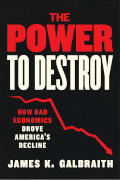
  • Q&A: James K Galbraith on the Myth of Petpetual Growth, How Language Shapes Economic Thought, and More: An interview with Galbraith, whose new book, The End of Normal: The Great Crisis and the Future of Growth is next on my reading list. Galbraith seems to doubt Ryan Cooper's argument that we need to counter inequality to increase growth. I've long agreed with Cooper (and Stiglitz, but not Krugman) that inequality is depressing demand at least in the US, but Galbraith seems to be arguing that growth is being hampered by more than just inequality -- e.g., that technology has something to do with it. One thing I'm pretty sure of is that technological advances have done much to blunt the political impact of inequality -- in effect, big TVs and smart cell phones make us less bitter about the rich getting richer. The new book is certain to be interesting. I've said many times that Galbraith's The Predator State: How Conservatives Abandoned the Free Market and Why Liberals Should Too is the best political book of the last decade.

  • Mike Konczal/Bryce Covert: The Real Solution to Wealth Equality: "Instead of just giving people more purchasing power, we should be taking basic needs off the market altogether." Social Security does this. So would universal healthcare and free education. Konczal and Covert have expanded this into a regular column in The Nation. All of these are worth reading:

  • Peter Van Buren: What Could Possibly Go Right? Iraq War 3.0, he calls it. Ignoring 1.0, I'm reminded more of Marx's quip about the Bonapartes: history repeats itself, first as tragedy, then as farce -- although for all concerned it'll look more like tragedy all over again: it's only from an insensitive distance that one can sit back and revel in how ridiculous everyone involved is.

Ask a question, or send a comment.

Wednesday, November 5, 2014


Post Hoc Ergo Propter Hoc

Got up this morning. The sky was clear, the air crisp, a really lovely day. People went to work. Some drove by. Others walked their dogs. The mail came. It all seems like a normal day. The ramifications of yesterday's elections will take some time to manifest themselves. It occurs to me that maybe I shouldn't fret so much. I'm 64. By the time the Republicans destroy Obamacare I'll be 65 and eligible for Medicare. By the time they kill off Medicare, I'll be dead. And otherwise I'm relatively immune to the scourges of Republican rule: I don't need decent or affordable schools, I'm unlikely to be harrassed by police or criminals (and the odds of a self-righteous gun nut striking me aren't much higher than the odds of being struck by lightning or mowed down by a tornado). I'm out of the job market, but (for now at least) don't need welfare either. And I don't have children, so while I wish good things for generations to come I don't have much skin in that game. If other Americans don't care what happens to them, why should I?

What happened? Nate Silver's postmortem claims The Polls Were Skewed Toward Democrats. I wish he had phrased this differently: the takeaway is likely to be that the pollsters were biased, something Republicans are always whining about (although Democrats usually suspect the opposite). Other reasons are possible: late shifts, volatile voter turnout levels. Pollsters try to limit their samples to "likely voters" but that can be hard to guess ahead of the fact. I don't have much data on turnout so far, but accepting the premise that people who don't vote are generally more liberal than people who do -- there's quite a bit of evidence for that -- a Democratic vote shortfall suggests a lower-than-expected turnout.[1] One turnout figure I have is Sedgwick County in KS (Wichita), where turnout was 51.5% -- actually a bit less than in 2010, despite much more competitive races this year. I suspect a variation on the so-called Bradley Effect (where people tell pollsters something that sounds better than the truth): I suspect more people told pollsters they would vote than actually did.

Silver's data shows that Republican Senate candidates did better than their weighted poll averages in 26 (of 34) races (he leaves KS off the list; Orman ran as an independent, but everyone treated him as a Democrat, especially since the Democratic nominee dropped out and wasn't on the ballot); Republican Gubernatorial candidates did better in 28 (of 35) races. Had the polls been right, the Democrats would have won two Senate seats (North Carolina, Alaska) and four governorships (Florida, Illinois, Kansas, Maryland) they lost, but they would have lost Connecticut. Had the Democrats run two points better than their polls, they would have saved or picked up three Senate seats (Colorado, Georgia, Iowa) and three governships (Maine, Michigan, Wisconsin). That would have turned into a decent night.

Still, polling wasn't the reason Republicans won. I hadn't taken it that seriously, but the main reason's been staring me in the face every time I visited Talking Points Memo: in their "PollTracker" Obama has had a steady job approval rating of 42.9%, ten points below is 52.9% disapproval. That number hasn't budged in months, and it's hard to imagine what Obama could do to move it. He can't legislate anything without help from Congress, and that's something the Republicans won't permit. He could, like Harry Truman when faced a Republian-controlled Congress in 1948, go out on the campaign trail and attack his "do-nothing Congress," but that's not his style (and anyway, he's not up for election). Nor does he really have much to talk about: the economy is recovering but it's not doing most people much good (nor did he do it much good); he has positive stories on issues ranging from domestic oil surpluses to reducing the national debt, but who cares?; he's managed to get back into Iraq and involved in Syria without having a clue where that's going; then there's the panic on Ebola, where the message is a boring we're doing what needs to be done. The quiet competency and subtle nudges he's always aimed for don't move anyone.

The rest of TPM's widget doesn't look so bad for Democrats: their unfavorable rating is 8 point higher than their favorable (46-38), but the Republicans are 20 points unfavorable (50-30). One troubling point is that even though Republicans are less liked and more loathed voters still give them a +2.4% (45.7% to 43.3%) edge in the generic congressional ballot (plus, in the House, they have more incumbents due mostly to gerrymandering). One reason I dismissed the top line is that some people, like me, disapprove of Obama but wouldn't think of defecting to the Republicans over it. (My main gripe is Obama's handling of what I call the Four Wars of 2014 -- Syria, Iraq, Gaza, and Ukraine.) But evidently there aren't many of us. On the other hand, in race after race Republicans figure all they have to do is to identify the Democrat (or in Kansas, independent Greg Orman) with Obama and voters will snap. I expected most people to see through something that transparent, but for various reasons (including but not limited to racism) lots of people are ready to blame Obama for whatever bugs them, no matter what. And a big chunk of the $3.6 billion spent on the campaign went into driving that one point home.


Matt Yglesias explained what's been happening in a post on Mitch McConnell's reëlection:

In the winter of 2008-2009, the leaders of the Obama transition effort had a theory as to how things would go and mainstream Washington agreed with them.

The theory went like this. With large majorities in the House and Senate, it was obvious that lots of Democratic bills would pass. But the White House would be generous and make concessions to Republicans who were willing to leap on the bandwagon. Consequently, incumbent Republicans from states Obama won (Maine, New Hampshire, Ohio, North Carolina, Indiana, Nevada) would be eager to cut deals in which they backed Obama bills in exchange for key concessions. With that process under way, many Republicans who weren't even that vulnerable would be eager to cut deals as well, in search of a piece of the action. As a result, bills would pass the Senate with large 70- to 75-vote majorities, and Obama would be seen as the game-changing president who healed American politics and got things done.

McConnell's counter plan was to prevent those deals. As McConnell told Josh Green, the key to eroding Obama's popularity was denying him the sheen of bipartisanship, and that meant keep Republicans united in opposition:

"Reporters underestimate how powerful the calendar is," says Jim Manley, the former communications director for Harry Reid, the Democratic Senate leader. "Say you want to break a filibuster. On Monday, you file cloture on a motion to proceed for a vote on Wednesday. Assuming you get it, your opponents are allowed 30 hours of debate post-cloture on the motion to proceed. That takes you to Friday, and doesn't cover amendments. The following Monday you file cloture on the bill itself, vote Wednesday, then 30 more hours of debate, and suddenly two weeks have gone by, for something that's not even controversial." All of this has slowed Senate business to a crawl.

"We worked very hard to keep our fingerprints off of these proposals," McConnell says. "Because we thought -- correctly, I think -- that the only way the American people would know that a great debate was going on was if the measures were not bipartisan. When you hang the 'bipartisan' tag on something, the perception is that differences have been worked out, and there's a broad agreement that that's the way forward."

To prevent Obama from becoming the hero who fixed Washington, McConnell decided to break it. And it worked. Six years into the affair, we now take it for granted that nothing will pass on a bipartisan basis, no appointment will go through smoothly, and everything the administration tries to get done will take the form of a controversial use of executive power.

It's been ugly. But in most voters' mind, the ugliness has attached to Obama and, by extension, Democrats.

Anyone who's paid much attention is aware of Republican obstruction and hostage taking -- some approving and some aghast -- but many don't notice until it's too late, and it's easy for them to blame Obama, especially with the right-wing media attacking Obama for pretty much everything they can imagine. The one exception that reflects back on Republicans seems to be shutting down the government, but folks rarely notice when the safety net is shredded until they fall through and go splat. Similarly, who notices when jobs (e.g., judges and ambassadors) go unfilled as long as they don't affect you personally. But the idea isn't just to obstruct Obama, it's to make life so difficult that the Democrats don't even try to do new things -- and that has the effect of making Obama and the Democrats look ineffective, like they aren't even trying.

What McConnell and the Republicans have done isn't unprecedented -- indeed they did much the same thing to Clinton -- except in frequency and persistence: there's never been anything quite like that before. The Senate, in particular, has many arcane rules ripe for abuse, and only limited by conscience -- something rarely seen among a group who increasingly favor incompetent and unrepresentative government. Like most schemes, the only way around it is to cut through it, exposing the ill intent and holding all sides to a higher standard of public interest. One might expect the mainstream media to do just that, but their sense of even-handedness blinds them to asymmetric behavior. Nor does it help that the media are held by large corporations, not the public trust (an idea increasingly regarded as quaint).


I'm not interested in speculating on what Obama can or cannot, should or should not do during the last two years of his term. I will say that the Democratic Party needs a spokesman independent of the White House, and that they need to rebuild the party from the roots up, much like the Republicans did in the early 1990s. Obama blew his opportunity to get much done when he lost Congress in 2010, much as Clinton did in 1994. That plus eight much-worse-than-wasted years with GW Bush has left us with an increasing roll of problems, little wherewithal to solve them, and it seems even less imagination. Until the latter opens up, we're stuck in this hopeless game, where nothing is possible because nothing viable can be imagined. In this, I'd say the Democrats are as blind as the Republicans, albeit somewhat less cynical.


It's worth noting that nearly all of the actual issues on the various ballots were won by progressives, including a higher minimum wage in Arkansas, more thorough gun control checks in Washington, guaranteed sick leave in several states, and decriminalization of marijuana. (A medical marijuana initiative in Florida lost when it fell just short of a 60% supermajority requirement, after Sheldon Adelson spent millions against it.) Perhaps more Democrats should have run on issues, instead of shying away from them. It's been observed that the election results will most likely end medicare expansion in Arkansas, Kentucky, and West Virginia, but that's due to Republican gains, not to referenda on the issue. Indeed, it's doubtful most voters in those states realize what they've done. All they think they've done is to have thwarted Obama and his nefarious plots.


[1] Indeed, the first turnout numbers show Preliminary Turnout Numbers Are Way Down From 2010 and 2012, the overall percentage voting dropping from 40.9% in 2010 to 36.6% in 2014. (The presidential elections Obama won in 2008 and 2012 drew 56.8% and 53.6% respectively.) Turnout varied from 59.3% in Maine to 28.5% in Texas; Kansas was 42.8%. Although the bottom of the barrel was solid red (Texas, Tennessee, Mississippi, Oklahoma), some Democratic-leaning states had low turnouts (New York: 30.2%; California: 34.8%). I think there are at least two factors here: there is an underlying variation by state (e.g., Minnesota, which ranked 5th this year, is usually near the top, while Texas is almost always at the bottom), which are then tweaked somewhat by having competitive races.

There is also a map which compares 2014 to 2010. States with higher turnout in 2014 are: Nebraska (+7.6), Louisiana, Wisconsin, Maine, Arkansas, Alaska, New Hampshire (+3.1). Kansas was +1.1, a pretty small gain compared to campaign spending (through the roof). Colorado was +1.8, Kentucky +1.8, North Carolina +1.5, Florida +1.4.

Also, Ed Kilgore reports (What the Hell Happened to the Democratic Vote):

Comparing yesterday's exit polls to those of 2012, the first thing that jumps out at you is a big shift in age demographics: under-30 voters dropped from 19 percent of the electorate in 2012 to 13 percent in 2014, while over-65 voters climbed from 16 percent in 2012 to 22 percent in 2014. That's quite close to the age demographics of 2010.

[2] By the way, here's a report on Kansas: How the Kansas Democratic Party Drove Itself to Near Extinction (Pt 1): I can't really vouch for this -- I know some people who are active in the party, but I'm not one of them -- but certainly the lack of organization, offices, and candidate support is a big problem here. The Democrat who ran for an empty Senate seat against Jerry Moran did so with a total budget of about $23,000 (vs. about $5 million, if memory serves). This makes me wonder whether the Democratic gubernatorial ticket this year would have been stronger with Jill Docking on top and Davis slotted for Lieutenant Governor. For one thing, Docking wouldn't have been characterized as a "Lawrence liberal" (she's from Wichita), nor would she have been subject to those lurid "strip club" ads. Women have a good track record in KS politics: the last two Democratic governors were women, and before that two previous Democratic governors were named Docking (Jill married into a rather famous family, as by the way did Kathleen Sebelius). Also see Pt. 2.

Ask a question, or send a comment.

Monday, November 3, 2014


Music Week

Music: Current count 23966 [23933] rated (+33), 540 [543] unrated (-3).

Week didn't start until Wednesday, when I posted last Music Week, so the rate count rate was exceptionally high -- 30 is a very solid 7-day week, ridiculous for a 5-day week. Played a lot of new stuff on Rhapsody, including a couple records I had acquainted myself with on the road. While the top-rated records all got multiple spins, I didn't dawdle on the clear misses (other than Dan Weiss favorite Ex Hex).

I've especially been missing the recommendations of Jason Gubbels, so was glad to see his Third Quarter 2014 Wrap-Up -- really just a cribsheet. He tabs five records as "pretty great": Run the Jewels, Angaleena Presley, Leonard Cohen, Spider Bags, and Aphex Twin. I had three of those, but "ran the jewels" way too fast a week back to get any real feel for the record, not that I didn't like what I heard [**]. I gave Spider Bags another play: I probably have it too low [*], but not so much so that I felt compelled to regrade it. I only know about half of the "pretty goods" (including Elio Villafranca and Changari below), but only have Orlando Julius' Jaiyede Afro at A-. No major disagreements below that, although the "pretty meh" Bill Frisell was well received by my friends on the Cape (I wound up at [***]), and I dislike Jason Moran's All Rise more than my grade [*] suggests.

Thought I noticed a blip in B+(**) grades this week, so I went to the year-in-progress file to check. I assumed B+ grades would be evenly distributed, but there is a small bell curve in the middle: 168-185-162. Actually, that bump was much more pronounced last year: 222-318-262. And now that I think about it last year's distribution makes more sense: there should be fewer higher-rated records than lower, but my actual lower-rated counts are progressively attenuated as we get ever deeper into records I don't consider prospects. Consider this sequence, comparing this year's count-per-grade to last year's: [A-] 68.7%, [***] 75.6%, [**] 58.1%, [*] 61.8%, [B] 52.9%, [B-] 76.9%. The way I read this, I'm listening to less crap this year -- probably because I don't have the metacritic file to make me conscious of lousy records other people like.

By the way, adding up all these numbers shows I only have 64.2% as many records in the 2014 (738) file as in 2013 (1149 and still growing until I freeze it end of December). It seems unlikely I'll ever make that deficit up (although 1000 is probably a 50-50 proposition).


Get out and vote tomorrow. It's the only day of the year when you get to act like you live in a democracy, even though your choices aren't likely to amount to much and the powers-that-be have done all they could to rig the results. Also the day you can blame your fellow citizens for their foolish choices, as opposed to every other day when the problem is more likely to be the corruption of the system.


New records rated this week:

  • Allo Darlin': We Came From the Same Place (2014, Slumberland): I don't follow lyrics well enough to be sure these are as deep as they might be [r]: A-
  • Tony Bennett & Lady Gaga: Cheek to Cheek (2014, Interscope): Italian-Americans bonding over their roots: great songs with shlocky arrangements [r]: B+(*)
  • Maggie Björklund: Shaken (2014, Bloodshot): singer-songwriter from Denmark to LA, given to open spaces and melancholy with steel guitar shimmer [r]: B
  • Chingari [Ranjit Barot/U Shrinivas/Etienne Mbappé]: Bombay Makossa (2014, Abstract Logix): two Indians (mandolin, drums) and a bassist from Cameroon fusion with fusion jazz then sing about it [r]: B+(*)
  • Gary Clark, Jr.: Live (2014, Warner Brothers, 2CD): major Texas blues hopeful returns to his strong suit after that awful debut LP, then stretches too long [r]: B+(*)
  • Chris Dundas: Oslo Odyssey (2014, BLM, 2CD): LA pianist goes to Norway, picks up a band with a saxophonist suited to his pace, a bass great too [cd]: B+(***)
  • Brian Eno/Karl Hyde: High Life (2014, Warp): rough-edged guitar replaces synth for the riffwork, like Fripp minus the Frippertronics [r]: A-
  • Ex Hex: Rips (2014, Merge): Mary Timony leads a tight pop-punk trio, no vocal presence, second hand riffs, but they're close to irresistible [r]: B+(***)
  • Flying Lotus: You're Dead (2014, Warp): and you've gone to hell with a soundtrack that taunts you with talent then slams the door, repeatedly [r]: B+(**)
  • Fumaça Preta: Fumaça Preta (2014, Soundway): Dutch band led by Portuguese-Venezuelan drummer is rooted in garage rock but sports exotic psychedelia and more [r]: A-
  • Benjamin Herman: Trouble (2013 [2014], Dox): polishing up standards, stretched and strained by Daniel von Piekartz's sentimental piano and vocals [r]: B+(*)
  • EG Kight: A New Day (2014, Blue South): blueswoman from Georgia via Chicago stays close to classic form, which keeps her consistent [r]: B+(**)
  • Jerry Lee Lewis: Rock & Roll Time (2014, Vanguard): at 79 has turned full circle back to Memphis; appreciates the guest help but doesn't need it [r]: B+(**)
  • Logic: Under Pressure (2014, Def Jam): young rapper makes debut after four mixtapes, avoids guests, does a fair job justifying his name [r]: B+(**)
  • Jemeel Moondoc/Connie Crothers: Two (2012, Relative Pitch): alto sax-piano duets, free but far from rough partly because they don't aim for speed [r]: B+(*)
  • The New Pornographers: Brill Bruisers (2014, Matador): much viable talent, many pop hooks, often a bit bruised which isn't the problem; caring is [r]: B+(*)
  • Karen O: Crush Songs (2006-10 [2014], Cult, EP): Yeah Yeah Yeahs singer goes lo-fi (more like demo quality and EP-length), crude but not without interest [r]: B+(*)
  • Tineke Postma/Greg Osby: Sonic Halo (2013 [2014], Challenge): two alto saxes play like one (only better), spur Matt Mitchell to try to steal the show [r]: B+(***)
  • Bobby Previte: Terminals (2014, Cantaloupe): five pieces match SO Percussion with a guest; Greg Osby brings jazz, Nels Cline something beyond [r]: B+(*)
  • Sylvain Rifflet & Jon Irabagon: Perpetual Motion: A Celebration of Moondog (2013 [2014], Jazz Village): saxophonists toast Moondog, but they also drag a choir in, so texts matter? [r]: B+(*)
  • Pat Senatore Trio: Ascensione (2008-12 [2014], Fresh Sound): Josh Nelson plays piano in bassist-led trio, loves the lush harmonies until they're squishy [cd]: B+(**)
  • Elio Villafranca and His Jazz Syncopators: Caribbean Tinge: Live From Dizzy's Club Coca-Cola (2011-12 [2014], Motéme): Cuban pianist does two shows uptown, toning down that tinge [r]: B+(*)
  • Ezra Weiss Sextet: Before You Know It: Live in Portland (2013 [2014], Roark): live in home town Portland, the gritty horns warm up the joint, a gorgeous ballad closes [cd]: A-
  • Luke Winslow-King: Everlasting Arms (2014, Bloodshot): overeducated eclectic singer-songwriter can't quite figure out what to do in New Orleans [r]: B
  • Yelle: Complčtement Fou (2014, Kemosabe): French electronica leaning toward dance-pop, not crazy at all let alone crazy enough [r]: B+(**)

Recent reissues, compilations, and vault discoveries rated this week:

  • Jerry Lee Lewis: The Knox Phillips Sessions: The Unreleased Recordings (1970s [2014], Time-Life): at 44(?) he drowns his mid-life crisis, threatening to kick your ass but doesn't [r]: B+(**)


Unpacking: Found in the mail last week:

  • Paul Dietrich Quintet: We Always Get There (Blujazz)
  • Aaron Goldberg: The Now (Sunnyside)
  • Tony Monaco: Furry Slippers (Summit)

Ask a question, or send a comment.

Sunday, November 2, 2014


Weekend Roundup


Tuesday is election day. Six years ago Barack Obama was elected president with 69 million votes -- 52.9% of the 132 million voters (56.8 of the voting-age population, the highest share since 1968) -- and the Democrats swept both houses of Congress, even achieving what was widely touted as a "fillibuster-proof Senate" (not that I can recall them breaking any fillibusters with narrow partisan votes, aside from the ACA health care reform). Almost immediately, right wing talk radio exploded with hatred for Obama and the Democrats, and the Republican members of Congress turned into intransigent and remarkably effective obstructionists.

Meanwhile, Obama quickly pivoted from promising to change Washington to doing whatever he could to salvage the status quo, starting with the banks that had crashed the economy and Bush's military misadventures in the Middle East. Instead of using his congressional majorities, he plead for bipartisan support, often compromising before he even introduced a plan -- as when he sandbagged his own stimulus program by saddling it with ineffective tax cuts, or introduced health care reform and global warming proposals that were originally hatched in right-wing think tanks. He gave the incumbent Republican Federal Reserve chair an extra term, and he kept on the incumbent Republican Secretary of Defense -- and both screwed him in short form. Moreover, like Bill Clinton when he won in 1992, Obama dismantled a successful national Democratic Party leadership and replaced them with cronies who promptly threw the 2010 congressional election.

The 2010 elections rival 1946 as one of the dumbest things the American people ever did. The Republicans took over the House, not only ending any prospect of progressive legislation but constantly threatening to shut down the federal government. Republicans also took over many governorships and state houses, and used those power bases to consolidate their power: by gerrymandering districts, and by passing laws to make it harder to vote. It turns out that the difference between 2008 and 2010 was not just a matter of Republican enthusiasm and Democratic lethargy: it registered as a massive drop in the number of voters, from 132 million to 90 million, from 56.8% of voting-age population to 37.8% (link; note also that the 2006 turnout was only 37.1% and that produced a Democratic landslide, so it's somewhat variable who stays home).

In 2012, when Obama finally took a personal interest in an election, he was again able to get out the vote (albeit still a bit off from 2008 with 130 million, 53.6%). Obama won again, the Democrats increased their share of the Senate, and won a majority of the vote for the House (but not a majority of seats, thanks to all that gerrymandering, so the last two years have seen the same level of obstruction as the previous two). If those trends hold, turnout will be down again this year, and that will give the elite-favoring Republicans an edge: at this point, nobody expects them to lose the House, and most "experts" expect the Republicans to gain control of the Senate. That would be a horrific outcome, which makes you wonder why the Democrats don't seem to be taking it seriously, and more generally why the press doesn't talk about it as anything but a horserace. That trope suggests a race between two more-or-less equals, horses, whereas the actual race is between predator and prey: if the Democrat is a horse, the Republican is more like a lion, or a pack of wolves (or an army of flesh-eating ants). The Republicans don't back off when a Democrat wins a race. They don't socialize, and don't compromise. They keep attacking, figuring that no matter how much damage they do, the public will blame the incumbent.

An old, but not outdated, Crowson cartoon

It's a long story how the Republicans have gotten to be the menace they currently are -- one I can't go into with any hope of posting today. Suffice it to say they've managed to combine three threads:

  • An anti-democratic campaign ethic ranging from Nixon's "dirty tricks" to voter suppression to flooding the airwaves with bile, baldfaced lies, and carefully vetted pet phrases -- anything to seize power.
  • Their single substantial political position is to help the rich grow richer, a position that has hardened even as business has become more predatory -- indeed, their individualist, "greed is good" ideology has hardened into self-destructive dogma.
  • Since anti-populism is an inherently losing strategy in a democracy, they've built a diverse base by cultivating "single issue voters" -- especially ones who can be focused to hate proxy groups (including those so-called "cultural elites," but mostly the non-white, the poor, single women, deviants, peaceniks, policy wonks, anyone who doesn't like guns).

I know that this sounds like a recipe for disaster, and indeed every time the Republicans have tried to put their ideas into practice they have backfired. (Reagan got away relatively free although his S&L deregulation disaster was a harbinger of things to come, and his arming of the mujahideen in Afghanistan still haunts us. But the Bushes plunged us into endless, bankrupting war, and the latter's laissez-faire bank policy wrecked the economy, while Katrina exposed the moral rot caused by Bush's privatization of government services. And right now Kansas is reeling from Gov. Brownback's "experiments" -- they say that "absolute power corrupts absolutely," and the total hammerlock of the RINO-purged ultra-right party in the Sunflower State offers further proof.) Yet much of the country, led by the fawning mainstream media, continues to accord Republicans a measure of respect they've done nothing to earn. For while the Republicans could care less about destroying the social fabric of the nation, they are always careful to honor the rich, their businesses, the military, the nation's self-important legacy, and, of course, almighty God -- their idea of the natural order of things, one no Democrat politician dare challenge. (Indeed, the Democrats' cheerleader-in-chief for those verities has been Barrack Obama -- the very man most Republicans insist is the root of all evil.)

When the dust settles the amount of money spent on this election will be staggering, not that many people will move on to the next obvious question: since businessmen always seek profits, what sort of return do the rich expect from their largesse? Thanks to modern technology -- caller ID to screen calls and a DVR to skip through commercials -- we've managed to avoid most of the deluge, but I've managed to catch enough to get a sense of how bad unlimited campaign spending has become. Kansas and Arkansas both have competitive races for Governor and Senator, and in both cases the Republicans, with their sense of entitlement, have pulled out all the stops. However, their commercials are one-note attacks on Obama, as if that's the magic word that boils voters' blood.

That acrimony is hard to fathom: a combination of prejudice and ignorance and, well, gullibility if not downright stupidity. For anyone who's paid the least bit of attention over the last six years, Obama is a very cautious, inherently conservative politician -- one who goes out of his way not to ruffle feathers, least of all of the rich and powerful. Indeed, that makes perfect sense: all his life he's strove to conform to the powers that exist, and he's been so adept at it that he's been richly rewarded for his service. The idea that he's surrepititiously out to destroy the country that so flattered him by making him president is beyond ridiculous, yet judging from their cynical ads, Republicans don't just believe this -- they take it as something so obvious they need merely to repeat it. And that's just one of many cases where the Republicans think they can simply talk their way out of reality.


Some scattered links this week:


  • Dean Baker: Economists Who Saw the Housing Bubble Were Not Worried About a Depression: The article doesn't really explain the title, but the main point is worth repeating:

    It is quite fashionable among Washington elite types to insist that we would have had another depression if we didn't save the Wall Street banks, but do any of them have any idea what they mean by this?

    The first Great Depression was the result of not having enough demand in the economy. We got out of it finally in 1941 by spending lots of money. The motivation for spending lots of money was fighting World War II, but the key point was spending the money. It might have been difficult politically to justify the spending necessary to restore the economy to full employment without the war, but that is a political problem not an economic problem. We do know how to spend money.

    In effect, the pundits who say that we would have had a depression if we did not bail out the banks are saying that our economic policy is so dominated by flat-earth types that we would have to endure a decade or more of double-digit unemployment, with the incredible amount of suffering it would cause, because the flat-earthers would not allow the spending necessary to restore full employment.

    That characterization of our political process could be accurate, but it is important to be clear what is being said. The claim is not that anything about the financial crisis itself would have caused a depression. The claim is rather that Washington economic policy is totally controlled by people without a clue about economics.

    In fact, let's repeat it again. One of the most basic things we know from macroeconomics is that government can restore a depressed economy to full employment by sufficiently increasing spending, and that if the depression is caused by insufficient demand, government spending is the only way that works. We know that this depression is due to insufficient demand because businesses are sitting on cash instead of investing in more capacity, and giving them more money doesn't change a thing. So the only way to bring employment is for government to spend more, and there are several obvious benefits to that. For one thing, investments in infrastructure pay dividends well into the future, and they are never cheaper than during a depression. That's also true of investments in "human capital" -- education, science, engineering, the arts. But even plain transfers are a plus, as they move money from people who have more than they spend to people who need to spend more. One obvious thing to do when the housing bubble burst was to make it possible to refinance mortgages -- it would have helped banks clean up their balance sheets and it would have help people hang onto their homes -- but it wasn't done, for purely political reasons.

    In fact, virtually none of this was done, again for political reasons -- and that mostly means because of Republican obstruction (although in states with Republicans in power, like Kansas, they did considerably worse). Of course, the Democrats weren't too sharp here either. Obama's belief in "the confidence fairy" was so strong that he spent his first two years insisting that the economy was in better shape than it was, foolishly believing that business would believe him (and not their own accountants) and stop deleveraging. By the time he realized that wasn't working: he had missed the opportunity to blame the whole mess on Bush, he had settled for a stimulus bill way too small, he missed the opportunity to unwind the Bush tax cuts for the rich (and therefore found himself in a gaping deficit hole), and then he stupidly bought into the argument that deficit reduction was more important than cutting unemployment. It's easy enough to see why the Republicans didn't mind sandbagging the economy: it weakened labor markets, scarcely touched monopoly profits, reduced government (and the possibility that government might do something for the people), and in the end people would blame Obama anyway. It's harder to understand why Obama inflicted all this misery on himself, his party, and his voters.

    Forty years ago all this was common sense -- so much so that Richard Nixon proclaimed, "We are all Keynesians now." But the US was more of a democracy then, and the economic effects of government were more clearly seen for what they were. Nixon was a Keynesian because he wanted to get reëlected, and that was what worked. With Obama, you have to wonder.

  • Henry Farrell: Big Brother's Liberal Friends: "Sean Wilentz, George Packer and Michael Kinsley are a dismal advertisement for the current state of mainstream liberal thought in America. They have systematically misrepresented and misunderstood Edward Snowden and the NSA." Intellectuals like those three, who spend [at least] as much time trying to separate themselves from the left as they invest in their proclaimed liberalism, are why I felt such contempt for liberals during the Vietnam War (and its broader Cold War context).

    Why do national-security liberals have such a hard time thinking straight about Greenwald, Snowden and the politics of leaks? One reason is sheer laziness. National-security liberals have always defined themselves against their antagonists, and especially their left-wing antagonists. They have seen themselves as the decent Left, willing to deploy American power to make the world a happier place, and fighting the good fight against the knee-jerk anti-Americans.

    This creates a nearly irresistible temptation: to see Greenwald, Snowden and the problems they raise as antique bugbears in modern dress. Wilentz intimates that Greenwald is plotting to create a United Front of anti-imperialist left-wingers, libertarians and isolationist paleoconservatives. Packer depicts Greenwald and Snowden as stalwarts of the old Thoreauvian tradition of sanctimonious absolutism and moral idiocy. Kinsley paints Snowden as a conspiracy-minded dupe and Greenwald as a frustrated Jacobin.

    Yet laziness is only half the problem. A fundamental inability to comprehend Greenwald and Snowden's case, let alone to argue against it, is the other half. National-security liberals have enormous intellectual difficulties understanding the new politics of surveillance, because these politics are undermining the foundations of their worldview.

    I suspect that part of that worldview is a desire to see themselves as part of the security state, something they project as having their own morality, even though there is no evidence of such. This makes them defensive when confronted with an outsider like Greenwald or a turncoat like Snowden. It also makes them gullible to campaigns like the Bush snow job on invading Iraq: their sense of belonging with the state isolates them from adverse consequences to others, even while they justify their acts by pointing to supposed benefits to others (whom I doubt they are actually capable of relating to).

    Another quote:

    Snowden and Greenwald suggest that this project is not only doomed but also corrupt. The burgeoning of the surveillance state in the United States and its allies is leading not to the international spread of liberalism, but rather to its hollowing out in the core Western democracies. Accountability is escaping into a realm of secret decisions and shadowy forms of cross-national cooperation and connivance. As Princeton constitutional scholar Kim Lane Scheppele argues, international law no longer supports national constitutional rights so much as it undermines them. U.S. efforts to promote surveillance are hurting civil liberties at home as well as abroad, as practices more commonly associated with international espionage are redeployed domestically, and as security agencies (pursuing what they perceive as legitimate goals) arbitrage the commingling of domestic and international data to gather information that they should not be entitled to.

  • Thomas Frank: Righteous rage, impotent fury: the last days of Sam Brownback and Pat Roberts: I'm still skeptical that Brownback and Roberts will fall on Tuesday, but he's right that it's close, and that it's notable in a year when so much of the conventional wisdom expects Republican gains. It's worth noting that Brownback and Roberts got to this point by two very different routes, but they're likely to fall for the same reasons. Six years ago Roberts was cruising to an easy third term, and Brownback was up in Iowa campaigning for president. Brownback fizzled embarrassingly, losing the caucuses not just to Mike Huckabee -- his rival for the pious church crowd -- but to everyone else as well. He then decided to burnish his credentials with some executive experience, so he gave up his own safe senate seat in 2010 to run for governor. He won easily, then set out to establish his presidential bona fides by overhauling everything in state government to meet state-of-the-art Republican standards. He was, after all, convinced that his ideology worked, and meant to run not just on theory but on proven success. For starters, he had Kansas hire the memorably named Arthur Laffer to come up with a tax proposal: one that eliminated all state income taxes for "small business" owners, which in Kansas includes billionaires like Charles Koch. Laffer assured us that the taxes would be a "shot of adrenaline" straight into the Kansas economy. The only effect they had was to blow a monster hole in the state budget, which led to cutbacks all across the state, which . . . stalled the economy. With Republicans controlling both houses of the state legislature, Brownback had no trouble getting his "experiments" approved, but in 2012 he didn't like the occasional no vote from the few remaining moderate Republicans, so he arranged a purge of the so-called RINOs -- pushing the legislature even more to the right. Resistance against Brownback has been growing almost since the day he took office. The taxes are just one of dozens of issues Brownback has been offensive on, ranging from fanciful new restrictions against abortion providers to a campaign to exterminate the lesser prairie chicken (before the federal government can declare it an "endangered species" -- some kind of inconvenience to ranchers).

    Roberts, on the other hand, had nothing to fear but fear itself, but being the very definition of chickenshit, when the tea partyfolk started questioning his fanaticism he lurched suddenly to the right, even going so far as to vote against the Agriculture bill most Kansas farming corporations depend on. He barely escaped a primary where he was tagged as "liberal in Washington, rarely in Kansas" (indeed, he had to fire a campaign manager who told the press that Roberts had "gone home to Virginia"). And then when he assumed that he'd have no trouble with whoever the Democrats nominated, he wound up facing a well-to-do independent, Greg Orman, with the Democrat bowing out. Since then, his campaign commercials have never risen above the level of trying to equate Orman with Obama and Harry Reid. Orman's ads also identify Obama and Reid as problems in Washington, but add Mitch McConnell and Pat Roberts to the list. Where Brownback is some sort of true believer in things that clearly don't work, Roberts is a mere poster boy for the usual run of Washington corruption. Neither approach is very popular anywhere, but Kansas offers exceptionally vivid choices.

    What Frank doesn't do is take credit for causing this debacle. His book, What's the Matter With Kansas? How Conservatives Won the Heart of America (2004) made a big point about how Republicans took advantage of rank-and-file cultural conservatives, catering to them with election rhetoric then only implementing business favors once elected. Since Frank's book came out, the rank-and-file revolted, and they've pushed their crazy agenda through the legislature -- that's why, for instance, Kansas passed a law to nullify federal gun laws, and another to allow conceal/carry into all government office buildings. Under the old pre-Frank scheme, electing far-right nuts helped the rich get richer but didn't impact many others. Now, everyone's affected, which is one reason for the backlash. Another is the purge, which has rallied hundreds of prominent RINOs to campaign against Brownback.

  • Stephen M Walt: Netanyahu's Not Chickenshit, the White House Is: Israeli pawn/propagandist Jeffrey Goldberg quoted an anonymous White House aid as describing Benjamin Netanyahu as "chickenshit" -- evidently for not attacking Iran like the Israelis promised Goldberg they'd do -- so the Israelis got worked up into a snit fit and demanded apoligies, a diplomatic nicety the US didn't bother to demand a few weeks ago when Naftali Bennett accused John Kerry of anti-semitism. Evidently, Netanyahu has a very prickly sensibility, whereas we all know that Obama is used to sloughing off far worse insults. Walt covers the whole "chickenshit-gate" affair here. I've said a lot of things about Netanyahu, but I'd never call a politician who wields nuclear weapons "chickenshit" -- even if he was, I wouldn't dare taunt him.

    Actually, I doubt that Netanyahu is that thin-skinned. Rather, he saw this as an opportunity to remind his supporters how completely he has Obama under his thumb. When Netanyahu came to power in the wake of Obama's victory, I figured it would be short order before his narrow coalition would fall. All the nudge it would take would be a clear signal from Obama that Netanyahu wasn't someone we could work with, and that decision wouldn't take long. There even were a few hints, but nothing Netanyahu couldn't wiggle out of. After a couple years Obama stopped trying, threw in the towel on settlements, and he's been Netanyahu's bitch ever since. For more, see Gideon Levy: Who's the real chickenshit?.

    The United States' policy can only be described as "abject cowardice." Netanyahu, at least, is acting according to his ideology and belief. Obama is acting against his -- and that's pure cowardice. A captive of internal politics and a victim of the de-legitimization campaign in his country, the president didn't have the guts to overcome those obstacles, follow his world view and bring an end to the occupation. Yes, he could. Israel is totally dependent on America and he is America's president. Instead Obama continued the policy of automatic support for Israel, believing, in vain, that flattery will change its policy.

    Obama was destined to be the game changer in the Middle East. When he was elected, he ignited the hope that he would do that. But he preferred to stay with his cowardice. To grovel before Israel and turn his back on the Palestinians. To talk about peace and support Israel's built-in violence.

    Now, in the winter of his career, he is showing signs of being fed up with all this. He can still change things, but not with insults, only with deeds that shake Israel up. Two years are time enough for an American president to make it clear to Israel that its corrupt banquet is over. But for that we need a president who isn't a chickenshit.

  • Some stupid politics links (from TPM, where it's impossible to find stories more than two days old, but they carry roughly a dozen like these every week):

    Then there is:


Also, a few links for further study:

  • Larry Diamond: Chasing Away the Democracy Blues: It bothers me when pundits get on their high horse about democracy and use that to dismiss states with basic democratic institutions that offend them for some other reason -- usually that they have elected leaders the US doesn't approve of for one reason or another. Diamond, for instance, doesn't think much of Russia, Iran, Turkey, or Venezuela, but he likes Ukraine much better since a coup deposed its last democratically elected president. Of course, I don't like restrictions on free press like we've seen in Russia and Turkey recently, nor restrictions on who can run for office like those practiced in Iran, but few political systems cannot be improved. I'll add that while I agree with Diamond and virtually everyone else that China is not a democracy, my impression is that the Chinese government is more popular and a more effective public servant than the governments of many nominal democracies. Diamond's US-centric list of democracies -- you don't find Hungary mentioned anywhere, but the antidemocratic laws recently passed there aimed at perpetuating the power of a right-wing party look like something ALEC would work up for the Republicans here -- shows widespread decay which a more balanced list might reduce, but the following paragraph raises an interesting point:

    Like many of you who travel widely, I am increasingly alarmed by how pervasive and corrosive is the worldwide perception -- in both autocracies and democracies -- that American democracy has become dysfunctional and is no longer a model worth emulating. Fortunately, there are many possible models, and most American political scientists never recommended that emerging democracies copy our own excessively veto-ridden institutions. Nevertheless the prestige, the desirability, and the momentum of democracy globally are heavily influenced by perceptions of how it is performing in its leading examples. If we do not mobilize institutional reforms and operational innovations to reduce partisan polarization, encourage moderation and compromise, energize executive functioning, and reduce the outsized influence of money and special interests in our own politics, how are we going to be effective in tackling these kinds of challenges abroad?

    Of course, one answer is that maybe we shouldn't -- especially as long as we seem incapable of distinguishing public interests from the parochial private interests and imperial hubris that dominate US foreign policy. Winston Churchill used to quip that democracy was the worst possible form of government, except for all the rest. I've long thought that the key virtue of democracy was that it offers a way to remove leaders like Winston Churchill from power without having to shoot them. Democracy promises stability even where leadership changes, and stability is reason enough to want to see democracy propagated throughout the world. There are, of course, others, like accountability of leaders to subjects, an essential element of justice, which is in turn essential for the mutual trust that every modern society requires.

  • Mark Kleiman: Cannabis Legalization in Oregon: Is Measure 91 Close Enough for Government Work?: I don't get (or care for) all the quibbles, but I am glad to see progress on this front.

  • Corey Robin: Jews, Camps, and the Red Cross: Recent research shows that Israel ran several "detention camps" from 1948 into the 1950s where they kept Palestinians as prisoners and subjected them to the usual concentration camp degradations, including forced labor. I'm not sure if this is news -- Israel has run its gulags as long as I can recall, so 1948 is a plausible starting date. I've long known that Israel's military rule regime ran from 1948-67, when it was dismantled a few months before being reconstituted for the Occupied Territories. I've been reading Shira Robinson's Citizen Strangers: Palestinians and the Birth of Israel's Liberal Settler State, which covers this period fairly well.

  • Juliet Schor: Debating the Sharing Economy: A fairly long survey both of commercial and nonprofit sharing organizations with various pluses and minuses -- something that is analogous to my Share the Wealth project but not clear what I want to do. (I suppose the nonprofits are close to what I have in mind, but my own thoughts are far from developed.) Schor has a series of interesting books, the most recent and relevant True Wealth: How and Why Millions of Americans Are Creating a Time-Rich, Ecologically-Light, Small-Scale, High-Satisfaction Economy (2011), which among other things goes into makerspace technology at great length.

Ask a question, or send a comment.

Friday, October 31, 2014


Rhapsody Streamnotes: October 31, 2014

Three weeks on the road put a crimp into this month's output: I pushed the deadline out to the end of the month and still only came up with 62 records. Not a lot of finds either, although it's possible that the A-list is getting so full so early -- I currently have 100 records listed (I expected to wind up around 120, but hit 147 last year, after 131 in 2012, 132 in 2011, 132 in 2010, so maybe I'm not that far ahead) -- that I'm starting to think twice before letting anything the least bit marginal in. On the other hand, the two jazz records didn't get in by much, nor did Allo Darlin'. A larger problem is likely the breakdown of my scoutinig network, especially with the demise of Odyshape. Nor has Christgau's return been much help -- he fell so far behind I had heard most of what he's written about (with the usual adjustments up and down).

Most of the old music this month is by Oscar Peterson. I started playing him on the road when I got some flak from over some avant jazz from a piano jazz fan -- figured who could object? I held this month to records up to 1962, chiefly from the 1959 Song Book series (usually composers Peterson surveyed in 1952-54, which many reissues tack onto the later albums). Peterson is a marvelous piano player but he tends to stay in his own comfort zone, using his spectacular technique to dress up rather than deconstruct standards. He raced through the 1954 and 1959 sessions so quickly that he rarely came up with anything new, and when you listen to a lot of them the initial dazzle quickly wears off: so while those albums are uniformly good, none are really great. So the grade average is a bit off, but that's also because I skipped previously graded records, including these A- efforts: At the Concertgebouw (1957); Night Train (1962). I tried to identify Song Book reissues that pick up the 1952-54 material as a bonus, and chose not to split them apart -- in part because the early albums don't seem to be in print anywhere (although you'd think European copyright laws would allow that).

One more thing about Peterson: he was an exceptional accompanist, as is clear from albums like the following:

  • Benny Carter: Cosmpolite: The Oscar Peterson Sessions (1952-54 [1994], Verve) A
  • Ella Fitzgerald/Louis Armstrong: Ella and Louis (1956 [1985], Verve) A
  • Ella Fitzgerald/Louis Armstrong: Ella and Louis Again (1957 [1990], Verve) A+
  • Coleman Hawkins: The Genius of Coleman Hawkins (1957 [1997], Verve) A-
  • Coleman Hawkins: Coleman Hawkins Encounters Ben Webster (1957 [1992], Verve) A+
  • Clark Terry: Oscar Peterson Trio + One: Clark Terry (1964 [1984], Emarcy) A
  • Ben Webster: Soulville (1957 [1989], Verve) A
  • Ben Webster: Ben Webster Meets Oscar Peterson (1959 [1991], Verve) A-
  • Lester Young: The President Plays With the Oscar Peterson Trio (1952 [1997], Verve) A

Peterson remained very productive well into the 1990s, and there is a lot of material on Pablo (his reunion with Norman Granz) that I haven't heard.

The odd-record-out in the old music is the Richmond Fontaine that Christgau singled out in a recent EW post. It's more or less as he says, but my two plays lean toward less, not enough to get me to dig through a catalog with a dozen titles, especially knowing that The High Country only hit B.

Recent compilations include two Rough Guides, a label I continue to loathe -- but it helps me (if not you) that I've largely given up trying to figure when the music comes from. It looks like everything they do now is coming out as 2CD sets. Their pricing suggests grading the first disc alone under its title, then their bonus disc separately as its original release. I'm not sure how well this will work out, or how much I can find, or how much I can stand, but that's working theory for now.

I bought the Spruill set on the recommendation of an EW-fan who declared it the best compilation to have come out in this millennium. I don't quite agree with that judgment, but my wife does.


These are short notes/reviews based on streaming records from Rhapsody. They are snap judgments based on one or two plays, accumulated since my last post along these lines, back on September 30. Past reviews and more information are available here (5468 records).


New Releases (More or Less)

Jhené Aiko: Souled Out (2014, Def Jam): Slotted as an r&b singer, she doesn't really have the voice, but manages to turn that into a charm, at least as long as the beats hold up. B+(*)

Allo Darlin': We Came From the Same Place (2014, Slumberland): Brit guitar-rock group led by Australian singer Elizabeth Morris, third album, all at a very high level. A-

Marcia Ball: The Tattooed Lady and the Alligator Man (2014, Alligator): Blues-singing boogie-woogie pianist from Texas although she's also at home in New Orleans -- check out how Hot Springs is "way up in Arkansas." Always starts with a fast one, and rarely lets up. B+(*)

Kenny Barron/Dave Holland: The Art of Conversation (2014, Blue Note): Piano-bass duets, both masters who have been working since the 1960s -- Barron perhaps most famous for accompanying Stan Getz, Holland associated with Miles Davis and Anthony Braxton, but also a major bandleader of late. Despite both principals having long songbooks on their own, interesting how the Monk pieces stand out. B+(***)

David Binney: Anacapa (2014, Criss Cross): Saxophonist -- lists alto ahead of tenor then soprano and throws in some synths -- backed by John Escreet (piano, FR), two guitarists (Wayne Krantz and Adam Rogers), and electric bass (Matt Brewer). The electronic soup is neither here nor there -- neither grove-centered nor postboppy -- but sometimes the sax prevails. B+(*)

Samuel Blaser/Paul Motian: Consort in Motion (2010 [2011], Kind of Blue): Trombone quartet, with Russ Lossing (piano) and Thomas Morgan (bass). The trombone offers a sort of gruff determination, but by the end everyone is dancing, gingerly, to the drummer's off-kilter riddim. The others help out without being too conspicuous about it. B+(***)

Buck 65: Neverlove (2014, WEA Canada): Canadian rapper, a legend in these parts, turns in an album streaked with his usual brilliance but it's also a major bummer of a breakup album, with "Gates of Hell" opening into "That's the Way Love Dies" and "Love Will Fuck You Up" and more until "She Fades." More often he's rapping against a female vocal backdrop -- Francesca Anderson or Tiger Rosa -- which with his voice veers toward Eminem, who's much clearer about his fucked up relationship(s). B+(**)

François Carrier/Michel Lambert/Alexey Lapin: The Russian Concerts Volume 2 (2013 [2014], FMR): Alto sax, drums, piano, respectively -- the first two close collaborators from Quebec going back to the 1990s, the pianist joining them on five albums now. This one is a shade less consistent and/or impressive than Volume 1 (came out earlier this year). B+(***) [cd]

Jack Clement: For Once and for All (2014, IRS Nashville): Died in 2013, leaving this as his fourth album, including one from 1978 and another credited to Cowboy Jack Clement in 2004 -- if the name seems vaguely familiar, it's probably because he worked as Sam Phillips' engineer during Sun Records' heyday and went on to become an important Nashville producer. This record stakes his claim as a songwriter -- not a lot of classics here, but a couple songs I know well ("Miller's Cave," "Just a Girl I Used to Know") and solid fare, done with a light, gracious touch. B+(***)

Neil Cowley Trio: Touch and Flee (2014, Naim Jazz): British pianist, has a fine touch and rhythmic command that reminds me of semipopular groups like EST -- notable that he cites James Brown as an influence, ahead of Erroll Garner and Ahmad Jamal. Evan Jones (drums) has offered steady support for more than a decade now. B+(*)

Lajos Dudas Quartet: Live at Salzburger Jazzherbst (2012 [2013], Jazz Sick): Clarinetist, b. 1941 in Budapest, Hungary, studied at conservatories named for Béla Bartók and Franz Liszt, long based in Germany. Quartet features longtime collaborator Philipp van Endert on guitar, plus Kurt Billker on drums and Jochen Büttner on percussion. Slow start but ultimately quite lovely, some tasty guitar, and the rhythm helps. A- [cd]

Lajos Dudas Trio: Live at Porgy & Bess (2009 [2013], Jazz Sick): Back cover says "20 Years of Lajos with Philipp, 1993-2013 / The Jubilee CD" but all of this comes from a single date in Vienna, with Philipp van Endert on guitar and Leonard Jones on bass. Four originals, two pieces from Attila Zoller, standards from Monk, Gershwin, and Porter. B+(***) [cd]

Chris Dundas: Oslo Odyssey (2014, BLM, 2CD): Pianist, from Los Angeles, one previous album back in 2000, picks up a band in Norway with bassist Arild Andersen, Patrice Heral on drums, and Bendik Hofseth on tenor sax, and runs on for 1:44:21. The Dundas-composed first disc opens up gracefully for the sax. The improvised second takes a bit longer to find its métier. B+(***) [cd]

Mark Elf: Returns 2014 (2013 [2014], Jen Bay Jazz): Jazz guitarist, has more than a dozen albums since 1987; sounds like he's picked up on the early generation of bop-oriented guitarists, like Herb Ellis and Barney Kessel (or Tal Farlow, the one he has a tribute album for). Backed by a dream band: David Hazletine, Peter Washington, and Lewis Nash, plus some extra percussion on one track. B+(**)

El-P/Killer Mike: Run the Jewels (2013, Fat Beats): Producer and rapper, respectively, the former's deeply shrouded beats sometimes run away with the flow, otherwise are sharp and heavy, while the rapper tries to get his political points in. B+(***)

El-P/Killer Mike: Run the Jewels 2 (2014, Mass Appeal): Usual sequel problems: longer, trying to make up for having shot their best material on the debut. Beats still hard and sharp, and Mike still has things that piss him off. Don't really make him for a killer, though. B+(**)

Bill Frisell: Guitar in the Space Age (2014, Okeh): Aside from two retro-originals, all these songs are buried deep in the 1960s, so the first point that occurs to me is that Frisell is acknowledging that the "space age" is a thing of the now-distant past. You still hear the cliche that "if we can put a man on the moon, we can do x and y," but we haven't put anyone on the moon in more than forty years, so how sure can you be that we still can? Isn't it possible that we've lost that skill to the new Dark Ages? Frisell is old enough to recall when the Space Age meant the future -- I know because I'm his age -- but now it means "Rebel Rouser" and "Pipeline" and "Telstar." That isn't nostalgia, except for a time when we felt like we had a future. B+(***)

Alice Gerrard: Follow the Music (2014, Tompkins Square): Folksinger, up around 80 these days, belonged to the Strange Creek Singers back in the 1960s along with Mike Seeger and Hazel Dickens, but is best known for her duet albums with Dickens, starting with the 1965 classic Pioneering Women of Bluegrass. Way back when her voice moderated Dickens' deep drawl, but as she's started to put together a modest solo career since 1996, Gerrard's voice has gotten strangely distinctive in its own right, especially when she goes a cappella. B+(***)

David Hazeltine: For All We Know (2014, Smoke Sessions): A fine mainstream piano player, his trio the perfect framework for tenor saxophonist Seamus Blake. B+(***)

Benjamin Herman: Trouble (2013 [2014], Dox): Dutch sax trio expanded with piano/keyboards and vocals by Daniel von Piekartz, listened as "featuring" on the cover. The vocals are rather ambiguous sexually, stretched and sentimental -- the sax too, but so much clearer. B+(*)

Darrell Katz and the JCA Orchestra: Why Do You Ride? (2013 [2014], Leo): A big band arranger whose work has been buried on avant labels -- first record on Cadence Jazz in 1993 -- although it's less than clear why: nothing very free here other than his desire to go his own way. This one is built around texts, often involving Albert Einstein, sung by Rebecca Shrimpton, but the most compelling music doesn't have to carry the weight of the words. B+(*) [cd]

Tove Lo: Queen of the Clouds (2014, Island): Swedish electro-pop singer, upbeat but not much fun, nothing much sticks. B

The Mike Longo Trio: Celebrates Oscar Peterson: Live (2013 [2014], CAP): Pianist, worked for Dizzy Gillespie 1966-73, and earlier still studied with Oscar Peterson and played with Red Allen and Coleman Hawkins -- cover has a picture Peterson embracing the young pianist. Celebrating here means playing standards -- fair game since Peterson played all of them with everyone -- so from "Love You Madly" through "Daahoud" the songs carry the album. With Paul West on bass and Ray Mosca on drums. B+(**) [cd]

Branford Marsalis: In My Solitude: Live at Grace Cathedral (2012 [2014], Okeh): Solo sax, no evidence of the Ellington tune but the idea remains, with no effort to stretch the instrument's boundaries, to play up the percussion or such. Rather, you get a very nice "Stardust," an adapted "Sonata in A Minor for Oboe," four minor improvs, and warm applause. B+(**)

Tineke Postma/Greg Osby: Sonic Halo (2013 [2014], Challenge): Two alto saxophonists -- Osby was something of a big deal when he first appeared but he's receded somewhat, possibly because he's taken second billing on a number of albums. (Friendly Fire with Joe Lovano was one of the first.) Here he's meshed completely with Postma. Quintet is superb all around with Matt Mitchell especially striking on piano, Linda Oh on bass, and Dan Weiss on drums. B+(***)

Angaleena Presley: American Middle Class (2014, Saddle Creek): Debut album from the last third of the Pistol Annies to make the move, and probably the best of the bunch. Noteworthy that the title song sees union membership as the key to middle class identity. A-

Prince: Art Official Age (2014, Warner Brothers): For some reason seems like an artist far removed from present concerns, even though I have to look back less than a decade to find not one but two A- records (2004's Musicology and 2006's 3121) -- it's just that I have no recollection of either, so I'm reluctant to grant too much to the perfunctory funk tracks here. B+(**)

Prince/3rdEyeGirl: Plectrum Electrum (2014, Warner Brothers): Could be the "all-female power trio" should get top billing -- I've seen this printed both ways. "Power trio" seems to mean they've memorized all of Cream's bass lines but they're less monumental when they sing. B+(*)

Joshua Redman: Trios Live (2009-13 [2014], Nonesuch): Sax trios, from two sets (hence two token soprano cuts), both with Gregory Hutchinson on drums, Matt Penman and Reuben Rodgers the bassists. After various conceptual missteps, nice to just hear him blow. [Rhapsody has 5/7 tracks]. B+(**)

Sylvain Rifflet & Jon Irabagon: Perpetual Motion: A Celebration of Moondog (2013 [2014], Jazz Village): Louis Hardin (1916-99), aka the Viking of 6th Avenue, aka Moondog, is a SFFR (Subject For Future Research), someone I've long meant to check out but never have. Like Hardin, both leaders play tenor sax, Rifflet with a couple albums, Irabagon with a more auspicious resume. The instrumental passages are intriguing, the saxes strong, but I'm unclear how the chorus should fit in -- seems like a distraction so far. B+(*)

Rafael Rosa: Portrait (2014, self-released): Puerto Rican guitarist, based in Brooklyn, seems to be his first album, runs warm and lyrical, playing up the guest spots and leaving plenty room for saxophonist Edmar Colon. B+(**)

Matthew Shipp: I've Been to Many Places (2014, Thirsty Ear): One of the great jazz pianist of the last thirty-so years, with yet another solo album -- I must admit I'm getting a little tired of those, not necessarily because this one seems to be thicker and heavier than usual. B+(*)

Wadada Leo Smith/Bill Laswell: The Stone (Akashic Meditation) (2014, MOD Technologies): Trumpet-bass duo, one 38-minute cut, stark and meditative. B+(*)

Spoke: (R)anthems (2013 [2014], River): Two-horn quartet -- Andy Hunter (trombone), Justin Wood (alto sax, flute) -- backed with bass and drums, plus congas on two cuts. Tightly knit postbop, including covers from Mingus and Monk (and the unspeakable "Blackbird"). B+(*) [cd]

Marty Stuart and His Fabulous Superlatives: Saturday Night/Sunday Morning (2014, Superlatone, 2CD): Ralph Stanley used the same concept and title c. 1992, but bluegrass is always looking back. The band earns its name especially on the upbeat first disc, while the singer (presumably Stuart) does a fairly grizzled Jerry Lee impression. The gospel side generally avoids the obvious, and sometimes suggests they're not really done with Saturday night. B+(*)

Tricky: Adrian Thaws (2014, !K7): Not the first alias to release an album after his original name -- Richard D. James came first to mind, but Marshall Mathers is more famous. Touches on most of his career, throwing out such a range of poses it's hard to tell who's putting on whom. B+(***)

Ulf Wakenius: Solo: Momento Magico (2013 [2014], ACT): Swedish guitarist, played with Oscar Peterson, has a couple fine albums dedicated to pianists so he has a fine sense of melody. Solo he goes for thick chords, adding gravitas to an intrinsically lite album. B+(*)

Ezra Weiss Sextet: Before You Know It: Live in Portland (2013 [2014], Roark): Pianist, based in Portland, sixth album since 2003, including some "children's musicals" I've neglected and The Shirley Horn Suite (which I rather liked). What lifts this above the postbop norm is some growl and fury in the horns (Farnell Newton on trumpet, John Nastos on alto sax, Devin Phillips on tenor). And after they warm up the joint, he closes with a really lovely ballad. A- [cd]

Dann Zinn: Shangri La (2014, self-released): Tenor saxophonist, also plays processed sax and wood flute here, cut his first album in 1996. This one is a trio with Chris Robinson on guitar (etc.) and Peter Erskine on drums (etc.). Originals except for Brahms, Puccini, and Green Day -- not much appeal there. B [cd]

Reissues, Compilations, Vault Discoveries

Charlie Haden/Jim Hall: Charlie Haden/Jim Hall (1990 [2014], Impulse): Guitarist Hall died last year, followed by bassist Haden this year, so some nostalgia is in order. This was recorded at the Montreal Jazz Festival in 1990, a year after the many volumes of The Montreal Tapes, a festival that recapitulated much of the bassist's career. Haden has done guitar duets -- Egberto Gismonti (1989) and Pat Metheny (1996) -- but he is especially tuned into Hall, whose often understated style ripens luxuriously here. A-

Jerry Heldman: Revelation(s) (1973-74 [2014], Origin, 2CD): Credited here with acoustic bass, piano, flute, and vocals), a longtime fixture on the Seattle jazz scene, died in 2013 at age 76. Not sure if any of his work had previously been released -- cursory search suggests not. Starts with a Bible reading (I could do without), then saunters into some period fusion with Sam Lipuma on guitar and bassist David Friesen sometimes taking over the piano. B [cd]

Oscar Peterson: Plays the Harry Warren & Vincent Youmans Song Books (1952-59 [2014], Solar, 2CD): Between July 19 and August 9, 1959, Peterson's trio -- Ray Brown on bass and Ed Thigpen on drums -- recorded virtually the whole of the "songbooks" series, a pace which didn't produce much innovation but showcased their chops and let the songs shine. It was his second troll through Warren and Youmans, the first occurring for a pair of 1954 LPs with Brown and Barney Kessel or Herb Ellis on guitar, so those LPs are the source of most of the "bonus tracks" -- the other find is a 12:52 "Tea for Two" from a live shot in 1952. B+(***)

Oscar Peterson: Plays the Richard Rodgers Song Book (1954-59 [2014], Solar): Most likely the same deal, with his 1954 Plays Richard Rodgers tacked on as a bonus to the 1959 frog march through the hits, although I'm not sure that's all -- e.g., where did the odd vocal come from? B+(**)

Oscar Peterson: Plays the Irving Berlin Song Book (1952-59 [2014], Solar): Mostly such marvelous songs that Peterson's magical touch adds surprisingly little, while the occasional slip makes you wonder how such a thing could happen. Again, looks like two albums tacked together, the 1957 (recorded 1952) Plays Irving Berlin tacked onto the 1960 (recorded 1959) songbook album. B+(***)

Oscar Peterson: Plays the Jimmy McHugh Song Book (1954-59 [2014], Solar): Tunes written for the Cotton Club in the 1920s are highlights here, again given two treatments, one with bass and guitar from 1954 and the later one with bass and drums. B+(**)

The Rough Guide to Arabic Jazz ([2014], World Music Network, 2CD): Traditional Arabic music has long had an affinity to jazz, but that prospect has only sporadically been developed in recent years, leading to this skimpy and eclectic collection: the best known musicians here are Lebanese oudist Rabih Abou-Khalil and French bassist Renaud Garcia Fons, aside from Cuban percussionist Roberto Rodriguez (exploring a Sephardic riff with Tunisian pianist Maurice El Médioni -- the highpoint of the album but the least Arabic thing here). B+(*)
Bonus Disc: Hijaz: Chemsi (2011, Zephyrus): Based in Belgium, with Moufadhel Adhoum on oud providing the Arabic component, Niko Deman on piano, Vincent Noiret on bass, and Chryster Aerts on drums, plus various guests on violin, duduk, ney, tabla, and percussion. B+(**)

The Rough Guide to Bollywood Disco (1965-93 [2014], World Music Network, 2CD): Film music, but given how often Bollywood breaks out in dance it must not have been hard to program an ear-opening compilation. Also, for once, relatively easy to check the dates, since the songs are keyed to films. The pre-disco Manna Dey is a highlight, suggesting that some day we'll see a Rough Guide to Bollywood Twist and Shout. B+(***)
Bonus disc: Kishore Kumar: The Rough Guide to Kishore Kumar ([2014], World Music Network): Kumar (1929-87) scored three songs on the main disc. Don't know where or when these come from. B+(**)

Wild Jimmy Spruill: Scratchin': The Wild Jimmy Spruill Story (1956-63 [2014], GVC, 2CD): An r&b guitarist (1934-96), Spruill cut a few sides under his own name but his story is spread out in session work, especially for producers Danny and Bobby Robinson at Fire, Fury, and other New York labels. This collects 61 songs, bracketted by two Wilbert Harrison songs, his big hit "Kansas City" and eventual sequel, "Goodbye Kansas City." Not much else here is as famous, although Solomon Burke and the Shirelles show hints of major talent, but unfamiliarity opens up the era to fresh ears. A

Lester Young: Boston, 1950 (1950 [2013], Uptown): Recently discovered radio shots, with Jesse Drakes on trumpet, Kenny Drew on piano, Connie Kay on drums, various bassists, running through standards with Steve Allison or Symphony Sid as MC. B+(*)

Old Music

Oscar Peterson: The Oscar Peterson Trio at Zardi's (1955 [1994], Pablo/OJC, 2CD): Live trio with Herb Ellis on guitar (and occasional percussive effects) and Ray Brown on bass. Hard to quibble with, or to fault Ellis when he manages to break loose. A-

Oscar Peterson: Plays My Fair Lady (1958, Verve): Piano trio, with Ray Brown and Gene Gammage, playing songs from Lerner and Loewe's hit musical. B+(**)

Oscar Peterson: Plays the Harold Arlen Song Book (1954-59 [2001], Verve): The prototype for the recent Solar reissues above, combining Peterson's 1954 Plays Harold Arlen with his 1959 Plays the Harold Arlen Song Book, replacing guitarist Herb Ellis with drummer Ed Thigpen for the latter. B+(**)

Oscar Peterson: Plays the Cole Porter Song Book (1959 [1990], Verve): Just the 12-cut album from the 1959 "song book" round, although I imagine it's only a matter of time before someone pads this out with cuts from 1951-52's Plays Cole Porter -- the first such album Peterson cut. Actually, the brevity is a relief after listening to many songbook combos, but one still feels that the mass production of the 1959 sessions missed some opportunities. B+(***)

Oscar Peterson: Plays the George Gershwin Song Book (1952-59 [1996], Verve): Padded to 24 cuts with the 1954 Plays George Gershwin packed onto one disc. The early sessions with Barney Kessel (guitar) stand out. B+(***)

Oscar Peterson: Plays the Duke Ellington Song Book (1952-59 [1999], Verve): Another twofer, picking up the 1952 Plays Duke Ellington (with Barney Kessel on guitar) along with the 1959 trio sessions. B+(***)

Oscar Peterson: A Jazz Portrait of Frank Sinatra (1959 [1990], Verve): Twelve songs, so snappy most don't top three minutes and only one makes it to 3:41 (total: 25:25). Sinatra needed a full big band to swing these tunes, but the trio is more than enough, the piano so bright you hardly miss the vocals -- in part because you're bound to sing along. B+(***)

The Oscar Peterson Trio: Fiorello (1960, Verve): Songs from the Broadway musical -- add an exclamation mark for the title -- by Sheldon Harnick and Jerry Bock based on the life of New York City mayor Fiorello LaGuardia. B+(*)

Oscar Peterson Trio: West Side Story (1962, Verve): Songs from the hit Broadway musical by Leonard Bernstein and Stephen Sondheim, although the only one you run across much in the standards repertoire is "Somewhere." B

Oscar Peterson: The Jazz Soul of Oscar Peterson/Affinity (1959-62 [1996], Verve): Two trio albums -- Ray Brown on bass, Ed Thigpen on drums -- packed onto a single CD, with much more of the bright, fast postbop they've always excelled in. B+(**)

Richmond Fontaine: Winnemucca (2002, El Cortez): After reviewing a pile of Willy Vlautin novels, Christgau jotted down a HM squib for Vlautin's female-fronted Delines debut, then decided this old Vlautin-fronted album was the prize of more than a dozen dating back to 1997. Off and on it is, but Colfax impressed me more. B+(***)

Matthew Shipp/Guillermo E. Brown: Telephone Popcorn (2005 [2008], Nu Bop): Piano-drums duo, two members of David S. Ware Quartet at the time. B+(*)

Revised Grades

Sometimes further listening leads me to change an initial grade, usually either because I move on to a real copy, or because someone else's review or list makes me want to check it again:


Oscar Peterson: Plays the Jerome Kern Song Book (1959 [2009], Verve): One of the best sets to roll off the 1959 assembly line, perhaps because the juxtaposition of the bright fast ones and the delicate slow ones works to benefit both. [was: B+(**)] B+(***)

Ask a question, or send a comment.

Wednesday, October 29, 2014


Music Week

Music: Current count 23933 [23893] rated (+40), 543 [526] unrated (+17).

Back from three weeks on the road. I did manage to file a few blog posts with link comments, but there wasn't much I could do with Music Week, or indeed much to do until I got back. The incoming mail jumped up a level while I was gone. I didn't take any new CDs with me. I did take a Chromebook and listen to Rhapsody and jotted down a few record reviews, but I didn't have a lot of time for that. (I got flak for playing Wadada Leo Smith, so wound up switching to Oscar Peterson, but I wasn't able to sort out the songbooks until I got home.)

I also fell out of the habit of writing tweet-length review lines, and it doesn't seem like it would either be fun or all that useful to try to catch up at this point. I'm due to post a Rhapsody Streamnotes before the end of October, so you'll get the reviews soon enough. I only have about 50 notes in the draft file, so it will likely be the shortest one all year, but those are the breaks.

I'll resume the grade-tweets after this post. One thing on my "todo" list is to update the Music Tracking 2014 file. One thing not on my "todo" list is to organize another Turkey Shoot on Thanksgiving. I wouldn't mind running it if someone else stepped forward (or you could, as Christgau suggested to me, self-publish it on Medium). I am leaning toward doing a metacritic file based on year-end lists (as opposed to previous years when I folded year-long review data in). And I expect there will be a Jazz Critics Poll, but don't have any details yet.


New records rated over the previous three weeks:

  • Jhené Aiko: Souled Out (2014, Def Jam): [r]: B+(*)
  • Kenny Barron/Dave Holland: The Art of Conversation (2014, Blue Note): [r]: B+(***)
  • David Binney: Anacapa (2014, Criss Cross): [r]: B+(*)
  • Samuel Blaser/Paul Motian: Consort in Motion (2010 [2011], Kind of Blue): [r]: B+(***)
  • Buck 65: Neverlove (2014, WEA Canada): [r]: B+(**)
  • Lajos Dudas Trio: Live at Porgy & Bess (2009 [2013], Jazz Sick): [cd]: B+(***)
  • Lajos Dudas Quartet: Live at Salzburger Jazzherbst (2012 [2013], Jazz Sick): [cd]: A-
  • El-P/Killer Mike: Run the Jewels (2013, Fat Beats): [r]: B+(***)
  • El-P/Killer Mike: Run the Jewels 2 (2014, Mass Appeal): [r]: B+(**)
  • Bill Frisell: Guitar in the Space Age (2014, Okeh): [r]: B+(***)
  • David Hazeltine: For All We Know (2014, Smoke Sessions): [r]: B+(***)
  • Branford Marsalis: In My Solitude: Live at Grace Cathedral (2012 [2014], Okeh): [r]: B+(**)
  • Angaleena Presley: American Middle Class (2014, Slate Creek): [r]: A-
  • Joshua Redman: Trios Live (2009-13 [2014], Nonesuch): [r]: B+(**)
  • Rafael Rosa: Portrait (2014, self-released): [cd]: B+(**)
  • Spoke: (R)anthems (2013 [2014], River): [cd]: B+(*)
  • Wadada Leo Smith/Bill Laswell: The Stone (Akashic Meditation) (2014, MOD Technologies): [r]: B+(*)
  • Marty Stuart and His Fabulous Superlatives: Saturday Night/Sunday Morning (2014, Superlatone, 2CD): [r]: B+(*)
  • Dann Zinn: Shangri La (2014, self-released): [cd]: B

Recent reissues, compilations, and vault discoveries rated this week:

  • Jerry Heldman: Revelation(s) (1973-74 [2014], Origin, 2CD): [cd]: B
  • Oscar Peterson: Plays the Harry Warren & Vincent Youmans Song Books (1952-59 [2014], Solar, 2CD): [r]: B+(***)
  • Oscar Peterson: Plays the Richard Rodgers Song Book (1954-59 [2014], Solar): [r]: B+(**)
  • Oscar Peterson: Plays the Irving Berlin Song Book (1952-59 [2014], Solar): [r]: B+(***)
  • Oscar Peterson: Plays the Jimmy McHugh Song Book (1954-59 [2014], Solar): [r]: B+(**)
  • Lester Young: Boston, 1950 (1950 [2013], Uptown): [r]: B+(*)

Old records rated this week:

  • Oscar Peterson: The Oscar Peterson Trio at Zardi's (1954 [1994], Pablo/OJC, 2CD): [r]: A-
  • Oscar Peterson: Plays My Fair Lady (1958, Verve): [r]: B+(**)
  • Oscar Peterson: Plays the Harold Arlen Song Book (1954-59 [2001], Verve): [r]: B+(**)
  • Oscar Peterson: Plays the Cole Porter Song Book (1959 [1990], Verve): [r]: B+(***)
  • Oscar Peterson: Plays the George Gershwin Song Book (1952-59 [1996], Verve): [r]: B+(***)
  • Oscar Peterson: Plays the Duke Ellington Song Book (1952-59 [1999], Verve): [r]: B+(***)
  • Oscar Peterson: A Jazz Portrait of Frank Sinatra (1959 [1990], Verve): [r]: B+(***)
  • Oscar Peterson: Fiorello (1960, Verve): [r]: B+(*)
  • Oscar Peterson Trio: West Side Story (1962, Verve): [r]: B
  • Oscar Peterson: The Jazz Soul of Oscar Peterson/Affinity (1959-62 [1996], Verve): [r]: B+(**)
  • Richmond Fontaine: Winnemucca (2002, El Cortez): [r]: B+(***)

Grade changes:

  • Oscar Peterson: Plays the Jerome Kern Songbook (1959 [2009], Verve): [was: B+(**)] B+(***)


Unpacking: Found in the mail last three weeks:

  • Greg Abate Quartet: Motif (Whaling City Sound)
  • Allison Au Quartet: The Sky Was Pale Blue, Then Grey (self-released)
  • David Borbo & Paul Pellegrin: Kronomorfic Entangled (Origin)
  • Nels Cline & Julian Lage: Room (Mack Avenue): advance, November 25
  • Freddy Cole: Singing the Blues (High Note)
  • Kevin Conlon/The Groove Rebellion: In Transit (Blujazz)
  • Michael Denhoff/Uli Phillipp/Jörg Fischer: Trio Improvisations for Campanula, Bass and Percussion (Sporeprint)
  • Expansions: The Dave Liebman Group: Samsara (Whaling City Sound)
  • Jean Luc Fillon: Oboman Plays Cole Porter: Begin the Night . . . (Soupir Editions)
  • Brad Goode Quartet: Montezuma (Origin)
  • Jonathan Kreisberg: Wave Upon Wave (New for Now Music)
  • Thomas Marriott: Urban Folklore (Origin)
  • Delfeayo Marsalis: The Last Southern Gentlemen (Troubadour Jass)
  • Sam Newsome: The Straight Horn of Africa: A Path to Liberation [The Art of the Soprano, Vol. 2] (self-released)
  • Clarence Penn & Penn Station: Monk: The Lost Files (Origin)
  • Rex Richardson & Steve Wilson: Blue Shift (Summit)
  • Boris Savoldelli/Garrison Fewell: Electric Bat Conspiracy (Creative Nation Music)
  • Ryan Schultz Quintet: Hair Dryers (Origin)
  • Pat Senatore Trio: Ascensione (Fresh Sound)
  • Judy Silvano with Michael Abene: My Dance (JSL): January 6
  • Tyshawn Sorey: Alloy (Pi)
  • The Spin Quartet: In Circles (Origin)
  • Lyn Stanley: Potions (A.T. Music)
  • Brian Swartz & the Gnu Sextet: Portraiture (Summit)
  • Natsuki Tamura/Alexander Frangenheim: Max (Creative Sources)
  • Touch and Go Sextet: Live at the Novara Jazz Festival (Nine Winds)
  • Marlene VerPlanck: I Give Up, I'm in Love (Audiophile)
  • Walter White: Most Triumphant (Summit)
  • Jason Yeager Trio: Affirmation (Inner Circle Music)
  • Peter Zak Trio: The Disciple (Steeplechase)
  • Miguel Zenón: Identities Are Changeable (Miel Music): November 4

Ask a question, or send a comment.

Sunday, October 26, 2014


Weekend Roundup

Having jotted down one or two of these on the road, I figured on doing a Sunday links column, followed by a Monday music column, just like normal times. Didn't work out that way, but thanks to the magic of back-dating my tardiness will eventually be forgotten.


  • Alex Henderson: Rise of the American police state: 9 disgraceful events that paved the way: Let's just list 'em:

    1. Ronald Reagan Escalates the War on Drugs
    2. Rodney King Beating of 1991
    3. 9/11 Terrorist Attacks
    4. Waterboarding and Torture at Guantánamo Bay Naval Base
    5. Growth and Expansion of Asset Forfeiture Laws
    6. National Defense Authorization Act and Erosion of Habeas Corpus
    7. Department of Homeland Security Promoting Militarization of Local Police Departments
    8. Growth of the Prison/Industrial Complex
    9. NYPD Assault on Occupy Wall Street

    Note that nothing facilitates the creation of a police state like war -- even pretend-wars like the one on drugs, but see how the pace picks up with 2001?

  • Paul Krugman: The Invisible Moderate: A more accurate assessment of Obama than the one Krugman put forth in his Rolling Stone puff piece:

    I actually agree with a lot of what David Brooks says today. But -- you know there has to be a "but" -- so does a guy named Barack Obama. Which brings me to one of the enduringly weird aspects of our current pundit discourse: constant calls for a moderate, sensible path that supposedly lies between the extremes of the two parties, but is in fact exactly what Obama has been proposing. [ . . . ]

    Well, the Obama administration would love to spend more on infrastructure; the problem is that a major spending bill has no chance of passing the House. And that's not a problem of "both parties" -- it's the GOP blocking it. Exactly how many Republicans would be willing to engage in deficit spending to expand bus networks? (Remember, these are the people who consider making rental bicycles available an example of "totalitarian" rule.) [ . . . ]

    It's an amazing thing: Obama is essentially what we used to call a liberal Republican, who faces implacable opposition from a very hard right. But Obama's moderation is hidden in plain sight, apparently invisible to the commentariat.

    Actually, when I think of Obama as a "liberal Republican" I flash back to an earlier Illinois senator, Charles Percy, who was better on foreign policy and no worse on economics or civil rights than Obama. But Obama doesn't have the luxury of being a liberal Republican, or for that matter a centrist Democrat. Today's Republicans allow no such luxury, nor do today's problems. As far back as 1998, Jim Hightower warned: "there's nothing in the middle of the road but yellow stripes and dead armadillos." Today there's just more roadkill.

    By the way, Krugman's too kind to Brooks, whom he quotes as saying, "the government should reduce its generosity to people who are not working but increase its support for people who are. That means reducing health benefits for the affluent elderly . . ." You may wonder why the party of the rich proposes adding means tests to Medicare. It's because they don't want anyone to think they have a right to medical care.

  • Seth McElwee: Why Turning Out the Vote Makes a Huge Difference in Four Charts: The charts show that non-voters are consistently more liberal than voters, which reinforces the by-now-conventional view that Democrats win when then can get the vote out, while the key for Republican gains is voter suppression. This doesn't go into the question of why non-voters don't vote, even though voting is one of the few ways they have to advance their own interests. Clearly one reason is that the economic costs of voting (which include things like the time it takes to vote) are high enough to suppress turnout. Another likely reason is widespread cynicism about politicians -- especially about Democrats, who appeal for public support on election day but more often than not spend the rest of their time triangulating between interest group lobbies, raising money that they often see as more valuable in securing reëlection than any work they do to benefit their constituents.

    When voter turnout is discussed in public it is often treated as a civic obligation, rather than a means to advance individual interests. Republican candidates often denounce low-income voters for voting for the party that best advances their class interests (while at the same time supporting massive tax cuts for their rich constituents). Yet when Benjamin Page interview the rich he finds that they, "acknowledged a focus on fairly narrow economic self-interest" when discussing their engagement in the political process. In this way, the recent Lil' Jon video, "Turnout For What," while tacky, has reframed the voting as a means to forward political interests, rather than as a civic obligation. Since some 41 percent of non-voters claim that their vote wouldn't matter, this message is important. It's also important to remove barriers to voting. Research by Jame Avery and Mark Peffley finds, "states with restrictive voter registration laws are much more likely to be biased toward upper-class turnout." In contrast, states that have adopted same-day registration and vigorously enforced the National Voter Registration Act (NVRA) have lower levels of class bias in their electorate. Research also suggests that unions are an important mechanism for low and middle income voters to engage with the political process. Attempts to disempower than should also be viewed through the lens of voter suppression.

    Indeed, Republican opposition to unions seems to have more to do with reducing their political effectiveness than as a favor to the rich. Since their blip in 2010, when Obama voters took a nap, Republicans have seized the opportunity to do as much as they could to suppress voting (as well as to distort it through the infusion of extraordinary sums of money). I expect this to produce some kind of backlash -- the message for those who bother to pay attention is that your vote must be worth something, otherwise why would they be so eager to take it away? -- but thus far the clearest message is how shameless Republicans have become about their desire to exclude a really large segment of the American people. For more on voter suppression efforts, see Jeffrey Toobin: Freedom Summer, 2015 (and from 2012, Jane Mayer: The Voter-Fraud Myth).

  • Paul Woodward: Terrorism exists in the eye of the beholder: I was in Arkansas Tuesday [October 22], when a soldier on duty at a "war memorial" in Ottawa [Canada] was shot by a lone gunman, presumably the person shot and killed later that day in Canada's Parliament building. The TV was tuned into CNN, where they spent the entire day blabbing on and on based on scant information and fervid imagination. The shooter was later identified as Michael Zehaf-Bibeau.

    In 2012 there were seven murders in Ottawa (population close to a million), 2013 nine murders, and so far in 2014 there have been five (including yesterday's).

    The overwhelming majority of the crazy men running round shooting innocent people are on this side of the border. What makes them dangerous is much less the ideas in their heads than the ease with which they can lay their hands on a gun.

    It's often hard to be clear about what should be described as terrorism. What's much easier to discern is hysteria.

    By the way, Zehaf-Bibeau's gun was evidently a Winchester Model 94 lever-action rifle, a design that dates back to 1894 and is limited to eight rounds, which have to be individually loaded -- a very inefficient choice for a "shooting rampage."

    Then on Friday [October 24], a high school student in suburban Seattle went on his own shooting rampage, killing two and injuring three more before shooting himself. I missed CNN's wall-to-wall coverage (assuming that's what they did), but it's safe to guess that the talking heads spent much less time speculating on the shooter's ties to ISIS. For one thing, shooting each other is just something Americans do.

  • I don't have time to dig through Israel's recent garbage, but if you do here are some typical links from Mondoweiss:


Also, a few links for further study:

  • Tom Engelhardt: Entering the Intelligence Labyrinth: An introduction, or precis, of Engelhardt's new book, Shadow Government: Surveillance, Secret Wars, and a Global Security State in a Single-Superpower World (paperback, Haymarket Books). It bears repeating that the US annually spends $68 billion on 17 major "intelligence" agencies -- sorry for the quotes but it's hard to think of them without choking on that word -- that do, well, what exactly? Sorry, that's a secret, but thanks to the occasional leak or boast we do know a wee bit:

    You build them glorious headquarters. You create a global surveillance state for the ages. You listen in on your citizenry and gather their communications in staggering quantities. Your employees even morph into avatars and enter video-game landscapes, lest any Americans betray a penchant for evil deeds while in entertainment mode. You collect information on visits to porn sites just in case, one day, blackmail might be useful. You pass around naked photos of them just for . . . well, the salacious hell of it. Your employees even use aspects of the system you've created to stalk former lovers and, within your arcane world, that act of "spycraft" gains its own name: LOVEINT.

    You listen in on foreign leaders and politicians across the planet. You bring on board hundreds of thousands of crony corporate employees, creating the sinews of an intelligence-corporate complex of the first order. You break into the "backdoors" of the data centers of major Internet outfits to collect user accounts. You create new outfits within outfits, including an ever-expanding secret military and intelligence crew embedded inside the military itself (and not counted among those 17 agencies). Your leaders lie to Congress and the American people without, as far as we can tell, a flicker of self-doubt. Your acts are subject to secret courts, which only hear your versions of events and regularly rubberstamp them -- and whose judgments and substantial body of lawmaking are far too secret for Americans to know about.

    You have put extraordinary effort into ensuring that information about your world and the millions of documents you produce doesn't make it into our world. You even have the legal ability to gag American organizations and citizens who might speak out on subjects that would displease you (and they can't say that their mouths have been shut). You undoubtedly spy on Congress. You hack into congressional computer systems. And if whistleblowers inside your world try to tell the American public anything unauthorized about what you're doing, you prosecute them under the Espionage Act, as if they were spies for a foreign power (which, in a sense, they are, since you treat the American people as if they were a foreign population). You do everything to wreck their lives and -- should one escape your grasp -- you hunt him implacably to the ends of the Earth.

    As for your top officials, when their moment is past, the revolving door is theirs to spin through into a lucrative mirror life in the intelligence-corporate complex. [ . . . ]

    Keep in mind that the twenty-first-century version of intelligence began amid a catastrophic failure: much crucial information about the 9/11 hijackers and hijackings was ignored or simply lost in the labyrinth. That failure, of course, led to one of the great intelligence expansions, or even explosions, in history. (And mind you, no figure in authority in the national security world was axed, demoted, or penalized in any way for 9/11 and a number of them were later given awards and promoted.) However they may fail, when it comes to their budgets, their power, their reach, their secrecy, their careers, and their staying power, they have succeeded impressively.

    Speaking of secrets, also see: Nick Turse: Uncovering the Military's Secret Military (back from 2011, more relevant than ever):

    In 120 countries across the globe, troops from Special Operations Command carry out their secret war of high-profile assassinations, low-level targeted killings, capture/kidnap operations, kick-down-the-door night raids, joint operations with foreign forces, and training missions with indigenous partners as part of a shadowy conflict unknown to most Americans. Once "special" for being small, lean, outsider outfits, today they are special for their power, access, influence, and aura.

    That aura now benefits from a well-honed public relations campaign which helps them project a superhuman image at home and abroad, even while many of their actual activities remain in the ever-widening shadows. Typical of the vision they are pushing was this statement from Admiral Olson: "I am convinced that the forces . . . are the most culturally attuned partners, the most lethal hunter-killers, and most responsive, agile, innovative, and efficiently effective advisors, trainers, problem-solvers, and warriors that any nation has to offer."

    I suspect that the main target of that propaganda campaign is the president, to drive home the point that "special forces" are a no-risk, high-return, small scale option for any problem that can be solved simply (with a bullet, that is).

  • Rory Fanning: Why Do We Keep Thanking the Troops?: I can't be the only person who finds the constant adulation given to the "troops" of the US military downright disgusting, but it sure is hard to find anyone saying so in print. America has always cultivated hypocrisy, and those in my generation suffered through more than usual dose. We noted the beginnings of a cult of the troops in the Vietnam War, where failure on the battlefield was ever-more-generously decorated with medals, but memory was too close to WWII to get carried away: WWII was an intense, all-encompassing collective effort; with so few uninvolved it would have seemed silly to declare everyone a hero (although as memory dimmed that eventually happened with the "greatest generation" hype). The obvious excuse for putting troops on a pedestal today is that so few people sign up (and many of them are tricked into thinking it's some sort of jobs program). Still, this idolatry obscures one of the fundamental political questions of our time: do the sacrifices of US troops do any good for the vast majority of Americans who are otherwise uninvolved? The answer, I'm certain, is no. If all the US had done after 9/11/2001 was to put out a few Interpol warrants, I doubt that even the tiny number of "terrorist attacks" we've seen since would have happened. Had we practiced policies in the Middle East favoring democracy and basic human rights for all but eschewing intervention and arms sales we probably would have missed out on 9/11 (and both Gulf Wars). Sure, the troops had no real say in the decision to squander their lives in a vain attempt to buttress the Neocon ego, but I'm not so sure they shouldn't shoulder some of the blame. Back in the Vietnam War days there was a popular saying: "suppose they gave a war and nobody came." We were under no illusion that most of those who "came" for the war then were compelled to do so. I can understand, and even sympathize, how one might succumb to the force of the state -- I did, after all, feel that force -- but for me that made those who resisted, either by going to jail or avoiding that fate, were the era's real heroes; nothing one could do in battle came close. Since the draft ended, the choice to deny the war machine its bodies is less fraught, and indeed most people choose that path. So today's troops range from malevolent to the merely misinformed, but they all help to enable a set of policies that ultimately do massive harm to the nation and its people. And often, of course, they do great harm to themselves, adding to the public costs of war. (Aside from the dead and maimed, Fanning mentions that "there is a veteran suicide every 80 minutes in this country," nor does the PTSD stop there.) Of course, there are more nuances to the whole phenomenon, but at root is a common misconception that those who "served" did something to protect the rest of us, something that we all should be grateful for. That simply did not happen. That they sacrificed for something we should regret and be embarrassed by, well, that's more to the point. Only once we recognize that can we get past the charades, and that will be better for all of us.

  • David Bromwich: American Exceptionalism and Its Discontents: Speaking of hypocrisies, here's the hoary mother lode, the notion that we're so special the world wouldn't know what to do without our enlightened guidance. Needless to say, the tone has changed over time. Once America was unique in declaring that "all men are created equal"; today our self-esteem is the very celebration of inequality.

  • David Gerald Finchman: The hidden documents that reveal the true borders of Israel and Palestine: In 1947 David Ben Gurion begged the UN to vote in favor of partition borders for Palestine which would give 55% of the mandate to a majority-Jewish nation that represented only 35% of the total population, and 45% to an almost exclusively Arabic-speaking nation. In 1948 Israel's Declaration of Independence proclaimed a Jewish State but said nothing about borders. This unwillingness to define borders has kept Israel in a state of war ever since, with Israel grabbing another 23% of the Mandate's territory during the 1947-49 war, and the remaining 22% in 1967 (plus chunks of Egypt and Syria). This piece looks into the decision-making process from UN-borders to no-borders. A longer version is available here.

  • Karen Greenberg: Will the US Go to "War" Against Ebola? It's telling that Obama's initial response to the Ebola outbreak in West Africa was to send in the US military. That made some sense inasmuch as AFRICOM has money to burn and some expertise in logistics, but it also imposes a rigid worldview and introduces a dangerous level of intimidation. The one thing Ebola does have in common with Terrorism is an exaggerated level of hysteria, but that seems of a piece with the media's highly orchestrated kneejerk reactions. I'm reminded of the anthrax scare of 2001, which would have soon gone freaking insane had the perpetrator not had the good sense to stop. Greenberg points out many ways Ebola differs from the Terrorism model.

  • Louis Menand: Crooner in Rights Spat: A useful review of copyright matters:

    Baldwin joins Saint-Amour, the law professors Lawrence Lessig, Jeanne Fromer, and Robert Spoo, and the copyright lawyer William Patry in believing that, Internet or no Internet, the present level of copyright protection is excessive. By the time most works fall into the public domain, they have lost virtually all their use value. If the public domain is filled with items like hundred-year-old images of the back of Rod Stewart's head, the public good will suffer. The commons will become your great-grandparents' attic.

    As it is, few creations outlive their creators. Of the 187,280 books published between 1927 and 1946, only 2.3 per cent were still in print in 2002. But, since there is no "use it or lose it" provision in copyright law, they are all still under copyright today. Patry, in his recent book, "How to Fix Copyright," notes that ninety-five per cent of Motown recordings are no longer available. Nevertheless, you can't cover or imitate or even sample them without paying a licensing fee -- despite the fact that your work is not competing in the marketplace with the original, since the original is no longer for sale.

  • Katha Pollitt: How Pro-Choicers Can Take Back the Moral High Ground: An excerpt from Pollitt's new book, Pro: Reclaiming Abortion Rights.

    A man's home is his castle, but a woman's body has never been wholly her own. Historically, it's belonged to her nation, her community, her father, her family, her husband -- in 1973, when Roe was decided, marital rape was legal in every state. Why shouldn't her body belong to a fertilized egg as well? And if that egg has a right to live and grow in her body, why shouldn't she be held legally responsible for its fate and be forced to have a cesarean if her doctor thinks it's best, or be charged with a crime if she uses illegal drugs and delivers a stillborn or sick baby? Incidents like these have been happening all over the country for some time now. Denying women the right to end a pregnancy is the flip side of punishing women for their conduct during pregnancy -- and even if not punishing, monitoring. In the spring of 2014, a law was proposed in the Kansas Legislature that would require doctors to report every miscarriage, no matter how early in the pregnancy. You would almost think the people who have always opposed women's independence and full participation in society were still at it. They can't push women all the way back, but they can use women's bodies to keep them under surveillance and control.

  • Peter Van Buren: Seven Bad Endings to the New War in the Middle East: I know what you're saying: "only seven?" Van Buren doesn't get to the political effects of continuing the War on Terrorism -- of continuing to fund the surveillance state, of the increasing militarization of police departments, of the circumvention of the justice system, of how public funds are being drained as remote and preventable problems are prioritized over real and immediate ones by a political establishment deeply in hock to the security phantom.

Ask a question, or send a comment.

prev -- next