Blog Entries [140 - 149]Monday, September 16, 2024
Speaking of Which
Opened this file on September 11, 1:27 PM, with the big debate
looming that evening. As I'm writing this Sunday evening, that
start seems like ages ago. Little chance I'll make my rounds
before nodding off tonight. I could see posting or of not, where
the main reason for posting is to move earlier into doing endlessly
delayed non-blog work.
Indeed, late Sunday night I decided to pack it in without posting.
I don't expect I'll need to add much on Monday. And in general,
I won't be circling back to publications I checked on Sunday, or
reporting news that only broke on Monday.
Finally posted this late Monday night. I ran into a lot of pieces
on Monday that added a lot of extra writing, in many cases including
regrets that I didn't have time to write even more. Even with the
extra day, I didn't make all the usual rounds. I also found myself
needing to search for further articles on specific topics, which
may wind up being a better way to go about doing this. I also hit
a bunch of paywalls. That's a horrible way to run a democracy, but
that's a rant for another day.
For what it's worth, this week, on initial post, has the most
words (15635) and the third most links (288, behind
317 and
290) of
any week since I embedded the counting software.
I was struck by the following passage from Annie Proulx's
Fen, Bog & Swamp: A Short History of Peatland Destruction
and Its Role in the Climate Crisis, where talking about
the bogs in Germany she brings up some old Roman history. The
significance here is about how arrogant empires seed their own
destruction (p. 120):
Rome's first emperor, Caesar Augustus, was seventy-two years old and
near the end of his rule when the legions suffered their catastrophic
defeat on the edge of the Great Bog. Germania's population was rural,
made up of farmer-warriors and their families living in small
settlements at the time of the battle. There were no real towns, and
private ownership of land had been unknown among the eastern
barbarians fifty years earlier when Caesar conquered Gaul. In general,
where colonial- and imperial-minded aggressors make their moves into
new territories and encounter indigenous people, often very numerous
and "complex, multi-lingual, culturally diverse," as the two groups
gradually mix and confront each other, tribal identities begin to take
shape and individual "tribal leaders" are named. For the aggressor,
this bundling is the opening process of controlling the indigenous
people who, up to that time, may not have seen themselves as
distinct tribes. Suddenly, they are corralled by identity to a
specific area.
The Roman system of conquest was to grant conquered people Roman
citizenship and involve them in Roman customs and culture. What Rome
got from its aggressive takeovers encircling the Mediterranean Sea
was an increase of manpower to serve in the army, slaves and money
from taxation of its new colonies.
The Roman legions were augmented by auxiliaries of men from
conquered lands. Yet many of the vanquished hated the Romans, their
martial ways, their enslavements, their self-proclaimed superiority,
their heavy taxes and their strutting presence as overseers and
governors in seized territories. At the same time the conquered
population wanted to be joined to the powerful, to visit glittering
Rome whence all roads led.
The next couple pages go into specifics about the battle, where
over 13,000 Roman troops were slaughtered at a loss of 500 Germans.
I had long been under the impression that the Roman Empire expanded
steadily up to its maximum under Hadrian (117-138 CE;
Wikipedia has maps from 117 and 125), but I've since learned
that history is messier. I first heard about the German bog debacle
after the Bush invasion of Iraq, when I
noted:
Of course, this will take a while to play out, but the logic of
self-destruction is clear. A while back Martin van Creveld compared
the Bush invasion of Iraq to the disastrous Roman invasion of Germany
in 9 BCE when Augustus marched his legions into a swamp, losing them
all.
By the time I wrote that, I had already
noted a comparable Roman military disaster, when in 53 BCE
Crassus led "across the Euphrates" into Iraq, where the desert
proved as debilitating as the German bog -- although in both cases
the real culprit was the Roman ego. Back then I was thinking more
about the hubris of the invaders, but one could just well focus on
the inevitability and resilience of resistance.
A short while later, I read this, from
Timothy Egan, Short Nights of the Shadow Catcher: The Epic Life
and Immortal Photographs of Edward Curtis (2011, pp. 16-17):
What Curtis knew of Indians was informed, in large part, by depictions
of dead natives he had seen in a book as a child. More than a thousand
Eastern Sioux had been rounded up following an 1862 raid on settlers
in Minnesota. The carnage was widespread in villages and farms in the
southwest part of the state; by one estimate, eight hundred whites
were killed in what became known as the Sioux Uprising. The Sioux had
been roused to violence by repeated violations of their treaty, and by
the mendacity of corrupt government agents who refused to make the
required payments from the pact. In defeat, after the uprising, the
Indians were sentenced to death. At the same time, many in Congress
demanded that all Indians be wiped from the map, echoing the view of
their constituents after the Sioux had caused so many casualties.
President Lincoln commuted the sentences of most of the insurgents.
But the death penalty remained for more than three dozen of them. On
December 16, 1862, they were all hanged, the largest mass execution
in American history. Curtis had studied an engraving of the lifeless
Sioux in Mankato, Minnesota. Necks snapped, faces cold -- it haunted
him. "All through life I have carried a vivid picture of that great
scaffold with thirty-nine Indians hanging at the end of a rope," he
wrote.
Top story threads:
Israel:
America's Israel (and Israel's America):
Ruwaida Kamal Amer/Mahmoud Mushtaha: [09-12]
'People torn to pieces' in Israeli airstrike on Gaza displacement
camp: "Israeli bombs set tents ablaze and left deep craters in
the earth as the army attacked Al-Mawasi, a designated 'safe zone,'
for the fifth time." Michael Arria:
James Bamford: [09-13]
Israel's crackdown on the West Bank has already killed an American
citizen: Aysenur Ezgi. Rachel Chason/Jennifer Hassan/Alon Rom/Niha Masih/Kareen
Fahim: [09-15]
Houthis fire missile from Yemen into central Israel, warn of more
strikes: "Israeli forces said the missile Sunday did not cause
any direct injuries, but Netanyahu threatens, 'we exact a heavy
price for any attempt to harm us.'" Ellen Ioanes: [09-11]
How Israel keeps evading responsibility for killing Americans. Fred Kaplan: [09-11]
The key reason why we're not close to a cease-fire: That's an
easy one -- "Netanyahu refuses" -- but one should note that Biden
doesn't dare make his refusal the least bit awkward, even though
that simply reinforces the ideas that he is helpless as a leader
and/or he actually endorses as well as facilitates genocide.
Previous American presidents have generally been able to prevail
on Israeli leaders to make some gestures toward accommodating
American needs, even if they really didn't want to (withdrawing
from Sinai in 1957) and/or doublecrossed the Americans later
(basically, every time since). Also, what the hell is this?
Both sides' positions are reasonable, given their interests. Hamas
fears that without a permanent cease-fire and total withdrawal,
Israel will inflict utter devastation on all of its positions (and
suspected positions) after the last hostage is released. And Israel
fears that Hamas will attempt another Oct. 7 if the group isn't
first destroyed as a political and military power.
I mean, the Hamas position sounds reasonable, because that's
exactly what Israel is doing, and without a permanent ceasefire
has vowed to continue doing until the last Hamas fighter is dead,
even if they have to kill every other Palestinian to get to him.
But Israel has no grounds for any such "reasonable fear." Another
"Oct. 7," if indeed any such thing is possible, will only happen
if Israel recreates the same (or worse) conditions. There are
many ways to prevent further eruptions from Hamas. Killing every
Palestinian is the worst possible option. Joshua Keating: [09-13]
Can the world stop a massive oil spill in the middle of a war
zone? "If the race to stop a spill in the Red Sea fails,
it would be one of the worst in history." Branko Marcetic: [09-13]
The US government is a partner to Israel killing US citizens. Mitchell Plitnick: [09-12]
Israel's lie about a US activist's murder has exposed the
Biden-Harris double standard on Palestine: "Israel's lie
over the murder of U.S. activist Aysenur Ezgi Eygi has been
exposed, and in the process, so has Joe Biden and Kamala Harris's
double standard on the worth of Palestinian lives." Josephine Riesman/SI Rosenbaum: [09-10]
Kamala is sending a subtle message on Israel. Is anyone listening?
What she said in the debate was almost literally what she said in
her DNC acceptance speech. "Subtle" is one word for it, if you assume
that she's being completely honest, and has every intention of filling
out every little detail. Or, less generously, you could say she's being
cynical and deceptive. As I pointed out a while back, her "subtle"
message would be more effective if she reversed the order of terms,
and first bemoaned the massive destruction and loss of life before
touting her deep commitment to a secure Israel. At this point, when
most people hear "Israel's right to defend itself" they automatically
translate it to a license to commit mass murder, because that is
exactly what Israel has done every time they've uttered those magic
words.
The authors make their case at great length. I'm not completely
dismissive, but I'm far from convinced. I do have some feeling for
the pressure she is under, and of the stakes should she fail. I'm
personally willing to let this play out through November, after
which she will either have much more leverage, or will be totally
irrelevant. Partly for that reason, I've moved this discussion
away from the sections on Debate and Harris. But another part of
that reason is that I feel her critics for failing to come out
more clearly in favor of ceasefire and conflict resolution have
every cause to speak their piece. And even to vote against her
if they feel the need, although I think that would be a mistake,
especially as an attempt to move your fellow Americans to be
more critical and independent of Israel.
Here's part of the piece:
If you're trying to determine Harris' position on Israel from the
mainstream news media coverage of it, you're likely confused.
Headlines point in all directions, from
"Harris'
Support for Israel 'Ironclad' After Attack on Golan Heights" to
"Harris
Team 'Expressed Openness to a New Direction' on Israel Policy."
One article
claims there are "Democrats Working Inside the Party to Persuade
Kamala Harris to Stop Weapons for Israel," while another
dishes: "Harris Steps Out on Israel." But many explainers wind up
throwing their hands in the air, like the Forward
did: "Kamala Harris Wants to Support Israel, and Palestinians.
It Will Be Even Harder Than It Seems." Indeed.
But taken together, Harris' statements and movements around Israeli
policy -- throughout her career but especially in recent months, after
the candidacy was bestowed on her -- do add up to something.
Ali Rizk: [09-12]
Is Gaza war feeding ISIS resurgence in Middle East? "As
resources are drawn to Israel-Lebanon region, US troops are
fighting the terror group more than ever." Norman Solomon: [09-11]
Undebatable: what Harris and Trump could not say about Israel and
Gaza: Starts with "Kamala Harris won the debate. People being
bombed in Gaza did not." Ends with: "Silence is a blanket that
smothers genuine democratic discourse and the outcries of moral
voices. Making those voices inaudible is a key goal for the
functioning of the warfare state." Jeffrey St Clair: [09-13]
Murder in Beita: the IDF's killing of Aysenur Eygi. Jonah Valdez:
Most Americans want to stop arming Israel. Politicians don't
care.
Israel vs. world opinion:
Gideon Lewis-Kraus: [09-08]
The angst and sorrow of Jewish Currents: "A little magazine
wants to criticize Israel while holding on to Jewishness." Ben Lorber: [09-05]
The right is increasingly exploiting the horror of genocide:
"Right-wing operatives are channeling the genocide in Gaza into
mainstream antisemitism." A report from the fifth annual National
Conservatism (NatCon) conference ("the cutting edge of the Trumpian
Right"). I'm not making a lot of sense out of this. Traditional
right-wing antisemites, including some NatCon grandees, have more
often been staunch supporters of Israel: Zionism both flatters
their prejudices and offers them hope for their own societies
becoming Judenrein. However, we're not dealing with especially
clear-headed thinkers here, so it shouldn't be much of a surprise
when they start confusing their complaints. Anyone who sees the
atrocities Israel is committing and conflates them with all Jews
(or even all Israeli Jews) is a fool -- and note that the most
flagrant offenders here are the propagandists who try to equate
any criticism of Israel with antisemitism. It's inevitable that
people who don't know any better will take this hint and run
with it, which seems to be Lorber's subject here.
I hadn't run across Lorber before, but he has a book (co-written
by Shane Burley),
Safety through Solidarity: A Radical Guide to Fighting
Antisemitism, and some older articles:
Craig Mokhiber: [09-10]
No, Israel does not have a right to defend itself in Gaza. But
the Palestinians do. "Basic morality and simple logic dictate
that the right of self-defense belongs to the Palestinian people,
not to their oppressor. And international law agrees." True that
international law does recognize some right to self-defense, but
it is not a moral principle, and I am suspicious of whatever logic
you might think supports it. Although law often reinforces what we
take to be moral, it has to deal not just with what people should
do, but with real people in complex situations who do things that
do not always conform with morality. One thing that people often
do, whether by nature or culture, regardless of law, is attempt to
defend themselves. Self-defense is used to describe a wide range
of acts, from shielding your face from blows to throwing punches
of your own. Modern weapons magnify and accelerate both threats
and damage. Some are so powerful that they can harm bystanders,
who never were threats, so never needed to be defended against.
What law has to do is to decide whether self-defense
is understandable and/or excusable, or should be condemned and
possibly punished. To say self-defense is a right is to assert
that acts which otherwise would be considered criminal should
be not just tolerated but taken as exemplary, as precedents to
encourage others to even greater violence.
But in this specific case, to the extent that one allows such
a right, why shouldn't Palestinians enjoy it same as Israelis?
If you only allow Israel a right to self-defense, and allow it
so broadly, you're really just saying that you think Palestinians
are sub-human, that they don't count or matter, and might as well
be slaughtered indiscriminately. As the last year has proven,
that's no hypothetical. That's what Israel is doing, and anyone
who thinks they have a "right" to do so is simply aiding and
abetting genocide. James Ray: [09-13]
Electoral politics are not the way forward for the Palestine
movement: "The question of how Palestine activists should
engage in electoral politics has split the movement, but the
2024 election season should clarify why they are not an effective
strategy for building power." I'll endorse the title, but the
article itself leans way to heavy on "the Palestine movement,"
which I have some sympathy for but little faith or interest in.
Electoral politics are set for the year, with nothing but the
voting left to do. While there are important issues and major
differences in candidates yet to be decided, lots of issues
aren't on the ballot, including America's support for Israel's
genocide against Palestinians -- which is how I prefer framing
the issue, as it seems much broader (of interest to many more
people) and deeper (of greater importance) than the question
of where and when one can fly Palestinian flags.
The movement, of course, can and must continue, using any
tactics that seem likely to move public and/or elite opinion --
anything that would put pressure on those in power to act to
halt these atrocities and start the long process of healing.
I can argue that those of you who are intensely concerned with
this issue should spend your vote on Harris and the rest of
the Democrats -- it's not much, but it's yours, and if you
don't vote, even out of righteous spite, you're wasting your
right to participate in even our bare minimum of democracy.
Also, by spoiling your vote, you're not just being negligent
but showing contempt for people who need your help on issues
that really matter to them -- the same people you need most
urgently for your issue.
I could also argue that Harris is more cognizant of and
amenable to further pressure on this issue. I'm not going to
plead this case here: it's just a feeling, not supported by
clear statements on her part, or by a track record which shows
any great will on her part to withstand the enormous pressures
the entire political systems puts on politicians like her to
pledge allegiance to Israel. My own inclination is to not just
vote for her but to give her a free pass through November, as
I don't see any constructive value in further embarrassing her
on this issue (or in encouraging her to embarrass herself by
reiterating her blanket support for Israel). But I'm not saying
that anyone active on this issue should stop talking about it,
and I'm not going to be holding any grudges against others who
can't help but include her among the many American political
figures who are complicit in this genocide. For pretty much
the same reason, I may think that people who self-identify as
"pro-Palestinian" have a dubious grasp of political tactics, I
bear them no ill-feeling, because they at least are committed
to opposing Israel's hideous and shameful reign of terror.
Until the atrocities are stopped, whatever thoughts they may
have about Palestinian statehood are mere curiosities.
By the way, don't give Trump the same free pass until the
election. Feel free to point out how his presidency contributed
to the conditions that elected Israel's ultra-right government,
that cornered and prodded Hamas into their desperate Oct. 7
revolt, and that revealed so many Republicans as genocide's
biggest cheerleaders. This is not just a matter of setting the
historical record straight, but it directly counters the ridiculous
notion that Trump is some kind of antiwar candidate. Ben Reiff: [09-11]
Why did a British Jewish newspaper publish fake Israeli intelligence?
"Israel's army suspects fabrications published in the Jewish Chronicle
were part of a pro-Bibi influence campaign, while the article's author
is not as he claims." Stephen Semler: [09-12]
Is Israel intentionally attacking aid workers? "We've compiled
14 incidents where humanitarians were attacked despite giving the
IDF their coordinates and being clearly identified as civilians."
The Harris-Trump debate:
Vox [Andrew Prokop/Nicole Narea/Christian Paz]: [09-10]
3 winners and 2 losers from the Harris-Trump debate: The winners
were: Kamala Harris, ABC News's debate moderators (David Muri and
Linsey Davis), and Swifties for Kamala; the losers: Donald Trump,
and Immigration. Once again, the Vox writer were out in force:
Ellen Ioanes: [09-10]
Kamala Harris's and Donald Trump's wildly different tax plans,
explained. Joshua Keating: [09-11]
Biden and Harris say America's no longer at war. Is that true?
"Harris says US troops aren't fighting in any 'war zones.' What
about Iraq, Syria, and the Red Sea?" Within the context of the
debate, Harris had a point, which was useful in countering Trump's
lie:
Beyond the legal hair-splitting, Harris made the comment in the
context of a defense of the withdrawal of US troops from Afghanistan,
and it is true that under Biden, the US military posture overseas
has significantly shrunk from what it was under the Bush, Obama,
and Trump administrations.
(Trump has falsely claimed in the past that his presidency was
the first in 72 years that "didn't have any wars," despite the fact
that he oversaw four years of combat in Afghanistan as well as major
military escalations in Iraq, Syria, and Somalia. At least 65 US
troops died in hostile action under Trump's presidency.)
That number under Trump was significantly less than under Obama,
which in turn was less than under Bush. A comparable Biden number
is probably less than Trump's, but not much less. Eric Levitz: [09-11]
Donald Trump lost the debate because he's too online: "The GOP
nominee spoke to swing voters as though they were his Truth Social
followers." Also note the section head: "For swing voters, many of
Trump's ravings sounded like a summary of the sixth season of a
show they'd never watched." Intelligencer:
Emma Brockes: [09-11]
Harris clearly beat Trump -- not that you'd know it from the
right-wing media. Shame on them. "From the likes of Fox News
has come a masterclass in post-debate pretzel logic. Surely the
excuses must run out soon." Frank Bruni: [09-12]
Kamala Harris is serious. Donald Trump is not. Margaret Carlson: [09-11]
Harris shows how to dismantle a would-be dictator: "Humor,
ridicule, gut punches, and that look of puzzlement and contempt
were just some of the tools the vice president used to take down
Trump." Nandika Chatterjee: [09-12]
Fox News host triggers Donald Trump by saying "he decisively lost"
the debate with Kamala Harris: "Fox Business anchor Neil Cavuto
said the debate wasn't close." John Ganz: [09-11]
Cats and dogs: "I can't believe I watched the whole thing!"
Trump still has considerable powers of self-expression, which are
often underrated by liberals, but they should not be overrated
either. He has a very limited vocabulary and it constrains the
extent to which he can articulate responses on any issue. So, he
falls back into hyperbole -- everything is the worst, the best,
the greatest. This can be effective, but often last night it
sounded repetitive and, yes, kind of dull. If the American simply
people tire of his antics, it will really be over for him. Harris's
message of "let's turn the page" is a good one because it presents
Trump as tiresome as much as fearsome.
Richard A Friedman: [09-12]
Trump's repetitive speech is a bad sign: "If the debate was a
cognitive test, the former president failed." Susan B Glasser: [09-11]
Donald Trump had a really, really bad debate. Shane Goldmacher/Katie Rogers: [09-11]
Harris dominates as Trump gets defensive: 6 takeaways from the
debate: "Layout out bait that Donald Trump eagerly snatched,
the vice president owned much of the night, keeping him on the
back foot and avoiding sustained attention on her own
vulnerabilities." As
Rick Perlstein tweeted: "In a strictly intellectual sense, I'm
very excited to see how the New York Times solves the linguistic
puzzle of making that sound like a tie. It will require a Fermat's
Last Theorum-level of ingenuity." Perlstein later linked to a NYT
app article headline ("Fierce Exchanges Over Country's Future
Dominate Debate") that satisfied his expectations, but when I
searched for that headline, I found this article instead. Perhaps
sensing that such precise (albeit vague) balance wouldn't stand
up to scrutiny, they conceded the debate to Harris, while playing
up whatever they could for Trump. The six takeaways:
- Harris set traps. Trump leaped into them.
- Trump played defense on his record.
- Harris seized the advantage on abortion.
- Trump didn't hide his disdain of Harris.
- Harris missed some opportunities.
- Trump missed Biden.
Nardos Haile: [09-10]
"I went to the Wharton School of Finance": Harris getting Trump
flustered makes for great TV. Thom Hartmann: [09-13]
Inside Trump's 'peace candidate' debate scam. This is an important
subject -- one I wish he did a better job of handling. Trump should
have zero credibility as a "peace candidate," well below Biden/Harris,
even though they've set the bar pretty low. They at least have a
modicum of empathy for the costs of war. As such, they can see some
reason to stay clear of war, or to clean up the wars they've been
given (e.g., Afghanistan). What Hartmann is pretty good at is pointing
out "our media failures":
Thus, Trump and the entire GOP are now furiously trying to rewrite
their party's history of using unnecessary wars to get re-elected.
And, according to opinion polls, it's working because America's
corporate media pretty much refuses to point out Republican perfidy
in any regard.
Consider these indictments of our media failures. Polls show:
- 52% trust Trump more compared to 37% for Harris on inflation
(even though America has the lowest inflation rate in the developed
world because of Biden's policies)
- 51% trust Trump vs. 43% for Harris on handling the economy (even
though Biden's economy beats Trump's by every metric, even pre-Covid)
- 54% trust Trump more on border security compared to 36% for Harris
(even though border crossings are at historically low levels now,
lower than any time during Trump's non-Covid presidency)
- 53% trust Trump vs. 40% for Harris on immigration (even though
Trump wants to build concentration camps, go door-to-door arresting
Hispanics, and again tear children from their mother's arms)
- 51% trust Trump vs. 41% for Harris to stand up to China, even
though Trump got millions in bribes from them for his daughter
- And on crime and public safety, 48% trust Trump versus 42% for
Harris, even though crime levels today are lower than any time during
Trump's presidency
None of these numbers would be where they are if our news
organizations had accurately reported the facts.
Jeet Heer: [09-11]
With her rope-a-dope strategy, Kamala Harris baited Trump into
scaring swing voters: "Last night's debate will help give
Democrats an edge. But strengthening the base remains crucial." Fred Kaplan: [09-11]
Harris exposed how easy Trump is to manipulate. Dictators have known
this for a long time. Easy to manipulate, for sure, but when it
comes to manipulation, you need proximity, which only his staff really
has, and they've generally been able to cancel out any idea foreign
dictators may have planted. While Trump threatens to break the mold
on US foreign policy, in his first term, he was hamstrung by orthodox
blob operatives, leaving him with nothing but a few ridiculous photo
ops. A second term could be better or worse, but given how consistent
(and wrong-headed) US foreign policy has been across both partisan
administrations, he'll probably just make the same mistakes over and
over again. It's not like he actually knows any better. Ezra Klein: [09-11]
Harris had a theory of Trump, and it was right: "The vice president
successfully baited Trump's angry, conspiratorial, free-associating
side. But what wasn't said was just as telling." Robert Kuttner: [09-11]
Notes for next time: "Kamala Harris did well in the debate but
missed some opportunities to remind voters of Trump's sheer
craziness." Dahlia Lithwick:
Amanda Marcotte: [09-11]
"The same old, tired playbook": Harris baits an aging Trump into
being his grumpiest, weirdest self: "Even with the muted
microphones, there is no 'sane-washing' Trump during the debate."
There's also an interview of Marcotte by
Alex Henderson. Melanie McFarland: [09-11]
"She whupped him": Kamala Harris won the debate by turning a potential
disaster into a laugh-in. Mary McNamara: [09-12]
How Kamala Harris de-normalized Trump is less than 2 hours. Harold Meyerson: [09-11]
Normal meets weird: "And normal wins by a knockout in Tuesday's
Harris-Trump debate." John Nichols: [09-11]
Kamala Harris won the debate about the future of American democracy:
"Harris exposed Donald Trump as a clear and present danger, framing a
stark choice and inviting voters to 'turn the page.'" Andrew O'Hehir: [09-12]
Trump's self-destruction was epic -- but this is America, so it might
not be enough. Molly Olmstead:
Bernie Sanders: [09-12]
Kamala Harris was great in the debate. Will that be enough to win? Bill Scher: [09-11]
Kamala Harris is good at this: "The vice president laid out her
plans for the future while Donald Trump was caught in a tangle of
grievances about the past." Adam Serwer: [09-14]
The real 'DEI' candidates: Kamala Harris's evisceration of Donald
Trump at the debate revealed who in this race is actually unqualified
for power." Rebecca Solnit: [09-11]
Kamala Harris, unlike Donald Trump, was well prepared for this debate --
and won: "Harris spoke in lucid paragraphs, but Trump spouted
lurid, loopy stuff." Margaret Sullivan: [09-11]
ABC's debate moderators did what some said was impossible: factcheck
Trump. Charles Sykes: [09-11]
Trump blames everybody but himself: Talk about infinitely
recyclable headlines! "He can't face the truth about his performance
at the debate." Robert Tait: [09-11]
Republicans dismayed by Trump's 'bad' and 'unprepared' debate
performance: "GOP lawmakers and analysts virtually unanimous
that Trump was second best to Harris in first presidential
debate." William Vaillancourt: [09-12]
Longtime GOP pollster Frank Luntz says Trump's campaign is over
after bad debate. John Zogby: [09-14]
The polling is in and Harris won the debate. But Democrats shouldn't
get cocky. Steve M: [09-11]
How the right-wing mediasphere -- and Trump's fragile ego -- set him
up for failure last night. This elaborates on a theme that I've
been noticing for years, which is that Trump is merely a receptacle
for right-wing propaganda. Right-wingers have cynically formulated
their propaganda to trigger incoherent emotions in their listeners --
a technique often dubbed "dog-whistling." To carry the analogy a bit
farther, Trump isn't a whistler; Trump's just one of the dogs. What
makes him the MAGA leader is his money, his ego, his ability to
capture the media's attention. But as a thinker, as a speaker, as
an organizer, he's strictly derivative, a second-rate hack picking
up and repeating whatever he's been told. M explains:
Trump has always been cultural conservative -- a racist, a fan
of "law and order," an admirer of strongmen and authoritarians --
but years of binge-watching Fox News have made his opinions and
prejudices worse. Now he has a set of opinions -- on renewable
energy vs. fossil fuels, on immigration, and so on -- that are
made up of talking points from the right-wing informationsphere.
When he says that windmill noise causes cancer, he's repeating
an idea spread by pseudo-scientists funded by the fossil fuel
industry.
But that's how his mind works -- his ego is so fragile that he can't
bear to be wrong, so he clings desperately to any assertion that
reinforces his notion that he's right. Windmills kill birds! Solar
energy is useless when it's cloudy! Of course, the right-wing
infosphere is a machine designed to reassure all of its consumers
that their prejudices and resentments are right. . . .
But in recent years, as Fox News has begun losing its primacy
on the right while the Internet has increasingly been the main
source for what rank-and-file right-wingers believe, fringe ideas
have become more mainstream: Barack Obama birtherism, the allegedly
stolen election in 2020, QAnon's notion of a vast elitist pedophile
ring that somehow excludes all Republicans.
And now we have the cats.
When even J.D. Vance was spreading scurrilous stories about
Haitian immigrants eating cats in Springfield, Ohio, I was surprised --
not because right-wingers are spreading hateful and dangerous blood
libels about immigrants (that happens all the time), but because
Republicans weren't confining the spread of this preposterous and
easily disproved story to the fringier parts of their infosphere.
They were going mainstream with this.
But of course they were. In 2024, it's hard to restrict a story
like this to the fringe. Naturally, Elon Musk promoted it, as did
many online influencers and Trumpist members of Congress.
Trump hates immigrants, so of course he seized on this story
and talked about in the debate. Trump's confirmation bias is tied
to his delicate ego, which always needs to say, See? I was right.
A few years ago, he might not have even noticed this story. But
the tiers in the right-wing mediasphere have collapsed, so the
confirming messages Trump is exposed to are stupider. And he
believes them. . . .
Trump simply can't take in information that challenges his
beliefs. His ego can't handle it. The right-wing infosphere
flatters Trump the way dictators flatter Trump: by telling him
what he wants to hear. That's the person Kamala Harris showed
us last night, and that's why we can't allow him to win the
presidency again.
Taylor Swift endorses Harris:
I wouldn't be surprised to find that her lawyers drafted the
statement (released on Instagram) weeks ago, but its timing
does two useful things: it shows due diligence, as she waited
for a moment when it would appear she considered both options
fair and square, and it provided a singuarly conspicuous
verdict on the debate, thereby underscoring its importance.
Constance Grady: [09-11]
Will Taylor Swift's Kamala Harris endorsement actually matter? Margaret Hartmann:
Amanda Marcotte: [09-12]
Taylor Swift's "childless cat lady" endorsement of Kamala Harris
exposes what MAGA men fear most. Alex Galbraith: [09-15]
"I HATE TAYLOR SWIFT": Trump goes on Truth Social tirade against
Harris supporters: "In a series of Sunday morning posts to
Truth Social, Donald Trump rallied [sic] against Kamala Harris'
rich supporters." Apologies for the Latin, but I think whoever
titled this meant "railed." Trump's identity as a billionaire
is so narcissistic that he takes any billionaire who doesn't
bow to his class leadership an act of treason. This sense of
entitlement is most common among those who inherited fortunes
(like Trump, and certain Kochs and Mellons come quick to mind),
as opposed to billionaires who can remember or imagine what
life is like for the non-rich.
Donald Trump told his supporters how he really feels about Kamala
Harris' most-famous booster in a Sunday morning flurry of angry
posts to his Truth Social platform.
"I HATE TAYLOR SWIFT," the former president wrote, as one part
of a tirade against rich supporters of Harris' candidacy.
"All rich, job creating people, that support Comrade Kamala
Harris, you are STUPID," he wrote. "She is seeking an UNREALIZED
TAX ON CAPITAL GAINS. If this tax actually gets enacted, it
guarantees that we will have a 1929 style Depression. Perhaps
even the thought of it would lead to calamity - But at least
appraisers and accountants would do well!"
Trump also said: "She's a very liberal person. She seems to
always endorse a Democrat. And she'll probably pay a price for
it in the marketplace." Griffin Eckstein: [09-12]
Trump campaign sells Taylor Swift-themed shirts after he denounced
her Harris support.
Trump:
Sasha Abramsky: [09-13]
Trump is as gullible as he is a threat to democracy: "A decade
into his political career, Donald J Trump is entirely at the mercy
of his own BS." David Atkins: [09-12]
Trump doesn't understand tariffs, but he knows enough to be menacing.
Trump's fascination with tariffs seems to be based on the notion
that he can impose them arbitrarily and with impunity, so they
function as a massive ego stroke. On the other hand, his opponents
are nearly as simple-minded and dogmatic as he is. As I've said
before, tariffs only make sense as part of a strategy to build up
domestic industries (i.e., if you are doing economic planning,
which is something most American politicians have long denounced).
It now occurs to me that there may be better ways to do that than
tariffs.
Facts cannot penetrate Trump's narrow, incurious, egotistical
worldview. He believes that as the leader of the world's dominant
economy, he can bully the rest of the world into submission. And
like Hoover -- not coincidentally, the only other president to
preside over a net loss of jobs in the United States -- he will
make an easily avoidable mistake that costs everyone.
Peter Baker: [09-09]
As debate looms, Trump is now the one facing questions about age
and capacity. Charles R Davis: [09-08]
Trump, lying about migrants and crime, says mass deportations "will
be a bloody story": "he claimed he would use police and soldiers
to deport at least 12 million undocumented people." John Cassidy: [09-09]
Donald Trump's new "voodoo economics": "The former president's
tax plan would cost the government trillions of dollars. Tariffs
and Elon Musk will pay for everything, he says." Chauncey DeVega: [09-12]
The problem with pinning Donald Trump down: Americans' attention
spans are too short: "The American people are not well. Sick
societies produce sick leaders." Time to "elect a new people"?
Wouldn't it be much simpler to just slam Trump with the truth
day and night until everyone sees him as an embarrassment? Kevin T Dugan: [09-11]
Trump's bad debate cost him nearly $500 million. The metric here
is the value of Trump's Truth Social stock. Eugene R Fidell/Dennis Aftergut: [09-13]
Trump's plan to undermine foreign policy: The authors argue
that Trump promised to violate the Logan Act, a law which "makes
it a felony for private citizens, including presidents-elect, to
interfere in foreign policy." I doubt that anyone, least of all
Trump himself, is going to take his statements that literally,
but the sloppy thinking is typical. The innuendo, that he's just
a Putin stooge, is more barbed, but its plausibility is also
based on his sloppy thinking. Adam Freelander: [09-09]
Exactly how Trump could ban abortion: "Whether the US bans it
everywhere could be up to the next president." David A Graham:
Elie Honig: [09-13]
Jack Smith's reckless gamble: "The special counsel seems ready
to bet the entire January 6 case against Trump on an improbable
outcome." David R Lurie: [08-19]
Trump's carny act isn't working anymore: "His Folgers Coffee
Conference showed a candidate in decline." Compares his Aug. 15
"press conference," with tables of grocery items, props for his
wild claims about inflation, with a similar branding event from
his 2016 campaign, describing the latter:
It was all pretty darn weird; but the press lapped it up and, for
the remainder of the campaign, gave Trump all the airtime and
attention he wanted for similar performances.
The Trump Steaks Conference was to become the template for
Trump's political strategy during the ensuing decade, a mélange
of elaborate (and often patently false) self-promotion blended
with equally false and correspondingly vicious attacks on whoever
happens to be Trump's opponent du jour.
Jason Stanley: [09-13]
Donald Trump is openly running on a Great Replacement Theory
campaign. If you're not familiar with
GRT (especially as used by the
American right), here's an
index of articles. Margaret Sullivan: [09-07]
The power of a single word about media malfeasance: "It's
'sanewashing' -- and it's what journalists keep doing for Trump."
She credits various pieces by
Parker Molloy,
Michael Tomasky,
Aaron Rupar, and
Greg Sargent, quotes some, quotes a definition, and notes:
Here, as an example, is a Politico news alert that summarizes a
recent Trump speech: "Trump laid out a sweeping vision of lower
taxes, higher tariffs and light-touch regulation in a speech to top
Wall Streets execs today." As writer Thor Benson
quipped on Twitter: "I hope the press is this nice to me if
I ever do a speech where no one can tell if I just had a stroke
or not."
Trump has become more incoherent as he has aged, but you wouldn't
know it from most of the press coverage, which treats his utterances
as essentially logical policy statements -- a "sweeping vision,"
even.
After the intense media focus on Joe Biden's age and mental acuity,
you would think Trump's apparent decline would be a preoccupation. He
is 78, after all, and often incoherent. But with rare exceptions, that
hasn't happened. . . .
But why does the media sanewash Trump? It's all a part of the
false-equivalence
I've been writing about here in which candidates are equalized
as an ongoing gesture of performative fairness.
And it's also, I believe, because of the restrained language of
traditional objective journalism. That's often a good thing; it's
part of being careful and cautious. But when it fails to present a
truthful picture, that practice distorts reality.
I was pointed here by a Paul Krugman reference. I figured it
was worth noting separately, and for good measure, I searched for
"sanewashing Trump" and found it's suddenly been adopted widely
of late. Links follow -- I skipped "Trump has not been 'sane-washed',"
because it's at Atlantic, and I didn't want to blow one of my few
"free article" credits on something as transparently worthless.
(Parker Molloy critiques the Paul Farhi piece below, so you can
find the link there.)
But let me make a couple preliminary points. The term has never
been used pre-Trump, because no previous candidate has ever given
us such copious evidence of dubious sanity. It's not that we've
never seen neuroses or delusions before, but they've never seemed
so disconnected from reality. Trump has three personal problems
that are relevant here, and while none of these are unprecedented,
his combination is pretty extreme. (1) He lies a lot, and not just
about things we're used to other politicians lying about. (2) He
has very little grasp of policy ideas, but even his conventional
policy ideas -- the ones common to most Republicans, most of which
he thoughtlessly picked up from Fox News -- are ill-considered and
unworkable, so detached from reality even before he embroiders and
imbues them with his personal twists. (3) He is old and mentally
clumsy, as well as extremely vain and conceited, states that we
perhaps too readily associate with dementia.
While "sane-washing" is new and especially Trump-specific --
unless the term ever appeared in the Republican campaign to
impugn "Biden's dementia" -- the media angle is much older, this
a mere inflection on the more common term "white-washing," which
occurs when reporters suppress, sanitize, and/or rationalize
their reporting. This has been going on for ages, but few if
any candidates have benefited more from an indulgent press than
Trump, not least because few candidates have ever needed so much
indulgence. Worse still, the process has been self-normalizing,
so rather than gently nudging Trump back into normal discourse
(as white-washed Trump), he figures he can push his boundaries
even further, confident the media will excuse further excesses
(or that he can denounce them as 'fake news").
Jon Allsop: [09-09]
Is the press 'sanewashing' Trump? Tom Boggioni: [09-14]
Mary Trump bashes media outlets for 'sane-washing' Donald's
'delusional' rants. David Corn: [09-10]
The "sane-washing" of Donald Trump. Carl Gibson: [09-13]
Why the media's 'sanewashing' of Trump is uniquely dangerous. Drew Goins: [09-13]
How Fox News sane-washes Trump. Josephine Harvey: [09-10]
Lawrence O'Donnell spots New York Times 'confession' to 'sane-washing'
Trump. Bruce Maples: [09-10]
If Donald Trump were your dad, you'd take away his car keys:
"And the mainstream media is making the situation worse." Parker Molloy:
Heather Digby Parton: [09-06]
Donald Trump's incoheence makes the media's double standard hard
to hide: "Donald Trump has the whole press corps acting as his
ghostwriter, sanitizing his babble for the public." Zachary Pleat: [09-12]
Conservative economic commentators have been "sanewashing" Trump's
incoherent tariff proposals. Stephen Robinson: [09-10]
Sanewashing and the damage done: "The press is helping Trump hide
in plain sight." This is a pretty good piece, but inadvertently points
out a major problem with reporting on Trump:
A common defense of the media's Trump coverage is that it's almost
impossible to detail every awful thing he says and does. But there's
a consistent narrative through line with Trump: He's a criminal who'd
use the power of the presidency to seek revenge on his enemies. That's
not complicated, and his every action supports this thesis. The
mainstream media simply chooses to ignore the obvious.
But in reducing everything to a single defamatory statement, you
lose the truth that it's really not that simple. Just calling him
a criminal doesn't tell you much (and not just because the standard
for him isn't "innocent until proven guilty" but "innocent until
even his hand-picked Supreme Court can't take it any more"). And
while, sure, he'd like "to use the power of the presidency
to seek revenge on his enemies," the problem here is not what he
would actually do but his attitude, that he's the sort of person
who'd relish doing things like that. He's simply so far outside
our normal perception frameworks that hardly anyone can talk about
him precisely and accurately. We're always self-correcting, simply
because we're incapable of processing that he's really as hideous
as he quite obviously is. Journalists are the worst here, because
their job is to report credible stories, and every day they have
to sift through all of his bullshit and try to make him credible.
Blame them if you must, but it's a fucking hopeless job. Kathy Sheridan: [09-11]
US media must stop 'sanewashing' Trump's deranged speeches:
"Ignorant madness of presidential candidate's gibberish is being
played down as news outlets make him sound sane and rational." Rebecca Solnit: [09-12]
'Sanewashing' Trump's gibberish: Solnit interviewed by Alan
Rusbridger & Lionel Barber. David Swanson: [09-08]
The making (and sanewashing) of Donald Trump. Kelley Beaucar Vlahos: [09-09]
Rustbelt poll: Majority say Trump more likely to avoid war:
"Survey finds strong support for Gaza ceasefire; most believe
today's foreign policy doesn't put America first." The poll was
designed and run by Cato Institute. Elizabeth Warren: [09-14]
What Donald Trump isn't telling us: Starts off with Trump's
"concepts of a plan" for replacing Obamacare:
Plans translate values into action. They test the quality of the
ideas and the seriousness of the people advancing them. Plans reveal
for whom candidates will fight and how effective they are likely to
be. And in a presidential race, if either party's nominee is asked
about his or her plans for something as fundamental as health care,
voters should get a straight answer.
The problem is not that Mr. Trump can't think up a way to put his
values into action. The problem is that when he and other Republican
leaders produce plans with actual details, they horrify the American
people.
Mr. Trump's health care values have been on full display for years.
In 2017, Republicans controlled Congress, and their first major
legislative undertaking was a bill to repeal the Affordable Care
Act. Every time they drafted something, independent experts would
point out that their plan would toss tens of millions of people off
their health insurance, jack up premium costs and slash benefits for
those with ongoing health problems. . . .
But at the debate, Mr. Trump displayed a new strategy. He seems
to realize that his health-care plans are deeply unpopular, so he
simply doesn't talk about them. Thus, after nine years of railing
against the A.C.A. and trying mightily to repeal it, he has moved
to "concepts of a plan," without a single detail that anyone can
pin him down on.
The new strategy might have worked -- except Mr. Trump's right-wing
buddies have already laid out the plans. No need for concepts. Project
2025 has 920 pages translating Republican values into detailed action
plans, including on health care: Repeal the A.C.A. Cut Medicare benefits.
End $35 insulin. Stop Medicare drug price negotiations. Cut health-care
access for poor families. Restrict contraceptive care. Jeopardize access
to I.V.F. Ban medication abortion.
As Project 2025's favorability plummets, Mr. Trump is once again
scrambling. "I have nothing to do with Project 2025," he claimed at
the debate. "I'm not going to read it." But it was written by many
members of Mr. Trump's former administration and over 250 of the
policies in the plan match his past or current policy proposals.
Agence France-Presse: [09-14]
Laura Loomer, far-right flame thrower who has Trump's ear.
Meet Laura Loomer, the latest fringe figure to set up in the
presidential candidate's inner circle, and who has managed to
shock even Trump's most extreme allies as he seeks to reclaim
the White House.
Loomer, a 31-year-old social media influencer and provocateur,
has managed to squeeze into Trump's entourage as he is struggling
to win over the independents and moderates needed to prevail in
November's election against Kamala Harris, a race that is coming
down to the wire. . . .
Asked Friday about her incendiary posts and conspiracy theories,
Trump -- a voracious consumer of social media who has previously
amplified Loomer's posts on his own account -- shrugged them off,
telling reporters in California: "I don't know that much about it."
Trump declined to criticize Loomer, instead hailing her as a
"free spirit" supporter with "strong opinions."
More on Loomer:
Madeline Halpert/Laurence Peter: [09-15]
Trump rushed to safety and suspect held after man spotted with
rifle: Evidently someone was seen with a gun on a golf course
where Trump was playing. Secret Service shot at a man, who dropped
the gun and fled, and was later apprehended. Many articles call
this "a shooting" and/or "an assassination attempt," which is
something to look into, but not established fact. Presumably
we'll know more soon, but I don't recall ever learning much
about the previous "assassination attempt." While it would be
bizarre to fake events like this -- the previous one seemed to
spike his polls -- it's hard to rule anything out with Trump,
or to assume that normal rules apply. It's also hard to care,
possibly because he seems so keen on assassinating other folks
that you can't discount the karma, and possibly because when I
think of similar cases the one I always land on first is
George Lincoln Rockwell.
Vance, and other Republicans:
Vance's psyop about immigrants eating
pets:: Vance
had been pushing a story about Haitian immigrants in Springfield,
Ohio abducting and eating dogs and cats. Trump made a big deal
out of this during the debate, so it's already been mentioned
above, but this is a place to file additional stories as they
pop up:
Zack Beauchamp: [09-12]
How the GOP became the party of racist memes against Haitian
immigrants: "Back in 2016, the alt-right tried to normalize
joyful bigotry. It worked." Aaron Blake: [09-16]
The staggering reach of Trump's misinformation -- not just on
Haitian migrants: "A new poll shows lots of Trump backers say
they believe his pet-eating claim about Haitians, as well as plenty
of other claims." Philip Bump: [09-16]
JD Vance explains the political utility of anti-immigrant hostility:
"The Ohio senator's effort Sunday to defend his virulent, racist
rhetoric about immigrants eating pets was remarkably dishonest." Nandika Chatterjee: [09-13]
Schools evacuated in Springfield, Ohio, following Trump-Vance lies
about immigrants eating pets. Chas Danner: [09-15]
How Vance and Trump's lies about Springfield, Ohio continue to
unravel. Alex Galbraith:
Edward Helmore: [09-14]
More bomb threats hit Springfield, Ohio after Trump elevates false
claims about Haitians. Eric Levitz: [09-13]
Thw twisted political logic behind Trump's attacks on Haitian
immigrant: "Republicans know exactly what they're doing."
Getting the media to focus on any given issue or storyline over
others is not easy. Yet precisely because Vance's attack on Haitian
immigrants in Springfield is so incendiary, it has generated great
quantities of media coverage.
What's more, because Trump and Vance's behavior is so repugnant
to liberal values, it has provoked Democratic politicians and
commentators into advertising their sympathy for immigrants and
concern for their welfare.
The calculation here is that it could nudge a swing voter
rightward, even if they find Vance's conduct off-putting. That
voter can disapprove of Vance's cat memes and still glean from
the conversation around them that Republicans are the party that's
harsher on immigration.
The Republican ticket, if this reading is correct, is betting
that voters are looking for someone who can get an ugly job done.
The health of our republic, and the safety of its most vulnerable
residents, depends on this being a mistake.
Amanda Marcotte: [09-13]
Cat ladies and dog-eating: MAGA can't quit the weird talk about
pets: "MAGA's animal obsession is getting deranged." Stephen Starr: [09-14]
Haitian immigrants helped revive a struggling Ohio town. Then neo-Nazis
turned up: "Springfield's immigrant community was targeted by
far-right extremists months before Trump shared racist rumors." Joan Walsh: [09-13]
Trump and Vance won't be happy until Springfield Haitians die:
No, they won't be that easily satisfied. Li Zhou: [09-15]
America's long history of anti-Haitian racism, explained. Freddy Brewster: [09-13]
JD Vance is trying to push Citizens United further:
"JD Vance and other Republicans are spearheading a lawsuit that
aims to get the Supreme Court to move beyond its Citizens United
decision and tear up some of the last remaining rules designed to
limit the influence of money in politics." Karen Dolan: [09-13]
Project 2025 is a blue print for the end of the American dream.
Bullet points:
- Millions of Americans will lose health care.
- Children will be sicker, poorer, and hungrier.
- Public schools will suffer.
- Millions of families will be criminalized.
- Food, water, and air will be poisoned.
- Only the wealthy win.
That only scratch the surface, and I'm not even sure the "wealthy"
come out much ahead, as the world they think they run increasingly
turns against them. Even in terms of cash accounting, lower taxes
hardly compensate for converting public goods to more exclusive and
expensive private goods erodes much of your imagined gains. The
super-rich may escape the trap longer, but they'll still be stuck
looking over their shoulders. Jeet Heer: [09-16]
JD Vance can't even bullshit properly: "Donald Trump is a world-class
BS artist. His running mate is just a twitchy liar." Chris Lehmann: [09-16]
How the liberal media gave us JD Vance: "The months-long romance
between Vance and an easily duped press in 2016 led directly to his
sordid political rise." Nicholas Liu: [09-12]
Republican megadonor Leonard Leo tells allies it's time to "weaponize
our conservative vision": Leo "wants less conversation and more
action to seize the 'choke points of power.'" You know, like he did
with the Supreme Court. Mike Lofgren: [09-07]
The far right actually hates America: its dark ideology has foreign
roots. Drops various names, starting with Joseph de Maistre.
There is a pitch here "to support Mike Lofgren's historical
commentary," so I brought up his
index. Some interesting articles there, including:
Ian Millhiser:
[09-11]
Republicans' racist, cat-eating conspiracy theory, briefly explained:
After Trump adopted this theme in the debate, I could have filed it
up there, but it evidently started elsewhere -- the first meme here
was posted by Ted Cruz, and the second by "House Judiciary GOP," so
let's credit the whole Party. Trump's contribution is his usual one:
he just sucks up all the malevolence in the Party, and oozes it out
in concentrated form.
Rick Perlstein: [09-11]
The zeal of the convert: "Matthew Sheffield, a former rising star
in the conservative movement, turned away from what he finally realized
was an extremist, anti-truth agenda."
Tatyana Tandanpolie: [09-15]
"What homegrown fascism looks like": The insidious nature of GOP's
not-quite-dog-whistle politics: "Experts link the right's
'DEI hire' attacks to a dark history of racist political violence."
Sarah Zhang:
'That's something that you wont' recover from as a doctor': "In
Idaho and other states, draconian laws are forcing physicians to
ignore their training and put patients' lives at risk."
Harris:
Jedediah Britton-Purdy: [09-12]
Harris can win on the economy, but she needs a stronger message.
Dean Baker
reacted to this piece -- "the gist of the piece is that
most people are hurting now, but Harris can turn things around by
adopting a more populist agenda" -- adding that "it would be great
to see Harris push a more populist agenda," but mostly attributing
the problem to misinformation ("the media have lied to the public"),
but also by asserting that "most people are not hurting how, or at
least not more than they did in the past." One problem is that the
whole system is rigged to maintain a level of economic pain, so
most people feel precarious even when conditions are within normal
bounds. Also not clear to me what Britton-Purdy's "clear economic
program" actually is. Certainly there are lots of opportunities,
but making them clear and tangible to voters is much easier said
than done. Marin Cogan: [09-11]
Wait, Kamala Harris owns a gun? Jill Filipovic:
The big thing Kamala Harris is doing differently than Hillary
Clinton: "The Democratic Party is finally figuring out how to
right-size its focus on identity politics." Jacob S Hacker: [08-14]
Kamala Harris had a great health care idea in 2019. She should
embrace it. Heather Digby Parton: [09-13]
Kamala Harris' big tent strategy -- and its success -- has thrown
Trump for a loop. I personally find the Cheney endorsements
damning, but when she mentioned them, I thought she got the "even"
inflection just right. I suppose what that shows is that she's the
politician, and I'm not. I'm skeptical of how many disaffected
Republicans she can win over, but as long as she can pick up some
without turning on (or off) her natural base, that not only helps
her chances of winning, it opens up the possibility of winning
big -- and that would be a good thing, even if it muddies the
message a bit.
I could go farther here and argue that for most Republicans,
a big Harris win, even one that gave her a comfortable margin in
Congress, would be a blessing. Trump and his movement are a dead
end, desperately clinging to demographics that are slipping away,
that can only be shored up by disabling democracy, while their
policy prejudices only make problems worse, and their reflexive
resort to force behind propaganda only makes their victims and
opponents more desperate.
In the 1970s, Republicans argued -- wrongly, I think, but not
without reason -- that America has swung too far to the left, so
they set about "rebalancing" government. Since then, they never
let up, pushing inequality to levels that never existed before:
the "gilded age" of the 1880s and the "roaring '20s" were past
peaks, both ending in massive depressions, which were corrected
with shifts back to the left -- never far, as the rich fared
handsomely in the Progressive and New Deal/Great Society eras.
Pace the Trump paranoia, they have little to fear from Harris
and the Democrats -- even from the farthest left reaches of the
party, whose actual programs proposed are modestly reformist,
and easily compromised by lobbying.
Capitalism doesn't help anyone develop a sense of enough, but
common sense does, and Republicans need some of that. Especially,
they need a break from the Trumpists, who are paranoid and delusional,
prepared to burn it all down for the sake of idiot theories, just
to exercise their malice against much of the world. It's good to
respect the new Republicans who, like recovering alcoholics, are
willing to break. The the Cheneys still have a lot of recovering
to go. Charles P Pierce: [09-16]
Kamala Harris understands that an overly serious campaign is a
losing campaign: "Our history is not all crises weathered
and problems solved. It is also brass bands, and torchlight
parades, and barrels of hard cider at rural polling stations."
Point noted, but then: "Sorry. This article is for subscribers
only." Zephyr Teachout: [09-09]
Stop calling Kamala Harris' anti-price gouging proposal price
controls: "Her plan to control inflation is not some leftist
plot. It's rooted in mainstream American legal tradition -- and
sorely needed." Rebecca Traister: [09-09]
The people for Kamala Harris: "How a women-led movement,born
in the devastation of 2016, put Democrats on the brink of making
history." Magazine cover story article, takes the time needed to
sketch out the big picture. This article was paired with:
Olivia Nuzzi: [09-09]
The afterlife of Donald Trump: "At home at Mar-a-Lago, the
presidential hopeful contemplates miracles, his campaign, and
his formidable new opponent." Note, however, that the magazine
cover used a different, more intriguing title: "Peering into
Donald Trump's ear, and soul." (Actually, the Traister article
also has a different cover title: "The joyous plot to elect
Kamala Harris.") The Cheney endorsements
Walz, Biden, and other Democrats:
Election notes:
Supreme Court, legal matters, and other crimes:
Climate and environment:
Economists, the economy, and work:
Dean Baker:
Jenny Brown: [09-14]
Boeing machinists are on strike.
Paul Krugman: Several weeks of columns to catch up
with, mostly on Trump, but let's start with inflation, and work
forward:
Kelsey Piper: [09-12]
Shrinking the economy won't save the planet: "561 research papers
in, the case for degrowth is still weak." The author wrote a previous
piece arguing against the idea of "degrowth" as a panacea for dealing
with world environmental problems (especially climate change) --
[2021-08-03]
Can we save the planet by shrinking the economy? -- where the
author turned "degrowth" into a strawman, arguing that it is not
necessary (is the only way to solve the problem) or sufficient (is
able to solve the problem on its own), and with that throws the
whole cluster of ideas out. But at least that piece took the ideas
seriously. All this piece does is say we've looked at a bunch of
research papers purportedly about "degrowth" and found them wanting
(e.g., "paper after paper with meaninglessly tiny sample sizes,"
"studies are opinions rather than analysis," "studied offer ad hoc
and subjective policy advice").
Ukraine and Russia:
Elsewhere in the world and/or/in spite of America's empire:
Zack Beauchamp: [09-13]
It happened there: how democracy died in Hungary: "A new kind
of authoritarianism is taking root in Europe -- and there are
warning signs for America." In case you didn't quite grasp Trump's
reference to Viktor Orban in the debate, here's a refresher.
Marcus Stanley: [09-11]
House passes $1.6 billion to deliver anti-China propaganda overseas:
"Somehow it's a crime when Russia does it to us, but good 'information
ops' when we want to discredit Beijing's Belt & Road initiatives
worldwide." Ishaan Tharoor:
Nick Turse:
Parker Yesko: [09-10]
The war crimes that the military buried: "The largest known
database of possible American war crimes committed in Iraq and
Afghanistan shows that the military-justice system rarely
punishes perpetrators."
Other stories:
Yet another 9/11 anniversary: WD Ehrhart: [09-13]
Why I don't watch political speeches: A position I sympathize
with, although I've never been tempted to throw things at the TV,
other than the occasional snide comment. So I'd have to explain my
aversion differently. Nathan J Robinson/Current Affairs:
[09-13]
The worst magazine in America: The Atlantic poses as a magazine
of ideas, but its writers get away with terrible arguments. Its
ascendance is a sign of the dire state of American intellectual
life." Long article, seems like he spends a lot of time on effort
on such obvious atrocities as Robert D Kaplan's "In Defense of
Henry Kissinger." More interesting is Simon Sebag Montefiore's
"The Decolonization Narrative Is Dangerous and False," which is
about how we shouldn't describe Israel as a "settler colony"
because the settlement took place over several generations, the
"settlers" are no different from immigrants elsewhere, but their
designation as "settler-colonists" marks them as "ripe for murder
and mutilation." Robinson spends a lot of time on this piece, but
that last bit is too insane for him to bother with further. What
he does instead is spend considerable time discrediting the sort
of mythmaking Montefiore's "caricature" attempts. Whole books
have been written to that effect. Robinson makes good points
here, but misses most of the angles I would have focused on --
like why does the "settler-colonial" analysis help or hinder you
from understanding the history? and what's with this "murder and
mutilation"? -- as well as the deeper question of why Atlantic's
editors like to publish overblown articles by ill-tempered
nincompoops?
One reason could be that some articles, even if you know they're
not just wrong but horribly so, should be published somewhere, if
only for smarter people to knock them down. I don't know from
Montefiore, but I can imagine someone deciding they want a piece
on Kissinger, and wondering if Kaplan might have an interesting
take. (I've read a lot of Kaplan, and while he's often wrong --
any time he opens a paragraph with "that got me thinking," you
know some really insane shit is coming around the bend -- I've
learned a lot along the way. Same for George Packer, source of
another Robinson case study.) You're never going to convince me
that Atlantic editorial choices are above political prejudices,
or even that they are seriously dedicated to providing some sort
of open forum, but you need more than just a few examples. You
could really use some statistical analysis. But I suppose you
could point out examples that are both countersensical and have
no "prestige" reason to be published, like the
sanewashing article I mentioned
above. Robinson does get into this a bit later on, but mostly
as asides to a big bang of extra example outrages.
I sometimes wonder whether I should break down and subscribe
to Atlantic. I frequently see links to articles that look like
they may be interesting (some by writers I respect, like Adam
Serwer and David Graham), and some that just look like arguments
I want to knock down, but in the end, I'm just too cheap (and/or
committed to free speech), so I almost never click on them. (My
wife does pay for digital subscriptions, so sometimes I'm able
to piggyback on her accounts, but she really loathes much of
what appears in Atlantic, so it's not on her list.) Still, I
regularly look at their
table of contents to get the lay of the land. From Monday's
list, here are some articles I might have considered (a few
more I slipped into relevant slots above, especially on Trump
and the debate):
[09-13]
How the soul of New York City is vanishing: Interview with
Jeremiah Moss "on what neoliberalism has done to the culture and
soul of New York City." [09-13]
What doesn't get said: "Commentary around the first Harris-Trump
debate focused on Harris's impressive performance. But both candidates
accepted dangerous right-wing premises on climate, immigration,
economics, and foreign policy." Well, as the joke goes: two campers
are surprised by a bear in the woods. One says, "you can't outrun
that bear." The other says, "I don't have to; I just have to outrun
you." I hate Chait's concept of
"the
assignment" , but I accept that Harris has one, which is
make sure she beats Trump in November, preferably by a lot. To do
that, she needs to run fast and not trip and fall. (Trump tripping
and falling would help, but isn't something you can count on.) I
see three risks for her: one is that the war situation gets worse,
with Biden and her getting by a public that isn't very sharp on
such issues; the second is that she loses support from the money
people, most likely by appearing too far to the left; the third
is that in steering away from the left, she loses the enthusiasm
she needs to get out the popular vote. She's done a pretty solid
job of avoiding two and three so far, while Trump and Vance are
proving to be even worse than expected, so I'm not inclined to
nitpick. War I'm more worried about, but at this point turning
on Israel may be the more dangerous option: I was thinking about
what Netanyahu's
latest threats against Yemen might mean, and wound up wondering
what would stop him from exacting his "heavy price" with "a mushroom
cloud." How would Biden and Harris react to that kind of "October
surprise"? (Trump would probably cheer, and seize it as a wedge
issue, which would only encourage Netanyahu.)
Still, I don't have any beef with Robinson writing articles like
this. He, and his readers, quite properly focus on issues. No need
for them to stop during what Matt Taibbi used to call "the stupid
season." That will pass, while the issues keep coming back, at least
until someone finally takes them seriously. [09-11]
You've got to read books: "Not everyone has the available time
or energy to do deep reading. But if you're going to make confident
public pronouncements on matters that require a lot of research,
books will help you avoid dangerous foolishness." Needless to say,
I endorse this view. Following something
Billmon did on
his blog (defunct since 2006), I've kept a "current reading" roll and
list going for 20+ years now,
so I can check how much (and how little) I've read, and just what --
at least in book form. Curiously, I haven't read any of the four books
Robinson cites on the 2000 Camp David negotiations, although I've
read 3-6 (or maybe 12, depends on how you slice them) other books
that cover the same ground -- we're in general agreement on the
facts, but I wouldn't go around citing Quandt's "it's really
complicated" explanation.
This is a big subject, one that I can imagine writing quite a
lot about. It's true that bad books can be worse than no books at
all. (Robinson mentions Robert Fisk's Pity the Nation on
Lebanon, which is monumental, but I've actually run into people
who got everything they know about Lebanon from Thomas Friedman,
and they're painful to deal with.) It's also true that one can
learn to read bad books and get value out of them (like the
aforementioned Robert D Kaplan library). But even journalists
doing "first draft" history often get much better by the time
their work comes out in book form (cf. practically everyone who
started embedded and wound up with a book on Iraq -- hell, even
George Packer got better with a bit of perspective; I wouldn't
be surprised if Thomas Ricks' Fiasco had Gung Ho!
as its working title). [09-05]
How to approach the crisis of mass incarceration: "Mass
incarceration is extremely harmful to prisoners and society.
But what do we do about it? The editors of
Dismantling Mass Incarceration discuss." Interview with
Premal Dharia, James Forman Jr., and Maria Hawilo.
Obituaries
Books
Zack Beauchamp: [09-11]
How a 2006 book by a Harvard professor explains the Trumpist right's
gender politics: "Harvey Mansfield's book on 'manliness' prefigured
JD Vance's musings about 'childless cat ladies' by nearly two
decades." Daniel Immerwahr: [09-09]
What if Ronald Reagan's presidency never really ended? "Anti-Trump
Republicans revere Ronald Reagan as Trump's opposite -- yet in critical
ways Reagan may have been his forerunner." A long review of Max Boot's
"definitive" 880 page biography,
Reagan: His Life and Legend.
Recent events have forced Boot to ask if Reagan was part of the
rot that has eaten away at Republicanism. Boot now sees him as
complicit in the "hard-right turn" the Party took after Dwight D.
Eisenhower which "helped set the G.O.P. -- and the country -- on
the path" to Trump.
And yet Boot sees a redeeming quality as well: Reagan could
relax his ideology. He was an anti-tax crusader who oversaw large
tax hikes, an opponent of the Equal Rights Amendment who appointed
the first female Supreme Court Justice, and a diehard anti-Communist
who made peace with Moscow. "I've always felt the nine most terrifying
words in the English language are: I'm from the government, and I'm
here to help," Reagan famously quipped. But he delivered that line
while announcing "record amounts" of federal aid. He viewed the world
in black-and-white, yet he governed in gray.
I rather doubt that Reagan wanted to "govern in gray." That
was a concession to the Democrats who controlled Congress, to
the still-existing liberal Republicans, to the liberal courts,
and to the popularity of New Deal and Great Society programs.
Reagan was realistic about what he could accomplish, but he
did move the needle on all fronts. How anyone could see his
program, or his personal charisma, as heroic escapes me.
Here's another review:
Michael Ledger-Lomas:
All roads lead to ruin: "Sunil Amrith's The Burning Earth
takes us on a gloomy and bleak tour of how, in the name of progress,
Western empires made a mess of everything." Rohan Silva: [2022-09-19]
Fen, Bog & Swamp by Annie Proulx review -- where have all out
wetlands gone? I just read this book, and quoted a bit of it
in the introduction, which is why I found this review. While there
is much of interest in the book, it's connection to climate change
never gets developed, beyond the occasional occasional notes that
peatlands sequester a lot of carbon, so their loss has increased
atmospheric carbon dioxide.
Annie Levin: [09-16]
Why you should host a hootenanny: "Outside of a church or karaoke
room, singing is mostly left to the professionals. But anyone can --
and should -- partake in the joys of collective singing." I can
imagine, but I gave up singing in public in 5th grade, when Lannie
Goldston insisted that I lip-synch, and kicked me in the shins
every time I slipped up and uttered a sound.
Chatter
It took me the better part of two days to finally insert all of
the entries in my April 25, 2024
Book Roundup into my
Book Notes file, which
at this point is probably too long to be a useful web page
(6944 paragraphs, 369868 words), but which I need to figure
out whether I've mentioned a book before. I couldn't really
start on a new post until that bit of housekeeping got done.
One thing I noticed there was this blurb on a 2017 book
(presumably written then) that seems completely relevant to
this week's news:
Nathan Thrall: The Only Language They Understand: Forcing
Compromise in Israel and Palestine (2017, Metropolitan Books):
Hard to think about the conflict without considering how to end it,
especially if you're an American, since we've long assumed that our
mission on Earth is to oversee some sort of agreement. Thrall has
been following the conflict closely for some time now, and writes
up what he's figured out: that the only way it ends is if some
greater power wills it. The title has a certain irony in that the
Israelis, following the British before them, have often said that
violence is the only language the Palestinians understand. But as
students of the conflict should know by now, the only times Israel
has compromised or backed down have been when they been confronted
with substantial force: as when Eisenhower prodded them to leave
Sinai in 1956, when Carter brokered their 1979 peace with Egypt,
when Rabin ended the Intifada by recognizing the PLO, or when Barak
withdrew Israeli forces from Lebanon in 2000. Since then no progress
towards resolution has been made because no one with the power to
influence Israel has had the will to do so -- although Israel's
frantic reactions against BDS campaigns shows their fear of such
pressure. On the other hand, one should note that force itself
has its limits: Palestinians have compromised on many things,
but some Israeli demands -- ones that violate norms for equal
human rights -- are always bound to generate resistance. What
makes the conflict so intractable now is that Israel has so
much relative power that they're making impossible demands. So
while Thrall would like to be even-handed and apply external
force to both sides, it's Israel that needs to move its stance
to something mutually tolerable. The other big questions are
who would or could apply this force, and why. Up to 2000, the
US occasionally acted, realizing that its regional and world
interests transcended its affection for Israel, but those days
have passed, replaced by token, toothless gestures, if any at
all. It's hard to see that changing -- not just because Israel
has so much practice manipulating US politics but because
America has largely adopted Israeli norms of inequality and
faith in brute power.
Curiously, I noted but wrote nothing about Thrall's later
book:
Nathan Thrall: A Day in the Life of Abed Salama: Anatomy
of a Jerusalem Tragedy (2023, Metropolitan Books).
Local tags (these can be linked to directly):
music.
Original count: 290 links, 15664 words (20559 total).
Current count:
290 links, 15873 words (20775 total)
Ask a question, or send a comment.
Tuesday, September 10, 2024
Music Week
September archive
(in progress).
Music: Current count 42939 [42905] rated (+34), 28 [30] unrated (-2).
Speaking of Which overshot its Sunday deadline once again.
Not sure whether I should brag about how hard I worked (154
links, 10515 words, several lengthy comments), or make excuses
for the time I spent on other things -- notably, a
fairly large menu for dinner Thursday. I added a bit more today,
but not much. I figure most stories will keep, but I did add some
more pieces on the late jazz critic Dan Morgenstern.
Big expense of time today was casting a ballot for the
DownBeat Readers Poll, for which I've taken a few
notes.
I put very little thought into the effort, as the results
are usually pretty worthless. I've already noted one vote
I clearly didn't think through (Female Vocalist: Catherine
Russell over Fay Victor; both have good records this year,
but Victor's is my top-rated album; careerwise they're
pretty comparable, with Victor taking the riskier path.)
What took considerable time
was reformatting the album lists, which I used to check
how much I've listened to: new jazz albums: 97/110 (88.1%),
historical jazz (24/32, 75.0%), blues (23/34, 67.6%), and
"beyond" (28/32, 87.5%). I'll nudge those numbers up a bit
in coming weeks, but the first 3-4 new jazz albums I looked
up weren't readily available.
One disturbing thing that emerged from the exercise was that
I found four albums I had reviewed but didn't have an entry for
in my database. I found all of the reviews in the
Streamnotes archives. I also
found this week's Patricia Brennan review back in the August
archive. At my age, mental lapses like these are troubling.
My eyes have also been pretty bad the last few days. I haven't
gotten back to the "to do" list I started a couple weeks ago,
let alone checked much off of it. We did manage to get the
latest Covid boosters today, and stocked up on groceries.
Plus I have this almost ready to roll out.
Seems like the A-list albums this week (except for Lowe) took
a lot of extra plays. Hicks, Alvin/Gilmore, and Shorter all got
upgrades the day after I had them filed at B+(***). The others
got re-checks. The old rap records came off a checklist of 5-mic
albums as rated by The Source (in a
notebook entry). Oddly
enough, all four albums I hadn't heard came in sequence, from
2001-10. I've often explained that my focus shifted in the
1990s from contemporary rock/rap/pop to jazz and oldies when
I grew tired and/or disgusted with "grunge and gangsta." This
just shows how completely I tuned gangsta out. Much more back
then that I missed, including everything by the Scarface and
Bun B precursor groups (Geto Boys, UGK). I doubt I'll do a
dive any time soon, but the old school beats struck a chord,
and not much really offends me these days.
Speaking of checklists, I compiled
one based on two
posts by Dan Weiss on "The Best 50 Rock Bands Right Now" (links
therein). A couple of this week's records were sampled off this
list, and there's still a dozen I haven't heard yet.
I didn't watch the Tuesday debate, but my wife did, and stuck
with it to the end. She thought Harris did fine. I overheard bits,
and watched the recap on Colbert. I heard Harris say a few things
I really disagree with, especially on foreign policy. Literally
everything I heard Trump say was a lie, but he delivered them
with relentless conviction, which seems to be all that way too
many people need. Plenty of time to rehash that next week.
New records reviewed this week:
Dave Alvin & Jimmie Dale Gilmore: TexiCali
(2024, Yep Roc): Country-folksingers from California and Texas,
the former starting in the Blasters, the latter in the Flatlanders,
both with long and distinguished solo careers, Gilmore with an
especially remarkable voice. This starts off rather perfunctory,
but gets better, and better still, with "We're Still Here" an
applause line, anticipating an encore.
A- [sp]
Bacchae: Next Time (2024, Get Better): "Punk
band from Washington, DC," Katie McD (vocals/keys), with guitar
(Andrew Breiner), bass (Rena Hagins), drums (Eileen O'Grady),
fourth album since 2024.
B+(***) [sp]
Rahsaan Barber & Everyday Magic: Six Words
(2022 [2024], Jazz Music City): Saxophonist (alto, soprano, tenor),
fourth album since 2011, leads a sextet with trumpet (Pharez Whitted),
trombone (Roland Barber), piano, bass, and drums, through a nice
set of original pieces.
B+(**) [cd]
Andrew Barker/William Parker/Jon Irabagon: Bakunawa
(2022 [2024], Out of Your Head): Drummer, not a lot under his own
name, but I remember a 2003 album with Matthew Shipp and Charles
Waters fondly, also his work in Gold Sparkle Trio (also with Waters).
Discogs gives him 65 credits since 1993. Of course, the bassist (also
playing b flat pocket tuba and gralla here) has a great many more,
and the saxophonist (tenor/sopranino) is up to 144 since 1998.
Best part here is the gralla/sopranino clash.
B+(***) [sp]
Beabadoobee: This Is How Tomorrow Moves (2024,
Dirty Hit): Filipino-born, Beatrice Kristi Ilejay Laus, grew up
in London, pop singer-songwriter, third album, opened on top of
UK charts, limited US breakout. Girly voice, has a soft touch
that I find rather appealing, but don't quite trust, until she
delivers some substance.
A- [sp]
Geoff Bradfield: Colossal Abundance (2023 [2024],
Calligram): Tenor saxophonist, also plays bass clarinet and mbira,
albums since 2003, this one mostly features an expansive 12-piece
group with African percussion.
B+(***) [cd]
Patricia Brennan Septet: Breaking Stretch (2023
[2024], Pyroclastic): Vibraphonist, if memory serves was the Poll
winner for her debut album, has since only grown more ambitious.
Wrote compositions here, also plays marimba and electronics, but
this is mostly a powerhouse group, with saxophonists Jon Irabagon
and Mark Shim, trumpet (Adam O'Farrill), bass (Kim Cass), drums
(Marcus Gilmore), and percussion (Mauricio Herrera).
A- [cd]
The Chisel: What a Fucking Nightmare (2024, Pure
Noise): English punk band, second album.
B+(*) [sp]
Clairo: Charm (2024, Clairo): Singer-songwriter
Claire Cottrill, born in Atlanta but grew up in Massachusetts,
started with home recordings in her teens, with an EP at 15
and a full album just before she turned 20. Third album here,
relaxed and engaging.
B+(***) [sp]
Greg Copeland: Empire State (2024, Franklin &
Highland, EP): Folkie singer-songwriter from Los Angeles, three
widely spaced albums (1982, 2008, 2020), the debut produced by
Jackson Browne. This adds five more well-observed songs, 20:31.
B+(**) [cd]
Elbow: Audio Vertigo (2024, Polydor): Britpop
band, debut 2001, won a Mercury Prize in 2009, 10th album, only
the second I've bothered with. Not bad, but still not very
interesting.
B [sp]
Fontaines D.C.: Romance (2024, XL): Irish post-punk
band, from Dublin, fourth album since 2019, singer-songwriter Grian
Chatten also has a solo album, sounds good.
B+(**) [sp]
Future Islands: People Who Aren't There Anymore
(2024,4AD): American synthpop band, based in Baltimore, Samuel T
Herring the singer-songwriter, seventh studio album since 2008,
has a beat, a vibe, and some human interest.
B+(*) [sp]
Dylan Hicks & Small Screens: Modern Flora
(2023 [2024], Soft Launch): Singer-songwriter (and novelist)
from Minnesota, plays piano, called his first self-released
cassette The New Dylan in 1990, has one album I've
A-listed (2012's Sings Bolling Greene), a couple more
that high in Christgau's estimation, though not quite in mine.
I was surprised to receive this, but found it opens with a
slow jazz instrumental, with horn section and cello, setting
the mood before easing into a song. He sustains the jazzy
vibe, reminding me of Donald Fagen, while interesting bits
of songs sneak into your subconscious.
A- [cd]
Illuminati Hotties: Power (2024, Hopeless):
Indie rock (or twee pop?) band led by Sarah Tudzin, third album.
B+(**) [sp]
Jon Irabagon: I Don't Hear Nothin\' but the Blues:
Volume 3 Part 2: Exuberant Scars (2024, Irabbagast):
Tenor saxophonist, fourth installment of a series that started
in 2008 as a duo with Mike Pride (drums), added guitarist Mick
Barr for Volume 2, and a second guitarist, Ava Mendoza,
for Volume 3. Each album consists of one long improv
piece, this one 45:52.
B+(**) [bc]
Jon Irabagon Trio + One: Dinner & Dancing
(2023 [2024], Irrabagast): Tenor/sopranino saxophonist, also
alto clarinet here, trio with Mark Helias (bass) and Barry
Altschul (drums) described as "longstanding" (I didn't find
any previous "Trio" album, but they shared credit for a 2013
album, and there's one with Altschul from 2010.) The "+ One"
is pianist Uri Caine.
B+(***) [bc]
Tom Johnson Jazz Orchestra: Time Takes Odd Turns
(2023 [2024], self-released): Not the minimalist composer, this
one is a professor emeritus of psychology at Indiana State, has
studied "effects of listening to sad music and personality styles
of jazz musicians," first album, arranged for 20-piece big band
plus some extras.
B [sp]
Allen Lowe & the Constant Sorrow Orchestra: Louis
Armstrong's America Volume 1 (2023-24 [2024], ESP-Disk,
2CD): In Lowe's America, Armstrong never died but just entered
some parallel dimension where he continued to evolve, along
with Buddy Bolden, Jelly Roll Morton, Duke Ellington, Charlie
Parker, Dave Schildkraut, Bo Diddley, Ornette Coleman, Lenny
Bruce, Roswell Rudd, and hundreds of others. I've long thought
of him primarily as a historian, but he plays alto sax, has
been making records since 1990, and significantly picked up
the pace c. 2011 (cf. the 3-CD Blues and the Empirical
Truth), which seems to have been around the time he
somehow figured out how to tap into this extra dimension,
and claim copyright for all he found. My eyes aren't good
enough to read the microprint on the CD packaging, but it's
online, and entertaining with or without the music, which
sounds like something altogether different. Bill James came
up with a concept he called "similarity scores," which is
relatively easy to calculate for baseball players, as so
much of what they do can be quantified, whereas very little
for musicians can. But intuitively, the jazz figure Lowe is
most similar to is Henry Threadgill, as they both make music
that is new yet steeped in everything that came before.
A- [cd]
Allen Lowe & the Constant Sorrow Orchestra: Louis
Armstrong's America Volume 2 (2023-24 [2024], ESP-Disk,
2CD): Major personal peeve here is that something that was
obviously intended as a single 4-CD work (the discs here are
identified as "CD 3" and "CD 4," and the liner notes cited in
the Volume 1 review cover them) has been split up into
a pair of releases. I've spent a lot of energy the last couple
years forcing poll voters to choose between related releases --
I thought the 2022 Mary Halvorson releases (Amaryllis,
Belladonna) were distinct enough for an easy call, the
Charles Lloyd "trilogy of trios" came out separately before
they were eventually boxed, and the first two Ahmad Jamal
Emerald City Nights were part of a series that lapsed
into the next year -- but forcing people to split hairs between
these two volumes will be tough. I'm not sure I can do it myself
(although as I'm writing this, "CD 4" is sounding exceptional).
One should mention somewhere here that the supporting cast,
as noted on the front covers, includes "Marc Ribot, Andy Stein,
Ursula Oppens, Lewis Porter, Loren Schoenberg, Aaron Johnson,
& Ray Anderson," although there are others (not in the
"liner notes" but in the fine cover print I can't read, which
minimally includes Matthew Shipp, Ray Suhy, Elijah Shiffer,
and Jeppe Zeeberg -- names I recognize as regulars and/or as
more recent raves.
A [cd]
Shelby Lynne: Consequences of the Crown (2024,
Monument): Country singer-songwriter, 16th studio album since
1989. Ended before I had anything to say, which is probably
unfair, but noteworthy in itself.
B [sp]
Rose Mallett: Dreams Realized (2024, Carrie-On
Productions): "Veteran jazz and soul singer," "living jazz legend,"
old enough for white hair, but nothing on her in Discogs, even for
backup vocals at Motown, so this seems to be her debut album.
Standards (counting BB King and Stevie Wonder), one original,
striking voice, interesting arrangements.
B+(***) [cd]
Brian Marsella/Jon Irabagon: Blue Hour (2019-22
[2024], Irabbagast): Duo, piano/keyboards and saxes (mezzo
soprano/tenor/sopranino). Interesting clashes, but can get a
bit sketchy for too long.
B+(*) [bc]
Claire Rousay: Sentiment (2024, Thrill Jockey):
Moved from Winnipeg to San Antonio, "is known for using field
recordings to create musique concrète pieces," Discogs lists
26 albums since 2019, this by far the closest to a high profile
label.
B+(*) [sp]
Bria Skonberg: What It Means (2023 [2024],
Cellar Live): Canadian trumpet player, half-dozen albums since
2009, also sings (quite well), recorded this one in New Orleans,
which provides musicians and inspiration -- the better part of
the album.
B+(**) [sp]
This Is Lorelei: Box for Buddy, Box for Star
(2022 [2024], Double Double Whammy): Solo album by Nate Amos,
away from his group, Water From Your Eyes.
B+(**) [sp]
Recent reissues, compilations, and vault discoveries:
Raymond Burke: The Southland Recordings 1958-1960
(1958-60 [2024], Jazzland): New Orleans clarinet player (1904-86,
trad jazz, his earliest recordings are collected by American
Music in 1937-1949. This picks up three sessions, most
previously unreleased, later but probably little different.
B+(*) [sp]
Gastr Del Sol: We Have Dozens of Titles (1993-98
[2024], Drag City, 2CD): Chicago-based experimental rock group,
principally David Grubbs and Jim O'Rourke, released four albums
1993-98, the dozen titles here (103 minutes) mostly previously
unreleased live dates, although this includes a 17:12 EP where
the group expands to ten. Vocals are rare, but some talk got
picked up. The music itself leans toward avant-minimalism, but
not just that.
B+(**) [sp]
Wayne Shorter: Celebration, Volume 1 (2014
[2024], Blue Note): First in a promised series of archival albums
from the late saxophonist, a live set from the Stockholm Jazz
Festival with a quartet of Danilo Perez (piano), John Patitucci
(bass), and Brian Blade (drums) -- the same quartet that put
Shorter back in business c. 2000 (cf. Footprints Live!).
I've never been much of a Shorter fan, but this group gets him
going, finally convincing me that there's something distinct to
his soprano sax.
A- [sp]
Old music:
Charles Bevel: Meet "Mississippi Charles" Bevel
(1973, A&M): Google identifies him as an actor, multi-media
artist, and lecturer, but Discogs credits him with two albums,
this debut and one more from 2000. Easy as folk, light on the
blues.
B+(**) [yt]
Bun B: Trill O.G. (2010, Rap-A-Lot): Houston
rapper Bernard Freeman (b. 1973), started in UGK, went solo
in 2005 with Trill, sold enough for RIAA Gold, kept
"Trill" in all of his subsequent titles, of which this was his
third. The next-to-last of The Source's 5-mic albums --
Kanye West's My Beautiful Dark Twisted Fantasy, also
2010, was the last -- starts out as another gangsta retread,
but ends strong ("All a Dream" and "It's Been a Pleasure").
B+(**) [sp]
Raymond Burke: Raymond Burke 1937-1949 (1937-49
[2014], American Music): Trad jazz clarinetist from New Orleans,
the first batch (15 tracks from 1949) by Ray Burke's Speakeasy
Boys, one track from 1937 with George Hartman's Band, others
from 1942 with Vincent Cass and 1945 with Woodrow Russell.
Sound is variable, but there is some real spirit here.
B+(**) [sp]
Lil' Kim: The Naked Truth (2005, Atlantic):
Rapper Kimberly Jones, recorded four albums 1996-2005, selling
15 million, only one more album since. This was her fourth,
"the only album by a female rapper to be rated five mics by
The Source," runs 21 songs, 76:31, mostly filler, and
not just the skits and guest shots.
B [sp]
Nas: Stillmatic (2001, Columbia): Rapper Nasir
Jones, fifth album checks back on his 1994 debut Illmatic,
justly famous, although I was warned off the stretch of albums
that followed, including this one -- which, like the original,
showed up recently on a checklist which added only a handful of
post-2000 albums to its roster of 1990s classics. This remains
haunted by gangsta myth, hooked by savvy samples. High point is
"Rule," what "everyone wants."
B+(***) [sp]
Scarface: The Fix (2002, Def Jam South): Houston
rapper Brad Jordan, joined the Geto Boys in 1989 and never really
left, despite a string of solo albums from 1991 on, this his 7th.
Cold-blooded gangsta rhymes, so relentless it's hard to stay
offended, especially given the beats, which is what made the '90s
rock.
B+(**) [sp]
Unpacking: Found in the mail last week:
- Gino Amato: Latin Crsossroads (Ovation) [09-01]
- Dawn Clement/Steve Kovalcheck/Jon Hamar: Dawn Clement/Steve Kovalcheck/Jon Hamar Trio (self-released) [09-06]
- Rebecca Kilgore: A Little Taste: A Tribute to Dave Frishberg (Cherry Pie Music) [10-28]
- Delfeayo Marsalis Uptown Jazz Orchestra: Crescent City Jewels (Troubadour Jass) [08-30]
- Eric Person: Rhythm Edge (Distinction) [10-01]
- Claudio Scolari Project: Opera 8 (Principal) [04-05]
Ask a question, or send a comment.
Monday, September 9, 2024
Speaking of Which
I opened this file early enough (2024-09-03 01:16AM), but did
little on it, and spent much of Wednesday/Thursday working up a
fairly large dinner menu. So I didn't really get into this
until Saturday, and then got waylaid on the long
Plitnick comment (conceived in lieu of
an introduction). I still hoped to wrap this up Sunday evening,
but after a TV break was too exhausted to continue. Then Monday
morning (for me, anyway) I quickly found myself writing more long
comments (look for the star bullets below). Still hoping to post
Monday evening, but once again time is running out.
After several weeks dominated by campaign news, this week
Israel/Gaza came roaring back with a vengeance -- which reflects
poorly on Biden/Harris, not that they are alone in that regard.
Tuesday's Trump-Harris debate will probably be a big deal next
week, although I'm skeptical that anything good will come out
of it. I just got an unsolicited text from "Harris":
Tomorrow night may be my first debate with Donald Trump, but I
am no stranger to taking on perpetrators of all kinds: predators
who abused women, fraudsters who ripped off consumers, cheaters
who broke the rules for their own gain.
Believe me when I say I know Trump's type. And on tomorrow's
debate stage, I will do my best to put my record against his.
Then she asks for money.
Approaching 10PM, I'm giving up for the day, and calling this a
week. I've just spent the last several hours on even more Israel
comments. My guess is that there's a decent essay buried herein,
awaiting an editor I don't have to dig up the bits, restructure
them a bit, and demand some finishing touches. Having barely touched
on the election stories, I'm just now seeing lots of disturbing
stories I have no energy for right now. (Last add was Kuttner's
story on Harris' "capitulation," after which I saw a similar story
in New Republic, and I have little doubt there are more. And now
I'm seeing new Intelligencer pieces I suddenly find I can't read
by Jonathan Chait:
Kamala Harris should cut Joe Biden loose -- hasn't he been
reading about those "capitulations to capital"? -- and Ed Kilgore:
Believe it or not, many voters think Trump is a moderate, let
alone Margaret Hartmann:
Melania slams effort to 'silence' Trump on social-media site he
owns.)
Top story threads:
Israel:
Mondoweiss:
Isaam Ahmed: [08-29]
Under cover of Gaza war, Israel is seizing Palestinian land in the
West Bank: "The Gaza war is serving as a cover for Israel to
accelerate expansionist policies in the West Bank, with the ultimate
aim of annexing the territory." Anadolu Agency:
[09-06]
'Game of demographics': How Israel aims to wipe out Palestinians
from Occupied East Jerusalem. [08-22]
Is the US a suitable actor for a mediation role in Gaza?
I think at this point, we can all agree that the US cannot act
as an impartial arbiter in the dispute. That ship sailed long
ago, assuming it ever floated in the first place. But mediation
is a slightly different art: for that, you need to be able to
find a solution acceptable to both sides, and you need to be
willing and able to apply leverage to both sides to close the
deal. This conflict should be slightly simpler than most, as
Israel has all of the power, so mediation only has to work to
rein in one side. That makes America the only possible mediator
for the conflict, because only America has any serious leverage
to bring Israel to a deal -- partly because American support
has been so essential to Israel for so long. (Proviso here is
that while Palestinians
have no power to set terms, they can reject and resist imposed
terms they find demeaning and debilitating. Similarly, Israel
can also reject terms, regardless of the mediator's leverage.)
You can go through Israel's history and see various examples
of American mediation working (e.g., Sadat-Begin in 1979, the
recent Abraham Accords, as far as they got) and not working
(Barak-Assad and Barak-Arafat in 2000). The latter failed because
Barak's demands, due to internal political pressure, became
unreasonable, and/or Clinton didn't have the willpower to put
sufficient pressure on Barak. The situation is even worse with
Biden, because he seems to have no independent willpower over
anything having to do with Israel: he can't even imagine any
alternative solutions, nor dare he challenge Israel's leaders.
On the other hand, can you even conceive of any other mediator?
You may recall the Quartet, but that was never more than a US
front -- and given how subservient the US has become, Israelis
were free to treat them as a mirage.
So we're stuck: Israel has no need to change course unless
the US challenges it with an acceptable alternative, which the
US won't dare do as long as it is under Israel's thumb. With
nothing to stop them, or even to induce second thoughts --
Israel is not quite the monolithic autocracy it has presented
since last October -- Israel's genocide will continue, until
its logical conclusion (which could take years or decades, to
the whole world's detriment). All anyone else can do is to look
for weak links that could be moved with the limited pressure we
can muster. That's already happened enough to make the powers
involved here nervous, and the movement to end this war and the
injustices that caused and sustain it will only grow. But make
no mistake: this only ends when Israel is willing to change,
and that means America must also be willing to change. Mariam Barghouti: [09-04]
Inside the brutal siege of Jenin: "The Israeli army is destroying
civilian infrastructure, blocking medical access, and conducting
mass arrests in the largest West Bank operation in years." Ramzy Baroud: [09-05]
War on children -- Gaza kids are unvaccinated, hungry and orphaned.
Zack Beauchamp: [09-04]
The real reason Netanyahu won't end the Gaza war: "The Israeli
public has turned against Netanyahu's war, but they can't stop it."
I'm not sure how true this is. Israelis have run hot-and-cold on
Netanyahu all year, but the only practical dissent on the war has
come from the hostage families, who would make some concessions to
release the hostages, whereas Netanyahu and his allies would be
happier if the hostages would die already (see
Hannibal Directive). But the war, fought so brutally that many
outsiders have called it genocide, seems to have few dissenters
within Israel (at least among the Israelis that count). Netanyahu
still has a fairly slim coalition majority (64 of 120), so it
wouldn't take many defections to bring it down. If Likud really
was the "center-right" party as claimed, it shouldn't be hard to
fracture, but it appears that they're not merely loyal to Netanyahu,
and that Netanyahu is not merely maneuvering to keep out of jail,
but that the policies Smotrich and Ben-Gvir have been demanding
are things they've long wanted to do.
The answer is brute power politics. The 2022 election gave right-wing
parties a clear majority in the Knesset (Israel's parliament), allowing
Netanyahu to build the most far-right government in Israeli history.
Though this coalition has since become extremely unpopular, there's
no way for voters to kick it out on their own.
The government could only collapse if it faces defections from
inside the governing coalition. But at present, the greatest threat
to Netanyahu's coalition comes from his extreme right flank, which
wants him to continue the war at all costs. And for that reason, he
seems intent on doing so. . . .
"For [the government to fall], Israeli political leaders would
need common sense, political courage, and a moral backbone. Too
clearly, the overwhelming majority have none,"
Dahlia Scheindlin, a leading Israel pollster, writes in the
Haaretz newspaper.
Jessica Buxbaum:
Abdallah Fayyad: [09-04]
How a disease the world (mostly) vanquished reared its head in Gaza:
"Israel's attacks on Gaza created conditions for polio to spread. Now,
a vaccination campaign is racing against time." Tareq S Hajjaj: [09-07]
'The world has gotten used to our blood': Israeli massacres in
Gaza continue: "Despite the shift in the media's attention to
regional developments and the Israeli invasion of the northern West
Bank, the massacres in Gaza continue in silence. In the first three
days of September, Israel committed nine massacres in the strip." Shatha Hanaysha: [09-06]
'Days filled with terror': Palestinians in Jenin recount harrowing
10-day Israeli army invasion: "Israeli occupation forces withdrew
from the occupied West Bank city of Jenin, including the Jenin refugee
camp, early on Friday." Gideon Levy:
[08-29]
Israel holds a ceremony for a war that hasn't ended -- instead of
ending it. Looks like Israel's "never forget" industry is back,
working harder than ever:
Why is it even important to hold a ceremony on October 7? Is there
anyone who doesn't remember? And has anyone learned any lessons from
it? . . .
Since October 7, Israel has been wallowing nonstop in October 7.
There has yet to be a news program that doesn't wallow again in that
day -- the longest day in Israel's history, the day that still hasn't
ended.
Yet this, too, is meant to repress, deny and escape what really
matters. We'll wallow in the past, and then we won't have to think
about how to extricate ourselves from it. We'll play the victim to
the hilt, and then we won't have to deal with the victims of our
own horrific crimes.
October 7 doesn't need a ceremony. It's still alive and well,
dead and held hostage. It's present all the time.
[09-05]
When six Israelis are mourned more than 40,000 Palestinians:
The "six" were hostages recently found dead by Israel. The
"40,000" is the minimal number of Palestinians in Gaza killed
by Israeli military operations since October 7, 2023.
While the world is shocked by the fate of Gaza, it has never paid
similar respect to the Palestinian victims. The president of the
United States does not call the relatives of fallen Palestinians,
not even if they, like the Goldberg-Polins, had American citizenship.
The United States has never called for the release of thousands of
Palestinian abductees that Israel has detained without trial. A
young Israeli woman who was killed at the Nova festival arouses
more sympathy and compassion in the world than a female teenage
refugee from Jabalya. The Israeli is more similar to "the world."
Everything has already been said about the overlooking and
concealment of Palestinian suffering in the Israeli public
conversation, and not enough has yet been said. The Palestinian
killed in Gaza who had a face, a name and a life story and whose
killing shocked Israel has not yet been born.
Yoav Litvin:
Harold Meyerson: [09-03]
Only Israelis can end their war on Gaza: "But even the massive
demonstrations weren't enough to get Bibi to shut down the war to
which his own job security is linked." Abdaljawad Omar: [09-04]
Testing the boundaries for ethnic cleansing in the West Bank:
"The current operation in the West Bank is meant to test the
boundaries of what Israel will be allowed to get away with. It
is setting the stage for the forced ethnic cleansing of the
Palestinian people." The author is basically right, but I have
a couple nits to pick. There are no boundaries, in large part
because there is no one monitoring what they are or are not
"allowed to do." If their actions seem measured, it's because
they have their own reasons for measuring them. They aren't
seriously worried about the Americans turning on them, but
they respect the threat enough to take some care in managing
the issues. It seems to me that their game in the West Bank
is to provoke an armed uprising, similar to Gaza, which they
can then respond to with a major escalation of violence (as
they did in Gaza). The the West Bank is a trickier proposition,
so they're exercising a bit more care, but they've been pretty
relentless about tightening down their control to maximize
pressure. Paul R Pillar: [09-04]
Why Isreal is attacking the West Bank: "Another chapter in
the long, tragic story of Tel Aviv's leaders choosing to live
forever by the sword." Meron Rapoport: [09-04]
To sacrifice or free the hostages? Israeli protesters have chosen
a side: "Fearing for the remaining captives, the mass rallies
that erupted across Israel were essentially demanding an end to
the war -- and Netanyahu knows it." There is an element of hopeful
thinking here, as the author admits: "To be clear, such a statement
was not uttered from the stage nor was it seen on many placards,
save for among the small pockets of left-wing protesters that
formed
the anti-occupation bloc." Adnan Abdul Razzaq: [09-05]
Israel's growing emigration rate has serious consequences:
The number of migrants to Israel fell by more than half between
7 October and 29 November last year, according to statistics
provided by the Israeli Immigration Authority. The Times of
Israel reported that half-a-million people have left the
occupation state and not returned, which confirms the erosion
of trust and the decline of the population which frightens the
regime in Tel Aviv. Prophecies about the "curse of the eighth
decade" loom ever more menacingly over the apartheid state of Israel.
Nathalie Rozanes: [09-05]
The Gaza war is an environmental catastrophe: "Toxic waste,
water-borne diseases, vast carbon emissions: Dr. Mariam Abd El Hay
describes the myriad harms of Israel's assault to the region's
ecosystems." I'd say all wars are environmental disasters, and have
been so for quite some while now, but this one is exceptionally
egregious, both in the extent of devastation and for its clearly
deliberate intent, where rendering the environment uninhabitable
is a critical strategy for genocide.
In recent months, the phrase
ecocide has been widely used to describe the
environmental impact of the Israel-Hamas war (as Wikipedia
put it). "Ecocide" is not a new coinage: the Wikipedia article
cites several examples, starting with the US use of chemical
defoliants in Vietnam, but doesn't mention similar antecedents
like the fire-bombing of urban area in WWII, atomic bombs in
Japan (although Chernobyl gets a mention), or the bombing of
dams in North Korea, as well as older strategies aimed at mass
starvation (another Israeli strategy).
I've probably cited some of these already, but a quick search
for "Gaza ecocide" produces a long list of articles, including:
The Century Foundation: [2023-12-19]
War has poisoned Gaza's land and water. Peace will require
environmental justice. Rabia Ali: [03-19]
Poisonous effects of Israeli 'ecocide' will plague Gaza for years. Kaamil Ahmed/Damien Gaylle/Aseel Mousa: [03-29]
'Ecocide in Gaza': does scale of environmental destruction amount
to a war crime? "Satellite analysis revealed . . . shows farms
devastated and nearlyl half of the territory's trees razed. Alongside
mounting air and water pollution, experts says Israel's onslaught on
Gaza's ecosystems has made the area unlivable." Forensic Architecture:
Jake Johnson: [03-29]
Ecocide a 'critical dimension of Israel's genocidal campaign' in
Gaza: "Analysis by a research group found that roughly 40% of
Gaza land that was previously used for food production has been
destroyed by Israeli forces." Saeed Bagheri: [04-03]
The silent victim of Israel's war on Gaza. This follows up
on the Forensic Architecture report. Philippe Pernot: [05-09]
Ecocide in Gaza: the environmental impact of Israel's war. Raphael Tsavkko Garcia: [06-05]
Don't ignore Israel's 'ecocide': "Just as we cannot turn away
from the human rights crisis unfolding in Gaza, we must not overlook
the intrinsic connection between environmental degradation and
justice." Helga Merkelbach: [06-20]
Forgotten victims of the Gaza war: environment and climate. Justin Salhani: [07-03]
Genocide, urbicide, domicide -- how to talk about Israel's war on
Gaza: Additional terms covered here: politicide, ecocide,
educide and scholasticide, culturcide. Such is the focus on
killing every aspect of humanity that disposing of the bodies
is almost a side-effect, although it's also a means to those
very ends. Lula Fox: [07-07]
Israeli ecocide in Gaza pollutes Palestinian futures. Palestinian Environmental NGOs Network:
Ecocide at its cruelest, among other relevant pages. Ethan Brown: [03-20]
The "ecocide" smear targerts Israel: "Wartime environmental
damage is devastating, but creating a poorly defined crime just
to stick the overworked ICC on Israel is simply one-sided
propaganda." I only included this in case you want to stick your
head back in the [now toxic] sand. Curiously enough, he doesn't
deny what Israel is doing, but has lots of quibbles about law,
including that Israel didn't sign it in the first place. By the
way, the author "is the creator and host of The Sweaty Penguin,
an award-winning comedy climate program." Khalil Abu Yahia/Natasha Westheimer/Mor Gilboa:
[2022-01-13]
Gazas race against climate breakdown: "Amid a deepening
climate crisis, Palestinians in Gaza are fighting to salvage
their land and livelihoods. But repeated bombardments and an
unrelenting blockade are devastating efforts to build climate
resilience." Another report from a few years back Devi Sridhar: [09-05]
Scientists are closing in on the true, horrifying scale of death
and disease in Gaza.
America's Israel (and Israel's America):
Branko Marcetic: [09-04]
Netanyahu is blocking a hostage deal. You know that. You've
known that all along. Netanyahu has always welcomed the opportunity
of war. I still clearly remember him on TV on Sept. 11, 2001, grin
on face, inviting the US to join Israel in the "war on terror." He
said something to the effect of "now you know what it feels like." Mitchell Plitnick: [09-06]
The genocide in Gaza is as American as it is Israeli. The US won't
stop it. "The desire for a ceasefire in the United States,
certainly among Democrat voters, is clear. Yet, as the slaughter
in Gaza enters its twelfth month, why does the US continue to
act the way it does?" I woke up this morning thinking I should
write an introduction on just this subject, so this article
gives me a chance to dodge the introduction -- which I really
don't have time for -- and just hang a couple comments here.
I think we need to sort this out several ways, which give us
slightly different answers.
Has Israel embarked on a deliberate program of genocide?
Short answer is "yes." Most Israelis will quibble over the term,
and there are various nuances and idiosyncrasies to their approach,
but they don't qualify the point. I could write much more on how
this resembles and/or differs from other genocides over history,
but the key points are: they know what they want to do, they are
working deliberately to realize their intentions, and they have
no effective internal constraints against continuing. Do the Israeli people (by which one means the Jewish ones
with full citizenship, which is a privileged subset of the total)
support this program of genocide? Short answer is "pretty much so."
Very few Israelis object to the dehumanization of Palestinians,
which underlies the indiscriminate brutality Israelis practice
on them. Israeli culture is designed to inculcate the fear and
alienation that makes this dehumanization possible. Do Americans understand and support Israel's genocide?
Some pretty clearly do: e.g., anyone (like Lindsey Graham and
Tom Cotton) who've uttered the words "finish it!" Especially
prominent among these people are neoconservatives who envy and
admire Israel's habit of using force to impose its will on its
supposed enemies. Such people are still very prominent in US
security circles in both political parties. But they are a small
(but exceptionally influential) faction. A somewhat larger faction,
including many otherwise liberal Democrats, is simply loyal to
Israel, and they are mostly in denial about the genocide. (Their
share is especially large among the politician class, as their
world has long been shaped by donors and lobbyists.) Support for
Israel has long been tied to cultural prejudices -- including
America's experience as a settler colony, its racist divisions,
religious focus, and fondness for world wars -- maintained with
extraordinary propaganda. Nonetheless, it is likely that most
Americans who are aware of what Israel is doing to Palestinians
are deeply unsettled and want to see the war and genocide stop. The Biden administration reflects all of these American
views (but especially the blind loyalty expected of politicians
on the take), but rather than trying to reconcile contradictions,
they have kept doing what they've long been doing -- supplying
Israel with large quantities of money and arms, while providing
Israel with diplomatic cover -- only touched with schizophrenia.
(I can think of dozens of examples, but let's start with the
air drops of relief supplies.) I think you have to ask five
questions about Biden's handling of this affair:
Did Biden conspire with, or intend for, Israel to commit
genocide? I think (but don't know) the answer here is "no." But
this does show considerable naïveté and/or carelessness on Biden's
part, as the conditions for Israel escalating its long-established
program of collective punishment into the range of genocide have
been brewing for more than a decade, and the provocation of the
Oct. 7 attack was exactly the sort of event that could trigger
such an escalation. That Biden's first response was to offer
Israel full-throated, open-ended support was seen by Netanyahu
as an open invitation. Did American support materially contribute to Israel's
ability to commit genocide? The answer there is "yes," which
is to say that the US was materially complicit in the genocide.
The obvious follow up here is: did Biden attempt to withdraw or
limit American support to end this complicity? The answer there
is "not really." Similar questions can be asked about political,
financial, and/or moral support, to which the answers are the
same. Is Israel able and willing to carry out its genocide without
American (and allied) support? I think the answer here is "maybe,
but not nearly as effectively, or for such a sustained period."
The main material supply was ammunition. Perhaps more important
is money. Israel has maintained a very high mobilization for an
exceptionally long time, while Israel's economy has lagged, so
American money has helped pick up the slack. While Israel could
self-fund their war, the cost-benefit analysis -- which is to
say the viability of the Netanyahu coalition -- would be much
harder to justify without the incoming cash. Is there some reason beyond loyalty for the US to support
Israel's program of genocide? Given America's efforts at global
hegemony, it is easy to imagine that there must be some sort of
master plan, but beyond promoting arms sales, global finance, and
the oil industry, there is very little coherence in US foreign
policy, and much arbitrary prejudice -- which Israel has been
very effective at playing for its own peculiar interests. So I
would answers this "no," and add that Biden is hurting the real
interests[*] of the American people in aligning with Israel.
[*] By which I mean peace, cooperation, and development of
equitable and mutually advantageous relationships, but those
"interests" have no effective lobby in Washington (unlike the
arms and oil industries, and Israel). If Biden finally decides to dissuade Netanyahu from his present
course, could he? The answer here is "probably," but it wouldn't
be easy. First problem would be gathering enough political support
in the US to keep the idea from being strangled in the crib. The
Israel lobby is very focused on preventing any politician from
even considering any shift away from complete support for anything
Israel's leaders desire, and they have a lot of influence both in
the media and behind closed doors.
Then you have to calculate
enough pressure to move Netanyahu, who has more experience in
manipulating American politicians than anyone else alive, and
therefore more arrogance at resisting them. I have some ideas
about how to do this, but it's a tricky business, especially
when you start out on your knees, with no sense of decency or
morals.
Finally, you need to anticipate which compromises will
ultimately prove to be acceptable, achievable, and viable. This,
too, is hard, not least because the people who you need to get
to accept the compromises -- which is to say, the ones with
enough power to ignore you (by which I mean Israel) -- want
something else instead (or just to play the game forever), and
are unwilling to see the benefit of settling for something less
injurious to the other party than they think deserved. Relative
power warps the field of options so severely that truly just
solutions may be impossible, so the best you can do is choose
among disappointments, trying to pick ones that will lessen
problems, rather than exacerbate them. Both Israel and the US should consider the reputational
damage their complicity in genocide will cause them. It's not
just that other people are tempted to sanction and shun them,
but it calls into question their motives and behavior everywhere.
Also related here:
Meron Rapoport: [09-02]
'This is also America's war': Why the US isn't stopping Israel's
Gaza onslaught: "Israelis and Palestinians are making a terrible
mistake by looking exclusively to Washington to solve their problems,
says former negotiator Daniel Levy." When asked about Harris's DNC
speech, Levy says:
I think she achieved what she wanted: that both of those kinds of
reporting could come out, and that both AIPAC and J Street could
endorse it. But if we shift attention to the Palestinian rights
movement or the Uncommitted Movement, there is nothing there for
them. The way the DNC treated the issue tells you everything you
need to know about the ways things aren't changing -- for instance,
[the fact there was] no Palestinian speaker or perspective on the
stage.
Harris can talk about bad things that have happened to Palestinians,
but from her words you wouldn't know who caused it -- a natural
disaster? An earthquake? When Hamas does something bad, they are
named and shamed; but when bad things happen to Palestinians, there
is never any acknowledgement that they are caused by Israel.
The nuances and differences between Biden and Harris do exist,
and they matter, but we always have to go deeper. The expectation
is totally misplaced that the United States will solve this.
Mohamad Bazzi: [09-06]
Kamala Harris should do what Joe Biden won't: commit to actually
reining in Israel: But she won't, and I'm not sure she should --
what she should say is that the slaughter and destruction has to
end, that it's really unacceptable for any country to treat any
people like that under any circumstances, and amends need to be
made to make sure nothing like that ever happens again. And it's
ok here to use the passive voice, which she has a lot of practice
at when describing things that Israel and/or the US have done to
get to this point. What we need to know now is that she takes
this seriously, and will work on it when and as she's able, but
I expect that her work will almost all be done in the shadows.
It is important that Israel be seen as calling their own shots.
And it is important that the US not be seen that way -- we really
need to break out of the really bad habit of thinking we can go
out and tell other countries what to do and how to behave.
I got some flak last week over something I wrote about how
the Biden couldn't force Israel to end the genocide even if he
wanted to. My wife was arguing that Biden does have the power,
at least to force a ceasefire, given the enormous amount of aid
the US provides Israel. I allowed that might work, but hasn't
been tested (and won't) because Biden lacks the understanding
and willpower to apply such leverage. My wife added that he lacks
the morals, which is true, but I've grown weary of moralizing
over foreign policy. But my point wasn't that such pressure
couldn't work. It was that it's not guaranteed to work, because
Netanyahu could hold firm, accepting the loss of support, and
doubling down. We know from bitter experience that even maximal
sanctions can be resisted (e.g., North Korea), and Israel has
both the wherewithal and the psychology to do just that.
Or so we should assume, and respect. As far as I'm concerned,
the only escalation possible, direct war, is an option off the
table. On the other hand, we don't know that Israel would take such
extreme measures in resisting sanctions. They are, for the most
part, rational people, who can be expected to carefully weigh
their options, balancing costs against benefits, not least those
of their own political careers. A big part of Netanyahu's political
capital is the perception that he can wrap the Americans around his
little finger, which could make him vulnerable to pushback -- sure,
not from a pushover like Biden (or Trump), but perhaps from someone
with a clear idea what they want. (Whether Harris is such a person
remains to be seen. Obama never quite got ahead of Netanyahu.)
Ishaan Tharoor: [09-04]
Netanyahu still wants more war: "The Israeli leader's critics
argue he would rather prolong the war to assuage his far-right allies
(and keep hold of power) than clinch a deal that stops hostilities
and frees the remaining hostages." His critics are right, of course,
but his friends would probably tell you the same thing. Where one
might quibble is in his motivation: his odds of staying in power
don't change much one way or the other, but what he mostly wants
to do is to see how much war he can get away with -- before Biden
gets disgusted and pulls the plug, before his coalition cracks up
and forces a new election. Worst case scenario, he goes back to the
people, campaigning on his defiance of the lily-livered turncoats
who tried to derail his path to absolute victory. Jonah Valdez: [09-06]
Israel just killed another American in the West Bank. Will the
US ever respond? "Aysenur Ezgi Eygi, a human rights activist,
was protesting an illegal West Bank settlement when she was
reportedly shot in the head by Israeli soldiers."
Israel vs. world opinion:
Michael Arria: [09-08]
Former Jewish Voice for Peace leaders reflect on the lessons of
anti-Zionist organizing: "Mondoweiss speaks with Rebecca
Vilkomerson, co-author [with Alissa Wise] of the book
Solidarity Is the Political Version of Love: Lessons from Jewish
Anti-Zionist Organizing,
about the evolution of Jewish Voice for Peace and the state of
anti-Zionist organizing." I think JVP has done truly heroic work
not just since last October but for at least 20 years prior. We
attended their confab in 2003, which for me at least was very
informative and ingratiating. After that, we bought a series of
video tape lectures they had produced, and presented them with
discussions to the Wichita Peace group. My own study largely
grew out of that experience. The interview here notes that JVP
didn't officially support BDS until 2015, but I recall it being
a hot topic with considerable interest back in 2003. I dare say
that had the BDS movement been more successful, the atrocities
on (and after) October 7 would never have happened.
I'm tempted to quote the entire section on "decoupling Zionism
from Judaism," but just go read it. Allan C Brownfeld: [07-23]
Palestinians: the final victims of the Holocaust. Old history,
worth knowing and reflecting upon, although it's actually rather
light on the ways Palestinians have reflected and recapitulated
the legacy of the Nazi Judeocide, which at this point might be
useful not just for pluralizing the Holocaust but for finding a
way to break the cycle of genocide. Maybe "never again" isn't
the answer, especially while "again" is actually happening? Nuvpreet Kalra: [09-04]
Israel's allies are using anti-terror laws to lock up anti-genocide
activists. Suhail Kewan:
What options has the Israeli occupation left for the Palestinians?
That's a very good question, one we should have been asking at every
step along the way.
What has happened in the Gaza Strip could easily happen in the West
Bank, in terms of the destruction of its refugee camps and cities,
collective punishments and huge numbers of Palestinians killed and
wounded. All the signs are that the occupation state is ready and
willing to do this. It will, to a large extent, be up to the
Palestinians to decide if and how to challenge this.
What is happening in the West Bank at the moment is that Israel
is forcing people to defend themselves and is leaving them with only
two options: complete and unconditional surrender to the extremist
settlers; or defending themselves and their property. Both options
are very costly, and the occupation state has not left a middle option.
I'd argue that neither of those qualify as options, understood as
realistic free choices. Fighting back might, if one had a reasonable
chance of success. Surrender might, if one could expect mercy. Israel,
however, does have options, and the one they've chosen is to deny
Palestinians any choice at all. The New Arab:
James North:
Orly Noy: [09-02]
Hersh is gone, sacrificed on the alter of Israel's 'total victory':
"The parents of hostage Hersh Goldberg-Polin pleaded for their son's
release. But Netanyahu chose to cling to power and spill rivers of
blood in Gaza instead." Norman Solomon: [09-06]
Knowledge is power. Gaza war supporters don't want students to have
both. David Spero: [09-05]
Contrived charges of antisemitism are the new 'red scare':
"How an evidence-free smear is being used to suppress those fighting
for justice in Palestine." Tom Suarez: [09-08]
Palestine defines us: "Palestine is the perfect illustration of
the West's staggering hypocrisy. The Gaza genocide defines us because
it is us." Jonah Valdez:
Columbia welcomes students back to campus with arrests: "Two
students, including one activist with Columbia University Apartheid
Divest, were arrested in front of campus."
Election notes:
Trump:
Zack Beauchamp: [09-04]
Trump's biggest fans aren't who you think: "A new book shows
how people are getting the right's class appeal all wrong." The
book is
Stolen Pride: Loss, Shame, and the Rise of the Right,
by Arlie Russell Hochschild (whose 2016 book,
Strangers in Their Own Land: Anger and Mourning on the American
Right, got a lot of attention after Trump's win as "a
guide and balm for a country struggling to understand the election
of Donald Trump" -- the other book from back then that was often
cited alongside it was JD Vance's
much
discredited
Hillbilly Elegy). As revelations go, this -- that Trump does
best among "the elite of the left-behind" -- doesn't strike me as a
very big one. The more common term for many in that demographic is
"asshole," and sure, Trump's their guy. (To be clear, supporting
Trump doesn't make you an asshole, but being an asshole makes you
much more likely to rally for Trump.) Sidney Blumenthal: [09-04]
Donald Trump is deeply threatened by Kamala Harris -- and desperately
flailing. Kevin T Dugan:
Trump bombs his big speech debuting Elon Musk's commission. Tom Engelhardt: [09-03]
Trumptopia and beyond: "Is reality the biggest fiction of all
today?" Margaret Hartmann:
The highs and lows from Trump's lazy new coffee table book:
"From the glaring errors to the debunked gossip about Castro and
Trudeau, Save America is a dizzying semi-literary adventure." Sarah Jones:
Jerelle Kraus: [09-06]
Two and a half hours alone with Nixon, the anti-Trump. Nia Prater:
Trump won't be sentenced before election day: "Juan Merchan, the
presiding judge, ruled that Trump's sentencing hearing will be moved
to November 26, weeks after the general election." Robert Wright: [09-26]
Is Trump a peacenik? No, but if you're worried that Biden
(now Harris) is a bit too fond of war, he says a vote for him
will save you from WWIII. And given that American politicians
of both parties have long and ignominious histories of lying
about wanting peace while blundering into war, and given how
little reliable information there is about either, there may
be enough gullible but concerned people to tilt the election.
Wright reviews some of the contradictions here, and there are
much more that could be considered.
I've been worried about just this prospect all along, and
I remain worried. I don't have time to explain all the nuances,
but very briefly, Biden has done a very bad job of managing US
foreign affairs, failing to make any progress dealing with a
number of very manageable hostilities (North Korea, Venezuela,
Iran, many others) while letting two crises (Ukraine, Gaza)
drag into prolonged wars that he seemingly has no interest in
ever resolving (at least he doesn't seem to be putting in any
effort). The only good thing you can say about his handling of
Afghanistan is that he dodged the worst possible option, which
was to stick around and keep losing. And while he's made money
for the arms and oil industries, both have made the world a
much more dangerous place. And then there's China -- do we
really need to go there?
One might reasonably think that anyone could have done a
better job than Biden has done, but we actually know one person
who had every same opportunity, and made them all worse: Donald
Trump, the president before Biden. Is there any reason to think
that Trump might do better with a second chance? The plus side
is that he may be more wary this time of relying on the "deep
state" advisers who steered him so badly. (Biden, too, was
plagued by their advice, but he seemed to be more in tune with
it -- the only changes Biden made in US foreign policy were to
reverse Trump's occasional unorthodox lapses, especially what he
viewed as softness on Russia.)
On the other hand, Trump brings
a unique set of disturbing personal characteristics to the job:
he cares more about perception than reality; he wants to be seen
as very tough, but he's really just a whiney bitch; he's majorly
ignorant, and incoherent on top of that; he's impetuous (but he
can usually be talked down, because he rarely has any reasons
for what he wants to do); he's vain and narcissistic; he has
no empathy with people he meets, so has no idea how to relate
with them (e.g., to negotiate any kind of agreement); he has
no sympathy for other people, so he has no cares for anything
wrong that could happen; he has a weird fascination with using
nuclear weapons, so that's one of the things he often has to
be talked down from; I know I already said that he's ignorant
and implied that he's clueless, but he's also pretty stupid
about how most things in the modern world actually work. He
does, however, have a keen interest in graft, and a passing
admiration for other right-wing demagogues, if only because
he admires their art and sees them as his peers. About the
only thing I can see as a positive is that he doesn't seem
to feel any personal need for war to prove his masculinity --
for that he's satisfied abusing women.
Steve M: [09-08]
In addition to "sanewashing," can we talk about "reality-washing"?
Various bits quoting Donald Trump, summed up in the end:
I still say Trump isn't crazy or suffering significant dementia. He's
just beginning to realize that he can tell any lie, no matter how
divorced from reality it is, and no one will say that his lies are
categorically different from ordinary political lies. To the media,
there's no difference between Trump saying schools are forcibly
performing gender reassignment surgery on children and Tim Walz
saying that he and his wife conceived their children using in vitro
fertilization when they really used intra-uterine insemination.
A lie is a lie! Nothing to see here, folks!
Maybe the press has a sense of futility about fact-checking Trump --
it's never stopped him from insisting that the 2020 election was rigged,
so why bother? And fact checking clearly can't kill other Republican
Big Lies -- that Democrats support abortion after birth, or that entire
cities were burned to the ground during the George Floyd protests in
2020. (Many Republicans other than Trump tell these lies and get away
with them.)
If we continue to let Trump lie this brazenly without making the
sheer magnitude of the lies a story, we run the risk that he'll become
president and indict enemies or call out troops on disfavored groups
based entirely on fictional scenarios. Once that happens, the press
might finally tell us that he's the worst-ever purveyor of Big Lies,
but it could be too late by then.
Also see his earlier post, on a point I also recall making:
Vance, And other Republicans:
Harris:
Jack Hunter: [08-26]
Harris' aversion to talks with dictators is more Bush than Obama:
"Negotiating with adversaries is not 'cozying up to tyrants' as she
suggested in her DNC speech." Joshua Keating: [09-06]
The guessing game over Kamala Harris's foreign policy:
"Nobody knows." Robert Kuttner: [09-09]
Kamala's capital capitulation: "The money is not that huge, but
the optics are terrible." Eric Levitz: [09-05]
Harris is swimming in cash -- but Democrats may still have a fundraising
problem: "Democratic donors are underinvesting in state legislative
races, where money goes a lot further." This has been a persistent
problem, especially when Clinton and Obama used the Democratic Party
as a personal piggy bank, while letting Democratic majorities in
Congress go under. This happens because Democratic donors have very
different priorities than Democratic voters, and may even prefer to
sandbag policies that Democratic majorities would pass if they had
the numbers. Republicans, on the other hand, work much harder to get
their candidates elected down ballot, because they need to pass laws
to implement their regressive agenda. Nicole Narea/Sean Collins: [09-06]
Will Harris's massive fundraising spree actually help her?
The chart here shows that both candidates combined raised almost
twice as much money in 2020 as in 2016 ($1774M vs. $896M). As
Jeffrey St Clair pointed out (article below), 2020 was the first
year in many when the winner got more votes than the number of
eligible voters who didn't vote, so one correlation seems to be
that more money means more voter participation (although the
returns there are pretty slim). Chart also shows that Trump more
than doubled his fundraising in 2020 over 2016. I was thinking
that shows the value of incumbency, but Obama's raised almost
exactly the same in 2012 and 2008. Adam Wren/Megan Messerly: [09-09]
Why the 'one-two punch' of Liz and Dick Cheney backing Harris
matters: Evidently they have their own PACs, so they can
back up their votes with some money. Whether they have any
credibility with anyone who wasn't already a "never Trumper"
isn't very likely. Dick Cheney ended his VP term with the lowest
approval numbers ever (9% is the number I remember). Liz Cheney
has some fawning admirers among the DC press core (including
Joan Walsh?). But it's quite possible that the net change will
be negative. By far the biggest liability Biden (and now Harris)
had was their involvement in senseless foreign wars -- which they
seem completely powerless to do anything to stop -- and here they're
picking up endorsements from bona fide super-hawks. That's a very
bad look.
Walz, Biden, and other Democrats:
Perry Bacon Jr.: [09-03]
What a conference for the left just revealed about November:
"The war in Gaza and the threat of another Trump presidency pulled
democratic socialists in opposite directions at a post-convention
meeting in Chicago." Look, life can be frustrating on the left.
You've managed to figure out some basic truths about how the
world works, and how for most people it could work better, but
one major group of people keep telling you that your proposals,
which you see as just plain common sense, are impossible dreams,
that instead you have to not just limit yourself to corporate
compromises but smile when you vote for the Democrats who broker
those deals (or just let them wither and die) -- and be assured
that if you don't vote for them, if you even criticize them at
inopportune times, they will blame all their failures on you.
Then there's that other major group of people who simply hate
you for even suggesting that any conscious change is possible
let alone desirable, even though those people have consistently
pursued their own self-interests in ways that have drastically
altered the world, with hardly any regard for the vast harm
they have caused all around the world.
These major groups dominate the political parties that limit
our choices in what passes for democracy in America: the Democrats,
who are leery and dismissive of the left, and the Republicans,
whose fear and loathing is so unbounded we often recognize them
as Fascists. (Fascism is sometimes dignified as an ideology, but
for leftists, the telltale sign is sensing that someone wants to
kill you.) November matters because that's the next big election,
a rare opportunity for most people (even leftists) to vote for
one of the two major parties' vetted candidates. Most of us feel
the need to participate, on principle for democracy, but also
because we usually have a pretty good idea which candidate is the
worst -- it may be hard to vote for some ideal, but we shouldn't
squander the opportunity to vote down someone truly malignant.
But that's just one moment: too glaring to ignore, not least
because so many people invest so much hope in its outcome. I can
identify with one leftist quote here: "Presidential elections, the
Democrats specifically, have a way of sucking all life out of any
movement." In November, winners will celebrate, losers complain,
but leftists (and lobbyists) can only go back to work.
Supreme Court, legal matters, and other crimes:
Climate and environment:
Economists and the economy:
Ukraine and Russia:
Ben Armbruster: [09-06]
Diplomacy Watch: Are Moscow and Kiyv on collision course to
talk? "Both sides now appear to be signaling that the war
cannot be won outright." Michael Corbin: [09-06]
Turkey's BRICS gambit is just what Russia ordered: "Joining
the geopolitical block would allow Ankara access to non-EU/Western
institutions, which makes Moscow happy." John Feffer:
[09-04]
Why Ukraine invaded Russia: "How many more mistakes will Putin
make before Russians give up on him?" [08-14]
When do autocrats give up? "Protestors pushed out the leader
of Bangladesh. They have yet to succeed in Venezuela. Why the
difference?" No real answers here, but there is the contrast,
and one could easily extend this essay with the Putin case. Anatol Lieven: [09-05]
When will the war in Ukraine end? "One month later, Kyiv's
invasion of Russia hasn't moved the needle, while Moscow has made
gains on other fronts." Ray McGovern: [09-04]
Conditioning Americans for war with Russia: "With new US action
today against Moscow, Russiagate remains like a vampire, with no
one able to drive a wooden stake into its heart and keep it there."
This was in response to:
Ian Proud: [09-04]
Will Kursk be a sideshow that turns into tragedy for Ukraine?
"The Russians are hardening their positions while Ukraine may not
have a lot of maneuvering room left." Aja Romano: [09-05]
The right-wing podcasters turned Russian propaganda dupes, explained:
"The DOJ says Tim Pool, Dave Rubin, Benny Johnson and others were
unwitting Russian stooges." This is already being dubbed "Russiagate
II: Kamala's Revenge" by right-wingers like
Ben Shapiro
The World and/or America's empire:
Other stories:
Marty A Bullis: [08-12]
MAGA to MAGNA: "True greatness -- magnanimity -- is rooted in
giving our selves away, not attempting to make ourselves great
again." Philosophy professor, launched this newsletter a month
ago, evidently he's a friend of
a friend, deep enough I decided not to bury it in the "laugh
and cry" section under
Donald Trump's name. I'm afraid I lost
my interest in all things great long ago, so it's hard for me to
take "make America great" as anything other than sardonic conceit.
For starters, it always conjured up the Bill Moyers story of how
he suggested calling Lyndon Johnson's social programs "the good
society," but Johnson insisted on "great." A big chunk of the
problem is that very little of what people claim as great is
really much good. And Hillary Clinton's counterpoint, that
"America has always been great," was really unhelpful (but,
I supose, revelatory). What kind of person even aspires to
greatness? Especially after models like these.
Bullis does us a service in describing how the phrase works,
and in breaking it down to five "core values" (which I might
add are not tautological, but are empirically derived from
observation of the people we've come to shorthand as "MAGA"):
"Make America Great Again" (MAGA) is the central value-phrase Trump
uses to activate our instinct for greatness. MAGA stimulates a
simultaneous sense of loss for, and desire to work and fight to
regain some part of our past -- whether real or imagined. The
phrase is generic in a way that it can be all things to all people.
Who hasn't experienced loss? And who would not want to get something
valuable back? Trump for his part had the brilliant (and self-serving)
idea to trademark and market this motivational phrase, and then turn
it into a repetitive rallying cry to channel our fears and hopes for
his benefit.
I will be highlighting five core MAGA values that play on these
fears and hopes, bringing harm in their path. The list is not meant
to be exhaustive of the values driving negative actions in the
MAGA-sphere, and I am not the first to discuss them. My goal is,
however, to show how these values can be redirected in ways that
will allow us to be authentically great. The five MAGA values are:
1) insular self-interest; 2) cultural homogenizing;
3) social wall building; 4) patriotic ranting; and
5) self-serving aggression. Like Trump, these values are
attractive to many people.
His emphasis. He then spoils the mood with his next sentence:
"But I will argue that there are better and truly authentic
value-paths to greatness." He really needs a better destination,
and not just because "greatness" has been spoiled. (I don't
have a counterproposal, but the first word that popped into
mind was "satori.) Looks like he at least has his path plotted
out, with a first section here and the promise of more to come:
- Unselfing America: Embracing service rather than self-interest
- Unhomogenizing America: Embracing diversity as our identity
- Unwalling America: Embracing our immigrant status rather than isolation
- Unranting America: Embracing gracious discourse rather than hateful speech
- Unaggressing America: Embracing nonviolence rather than picking a fight
- Stepping out in authentic greatness
Mostly good themes, so good luck with that. Maybe something good
can come out of "greatness" after all. But don't get me started on
"authenticity," a concept I like even less than "greatness." Ted Chiang: [08-31]
Why A.I. isn't going to make art: "To create a novel or a painting,
an artist makes choices that are fundamentally alien to artificial
intelligence." I was directed to this piece by a
tweet, which quoted this nugget:
The task that generative A.I. has been most successful at is lowering
our expectations, both of the things we read and of ourselves when we
write anything for others to read. It is a fundamentally dehumanizing
technology because it treats us as less than what we are: creators
and apprehenders of meaning. It reduces the amount of intention in
the world.
Gabor Maté: [09-06]
We each have a Nazi in us. We need to understand the psychological
roots of authoritarianism: I don't have any specific insight
into this question, other than my experience that every argument
ever made constructed along these lines has been complete and utter
horseshit -- the most obvious examples being blatantly racist, or
closely analogous.
Neuroimaging studies have shown that the amygdala, the tiny
almond-shaped brain structure that mediates fear, is larger in
people with more rightwing views. It is more active in those
favoring strong protective authority and harboring a suspicion
of outsiders and of people who are different.
I have a pretty low opinion of right-wingers, but I'm pretty
sure the only ones "born that way" are explicable in terms of
class acculturation, and even if tightly held are not locked
in. Caitlin PenzeyMoog: [09-04]
Organize your kitchen like a chef, not an influencer. Well,
this is the sort of soft "lifetyle" feature I often bother to
read, and I kept the link for future reference (partly because
I didn't know what a "cambro" was, although I have some cheaper
alternatives). I have the largest refrigerator I could find,
and I keep it jammed, for better or worse, so managing it (as
opposed to presenting it as a gallery) is something often on
my mind. Jeffrey St Clair: [09-06]
Roaming Charges: Ain't that America, something to see, baby?
Starts off with the latest school shooting, then gives you some
Xmas cards from our "family values" Republicans. After that, the
usual smorgasbord. Jason Stanley: [09-05]
Why fascists hate universities: "Authoritarians and would-be
authoritarians are only too aware that universities are primary
sites of critique and dissent." Mostly on Bangladesh and India,
but of more general interest. Stanley has a recent book:
Erasing History: How Fascists Rewrite the Past to Control the
Future, following up on his previous books:
How Propaganda Works (2015), and
How Fascism Works: The Politics of Us and Them (2018). Barry Yourgrau: [09-03]
Lessons of a Weimar anti-fascist in Palestine: "After my father
fled Nazi Germany in 1933, he witnessed a toxic new nationalism
rising among Jews in Palestine -- and was silenced for trying to
warn of its dangers."
Obituaries
Books
Riotriot: [09-02]
The 50 best rock bands right now (#50-26); and [09-03]
The 50 best rock bands right now (#25-1). This is a genre I've
gradually lost interest in, at least since the early 1990s, when I
found Nirvana and Sleater-Kinney so underwhelming. But, as I still
check out most such well-regarded bands, I've turned this into a
personal
checklist. From these 50 bands, I've identified 27 A- and 3
full A albums (although only 6 since 2020, 11 since 2015).
Chatter
Zachary D Carter: [09-06] [Responding to Leah Greenberg, writing
on Vance: I can't get over how disrespectful this is. It's the answer
of someone who has never seriously considered any aspect of how care
policy works, because he believes -- but knows better than to say out
loud -- that women should be home taking care of the kids.]
When you did get past the gender hang-ups there's nothing here
except warmed over occupational licensing reform stuff from the 60s
and 70s. These guys say they want to represent working families but
they have no interest in how working families live.
To the extent there is a policy argument here, Vance is saying
we should lower daycare costs by paying lowering pay for childcare.
If your solution to an economic problem is "lower wages," you aren't
interested in supporting working families.
Stephen Walt: [09-05]
By now it is clear that there is nothing #Netanyahu could do or
say that would lead @SecBlinken to withhold U.S. support. A more
ineffectual approach to diplomacy is hard to imagine, and the
failure to achieve any positive results is entirely predictable.
[Comments follow:]
Blairja: [09-05]
The entire Biden Administration simply does not know how to negotiate.
The entirety of US current foreign policy is purely the result of this
basic inability to negotiate. No negotiations = endless support for war.
The ONLY way conflicts ever end is with negotiation. Jean-Noël: [09-05]
It is clear that the Biden administration and Blinken in particular
are completely under the thumb of Netanyahu. They all follow Biden's
example of unconditional support, whatever humiliation Netanyahu
inflicts to them over and over again. We are the laughing stock of
the world.
[Given the company they're joining, it's a bit surprising that
anyone bothers to offer intelligent commentary. I've understood
all along that the longer this war continues, the more people who
are appalled by it may turn to antisemitic tropes. Most of the
people I read are careful not to fall into that trap, but there's
quite a bit of it in the commentary here -- most personal about
Blinken (e.g., "Blinken is effectual, he's just not playing for
our team"), although there was also a "Jews run America." Still,
by far the most offensive comment was "Hamas supporter," followed
by a cartoon showing Netanyahu and someone labeled Hamas holding
a child wrapped in a suicide vest and a paper that reads "Demands:
Death to all Jews," with Blinken in the middle saying, "Could you
at least meet him half way?"]
Local tags (these can be linked to directly):
Plitnick ("the genocide in Gaza is as
American as it is Israeli"),
Trump,
music.
Initial count: 154 links, 10515 words (13320 total)
Current count:
167 links, 11084 words (14075 total)
Ask a question, or send a comment.
Monday, September 2, 2024
Music Week
September archive
(in progress).
Music: Current count 42905 [42869] rated (+36), 30 [34] unrated (-4).
Yesterday's
Speaking
of Which slacked off a bit, only citing 141 links, less than
half of the
previous week's 290 (although the word count only dropped
by 28%, as I got off on more tangents; also last week included
an extra day plus extra adds, whereas this one appeared on
schedule, and I haven't tallied up what little I've added
since).
Music Week is also coming in a day short. Rating count got a
boost as my dive into Houston Person's old records carried over
from
last week, and led me to a new one. Also the A-list bounced
back after only one
record each in three of the last four weeks (but 7 for the week of
August 20.
Three of those came from promos I had been sitting on until their
late August release dates. (An extra day would have added Patricia
Brennan's Breaking Stretch, but that's banked for next week.)
I'm still updating the
2024 Jazz list,
which has already reached a ridiculous A-list length (70+3 new
music, 16+1 old music). I haven't sorted out the Non-Jazz yet,
but at this point it's unlikely that I have half as many albums
in any subdivision. Four pop records I tried I played multiple
times before leaving them in the B+ ranks: Sabrina Carpenter,
Lainey Wilson, Buoys, Magdalena Bay. The latter's Mercurial
World was one of my favorite records of 2021, but only hints
at that level toward the end. Same fate seems likely for
Beebadoobee's This Is How Tomorrow Moves next week,
but there's a lot to like there.
I started to write up a "to do" list in my Aug. 30 notebook
entry, and hope to get back to it soon. I did cross a couple
items off today already: I updated and did the indexing for
August Streamnotes.
I was surprised to find I have more patience for that kind of
work early in the day.
Joan Didion's Where I was From is the first (of three)
books I picked up in the brick-and-mortar bookstore last week.
I've never read her fiction, but have read two books of political
reporting: Political Fictions (2002), and Fixed Ideas:
America Since 9.11 (2003), by which time she was a recovering
Republican. Less of a memoir than I expected, but interesting as
history, even as drawn from novels. I have more typical political
books "on the nightstand" (Zack Beauchamp, Danielle Allen, Henry
Farrell/Abraham Newman), but figured I could use a break.
New records reviewed this week:
The Buoys: Lustre (2024, Sony): Australian
indie rock band, Zoe Catterall the lead singer and only constant
member since 2016. This seems to be their first album, following
several EPs (as far back as 2017). On first play, they're about
as good as a dozen similar bands going back at least to the
Go-Gos in the early 1980s.
B+(***) [sp]
Bex Burch: There Is Only Love and Fear (2023,
International Anthem): Percussionist, from London, but ranges
far and wide (Ghana and Berlin are mentioned), makes her own
instruments, calls this first album "messy minimalism." It's
messy, but that's where the charm emerges.
A- [sp]
Gunhild Carling: Jazz Is My Lifestyle! (2024,
Jazz Art): Jazz singer-songwriter from Sweden, started in her
cornetist father's trad-oriented big band, also plays trombone,
likes it bold and brassy. Group credit could be expanded "Big
Band with Strings" (Prague Strings Chamber Orchestra).
B+(***) [cd]
Sabrina Carpenter: Short n' Sweet (2024, Island):
This month's pop sensation, started posting YouTube videos when
she was 10, became a Disney teen actor, first album at 16, fourth
at 25. Slick, or sleek, took me a while, and I'm still not there,
not that I quarrel with "refreshingly light" or "cheeky, clever,
and effortlessly executed."
B+(***) [sp]
Bill Charlap Trio: And Then Again (2024,
Blue Note): Mainstream pianist, albums started on Criss Cross in
1995, moved to Blue Note in 2000. Trio with Peter Washington (bass)
and Kenny Washington (drums) formed in 1997, their boast as "one
of the great working jazz groups of our day" well earned. Eight
standards, with Barron, Monk, and Brubeck from the jazz side,
the show tunes even more impeccable.
B+(***) [sp]
Doechii: Alligator Bites Never Heal (2024, Top
Dawg/Capitol): Rapper Jaylah Hickman, third mixtape, has a couple
EPs.
B+(**) [sp]
Girl in Red: I'm Doing It Again Baby! (2024,
Columbia): Norwegian indie pop singer-songwriter Marie Ulven
Ringheim, second album after a couple EPs, short at 27:51
(10 songs).
B+(**) [sp]
The Haas Company [Featuring Frank Gambale]: Vol. 2:
Celestial Latitude (2024, Psychiatric): Drummer Steve
Haas, credits keyboardist Pete Drungle as the fusion group's
musical director, with Gambale the featured guest guitarist
(replacing Andy Timmons from Vol. 1, an improvement).
B+(**) [cd]
Javon Jackson/Nikki Giovanni: Javon & Nikki Go
to the Movies (2024, Solid Jackson/Palmetto): Tenor
saxophonist, started with Art Blakey 1987-90, led his first
album on Criss Cross in 1991, moved to Blue Note 1994-99,
then to Palmetto through 2008. He's been much less prominent
since then, mostly on his own label, but got some notice in
2022 for his album with the famed poet (22 years his senior).
They return here with a mixed concept album. She's featured
on three tracks, spread out to make room for the movie-themed
standards sung superbly by Nicole Zuraitis, lavishly burnished
with Jackson's saxophone.
A- [cd]
Magdalena Bay: Imaginal Disk (2024, Mom + Pop):
Synthpop duo, Mica Tenenbaum (vocals) and Matthew Lewin (arrangements),
with lots of strings and brass. I thought their first album was
terrific, but this one is less immediately appealing.
B+(**) [sp]
Mavi: Shadowbox (2024, Mavi 4 Mayor Music):
Rapper Omavi Ammu Minder, grew up in Charlotte, NC; third album
since 2019.
B+(**) [sp]
Nicole Mitchell and Ballaké Sissoko: Bamako Chicago
Sound System (2017 [2024], FPE): The AACM flautist
hosts the Malian kora player and his cohort, most notably
Fassery Diabaté (balafon) and Fatim Kouyaté (vocals), for a
session that's much more theirs than hers, even with backing
from additional jazz musicians Jeff Parker (guitar), Joshua
Abrams (bass), and JoVia Armstrong (percussion). This is
pretty delightful.
A- [sp]
Houston Person/Peter Beets: Live in Holland: Houston Person Meets
Peter Beets Trio (2024, Maxanter): I get nervous when I see a live
album without the recording date, especially when the star up around
89. His first notes here sound as strong as ever, but that was also
true of his eature turn in Emmet Cohen's Master Legacy Series
Volume 5, which I have reliably dated to 2023. Beets is a Dutch
pianist I should probably learn more about: he has several albums
on Criss Cross (Chopin Meets the Blues is one on a recurring
theme), other albums back to 1997, ranging from Concertgebouw to an
ICP quartet with Han Bennink, with an Oscar Peterson tribute along
the way. Beets is in Peterson mode here. Norman Granz would love
this.
A- [sp]
Catherine Russell/Sean Mason: My Ideal (2023
[2024], Dot Time): Standards singer, eighth album since 2006,
had a famous father but their lives only overlapped seven years,
with a great distance between his early peak in the late 1920s
and her late emergence (first album at 50). Backed with just
piano here, a young pianist steeped in blues and stride, which
makes her sound rather like Bessie Smith. (I'm assuming that
the August 2003 recording date is a typo.)
A- [cd]
Taliba Safiya: Black Magic (2024, self-released,
EP): Singer-songwriter from Memphis, some rhythm, more blues, first
release, seven songs, 19:17.
B+(*) [sp]
Sault: Acts of Faith (2024, Forever Living
Originals): British r&b group, members mysterious, eleventh
album since 2019, one track of 32:09. Their best stuff reminds
me of Chic. The rest reminds me they're not as good as Chic.
B+(*) [yt]
Philip Weberndoerfer: Tides (2023 [2024],
Shifting Paradigm): Guitarist from Germany, 26, based in New
York, seems to be his first album, seven originals plus two
covers, backed by bass and drums, with saxophonist Dayna
Stephens joining on five tracks. Billed as "a sonic portrayal
of the human condition," I found it reassuringly pleasant.
B+(**) [cd]
Lainey Wilson: Whirlwind (2024, BBR): Country
singer-songwriter, fifth album since 2014, sounds great at first,
upbeat, one could even say rocks out.
B+(***) [sp]
Miguel Zenón: Golden City (2023 [2024], Miel
Music): Alto saxophonist, from Puerto Rico, has explored his
roots music extensively, but is mostly a postbop guy, with an
Ornette Coleman tribute on his résumé. Some Latin tinge here
(but not much, or at least not the main point), in an expansive
set of pieces commissioned by the Hewlett Foundation and SFJAZZ,
themed for San Francisco, performed by an all-star nonet that
hits all the bases.
A- [cd]
Recent reissues, compilations, and vault discoveries:
None.
Old music:
Ashtyn Barbaree: Debut EP (2018, self-released,
EP): Country/Americana Singer-songwriter from Fayetteville, plays
ukulele and guitar, voice somewhat quirky, backed with guitar,
piano, bass, and drums, for six songs, 19:31. Followed up with
a 2022 album, and has a new one coming out late October.
B+(*) [bc]
Ashtyn Barbaree: Better Luck Next Time (2022,
self-released): First album (9 songs, 29:10), after an EP (2018)
and a couple of singles. Nice enough, but little stands out.
B+(*) [bc]
Houston Person: Broken Windows, Empty Hallways
(1972 [2004], Prestige): The tenor saxophonist's tenth album on
Prestige, a fairly large group arranged and conducted by Billy
Ver Planck, with Cedar Walton on piano and Ernie Hayes on organ.
Reissue adds a second album from the same sessions, originally
released as Sweet Buns & Barbeque. Both feature
recent rock tunes, the first starts with Randy Newman and moves
on to "Mr. Bojangles" and "Imagine" before slipping in a Monk
and an original; the second kicks off with a swell "A Song for
You" and winds up funky.
B+(***) [sp]
Houston Person: A Little Houston on the Side
(1977-94 [1999], 32 Jazz): Compiled from the tenor saxophonist's
Muse albums, not so much his as the occasions where he appeared
on others' albums. Discogs has artist credits, and undated source
albums (some from other 32 Jazz comps with their own lapses), so
so this could really use better documentation. Two Etta Jones
vocals, one from Charles Brown. He is solid as ever.
B+(**) [sp]
Houston Person: My Romance (1998, HighNote): Same
quartet, but slower, as Person's evolving into one of the great
ballad saxophonists.
B+(**) [sp]
Houston Person: Soft Lights (1999, HighNote):
Grady Tate takes over on drums, and guitarist Russell Malone
joins in -- adding another dimension, where more saxophone might
have been better.
B+(**) [sp]
Houston Person: In a Sentimental Mood (2000,
HighNote): Quartet with Stan Hope (piano), George Kaye (bass), and
Chip White (drums), playing well-worn standards.
B+(***) [sp]
Houston Person: Blue Velvet (2001, HighNote):
Quartet with Richard Wyands (piano), Ray Drummond (bass), and
Grady Tate (drums), for another luscious batch of standards.
B+(***) [sp]
Houston Person With Ron Carter: Dialogues (2000
[2002], HighNote): Tenor sax and bass duo, a third album after
two on Muse: Something in Common (1990), and Now's the
Time (1993).
B+(**) [sp]
Houston Person: Sentimental Journey (2002, HighNote):
Another very nice set of standards, a little more upbeat, backed by
Richard Wyands (piano), Peter Washington (bass), and Grady Tate (drums),
with guitarist Russell Malone in on four (of nine) tracks.
B+(***) [sp]
Houston Person: Social Call (2003, HighNote):
Another batch of standards, mostly drawing on jazz composers --
leads off with title piece by Gigi Gryce, followed by Tadd Dameron,
Horace Silver, and Benny Carter, with Cedar Walton and "Daydream"
coming later. Quintet with Stan Hope (piano), Paul Bollenbeck
(guitgar), Per-Ola Gadd (bass), and Chip White (drums). He's
been so consistently superb, and so casual about it, that it's
picking any album as a breakthrough is arbitrary. But no ballad
master has ever offered a better "Bewitched," and that's just
one example. Bollenback is an especially nice fit. By the way,
Person's next album, To Etta With Love, is even better.
A- [sp]
Houston Person: The Melody Lingers On (2014,
HighNote): I heard nearly all of his albums from 2004's To
Etta With Love on in real time, but this one slipped by.
Quintet with Lafayette Harris (piano), Steve Nelson (vibes),
Ray Drummond (bass), and Lewis Nash (drums).
B+(***) [sp]
Houston Person: Something Personal (2015, HighNote):
Another easy one, with Nelson (vibes) again, John Di Martino (piano),
James Chirillo (guitar 4/10 tracks), Drummond and Nash, the title
song the only original.
B+(**) [sp]
Houston Person: Rain or Shine (2017, HighNote):
Past 80, his duo album with Ron Carter, Chemistry, was one
of my top albums in 2016. Here he augments his quartet -- Lafayette
Harris (piano), Matthew Parish (bass), Vincent Ector (drums) --
with guitar (Rodney Jones on 8/9 cuts) and cornet (Warren Vache
on 5).
B+(***) [sp]
Unpacking: Found in the mail last week:
- Ashtyn Barbaree: Sent Through the Ceiling (Artists 3 60) [10-25]
- Anne Sajdera: It's Here (Bijuri) [09-20]
Ask a question, or send a comment.
Sunday, September 1, 2024
Speaking of Which
I opened this file about noon, Wednesday, August 28. First thing
I did was to revise the template. Most obvious thing was to move the
VP candidates (plus Biden) into the "and other D/R" sections. Also
some minor rephrasing. The three Israel sections overlap some, but
reflect different focuses: the first focuses on what Israel does
directly, but also includes items on Israel's domestic politics;
the second focuses on Israel's relationship to the US, and what
American political elites think and do about Israel; the third
focuses on the part of Israel's propaganda war directed at others,
and their responses to the atrocities (the word "genocide" comes
up here). Further subdivisions are possible, as is overlap, and
sometimes I just try to keep articles by single authors together.
I tend to put pieces on Israel's provocations with Lebanon, Iran,
and their so-called proxies into the second section, as my view
is that Israel's cultivation of regional enemies is mostly geared
toward keeping the Americans looking at Iran and away from Gaza
and the West Bank.
Ukraine and Russia still seems to need their own section, but
the broader context is the notion of America as imperial hegemon,
even if in fact it's defined more as an arms market where loyal
customers are counted as allies, and anyone who goes DIY and/or
shops on the black market is regarded as an enemy. For now, I'm
putting pieces on the arms cartel in the World section, along
with whatever scraps of world news that don't slot directly under
Israel or Ukraine/Russia. In theory, I should be covering news
that has nothing to do with America's imperial ego, but few such
stories reach my attention. So, for now this remains a grab bag.
Three topical sections -- law, climate/environment, economy --
cover most of what crops up domestically (sometimes overflowing).
"Other stories" is a catch all, from which I've broken out certain
recurrent themes, which may on occasion be empty.
Sunday, early afternoon, eager to get to a delayed breakfast.
With 82 links, 7415 words, this is way less than
last week's 290 link, 15528 word monstrosity. And already
I'm dead tired, disgusted, and just want to get it over with,
so today's plan is to just go through the motions, and fuck it.
In essence, I feel like I already know everything I need to
know, at least about the 2024 elections, where we will try to
fend off the grave peril of wrong-headed Republicans with the
vague hopes of naïve and uncertain Democrats. At this point,
further research and reporting is only likely to show that
the Republicans are even worse than imagined, and also that
the Democrats aren't quite as good as we hoped. Even that
can be readily intuited from what we already know -- not to
totally dismiss the "devil in the details," which I'm pretty
sure will be quite appalling.
At this point, I'd much rather return to the woefully incomplete
"to do" list I started in my August 30 notebook entry. At least
there are some tasks on that list that I can reasonably expect
to accomplish -- some within days, more in months, some that will
(like so much else) inevitably slip through the cracks. Today's
little bit of self-realization is that I'm basically an engineer:
I deal with things by making plans to change them by practical
measures in desirable directions.
Finally posted this after midnight. Link count way down this week,
but word count not so much. Uncertain at this point how much (little)
I managed to cover, but enough for now. Anything extra added on Monday
will be flagged.
Monday evening: did add a few bits here and there, but nothing
major.
Top story threads:
Israel:
Mondoweiss:
Hanna Alshaikh: [08-30]
Demystifying how the Hamas leadership works: "Media sources
have misunderstood how the leadership of Hamas operates, drawing
simplistic binaries between the 'moderate' Ismail Haniyeh and the
'extremist' Yahya Sinwar. In reality, Hamas decision-making is
far more institutionalized." Julian Borger/Sufian Taha: [08-31]
'There was no mercy, even on children': trauma in the West Bank
after Israeli raids: "Israel accused of using a 10-year-old
girl as a human shield as it carried out its devastating attack
on the occupied Palestinian territory." Juan Cole: [08-31]
Israeli PM Netanyahu says recovering hostages not a priority, occupies
Philadelphi Corridor instead. Dave DeCamp: [08-28]
Israeli forces launch major assault on the West Bank, killing at
least 10 Palestinians: "Israel's foreign minister said the
territory should be dealt with the same as Gaza and called for
the evacuation of Palestinians." Georgia Gee: [08-30]
What is Hashomer Yosh, the latest settler group his with US sanctions?
"The government-backed organization, which brings volunteers to Israeli
farming outposts, is a major driver of violent land theft in the West
Bank." Tareq S Hajjaj: [08-28]
'We won't leave our people': the medical workers refusing to
evacuate central Gaza's last functioning hospital: "Medical
staff at al-Aqsa Martyrs Hospital are refusing to abandon their
patients after an Israeli evacuation order. 'If we leave our
positions, we will fail ourselves and our society,' a doctor at
the hospital told Mondoweiss." Ellen Ioanes: [08-30]
Israel has launched a major operation in the West Bank. Here's what
to know. The main thing to know, which never quite gets stated
clearly here, is that this is all Israel's doing, with most of the
violence initiated by settler-vigilantes, knowing that the IDF will
back them up and amplify their violence.
Since the October 7 Hamas raid on Israel, at least 660 Palestinians
and 15 Israelis have been killed in the West Bank, according to the
United Nations. It's a smaller number than the more than 40,000
Palestinians killed in Gaza over the past 10 months, but it is
still a reminder of how intense ongoing violence in the West Bank is.
You hear much about "Israel's right to self-defense," but nobody
talks about Palestinians having such a right, nor does Israel agree
that they have any rights at all. Nonetheless:
Gaza, Jerusalem, and the West Bank are recognized as occupied
territory under international law, and therefore Israel is obligated
to protect the people living there. Israel denies that it is
occupying Palestinian lands, but just last month, the International
Court of Justice ruled that Israel is occupying Palestinian lands
and should end that occupation immediately.
Israel's recent escalations in the West Bank, including aircraft
bombing refugee camps, suggests their intent to extend genocide to
the West Bank (as some Israelis, not quoted here, have urged). Lubna Masarwa: [08-30]
West Bank attacks: To western leaders, there are no red lines for
Israel's slaughter: "Emboldened by the US and other western
powers, Israel feels it can get away with unleashing hell on all
Palestinians." Dana Mills: [08-30]
'Israelis are frustrated, but do they want to stop the war? Not
exactly': "Rallying around the flag, low trust in government,
rebounding support for Netanyahu: Dahlia Scheindlin unpacks Israel's
peculiar public opinion trends." Interview with the author of a
2023 book,
The Crooked Timber of Democracy in Israel: Promise Unfulfilled.
Also on her book:
Qassam Muaddi: [08-30]
The new status quo after Israel's assault on the northern West
Bank: "Israel's old policy of containing armed resistance
in the West Bank is over. Palestinians are now wondering whether
the war on Gaza has expanded to the West Bank." Adam Rasgon/Gabby Sobelman/Vivek Shankar/Thomas Fuller: [09-01]
Discovery of 6 dead hostages in Gaza spurs protest and division in
Israel: "The Israeli military said Sunday that Hamas had killed
the hostages before they were discovered by Israeli troops on
Saturday." Bel Trew:
Stripped and held at gunpoint, the Gaza schoolboys 'forced to be
Israel's human shields': "Palestinians as young as 12 describe
how they were forced to inspect houses and roads to look for tunnels
and militants, sometimes dressed in military fatigues, in a practice
an Israeli NGO warns is 'broadly used' and 'systemic'. Vivian Yee/Bilal Shbair: [08-22]
The war in Gaza is making thousands of orphans: "Extended
families, hospital staff and volunteers are stepping in to care
for Gaza's many newly orphaned children, some of whom are injured,
traumatized and haunted by memories of their parents." A point so
obvious few bother to make it -- especially the ones who work so
hard to deny that Palestinians are human. Oren Ziv: [08-29]
'If you try to defend yourself, you're dead': a West Bank village's
night of terror: "Palestinians in Wadi Rahal were left to pick
up the pieces after settler-soldiers from a nearby outpost stormed
the village and killed one resident." Mairav Zonszein: [08-13]
Israeli society is in a deepening state of contradiction:
"Israelis blame Prime Minister Benjamin Netanyahu for dragging
them into endless war -- and are at a loss for how to carve a
way out." I'd have to quote the entire article to give you a
sense of how hopelessly circular the thinking of most Israelis
is on their war, their political system, and their cloistered
society. There are lots of people who hate Netanyahu for one
thing or another, but few if any who are willing to rethink
Israel's founding paradigm of Iron Wall security. They've
never gotten to the point of thinking about what comes next,
and have no idea how to proceed (although an expanded war
against Hezbollah seems to be popular). If only Israel had
a friend who could guide them to something more viable.
America's Israel (and Israel's America):
Michael Arria: [08-29]
'I think we've reached a tipping point': James Zogby on Uncommitted
and the DNC: "James Zogby speaks to Mondoweiss about the DNC's
snub of the Uncommitted movement, and what it will take for Washington
to shift on Palestine." Michael Crowley/Eric Schmitt/Edward Wong: [08-29]
Inside the frantic US efforts to contain a Mideast disaster:
"A bigger disaster may have been avoided, even as the region
continues to teeter on the brink of wider war." Daniel DeCamp: [08-28]
Biden was told Gaza pier would undermine efforts to get Israel to
allow more aid into Gaza. Source here is:
Joe Gill: [08-23]
Kamala Harris's speech killed any hope she would end the Gaza
genocide. Only if you hoped that she would use the bully
pulpit provided by her nomination to publicly oppose what Israel
is doing. Regardless of her feelings, I don't see any political
advantage in her breaking with Biden and/or Israel, while to do
so could invite peril. She is, after all, running a popular
front campaign against Donald Trump, who is clearly an even
worse option if you style yourself as "pro-Palestinian," so
her present course doesn't hurt her much there. On the other
hand, she needs to hold onto "pro-Israel" donors, many with
long ties to the Democratic Party but so singly focused on
Israel that they could well defect to Trump.
There is still some reason to hope that when she is free to
make policy, and freed of the obligation to follow Biden, that
she will do a better job of restraining Netanyahu than Biden
has done. There is some evidence to support this hope -- she
has been more disciplined than Biden in calling for ceasefire,
and she has been more credible in recognizing the harm done to
Palestinians -- as well as the reasoning revealed in the logic
of her campaign. What's much harder to gauge is how much she
could (and should) influence Israel policy as vice-president.
I could only speculate on that, and I don't want to, other than
to point out that only Israel (which right now, and for the
foreseeable future, means Netanyahu) can stop the genocide, and
really needs to change much more.
Even as president, the only
thing Harris could do would be to tip Netanyahu's cost-benefit
analysis toward less egregious policies (which could still be
pretty awful). Even if Harris were tempted to burn all of her
good will with Israel and institute maximum-level sanctions,
Israelis are at least as likely to respond by hunkering down
like North Korea as by reforming like South Africa -- and with
their arsenal and in confirmation of their paranoia, they could
turn more militant than North Korea.
I just got a refresher course on Bush's Iraq war propaganda
from reading Lapham's Age of Folly, and could easily
imagine recycling it to gin up a regime change operation in
Israel, but nobody's going to do it: the architects of that
folly were then-and-now staunch fans of Israel, while those
who thought better (or who painfully learned their lesson)
are likely to point out that a "splendid little war" against
Israel can go wrong in many more ways than the Iraq one did --
for one thing, Israel actually has WMD; also, while that line
about "Saddam gassing his own people" hit its target, hardly
anyone thinks to think of Palestinians as Israel's "own
people" -- the dehumanization is far too complete for that.
Also on Harris and Israel (allowing me to compartmentalize
and exclude these articles from her section):
While I was writing the [PS] on
Risen, I sketched out some "unsolicited
advice" I would give the Harris campaign, if I could possibly see
any way to get the message through. (Down there, I talk a bit about
why I've never been able to do anything like that, then went off on
another tangent where I could have just offered a parade of failing
examples.) Anyhow, makes more sense to move that comment up here
(although by the time I post this it will probably be redundant to
other comments in this section.
Anyhow, my advice to the Harris campaign is this:
When asked about Gaza, don't start with your
rote mantra about "Israel's right to defend itself." Anyone who cares
has already heard that a million times already and will instantly
turn you off and never credit another word you way. What you have
to start with is acknowledgement of the immense suffering the war
has caused, to both sides if you really must (and you don't really
have to get into numbers here), and insist that the war has to stop,
as soon as possible. You can mention the hostages at this point, if
you really must, but understand that the hostages were taken to
negotiate a ceasefire, not for prisoner swaps. End the war, and
the hostages (what few are left; like Trump, Netanyahu only admires
those who didn't allow themselves to be captured) will be freed
(while there will still be thousands of Palestinians in Israel's
concentration camps; even if they have to replenish them, they're
a renewable resource). And then, after stressing the importance
of peace, and human rights, and dignity and security for all (sure,
both-sides this, but make sure you don't slight the Palestinians),
then segue to how you're working around the clock with Israel to
make peace happen, on terms, of course, that fully take into account
Israel's security and well-being (including, if you really must, its
much-abused "right to self-defense").
I'm not even asking her to say anything different from what she's
already saying. Just put it in a different order, so it gets heard
not just by pro-Israel donors but by genuinely concerned Americans
(the donors are smart enough to wait to the end for their reassurance;
they've been speaking in code for aeons now). Also, Harris has a bit
of unique value-added here. I think most people realize that Israel
is completely in charge of their war: they started it (long before
Oct. 7, which was merely a hiccup they decided to magnify), and they
alone can end it, which they will only when they decide they've had
enough, that it serves no further purpose.
For nearly everyone else,
all you can do is speak up, bear witness, demonstrate, maybe vote
(but almost never directly), all of which is ultimately directed at
making Israeli leaders think better, whether through conscience or
through self-interested cost-benefit analysis (which is what BDS
aims at). We've spent a lot of energy trying to get Biden, Harris,
other prominent Democrats to do what we've been doing, which is to
speak out, but they are actually very different from us: they don't
have to speak out, because they're close enough to speak to, if not
the right people, at least to people closer to the right people,
to make their appeals personal.
Unfortunately, the few people in
that position are severely compromised, but their loyalty should
earned them the right to a hearing. And in some cases, they have
some power to tip that cost-benefit analysis. Harris is already
in that general orbit, which is part of the reason why she has to
be discreet in public, in order to operate in private. We should
respect that, but she should also give us some sign that we can
trust her discretion. Reframing her answer does that, or at least
helps. And electing her president will increase her leverage --
assuming she wants to use it.
I think she can and will, but when she does, she will be subtle
and disciplined about it. Netanyahu is a bully, someone who has
taken great delight in humiliating American presidents (going back
to his Wye River sleight-of-hand with Clinton, and his pre-emptive
attack on Gaza between Obama's election and inauguration, but he
found Trump such an easy mark that when Biden came along he found
he could finally get away with being sadistic), but I'd venture
a guess that she has some experience in handling his type. Still,
there is no way she can simply dictate terms. The best she can
do is to look for tolerable compromises, which she's more likely
to find and sell by being sympathetic to Israel than by becoming
a clear-headed critic of Zionist settler-colonialism.
That won't necessarily, or even likely, lead to good solutions,
but damn near anything would be better than blank-check support
for genocide -- which is where we're at, and where we're stuck,
until someone in a position to do something thinks better of it.
(I've spent 20+ years racking my brain for solutions that would
help a bit while still being acceptable to the racist-paranoid
mindset of contemporary Zionism. My "pro-Palestinian" friends
hate this line of thought, but I see no other as possible, at
least within any reasonable time frame.)
Unfortunately, I fear that no one in such a position -- and we
can comfortably include Kamala Harris in that sharply circumscribed
circle -- is able to think better of it. They wouldn't be allowed
the chance if they could. So we have every reason to be profoundly
pessimistic about Israel, about America's relationship with Israel,
and about the possibility that Harris might finally change course.
Still, I give her slightly better odds than Trump, and with no other
alternatives this cycle, I'm inclined to cut her considerable slack.
But we can't stop talking about the problem, and we do need to
remain aware that she is still very much a part of it.
Daniel Levy: [08-27]
The US diplomatic strategy on Israel and Gaza is not working:
Well, it never has worked. It took Ben Gurion almost six months to
realize Eisenhower was serious about Israel leaving Sinai in 1956,
and that was pretty much the last time any American insisted on a
point. Maybe Carter's opposition to Israel's first Lebanon war --
which Reagan allowed the rerun in 1982, much to everyone's eventual
embarrassment. And sure, there was some mutual make-believe, like
Israel accepting the UN "land for peace" resolutions, or the nods
to a "two-state solution." But from Clinton on, no one took the
charades seriously. Netanyahu not only stopped playing, he took
advantage of American timidity to make himself look like he's the
strong one. Meanwhile, the Americans look like weak fools with no
principles or even interests, while being complicit in war crimes
and crimes against human rights. Branko Marcetic: [08-29]
Biden may be the president who kills the two-state solution:
"Israel is only doing this because it has learned that there is
nothing it can ever do that would make Biden cut off the weapons
and military support it needs to carry on its spree of violence." Taha Ozhan: [08-27]
Israel is rudderless, and Washington is going down with the ship.
Jeremy Scahill:
[09-01]
How the US enabled Netanyahu to sabotage a Gaza ceasefire. [08-30]
Israel's violent invasion of West Bank parallels the early stages
of war on Gaza: UN rapporteur on Palestine. One thing to note
here (and I have no idea how credible this reporting is) is:
On Thursday, Abdel Hakim Hanini, a senior Hamas official, suggested
that the group was preparing to engage in suicide bombings inside
Israel, a tactic that became common during the Second Intifada,
which spanned 2000-2005, but had ended almost entirely after 2006
when Hamas and other groups announced an end to the practice.
"The resistance in the West Bank has begun changing its tactics
and returning to martyrdom operations to strike at the occupation
within the occupied interior," Hamas said in a statement outlining
Hanini's announcement. "The resistance's change in tactics is a
result of the settlers and the occupation government crossing red
lines in their crimes against the Palestinian people." Hanini also
called on the security forces of the Palestinian Authority to
participate in a popular uprising against Israeli occupation
forces and settlers.
This is exactly what Netanyahu's right-wing allies have been
hoping (or should I say agitating?) for: a panic and pretense to
extend Israeli military operations and significantly increase
their destructive force. One might as well call this genocide --
Israel is less concerned with counting scalps than with reducing
the infrastructure that makes life viable, so that ultimately
whatever Palestinians are still alive will realize that their
only hope is to emigrate, emptying the land for more settlers.
It would be a sad mistake for any Palestinians to invite such a
savage response, but it would also be a sign of hopelessness --
a desperate resolve, once cornered, to make their menacers pay
as dear a price as possible. And make no mistake, while there is
no doubt that Palestinians would suffer far worse, a surge of
Palestinian violence would take a toll that ordinary Israelis
aren't used to. During the second intifada, Israeli casualties
rose to such an extent that Israel's kill ratio sunk to around
4-to-1, as opposed to typical ratios between 10-to-1 and 100-to-1.
(For comparison, the kill ratio since and including Oct. 7 is at
least 30-to-1, and probably double that, yet Israel's leaders
are showing no signs that their blood lust is abating.) Donald Shaw/David Moore: [08-27]
AIPAC officially surpasses $100 million in spending on 2024
elections. Yoana Tchoukleva: [08-31]
An arms embargo on Israel is not a radical idea -- it's the law:
"Halting military aid to Israel is the bare minimum the U.S. can do
to stop the Gaza genocide. An arms embargo is not only supported by
80% of Democratic Party voters, it is demanded by international and
U.S. law."
Israel vs. world opinion:
Election notes:
Trump:
Alex Abad-Santos: [08-29]
Your guide to the Brittany Mahomes-Donald Trump drama, such as it
is: "Why everyone suddenly cares about Brittany Mahomes'
politics." Everyone? Margaret Hartmann:
Sarah Jones:
[08-30]
Misogyny is about power: A pretty generic title, but filed here
because the first line is:
"Donald
Trump's supporters in search of apparel have no shortage of
options." The generalization is also true, and one can go even
wider and explore the intoxication of power and how seeking to
solve problems through its application is not just bad philosophy
but should more properly be regarded as a form of mental illness.
But back to Trump:
By attacking Harris's gender, Trump demonstrates his own masculinity
and makes himself seem more and more like the strongman that he --
and his followers -- believes the U.S. needs. Trump was the vehicle
for a vengeance fantasy in 2016, and that remains true in 2024. To
followers, his pursuit of raw power is a means to bully liberals
and the left into submission. . . . The sexual remarks that Trump
reposted this month are a way for him and his followers to put the
vice-president back in her place.
As I've observed on many occasions, the essence of conservatism
is the belief that each person has a proper place, and a passion
to use force to keep people there. [08-28]
The 'pro-life' policies hurting women: These specific examples
mostly come from Arkansas, but they are part of a much wider trend.
Filed here to keep the author's articles together, but also because
Trump is the single person most responsible for allowing things
like this to happen. Remember that in November. And don't believe
anything he says to the contrary . . . or to be safe, anything he
says at all. Ed Kilgore:
Casey Michel: [09-01]
Trump is making new, sketchy foreign business deals: "From
Saudi Arabia to Serbia, despots are cozying up, likely in preparation
for a second term." Every one of these deals is an advertisement
for ending Trump's political career. If I was a TV exec, I'd hire
Michael Moore to turn this story into a documentary. At this point
it would be a rush job to beat the election, which would make it
a public service as well as useful history. He could always redo
it as a film later, especially with a happy ending: Trump loses,
the business deals crash, he finally goes to jail. And if worse
comes to worse, he could continue it as a series, because crooks
like Trump don't just stop of their own accord. They have to be
busted. Ben Lefebvre: [08-30]
'Political poison': How Trump's tariffs could raise gasoline
prices. Chris Lehmann: [08-28]
The Trump campaign is now running on pure contempt: "Both Trump
and JD Vance are incapable of hiding their lack of basic humanity." Shawn McCreesh: [09-01]
Meandering? Off-script? Trump insists his 'weave' is oratorical
genius. "Former President Donald J Trump's speeches often wander
from topic to topic. He insists there is an art to stitching them
all together." Nicole Narea: [08-23]
Does RFK Jr. dropping out of the presidential race help Trump?
"The weirdest 2024 candidate endorsed Trump." Nia Prater:
[08-27]
RFK Jr. and Tulsi Gabbard are joining the Trump transition team:
I noted this story last week, dismissing it with "sounds like something,
but probably isn't." Here I should note that while it probably isn't,
it could actually be something. Kennedy and Gabbard have a lot of traits
that discredit them as presidential candidates, but the one thing they
do have is pretty consistent antiwar track records, which they are not
just committed to, but are eager to use against Biden and Harris, who
are not exactly invulnerable to such charges. Moreover, they can say
that they left the Democratic Party because they opposed how hawkish
the Party had become -- so hawkish that even Trump would be a safer
and more sensible foreign policy option. It remains to be seen how
credible they'll be, because, well, on most other issues they're nuts,
but on this one, they could be more credible than Trump himself to
people with real concerns. I've said all along that if Biden doesn't
get his wars under control, he will lose in November. The switch to
Harris gives Democrats a partial reprieve, but the one thing she is
most seriously vulnerable on is the suspicion that Democrats are
going to continue saddling us with senseless and hopeless foreign
wars. Kennedy and Gabbard could be effective at driving that point
home -- sure, not to rank-and-file Democrats, who are generally
much more dovish than their leaders, and who are even more wary of
Republicans on that count, but to the "undecideds," who know little,
even of what little they know. [08-29]
What does Jack Smith's new indictment against Trump mean? [08-30]
Trump throws another Hail Mary on the hush-money case. Andrew Prokop: [08-30]
The Trump Arlington National Cemetery controversy, explained:
"Shoving, insults, politicizing soldiers' gravesites." For more on
this:
Nikki McCann Ramirez:
James Risen:
Why the media won't report the truth about Trump: "The political
press has doubled down on horse-race coverage of the election,
overlooking the threat Trump poses to democracy." The mainstream
press does a half-assed job of covering nearly everything and
everyone, but they seem to be exceptionally inept when it comes
to Donald Trump. I have a few theories about why, and I'd love
to see an article that explored them, but this piece, with its
historical review of election books from 1960 on, never gets to
the point. One clue to the problem appears in the title: the
idea that there is such a thing as "truth about Trump." Sure,
it's a natural idea for the star writer for a publiciation that
prides itself on muckracking. But is there any such thing?
Sure, Trump has a history, so journalists can write about
what he's said and done in the past, and how rarely one has
anything to do with the other. Still, few journalists are up
to the task of sorting fact from fraud from utter bullshit,
which seems to exist in such profusion for no better reason
than to camouflage underlying meaning -- if, indeed, there
is any, for like Churchill's "armada of lies" you only have
his word that there is some "precious truth" somewhere. The
only sensible way to report on what Trump says would be to
put the quotes into a table, each one followed by a note
explaining the fallacy. (Feel free to apply the technique
to other politicians.) The revelation about Trump is that
there is nothing else leftover. Journalists stuck with
following him around can file each day's article under the
same headline: "Trump lies again." Or, if they want to mix
it up a bit, "Trump is a pompous asshole (again)."
Having disposed of the horse's orifices, journalists might
consider doing some actual reporting. The first thing they
need to work on is making the campaign more transparent: Who
are the operatives? How does their polling direct messaging?
What psychology does the messaging attempt to manipulate?
Where is the money coming from? And what do donors expect for
their money? Who's thinking about staffing? What are all those
eager staff-in-waiting plotting to do? Again, it's fair to ask
these same questions of Democrats, but you really need to start
with Trump, because with him the real interests are buried so
extra deep.
One mistake many people make is to assume that presidents
and administrations go hand-in-hand. While the president has
to sign off on who does what, and can oversee an administration
through cabinet meetings, directives, and the occasional staff
shake up, harmony requires a degree of focus that Trump simply
is incapable of. If Trump wins, he will quickly sign off on
whatever slate of generic Republican functionaries and donors
he's presented with, and they will go off and try to do whatever
they've long wanted to do.[*] Sure, they may be a bit Trumpier this
time than they were in 2016, but that's just fashion sense. All
Republicans, including Trump, have been marching to the same
ideological drumbeat for decades (as popularized by Fox News,
and articulated by their "think tanks," in forms like "Project
2025").
Trump is the Republicans' leader not because he leads (except
in the fashion sense) but because he's the perfect diversion: he
keeps the media focused on side-issues and trivia, all the while
cultivating an air of deniability, as in how can you possibly
believe he believes in anything? Given how many of his fans
seem to be in on the joke, it's really quite amazing that so
few journalists can figure it out. (Of course, they wouldn't
last long if they did, nor would anyone who did and still had
an ounce of self-respect stick around, so you might say that
natural selection favors gullible journalists on the Trump
beat.)
The main reason for wanting Trump to lose is to avoid having
to survive four more years of Republican administration, but
Trump as president presents its own discomforts, chiefly in the
form of embarrassment. As president, most of what he would do
may be harmless -- he'll watch a lot of TV, tweet, golf, pose
for pictures, talk nonsensically, waddle absent-mindedly, hold
campaign rallies even after being term-limited, make occasional
"perfect phone calls," and run his family grafts (or, like the
government, allow them to be run in his name). Any president
can stupefy, but no one else has ever come close to his level.
If this were a purely aesthetic matter, I might not mind seeing
the exalted office of the presidency reduced to buffoonery. But
the office has too much power to entrust anyone like him, let
alone to someone whose worst instincts are reinforced by the
malevolence of his party.
[*] Journalists would be well advised to dig up John Nichols'
2017 quickie, Horsemen of the Trumpocalypse: A Field Guide to
the Most Dangerous People in America. The book on Trump's
initial cabinet picks was soon obsoleted as several subjects
self-destructed almost instantly, but it's a useful empirical
account of on how Trump picks "the best people" and why.
[PS]: After writing the above, I got a spam pitch for
donations from The Intercept, which I might as well quote at
length:
When Donald Trump announced his third campaign for the White House,
leading voices in the journalism industry vowed that the press
couldn't fail in its coverage of Trump again.
This time, the media would aggressively investigate Trump while
focusing coverage on the threat that he poses to democracy, we were
told. The stakes for the nation in the election, not just the odds
of who was likely to win the campaign, would be put front and center.
But with 66 days until the election, it's clear that the major
national news media hasn't changed a bit.
Horse-race coverage is back in full force, with breathless reports
on every trivial social media spat or tick in poll numbers running on
an endless loop 24/7 -- while the threat Trump poses to democracy is
now relegated to an afterthought.
The Intercept rejects this failed approach to political journalism.
Every day, we're reporting on what the candidates really stand for,
how their policies will impact your life, and how billionaire campaign
donors stand to benefit.
Risen's article, which I had just found so wanting, was obviously
their best idea on how to do this, so I thought, maybe, write them
a letter? I did, following my quote with a few more thoughts:
I realize that this, like most things, is easier to complain about
than to fix. The subject is vast and deep, and perversely rooted
in the minds of people who don't read and are immune to analysis.
I could imagine this taking a whole book just to explain: perhaps
a sequel to Manufacturing Consent as something like
Manufacturing Faux Divisions in the Theater of the Absurd.
Paradoxically, if one reported as I suggest on both Harris and
Trump, it would probably be devastating for her while merely annoying
to him, for much the same reason as focusing on corruption killed
Hillary Clinton while letting Trump off the hook -- that we hold her
to higher standards, because she presents as worthy of them, whereas
he's just Trump.
By the way, my theory there was that voters saw both candidates
as really horrible choices, but also saw an opportunity to get rid
of one of them, and seized on that opportunity to vote Hillary off
the island. To some extent, that worked against Trump in 2020, but
he had other things buoying him up, and he refused to take the hint.
If I was a campaign strategist, I'd try to figure out how to raise
consciousness of this election as the voters' opportunity to finally
rid us of his oppressive presence.
I doubt anything will come of this, because it never does. I've
written a dozen or so unsolicited advice letters over the years, and
never gotten any meaningful response. (Two letters I wrote early on
did elicit responses that changed my life, but they were more in the
form of dismissive harrangues: Eugene Genovese convinced me to give
some serious study to Marxism, and Robert Christgau invited me to
write for the Village Voice. Come to think of it, aggressive letters
may work better for me. I once wrote a letter to Steve Ballmer, that
got me a job interview at Microsoft in 1984. They ran me through an
assembly-line gauntlet of middle managers from Xerox PARC who couldn't
square the timid, uncredentialed programmer they saw with the prick
who had written the letter, so they passed. Had they taken a chance,
it would have changed my life, and possibly theirs. I quite possibly
would have developed into a millionaire tech entrepreneur, instead
of becoming a free software diehard who hates every fiber of their
being.)
Sorry for that diversion, but that was something I've long wanted
to get off my chest. What I meant to write next was that I woke up
this morning trying to figure out how to pass some unsolicited advice
to the Harris campaign:
Matthew Stevenson: [08-30]
Trump IPOs his presidency:
Why does anyone think Donald Trump is actually running for president?
Granted, he's the Republican nominee and is on the ballot in all fifty
states, but the only election day that interests Trump is the one
around September 20. On that day (or perhaps a few days later) the
lockout period on his Trump Media shares (for which he paid nothing)
expires and he will be free to dump his gifted 57.6% stake (114,750,000
shares) on scheming billionaires (for example, the Saudis, Vladimir
Putin, a Mexican drug cartel, etc.) who might have an interest in the
first $2.4 billion IPO (initial public offering) of a prospective
American presidency.
Trump isn't so much a candidate these days as a walking
conflict-of-interest whose bumper stickers might well read:
"Trump-Vance 2024: On Sale September 20."
Vance, and other Republicans:
Zack Beauchamp: [08-27]
An inside look at how the far right is mainstreaming itself:
"A radical troll got unmasked -- and then spilled the beans."
On Jonathan Keeperman. Michael C Bender: [08-31]
JD Vance's combative style confounds Democrats but pleases Trump:
"Over dozens of events and more than 70 interviews, Mr. Vance's
performances as Donald Trump's attack dog have endeared him to
his boss, even if America is broadly less enthusiastic." I
noticed this because the headline elicited considerable ridicule
on X. In particular,
Andrew:
We weren't confounded @nytimes. We're disgusted. We're mortified
for our country that this weird misogynistic sociopath abomination
could be a heartbeat away from the Presidency. And that you keep
writing headlines line this while our democracy burns to the ground.
Some more comments:
- JFC another misleading headline from the rag @nytimes. At this
point, MSM are committing election interference with their overt
biased reporting. What happened to journalistic integrity. We are
NOT confounded, not in the least.
- JD Vance's Combative style? The man is a twerp. Nobody thinks
he's even the least bit impressive. He is -10 unfavorable and
Trump is crapping his diaper over it.
- Every single Democrat I know is delighted that Vance is on
the ticket. He's one of the least effective politicians in recent
memory.
Of course, the comment roll degenerates quickly once the
right-wing bots get into action: "That's a lot of propaganda
but you are the Communist Party. I never voted Republican but
I'm not voting for the candidate of no choice backed by the
war party." If this "I never voted Republican" line seems to
come gratuitously out of the blue, Steve M wrote an
eye-opening post on this phenomenon: [09-02]
A charitable explanation for the latest New York Times
reporting failure (a different one, but quel coïncidence),
following up on [09-01]
A failed attempt at humanizing Trump? It worked on your paper's
reporter.
One helpful commenter did point us to this:
Ben Smith: [05-05]
Joe Kahn: 'The newsroom is not a safe space': An interview
with the New York Times Executive Editor, who says:
It's our job to cover the full range of issues that people have.
At the moment, democracy is one of them. But it's not the top one --
immigration happens to be the top [of polls], and the economy and
inflation is the second. Should we stop covering those things
because they're favorable to Trump and minimize them?
The problem isn't that they're reporting on issues "favorable
to Trump," but that they're accepting that slant as fact instead
of exposing it as nonsense. They do that because they so readily
accept Republican framings at face value, when most of them are
not just partisan distortions but bald-faced lies. Of course,
it's not just Republicans they favor. They'll carry water for
any well-heeled lobby (Israel is a perennial favorite). Kahn
goes on to brag that the Times offers "a much more favorable
view of Biden's conduct over foreign policy at a difficult
time than the polling shows the general public believes."
Again, he's consciously catering to powerful interests, while
slighting honest reporting that the public sorely needs. Kevin T Dugan: [08-29]
The right-wing crusade against DEI isn't actually working. Gary Fineout/Kimberly Leonard: [08-30]
Ron DeSantis is struggling to maintain power in Florida following
presidential campaign flop. Margaret Hartmann: [08-28]
JD Vance blames staff for disastrous doughnut-shop visit:
Last week,
J.D. Vance took a break from saying weird things about
childless people to visit a doughnut shop in Valdosta, Georgia.
Presumably, the Trump campaign wanted to show off how well the VP
nominee connects with regular people. Instead, it got a viral video
that has been
compared unfavorably to an
infamously cringeworthy episode of The Office.
This story also provides context for a
New Yorker cartoon. David Sirota: [08-29]
Project 2025 started a half-century ago. A Trump win could solidify
it forever. Minor point, but both sides are tempted to indulge
in arguments of this form: that this election is some kind of tipping
point wherre the wrong way will lead to permanent, irreversible
horrors. While I can't categorically say that's impossible, it
seems pretty unlikely. The biggest problem with Project 2025 is
that it's mostly unworkable. Indeed, most conservative policies
are bound to fail: some are just designed that way (presumably to
make government look bad, or at least hapless), some attempt to do
impossible things, and many create feedback loops (or blowback)
that erode them from within. The last three Republican presidencies
have ended with remarkably low approval ratings, and their rate
of collapse has been accelerating (Reagan-Bush lasted 12 years,
Bush-Cheney 8, Trump 4; by contast, Democratic presidencies have
tended to end with a feeling of satisfaction, like a feeling that
we've recovered enough we can afford to go out and do something
stupid again).
Of course, there is a difference between right and left here.
Democrats' fear that incremental changes, while not so troubling
to start with, could eventually turn catastrophic, as in the
Republican packing of the Supreme Court. In another major example,
it took 30+ years for the repeal of Taft-Hartley to be turned into
a serious union-busting tool -- which radically undermined the
Democratic Party's political base, leading politicians like Bill
Clinton to turn for corporate support, and further alienate the
party base. Project 2025 would like to do lots of things like
that, but the one thing that looms largest there is the attack
on the civil service system.
On the other hand, right-wing paranoia is often just that.
For example, Stephen Miller has a pinned
tweet warning:
If Democrats win they will:
Eliminate the filibuster
Pack SCOTUS
Make DC a state
Import a new electorate with full voting rights
Declare dissent "hate speech," punishable with jail time
Enforce a vast censorship & surveillance regime
Make their power over you PERMANENT.
The first three sound like pretty reasonable ideas, as they would
expand democracy (well, restore is more like it, as they'd reverse
currently undemocratic practices). The last four are not on any
Democratic agenda, even as "blue sky" wish list items. (Ok, the
one about "hate speech" is being done to criminalize dissent over
Israel, but that's being driven by AIPAC, and mostly behind closed
doors.) On the other hand, those four points do smell a lot like
things Republicans would be keen on doing (they'd be deporting
and stripping rights, but that's effectively the same).
I had to go back and qualify my paranoia comment, because some
of their fears are that Democratic programs might not just work
but become so popular that they can't be repealed or rolled back:
there are several big examples, like Social Security and Medicare,
as well as numerous smaller ones. Ramon Antonio Vargas: [08-31]
Ex-beauty contestant condemns JD Vance for use of embarrassing
video: "Viral video of Caitlin Upton from 2007, which led to
her considering suicide, used by Vance to mock Kamala Harris."
Ryan Grim: [08-31]
Project 2025 roots date back half a century: Interview with
David Sirota on "how a memo from 1971 laid the groundwork for
enshrining corporate corruption in American politics." I'll spare
you the suspense and note that the "memo" was the famous Lewis
Powell letter, which pretty much everyone who's tracked the history
of right-wing think tanks, direct mail, and lobbying operations at
least references and often starts with. Still fits the definition
of "smoking gun." Interview also goes into Sirota's longer-term
project, a series of podcasts called
Master Plan: Legalizing Corruption.
Harris:
The CNN interview:
Perry Bacon Jr.:
Eric Levitz: [08-30]
Kamala Harris's big housing plan has a big problem: "Affordable
housing comes at a cost." I wouldn't be surprised to find one can
poke holes in Harris's plan (which I haven't studied any further),
but most of these points strike me as wrong-headed. I rented up to
1985, and have owned a series of houses since then. Still, I can't
say much about them as investments -- my record has been pretty
mixed. But what I can say is that owning made a big difference to
me psychologically, because I really hated the power that landlords
held over me as a tenant. On the other hand, owning gives me the
freedom to build, to tailor, to make my home work for me. Levitz
seems to be arguing that renting is more cost-effective, and in
some ways it may be. And I'm sure there are other arguments at
play here (e.g., renters are more mobile, which makes labor
markets more efficient). But there's more to it.
PS: Levitz tried to sum up his article in a pair of
tweets:
Harris wants housing to be more affordable -- and a good
vehicle for building wealth. Yet the cheaper housing becomes,
the worse it will perform as an investment. A frustratingly large number of people are reading this
tweet and concluding, "He must be arguing that we should keep
housing unaffordable to prop up home values; I should express
outrage about that imaginary claim, instead of reading the piece"
(which argues the exact opposite)
On the merits, there is little question that liberals should
prioritize making housing cheaper. There is nothing progressive
about putting property owners' return-on-investment above less
privileged Americans' access to shelter. Further, promoting
homeownership as a wealth building strategy also fails many
homeowners. Concentrating one's savings in a single asset is
a perilous investment strategy, especially for America's least
privileged groups.
This dual nature is so locked into our thinking about housing
it's hard to see anyone debunking it, least of all a politician.
Still, why not start by treating this as two separate problems,
which have been confounded in the interests of a special interest
group (the real estate industry, which seeks to drive up prices,
and finds it useful to disguise inflation as appreciation).
I can think of a dozen programs that would help in one way or
another, but they hinge on breaking the conceptual hold of this
dual nature -- one so strong that even Levitz can't see his way
out of. Of course, one could simply cut the Gordian knot and
blame it all on capitalism, and you can certainly make that
case, but that's too easy an answer, and too simple a solution.
John McWhorter: [08-29]
'Joy' is a euphemism for a word no one wants to say out loud:
I clicked on the title for the most basic of reasons, which is to
find out who is saying such a thing, and why? (Third edit, as my
first was filled with expletives.) This isn't the first time I've
done that and found this bloke dangling from the hook. His mission
in life is to help conservative white folk feel better about their
racism -- a task he has expanded beyond his columns to include
books like Woke Racism: How a New Religion Has Betrayed Black
America. And there he's said the "word no one wants to say,"
but evidently it's ok for him to say (guess why?). He starts by
asking us to compare Harris joy with a list of white alternatives
he finds no joy in (from Gretchen Whitmer to Beto O'Rourke, how
hard do you think he looked? did he even have any idea what to
look for? or does he just assume the euphemism is commutative?).
I mean, this is a guy who thought Woke Racism was clever,
so does he really know what joy means? And why can't he imagine
that joy is just a personality attribute that any individual can
exhibiti and/or find? Why does everything have to trace back to
race? Oh yeah, that's his business model. Christian Paz: [08-28]
How is Kamala Harris getting away with this? "The nominee is
pivoting hard to the right on immigration, so why do progressives
say they can live with it?" My answer is something along the lines
of "a candidate's gotta do what she's gotta do." I'm in no position
to second-guess, much less micromanage, her campaign. I wouldn't be
allowed to anyway, and the noise I might create is just spurious.
Sure, when she says or does something I really object to, I'll
speak up (cf. the sections this and every week on Israel), but
I don't see any point in getting hysterical about it. Candidates
says lots of things during campaigns that never turn real.
Besides, I really don't care about immigration per sé. It's
not a left-right issue (unlike equality, freedom, justice, and
peace). I have a problem with mistreating immigrants (which is
something Republican do and want to do much more of). I have a
problem with forcing people to emigrate (which is mostly done
by war, by repression, by economic hardship, and increasingly
by climate, which are all issues Republicans are on the wrong
side of). I think that people should have a "right to exile,"
because everyone should have a right to live in a country that
is safe and supportive -- as some countries demonstrably are
not -- but that doesn't mean that other countries have an
obligation to accept just anyone (I'm trusting that somewhere
someone will be agreeable, without coercion). But I accept that
there borders between countries, and that governments ("of, by
and for the people" that live therein) should regulate them,
subject to some fairly universal standards of decent conduct.
I doubt that it's possible (never mind desirable) to make those
borders totally impermeable, but I do believe that it's better
to manage affairs legally than it is to drive them underground.
(That the US has millions of "illegal immigrants" suggests that
they didn't do a very good job of managing things legally.)
I personally don't fear immigrants, and I don't have a lot of
patience or understanding for people who do (who for the most
part strike me as ignorant clods; although most that I know
would make exceptions for the immigrants they actually know --
it's only the hypothetical others that provoke their kneejerk
reactions). But I do fear the political issue, which dovetails
so neatly with much more delirious and dangerous right-wing
demagoguery, so I don't mind artful efforts to defuse the issue.
I can't really tell whether Harris' pivot qualifies, not least
because I'm not the audience she's pitching. I do know that it
is very difficult to pass any new law on immigration, so her
proposals are going to be kicked around many blocks before
anything becomes real. As with everything else she proposes,
we'll take it seriously when the time comes. Until then, the
only thing that really matters is that she beats Trump.
Since we're on immigration, here are some more pieces:
Walz, Biden, and other Democrats:
Daniel Han: [08-30]
From 'a nobody' to the Senate: George Helmy is ready to replace Bob
Menendez. Umair Irfan: [08-26]
Why Democrats aren't talking much about one of their biggest
issues: "Climate change was a huge issue for Democrats in the
the 2020 election. Voters care less now." Mitchell Plitnick: [08-31]
Why Democrats refused to allow a Palestinian speaker at the DNC:
"The Democrats did not allow a Palestinian speaker at the DNC
because they did not want to encourage any possible sympathy for
the Palestinian people who are facing a genocide fully supported
by the Biden-Harris administration." Sympathy would have been
cheap, hardly a step above "thoughts and prayers." And while
Israel has worked tirelessly at dehumanizing Palestinians, few
Democrats actually buy their arguments. They mostly ignore them,
because if they didn't, they'd have to confront the savage facts
of Israel's caste system, which is at odds with their cherished
"only democracy in the Middle East." I think the decision was
the logical result of three precepts: They see the DNC, as both
parties have for at least 30 years now, as an infomercial, and
want to squeeze every last drop of value out of it, so they add
speakers who enhance their brand, and reject any who might hurt
them. (The rejection of the Teamsters leader, simply for having
spoken at the RNC, was arguably worse than not slotting a token
Palestinian.) They believed that even admitting concern, much
less culpability, for anything bad on their watch would hurt
them, and Gaza was a major sore point -- and frankly one that
many of them could (and should) feel embarrassed over. And as
the party of the left (if only because Republicans left them
with no other choice), they were terrified of losing critical
donors -- wealthy pro-Israel donors are most likely to break to
Trump, whereas there was little risk in losing the anti-genocide
masses to Trump. Also a fourth one: this year at least, the
defense of democracy doesn't seem to allow much room for the
practice of democracy, so the notion that everyone in the party
should get a say just got squashed (without much complaint from
the rank and file). Lavanya Ramanathan/Christian Paz: [09-01]
Democrats' vibes are excellent. Can they turn that into votes? Bernie Sanders: [08-29]
The 'far-left agenda' is exactly what most Americans want.
Supreme Court, legal matters, and other crimes:
Climate and environment:
Economists and the economy:
Ukraine and Russia:
Kelley Beaucar Vlahos: [08-30]
Diplomacy Watch: F-16 crashes, Zelensky says they need more:
"Russia digging in, officials say no interest now in talking even
as Kyiv seems keen." Jack Detsch/Amy Mackinnon: [08-21]
Biden's Ukraine strategy is missing in action: "Lawmakers are
frustrated at the lack of a coherent plan as Biden prepares to
leave office." A plan suggests some expected series of steps,
but US policy seems to be a fixed attitude, held fast in the
belief that the longer they than can stretch the war out, the
more they'll degrade Putin and Russia, but they don't see any
risks in doing so, or potential benefits to reconciliation.
That strikes me as naive and short-sighted, but it does help
the US arms cartel, and props up oil and gas prices to the
extent that they can reduce Russia's market share. Mark Episkopos: [08-27]
Ukraine & the West are crossing red lines. Why isn't Russia
reacting? "Putin's aces -- non-Western countries unaligned
with the US -- are also preventing him from upping the ante." Luke Harding: [09-01]
Ukrainian drone attacks hit power stations and refineries in
Russia: "Russia plays down overnight strikes as its forces
make incremental gains in Donbas and launch missiles at Kharkiv." Ellen Ioanes: [08-26]
Zelenskyy's new plan to end the war, explained: "The plan is short
on detail but aims to push Russia to negotiate." Nothing here suggests
that he understands how negotiating works. Joshua Keating: [08-28]
Did Ukraine just call Putin's nuclear bluff? "By invading Russia,
Ukraine was also sending a message to America." Some questions --
like: "are Russia's threats still working?"; "are there any more
'red lines'?"; "does Putin have a breaking point?" -- should make
one doubt the questioners more than their objects. If Putin can
resist going berserk when one of his "red lines" is crossed, that
should suggest he's someone one can reason with, while raising
doubts about the "ally" who's brazenly attempting to provoke a
wider and deadlier war. Anatol Lieven: [08-27]
How the Russian establishment really sees the war ending:
"An inside look at what Russia expects -- and doesn't -- in a
cease-fire with Ukraine." Dylan Motin: [08-27]
Why Macron went full hawk on Ukraine and then backed down: "The
French president wants to go his own way, but as usual there are
limits to what he can do." Stephen M Walt:
The murky meaning of Ukraine's Kursk offensive: "A short-term
success doesn't necessarily have any long-term effects."
The World and/or America's empire:
Other stories:
Henry Farrell: I had these tabs saved off last week,
but didn't find them in time.
[08-12]
Seeing like a Matt: "The intellectual blind spots of
anti-anti-neoliberalism." Matt is Yglesias, who has a series of
articles defending neoliberalism against its enemies, cited
here: [07-11]
What was neoliberalism?; and [07-23]
Neoliberalism and its enemies. [08-21]
Illiberalism is not the cure for neoliberalism: "Democrats
should be reading Danielle Allen, not Deneen." In addition to the
Yglesias pieces, this cites James Pogue: [08-19]
The Senator warning Democrats of a crisis unfolding beneath their
noses, where the Senator is Chris Murphy [D-CT], which in turn
refers back to Chris Murphy: [2022-10-25]
The wreckage of neoliberalism, as well as where Patrick J Deneen
enters the picture -- his books are Why Liberalism Failed
(2018) and Regime Change: Toward a Postliberal Future (2023).
I don't have a good picture of what neoliberalism is: in economics
it seems to be an attempt to dress up laissez-faire as something new
(and therefore not yet discredited); in politics it wears two dresses,
as sleight-of-hand magic for liberals and as unfettered plundering
for conservatives; and in foreign policy (or "geopolitics"), it seems
to be the good cop teamed with the neoconservative bad cop; and on
the left/liberal side it is something self-evident to favor or oppose
(the right/conservative side doesn't much care for the term, so the
few people, like Yglesias, who advocate neoliberalism wind up trying
to defend something significantly different from what most leftists
attack as neoliberalism, a distinction blurred by how readily they
lapse into cartoonish anti-leftism).
Much of the piece is about Danielle Allen's book,
Justice by Means of Democracy, which turns on points I don't
quite grasp the subtlety of -- partly, no doubt, because I've never
made much sense of Rawls, but also because I don't believe conservatives
when they claim to discern some true "public interest" they've spend
much of their lives destroying. On the other hand, I am inclined to
lean into the notion that more democracy is the answer, especially
if it results in better justice. I'm intrigued enough to order a
copy. I also looked up the following:
Anna North: [08-29]
Kids today: your guide to the confusing, exciting, and utterly new
world of Gen Alpha. Igor Shoikhedbrod: [08-31]
Why socialists shouldn't reject liberalism: An interview with
Matt McManus, the author of the forthcoming book
The Political Theory of Liberal Socialism. Jeffrey St Clair: [08-30]
Roaming Charges: Genocide with a smile. Starts with Harris, but
ranges widely, including:
- "In CNN interview, Vice President Harris says she will appoint
Republican to her cabinet": First I heard of this sounded less like
a commitment than another cock-eyed suggestion by Bill Scher
(Kamala
Harris should pledge to appoint a Republican to her cabinet,
followed by
Which Republicans might serve in a Harris cabinet), but I figured
that was just Scher being Scher. I think committing to a type is dumb,
as well as self-crippling. (Remember how Clinton wanted a woman as
Attorney General, then wound up with Janet Reno as his 3rd pick?)
On the other hand, looks like there will be plenty of Republican
applicants even without a commitment: see Alex Gangitano:
More than 200 Bush, McCain, Romney aides endorse Harris.
- Notes that among states ranked by life expectancy, Biden won all
of the top 10, but Trump won 9 of the bottom 10.
- "Democracy in the post-Citizens United era: A mere 50 'mega-donors'
have pumped more than $1.5 billion into the election, so far."
- "On Tuesday, southern Iran recorded a heat index of 82.2°C and a
dew point of 36.1°C, provisionally the highest ever globally."
- I'll register a strong dissent on St Clair's dis of Philip
Larkin's jazz writing. I don't know much about Larkin's poetry
(or whatever), but Larkin's All What Jazz: A Record Diary,
1961-1971 is a personal favorite.
Obituaries
Books
Music (and other arts?)
Chatter
Dean Baker: [09-01] [responding to josh ryan-collins:
Part of the job of a progressive government is to shift the public
narrative towards the idea that the state can improve people's
lives. Pretending the govt budget is like a households', as in
this economically illiterate video, reinforces the idea that it
can't.]
I would argue that it's even more important for a progressive
government to explain to people that the government structures
the market to determine winners and losers, with things like
patent/copyright monopolies, rules of corporate governance,
and trade deals.
[Seems to me these points aren't exclusive, or even alternatives.]
Local tags (these can be linked to directly):
music.
Original count: 141 links, 10959 words (13527 total)
Current count:
156 links, 12153 words (14997 total)
Ask a question, or send a comment.
Tuesday, August 27, 2024
Music Week
August archive
(final).
Music: Current count 42869 [42830] rated (+39), 34 [34] unrated (-0).
Once again,
Speaking of Which took an extra day, and I'll probably
spend more time today adding to it than I spend writing here.
[PS: I did wind up adding another 63 links, 2607 words.]
Good reason to get this organized early, which means collecting
the reviews here, and also opening up a new draft file for
September, as this is the last installment in the August
archive. Meanwhile, I've been playing old Motown comps, and
now some Sonny Boy Williamson -- things I can enjoy immensely
without having to think (or write) about.
A-list shrunk back this week, with the Ottaviano coming early,
and nothing else coming very close (although I may have cheated
Houston Person, knowing that better albums were coming; maybe
also Dyani, whose 1978 Song for Biko is a favorite). The
old music offered welcome relief from the August doldrums. Phil
Overeem mentioned Dyani, and I realized that my ex-LP Music
for Xaba was missing from my database (memory pegged it at
B+, and the YouTube recheck refined that). I noticed Person when
I was looking at the late guitarist
Russell Malone's
discography. But before getting to the albums Malone played on,
I thought I'd check out some of Person's early Prestige releases.
We'll get to the later stuff, and maybe some of Malone's own work,
next week.
I mostly followed up recent posts from
Michael Tatum,
Christian Iszchak,
Chris Monsen, and
Dan Weiss. It's worth noting that despite critical pans damn
near everywhere else, Iszchak and Tatum A-listed the Eminem album,
while Weiss liked it about as much as I did (from one quick and
not very focused play, I must admit).
Some small progress on my house projects. After four failed
attempts, I gave up and hired an electrician to install the back
door light, so that's done. Key thing he did was to install a
box to mount the light to, whereas the old one was hung on the
vinyl siding cover. Still, the main trick was standing on a
ladder while holding the dead weight of the new fixture and
securing all of the wires. I'm supposed to be getting a quote
on repairing the fallen plaster ceiling. So if it's reasonable,
we can knock that off.
I did manage to do one small project on my own: shimming a
counter top to keep water from pooling and dripping. Next
project will be to try to weld a broken plastic garbage can
lid. I bought a tool, but I've never tried using it. Also
note that the electrician looked at the loose camera wire,
and decided he couldn't fix it, so I'm on my own there.
Just one more chapter in the late Lewis H Lapham's
Age of Folly: America Abandons Its Democracy.
Takes me back to much
history I lived through, starting in the late 1980s, but
mostly focuses on 2001-05, during the early days of the war
on the abstract noun. Sharp analysis, with many delicious
turns of phrase. One could go back and mine the book for
aphorisms. I should see if I can recover a few. One he uses
several times is the strange belief that "money is good for
the rich, but bad for the poor."
I stopped by Barnes & Noble last week, for the first time
I've been in a bookstore since the pandemic, possibly some years
longer. I picked out three books that I wouldn't have thought of
to buy had I not seen them first, so they're likely to be next
up. For most of my life, I headed to bookstores 3-4 times a week,
so it took considerable business malpractice to end that habit.
(Borders closing was a major blow, after which B&N seemed to
morph into some kind of glorified toy store. I was even under the
impression that B&N had stopped carrying magazines, but they
still had a fairly substantial section.)
Next up should be a return to the library. I need to figure out
how to make use of local library resources to do anything along
the lines of the research I need.
My future direction is very uncertain. But I've been getting
some help recently on the Jazz Poll, which makes it more likely
to continue.
New records reviewed this week:
Neil Adler: Emi's Song (2024, self-released):
Pianist, also plays harmonica, and incorporated that into his
website. Seems to be his first album, a quartet with bass,
drums, and congas, on a wide range of covers along with three
of his own.
B+(**) [cd]
Erlend Albertsen Basspace: Name of the Wind
(2024, Dugnad Rec): Norwegian bassist, second album as leader,
group a quintet, mostly strings and keyboards, with Albertsen
also playing some soprano sax, plus:
Ellie Mäkelä (viola, Hardanger fiddle),
Egil Kalman (modular synth, double bass),
Simon Albertsen (drums, synth), and
Hogne Kleiberg (piano, synth).
B+(**) [sp]
Gonçalo Almeida: States of Restraint (2023 [2024],
Clean Feed): Portuguese bassist, based in Rotterdam, prolific since
2014. With Susana Santos Silva (trumpet) and Gustavo Costa (percussion),
for "a set of remarkable minimalist tone poems distinguished by their
brooding crawl-time intensity and austere meditative aesthetics."
B+(***) [sp]
Marc Ciprut: Moonshine (2024, White Label):
Guitarist, from New York, plays fusion/funk, various lineups,
mostly electric keyboards (or organ), electric bass, drums.
B+(*) [cd]
Walter Crockett: Children So Long (2022,
self-released): Folk singer-songwriter, from Massachusetts,
seems to be his first (and only) album, although he looks
like he's been around a long time, dropping hints like
"drives through Michigan or Kansas in the '40s and '50s,"
"listening to Elvis in 1955," "Mom is 98 now," and he dates
his songs back to 1976.
B+(**) [sp]
Eminem: The Death of Slim Shady (Coup de Grâce)
(2024, Shady/Aftermath/Interscope): Twelfth studio album since
1996, namechecks the title character of his 1999 megahit, still
sells enough he can laugh off the bad reviews (46/15 Metacritic,
50/15 AOTY, 4.8 at Pitchfork). I don't know what the beef is,
and midway through I hadn't noticed much one way or the other,
but "Houdini" is pretty damn catchy, and tuning in on words
the next few songs was interesting enough, even though the
only words I jotted down were "deep down I'm a dork."
B+(**) [sp]
Signe Emmeluth: Banshee (2023 [2024], Motvind):
Danish alto saxophonist, based in Oslo, debut album in 2018
launched her group, Emmeluth's Amoeba.
B+(***) [sp]
Flukten: Flukten (2023 [2024], Odin):
Norwegian quartet, second album, I have the filed under saxophonist
Hanna Paulsberg but the writers this time are drummer Hans Hulbækmo
(6) and guitarist Marius Hirth Klovning (2); also with Bárður Reinert
Poulsen (bass).
B+(***) [sp]
Sahra Halgan: Hiddo Dhawr (2024, La Région/Danaya
Music): Singer from Somaliland, which is a "de facto independent
state" broken away from Somalia in 1991 but still unrecognized by
most other countries. Second album, combines Ethiopian and Arabic
influences, with some of the flavor of the "Saharan rock" common
in Niger and Mali.
B+(***) [sp]
Eirik Hegdal Eklektisk Samband: Turnchest (2022
[2024], Particular): Billed as "a new Scandinavian Super band!"
with the Team Hegdal saxophonist the "initiator," joined by Thea
Grant (voice/electronics), Per Texas Johansson (tenor
sax/flute/clarinets), Anja Lauvdal (piano/synth/pump organ), Ole
Morten Vågan (bass), and Hans Hulbækmo (drums/percussion/mouth
harp). As is often the case, it's the vocals that turn me off,
but while my usual complaint is arch or starchy, this time it's
deliriously disruptive.
B+(*) [sp]
Danny Jonokuchi Big Band: A Decade (2022 [2024],
Bandstand Presents): Trumpet player, has at least one previous
album (hype sheet says four, and mentions an ISJAC award), leads
a conventional big band through one original and a batch of
nicely done standards, ending with his vocal on a bonus take
of "Skylark."
B+(*) [cd]
I. Jordan: I Am Jordan (2024, Ninja Tune):
British electronica producer/DJ, previously released an EP as
India Jordan, seems this is first album. Opener is dead (or
worse), but gets better after finding a beat. Much better.
B+(*) [sp]
JPEGMafia: I Lay Down My Life for You (2024,
AWAL): Rapper-producer Barrington Hendricks, half-dozen albums
since 2016, last year's Danny Brown collaboration Scaring
the Hoes got a lot of critical applause, but I never made
any sense out of it. I can't say much about this one either,
but with only three "feat." slots, it mostly dwells in dank
and dark noise -- I've seen comps to Death Grips, which does
even less for me (perhaps because of the occasional break one
catches here).
B+(*) [sp]
Move: Free Baile: Live in Shenzhen (2023 [2024],
Clean Feed): Free jazz trio, Portuguese and/or Brazilian: Yedo
Gibson (sax), Felipe Zenicola (bass), João Valinho (drums). Second
album, a rabble-rousing crowd-pleaser.
B+(***) [sp]
Simon Nabatov Quartet Feat. Ralph Alessi: Lovely Music
(2021 [2024], Clean Feed): Russian pianist, left at 20 in 1979,
ostensibly for Israel but wound up in US, studying at Juilliard,
becoming a US citizen in 1986, but he's lived in Germany since
1989, which is shortly after his discography kicks off (Discogs
credits him with four 1988 albums). Quartet is rounded out with
Sebastian Gille (sax), David Helm (bass), and Leif Berger (drums),
so doesn't count the featured guest on trumpet. Rather grand and,
sure, lovely.
B+(***) [sp]
Navy Blue: Memoirs in Armour (2024, Freedom Sounds):
Rapper Sage Elesser, albums since 2020 (after a string of EPs back
to 2015). Underground, "conscious," flows about as well as ever,
not much sticks though.
B+(***) [sp]
Nils Økland Band: Gjenskinn (2021-22 [2024],
Hubro): From Norway, plays Hardnager fiddle, debut 1986, third
group album since 2015, draws on folk and aims for ambient.
B+(**) [sp]
Roberto Ottaviano/Danilo Gallo/Fernando Faraò: Lacy in
the Sky With Diamonds (2023 [2024], Clean Feed): Italian
soprano saxophonist, fairly long list of albums since 1985,
here with bass and drums, playing seven Steve Lacy songs plus
a few originals/improvs with a bit of "These Foolish Things."
A- [sp]
Jerome Sabbagh: Heart (2022 [2024], Analog Tone
Factory): French tenor saxophonist, postbop, dozen or so albums
since 2004, trio with Joe Martin (bass) and Al Foster (drums),
three originals and five standards (from Ellington to "Body and
Soul").
B+(**) [cd] [08-30]
Spanish Harlem Orchestra: Swing Forever (2023-24
[2024], Ovation): Latin jazz 13-piece big band led by pianist Oscar
Hernández, ninth studio album, with Doug Beavers co-producing, and
guest vocalist Gilberto Santa Rosa. Seems like records like this
always sound great to start, but tiring by the end.
B+(**) [cd]
Aki Takase Japanic: Forte (2023 [2024], Budapest
Music Center): Japanese pianist, long based in Berlin, Quintet
with Daniel Erdmann (tenor/soprano sax), Carlos Bica (bass),
Dag Magnus Narvesen (drums), and Vincent von Schlippenbach
(turntable), with guest credits for Nils Wogram (trombone) and
her husband, pianist Alexander von Schlippenbach. First track
hints at things Japanese, but the rest careens wildly, which
can provide a thrill, or not.
B+(**) [sp]
Zach Top: Cold Beer & Country Music (2024,
Leo33): Country singer-songwriter from Washington State, 25,
first album, no hint that's not his original name, serves up
a nice batch of country clichés -- title song is wedged between
"[My Life] Sounds Like the Radio" and "Cowboys Like Me Do,"
along with "Dirt Turns to Gold," "The Kinda Woman I Like,"
"Bad Luck", "Ain't That a Heartbnerak," "I Never Lie," and
"Things to Do" (that's not all, but you get the drift).
B+(**) [sp]
Luis Vicente Trio: Come Down Here (2023 [2024],
Clean Feed): Portuguese trumpet player, many albums since 2012,
this a trio with bass (Gonçalo Almeida) and drums (Pedro Melo
Alves).
B+(**) [sp]
Jack White: No Name (2024, Third Man): Singer-songwriter,
founder of White Stripes and other alt/indie groups, sixth studio album
under his own name, such as it is. I've never liked his solo albums,
aside from the first (and even then not much), but this "back to roots"
effort is pretty crunchy.
B+(**) [sp]
WHO Trio: Live at Jazz Festival Willisau 2023 First
Visit (2023 [2024], Ezz-Thetics): Trio of Michel Wintsch
(piano), Bänz Oester (bass), and Gerry Hemingway (drums/voice);
have at least a half-dozen albums since 1999. Live improv based
(loosely) on Ellington compositions.
B+(***) [bc]
Wilco: Hot Sun Cool Shroud (2024, Nonesuch, EP):
Six decent songs, isolated bits of showy guitar, 17:36.
B+(*) [sp]
X: Smoke & Fiction (2024, Fat Possum):
Postpunk band from Los Angles, debut 1980, John Doe and Exene
Cervenka the singer-songwriters, with D.J. Bonebrake on drums
and Billy Zoom on guitar (except for 1986-99, missing only one
album, but it took them even longer, until 2020, to come up
with another). This is supposed to be their last ever. I was
never much of a fan, but don't have any complaints here.
B+(*) [sp]
Recent reissues, compilations, and vault discoveries:
None.
Old music:
Johnny Dyani With John Tchicai & Dudu Pukwana:
Witchdoctor's Son (1978 [1987], SteepleChase): South
African bassist (1945-86), one of the Blue Notes who went into
exile in 1964, along with Pukwana (alto/tenor sax), joined here
by the Afro-Danish alto/soprano saxophonist, and a global rhythm
section of Alfredo Do Nascimento (guitar), Luez "Chuim" Carlos
de Sequaira (drums), and Mohamed Al-Jabry (congas/percussion),
with Dyani also on piano and vocals. Some two sax sections are
quite wonderful.
B+(***) [sp]
Johnny Dyani Quartet: Mbizo (1981 [1995],
SteepleChase): Bassist-led quartet with two saxophonists --
Ed Epstein (alto/baritone) and Dudu Pukwana (alto/soprano) --
and drums (Churchill Jolobe).
B+(***) [sp]
Johnny Dyani Quartet: Angolian Cry (1985 [1986],
SteepleChase): Bassist-led quartet with John Tchicai (tenor
sax/bass clarinet), Harry Beckett (trumpet/flugelhorn), and
Billy Hart (drums).
B+(**) [sp]
Johnny Dyani/Okay Temiz/Mongezi Feza: Music for Xaba
(1972 [1973], Sonet): South African bassist, Turkish drummer, South
African trumpet player, recorded in Stockholm, two pieces rooted in
South Africa, two joint improvs.
B+(***) [yt]
Johnny Dyani/Okay Temiz/Mongezi Feza: Music for Xaba
Volume Two (1972 [1980], Sonet): Five more tracks from
the same session, the opener by Feza, the rest by Dyani.
B+(**) [yt]
Houston Person: Underground Soul! (1966, Prestige):
Tenor saxophonist, b. 1934 in South Carolina, now regarded as one
of the great mainstream tenors ever, started here at Prestige, where
he also did a&r work for Prestige -- continuing with Muse from
1976-94, and HighNote after 1996. Soul jazz quartet with trombone
(Mark Levine), organ (Charles Boston), and drums (Frank Jones).
Gets off wrong-footed with a chintzy cover of "What the World Needs
Now Is Love," but rights that with a couple of originals, which
get the organ working, and show off some already impressive sax.
B+(*) [yt]
Houston Person: Blue Odyssey (1968, Prestige):
They cut 'em fast and loose at Prestige, so this was number four,
but the earliest reissue I've found to stream, a sextet session
that kicks off with two songs by pianist Cedar Walton, followed
by four covers, most expressively on "Please Send Me Someone to
Love." With Curtis Fuller (trombone), Pepper Adams (baritone sax),
Bob Cranshaw (bass), and Frank Jones (drums).
B+(**) [sp]
Houston Person: Goodness! (1969, Prestige):
Sixth prestige album, only horn in a sextet with organ (Sonny
Phillips), guitar (Billy Butler), electric bass, drums, and
congas.
B+(***) [sp]>
Houston Person: Legends of Acid Jazz (1970-71
[1996], Prestige): A volume in a series that each collected two
relatively obscure soul jazz albums onto a single CD, tied in
to the then-current "acid jazz" genre, which sometimes sampled
albums like those included. Person's entry combines the 1970
album Person to Person! (with Virgil Jones on trumpet,
Grant Green on guitar, Sonny Phillips on organ/piano, plus
electric bass, drums, congas) and 1971's Houston Express
(two groups with Billy Butler on guitar, one with a lot of
extra horns arranged by Horace Ott.
B+(*) [sp]
Houston Person: Person-ified (1996 [1997], HighNote):
The tenor saxophonist followed Joe Fields from Prestige to Muse to
HighNote, where this rather mellow quartet was his first album --
a session with Teddy Edwards was recorded earlier in the month,
but not released until later, and in any case gave Edwards first
billing. This one is impeccably mainstream, with Richard Wyands
(piano), Ray Drummond (bass), and Kenny Washington (drums),
playing one Person piece and a batch of standards.
B+(***) [sp]
Unpacking: Found in the mail last week:
- Rahsaan Barber & Everyday Magic: Six Words (Jazz Music City) [09-06]
- Anne Burnell & Mark Burnell: This Could Be the Start of Something Big (Spectrum Music) [10-01]
- Gunhild Carling: Jazz Is My Lifestyle! (Jazz Art) [09-01]
- The Kris Davis Trio: Run the Gauntlet (Pyroclastic) [09-27]
- Chad McCullough: In These Hills, Beyond (Calligram) [09-06]
- Jack Wood & Nichaud Fitzgibbon: Movie Magic: Great Songs From the Movies (Jazz Hang) [10-01]
Ask a question, or send a comment.
Monday, August 26, 2024
Speaking of Which
File opened Wednesday, August 21, 10:10 pm, night three of the
Democratic National Convention, which as usual I didn't watch a
minute of (although I may have overheard bits my wife watched, but
she didn't watch much, either). I did watch the replays on Steven
Colbert Live, except for Monday, when the delays wiped out the DVR.
As the
section below shows, I collected a fair
representation of writing, which for my purposes more than suffices.
I did overhear a bit of RFK Jr.'s end-of-campaign speech on Friday,
but didn't stick around for the punch line, so I was a bit taken aback
to read later that he had endorsed Trump. I had read rumors to that
effect earlier, but what I heard of the speech didn't inexorably lead
to that conclusion. Before the speech, I had collected two links to
speculative Ed Kilgore pieces, which are retained
below, along with various post-speech takes.
I speculated
last week that the DNC would be a splendid time for Biden to
deliver on his mini-ceasefire hostage deal, but Netanyahu -- ever
the GOP partisan -- managed to scotch even a proposal that was so
tantamount to surrender that Hamas could still be blamed. In the
end, the DNC's herculean efforts at damage control sufficed: the
street protests happened, but got scant notice; the "uncommitted"
delegates pressed, but were brushed aside; several "progressives"
trusted enough to speak (notably Bernie Sanders) showed that the
party welcomes their concerns within its unity of good feelings;
and the keynoters reminded us that Israel lobby still commands
the Party's deepest loyalty, while reserving the right to tailor
the propaganda line to a constituency increasingly uncomfortable
with the news.
That there was little meaningful dissent was a tribute to two
things: the extent to which the menace of Donald Trump has united
all Democrats, and the new sense of excitement that Kamala Harris
has brought in erasing the doldrums of the Biden candidacy, as
the keywords moved from good vibes to outright joy. Even the
inertia-bound polls have started to move. One thing the DNC was
not was democratic, but we've been spoon-fed bitter gruel for
decades now, compared to which this exercise in elitocracy felt
positively nourishing. While the Party elites haven't actually
ceded any power, for the first time in ages -- we can now admit
Obama's "yes we can" as a cynical advertising campaign -- they
have let up on their prime directive of "managing expectations,"
and have (at least briefly) allowed democrats to consider the
possibility that their hopes and desires might finally matter.
I don't doubt that post-November they'll struggle to push the
genie of democracy back into the bottle. The Harris cabinet will
be recruited from the usual suspects -- although they will have
to pass a gauntlet of lingering "we won't go back" sentiments.
(It is worth noting that some of the worst lingering tastes of
the Obama administration, like Larry Summers, didn't get invited
back -- even Rahm Emmanuel had to settle for an ambassadorship.)
Moreover, Harris is likely to know that Democrats can't survive
on spoils and cronyism alone. Democrats are increasingly demanding
tangible results. And while the influence of money makes that hard,
and often steers change in peculiar directions, that understanding
isn't going to go away easily.
I got to Sunday evening with about 180 links and 9200 words,
with maybe 80% of my usual sources checked. I wrote the above
introduction when I got up Monday, and should wrap this up not
too late evening, assuming I can avoid backtracking and breaking
news.
PS: Gave up working on this after midnight, and decided to go
ahead and post. Good chance for some Tuesday updates, but not
much (I hope). I need to move on to Music Week, and some other
long-delayed work.
Top story threads:
Israel:
Mondoweiss:
Ramzy Baroud: [08-23]
Prolonging genocide as a smokescreen: on Israel's other war in the
West Bank. Dave DeCamp: [08-26]
Ben Gvir says he wants to build a synagogue at al-Aqsa
Mosque. Haaretz:
Jewish terror has exploded, and nothing is standing in its way.
It may bring Israel down. Tareq S Hajjaj: [08-22]
Israeli army invades 'most crowded displacement camp in history,'
bombs Palestinians in shelters: "Over the past week, the Israeli
army has ordered a million civilians to evacuate central Gaza, and
has bombed two schools sheltering displaced people in Gaza City mere
minutes after issuing warnings." Ephrat Livni: [08-15]
New Israeli settlement in West Bank would encroach on World Heritage
Site: "An advocacy group, Peace Now, said that Israel was
accelerating new claims over West Bank land in a bid to prevent
the establishment of a Palestinian state." Qassam Muaddi/Faris Giacaman: [08-23]
Understanding Netanyahu's endgame in the war on Gaza: "The real
reason Netanyahu refuses to end the genocidal war on Gaza is because
his short-term political interests have perfectly lined up with
Zionism's long-term goal -- the ethnic cleansing of Palestine."
For decades, Netanyahu has believed that a major war could provide
Israel with the cover to conduct the mass expulsion of Palestinians,
not only in Gaza but also in the West Bank and within Israel's 1948
borders. He was quoted as
explaining this precise idea in 1977 by the British historian Max
Hastings. At the beginning of the current war, Netanyahu actively
attempted to push Palestinians out of Gaza before being confronted by
Egypt's refusal to play along. Meanwhile, Ben-Gvir and Smotrich, along
with the settlement movement, have been ramping up settlement expansion
and supporting settler violence in the West Bank, ethnically cleansing
at least 20 Bedouin communities under the cover of war. . . .
Netanyahu hopes to accomplish this by dragging the U.S. into a war
with Iran, ensuring Israel's position as the sole regional power in
the Middle East. This is a scenario he has been advocating for decades,
including before a congressional committee in 2002, where he also
urged the U.S. to invade Iraq. . . .
Netanyahu has been getting everything he needs from the U.S. at
every step of the way, allowing him to pursue his dangerous endgame
with barely any reproach. He is hoping that his gamble will pay off
by providing a final solution to the "Gaza question," thus emerging
as a Zionist national hero. But even as this presents the opportunity
of snatching a historic achievement for the Zionist project, it also
opens up the possibility that Israel will suffer a historic setback
that could usher in a new era of resistance for the indigenous
peoples of the region.
Meron Rapoport: [08-23]
Israeli society's dehumanization of Palestinians is now absolute:
"In the past, Israel's moral debate about its military actions may
have been narrow and hypocritical, but at least it existed. Not this
time."
The Israeli killing machine does not know how to stop, wrote +972
and Local Call's Orly Noy on
Facebook after the bombing of Al-Taba'een school, because it
operates by inertia and tautology. "It is acting out of inertia
because stopping it will force Israel to internalize what it has
caused, what atrocity on a historical scale is registered in its
name . . . And that's where the tautological logic comes in: As
long as we kill, it's obvious that they still deserve to die."
Just like the commander of the 200th Squadron said a few days
later.
Nevertheless, within the Green Line there is still a civil
society and a liberal camp that holds considerable power, as seen
at the weekly demonstrations against the government. The question
is what will happen if a ceasefire is reached and the Israeli
"extermination machine" is forced to stop. Will parts of Israeli
society realize that the unbridled violence Israel has unleashed
since October 7, and the forces of dehumanization that drive it,
threatens the very existence of the state?
"Silence is wretched," wrote Ze'ev Jabotinsky in the poem that
became the anthem of the Revisionist Zionist movement Beitar, the
forefather of Likud. The fact that Netanyahu and his partners want
the noise of constant war is clear. The question is why the liberal
camp is keeping quiet.
Tamer Nafar: [08-22]
Israelis are fearing the storm. Palestinian citizens fear the calm
that follows. "After the genocide ends, Palestinians in Israel
will have to live beside those who spent the past year cheering and
participating in Gaza's slaughter." Ramona Wadi: [08-17]
Israel's creation and exploitation of Palestinian human shields. Brett Wilkins: [08-23]
Slamming Israeli media lies, freed hostage says IDF strike -- not
Hamas -- wounded her: Noa Argamni. Oren Ziv: [08-19]
Israeli condemnations ring hollow after settler program in Jit:
"Palestinians describe the latest in a surge of settler rampages
in the West Bank, and demand justice for Rashid Sidda as his
murderers roam free."
America's Israel (and Israel's America):
Sunjeev Bery:
The US-led ceasefire talks are just buying more time for Israel's
genocide. Motasem A Dalloul:
[08-17]
The US is not a credible ceasefire mediator, but a genocide partner:
True enough, but you only need a credible mediator if you need to
negotiate something between two sides. For a ceasefire, all you need
is for Israel to cease firing. (Granted, it would be more effective
if Israel also withdrew its troops from Gaza, thus securing them and
making them less inviting targets.) The US may have no credibility
with Palestinians, but could put some ceasefire pressure on Israel,
which would help blunt the chare of "genocide partner" -- something
not even Biden wants to be known for. But one way the US has fallen
in to that trap is in describing the negotiations as being mostly
about hostage release. The only sense in which Hamas continues to
exist is in their control of hostages (or at least their ability to
negotiate on behalf of whoever actually holds the hostages). Once
the hostages are free, Hamas vanishes, and Israel loses their main
rationale for continuing the genocide. [08-21]
The untold terms of the new American ceasefire proposal. Joan E Greve/Chris McGreal/Will Craft: [08-16]
Five things we learned from our reporting on the US's pro-Israel
lobby.
- Aipac is spending more as public opinion on Israel shifts
- Pro-Israel groups spent big to pick off vulnerable incumbents
- Pro-Israel groups stayed out of races they deemed unwinnable
- The pro-Israel lobby's messaging didn't focus on the war in Gaza
- Battle-tested progressives performed better
Ellen Ioanes: [08-21]
The US says an Israel-Hamas ceasefire is close. What's really
happening? "A ceasefire between Israel and Hamas seems as
far off as ever." Jake Johnson: [08-25]
Israel launches massive attack on Lebanon, heightening fears of
all-out war. This is all Israel's doing, but expansion of war
into Lebanon and beyond is something Israel does mostly to keep
Americans thinking they need to help "defending" Israel, when all
they're doing is stoking further aggression. Branko Marcetic: [08-24]
The war on war at the DNC, RNC confabs: "The delegates and
attendees we spoke with often diverged with the party message
on stage, and that means something." Qassam Muaddi: [08-21]
Netanyanhu's latest strategy to avoid a ceasefire, explained:
"Hamas isn't blocking a ceasefire in Gaza, Israel is. Netanyahu has
systematically sabotaged negotiations at every turn, and his current
demands for military control over Gaza ensure they will fail." Stephen Semler: [08-26]
Gaza breakdown: 20 times Israel used US arms in likely war crimes:
"The following cases represent a small fraction of potential human
rights violations committed with American planes, shells, and
bombs." Amir Tibon: [08-11]
Netanyahu or the hostages? It's time for US Jews to choose:
"Everyone who cares about Israel and the hostages will have to decide
if they stand with the families of those held by Hamas, or with the
failed politicians who, we should never forget, were in power when
this atrocity took place."
Israel vs. world opinion:
Democratic National Convention:
The DNC was held in Chicago last week, Monday through Thursday,
four tightly-scripted nights of prime-time infotainment. Given its
prominence, this week we'll move the Democrats ahead of similar
sections on Republicans, and push "Election notes" even further
down. Also, some pieces specifically on Harris or Walz have been
relegated to their sections.
Intelligencer Staff:
Kate Aronoff:
The Democrats are running scared from the most important fights:
"At its convention this week, the party largely avoided two crises
that are the cause of mass suffering: climate change and Israel's war
in Gaza." Ben Burgis: [08-23]
Shawn Fain has been a light in the darkness: "UAW president
Shawn Fain's speech was the best part of the DNC. It featured a
direct focus on workers otherwise absent from party rhetoric,
and sidestepped the culture wars to identify the 'one true enemy'
of corporate power." Jonathan Chait:
[08-22]
Kamala Harris gave the best acceptance speech I've ever seen:
"A perfectly targeted message." Evidently the target was Chait.
How useful that was remains to be seen. But given how many things
Chait misunderstands, it's possible to satisfy him and still make
sense to other people. Just to pick out one bit:
Harris labeled her economic goal "an opportunity economy where
everyone has a chance to compete and a chance to succeed." The
notion of opportunity, with its implication that people
should control their own economic destiny, has long been a
conservative one. Harris stole it.
The magic word here isn't "opportunity" but "everyone." The
only opportunity conservatives offer is to fail, which matters
to them because their beloved hierarchy is built on the backs
of failures -- usually because the system is so rigged in the
first place. Offering opportunity to everyone is a classically
liberal idea, but actually achieving it is only something the
left would dare attempt. How far Harris will go not just to
permit opportunity but to nurture and sustain it remains to be
seen. But that she offered the word "everyone" suggests that
she will not be satisfied with the conservative game of failing
all but the master class. [08-23]
Kamala Harris understood the assignment: "The convention shows
how to re-create the Obama formula." Given that "the Obama formula"
lost Congress, weakening the Democratic Party so severely that they
wound up surrendering the presidency to Trump, that doesn't seem like
much of a goal, much less an accomplishment. But the "assignment" was
always a figment of Chait's imagination, his commitment to hopeless
mediocrity and inaction shared by virtually nobody else. Still, I
suppose it's good that he was willing to settle for whatever she
offered him. But I suppose it wasn't a surprise, given how little
he wants or expects:
There is little point in selling the public on new liberal programs
that a Republican-led Senate would ignore. . . .
Harris's choice was to focus relentlessly on targeting the voters
she needs to win 270 electoral votes, at the expense of fan service
for progressives. . . . Alienating the left is not the point of
these moves. It is simply the inevitable by-product. If you are
targeting your message to the beliefs of the median voter, you are
necessarily going to leave voters at the 99th percentile of the
right-to-left spectrum feeling cold. The bitter complaints from
the right that she is a fraud, and from the left that she is a
sellout, are indications that Harris has calibrated her campaign
perfectly.
But why does that perfect balance between charges of fraud and
sellout sound so familiar? Like Hillary Clinton in 2016?
Jessica Corbett: [08-23]
Working-class journalist's speech hailed as 'most radical' in DNC
history: "John Russell urged Democrats to serve working Americans
'looking for a political home, after years of both parties putting
profit above people.'" David Dayen:
[08-23]
Kamala Harris's DNC promises depend on filibuster reform: More
basically, they depend on Democrats retaining control of the Senate,
where they have an exceptionally difficult break this year, and on
winning the House. They will need to be able to pass laws, over and
against formidable lobbies, including laws that fight back against
adverse court rulings, which are nearly certain to follow. Given
the situation in the courts, it is unlikely that much can be done
simply by executive order. [08-22]
Will the Senate take off the handcuffs?: "The Harris-Walz ticket
and every Democrat are promising big things. But the filibuster makes
that agenda impossible. Will they finally remove that barrier?"
Possibly the same article as the one I cited before I noticed this
source. [08-27]
A convention that placed image over detail: "What happens when
the images break down?" Liza Featherstone: [08-23]
The 2024 Democratic Convention: More 1964 than 1968: "The media
was obsessed with comparing this year's DNC to Chicago 1968. But given
the party's rejection of the Uncommitted movement, Atlantic City 1964,
when Democrats refused to seat Fannie Lou Hamer and the Mississippi
Freedom Democratic Party, is more apt." Luke Goldstein: [08-21]
The convention nobody gets to see: "Many of the corporate-sponsored
events, and even some that aren't, are locked down to the press." Stanley B Greenberg: [08-23]
The success of messaging at the DNC: "Democrats are hitting all
the notes that have eluded them." DD Guttenplan: [08-27]
In "we're not going back!" Dems find an antidote to the politics of
nostalgia: "Underneath the cliché that 'we're all in this together'
lie harder truths that will need to be faced if Harris and Walz want
to rally the nation for real change." Patrick Iber:
[08-26]
The unity convention: "The DNC showed a party that has successfully
metabolized movement energy and insurgent campaigns while distancing
from demands deemed harmful to its electoral prospects." This
convention report was preceded by: [07-18]
A popular front, if you can keep it: "Biden claims he is remaining
in the race because the threat of Trump is too great. That's the exact
reason he should consider retiring." [07-24]
Kamala can win: "Hope will be an essential resource for her
campaign. At her first raly, she succeeded in providing it." Jake Johnson:
Susan Meiselas: [08-23]
Images from inside (and outside) the DNC. Heather Digby Parton: [08-23]
The DNC did not unify Democrats. Donald Trump did that long
before. Bill Scher:
Grace Segers: [08-22]
The DNC was a party. Now for the morning after. "It was a week of
raucous enthusiasm and ear-bursting decibels. But the convention wasn't
perfect. And the hard work of winning the election lies in wait." Alex Shephard: [08-22]
At the DNC, the Democrats are finally fighting: "With Kamala
Harris at the top of the ticket, Democrats have rediscovered their
partisan edge." Jeffrey St Clair: [08-23]
As I lay coughing: Watching the DNC with Covid and Faulkner. Matthew Stevenson: [08-23]
The Obamas sing songs of themselves. Vox: I made fun of their soft lifestyle features
last week, but this week they turned their whole crew loose at
the DNC, for a smorgasbord of articles
collected here, including:
Jada Yuan: [08-21]
How DJ Cassidy turned the DNC roll call into a party for the ages.
Amy Zimet: [08-23]
Isn't it moronic: America is ready for a better story. The
DNC in memes, the title referring to a piece of Trumpist fodder
warning that a Harris future would be "like being in a jail full
of black inmates." Israel, Gaza, and Genocide: Two stories
here: the anti-genocide demonstrations organized around the convention,
and the near-total blackout of any discussion of the issues inside the
convention. I'm roping these stories off into their own sub-section:
on the one hand, I believe that it is important to make people aware
of the importance of the issue, and to impress on them the importance
of changing US policy to weigh against the Israeli practice of war,
genocide, and apartheid. On the other hand, I'm not terribly bothered
that Democrats have chosen to compartmentalize this issue, to keep it
from the rest of an agenda which offers much to be desired, above and
beyond defense against far more ominous Republican prospects. And while
I'm unhappy that their leaders have failed to act in any substantial
way to restrain Israel, or even to dissociate themselves from support
of genocide, I take some heart in the ambivalence and ambiguity they
have sometimes shown, understanding as I do that peace is only possible
when Israelis decide to become peaceful, and that behind-the-scenes
diplomacy may be more effective in that regard than open-air protest.
The latter, of course, is still critically necessary, to help nudge
Israel's "friends" into such diplomacy, and should be supplemented
with tangible pressure in the form of the BDS movement.
Michael Arria:
James Carden: [08-23]
Kamala & Gaza: All words and no deeds make a divided party.
This includes Harris's "full (brief) remarks on the issue," which I
might as well also quote here:
With respect to the war in Gaza, President Biden and I are working
around the clock, because now is the time to get a hostage deal and
a ceasefire deal done. And let me be clear: I will always stand up
for Israel's right to defend itself, and I will always ensure Israel
has the ability to defend itself, because the people of Israel must
never again face the war that a terrorist organization called Hamas
caused on October 7, including unspeakable sexual violence and the
massacre of young people at a music festival.
At the same time, what has happened in Gaza over the past 10 months
is devastating so many innocent lives lost, desperate, hungry people
fleeing for safety, over and over again, the scale of suffering is
heartbreaking. President Biden and I are working to end this war,
such that Israel is secure, the hostages are released, the suffering
in Gaza ends, and the Palestinian people can realize their right to
dignity, security, freedom and self determination.
This is carefully written to show solidarity with Israel without
explicitly endorsing Israel's amply demonstrated aims and tactics,
while holding out a bare minimum of hope for peace and justice (but,
like, no pressure on Israel). The first obvious point is the omission
of any recognition of the context of the Oct. 7 outbreak. In terms
Harris might relate to, Hamas "didn't just fall out of a coconut
tree." Hamas was first founded as a charitable foundation in 1987,
but it was preceded by 20 years of Israeli military occupation, 20
more years of Egyptian proxy rule as a refuge for Palestinians who
were uprooted in Israel's 1947-49 "war for independence," and for
30 more years by the UK, whose Lord Balfour declared arbitrarily
that Palestine should be a "homeland for the Jewish people." Over
that entire period, basic political, economic, and human rights
in Gaza (and all over Palestine) have been systematically denied,
so the "suffering" finally admitted isn't something new after Oct.
7 but the result of longstanding Israeli policy.
A second obvious thing is that the ritual endorsement of
"Israel's right to defend itself" has become a sick joke. I'm
not sure that anyone has, or should have, such a right, but in
Israel's case it has been applied so frivolously, to justify so
much excessive and unnecessary force applied so widely, that it
should be discounted altogether. I've come to see "self-defense"
not as a right but as a common human reaction which may be taken
into consideration as a mitigating factor. Once Hamas started
fighting outside of Gaza, on "Israeli soil," few people would
object to Israeli forces fighting back, even indiscriminately,
until Hamas forces were repulsed. That, quite plausibly, could
have been called self-defense. I could imagine better ways to
respond, but at least that's within the meaning of the term.
However, Israel didn't stop at the walls of Gaza. They went on
to inflict enormous damage on all of Gaza, killing at least
40,000 Palestinians, rendering well over a million homeless,
destroying resources necessary for human sustenance, adding to
the incalculable psychic harm that they have been cultivating
for many decades. While one might argue that some of the damage
might deter future attacks, it is at least as plausible that it
will inspire future attacks. We shouldn't even entertain such
arguments. What Israel has done in the name of "self-defense"
is monstrous and shameful. Even observers with deep affection
for Israel, like Harris and Biden, should be able to see that.
If they don't, we should seriously question their cognitive
skills, their empathy, and their ability to reason.
A third obvious thing is her choice to put "a hostage deal"
ahead of a cease fire. It shows first that Biden and her value
Israeli lives much more than they do Palestinian lives, which
is unbecoming (for democrats, who profess to believe in equal
rights and respect for all) but hardly surprising (for Democrats).
(By the way, note that Netanyahu seems to value Israeli lives --
that of the hostages, anyway -- less than he does Palestinians
in prison or dead.) More importantly, Israel doesn't need to
negotiate a ceasefire deal. They can simply declare one --
perhaps with some proviso about how much return fire they will
unleash each time Palestinians fire back. For that matter, they
could have accepted Hamas's offer of a truce ("hudna") long
before, and prevented the Oct. 7 attacks altogether. That they
didn't shows that their interest all along was the devastation
of Palestinian society and economy, which has nothing to do
with self-defense.
Fourth point is "working around the clock" is belied, perhaps
not by the clock but by the evidence that nothing they've tried
has worked. The obvious reason is that as long as they're giving
Israel "blank check" support, Netanyahu has no reason to back away
from his maximal war program. While I don't think Washington should
go around ordering other countries how to do their business, there
are times when one must express disapproval and withdraw favor,
and this is one. Juan Cole: [08-23]
What you didn't hear at DNC: Israeli expulsion decrees disrupt last
Gaza aid hub, jeopardizing aid workers, thousands of civilians. Julia Conley: [08-19]
Thousands kick off DNC with protest in Chicago over Gaza. Rob Eshman: [08-23]
Kamala Harris did the impossible, and said exactly the right thing
about Israel and Gaza: "The Democratic candidate finally spoke
about her position on Israel's war against Hamas -- and revealed
her pragmatism." I voiced my disagreements with her speech above,
but here let me note that I'm a bit touched that someone bought
it, hook, line and sinker. I thought I recognized the author, so
I searched and found I had cited him once before (back on
June 2, in similar -- and thus far in vain -- praise for
Democratic sagacity):
David Freedlander: [08-22]
The convention that wasn't torn apart over Gaza: "Democrats
packed a pro-Israel party, while the Palestinian side didn't even
get a speaking slot." Emma Janssen: [08-23]
Uncommitted delegates denied a DNC speaker: "A sit-in outside
the convention in protest and support from numerous elected officials
did not succeed." Adam Johnson:
[08-17]
4 talking points used to smear DNC protesters -- and why they're
bogus: I think the fourth point here is basically true: "Harris
can't support the activists' demands even if she wanted to. She's
the vice president and must maintain President Biden's policies."
I'm not sure what precedents there are for vice presidents breaking
radically with presidents -- at least since early days when the VP
could be a president's worst enemy (e.g., John Calhoun, twice) but
it's generally bad form for any candidate to undermine an active
president's foreign policy options (although Nixon and Reagan did
it surrepetitiously). But also, if Harris wants to do something,
wouldn't she have a better chance of working her plans through the
Biden administration, rather than breaking with it? [08-23]
Celebrating at the DNC in a time of genocide. Akela Lacy/Ali Gharib:
Kamala Harris mentioned Palestinian suffering -- in the passive
voice. Joshua Leifer: [08-20]
'The Uncommitted movement did a service to the Democratic Party':
"As the Democrats' convention begins, political strategist Waleed
Shahid discusses the possibilities for shifting the party on
Israel-Palestine." Natasha Lennard: [08-20]
Democratic Party united under banner of silence on Gaza genocide:
"Progressives and moderates came together to support Kamala Harris by
largely ignoring the most pressing moral issue of our time." Branko Marcetic: [08-22]
Palestinians received both harassment and support at the DNC. Mitchell Plitnick: [08-23]
Message from the DNC: The Democrats do not care about Palestinians:
"The Democratic National Convention did not go well for supporters of
Palestinian rights where Democrats were largely successful in burying
their deep complicity in the Gaza genocide." Hafiz Rashid:
The black mark on the Democrats' big party: "Palestinian-Americans
and their allies were left alienated by a convention that went out of
its way to give them a slap in the face." April Rubin: [08-22]
Democrats refused to give Palestinian Americans DNC speaking slot. Norman Solomon: [08-20]
What got lost in the DNC's love fest for a lame duck.
Harris:
Frank Bruni: [08-22]
Kamala Harris just showed she knows how to win. John Cassidy: [08-26]
Kamala Harris and the new Democratic economic paradigm: "At their
Convention in Chicago last week, the Democrats looked like a party
that is unusually united in its goals." Jonathan Chait: [08-16]
Kamala Harris's economic plan: good politics, meh policy:
"It's hard to tell people they're wrong about inflation."
Although Chait tries hard, mostly by bringing his own wrong-headed
ideas about inflation. Maureen Dowd: [08-23]
Kamala came to slay. Richard Fausset, et al.: [08-23]
What voters outside the Democratic bubble thought of Harris's
speech: Most interesting thing here is the lengths they (five
authors here) have to go to find "out-of-bubble" voters, and how
disconnected they are from anything resembling reality. Katie Glueck: [08-24]
Why Harris's barrier-breaking bid feels nothing like Hillary
Clinton's. Maybe having multiple checklist identity groups
seems like too much bother, but more likely she just seems like
a real person, not some kind of idealized pathbreaking icon --
not that Clinton was all that ideal. Fred Kaplan: [08-23]
Trump should be very nervous about this part of Kamala Harris'
DNC speech: "She's uniquely prepared to step up to the job of
commander in chief." I don't know whether Trump is smart enough to
grasp any of this, but it's making me nervous:
Its emergence Thursday night was so striking that Wall Street
Journal columnist (and former GOP speechwriter) Peggy Noonan
[link below] complained that the Dems "stole traditional
Republican themes (faith, patriotism) and claimed them as their
own." Noonan misstates what's been happening in the era of Donald
Trump. The fact is, the Republicans have abandoned those themes,
and the Democrats -- who never rejected them -- are picking them
up, with intensity, as part of a broad rescue mission. Democracy,
freedom, equality, and community -- concepts so deeply embedded
in American politics that their validity has long gone unquestioned --
are "on the ballot" in this election. The same is true of national
security, and so the DNC's strategists elevated it too from a common
cliché to a cherished value and vital interest under threat from the
cult of personality surrounding Trump.
Some quoted parts of the speech I find bone-chilling, like:
- "As commander in chief, I will ensure America has the strongest,
most lethal fighting force in the world."
- "I will never hesitate to take whatever action is necessary to
defend our forces and our interests against Iran and Iran-backed
terrorists. I will not cozy up to tyrants and dictators like Kim
Jong-un, who are rooting for Trump . . . They know Trump won't
hold autocrats accountable because he wants to be an autocrat
himself."
- "I will always stand up for Israel's right to defend itself,
and I will always ensure Israel has the ability to defend itself . . .
At the same time, what has happened in Gaza over the past 10 months
is devastating."
- "I helped mobilize a global response -- over 50 countries --
to defend [Ukraine] against Putin's aggression."
That gives her a score of about 85 on a scale of American cliché
jingoism, but the admission on Gaza suggests that she can recognize
facts and limits, so she might be willing to adjust to deal with
them. I can't swear that she's free of the gratuitous hawkishness
that Hillary Clinton overcompensated in. It may even be possible
that she needs this armada of clichés to maintain her credibility
when/if she does think better of some doomed trajectory that the
rest of the blob is senselessly stuck on.
As I must have made clear by now, I think that Biden's foreign
policy has been a colossal mistake on nearly every front, and a
disaster on many, with more potential disasters lined up as far
as one can see. The whole paradigm needs a serious rethink, which
is hard to see happening because everyone in a position to be
consulted is there precisely because they've committed to the
old, increasingly dysfunctional paradigm -- one that's been
locked in by business and political interest groups (notably
including Israel) that profit from the status quo, and profit
even more when disaster strikes.
I can see two ways to change. One is simply to back away from
the strategies that have been failing and causing trouble -- let's
call this (a). This approach will be ridiculed as "isolationism,"
but it could just as well be dressed up as Roosevelt's "good
neighbor policy" -- just hold off the guns and judgment. The idea
here is that if America gives up its global hegemon ambitions,
other countries will follow suit, dramatically reducing the
present tendencies for conflict. Conventional blob theorists
hate this idea, and argue that any US retreat will result in
a vacuum where "our enemies" will rush in to expand their
hegemony.
The (b) alternative to this is for the US to use its current
dominant position as bargaining chips to negotiate military draw
downs elsewhere and development of international organization
to provide order and cooperation in place of power projection.
Given a choice between politicians advocating (a) or (b),
I'd go with (a), because it's simpler and clearer, both easier
to state and to implement. The problem with (b) is that it
involves misdirection and bluffing, and so is corrosive of
trust. But (b) could be the better solution, if you have the
patience and skill to see it through. Still, you don't have to
do either/or. You can carve out sensible steps from column (a)
and from column (b).
I have little faith that someone as tightly integrated into
the blobthink world as Harris seems to be will do either, but
she might be just what's needed for (b). There is at least one
historical example of a politician who was enough of an insider
to gain power, but who then used that power to change direction
radically. This was Mikhail Gorbachev. You can debate about how
successful he was, and much more. And for sure, there's little
reason to think Harris would (or could) pull a similar switch.
But there is some similarity in the problems, and in the sclerotic
thinking that made both cases seem so intractable.
In any case, Harris is doing what she needs to do: she is
reassuring the "deep state" powers that she can be trusted as
one of them. Beyond that, all she has to do is show voters that
she's smarter and more sensible than Trump. That's really not
very hard to do. Hoping for more in the short period left before
the election is rather foolish. She shouldn't risk stirring up
potential opponents. Nor does she really need, say, a groundswell
of pro-Palestinian support. All she has to do into November is
stay better than Trump. Later on, of course, the situation will
change. As president, she'll have to face and fix real problems,
and not just the polling ones that have bedeviled others.
Peggy Noonan: [08-23]
Kamala Harris gets off to a strong start: "Her DNC speech was
fine, but the race remains a toss-up. It's all going to come down
to policy." I originally had the Noonan link in situ above, but
brought it down here to share the title and subhed, which are
pretty funny. Zack Beauchamp: [08-23]
The moment when Kamala Harris's speech came alive: "The Democratic
nominee got foreign policy -- and especially Israel-Palestine --
right." I found this after the Kaplan piece, which it largely
recapitulates, so I dropped it in here. I've also talked about
her Israel/Gaza take already (see
James Carden). Errol Louis: [08-24]
Kamala Harris and the new politics of joy. Carlos Lozada: [08-22]
The shifting convictions of Kamala Harris. A former book review
editor, goes back to her previous books: Smart on Crime: A Career
Prosecutor's Plan to Make Us Safer (2009), and The Truths We
Hold: An American Journey (2019), both written in times when her
political horizons were expanding. Jim Newell: [08-23]
Kamala Harris showcased a quality at the DNC that Donald Trump
never has. Andrew Prokop: [08-23]
Kamala Harris just revealed her formula for taking down Trump:
"She cited three familiar issues -- but with new twists." Greg Sargent: [08-23]
Kamala's harsh takedown of Trump points the way to a post-MAGA
America: "In her speech, the vice president made real overtures
to non-Democrats. But she also insisted that we must reject MAGA
Republicanism whole cloth." I don't particularly like this way of
framing her pitch. As with most political ideas -- "MAGA" is short
for Trumpism, hinting at something that might survive the demise
of its author -- it contains a large amount of aspiration. You can
pick and choose which bits of aspiration you want to discredit and
which can be co-opted. Harris's "many olive branches to right-leaning
independents and Republican voters" shows that she understands this,
not that she's demanding "whole cloth" conversion. But easier than
fighting the ideas of MAGA is driving a wedge between them and the
vehicle, Trump. The clever way to do this is to adopts some ideals,
and turn them back on a very deficient Trump. Of course, that can
be tricky, especially as many of us would be happier to see the
whole edifice demolished.
In a remarkable turn, Harris appears prepared to run precisely the
aggressive, inspired campaign that combatting the rising forces of
domestic authoritarianism requires. Her vision hints at a post-MAGA
future that is fully faithful to liberal ideals -- freedom, autonomy,
open societies, free and fair elections -- while also addressing
dissatisfactions with American life, from economic precarity to
feelings of physical insecurity, that are leading many into the
temptations of illiberalism. Getting to that future, Harris and
Walz appear to be saying, will require fully consigning MAGA to
the dustheap of history where it belongs.
But is this really what they're saying. While Harris/Walz may
reflect liberal ideals -- and that seems to be why the idealist
idiots (like Chait) are going gaga over the DNC -- they're pushing
much more tangible programs, which aim to achieve levels of economic
support and social cohesion that Republicans can't deliver, or even
fake believing in. Also by Sargent (podcasts):
Peter Slevin: [08-23]
Kamala Harris's "freedom" campaign: "Democrats' years-long efforts
to reclaim the word are cresting in this year's Presidential race." Michael Tomasky: [08-23]
The female Obama? No. Kamala Harris is more than that. "Harris's
speech united her party -- an incredible task if you consider where
we were a month ago." Nick Turse:
What Kamala Harris meant by "most lethal fighting force" in her DNC
speech. Vox:
Vox's guide to Kamala Harris's 2024 policies.
Walz:
Biden:
Andrew Marantz: [08-23]
Why was it so hard for the Democrats to replace Biden? "After
the President's debate with Trump, Democratic politicians felt
paralyzed. At the DNC, they felt giddy relief. How did they do
it?" N+1 Editors:
Hollow Man: Biden, the Democrats, and Gaza. Title explained here:
In their recent book The Hollow Parties, Daniel Schlozman and
Sam Rosenfeld describe the Republicans and Democrats as lacking in
the internal organization that could, respectively, moderate extremist
tendencies and mitigate elite capture. The two parties, they write,
are "hard shells, marked with the scars of interparty electoral
conflict, [which] cover disordered cores, devoid of concerted action
and positive loyalties. . . . For all their array of activities,
[they] demonstrate fundamental incapacities in organizing democracy."
What we had in Biden was a hollow President, a figurehead with
fundamental incapacity issues and little substance inside the shell.
At best, Biden's hollowness contrasted powerfully with the great-man
theory of the presidency embodied by Trump, and his reactivity made
space for a resurgent electoral left. At worst, these qualities
devolved into impotence, and Biden was revealed as a leader who
simply couldn't lead.
Although much of the article focuses on Biden's relationship
with Israel ("the intensity of Biden's passion for Israel has
been the great constant of his career -- perhaps the only one")
the review of the administration's whole history is insightful
and nuanced, with references to Franklin Foer's insider book,
The Last Politician, that may make me reconsider shelving
the book unread.
Charles Lane: [08-22]
Biden's embarrassed silence on Afghanistan: Complaint is about
his DNC speech, which the author feels should have touted withdrawal
as a positive accomplishment. Indeed, it's something three previous
presidents failed monumentally at. He deserves credit for recognizing
that the decades-long had failed and needed to end. However, he ended
it badly, not that Trump left him with many options, in large part
because he never moved beyond the magical thinking that trapped the
US in Afghanistan in the first place. One result was the PR fiasco,
which marked the point where his approval ratings dipped under 50%,
something he never overcame. So it's easy to see why he skipped over
it.
However, his failures with Afghanistan haven't ended there. He's
fallen into the familiar American "sore loser" pattern, adopted first
by Eisenhower in 1953 when he signed an armistice with North Korea
but refused to call it peace, leaving a legacy of distrust and petty
hostilities that continue to this day (a grudge held and fed for 71
years), as US sanctions have largely hobbled North Korea's development.
(South Korea GDP per capita in 2022 was $32422, which is 22 times
that of North Korea's $1430.) The US harbors grudges everywhere it
has faced rejection and has left disappointed: Vietnam, Cuba, Iran,
Iraq, Venezuela, Yemen, Somalia, Syria, Russia, and now Afghanistan.
This usually takes the form of sanctions, which impose hardships on
the people while more often than not solidifying the control of
those countries' rulers. This proves two things: that regardless
of wartime propaganda, the US never cared about the people, and
that what it did care about was projecting its power (although
with repeated failures, these days that might be more accurately
defined as protecting its arms cartel -- the definition of "ally"
these days is anyone who buys guns from the US, Israel and/or
NATO, while "enemy" is anyone who shops elsewhere). Ironically,
nothing signifies weakness like shunning countries that would
gladly trade with us if we allowed them (e.g., Iran).
The deal that turned Afghanistan over to the Taliban was
negotiated by, or more accurately for, Trump, with zero concern
for Afghans who had welcomed US occupation, let alone for any
other Afghans, or really for anyone else. Trump's only concern
was to postpone the retreat until after the 2024 election, and
to minimize US casualties in the meantime. He made no effort
to reconcile the Taliban with other parties, to protect civil
rights of Afghans after the Taliban enters the government, to
ensure that people who might want to emigrate would be free
to do so, or to allow for postwar cooperation. In failing to
even raise those issues, he signalled to the Afghans that they
should come to their own accord with the Taliban, which they
did in arranging their instant surrender.
When Biden took over, he had little leverage left, but he
also didn't use what he had, which was the promise of future
cooperation to aid the Afghan people. Instead, he subscribed
to the fantasy that the US-affiliated Afghans would fight on
even without US aid, and delayed departure until the Taliban
had completed their arrangements for assuming power, turning
the actual departure into the chaos broadcast far and wide.
Since then, all Biden has done has been to add Afghanistan to
America's "shit list" of countries we sanction and shun.
Once again, all we've shown to the world is our own hubris
and pettiness. The Biden administration has made some serious
effort to rethink domestic policy, moving it away from the
high ideology of neoliberalism toward something where results
matter, and have even come up with some results that do matter,
but they've done the opposite in foreign policy, overcorrecting
from the cynicism and corruption of "America First" (which was
never more than "Trump First", as Trump's "America" seems to
exclude everyone but his family and retainers) by reclaiming
high moral ground, both to sanctify our own acts and opinions,
and to castigate those who aren't sufficiently deferential to
us. Unless you're an arms manufacturer or an oil company, the
Biden foreign policy has been an unmitigated disaster.
And other Democrats:
Trump:
Jared Abbott: [08-24]
Why do so many workers love Trump? "Racism and xenophobia are
a part of why so many ordinary workers were won over to Donald
Trump, but that's far from the whole story. A careful study breaks
down how Trump spoke to economic grievances and personal experiences."
This piece deserves some careful review, although my first reaction
is to ask for numbers ("so many"?), and my second is to wonder
whether the elixir is still working: it was much easier to paint
the Clintons and Obama as self-centered elitists than it is to
apply the same slurs against Biden and Harris, especially as the
latter actually have made some tangible gains for labor -- all of
which have been opposed by Trump and the Republicans. Kevin Breuninger: [08-27]
Trump taps RFK Jr. and Tulsi Gabbard for presidential transition
team: Sounds like something, but probably isn't. Maureed Dowd: [08-24]
Daffy Don, turning pea green with envy. David A Graham:
[08-19]
The fakest populism you ever saw: "The Trumpian GOP is in a battle
over which wealthy faction will win, not a class war."
But too much discussion of Vance's selection has accepted the supposed
worker-friendly orientation of the Ohio senator and the Trump-era
Republican Party, taking their bashing of elites at face value. What
is actually happening within the GOP right now is a battle among
different factions of the extremely wealthy over who will benefit
most if Donald Trump returns to power. Workers are a distant afterthought.
[08-27]
Jack Smith isn't backing down: "After a Supreme Court ruling
challenged his case, the special counsel filed a fresh indictment
of Donald Trump." Elie Honig: [08-26]
How Donald Trump may dodge sentencing before the election -- or
forever: "This is where politics collide with the criminal-justice
process." Clarence Lusane: [08-22]
Facing a smart, confident younger black woman Trump is running
scared: "Donald Trump confronts Kamala in his usual fashion:
Trump's never-ending malevolent war against black women." Kelley Beaucar Vlahos: [08-21]
Trump really doesn't want to talk about Israel: "In his billed
national security speech, the former president stayed far away from
Gaza and the Middle East tinder box." Here's what he had to say
("in full") about Israel:
We made peace in the Middle East with the Abraham Accords. And more,
more, more, we did things like nobody ever heard of and we brought
our troops, mostly back home . . . My attitude kept us out of wars.
I stopped wars with phone calls. Russia should have never happened.
With Ukraine would have never happened if I were president it would
have never happened. Nope, there was no talk of that, it would have
never, ever happened. With Putin, would have never happened. And
Israel October 7 would have never happened. Iran would have never
done that. They had very little money at that point. Now they're
rich as hell, but Biden allowed that to happen.
Vox:
Vox's guide to Donald Trump's 2024 policies: I've probably cited
some of these before, but here they're wrapped up with a bow:
Peter Wehner:
Trump's evangelical supporters just lost their best excuse:
"The pro-life justification for supporting the former president
has now collapsed." The author's a well-known anti-Trump
evangelical, so I get that he's trying to square some circle,
but the notion that there's some reasoning behind evangelical
support for Trump is hard to credit. Justin Zorn: [08-23]
Bros beware: Trump has a plan to shrink your testicles: "The
former president's crude appeals to masculinity culture clash with
his lax approach toward PFAS and pesticides, which have been linked
to lowered testosterone and sperm count." James D Zirin: [08-27]
Trump sues the Justice Department for $100 million.
Vance:
And other Republicans:
Stephanie Armour/McKenzie Beard: [08-22]
Project 2025 would recast HHS as the federal Department of Life. Nina Burleigh: [08-20]
The con at the core of the Republican Party: "The conservative
movement's total abandonment of even the appearance of principles
has been decades in the making." Review of Joe Conason's new book,
The Longest Con: How Grifters, Swindlers, and Frauds Hijacked
American Conservatism. Conason "devotes the first third
of the book to some of the right-wing scammers 'corroded to the
core' like [Roy] Cohn," only one degree of separation from Trump:
A crucial representative of this attitude, according to Conason,
was Roy Cohn, the red-baiting Joe McCarthy aide, New York power
broker, and Mafia lawyer whose "philosophy of impunity" was so
successful that it shaped right-wing politics for decades to come.
His most apt pupil was Donald Trump, whom he represented in his
later years. Cohn taught the younger Donald that "it was not only
possible but admirable to lie, cheat, swindle, fabricate, then
deny, deny, deny -- and get away with everything," Conason writes.
As a lawyer, Cohn's motto was: Better to know the judge than to
know the law. As a businessman, it was: Better to stiff creditors
than pay bills; and always worthwhile to lie, bribe, steal, and
swindle while never apologizing.
The editors offered links to two older pieces relevant here:
Eli Clifton: [08-22]
Ex-Rep. Gallagher [R-WS] psyched to 'leverage my network' for
Palantir: "The China hawk will be cashing in on public
service to work for a major defense contractor." Juleanna Glover: [08-26]
Republican donors: do you know where your money goes? At some
point, wouldn't you expect that even rich people, even those most
flattered by solicitations catering to their prejudices, would
tire of getting hounded and scammed by this corrupt system. This
is worth quoting at some length:
Anyone who has spent time reviewing Donald Trump's campaign spending
reports would quickly conclude they're a governance nightmare. There
is so little disclosure about what happened to the billions raised
in 2020 and 2024 that donors (and maybe even the former president
himself) can't possibly know how it was spent.
Federal Election Commission campaign disclosure reports from 2020
show that much of the money donated to the Trump campaign went into
a legal and financial black hole reportedly controlled by Trump
family members and close associates. This year's campaign disclosures
are shaping up to be the same. Donors big and small give their
hard-earned dollars to candidates with the expectation they will
be spent on direct efforts to win votes. They deserve better.
During the 2020 election, almost $516 million of the over $780
million spent by the Trump campaign was directed to American Made
Media Consultants, a Delaware-based private company created in 2018
that masked the identities of who ultimately received donor dollars,
according to a complaint filed with the F.E.C. by the nonpartisan
Campaign Legal Center. How A.M.M.C. spent the money was a mystery
even to Mr. Trump's campaign team, according to news reports shortly
after the election. . . .
A.M.M.C.'s first president was reported to be Lara Trump, the
wife of Mr. Trump's son Eric. The New York Times reported that
A.M.M.C. had a treasurer who was also the chief financial officer
of Mr. Trump's 2020 presidential campaign. Jared Kushner, Mr. Trump's
son-in-law, signed off on the plan to set up A.M.M.C., and one of
Eric Trump's deputies from the Trump Organization was involved in
running it.
Ms. Trump is now co-chair of the Republican National Committee,
which, soon after her arrival, announced it would link up with the
Trump campaign for joint fund-raising. The joint entity prioritizes
a PAC that pays Mr. Trump's legal fees over the R.N.C., The Associated
Press has reported, making assurances from Mr. Trump's campaign
co-manager that R.N.C. funds wouldn't be used to pay Mr. Trump's
legal bills seem more hollow.
One thing I'm curious about is why someone supposedly as rich as
Trump would get so invested in what are effectively petty cons --
I'm not denying that the money at stake in his media company, these
campaigns, and his son-in-law's hedge fund doesn't add up to serious,
but how are things like selling bibles and NFTs worth the trouble?
Speaking of campaign finance, I clicked on this "related" article:
Richard W Painter: [2016-02-03]
The conservative case for campaign-finance reform: Old article,
clicked on because I can imagine
there being such a case, one that would appeal to people who think
they are conservatives, and who think conservatism is an honest and
thoughtful philosophy that should appeal to enough people to win
fair elections. I even think that the most likely way we could get
serious campaign finance reform would be if some Republican takes
this sort of argument and uses it to guilt-trip Democrats and a
few more Republicans to support it.
As you may recall, Obama's fervor for campaign finance reform
faded after he saw how much more money he could raise in 2008 than
McCain -- a feat he repeated in 2012 against the more moneyed Romney.
However, even when Republicans started losing their cash advantage --
cultivated with such slavish devotion to business interests -- they
cling to unlimited spending, because they love the graft, but also
they've seen opportunities to paint Democrats as hypocrites and
scoundrels for cutting into their share. But mostly, no matter
how much they like to quote Burke (and in this case, Goldwater
and McCain), their staunchest belief is in inequality, which
these days is denominated in dollars. Patrick Healy: [08-26]
Harris has the momentum. But Trump has the edge on what matters
most. Author is Deputy Opinion Editor at the New York Times,
the infamous "fake news" outlet that seems most desperate right
now to bolster Trump's candidacy, or at least revitalizing the
horse race. Still, not much here to actually define "what matters
most. Consider:
Defining the race: Harris wants to make the race about the future,
freedom and unity; Trump wants to make the race about the past, his
presidency and threats to the country.
Does he really think that Harris would be troubled having to talk
about "the past, [Trump's] presidency, and threats to the country" --
you know, like more of what Trump did during his presidency? Having
so flailed himself, Healy turned to:
Rich Lowry: [08-26]
Trump can win on character: I clicked on this because I like a
good joke as much as anyone, but does Lowry (or Healy?) understand
how funny the very idea is? He may be right that "presidential races
are won and lost on character as much as the issues," though not
that "often the issues are proxies for character" -- more often
"character" is used as a mask for poor issues (and is most effective
when it also masks poor character -- cf. Nixon, Reagan, the Bushes,
Clinton, and Trump, all of whom were packaged to hide reality).
Still:
Mr. Trump's campaign has been shrewd to begin to hold smaller,
thematic-focused events rather than just set him loose at rallies,
where there is the most opportunity for self-sabotaging riffs.
By what possible definition is this proof of his superior
character?Thomas B Edsall: [08-21]
Trump isn't finished: The publisher's title fits this here, but
the substance should stand nicely on its own. Edsall mostly quotes
various eminences on the severe threat a second Trump term would
present to Amermica and what we still think of as democracy:
- Sean Wilentz: "Trump, who does not speak in metaphors, had made
it plain: 'If I don't get elected, it's going to be a blood bath.'"
- Laurence Tribe
- Julie Wronski
- Bruce Cain: "Trump is more erratic, impulsive, and self-interested
than your average candidate and is much bolder than most in testing
the boundaries of what he can get away with."
- Timothy Snyder
- Charles Stewart
- Julian Zelizer
- Jacob Hacker
- Frances Lee
- Eric Shickler
- Robert Y Shapiro
- Gary Jacobson: "[The biggest difference] will be the absence of
officials in the administration with the stature, experience, and
integrity to resist Trump's worst instincts in such matters."
Patrick Healy: [08-23]
Joy is not a strategy. Nicholas Kristof: [08-24]
Republicans are right: one party is 'anti-family and anti-kid'.
Election notes:
Legal matters and other crimes:
Edward Carver: [08-21]
Trump-appointed judge strikes down FTC ban on noncompete agreements:
"Thirty million workers who were trapped by these agreements will now
stay trapped thanks to this ruling."
Timothy Noah: [08-23]
Killing noncompete clauses is all about freedom: "Why Harris and
Walz should talk up an imperiled FTC regulation." This is an issue
I feel very strongly about, both in principle and because I had my
own extremely unpleasant (and probably quite damaging) experience
with one. The FTC ruling is one of the best things Biden has done.
It is very important to defend it, even to overturning the courts. Julia Conley: [08-23]
DOJ files rent-fixing lawsuit against corporate landlords' go-to
software firm: "Executives at the property management software
company RealPage claimed they had the 'greater good' in mind when
they offered corporate landlords a price-fixing algorithm service." Hila Keren: [08-26]
The courts are already starting to implement Project 2025, without
Trump. Ruth Marcus: [08-22]
Justice Gorsuch's book of fish tales: "A n ew book by the Supreme
Court conservative begs the question: does having all the facts matter?"
The book, co-credited with ("former law clerk") Janie Nitze, is
Over Ruled: The Human Toll of Too Much Law. The premise,
that "some law is essential to our lives and our freedoms," but
also that "too much law can place those very same freedoms at risk
and even undermine respect for law itself," seems inarguable. But
where does he go from there? Of the cases cited here, I'm at least
sympathetic to that of Aaron Swartz: it seems to me that a key part
of theft is depriving the owner of access, which copying doesn't
do. Rather, the legal creation of "intellectual property" is a
prime example of the "too much law" that Gorsuch decries. Ian Millhiser:
Climate and environment:
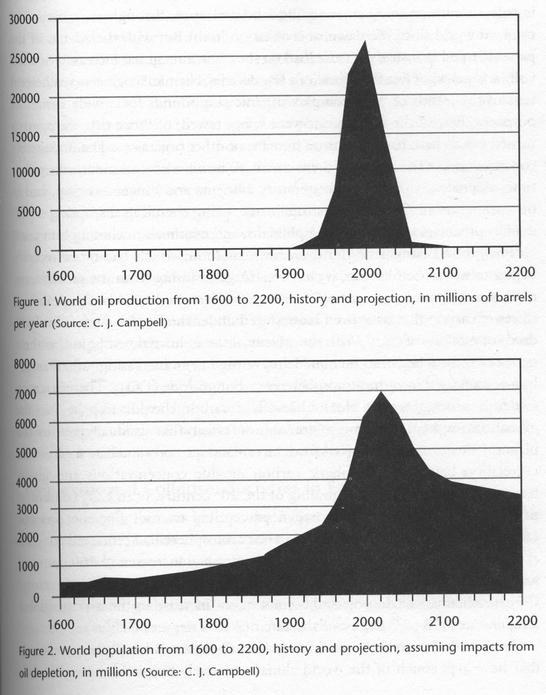 Richard Heinberg: [08-25]
7 steps to what a real renewable energy transition looks like:
"Historically, an overhaul for humanity's energy system would take
hundreds or many thousands of years. The rapid shift to cleaner,
more sustainable sources of power generations will easily be the
most ambitious enterprise our species has ever undertaken." Glad
to see this, as I've read several of Heinberg's books, although
none since 2009's Blackout: Coal, Climate and the Last Energy
Crisis, preceded by 2007's Peak Everything: Waking Up to
the Century of Declines. That was back in the
Oil Drum era
(see
Wikipedia"),
when
Hubbert's peak seemed to be kicking in, before secondary
extraction techniques like fracking became cost-effective
enough to allow oil and gas production to increase from
previously depleted or marginal fields. I read quite a bit on
this and related subjects back then. I was especially taken by
a chart from one of his books (float right; top: "world oil
production from 1600 to 2200, history and projection"; bottom:
"world population from 1600 to 2200, history and projection,
assuming impacts from depletion"), although I could think of
plenty of reasons why the post-peak decline would not be as
sharp or perilous (including enhanced secondary recovery.
Richard Heinberg: [08-25]
7 steps to what a real renewable energy transition looks like:
"Historically, an overhaul for humanity's energy system would take
hundreds or many thousands of years. The rapid shift to cleaner,
more sustainable sources of power generations will easily be the
most ambitious enterprise our species has ever undertaken." Glad
to see this, as I've read several of Heinberg's books, although
none since 2009's Blackout: Coal, Climate and the Last Energy
Crisis, preceded by 2007's Peak Everything: Waking Up to
the Century of Declines. That was back in the
Oil Drum era
(see
Wikipedia"),
when
Hubbert's peak seemed to be kicking in, before secondary
extraction techniques like fracking became cost-effective
enough to allow oil and gas production to increase from
previously depleted or marginal fields. I read quite a bit on
this and related subjects back then. I was especially taken by
a chart from one of his books (float right; top: "world oil
production from 1600 to 2200, history and projection"; bottom:
"world population from 1600 to 2200, history and projection,
assuming impacts from depletion"), although I could think of
plenty of reasons why the post-peak decline would not be as
sharp or perilous (including enhanced secondary recovery.
I don't have time now, but could probably write quite a bit
about this piece. For now, I'll note that I basically agree
with his first two section heads: "Why this is (so far) not a
real transition" and "The core of the transition is using less
energy." His concrete proposals are more troubling, especially
those that overreach politically (like rationing and "triage").
"Aim for population decline" seems both politically perilous
and unnecessary, given that current projections are that world
population will stabilize within 30-60 years. We have major
challenges accommodating the population we have (or will have),
but reducing the number of people doesn't make the task easier --
and given most ways population has been reduced in the past, may
make matters much worse. Benji Jones: [08-22]
This chart of ocean heat is terrifying: "The Gulf's looming
hurricane problem, explained in a simple graph."
Economic matters:
Dean Baker: Everything he
publishes is worth reading. Catching up with recent examples:
[08-13]
Is 'drill everywhere" good news for the oil industry? "If a
large increase in US production does send oil prices sharply lower,
the oil industry is not likely to be very happy." [08-14]
Why does a good inflation report require NPR to feature two people
who are struggling? [08-17]
Vice-President Harris proposes to increase the deficit by 0.5 percent
of GDP over the next decade: "In an effort to promote hysteria,
the media the media have jumped on the proposals laid out by [Harris],
telling their audience that they will increase the deficit by $1.7
trillion over the next decade." Or, as Baker explains:
However, the key point here is that almost no one knows how much
money $1.7 trillion is over the next decade. When the media present
this figure, they are essentially telling their audience nothing.
It would take all of ten seconds to write this number in a way
that would be meaningful to most people. GDP is projected to be
$352 trillion over the next decade, so this sum will be a bit less
than 0.5 percent of projected GDP. The country is projected to spend
$84.9 trillion over this period, so Harris' proposals would increase
total spending by roughly 2.0 percent.
If the point is to inform their audience, it is hard to understand
why the media would not take the few seconds needed to put large
budget numbers in context. On the other hand, if the point is to
promote fears of exploding deficits, they are going a good route.
By the way:
[08-19]
The WaPo's Republican columnists just make it up: "No one
expects serious economic analysis from the Washington Post's
conservative columnists and Mark Thiessen
doesn't let us down." [08-20]
Prices are still high, and other absurd things pushed by the media:
"Unfortunately, the media are dominated by unserious reporters who
ask unserious questions which gives us an absurd national debate
about bringing about the impossible." [08-21]
Mixed story: what the revision to the jobs data means. [08-26]
Yet another in the economy is bad under Biden series. [08-26]
E.J. Dionne, WaPo's liberal columnist, pushes right-wing propaganda:
Baker starts by noting:
It is totally understandable that the right wants people to believe
that "markets alone" were responsible for the massive upward
redistribution of income of the last half century. But it happens
to be total crap.
He then explains why it's "total crap," starting with monopoly
rents from rigged markets (citing, as he often does, his free book,
Rigged). He then concludes:
The market is just a tool, like the wheel. It makes as much sense
to rant against the free market as to complain about the wheel.
Unfortunately, the right has managed to get the bulk of the left
in this country screaming at the wheel. As long as that remains
the case, it will be difficult to make much progress in reducing
inequality.
Gordon Katic: [08-20]
The insidious elitist upshot of behavioral economics: "Behavioral
economics dangerously denigrates the rationality of ordinary people."
Paul Krugman: More political than economical, but always
an economist.
Andrea Mazzarino: [08-20]
Deep corporate America: "The corporate greed threatening out
stability."
Ukraine War and Russia:
America's empire and the world:
Afyare A Elmi/Yusuf Hassan: [08-26]
The coming war nobody is talking about: Ethiopia has been
land-locked since Eritrea broke away as an independent country,
and their prime minister, Abiy Ahmed, doesn't like it. Part of
the problem here is that Somalia is effectively divided, with
its northern (formerly British) wedge broken free of its nominal
central government in Mogadishu. Joshua Keating: [08-19]
Armed conflict is stressing the bones of the global economy:
"From shipping lanes to airspace to undersea cables, globalization
is under physical attack." Sarang Shidore: [08-21]
Dangerous China-Philippine clashes could be expanding: "Serious
incidents in the South China Sea are spreading well beyond the
Second Thomas Shoal, pulling the US in deeper." Aaron Sobczak: [08-21]
Fewer Americans willing to fight and die for other countries:
Probably fewer for their own, too, as various forces -- capitalism
is a pretty major one -- lead people to focus on individual interests,
downplay their group affiliations, and suspect states of being subject
to corrupt influences. As lives grow longer and richer, it's getting
harder to justify sacrificing one for war, especially as the
cost-benefit analysis of war only grows grimmer. Even if the
democratic left manages to stem the trend toward hyper-individualism
by restoring a sense of public interest, it won't make war more
attractive.
I've been thinking about this a bit while watching pre-modern war
culture dramas, like Shōgun and House of the Dragon.
The fealty warriors repeated express toward their "lords" is all but
unthinkable today, when everyone thinks they're self-interested. But
if the alternatives are primitive atomism (individuals, small packs,
or clans) and organized bandits. The latter, through cooperation, can
be so much more efficient that the rest have no alternative but to
organize their own collective defenses. There's more to this, of
course, like the argument that the Axial Age religions were efforts
to moderate the period's massive increase in warfare. Military-Industrial Complex:
Other stories:
Current Affairs:
[07-14]
Jeffrey Sachs on why US foreign policy is dangerously misguided:
"How US presidents from Clinton to Trump to Biden squandered chances
to establish a lasting peace in the post-Cold War era." [08-14]
Why you will never retire: "Economist Teresa Ghilarducci on why
some 90-year-old Americans are pushing shopping carts in the heat
trying to make ends meet." She has a book,
Work, Retire, Repeat: The Uncertainty of Retirement in the New
Economy. "She shows how the pension system disappeared,
why Social Security isn't enough, and explains how even the
concept of retirement is beginning to disappear, with
many arguing that work is good for you, people should do it for
longer." As always, much depends on what kind of work you do.
I've been effectively retired for 20+ years now, but what that
means is that I've been able to afford to do things I want to
do, free of having to spend a big chunk of my life toiling for
nothing better than making someone else money. I've been very
fortunate in that regard. A more generous retirement system
would help more people do socially worthwhile work like I do,
even if it doesn't contribute to the great GDP fetish. It would
also help people avoid doing useless and/or senseless work, of
which there is way too much required these days, just because
someone has figured out how to turn a profit from it. [08-22]
The extreme danger of dehumanizing rhetoric: "David Livingstone
Smith, one of the world's leading scholars of dehumanization, explains
what it is, why we're so prone of it, and how to resist it." Author
of books like:
Nathan J Robinson:
[08-05]
How empires think: "The imperial mentality sanctions some of the
worst imaginable crimes in the name of progress, enlightenment, and
civilization." [08-07]
An encouraging sign: "Choosing Tim Walz as a vice presidential
nominee shows Kamala Harris has good political instincts. But what
matters is policy, and we should demand real commitments." [08-12]
Politics should not be parasocial: "These are not our dads or
aunts. We are electing a head of state who will wield immense power
and control a massive nuclear arsenal. 'Policy' is not peripheral
or dispensable, it's the only thing that really matters." Critique
of an Atlantic article on Kamala Harris -- Tom Nichols: [08-19]
Policy isn't going to win this election: "The Harris campaign
seems to have grasped an important reality" -- which may in turn
have led to the Giridharadas kerfuffle below (I'm reaching them
in opposite order, and the point doesn't seem worth fact checking).
I lean toward Robinson here, but that's largely because I think
writers who focus on political policy should take care to get the
policy right, regardless of the politics. (If you get the policy
right, you can conceivably steer the politics toward it; but if
you take the politics as a given, you're very unlikely to get to
the right policy.)
Nichols says that it's a myth that Americans care about policy. But
perhaps the opposite is true. I think the very reason that so many
Americans are disillusioned with politics is that they don't see
how it affects them. If you went around this country and you asked
everyone you saw how much attention to politics they pay, and why
they don't pay more attention, I guarantee you you'll get many
variations on an answer roughly like: None of these politicians
ever actually do anything for us, they just care about themselves,
they don't care about us, look at my community, what have the
politicians ever done for us?
I've only read the first two paragraphs of the Nichols piece
(paywalls, you know). He may well have a point -- it's a truism
among political consultants that voters rarely go deep into policy
details, and often respond to non-policy signals, voting with an
emotional hunch over reasoned analysis. Still, no matter how much
politicians and journalists try to dodge them, policy positions
do matter, and in a broad sense are likely to be decisive. [08-15]
Panic about immigrants is based on feeling and emotion: "Christopher
Rufo visited Britain and saw non-white people, leading him to conclude
that civilization is being hollowed out." [08-25]
On the role of emotion in politics: "A response to MSNBC's Anand
Giridharadas, who thinks I am not fun. . . . His reply was quite
personal, and he even placed a picture of me next to a picture of
Lil Jon to illustrate how much less fun I seem." Seems like an
unnecessary response to a charge that has no reason for being,
but as a writer who can only imagine how his readers misinterpret
him, I concede a bit of interest in such things. Alex Skopic:
K Wilson: [04-01]
Why the right constantly panics over societal 'decadence': "No,
'Western society' has not fallen from some mythic elevated past. But
such right-wing views are appealing, and the left needs an answer
to them if we want to avoid being pushed back into traditional
hierarchies." Arwa Mahdawi: [08-22]
Stop using the term 'centrist'. If doesn't mean what you think it
does: "If you simplify your English, you are freed from the
worst follies of orthodoxy, wrote Orwell. That applies today more
than ever." My eyes glaze over when I see Orwell, so I can't tell
you what that's about. And while there's plenty to say about the
dysfunctionality of "centrism" -- it mostly seems to mean that
you would like to see some nicer things happening, but aren't
willing to do anything to make it happen that might offend the
rich -- the actual examples given here are mostly from Israel.
A couple are grimly (or sickeningly) amusing:
This narrative is so entrenched that people don't believe
their eyes when it comes to Palestinians. Last October, the actor
Jamie Lee Curtis posted a photo on Instagram showing terrified-looking
children peering up at the sky. She captioned the post "terror from
the skies" with an Israel flag emoji. When it was pointed out that
the kids were Palestinian, she deleted the post. Her eyes may have
told her that those innocent children were terrified; the narrative,
however, was more complicated.
Around the same time, Justin Bieber posted a photo of bombed houses
with the caption "praying for Israel." When it was pointed out the
picture was of Gaza, he deleted it and apparently stopped praying.
Timothy Noah: [2022-02-10]
Washington is not a swamp: "Ignore the lazy conventional wisdom.
The nation's capital is the most public-spirited city in the country.
By far." Not sure why this piece popped up suddenly, but it remains
relevant, especially with the pending Trump/Project 2025 plan to purge
the civil service and replace them with political hacks. This reminds
me that one of the best political books to appear during the Trump
years was
Michael Lewis: The Fifth Risk: Undoing Democracy, about
"a government under attack by its leaders through willful ignorance
and greed." Still, whenever I heard the phrase "drain the swamp,"
I automatically assumed that the subject was lobbying corruption,
which is rife in Washington, even though Trump using it as such
was certainly hypocritical -- I always assumed that, like Tom
DeLay's K Street Project, his real aim was to take the racket
over, to skim his vig. That he meant it as code for the civil
service was unthinkable, yet that's clearly what he means. Maya Wei-Haas: [08-26]
Dismantling the ship that drilled for the ocean's deepest secrets:
"The JOIDES Resolution, which for decades was key to advancing the
understanding of the Earth and its innards, concluded what could be
its final scientific expedition."
Obituaries
Common Dreams: [08-21]
The best Bill Pascrell takedowns of 'lowlife' Trump and his 'soulless
goons': "The feisty Democratic congressman from New Jersey died
August 21."
Trip Gabriel: [08-14]
Betty A Prashker, 99, who pushed boundaries in book publishing,
dies: "A top editor and executive at two publishing houses, she
was an advocate for women in publishing, and for equal pay in an
industry that had long been male-dominated." Two of the books noted
here are
Kate Millett: Sexual Politgics: A Surprising Examination of
Society's Most Arbitrary Folly (1970), and
Susan Faludi: Backlash: The Undeclared War Against American
Women (1991). Anita Gates: [08-14]
Gena Rowlands, actress who brought raw drama to her roles, dies
at 94. Penelope Green: [08-25]
Hettie Jones, poet and author who nurtured the beats, dies at 90:
"She and her husband, LeRoi Jones, published works by their literary
friends. After he left her and became Amiri Baraka, she found her
own voice." Clay Risen: [08-25]
Russell Malone, acclaimed jazz guitarist, dies at 60. Obit
credits him with leading ten albums -- Triple Play (2010)
is one I liked -- but he also has a lot of
side-credits, some quite impressive. Jon Schwarz: [08-25]
Phil Donahue, The New York Times, and the Iraq War: "More than 20
years later, the Times continues to diss anyone who got it right on
the war after they got it so wrong." The quote from
NYT's obituary doesn't strike me as all that inflammatory, but
it obviously hit a still-sensitive nerve, and Donahue should be
remembered for political insight and bravery in an industry that
sadly deficient. Remy Tumin: [08-26]
Alabama high school football player dies after sustaining head
injury: Caden Tellier. Alex Williams/Alexandra E Petri: [08-15]
Greg Kihn, 75, dies; scored hits with 'Jeopardy' and 'The Breakup
Song'.
Books
Nick Cleveland-Stout: [08-19]
'Poison' Ivy Lee, America's first foreign lobbying tycoon:
"A new book reckons with the legacy of the man who helped burnish
the reputations of Soviets, Nazis and other US adversaries."
The book is
Casey Michel: Foreign Agents: How American Lobbyists and
Lawmakers Threaten Democracy Around the World. Aaron Gell: [08-19]
The unsavory confessions of a PR guru: "A flack's new memoir
touts his work for dictators and tycoons. But that's only part of
today's misinformation industry." Review of
Phil Elwood: All the Worst Humans: How I Made News for Dictators,
Tycoons, and Politicians, and
Renée DiResta: Invisible Rulers: The People Who Turn Lies Into
Reality. Benjamin Kunkel: [08-26]
Your life and mine: "The intractable puzzle of growth." Review of
Daniel Susskind: Growth: A History and a Reckoning, and
Kohei Saitō: Slow Down: The Degrowth Manifesto, although
other books are mentioned, including: Kenneth Pomeranz: The Great
Divergence: China, Europe, and the Making of the Modern World Economy;
Matthias Schmelzer: The Hegemony of Growth; Robert Collins:
More: The Poliltics of Economic Growth in Postwar America;
Herman Daly: Steady-State Economics; Kate Raworth: Doughnut
Economics; as well as references to Braudel, Polanyi, Kuznets,
Gorz, and Adorno. A quote from the latter is especially striking:
Perhaps the true society will grow tired of development and, out
of freedom, leave possibilities unused, instead of storming under
a confused compulsion toward the conquest of strange stars. A
mankind which no longer knows want will begin to have an inkling
of the delusory, futile nature of all the arrangements hitherto
made in order to escape want, which used wealth to reproduce want
on a larger scale.
Samuel Moyn: [08-27]
Zig and zag: "The surprising origins and politics of equality."
A review of three books:
Paul Sagar: Basic Equality;
Darrin McMahon: Equality: The History of an Elusive Idea; and
David Lay Williams: The Greatest of All Plagues.
Music (and other arts?)
Chatter
Local tags (these can be linked to directly):
music.
Original count: 224 links, 12870 words (16802 total)
Current count:
290 links, 15528 words (20514 total)
Ask a question, or send a comment.
Tuesday, August 20, 2024
Music Week
August archive
(in progress).
Music: Current count 42869 [42830] rated (+39), 34 [34] unrated (-0).
Delayed a day, because that's how long the week's
Speaking of Which took (219 links, 12161 words, before
whatever I add today). Probably just as well, given that (as
I noted yesterday) my week was light, which I can only partly
blame on time out to
cook a nice dinner on Saturday. I made no attempt to count
calories, which ingredients suggest were astronomical, but can
now report that my weight is down 0.2 lbs today, compared to a
day or two before, so maybe I can afford to indulge on the rare
occasions when I can line up some willing guests.
I've been bemoaning my inability (and sometimes incompetence)
at getting routine maintenance tasks done around the house. One
of those came crashing down after dinner on Saturday: a big chunk
of plaster-on-lath ceiling in one of the upstairs bedrooms. I've
been aware of a crack growing there at least since 2005, viewing
it with increasing alarm over the past few months. I even started
to plot out
possible ways to fix it.
After the first pieces broke away, I got up and tore out some
extra, so now I have about a 4 sq. ft. patch of exposed lath.
In some ways it's less troubling (certainly less ominous) now,
especially as I can gauge the thickness of the plaster (about
3/8-inch, the state of the lath (ugly but dry), and how solid
what's remaining is (looks like I'll wind up doubling the size
of the patch, but nothing else is likely to fall down on its
own). In the past, I would have figured out how to fix this,
but we've started looking for help. Same for some other small
projects.
Barely topped 30 albums below, but the A-list -- after only
one album each of the last two weeks -- came roaring back. I'm
also pretty caught up with the demo queue, although I still
have a lot of albums in hand for September into mid-October.
I spent some time re-checking older albums, so came up with
a couple re-grades.
I guess I can finally mention now that Fifth Column Filmworks
has a
web page with a 4:52 trailer for a feature documentary about
saxophonist Sam Rivers, based on the extraordinary
764-page book,
The Sam Rivers Sessionography by
Rick Lopez.
I considered using "we" in the opening line, because this film
was originally my idea, but about all I did was to introduce Rick,
an internet friend for over 20+ years, and Mike Hull, my nephew
and the filmmaker who previously directed and produced
Betrayal at Attica, dump some starter money into the
project, and let them work it out.
New records reviewed this week:
Okaidja Afroso: Àbòr Édín (2024, Chechekule):
Singer-songwriter and traditional dancer from Ghana, has a couple
previous albums.
B+(*) [sp]
John Alvey: Loft Glow (2022-23 [2024], Jazz
Music City): Nashville-based drummer, first album, wrote first
song, local-based band members added two more, plus some jazz
covers (Benny Golson, Ron Carter, John Stubblefield), nice
postbop group with a little swing.
B+(**) [cd] [08-25]
Charlie Apicella & Iron City Meet the Griots Speak:
Call to Action/Call to Prayer (2022 [2024], OA2):
Guitarist, his Iron City group has mostly played funk-fusion
since 2008, but his griots are from another musical planet,
mostly veterans of the old NYC loft scene, like Daniel Carter,
William Parker, and Juma Sultan.
B+(**) [cd]
Art Baden: How Much of It Is Real (2023 [2024],
Rainy Days): Tenor saxophonist, born in Russia, first album, also
plays bass clarinet and flute, leads a quartet with Joe Locke
(vibes/keyboards), Jay Anderson (bass), and Jeff "Tain" Watts
(drums, recorded in his studio).
B+(**) [cd]
George Dearborne: Lotta Honky Tonkin' Left in Me
(2024, Wingate): Country singer, from Beaumont, Texas, started out
as a drummer in the 1970s, started leading bands in the 1990s,
released his first album in 2020. No original songs, but most
are new to me (exceptions: Doug Sahm, Merle Haggard).
B+(**) [sp]
Jeff Evans Porkestra: Willow Pillow (2024,
self-released, EP): Evans is "a seasoned figure in Atlanta's
roots and alt-country scene," seems to have had a previous
group called Chickens and Pigs, calls this "a musical rewrite"
of their 2021 album Guitars Food Music Beer Dog, which
I can find no corroborating evidence for (although Spotify
has three other Chickens and Pigs albums, none in Discogs).
Six songs, 22:31.
B+(***) [sp]
Claudia Gibson: The Fields of Chazy (2024,
self-released): Austin-based folk singer-songwriter, second
album, has some appealing songs.
B+(**) [sp]
Russell Haight: Go Forth (2023 [2024], OA2):
Saxophonist (tenor pictured), studied at Texas, was based in
Austin until moving to Saratoga Springs and Skidmore college.
Has a previous album, also a book on Odd-Meter Etudes for
Saxophone. Quartet with Sean Giddings (piano), bass, and
drums. Original pieces. Strong on upbeat pieces.
B+(***) [cd]
Joel Harrison & Alternative Guitar Summit: The Middle
of Everywhere: Guitar Solos Vol. I (2024, AGS): Harrison,
a notable guitarist in his own right, is credited as producer here,
with eleven other guitarists doing the heavy lifting. No recording
dates given, but AGS has at least existed for 14 years, so they're
probably working off some backlog. Only two names don't ring a bell
for me, but check yourself: Fareed Haque, Nguyen Lê, Nels Cline,
Liberty Ellman, Anupam Shobhakar, Camila Meza, Kurt Rosenwinkel,
Anthony Pirog, Cecil Alexander, Miles Okazaki, Henry Kaiser. Not
ambient exactly, but insider plays I suspect are more to impress
each other than to excite fans.
B+(*) [cd]
Hyeseon Hong Jazz Orchestra: Things Will Pass
(2023 [2024], Pacific Coast Jazz): Korean composer and band leader,
based in New York and/or Seoul, has a previous album from 2017,
leads a conventional big band with saxophonist Rich Perry getting
a "featured" credit.
B+(**) [cd]
Ice Spice: Y2K! (2024, 10K/Capitol/Dolo):
Rapper Isis Gaston, first studio album (10 songs, 23:17) after
a well-received EP in 2023 (13:08, then 16:01, then finally in
a 24:15 "deluxe edition," which is the one I liked).
B+(***) [sp]
Eric Jacobson: Heading Home (2023 [2024], Origin):
Trumpet player, based in Chicago, couple previous albums, this
a postbop quintet with Geoff Bradfield (tenor sax), Bruce Barth
(piano), bass, and drums.
B+(*) [cd]
Boldy James/Conductor Williams: Across the Tracks
(2024, self-released): Rapper James Clay Jones III, several albums
per year since 2020, various producer/collaborators, this one is
Denzel Williams, from Kansas City, coming off joints with Stik Figa
and Conway the Machine.
B+(**) [sp]
Kirk Knuffke: Super Blonde (2023 [2024],
SteepleChase): Cornet player, albums since 2007 range from
free to mainstream, often superb either way. This one is
mostly standards, sharply etched, with a mainstream rhythm
section of two bassists (Jay Anderson and Thommy Andersson)
and drums (Adam Nussbaum).
A- [sp]
David Liebman & the CNY Jazz Orchestra: If a White Horse
From Jerusalem . . . (2022 [2024], CNY Jazz Arts Foundation):
This should probably be filed under Bret Zvacek, who is music director
of the Syracuse-based Central New York Jazz Orchestra -- spine credit
is just CNY Jazz Orchestra -- a conventional big band -- but the
featured soprano saxophonist gets top billing on the cover. Zvacek
composed the title suite (4 parts, 25:27), with others arranging the
rest of the program, including covers of "Somewhere" and "Where or
When."
B+(**) [cd]
Lux Quartet: Tomorrowland (2023 [2024], Enja/Yellowbird):
Co-led by Myra Melford (piano) and Allison Miller (drums), with Dayna
Stephens (tenor sax) and Scott Colley (bass). Relentlessly inventive
postbop, the pianist can delight and dazzle, the sax more tentative
but substantial,the rhythm always en garde.
A- [cd]
Matt Mitchell: Zealous Angles (2024, Pi):
Pianist, one of the best to have emerged in the last decade,
presents a trio of Chris Tordini (bass) and Dan Weiss (drums),
playing a batch of original pieces.
B+(***) [cd]
ØKSE: ØKSE (2023 [2024], Backwoodz Studioz):
Free jazz quartet with an electronic twist -- "sound chemist"
Val Jeanty plays electronics, while bassist Petter Eldh also
wields sampler and synths, along with saxophonist Mette Rasmussen
and drummer Savannah Harris -- but four (of eight) pieces also
feature guest rappers: Elucid, Billy Woods, Maassal, and Cavalier.
Remarkable on all counts.
A- [sp]
Jonathan Powell: Mambo Jazz Party (2022 [2024],
Circle 9): Trumpet player, from Florida, based in New York, has
played in Latin jazz bands, leading this one, a powerhouse
outfit.
B+(***) [cd]
Alvin Queen Trio: Feeling Good (2023 [2024], Stunt):
Drummer, born in New York, credits start in 1970, picking up after
he moved to Switzerland in 1979. Trio with Carlton Holmes (piano)
and Danton Boller (bass), playing standards, and doubling down on
Cedar Walton.
B+(*) [sp]
Ayra Starr: The Year I Turned 21 (2024, Mavin
Global Holdings): Pop singer-songwriter, born in Benin, grew
up in Lagos, titles so far note her age -- debut was 19 &
Dangerous.
B+(**) [sp]
Linda Thompson: Proxy Music (2024, Storysound):
Much beloved as the better half of a 1970s duo with then-husband
Richard Thompson, spotty solo career since then with several
decade-plus breaks, no longer sings but co-wrote a batch of
songs, performed by various family and friends, with son Teddy
Thompson most involved.
B+(*) [sp]
Tinashe: Quantum Baby 2024, Nice Life): R&B
singer-songwriter, born in Kentucky but grew up in California,
last name Kachingwe, seventh album since 2014, single "Nasty"
her biggest since 2014's "2 On."
B+(**) [sp]
Piet Verbist: Flamenco Jazz Summit: El Mar Empieza Aquí
(2023 [2024], Origin): Belgian bassist, has several albums, none
particularly like this foray into Spanish flamenco, represented
with bansuriney (Carmelo Muriel), guitar (Carlos Cortés), and drums
(Juan Sainz), mixed with piano (Milan Verbist) and alto/soprano sax
(Tom Van Dyck).
B+(***) [cd]
Recent reissues, compilations, and vault discoveries:
África Negra: Antologia Vol. 2 (1979-90 [2024],
Bongo Joe): Band, established in the early 1970s by Horacio and
Emidio Pontes, in the formerly Portuguese colony of São Tomé
and Principé, islands in the Atlantic of the west coast of
Africa, fitting midway between Nigerian highlife and Congolese
soukous.
A- [sp]
Phil Haynes' 4 Horns and What?: The Complete American
Recordings (1989-95 [2024], Corner Store Jazz, 3CD):
Drummer, mostly associated with the late trumpet player Paul
Smoker (on all three sets here), also with Ellery Eskelin
(tenor sax, on the first two sets) and Herb Robertson (on
the last two, credited here with "multi-brass"). Other horns
here include Andy Laster (alto/bari sax/clarinet/flute on
all three sets), Joe Daley ("low brass" on the first), and
John Tchicai (tenor sax on the third). It's a formula that
generates a lot of excitement.
A- [sp]
Old music:
Okaidja Afroso: Jaku Mumor (2022, Chechekule):
From Ghana, earlier album has a nicer flow.
B+(**) [sp]
Ellery Eskelin/Drew Gress/Phil Haynes/Paul Smoker: Joint
Venture (1987, Enja): Free jazz group, artist names --
tenor sax, bass, drums, trumpet -- on cover but appears conceived
as an eponymous group album, first of three albums through 1993,
although their intertangled histories continued much longer.
Starts with two covers, a slow "Day Dream" and a "Just in Time"
which picks up momentum before getting into the originals.
B+(***) [bc]
Rosie Tucker: Lowlight (2015, self-released, EP):
Singer-songwriter from Los Angeles, first album if you count it --
nine songs, 23:26, as best I can figure was 17 at the time, very
much on her own. Her latest album sent Christgau back to her 2019
"debut," which I will get to in due course, but this one is very
impressive in its own right, with several songs I'm tempted to
quote not just lines but verses from, including two where she
advises guys to look for love elsewhere, with one turning to
suicide instead.
A- [sp]
Rosie Tucker: Never Not Never Not Never Not
(2019, New Professor): With 11 songs, we'll call this a proper
album, but still only runs 26:40, with only one song topping
3:04. She also has band backup here, but maybe the new songs
needed that -- they're not as immediately striking, nor are
they obviously not.
B+(***) [sp]
Rosie Tucker: Sucker Supreme (2021, Epitaph):
Fourteen songs, 35:43, semi-major label dropper her after one
album, music continues to develop, lyrics get harder to follow,
or maybe just more complex and elusive. This seems to be the
consensus pick among her albums, but I don't quite get it.
B+(***) [sp]
Grade (or other) changes:
Chappell Roan: The Rise and Fall of a Midwest Princess
(2023, Amusement/Island): I played this last year, wrote virtually
nothing on it, so must not have been paying much attention, losing
the single "Red Wine Supernova" after the later ballad fare, which
on closer inspection turns out to be pretty good, too.
[was: B+(**)] A- [sp]
Rosie Tucker: Utopia Now! (2024, Sentimental):
I played this when it came out, and liked it but didn't get much.
Christgau picked it, went into her back catalog, and was even more
smitten by Sucker Supreme. Various others have seconded his
approval. So I figured odds were good that I had been hasty, and
her previously unreported Lowlight raised my expectations
even higher. Working forward confirmed her smarts and added chops
and (less often) hooks, but as her increasing chops brings extra
clutter, I'm getting
less and less satisfaction out of her records. When I played this
last night, I wound up inclined to save myself the paperwork by
leaving my original grade. Playing it again today, I'm finally
hearing lots of interesting stuff, but I'm still not enjoying it
enough -- perhaps her voice, the time shifts, other little things
I don't have any idea how to characterize. But her rep is certainly
earned.
[was: B+(**)] B+(***)
Unpacking: Found in the mail last week:
- Neil Adler: Emi's Song (self-released) [05-29]
- David Bailis: Tree of Life (Create or Destroy) [10-11]
- Marc Ciprut: Moonshine (White Label) [07-11]
- Buck Curran: One Evening and Other Folks Songs (ESP-Disk): [0628]
- Michael Dease: Found in Space: The Music of Gregg Hill (Origin) [09-20]
- Dharma Down: Owl Dreams (Dharma Down) [10-11]
- Javon Jackson/Nikki Giovanni: Javon & Nikki Go to the Movies (Solid Jackson/Palmetto) [08-23]
- Allen Lowe & the Constant Sorrow Orchestra: Louis Armstrong's America Volume 1 (ESP-Disk, 2CD) [09-03]
- Allen Lowe & the Constant Sorrow Orchestra: Louis Armstrong's America Volume 2 (ESP-Disk, 2CD) [09-03]
- Matt Panayides Trio: With Eyes Closed (Pacific Coast Jazz) [09-20]
- Jeff Rupert: It Gets Better (Rupe Media) [09-06]
Ask a question, or send a comment.
Monday, August 19, 2024
Speaking of Which
I started this in a timely manner, but had various distractions
during the week, and skipped Saturday altogether as I decided to
cook dinner for some guests. So I only made it about half way
through my usual rounds on Sunday before I ran out. Picked it up
Monday morning, and should get something out in the evening,
hopefully not real late. That will push Music Week back another
day, which will probably bring my slow week back over the 30
mark.
As I'm wrapping up, the Democratic National Convention has started.
Nothing on it below. That's definitely one for next week. There is
also a report of a ceasefire deal, which would be nice timing for
the Convention, but may not yet be real:
Netanyahu agrees to mediators' cease-fire proposal, Blinken says.
More on that (if there is anything more) next week. I didn't quite
get to everything I usually hit, but I figure I have quite enough
for now. I may add some things on Tuesday while I work on Music
Week. I've already held back two Jonathan Chait pieces, which may
turn out to be especially irritating.
I added a fair amount of material on Tuesday, while working on
the much more manageable
Music Week. Hard to say when one of these things is done,
except by opening its successor, which will happen shortly after
posting Music Week.
This is just an aside, but as long as I've been doing this, my
first stop for news has been
Vox. However, a few months ago, they redesigned their website
to make it much harder to find new articles -- the chronological
roll has been replaced by clusters of pieces that are dominated
by what I suppose they consider "human interest" stories. Today's
(rarely with author names, never with dates/times):
Of those stories, I only clicked on the last, and that only because
I had no idea who Blake Lively was. (Actor, It Ends With Us,
"the second biggest movie in America," something else I had no
inkling of. At the end of which was a pitch for money, informing
me that I had read 80 articles in the last month.) Further down
the page, more articles I skipped:
I can't say that I have zero interest in these pieces, but
they don't look very promising for my purposes. (To be fair, I
often click on their culture and tech pieces, without writing
anything about them.) The bottom of the home page still has
a listing of "more news," which is chronological and labeled
and I'm still finding quite a lot down there. So I may not be
complaining about their irrelevance so much as I'm disturbed
by their apparent belief that the other stuff is what really
matters. In addition to the pieces I've actually cited below,
the roll includes a bunch of articles that are interesting
but don't immediately fit in what I'm doing below (this is a
judgment call being made late Sunday, as I'm rushing to wrap
up, so don't want to open up any more cans of worms than I
have to). So I thought I might just mention them here:
Back in what we might call my "middle years" (roughly 30-50, or
1980-2000) I focused much less on politics, and more on general
social, cultural, scientific, and business issues like these.
They remain interesting subjects, but seem to be getting pushed
aside in favor of more conventionally political matters.
Top story threads:
Israel:
Mondoweiss:
Ghada Ageel: [08-15]
Gaza's other death toll: "Israel has caused countless preventable
deaths which are yet to be reflected in the official Gaza death
toll." Yousef Aljamal:
The daily battles to survive the Gaza genocide: "Tents out of
aid parachutes, waiting days for a tin of beans, re-digging graves
to bury martyrs: here's what Palestinians have to overcome." Haaretz:
Don't buy the lie that Israeli settler violence is the exception.
It's the rule. Reem A Hamadaqa: [08-14]
What it's like living in a tent in Gaza:
"Gaza's landscape is dominated by tents that have become homes to
the hundreds of thousands of displaced Palestinians. But building
a tent and living in one with your entire family isn't easy." Tareq S Hajjaj:
[08-11]
The Fajr massacre: Every 70 kg bag of human remains is considered
a martyr: "The bodies of Palestinians killed in the latest Israeli
massacre in Gaza were destroyed so far beyond recognition that doctors
have only been able to give grieving families an anonymous bag of
human remains to bury." I don't like the word "martyr," but one does
need some term to honor those who died, not as willing sacrifices to
a great cause, but as victims of victims of atrocities committed by
people who have no honor and decency. [08-15]
Fighting the Israeli army in Gaza: Inside the battle for Shuja'iyya:
"In a testimony obtained by Mondoweiss, a resident of Shuja'iyya
recounts his motivations for wanting to join Hamas's al-Qassam
Brigades to fight against the Israeli army." Samah Jabr: [08-15]
Sadism as a tool of war in Gaza. Rifat Kassis: [08-18]
Why the Israeli 'peace camp' disappeared: "It is primarily in
the hands of Israelis to reject their settler colonial occupation,
their apartheid laws, and their current government and nationalist
parties. The alternative means the loss of their humanity." Joseph Massad: [08-12]
Why raping Palestinians is legitimate Israeli military practice:
"Sadism has long characterized Zionist colonists' treatment of
Palestinians, rooted in orientalist views that Arab only 'understand
force' -- including sexual violence." This led me to a couple older
pieces:
Qassam Muaddi:
Jonathan Ofir: [08-12]
Israeli media's coverage of the rape of Palestinian detainees
shows support for sexual violence in service of genocide:
"Israeli media coverage of the rape of Palestinian detainees
demonstrates the widespread acceptance within Israeli society
of sexual violence as a weapon of genocide." Noa Pinto:
The taps have run dry in Jerusalem's largest Palestinian neighborhood:
"Long neglected by the Jerusalem Municipality, Kufr 'Aqab residents
now receive only a few hours of water a week."
Richard Silverstein: [08-14]
As Israel wages genocide, its economy is buckling. US aid
is vital to Israel not just to keep resupplying them with bombs
but to keep the economy operating given how expensive their war
is. (The same thing can also be said for Ukraine. In both cases,
the US should have enough leverage to shut down the wars, if only
the powers in Washington decide to do so.)
Four hundred thousand Israel Defense Forces (IDF) soldiers have
served extended tours of duty in Gaza, the West Bank, and northern
Israel. They have left families and jobs and, in many cases, lost
their businesses. In addition, almost 250,000 Israelis have become
refugees due to fighting with Hezbollah. This has had a massive
impact on the Israeli economy. Economic growth and GDP have plummeted.
Forty-six thousand businesses have failed since October 7. That
number will increase to sixty thousand by the end of 2024. This has
a ripple effect throughout the economy. Bankruptcies hit the bottom
line of the lenders who extended credit to the failed businesses.
Vendors and suppliers also take a hit, while the lives of many small
business owners have been reduced to shambles. They have sunk into
debt and often are forced to rely on handouts from friends, family,
and charities:
Many of those [IDF] fighters are close to a breaking point. Exhausted
and in some cases demoralized, they are struggling to balance family
and work with military service, while the economic toll from their
absences mounts.
The Israeli Population Authority reported that in the past year,
575,000 more Israelis left the country than returned to it. The
immigration rate has halved since October 7.
Activity in the construction sector, reliant on over two hundred
thousand Palestinian workers who are now barred from entering Israel,
has declined by 25 percent. This has led to the collapse of building
contractors and developers.
The Palestinian economy has been decimated and driven residents
into penury. The desperation they face will lead inevitably to bitter
resentment and future violence. Tourism, once a powerhouse of the
economy, has dried up. The agriculture sector (20 percent decline)
is based mainly in the north and the south, regions hard-hit by
hostilities. Trade has plummeted drastically at Israel's southern
port, Eilat, due to Houthi interruption of maritime traffic in the
Red Sea. . . .
The Bank of Israel announced that the 2024 growth rate would
be -2 percent, unprecedented in an Israeli economy used to sustained
growth. Fitch has just downgraded the country's credit rating,
describing the economic outlook as "negative." The Bank of Israel
has raised the interest rate to 4.5 percent. . . .
Israel's buckling economy will increase social unrest. Massive
increases in funding for the ultra-Orthodox and settlements will
sow sectarian division between secular (40 percent of the population)
and religious Israelis. Wars in Gaza and Lebanon will destabilize the
region and increase the likelihood of future wars, which will require
massive increases in military spending. The current economic strain
will increase hostility, already at a fever pitch, toward Netanyahu
and his government and lead to their likely downfall in 2026 elections.
Aaron Sobczak: [08-14]
Israelis using Gaza civilians as human shields: "IDF soldiers give
gruesome first hand accounts to Haaretz newspaper." Jonah Valdez:
Video of sexual abuse at Israeli prison is just latest evidence Sde
Teiman is a torture site. Kelley Beaucar Vlahos: [08-12]
Nearly 2% of Gazans killed in last 10 months:
"Harris laments bombing of shelters yet her administration just
released $3.5B in more weapons to Israel."
America's Israel (and Israel's America):
Jehad Abusalim: [08-17]
How US policy in the Middle East is unravelling: "As we stand on
the precipice of what could be a decisive turning point in the region's
history, it is essential to ask how we got here." Peter Beinart: [08-18]
Harris can change Biden's policy on Israel just by upholding the
law. Beinart also posted:
Dave DeCamp: [08-13]
State Department approves over $20 billion arms package for Israel:
"It's unclear how much of the massive weapons sale will be funded by
US military aid." Belén Fernández: [08-14]
'Less flexible?' Just say it, NYT, Israel is sabotaging a ceasefire
deal: "Israel has been sabotaging efforts for peace since long
before the beginning of this latest round of slaughter in Gaza." Ishaan Tharoor:
Robert Wright: [08-16]
America's out-of-control client states: Picture Zelensky and
Netanyahu, which hardly exhausts the subject: lacking a coherent
sense of its own interests, and unable to see the world as anything
else, US foreign policy is easily steered by its supposed clients,
whose interests are distinctly their own. One could illustrate this
same dynamic using east Asia (Japan, South Korea, Taiwan, Philippines,
probably Indonesia and Australia). South Asia, lacking traditional
alliances, is even more muddled. In Europe, NATO was supposed to
function as a benign, painless occupation, but now Europeans are
jockeying for position, and often calling the shots. And Africa?
If you have any clue what's going on there, you clearly don't work
in AFRICOM. Latin America is another mess, where the US has lost
all of its allies, and now only clings to memory of its enemies.
But Ukraine's incursion into Russia, and Israel taking pot shots
as far afield as Iran and Yemen, are increasingly outlandish, and
dangerous. Alexander Ward/Nancy A Youssef: [08-15]
The missteps in Washington and Tehran that brought Middle East to
the brink. Writers Against the War on Gaza: [08-16]
'Words like slaughter': a comparative study of The New York Times
reporting in Ukraine and Gaza. "An in-depth comparison of The
New York Times coverage of the Russian invasion of Ukraine vs.
Israel's genocidal war on Gaza shows how the Times dutifully
launders the news to fit the U.S. government's agenda."
Israel vs. world opinion:
Abdullah Al-Arian: [08-14]
Why Arab regimes' betrayal of Palestine may come back to haunt them.
Maybe, but the phrase "learned helplessness" -- which I've seen in
various contexts of late -- comes to mind. They tried declaring their
solidarity with Palestinians, and even went to war against Israel --
most notably in 1948, 1956, 1967, and 1973, plus numerous skirmishes,
with Iraq's Scud missile attacks in 1990 a "last hurrah" -- to no
avail. They tried negotiating peace, which Israel only allowed on
terms injurious to Palestinians. The Palestinians themselves passed
through both phases, multiple times, getting screwed both ways. The
"Abraham Accords" promised normalcy through commerce but just made
Israel more arrogant, leaving Hamas so desperate they resorted to
what was effectively a suicide bombing. No doubt most people in the
Arab (and other Muslim) countries feel more solidarity than their
leaders, which could make it a potent issue when and if the outs --
which is nearly everybody -- rise up against the ins, for whom this
is but one of many discrediting issues.
Israel doesn't care. What's the worst case scenario for them?
Say, Saudi Arabia is overthrown by a novel Islamo-Fascist party --
the term has never been more than an idle slander before, but if
you start from the Nazi notion of a Third Reich (this one would
seek to revive the Abassid and Ottoman Empires, which can provide
plenty of Islamic trappings to pave the way to war) -- which then
moves on to form alliances with Egypt, Iran, and/or Turkey (each
susceptible in their own ways to such thinking), Israel could
simply respond by obliterating them all with nuclear weapons --
and could depend on the US as backup. Some Israelis may even
relish the challenge, as cover for finishing off the Palestinians,
and extending their settlements onto the East Bank.
Needless to say, no actual Arab political leader is thinking
even remotely along these lines. Even ISIS isn't ambitious enough
to challenge Israel. The only way this situation can be resolved --
the only way Palestinians can finally catch a break -- is if/when
Israel decides to change course. To paraphrase
Golda Meir, "Peace will come when the Israelis will love their
children more than they hate Palestinians." That's not happening
soon, and there's not a damn thing Arabs, including Palestinians,
can do about it. (Well, the BDS work is good; the UN, the ICJ;
the protests in the US and Europe directed at curtailing support
Israel still depends on for its warmaking. Threats and acts of
violence against Israelis and/or their supporters abroad are more
likely to do harm than good.) Related here:
Alain Alameddine/Nira Iny: [08-17]
Germany was never denazified. That's why it's siding with Israel
today. "The Allies failed to denazify Europe by failing to
dismantle the political foundations their own nations shared with
the Nazi regime. Europeans need not repeat that mistake." I don't
buy this argument on any level. There was an explicit denazification
program in the late 1940s. It was narrow and shallow, and abandoned
shortly, as it turned out that the most anti-communist Germans the
West needed after partition had Nazi backgrounds, and by then simple
disavowal seemed like a satisfactory compromise.
The real change of
heart occurred in the 1960s, when a new generation came of age, and
was eager to break with the past. That's when acknowledgment of the
Holocaust started to appear in German literature, e.g., the plays of
Rolf Hochhuth and Peter Weiss. That also happened after Israel tried
Eichmann, and started lobbying Germany for reparations -- not just
money, but recognition that Israel alone represented the survivors
of the Holocaust. That was a good deal for Israel. What Germans got
out of it is less tangible, but they could afford some charity to
feel and look better, and having no Jewish population of their own,
they could easily equate Jews with Israelis.
That Israel would
eventually manifest symptoms of Nazism was unforeseen, and may
still be bewildering. As far as I can tell, no western state that
supports Israel does so because they're in favor of the genocide.
Most go to great lengths to deny that Israel is doing any such
thing, and to insist that Israel is only defending itself, as is
assumed to be their right. Where Germany is exceptional is in how
dogmatically they equate antisemitism, which they are well trained
to eschew, with any criticism of Israel. But that has more to do
with the fact that they were once ruled by Nazis than that they
still feel the urges that once drove them to genocide. Omer Bartov: [08-14]
As a former IDF soldier and historian of genocide, I was deeply
disturbed by my recent visit to Israel: "This summer, one of
my lectures was protested by far-right students. Their rhetoric
brought to mind some of the darkest moments of 20th-century history --
and overlapped with mainstream Israeli views to a shocking degree."
Following is a long quote, but virtually all of it is needed to
get a sense of how ordinary Israelis are considering events.
This is preceded by a long section on Bartov's own experiences
in the IDF and in studying Nazi Germany and how soldiers are
trained to commit war crimes. That has much bearing on how IDF
soldiers are fighting this war, but their popular support (or
at least forbearance) is something different. Although Israel
prides itself on being a democracy -- at least for some of the
people, some of the time -- there has long been a divide between
the political/military class, who are trained to lead and fight,
and the elect citizenry, who are terrorized and ingrained with
propaganda, so they will follow and fight (as ordered).
Today, across vast swaths of the Israeli public, including those
who oppose the government, two sentiments reign supreme.
The first is a combination of rage and fear, a desire to
re-establish security at any cost and a complete distrust of
political solutions, negotiations and reconciliation. The
military theorist Carl von Clausewitz noted that war was the
extension of politics by other means, and warned that without
a defined political objective it would lead to limitless
destruction. The sentiment that now prevails in Israel similarly
threatens to make war into its own end. In this view, politics
is an obstacle to achieving goals rather than a means to limit
destruction. This is a view that can only ultimately lead to
self-annihilation.
The second reigning sentiment -- or rather lack of sentiment --
is the flipside of the first. It is the utter inability of Israeli
society today to feel any empathy for the population of Gaza. The
majority, it seems, do not even want to know what is happening in
Gaza, and this desire is reflected in TV coverage. Israeli
television news these days usually begins with reports on the
funerals of soldiers, invariably described as heroes, fallen in
the fighting in Gaza, followed by estimates of how many Hamas
fighters were "liquidated." References to Palestinian civilian
deaths are rare and normally presented as part of enemy propaganda
or as a cause for unwelcome international pressure. In the face
of so much death, this deafening silence now seems like its own
form of vengefulness.
Of course, the Israeli public long ago became inured to the
brutal occupation that has characterised the country for 57 out
of the 76 years of its existence. But the scale of what is being
perpetrated in Gaza right now by the IDF is as unprecedented as
the complete indifference of most Israelis to what is being done
in their name. In 1982, hundreds of thousands of Israelis protested
against the massacre of the Palestinian population in the refugee
camps Sabra and Shatila in western Beirut by Maronite Christian
militias, facilitated by the IDF. Today, this kind of response is
inconceivable. The way people's eyes glaze over whenever one
mentions the suffering of Palestinian civilians, and the deaths
of thousands of children and women and elderly people, is deeply
unsettling.
In theory, the political/military class serves at the sufferance
of the voters, but for all intents and purposes, the voters only
exist to ratify their leaders, who have been carefully selected
through decades of conflict and combat. As Americans, we should
know what that feels like, although we feel it less intensely:
our businesses are booming, our wars are more distant and less
intrusive, our homeland more secure, our history unclouded by
Holocaust paranoia. Still, our information is manipulated, our
options are selected and limited, and our attention diverted,
so how responsible are we for our leaders, let alone for what
they do once elected?
By the way, I also ran across this article
Bartov wrote early on: [2023-11-10]
What I believe as a historian of genocide. His article starts:
"Israeli military operations have created an untenable humanitarian
crisis, which will only worsen over time." He then asks whether
those military operations constitute genocide, and tries his best
to answer "not yet."
Marco Carnelos: [08-19]
European leaders are stoking the flames of a Middle East inferno:
"Their wilful blindness to Israel's atrocities in Gaza, and their
refusal to hold Netanyahu to account, could sharply escalate the
conflict." The author has been following European leaders, to little
avail:
Juan Cole: [08-16]
Saudi Crown Prince fears assassination if he recognizes Israel
without getting a Palestinian state. Draws on:
Hamid Dabashi: [08-18]
Thanks to Gaza, European philosophy has been exposed as ethically
bankrupt: "From Heidegger's Nazism to Habermas's Zionism, the
suffering of the 'Other' is of little consequence." Just noted,
not something I'm interested in digging into at the moment, but
I will note that back in the 1970s, my interest in the Frankfurt
School hit a brick wall when I attempted to read one of his major
works (probably Knowledge and Human Interests) and failed
to retain anything useful from it (not even rejection). While I
know a bit more, and care a bit less, about Heidegger, that's a
pretty narrow slice of European philosophy to attempt to generalize
from. As for Habermas's cheerleading for Israel against Hamas, I
noted that his principle statement -- a joint letter -- was from
relatively early in the genocide (Nov. 13), so I wondered if he
had since thought better. A quick search didn't reveal anything,
but I will note this:
Chip Gibbons/Nathan Fuller: [08-16]
More than 100 journalists come together with their fellow journalists
in Palestine and against US complicity in their killing. Miles Howe: [08-17]
Revocation of the JNF's charitable status indicates massive shift in
how Canada views the Israeli occupation: "The revocation of the
Jewish National Fund's and Ne'eman Foundation's charitable status
suggests a massive shift is underway in how Canada views the illicit
funding of West Bank settlements following the ICJ's opinion on the
Israeli occupation." Sarah Jones: [08-19]
Gaza is the defining moral issue of our time: Agreed that "what's
happening in Gaza today is a moral outrage and an ongoing genocide,
and our reaction to it will shape who we are as a nation." I'd add
that that's been the case since around Oct. 10, around the time when
Israel repulsed the last Hamas fighters and re-sealed the breached
walls around Gaza. A unilateral Israeli ceasefire at that point would
have ended the war, leaving Gaza badly damaged, but few would have
faulted Israel for that. Continuing the bombing for a week or two
more before a ceasefire would have made the point that Israelis are
vindictive bastards, which should have been unnecessary, but given
how much worse it could be, we would have sighed in relief. There's
no excuse for what they've done ever since then, and even if they
can't see that, there's no reason for the US, Europe, and everyone
else to make excuses, let alone aid and abet, their genocide.
On the other hand, one thing I had to come to grips with after
Oct. 7 was that moral judgments are a luxury that presume a degree
of free choice. I don't have time to go back through those issues --
you can check my
old columns
from Oct. 2023 on, which hold up pretty well (though may have been
a bit too generous toward Israel). One thing I do want to emphasize
here is that I think moral judgments are unnecessary and sometimes
dangerous luxuries in politics. For most of us, moral judgments
give us essential perspective on the world. But politicians have
to operate in a different world, one where being "right" signifies
very little, and what you can do is often quite constrained. I can
comfortably say that Netanyahu is immoral for wanting to prosecute
his war, and that Biden is immoral for not restraining him, but I
understand that what Harris can actually do is very limited, and
may not be helped by saying the right things (as Jones wants her
to do -- that is the point of the article). I think that we should
judge Biden harshly for what he has said, done, and not done, but
I'm not yet prepared to say the same about Harris. Moreover, while
I would like for her to take what I consider proper positions, I
understand that as VP under Biden, and as the Democratic nominee
for president, she is operating under constraints where saying
the right things may not contribute to the right actions, and may
even complicate them. Ahmed Khan: [08-16]
I left Biden's campaign over Gaza. Here's how Harris can earn my trust
again. Joseph Massad: [03-20]
In the West, Israel never initiates violence, it only 'retaliates':
"In the western narrative, it is the Palestinians who initiated violence
by daring to resist racist and colonial Zionist violence, which is why
their resistance can never be called 'retaliation.'" He notes that their
choice of language is not new or peculiar to Israel: "The New York Times
referred to the white Rhodesians' killing of 1,600 Africans in Zambian
refugee camps in 1978 as 'retaliatory raids.'" Craig Mokhiber: [08-12]
The ICJ finds that BDS is not merely a right, but an obligation:
"The ICJ's authoritative ruling on the Israeli occupation makes clear
that boycotts, divestment, and sanctions against Israeli occupation,
colonization, and apartheid are not only a moral imperative but also
a legal obligation." Jeff Wright: [08-11]
In significant reversal, Church of England head says Israeli occupation
must end following ICJ opinion: "'The [recent] Advisory Opinion
by the International Court of Justice,' Archbishop Justin Welby writes,
'makes definitively clear that Israel's presence in the Occupied
Palestinian Territories is unlawful and needs to end as rapidly as
possible.'" Election notes:
Sasha Abramsky: [08-16]
Arizona's abortion access measure is more bad news for Trump:
"The GOP has been desperately trying -- and failing -- to shift the
public's attention onto other issues." Jonathan Chait: [08-12]
The media's double standard favors Donald Trump, not Kamala Harris:
"Conservative complaints about bias miss the point." Some of it's just
"working the refs," which has worked fairly well for them, especially
on some metrics like unchecked lies and innuendos that get repeated as
if they're straight news. But it also mocks the very notion of bias.
Isaac Chotiner: [08-17]
What the latest presidential polls say and what they might be
missing: Interview with Nate Cohn. For his latest, see:
Ed Kilgore:
John Nichols: [08-15]
Ilhan Omar's very big, very important win: "Running as an outspoken
supporter of a ceasefire in Gaza, Omar dramatically increased her
Democratic primary victory margin." Having survived previous attempts
to primary her, AIPAC made her less of a priority than Jamaal Bowman
and Cori Bush. Still, she did face opposition:
Jennifer Rubin: [08-12]
The debate is a critical opportunity for media to regain credibility:
"Asking hard questions with follow ups shouldn't be that hard."
But it is, partly because so many in the media have really warped
notions of hard and soft, and partly because politicians are well
schooled in the art of avoiding questions and pivoting to their
sound bites.
Trump:
Charles M Blow: [08-14]
Another 'nasty' woman strikes fear in Trump: "But when Trump
talks about women who in any way challenge his power, his rhetoric
drips with sexism. In recent days, he has referred to Harris as
'incompetent,' 'nasty' and 'not smart.'" Jamelle Bouie:
[08-13]
What the Republican Party might look like if Trump loses. [08-16]
Trump has opened the pathway to reform: Not really, unless he
thinks Trump is going to lose so badly that Democrats will be able
to implement his major reforms -- he starts with "end the electoral
college and move to a national popular vote," removing all the vote
suppression and gerrymanders that have allowed Republicans to claim
elections, and ending the filibuster, which allows a minority party
to frustrate change. Oh yes, also "reform of the entire federal
judiciary." Only when denied such cheats will Republicans be forced
to become good citizens, and compete for real majority rule -- in
which case, would they still be conservatives? And in any case, why
credit Trump with "opening the pathway to reform" when all he did
was to reduce the old elitism and crony corruption ad absurdum?
Bouie is usually a pretty smart guy, so I really don't get what
he's driving at here. He writes, "The United States will always have
a conservative party," but why? Do we really need a party that is
dedicated to plutocracy? To keeping most people poor, in debt, and
powerless? To promoting racism and violence? To a police state that
protects fraud and rackets? There will always be a place for what's
called "conservative" personal values, but why should such values
be incompatible with conscientious and respectful government, fair
business, law and order, a sense of public interest, a generous
safety net, and broad-based equality? Republicans have to cheat,
because what they want is fundamentally unacceptable to a majority
of the people. Democrats don't have to cheat. They just have to get
out and run to honestly represent the people in their districts.
If half of the Republicans in the Senate were to lose next time
out, the Senate would not be suddenly flooded with socialists
like Bernie Sanders and liberals like Elizabeth Warren. They'd
wind up with a lot more people like John Tester and Joe Manchin,
who would be nearly as conservative on personal principles as
the Republicans they replaced, but at least believe in honest,
functional government, like Democrats do, and may be a bit more
tolerant of diversity, because they'll see more people as allies
and less as threats to their delicately perched minoritarian
rule.
And if Democrats did succeed in representing everyone (without
or even with the 1%), which is clearly the goal, what the hell do
we need Republicans for anyway? They can go the way of the Know
Nothings and the Mugwumps, for all I care.
Oh, one more thing: anyone who wants to talk about reforming
democratic institutions without starting at money should be
hooted out of the room. The number one threat to democracy is
money. And we know this because we've already seen it at work.
And even though the Democratic Party still gives lip service to
democracy, they've been afflicted as badly as the Republicans.
The only difference is that the Republicans brag about the power
of money in their party, while Democrats just whisper about it --
a hypocrisy that paradoxically makes them look even more corrupt,
and makes ordinary people all the more upset at them. Philip Bump:
Jonathan Chait:
Kevin T Dugan: [08-12]
Traders are having a hard time staying bullish on Trump media. Tom Engelhardt: [08-15]
Why voting for Donald Trump is a suicidal act. His main thing
has always been the folly of empire, but lately he keeps circling
back to climate change, with increasingly dire consequences. Michelle Goldberg: [08-16]
Trump is no longer even pretending to champion the working
class. Margaret Hartmann:
Ellen Ioanes: [08-12]
What we know about Trump's claim that Iran hacked his campaign. Jeet Heer: [08-16]
Donald Trump is already planting the seeds of the next insurrection:
"Insecure and contemplating defeat, the former president returns to a
familiar script." This, of course, speaks to his character and nature.
No doubt he will whine and lie, threaten and cajole. He may animate
some of his usual surrogates, assuming they're not yet in jail. But
he's not going to have anywhere near the credibility and resources he
had as sitting president. He might organize a rally, but they're not
getting anywhere close to the Capitol. He might try the fake elector
slate again, but with indictments still hanging over their heads in
Arizona and Georgia, it's less likely to happen. And the immunity the
Supreme Court seems to have granted him in 2020 won't be applicable
this time. At some point, even his hand-picked Justices are going to
throw him under the bus. And the military is not going to rise up
like some Praetorian Guard declaring him Caesar. Of course, if the
election hangs by a thread, it's going to be loudly contested through
the courts, where he plausibly has chances slightly above 50-50. But
if he loses by a clear margin (like 3%, with 30+ electoral votes)
there's nothing much he can do about it. The question then will be
whether he wants to martyr himself, or settle and plea bargain. No
matter his distasteful he considers the latter, I doubt he has the
constitution for the former. Ed Kilgore: [08-15]
Trump xenophobia reaches its apex in racist campaign post:
"A post from Trump's campaign embraces the 'great replacement
theory,' with Kamala Harris as the evil engineer of American
carnage." Whizy Kim: [08-13]
Why Musk and Trump are on the same side: "The richest man in the
world and the former president's glitchy, cringeworthy interview,
explained." Leon Krauze: [08-12]
What deporting 15 million people would look like. Even here,
Trump's mass deportation fantasy still looks like idle talk. When
I hear things like this, I try to imagine what it would actually
require. As near as I can figure, this is how it would have to
work (in order to work, which is supposedly the goal, but not the
most likely result):
- Due process would have to be short-circuited (to some extent it
already is, but we're talking much more extremely). Normally, the
courts would object, but Trump judges may not.
- You'd need a national identity system, so you can efficiently
sort out people, to determine whether they stay or go. To enforce
compliance, you may have to arrest massive numbers of people, just
to get them into the system. Enforcement is likely to involve a
lot of profiling.
- You'd need a massive expansion of enforcement and detention
resources. How massive depends on effectively the first two points
are implemented, but even if they're very efficient, you'll still
need a lot.
- You'll need to greatly expand monitoring and surveillance,
especially of businesses.
- You might consider expanding your network by offering bounties,
which would provide incentives for all sorts of abuse, and probably
produce some uncomfortable blowback.
- After all, the more you criminalize what many people accept as
normal behavior, the less respect people have for law and justice,
so you're likely to see a much broader increase in crime.
- One should also note that a government that is willing to do
all these things to punish immigrants isn't likely to treat its
own citizens much better. Immigrants aren't the only people
Republicans despise and disrespect.
While there are people who would applaud such a proposal, their
numbers are small, and their influence is limited. Republicans talk
a big game, but they're not very good at actually doing things --
nor, really, about thinking practically. The Iran nuclear deal is
a fair example: the only way to insure compliance to negotiate a
deal that would allow for inspections, but would also give Iran
some incentive to comply, with little risk to their own security.
No other way was possible, but Republicans (following Netanyahu's
lead, as usual) preferred threats and projection of force. You
know what happened after Trump ended the deal.
Republicans would rather yell about something than deal with it.
That's why Trump killed a border security bill that Republicans had
threatened to shut down the government to demand, one that Biden
was willing (and perhaps even eager) to accede to. He wants to run
on the issue, and he wants to build monuments to his vanity like
his border wall, and he has no qualms about inflicting cruelty on
the immigrants, but he isn't serious about fixing the problem. His
threats may be less transparently phony than Romney's solution of
"self-deportion," but they're still just threats -- accented, true
enough, with performative cruelty, because the Republican base eats
that up. But does the base want identity cards and bounty hunters?
And are the donors willing to sacrifice all that cheap labor? The
notion that deposed union workers from the coal mines and factories
are going to going to flock to Texas and California to pick lettuce
and strawberries, or to west Kansas to slaughter beef, is fantasy.
You're talking about deporting 5% of the people who live and work
in the country. You think Washington's lobbyists are going to pay
for that?
Chris Lehmann:
[08-13]
The true source of Trump's delusions: the gospel of positive thinking:
"Trump's obsession with crowd sizes is part of his lifelong quest to
prevent reality from blocking his fath to success." Sure, there's
something to this, but the seed planted by Norman Vincent Peale was
relatively benign for most people, but with Trump was planted in the
soil of class privilege and monstrous ego. Also, note that Trump knew
Peale personally (much as he knew Roy Cohn), which helped to make his
revelation seem like personal destiny. (The Bushes had a similar
relationship to Billy Graham, who most of us only knew via TV.) [08-14]
The press has the Trump campaign e-mails. Why haven't we seen them?
"The media went berserk over Hillary Clinton's leaked e-mails in 2016.
But when Trump campaign messages leaked this year, standards changed." Ruth Marcus: [08-14]
Trump's no Nixon. He doesn't deserve a pardon. My first reaction
was Nixon didn't deserve a pardon either, and then when I started
weighing them against one another, I still believe that Nixon was
much worse. Granted, his margin was largely on things (war crimes)
he never would have been prosecuted for in the first place. The
actual (or for Nixon potential) prosecutions are comparable in
that they were not just crimes against democracy but against the
Democratic Party, made even worse by the cover ups. And there, at
least, Trump far exceeded Nixon, who at least had the decency to
retreat into political irrelevancy -- and thereby proving that
even the worst criminals can be rendered harmless by removing
them from the conditions that made their crimes possible. That
may be a useful guideline for dealing with Trump: take away his
political ambitions, his soap boxes, nearly all of his money,
and it may not matter whether he spends his remaining days in
prison. On the other hand, if he doesn't, he will always be an
example of the American justice system's favoritism. That he
has gotten away with so much for so long means that those who
fear for the integrity of the system have already lost. Meridith McGraw/Adam Wren/Natalie Allison/Adam Cancryn: [06-22]
Trump keeps flip-flopping his policy positions after meeting with
rich people. Edith Olmsted: [08-19]
Trump's rare attempt to stay on message ends in disaster: "Donald
Trump gave a low-energy speech that elicited few cheers from the
audience." Charles P Pierce:
Jessica Piper: [08-20]
GOP megadonor drops another $50M into pro-Trump super PAC:
"Timothy Mellon has now given $115 million this cycle to the
group." Mellon has also given $25 million to a super PAC for
Robert F Kennedy Jr., who now seems likely to drop out. Nia Prater: [08-12]
What we know about the Trump-campaign hack. Brian Schwartz: [08-16]
GOP megadonor Miriam Adelson plans to do whatever it takes to help
Trump win with $100 million PAC: "The Adelsons donated nearly
$90 million to a pro-Trump PAC in 2020. Miriam Adelson could be
Trump's biggest financial booster by Election Day." Dylan Scott: [08-14]
Trump's campaign against public health is back on: "The former
president says he'll block funding for US schools that require
vaccines." Matt Stieb: [08-12]
Trump-Musk meeting begins with X meltdown. Rodney Tiffen: [08-11]
How Rupert Murdoch helped create a monster -- the era of Trumpism --
and then lost control of it. Michael Tomasky: [08-16]
Donald Trump has no idea what has hit him, and it's a joy to
watch: "He's had yet another horrible week. The old tricks
aren't working. Kamala Harris does not fear him. And it's showing
in the numbers." Li Zhou: [08-09]
Trump's ever-shifting position on abortion, explained (as best as
possible). No More Mr Nice Blog: []
The other W word:
I am all in on the One Weird Trick Democrats have found -- calling
Republicans "weird." It works because the GOP ticket is, let's face
it, a couple of fucking weirdos, but it goes way beyond them to
encompass the party as a whole: their weird conspiracy theories,
their weird obsession with children's genitalia, their weird and
creepy compulsion to control women.
But I'm wondering if there might also be gold in another, more
Trump-specific line of attack. Because the thing is, Trump is just
really, really whiny.
Trump complains a lot. Like, all the fucking time. He
complains morning, noon, and into the wee hours of the night. He
complains about being held accountable for his numerous crimes,
and he complains about anyone mentioning his convictions. He
complains about the polls. He complains about the fact that things
change in a campaign, then he turns around and complains about his
own campaign's inability to force him to adjust to change. He
complains about the microphone, his teleprompters, sound system,
and imaginary supporters being denied entry at his rallies. And
yesterday he complained about "audio issues" on the X call that,
he claims, were responsible for his lisp. There's a case to be
made that Trump is the whiniest whiner in the whole whiny history
of whinerdom.
Vance:
Sam Adams: [07-30]
The Hillbilly Elegy movie undercuts JD Vance's whole message:
"His VP nomination made the biopic a Netflix hit. That may not help
him." Zack Beauchamp: [08-13]
The right's plan to fix America: Patriarchy 2.0: "JD Vance and
like-minded conservatives are theorizing a kind of "neopatriarchy." Jeet Heer: [08-09]
Why JD Vance is unpopular and Project 2025 has gone
underground: "The Heritage Foundation's attempt to produce an
intellectual and wonkish Trumpism turns off voters." David Kurtz: [08-15]
With JD Vance, things just get weirder and weirder. Amanda Marcotte: [08-16]
JD Vance isn't just out to get cat ladies -- his weird plans target
dog people and grandmas, too. Charles P Pierce: He's into short
blog entries on a wide range of subjects, but we have a cluster
on Vance recently, to which I may add a couple extras:
Katha Pollitt: [08-15]
Jack Posobiec calls leftists "unhuman." JD Vance seems to agree.
"The alt-right grifter's new book echoes and endorses fascist rhetoric.
And the Republican vice presidential candidate blurbed it." Nathan J Robinson: [07-31]
The horrifying fascist manifesto endorsed by JD Vance: "A disturbing
book plans a ruthless total war against the 'unhuman' left." Opening
paragraph:
The book Unhumans, by Jack Posobiec and Joshua Lisec, is a
fascist manifesto. It argues that the "Great Men of History" should
take their cues from homicidal dictators like Augusto Pinochet and
Francisco Franco, reject reason and democracy, and ruthlessly
annihilate the gangs of communist "unhumans" who are currently
threatening to destroy the United States. It explicitly advocates
"eye for an eye" justice, promising a new McCarthyism complete with
blacklists, along with the immediate banning of all teachers' unions.
It is perhaps the most paranoid, hateful, and terrifying book I have
ever picked up. (I say this as someone who has read Mein Kampf.)
And it comes with a warm and supportive blurb from Ohio senator J.D.
Vance, who is currently the Republican party's vice presidential nominee.
Matt Stieb: [08-16]
Understanding JD Vance's exciting vision for women: "As the
campaign slogs on, we're getting a better view into JD Vance's
archaic thoughts about women." - [07-22]
Liberals are to blame for the rise of JD Vance: "The long
embrace of 'responsible conservatives' has always been dangerous."
This piece goes much farther back than 2016, when Vance's book
enjoyed a brief vogue among liberals who were troubled by Trump's
gains in Appalachia -- although even then locals were quick to
spot him as a phony and charlatan. (I've recently cited whole
books to that effect; e.g., Elizabeth Catte's What You Are
Getting Wrong About Appalachia; you might also look at her
2017 article,
The mythical whiteness of Trump country.) On the other hand,
liberal naivete had much less to do with Vance's "rise" to the
Senate and possibly Vice-President than Peter Thiel's billions.
Ian Ward: [08-09]
We mapped JD Vance's inner circle: "Silicon Valley donors, MAGA
allies, and political operatives: The networks behind Trump's VP
pick." Jessica Winter: [08-16]
The story that Hillbilly Elegy doesn't tell: "Like many
memoirs, JD Vance's book misses a few details, some of which complicate
the story upon which he has based much of his politics."
And other Republicans:
Harris:
Perry Bacon Jr.: [08-13]
It's not just vibes. Harris is polling really well. "Her
better-than-expected numbers are creating optimism, but Trump can
still win." Robert L Borosage: [08-13]
It's not about Harris "moving to the center": Responding to
a spate of recent articles urging Harris to "move to the center"
or reprimanding her for not doing so conspicuously enough. I wrote
enough about Jonathan Chait
last week, but Borosage adds this:
New York magazine's Jonathan Chait, the relentless Javert on the hunt
for any progressive stirring, argues that to make up for Walz, Harris
needs to adopt positions "that will upset progressive activists" and
"understand that the likelihood a given action or statement will create
complaints on the left is a reason to do something, rather than a reason
not to."
Chait doesn't deign to reveal how Harris should rile her base.
Instead, he invokes Trump as a model, arguing that the Donald's
"softening" of the abortion plank at the Republican convention "was
a smart move to reduce the party's exposure to unpopular positions"
and didn't cause a fracturing of the party, despite grousing from
anti-abortion zealots.
Really? It takes a fervid imagination to believe that Trump's
cynical repositioning on abortion makes a whit of difference to
voters concerned about the reversal of Roe v. Wade. The only thing
Trump gained was the admiration of pundits like Chait who consider
such political posturing to be sophisticated.
But when Trump waffles, his people know he's dissembling and
don't care: they trust him to stay true, at least to their core
emotional bonds. But who trusts a Democrat? They say one thing,
do another, always looking for compromises to reconcile everyone
and satisfy no one. The perception that HRC was crooked destroyed
her. On the other hand, you could understanding that Trump was far
more crooked, and take that as a badge of character. What Harris
and Walz need to do is to show some character and commitment, and
the worst way to do that is to reassure donors and pundits they're
no threat.
The real challenge for Harris is not how she insults the left but
how she makes herself into a credible champion of the economic
concerns of working people. . . . Harris can't and shouldn't
compete with those moved by Christian nationalism or racial
division, but she can and should seek to cut away at his support
by making a more compelling argument on what produced the economic
distress and growing despair among working people, the obscene
inequality that eviscerated the middle class -- and what can be
done about it. . . .
Her stump speech highlights her commitment to "an economy that
works for working people" with a practical agenda -- paid family
and medical leave, affordable childcare, taking on Big Pharma to
lower drug prices, making healthcare more affordable. Walz reinforces
that message because he's actually passed such measures in Minnesota.
And much of this agenda was passed by the Democratic House in Biden's
first two years, only to be blocked in the Senate by Republican
opposition. As to "moving to the center," these are all incredibly
popular programs, supported by the vast majority of Americans. . . .
For this to bite, Harris must become more populist, not less. She
must be clear that she will raise taxes on the rich to pay for
affordable childcare, that she will take on Big Pharma to lower
drug prices, break up corporate monopolies to lower prices, take on
Big Oil and invest in renewable energy, addressing the accelerating
climate catastrophe and capturing what already are the growth
industries of the next decades. Again, the contrast with Donald
Trump's promising oil executives that he'll do their bidding if
they'll ante up $1 billion for his campaign is telling.
As best I recall, all Democrats move left as elections approach,
then move back center after they win, as they face entrenched lobby
powers. I have little doubt that Harris will follow this usual arc.
But the answers to most pressing problems are to the left. If they
want to be taken seriously, they need to look in that direction.
Otherwise, if they follow centrist scolds like Chait, they're as
much as admitting they're hopeless. Borosage also cites:
Gabriel Debenedetti: [08-16]
Kamala is a (border) cop: "How the Harris campaign plans to deal
with the most common Republican line of attack." EJ Dionne Jr.: [08-11]
Harris is beating Trump by transcending him: "The vice president
and her running mate are achieving a radical shift in messaging." Kevin T Duan: [08-17]
Kamala Harris wants to build 3 million houses. Is that enough? Abdallah Fayyad: [08-13]
Trump and Harris agree on "no tax on tips." They're both wrong.
"The policy looks less like a pro-worker tax credit and more like
a big business tax cut." I accept that this was "Trump's idea" --
sure, he got it from Republican policy wonks, as did Ted Cruz, who
has introduced legislation to that effect (see links below) -- but
it's more interesting that Harris "stole the idea," rather than
making any attempt to refute it. On its own, it isn't a very good
policy idea, but by the time it turns into legislation, it will be
a small part of something much worse (if Trump does it) or maybe
not so bad (if Harris does it). It does make it much more possible
to happen, because now it's a "bipartisan" idea, and who can object
to that? Democrats like to present themselves as open to bipartisan
ideas, even if they wind up rejecting most of what Republicans offer
as such. (Actually, the only things Republicans offer as "bipartisan"
are wedge issues designed to alienate Democratic voters from their
donor-oriented leaders. NAFTA was a good example.) It also shows
that the Harris campaign is flexible and quick to change direction
when they see an opportunity. That's, well, not something Democrats
are renowned for.
My own reservations are largely because I really hate tipping
and the whole gratuity-driven sector of the economy (which is part
of the reason I've been so reluctant to put my cup out, despite
all the poorly-compensated work I do for public consumption). I
worry that exempting tips from taxation will just encourage more
companies not just to offload their labor costs but to monetize
their tip-making opportunities. I worry that exempting tips from
taxation will result in more "gig workers," poorly regulated and
often unprotected. On the other hand, I know that tips have never
been properly accounted for, and that more stringent enforcement
is likely to be onerous and unlikely to be cost-effective. A more
honest economy would have less, not more, tipping. Fayyad also
makes points about the nature and quality of working for tips,
which I can well imagine is even worse than stated.
A big part of the subtext is that Trump and the Republicans
don't just want rich people to have to pay lower tax rates, they
want to make it easier for them to cheat and pay even less (or
nothing at all).
Nick Hanauer: [08-16]
A very good sign: Kamala Harris is going right at corporate greed:
"Greedy CEOs have milked the average American household for $12,000
since the pandemic. As a businessman, I can explain how they're
doing it." Ginny Hogan: [08-14]
Can Harris and Walz meme their way to the White House? "The online
jokes are not just about having fun. They represent a new found political
energy within the Democratic Party." Paul Krugman:
[08-15]
Is it morning in Kamala Harris's America? That was supposed to
be Reagan's winning formula, back in 1980, in a contest between
optimism and "malaise." Clinton in 1992 and Obama in 2008 promised
change, but couldn't (or wouldn't) deliver. Harris at least has
the look of change, especially in contrast to Biden and Trump. [08-12]
Trump calls Harris a 'communist.' That shows how worried he is.
Or how dumb he is? Or how old he is, given that he learned the charge
from Roy Cohn, who was Joe McCarthy's lawyer (and McCarthy was a
has-been when he died in 1957, when Trump was 10). Josh Marshall: [08-12]
Team Happy vs Team Mad: "Team Mad" hardly need any explanation:
they're mad not just as hell but as hatters, but I haven't heard of
any presidential-level politician described as "happy" since Al Smith.
(Maybe Hubert Humphrey, but I was around in 1968 and I don't remember
him as being very happy that year.) But evidently this was already
a thing with Harris in 2020:
As Marshall notes: "Happy isn't the only or most important part
of a political campaign. Especially when there's quite a lot
not to be happy about." On the other hand, when you're
suddenly reprieved from impending doom, it's natural to feel
down right euphoric. That will wear off soon enough, but not
quite so quickly with a candidate who can smile and laugh as
with one that can only snarl and scowl (and whine).
Farah Stockman: [08-12]
Harris should take divisions over Gaza seriously. Hunter Walker: [08-15]
Bernie Sanders makes the progressive case for Kamala Harris.
Walz:
Biden:
Joshua A Cohen: [08-16]
When will the Biden dead-enders admit they were wrong? "Hey, can
we circle back to when many supposedly intelligent people were making
one of the most obviously ridiculous political arguments of all time?"
I don't doubt that there are past debates worth circling back to in
order to see who was right and who was wrong -- the war resolutions
in 2001 (Afghanistan) and 2002 (Iraq) are still instructive, and even
the Lincoln-Douglas debates (1858) are worth remembering -- but this
one was just a flash in the pan. But at this point, are there still
any "dead-enders" left to extirpate? Why be sore winners? It's a
nasty habit, like desecrating the corpses of the slain. But in this
case it's also a silly one. The "dead-enders" weren't even that --
unlike, e.g., those few Hillary Clinton supporters who carried their
grudges well into Obama's winning campaign. They were simply trying
their stiff-upper-lip best to be loyal to the presumptive nominee,
a guy the rest of us would very probably have voted for in November,
no matter how ill-advised we thought his candidacy. If any of them
have since failed to support Harris, I haven't noticed. The only
laments I have noticed came from Trump himself. David Dayen: [08-16]
The inflation reduction act at two: "Challenges remain, but
there's been a lot of progress on restoring an industrial base,
creating union jobs, and transforming our energy economy." Harold Meyerson: [08-12]
There are some damned good reasons why Joe Biden moved to the
left: "Biden's economic progressivism has been both historic
and (had he only been able to explain it) good politics." One
thing this reminds me of is that Franklin Roosevelt was really
good at explaining things. His bank holiday "fireside chat"
was possibly the most brilliant thing any American president
ever did. My other key thought here is that Democrats are
expected not just to complain but to solve problems, and for
most problems, the answers are to the left. That's one reason
Republicans are so bad at governing: they keep looking right,
running away from answers. There is also a long section here
on Jonathan Chait, but you know about him already. Nicole Narea: [08-13]
Biden wants to free you from all those subscriptions you meant to
cancel but didn't: "It's the latest way Biden is trying to
combat pesky 'junk fees' driving up prices."
And other Democrats:
Colbert I King:
A rerun of Chicago '68? Only if Harris lets it happen.
The violence of 1968 was almost exclusively due to Mayor Daley
and his police, so that part is unlikely to repeat. The wars,
or at least the president's culpability, are very different,
and so is the impact of those wars on the protesters. While
Humphrey was the probable nominee, he still had to secure his
nomination from a relatively open and contested convention,
whereas Harris has this one sewn up. And while Israel/Gaza is
divisive among the Democratic rank-and-file, I don't know of
a single left-leaning Democrat who isn't supporting Harris.
She needs to walk a fine line, both here and all the way to
November. If she's really lucky, the ceasefire and prisoner
exchange will kick in the day before the convention. If not,
that's one more grudge to bear against Netanyahu. Ezra Klein: [08-18]
Trump turned the Democratic Party into a pitiless machine. This
could be a bit more succinct, but it frames the 2024 election well
enough: on one side, you have a party of pragmatists who want to
get good things done and will compromise to make that happen, and
on the other side you have a self-aggrandizing nihilist criminal
and his personal cult of dysfunctional maniacs, plus hangers-on
who think they can wheedle some quick bucks.
There is a contradiction at the heart of the Republican Party that
does not exist at the heart of the Democratic Party. Democrats are
united in their belief that the government can, and should, act on
behalf of the public. To be on the party's far left is to believe
the government should do much more. To be among its moderates is to
believe it should do somewhat more. But all of the people elected as
Democrats, from Representative Alexandria Ocasio-Cortez to Senator
Joe Manchin, are there for the same reason: to use the power of the
government to pursue their vision of the good. The divides are real
and often bitter. But there is always room for negotiation because
there is a fundamental commonality of purpose.
The modern Republican Party, by contrast, is built upon a loathing
of the government. Some of its members want to see the government
shrunk and hamstrung. . . . The Trumpist faction is more focused on
purging government institutions of the disloyal. . . . Either way,
to become part of the government as it exists now -- to be engaged
in the day-to-day process of governing -- is to open yourself to
suspicion and potentially mark yourself for a later purge. . . .
For the Republicans, if government is trying to do something, they
want to try and stop it. Just reflexively. It is something that's
bred into the Republican Party that makes it hard to maintain an
organization that is supposed to be functioning in government.
Democrats have their own ideological tensions. But Trump's
victory turned Democrats into a ruthlessly pragmatic party. It
was that pragmatism that led them to ultimately nominate Joe Biden
in 2020. It was that same pragmatism that led them to abandon him
in 2024.
Timothy Noah: [08-01]
How the Democrats finally took on Big Pharma: "Millions of jobs?
Rising wages? Those are great, but the unsung economic achievement
has come in making health care much more affordable. The victories,
starting with insulin prices, are remarkable.
Legal matters and other crimes:
John Herrman: [08-19]
How do you break up a company like Google? Elie Honig: [08-16]
Jack Smith can still hurt Donald Trump: "It's time to start
thinking about the potential uses of an evidentiary hearing." Ian Millhiser:
[08-12]
The First Amendment is in grave danger if Trump wins: "Three
Supreme Court justices want to drastically roll back the First
amendment. Trump could make it five." [08-15]
What can be done about this Supreme Court's very worst decisions?
"It is important to hang onto grudges against the Supreme Court."
He mentions five cases in particular. Back when Barrett was being
confirmed, there was a lot of talk about reforming the Supreme Court.
I felt then that such talk was premature: you didn't have the power
to actually do anything about it, and you wouldn't get the support
until you could point to actual examples where the Supreme Court is
subverting democracy through arbitrary rulings. These five cases are
the sort examples that help build the case. Now, you still have to
build a sufficient political power base to implement radical change.
Roosevelt couldn't do it even after his 1936 landslide. On the other
hand, he didn't have to. The phrase I recall from my brilliant 8th
grade US history class was "the switch in time that saved nine."
After 1936, the Supreme Court stopped blocking New Deal programs
for the sheer hell of it. And Roosevelt lasted long enough that he
eventually nominated most of the Court, and for the first (and it
now seems, sadly, the last) time in history the Court became a
progressive force in American law. It is still possible that the
middle-third of the Court (Roberts, Kavanaugh, Barrett) could try
to bend a bit with the winds to save their jobs. If not, they'll
just keep adding weight to the already strong case for overriding
them. [08-19]
Republicans ask the Supreme Court to disenfranchise thousands of
swing state voters. Nicole Narea: [08-12]
Violent crime is plummeting. Why? "Donald Trump says crime is
out of control. The facts say otherwise." Jeffrey St Clair: [08-16]
Scam science and the death penalty: the case of Robert Roberson.
Climate and environment:
Economic matters:
Ukraine War and Russia:
America's empire and the world:
Dan M Ford: [08-16]
Peace hopes dashed as Sudan's warring factions blow off talks:
"Geneva negotiations will continue but outside guns and lack of
food are making this a real tinderbox." Nevin Kallepalli: [08-15]
To understand India, listen to the pandits of Kashmir: "They
have been lionized, targeted, exploited, and oppressed for decades.
And they have stories to tell." Amanda Lewellyn/Victoria Chamberlin: [08-08]
How the UK's far right used a local tragedy to spur chaos:
"Rumors and disinformation have fueled violence across the country."
Interview with Robyn Vinter and Noel King. Rebecca Nathanson: [08-05]
To see how the far right might run France, see how they run this
city: "The National Rally has been governing Perpignan for years.
They want much more." Nick Turse:
The US fueled Saudi jets bombing Yemen. Now the Saudis won't pay
their gas bill. Washington Post: [08-08]
Venezuela shows democracies must rethink how to fight global
autocracy: "Democracies need new ways to fight back." They
need to rethink a lot of things, but let's start with why they
think it's any of their business to fight to topple autocracies
in other countries. Each country needs to be its own democracy,
following the whims and interests of its own people. As Americans,
our beliefs are irrelevant to what other people want -- except
that, as Americans attempting to advance supposedly American
interests, our beliefs may be far from noble. Venezuela is a
case where Americans have an especially poor track record, so
it is one we should be especially wary of. I'm not saying we
cannot express feelings and dispense advice, but "fighting"
is overstepping. Sarah Leah Whitson: [08-16]
How Saudi Arabia went from pariah to patron: "Biden's
announcement of resumed offensive weapons sales to the Kingdom
says it all." David Whyte/Samira Homerang Saunders: [08-13]
From Papua to Gaza, military occupation leads to climate catastrophe:
"Environmental destruction is not an unintended side effect, but a
primary objective in wars of occupation."
Other stories:
Chico Harlan/Michael Kranish/Isaac Stanley-Becker: [08-17]
Jared Kushner wants to turn a wild stretch of Albania into a luxury
resort: In terms of graft, Trump was just a distraction. This
is the guy who really reaped dividends from his time in the White
House.
The former senior White House adviser [and Trump son-in-law] has
accepted billions from the sovereign investment funds of countries
that he dealt with as a government official, and is now investing in
countries his father-in-law would deal with if reelected. Kushner makes
an estimated $40 million in management fees, regardless of what happens
to the investment, and stands to make much more if the deals are
profitable, according to a recent letter from Senate Finance Committee
Chairman Ron Wyden, a Democrat from Oregon.
Daniel Judt: [08-13]
To build working-class power, we need a workers' education
movement: "A century ago, labor colleges transformed American
unions. It's time to bring them back." Max Moran/Henry Burke: [08-13]
What we talk about when we talk about the revolving door: "Bringing
tech and finance executives into government because they are 'the
country's smartest and hardest-working people' is faintly ridiculous."
Response to a Matthew Yglesias piece (link below) I saw because it
was hugely ridiculous and meant to write about but didn't get around
to. Maybe some day.
Gary Shteyngart: [04-04]
Crying myself to sleep on the biggest cruise ship ever: "Seven
agonizing night aboard the Icon of the Sea." Bottom banner says,
"This article was a gift from an Atlantic subscriber." I thought
I'd pass it along, leaving the full URL intact on the off chance
that it might work for you. (I usually strip the extraneous "GET"
attributes, a habit I initially got into to get rid of Facebook
callbacks.) Long article, only lightly sampled, as I have zero
interest in ever embarking on a cruise ship, no experiences to
compare with, and a kneejerk reaction that people who do have too
much money and are too self-indulgent -- even though I wouldn't
oppose either trait on principle. Still, like indulging in arty
porn, I have occasionally thought about reading David Foster
Wallace's cruise ship voyage account in
A Supposedly Fun Thing I'll Never Do Again. Looks like you
can still find a PDF of the original article here:
Shipping Out: On the (nearly lethal) comforts of a luxury cruise.
Obituaries
Books
Doha S Abdelgawad: [08-19]
Egypt under Sisi: Anatomy of a military regime: A review of
Maged Mandour's book,
Egypt Under el-Sisi: A Nation on the Edge, which "provides
a rich account of the militarisation of Egypt's economic, political
and legal systems since 2013." Of course, this didn't start with
el-Sisi. Long ago, I read much about it in Anouar Abdel-Malek's
superb 1968 book,
Egypt: Military Society: The Army Regime, the Left, and Social
Change Under Nasser. Evidently, I'm not the only person
to recently recall Abdel-Malek:
David Freedlander: [08-12]
Nate Silver knows who will win: "It's actually okay to be
polarizing." Headline sounds like this is on the election, and
that he's got some secret formula (which he's never disclosed
before -- from what I've seen, he just does a ton of simulations
based on assumptions that could possibly be nonsense. He does
allow here that his model gives Harris a 52.8% chance of victory,
which if memory serves is about 20 points worse than the edge he
gave Clinton in 2016. But the real reason this article exists is
to flog his upcoming new book,
On the Edge: The Art of Risking Everything, which as far
as I can tell is more about the gambling hustle than how to view
the world through statistics. (I've sometimes wondered whether
I should have read his previous book,
The Signal and the Noise: Why So Many Predictions Fail,
but I can't say I like this more recent direction.) Michael Friedrich: [08-12]
What is policing for? "Sociologist Michael Sierra-Arévalo's
recent book explains how an obsession with violence has defined
the police's purpose and worldview." The book is
The Danger Imperative: Violence, Death, and the Soul of Policing.
Examples here of how potential violence -- largely fueled by the
proliferation of guns -- becomes realized.
In quietly reaching for his firearm, the officer was indulging a
now-routine impulse. It may be irrational, given how rarely police
are attacked. But policing, as a profession, is obsessed with violence
and officer safety, a worldview that Sierra-Arévalo calls "the danger
imperative." Within its ambit, the officer's actions make perfect
sense. . . .
"The danger imperative is policing's governing institutional frame,"
Sierra-Arévalo writes. More simply, it is "the 'soul' of policing."
The Danger Imperative studies several police departments
around the country to catalog the often hidden mechanisms that
animate police violence. Beyond that, Sierra-Arévalo reveals how
danger has become a useful focus for a reactionary social project:
A vigilant police force is a necessary ingredient in protecting the
interests of both capital and the state. In an era when demands for
racial and economic justice have reached a fever pitch, the book
explains how a preoccupation with violence helps perpetuate a
system of inequality.
Joshua Leifer: [08-15]
In my youth, Judaism and Zionism felt synonymous. Now the American Jewish
consensus has collapsed. This is adapted from Leifer's book,
Tablets Shattered: The End of an American Jewish Century and the
Future of Jewish Life. Also:
Andrew O'Hehir: [08-16]
Unpacking the right's "50-year-plot" to wreck democracy -- and why
it might work: Review of David Daley:
Antidemocratic: Inside the Far Right's 50-Year Plot to Control
American Elections. Author previously wrote an important
book on Republican gerrymandering:
Ratf**ked: Why You Vote Doesn't Count.
Chatter
I don't go looking for memes, but sometimes they find me:
link:
Elon Musk is doing an incredible job of educating the public about
how capitalists end up aligning with fascists to maintain their
wealth and limit the power of the working classes. link:
In 2017 this guy paid $750 in taxes. In 2017, taxpayers paid $45
Million for this guy to go golfing. link:
Universal health care is such a complex beast that only 32 of the
world's 33 developed nations have been able to make it work.
Local tags (these can be linked to directly):
Original count: 219 links, 12161 words (15834 total)
Current count:
255 links, 14286 words (18776 total)
Ask a question, or send a comment.
Monday, August 12, 2024
Music Week
August archive
(in progress).
Music: Current count 42798 [42761] rated (+37), 34 [39] unrated (-5).
I went ahead and pushed
Speaking of Which out late last night, on schedule for the
first time in many weeks. I'm probably not done with it, but
figured that at 270 links, 12539 words -- I do love that little
counter I programmed in a week or two ago -- I figured I had
enough to present. Anything additional I come up with today
will be flagged by the red border bar. [PS: Not much. Today's
been shot to shit.]
Writing this mid-afternoon Monday. I probably won't post until
late, but I wanted to get it ready, so I don't slip up and delay
it again. At this point, I'd much rather work more on Speaking of
Which than on Music Week, not least because I find it easier and
more relaxing to do, but also because I feel like I know what I
understand what I'm reading there, and I'm able to write about
it with some coherency.
Whereas with music I just drop a lot of names and dates, and
arbitrary knee-jerk reactions, and have little if any inspiration
to write actual criticism. That feeling is being reinforced today
as I'm only fifth straight B+(*) or less album -- trying to whittle
down the demo queue while unpacking this week's haul pushed it back
up again, all the more aggravated because I can't see the small
print I need to file it all properly. (Optometrist has been telling
me for years that I need cataract surgery, but somehow I flunked the
surgeon's exam a couple weeks ago, so have to wait until inevitably
become even more debilitated.)
I suppose my self-doubts were pricked by the latest batch of
Questions and Answers,
only one of which is less than a year old. I thought the one on
Michael Brecker was worth not just answering but putting a bit
of time and thought into. That took some time getting to, and in
the end turned out rather unsatisfactory, as I still can't point
to any albums that justify his reputation. I started to explain
more here, then decided to add that as a PS, and leave it there.
I don't have much to say about the music below. Again, only one
A- record, which like Jay Skeese
last week, sounded qualitatively superior from the beginning,
although I don't see it coming close to the top of the
annual list. Some leftover
hip-hop and country from the previous week's searches, some
jazz from poll ballots and the demo queue, and a lot of old
stuff from the Q&A. Gabriel Sielawa was recommended by a
reader in a Q I just decided to treat as a tip.
I have an essay in a new book,
The Death Project: An Anthology for the Living, edited
by Gretchen Cassel Eick and Cora Poage. The essay is called
"Reading the Obits," which has been significantly revised from
an old blog post. Very pleased to be part of this project.
New records reviewed this week:
Livio Almeida: The Brasilia Sessions (2024,
Zoho): Tenor saxophonist from Brazil, based in New York, has
mostly worked with Arturo O'Farrill, second album as leader
(first on a real label), quartet with keys, bass, and drums.
B+(**) [cd]
Robby Ameen: Live at the Poster Museum (2024,
Origin): Drummer, from Connecticut, based in New York, early
Latin influence with Dizzy Gillespie, Eddie Palmieri, and
Horacio "El Negro" Hernandez. Sextet with two saxophonists
(Bob Franceschini and Troy Roberts), trombone (Conrad Herwig),
Fender Rhodes, and bass, playing "Oleo" and six originals.
B+(**) [cd]
Olie Brice/Rachel Musson/Mark Sanders: Immense Blue
(2022 [2024], West Hill): British bassist, many groups since 2011,
trio here with tenor sax and drums.
B+(**) [bc]
Bridgetown Sextet: Functionizin' (2023 [2024],
Rivermont): Portland-based trad jazz group, "actually a septet"
(see back cover photo), but I'm counting even more credits.
Old songs, from Jelly Roll Morton through Fats Waller.
B+(**) [sp]
Melissa Carper: Borned in Ya (2024, Mae Music):
Country singer-songwriter, from Arkansas, plays banjo and upright
bass, started in a family band. half-dozen albums since 2015,
appeared recently in Wonder Women of Country, along with
Brennen Leigh, who co-wrote several songs here. She also pulls
out two unexpected covers -- "That's My Desire" and "Every Time
We Said Goodbye," and namechecks Hank Williams, Leadbelly, and
Hazel Dickens in the title song.
A- [sp]
Morten Duun: Code Breaker (2024, Cmntx):
Guitarist, from Denmark, aka Morten Duun Aarup, mostly a trio
with trumpet (Brandon Choi) and drums (Wouter Kühne), plus
piano on two tracks, interesting as far as it goes, but he
adds voice on four tracks, which is where I lose interest.
B+(*) [cd]
Orrin Evans and the Captain Black Big Band: Walk a Mile
in My Shoe (2024, Imani): Pianist-led big band (less
than conventional, at 11 pieces, but supplemented with guests --
among whom vocalist Lisa Fischer gets "very special" status)
fifth group album since 2010.
B+(*) [cdr]
The Sofia Goodman Group: Receptive (2023 [2024],
Joyous): Drummer, based in Nashville, couple albums, eight-piece
group playing her original pieces. Fairly slick postbop, nicely
arranged.
B+(*) [cd]
Richard Guba: Songs for Stuffed Animals (2024,
self-released): "Veteran saxophonist, debut album": three original
pieces, five jazz standards, nicely done, reminds me in spots of
Horace Silver.
B+(**) [cd]
Monika Herzig's Sheroes: All in Good Time (2023
[2024], Zoho): German pianist, also plays electric, moved to US
1988, studied at Indiana, albums from 2000, formed her Sheroes
band in 2016, currently seven women, with Jamie Baum (flutes),
Reut Regev (trombone), Camille Thurman (tenor sax), Leni Stern
(guitar), Gina Schwarz (bass), and Rosa Avila (drums), playing
originals by her and Schwarz, plus a Beyoncé cover.
B+(**) [cd]
Ize Trio: The Global Suites (2024, self-released):
"Multi-cultural" trio of Chase Morrin (piano, compositions), George
Lernis (percussion), and Naseem Alatrash (percussion), jazz with
Middle Eastern flavors, joined here by John Patitucci (bass, get
a "featuring" on cover but plays on only 2 of 10 tracks) and by
singers Farayi Malek (2 tracks) and Heiraza (5 tracks).
[cd]
Karen Jonas: The Rise and Fall of American Kitsch
(2024, self-released): Country singer-songwriter from Virginia,
seventh album since 2014.
B+(*) [sp]
Rosemary Loar: Vagabond Heart/Curação Vagabundo
(2024, Atlor Music): Singer and actress, mostly theatrical, Discogs
credits her one previous album, from 2003, but website claims four,
and hasn't been updated for this one yet. Title song, from Caetano
Veloso and Gal Costa, is the only Brazilian venture, and the only
other non-English title is from Sting. Other than that, three
originals, and a bunch of show tunes. With pianist Frank Ponzio
as music director/co-producer, bass-drums-percussion, and a bit
of harmonica in lieu of horns.
B+(***) [cd]
Mai-Liis: Kaleidoscope (2023-24 [2024], OA2):
Canadian jazz singer-songwriter, has a previous album from 2021,
backed by piano, guitar, bass, and drums, with guest spots for
horns and vibes.
B+(*) [cd]
Paula Maya: Rio De Janeiro (2024, Yellow House):
Brazilian singer-songwriter, last name Niemeyer, plays piano,
her six originals supplemented by a Jobim standard.
B [cd]
Megan Moroney: Am I Okay? (2024, Columbia Nashville):
Country singer-songwriter, second album, seems pretty good,
quite consistent.
B+(***) [sp]
Sam Newsome/Max Johnson: Tubes (2023 [2024],
Unbroken Sounds): Saxophonist, started on tenor but has focused
on soprano at least since 1998's The Tender Side of Sammy
Straighthorn, and that's what he plays here, along with
toys and treatments, accompanied by bass (often the most
interesting thing here).
B+(**) [sp]
Miles Okazaki: Miniature America (2022 [2024],
Cygnus): Guitarist, eclectic mix of albums since 2022, gathers
ten musicians here for "22 vignettes exploring the wonder of
chance encounters and 'found' compositions." The musicians are
all prominent names (not all-stars, but people you should know,
like Patricia Brennen and Jacob Garchik). Unfortunately, three
of them are vocalists, and while they (Ganavya, Jen Shyu, and
Fay Victor) don't always rub me the wrong way, they do so way
too often for me here.
B [cd]
Michael Pagán: Paganova (2023 [2024], Capri):
American pianist, based in Kansas City, debut album 1995,
accent suggests Latin heritage, and there's much more than
tinge here, driving the rhythms behind saxophonists Michael
Herrera and David Chael.
B+(***) [cd]
The Palomar Trio [Dan Levinson/Mark Shane/Kevin Dorn]:
The Song in Our Soul (2023, Turtle Bay): Swing trio
from New York, with tenor sax/clarinet, piano, and drums,
playing old standards, including Jelly Roll Morton and Edmond
Hall.
B+(**) [sp]
Planet D Nonet: Echoes of Harlem: A Salute to Duke Ellington
Vol. 2 (2024, Eastlawn): Detroit group, founded by James
O'Donnell (trumpet) and RJ Spangler (percussion) back in 2010,
when they were working with John Sinclair, and their repertoire
extended from Bennie Moten to Sun Ra, only recently turning to
Ellington.
B+(***) [cd]
Real Bad Man & Lukah: Temple Needs Water. Village
Needs Peace. (2024, Old Soul Music/Real Bad Man): Los
Angeles-based producer Adam Weissman, has a dozen albums since
2020, mostly collaborations with underground rappers, this one
from Memphis.
B+(**) [sp]
Tarbaby: You Think This America (2022 [2024],
Giant Step Arts): Pianist Orrin Evans, took this group name
from his 2006 album, sixth group album since 2009, various
horn players over the years but just the core trio here, with
bass (Eric Revis) and drums (Nasheet Waits). Songs from each
and nall, plus covers of Sam Rivers, Fats Waller, Oliver Lake,
Andrew Hill, Paul Motion, and Bad Brains.
B+(***) [bc]
Juanma Trujillo: Howl (2024, Endectomorph Music):
Guitarist, from Venezuela, based in New York, fifth album since
2018, quartet with Kevin Sun (tenor sax), Andrew Schiller (bass),
and Matt Honor (drums). Slippery enough, but tends to slip past
me.
B+(**) [cdr]
Recent reissues, compilations, and vault discoveries:
Phil Ranelin: The Found Tapes: Live in Los Angeles
(1978-81 [2024], ORG Music): Trombonist, moved to Detroit in the
1960s, did some Motown session work, in 1971 co-founded the Tribe
(an important if very underground group with Wendell Harrison and
Marcus Belgrave), later moving to Los Angeles where Horace Tapscott
had been at the center of a similar community-oriented free jazz
movement, going on to found a new band, Build an Ark. Previously
unreleased live tapes, more tribal vibes.
B+(***) [sp]
Old music:
Joanne Brackeen [Featuring Michael Brecker]: Tring-a-Ling
(1977 [1978], Choice): Pianist, born JoAnne Grogan in California,
married saxophonist Charles Brackeen in the 1960s but started
releasing her own records in 1975, and easily eclipsed him.
Fourth album, "featuring Mike Brecker," the saxophonist in the
Brecker Bros. (1975-81), who already had a ton of studio work
on rock albums. Brackeen pushes him hard here, and he responds
credibly.
B+(**) [yt]
Michael Brecker: Don't Try This at Home (1988,
Impulse!): Tenor saxophonist (1949-2007), his eponymous 1987
album wasn't technically his first but his run as a leader/star
started there, with this as its sequel. Producer Don Grolnick
took over piano on 2 tracks, and brought in big names -- Herbie
Hancock, Charlie Haden, Jack DeJohnette, Mark O'Connor, Peter
Erskine -- limiting Brecker's touring band to bit roles: Mike
Stern (guitar, 6 tracks), Joey Calderazzo (piano, 2), Jeff
Andrews (bass, 4), Adam Nussbaum (drums, 3). The result is
pretty scattered, I'd say "not even fusion." Of course, if the
saxophonist was as great as some critics claimed, it shouldn't
matter (cf. Sonny Rollins). But he isn't, so it does.
B- [sp]
Michael Brecker: Now You See It . . . (Now You Don't)
(1990, GRP): Third album, three Brecker originals, two each by
producer Don Grolnick and keyboardist Jim Beard, ends with a Bobby
Troup blues, with a revolving cast of guitar-bass-drums-percussion.
That backing is rather lacklustre, but the saxophone, as least on
the slow ones, sounds pretty good.
B [sp]
Michael Brecker: Tales From the Hudson (1996,
Impulse!): With Grolnick gone, he's co-producing, lining up stars
like Pat Metheny, Dave Holland, and Jack DeJohnette, with pianist
Calderazzo spelled on two tracks by McCoy Tyner. With less muddle
in the middle, he finally juices up the saxophone.
B+(*) [sp]
Michael Brecker: Time Is of the Essence (1998
[1999], Verve): Sixth album, George Whitty produced, group is
reduced by a quartet, with Pat Metheny (guitar), Larry Goldings
(organ), and any of three drummers (Elvin Jones, Jeff "Tain"
Watts, Bill Stewart). I'm still not convinced he's a great
saxophonist, but he can be a pretty good one, and Metheny can
be a pretty good guitarist, too.
B+(**) [sp]
Don Grolnick [Featuring Michael Brecker]: Hearts and
Numbers (1985, Hip Pocket): Pianist (1947-96), played
in fusion groups Dreams and Brecker Bros. before recording a
pair of well-regarded albums on Blue Note (I'm thumbs up on
Nighttown but not Weaver of Dreams). This was
his first, playing as much synth as piano, and taking the
closing title song solo.
B [sp]
Herbie Hancock/Michael Brecker/Roy Hargrove: Directions
in Music: Celebrating Miles Davis & John Coltrane: Live at
Massey Hall (2001 [2002], Verve): Live set, piano, tenor
sax, trumpet, backed by John Patitucci (bass) and Brian Blade
(drums). Each brings an original in the style, they collaborate
on one more, and cover the obvious bases, plus a version of "My
Ship" that won a Grammy.
B+(*) [sp]
Pat Metheny: 80/81 (1980 [1981], ECM): 2-LP set,
recorded over four days in May, 1980, the guitarist is backed by
an exceptional rhythm section (Charlie Haden and Jack DeJohnette),
and joined by two tenor saxophonists, Dewey Redman and Michael
Brecker (both on three tracks, one with Redman only, three with
Brecker only. short final track with neither).
B+(***) [sp]
Gabriel Sielawa: Terra (2022, Bangue): Brazilian,
I think, sings and plays guitar, bass, cavaquinho; first (probably
only) album, very little on the web, recommended by a virtual friend.
B+(*) [sp]
Brian Wilson: I Just Wasn't Made for These Times
(1995, MCA): Beach Boys genius-turned-madman, promised to be coming
out of all that when he released a solo album in 1988 that wasn't
either, and wasn't followed up either, at least until this short
(29:27) collection of remakes from the madman period dropped seven
years later (or the solo album). Some of these songs once seemed
like mad genius, but here the singer sounds tired, as if nostalgia
is all there is left.
B- [sp]
Brian Wilson and Van Dyke Parks: Orange Crate Art
(1995, Warner Bros.): Parks wrote all of the songs, so all Wilson
had to do was sing. Parks wrote song cycles, long on concept with
eclectic borrowings that should be interesting but, at least in my
limited experience, aren't.
B- [sp]
Brian Wilson: At My Piano (2021, Lakeshore):
Solo, no vocals, songs you no doubt know, may not impress as jazz,
but the melodies are lovely as ever, harmony too.
B+(**) [sp]
Limited Sampling: Records I played parts of, but not enough
to grade: -- means no interest, - not bad but not a prospect,
+ some chance, ++ likely prospect.
Keith Jarrett: The Sun Bear Concerts (1976 [1989],
ECM, 6CD): I still don't feel up to taking on the entire 6+ hours,
but a 41:14 excerpt on
YouTube ("Sapporo, Pt. 1") is really quite good. Maybe,
someday.
++ [yt]
Unpacking: Found in the mail last week:
- Art Baden: How Much of It Is Real (Rainy Days) [08-16]
- Geoff Bradfield: Colossal Abundance (Calligram) [09-06]
- The Haas Company [Featuring Frank Gambale]: Vol. 2: Celestial Latitude (Psychiatric) [09-01]
- Hot Club of San Francisco: Original Gadjo (Hot Club) [09-13]
- Danny Jonokuchi Big Band: A Decade (Bandstand Presents) [08-23]
- Doug MacDonald and the Coachella Valley Trio: Live at the Rancho Mirage Library (DMAC Music) [10-01]
- Jonathan Powell: Mambo Jazz Party (Circle 9) [08-09]
- Dafnis Prieto Sí o Sï Quartet: 3 Sides of the Coin (Dafnison Music) [09-27]
- Catherine Russell/Sean Mason: My Ideal (Dot Time) [08-26]
- Spanish Harlem Orchestra: Swing Forever (Ovation) [08-23]
Ask a question, or send a comment.
prev -- next
|