|
An occasional blog about populist politics and popular music, not necessarily at the same time. LinksLocal Links Social Media My Other Websites Music Politics Others Networking Music DatabaseArtist Search: Website SearchGoogle: Recent Reading
Music DatabaseArtist Search: Website SearchGoogle: |
Blog Entries [520 - 529]Sunday, September 27, 2020 Weekend RoundupWell, it's official now: as of September 22, 200,000 Americans are now confirmed dead from Covid-19. For more:
Let's start with overflow from the Supreme Court crisis, opened up by the death last week of Justice Ruth Bader Ginsburg. Some articles came out in anticipation, but it's now official: Trump selects Amy Coney Barrett to Fill Ginsburg's seat on the Supreme Court:
Some scattered links on other topics this week: Bethany Albertson: Trump's appeals to white anxiety are not "dog whistles" -- they're racism. That's because Trump's no whistler. He's the dog. He isn't the leader of the Republican Party. He's just a guy who watches too much Fox News, but because he has money and has spent his whole adult life seeking fame, he's come to represent all the little people whose prejudices and fears and psychoses he embodies. Zeeshan Aleem: Half of Americans who lost their job during the pandemic still don't have one. Anne Applebaum: The complicity of Republican leaders in support of an immoral and dangerous president. Associated Press: Trump and Nixon were pen pals in the '80s. Here are their letters. Just to creep you out, from the original CREEP. Zack Beauchamp: The Republican Party is an authoritarian outlier: "Compared to center-right parties in developed democracies, the GOP is dangerously far from normal." Hannah Beech: 'I feel sorry for Americans': A baffled world watches the US: "From Myanmar to Canada, people are asking: How did a superpower allow itself to be felled by a virus? And why won't the president commit to a peaceful transition of power?" The answer to both questions is hubris: the latter specifically by Donald Trump, the former much more generally. Even the Soviet Bloc, with nothing we recognize as democracy, generally allowed a peaceful transfer of power. (As Jeffrey St Clair mentions, in the piece below, the exception was in Romania, where Ceaucescu's generals took the leader out into a field and shot him, then outlawed capital punishment.) The US used to be better regarded, even more generously than was really deserved, but in the late 1940s Truman decided to kick the Soviet Union out of the coalition that had won WWII, and to direct US foreign policy against communists, socialists, labor unions, and anti-colonial resistance everywhere. When the Soviet Bloc collapsed, Washington doubled down on its economic program to impose capitalist austerity everywhere. Where Republicans differed from Democrats was in their insistence on treating their own folk as shabbily as the rest of the world. Trump's only innovation to this Washington Consensus was to stop pretending that the "medicine" was good for others. His vision is a world of oligarchs who can buy and sell whole countries. His "America First" is really just Trump First. Otherwise, if he really represented a system or a party, he wouldn't cling to power so desperately. Julia Belluz: 156 countries are teaming up for a Covid-19 vaccine. But not the US or China. Interview with Seth Berkley, of "Vaccine Alliance, one of the partners behind Covax." Russ Buettner/Susanne Craig/Mike McIntire: The President's taxes: Long-concealed records show Trump's chronic losses and years of tax avoidance: "The Times obtained Donald Trump's tax information extending over more than two decades, revealing struggling properties, vast write-offs, an audit battle and hundreds of millions in debt coming due." Major article, although it's still far short of what a full public release of Trump's tax records might show. Side articles: Charting an empire: A timeline of Trump's finances; 18 revelations from a trove of Trump tax records; An editor's note on the Trump tax investigation. For more:
Laura Bult: How the US keeps poor people from accessing abortion. Katelyn Burns: Trump says he won't commit to leaving office if he loses the election because of a "ballot scam". I'm growing weary of repeatedly asking Trump about whether he'd agree to "a peaceful transition of power" if he loses the election. It should be obvious by now that his repeated refusals signify two things: he doesn't believe that elections in the US are fair, not least because he's spending a lot of effort and money in scamming them for his own benefit; and underlying that, he clearly doesn't believe that fair and open democratic processes are valuable in their own right. When Al Gore in 2000 and Hillary Clinton in 2016 conceded, despite receiving more votes than Bush or Trump, they were showing their respect for a flawed but established democratic system. Trump has no such respect. He probably regards Gore and Clinton as suckers and losers for rolling over so easily. In contrast, he wants to appear tough, as someone who will fight for his beliefs down to the last technicality -- his dedication is something his supporters love about him, whereas the willingness of Democrats to back away from power fights has made them look weak and indecisive. Nor is this just Trump being his authoritarian bad self. Republicans have signalled their contempt for democracy for decades ago, as they've exploited every imbalance and loophole available to them to secure power far beyond their numbers. Indeed, their agenda is so tailored to narrow (and unpopular) special interests that it's hard to see how they could prevail in fair and open elections. (Indeed, it's easy to find instances where Republicans admit as much.) Still, I think a large part of Trump's refusal to say something as obvious as "of course, if I lose I'll respect the law" is that he feels obligated to project confidence in his electability -- especially given that polling has consistently shown him to be way behind. Muddying the waters, casting suspicion on the integrity of voting, is one of the few ways he can gain credibility for his campaign, even if it's as likely as not to backfire on him. Given all the horrors of the last four years, given his manifest ineptness for the job, given the malevolence of his administration, he should have no chance to win a second term. Yet your uncertainty just goes to show that his ploy is working. But it also adds to the sense of how ominously he looms over the future of the country, and how much of a toll even recognizing him as a legitimate political figure is taking from our psyches. [BTW: I previously wrote more on this, see Rupar below, which includes additional links on post-election worries.] Jonathan Chait:
John Cassidy: Trump is attacking American democracy at its core. Fabiola Cineas:
Adam Clark Estes/Rebecca Heilweil: The most dangerous conspiracy theory in 2020 isn't about blood-sucking pedophiles: "QAnon is scary, but misinformation about voter fraud poses a bigger and more immediate threat to democracy." Susan B Glasser: Here are twenty other disturbing, awful things that Trump has said this month, and it's not over yet. Eric Goldwyn: Costly lessons from the Second Avenue Subway. Thom Hartmann: Trump's destruction of America started with Ronald Reagan: "Why Reaganism needs to be ripped out by the root." Umair Irfan: Scientists fear the Western wildfires could lead to long-term lung damage. Malaika Jabali: Joe Biden is repeating the same mistakes that cost Hillary Clinton the election: "Biden is trying to woo unhappy Republicans, when he should be mobilizing hundreds of thousands of Democrats." Well, that's one way to get your attention -- Hillary Clinton is, after all, the only Democrats who's ever managed to lose an election to Trump -- but why should those options be either/or? No doubt the Biden campaign needs to put a lot of effort into getting out the base vote -- that's how Obama won two elections for Biden, and that's one place Clinton dropped the ball. On the other hand, I don't see any harm from touting a few Republican endorsements -- former Michigan governor Rick Snyder (of Flint water notoriety) is mentioned here. I would worry if Biden started tailoring his program to make vague cross-party appeals, but considering his opponent, he has a readymade case -- e.g., sanity. Peter Kafka: Apple won't take a cut -- for now -- when Facebook sells online classes: The underlying story is that Apple currently claims 30% of all charges for digital services that occur using apps from their app store (thus exploiting their control over iPhone users). I wasn't aware of that -- I've studiously avoided doing business with Apple ever since my Apple II days, when I got disgusted over their pricing of hardware components -- but evidently Google does the same thing with Android apps (I have an Android phone, but don't think I've ever downloaded any apps from their store, and certainly haven't paid them any money for them). Roge Karma: To achieve racial justice, America's broken democracy must be fixed. Jen Kirby: Yes, Russia is interfering in the 2020 election. "It wants to cause chaos, again. But it's also learned some lessons from 2016." It's no secret that Russian hackers favor Trump, and reasonable to infer that's because Putin favors Trump. But why seems to be nothing but speculation: maybe it's to sow chaos, maybe it's because Putin thinks Trump will be easier to deal with, maybe it's because Russia just wants to be viewed as a serious player, maybe the Republicans are subcontracting (an angle Mueller doesn't seem to have considered, distracted as he was by high level contacts between people who don't really work). Ezra Klein:
Michael Kranish: Donald Trump, facing financial ruin, sought control of his elderly father's estate. The family fight was epic. Eric Levitz:
Jane Mayer: A young Kennedy, in Kushnerland, turned whistle-blower. Bill McKibben: A post-Ginsburg Court could be one more climate obstacle: Give him any arbitrary headline, and he'll write you a piece about how it threatens the planet, adding "any chance we still have will require abnormal action." Presumably, not abnormal as in McConnell's rush to approve Trump's pick. More like abnormal in attending demonstrations led by McKibben. I don't recall Ginsburg ever taking a stand on anthropogenic climate change, but I do recall the Supreme Court overturning EPA limits on greenhouse gases because they didn't consider the economic impacts. She may have dissented from that. Trump's next pick certainly won't, so I guess McKibben has a point. But it's always the same one. Ian Millhiser: How the Supreme Court revived Jim Crow voter suppression tactics: Interview with Carol Anderson, author of One Person, No Vote: How Voter Suppression Is Destroying Our Democracy. Sara Morrison: Section 230, the internet free speech law Trump wants to change, explained. Nicole Narea:
Anna North: The Trump administration's war on birth control: "The Affordable Care Act made birth control more accessible than ever. Then came Trump." Jeff Orlowski: We need to rethink social media before it's too late. We've accepted a Faustian bargain: "A business model that alters the way we think, act, and live our lives has us heading toward dystopia." Well, we never thought it through in the first place. Social media was created by private companies, and designed in ways to allow those companies to profit by taking advantage of their users, and delivering them to advertisers. There are as lot of problems with that, but giving the government more control over them, even if it's just regulating them as monopolies, isn't much better, and could be worse. I'd like to see non-profit entities set up to chip away at their market, with some kind of public funding replacing their need to sell things. One great thing about the Internet is that the marginal cost of data is nil, so there's no reason anyone has to excluded from anything. Working back from that point, it should be possible to subsidize content creation in ways that don't make it subject to political control. And all sorts of ancillary processes could be generated on the basis of what people actually want, as opposed to what a few entrepreneurs calculate can be turned into profit. Evan Osnos: The TikTok fiasco reflects the bankruptcy of Trump's foreign policy. JC Pan: Some rich people are hilariously freaked out about a Biden presidency: "The mere prospect of a Democratic president nominally meddling with their plunder has generated anxiety among the wealthy." The photo is of Jamie Dimon, CEO of JP Morgan Chase, worth $1.3 billion, and among the seriously worried:
Heather Digby Parton: Trump's eugenics obsession: He thinks he has "good German genes," because he's a fascist: "Trump's 'racehorse theory' of genetics is profoundly racist -- it's also why he thinks he's a natural-born genius." Matt Phillips: China is on a building binge, and metal prices are surging. Lili Pike: China's commitment to become carbon neutral by 2060, explained. Andrew Prokop:
David Roberts:
Aaron Rupar:
Jerry Saltz: I don't know where this ends. But I cannot stop panicking about November. Sounds like he's my age, or a bit more -- talks about being at Chicago in 1968, whereas I only watched it on TV. Still, I can relate to this:
I was pretty quickly disabused of the notion that America always does right -- the Vietnam War did that, but it was easy to find much more -- but it seemed like we always lucked out from the worst consequences of our deeds. After all, Americans are fundamentally practical people, so sooner or later you have to adjust to reality and go with something that works. Clearly, lots of things in America aren't working right now, and fixing them is going to be hard, in no small part because the solutions often run against myths right-wingers have propagated over the last 40 (to 75) years. Some such problems are subtle, intricate, difficult to see, and those will be the hardest. But some are as fucking obvious and transparent as Donald Trump, and can be solved as simply as voting him out (or if you're as angry as you should be, try this one). When I grew up, it was literally impossible to watch a movie or TV show that didn't inexorably lead to a happy ending, so you can see where my instincts came from. That started to change with the advent of "anti-heroes" (coincidentally with the Vietnam War), and has progressed to the point where villains are our heroes, and vice versa. And in this world, it's hard to believe that we'll catch a break, and see Trump and the Republicans caught up short. Theodore Schleifer: This billionaire built a big-money machine to oust Trump. Why do some Democrats hate him? Reid Hoffman, founder of LinkedIn and investor in other ventures. Nicholas Lemann wrote about him in Transaction Man: The Rise of the Deal and the Decline of the American Dream, where he was profiled along with Adolf Berle and Michael Jensen to illustrate the business thinking aligned with FDR's New Deal (Berle), Reagan's right-wing reaction (Jensen), and the business-friendly New Democrats like Clinton and Obama (Hoffman). Nancy Scola: "Holy s---" is what we're thinking': Inside Facebook's reckoning with 2020. Jeffrey St Clair: Roaming charges: Simple twists of fate: Weekly column, one I long avoided but these days he's starting to feel refreshing. Starts with a series of bullet items on Breonna Taylor, ranging from "There were 146 arrests in Louisville on Wednesday, none for the murder of Breonna Taylor" to this:
Also this on the Supreme Court, which could have added more old cases (hundreds, maybe thousands) but stuck with the most notorious ones:
The answer is that the 1940s-1970s court did a few things (but not everything) right, which led people of my age to look to the Court for protection against unjust political power. That Court has been systematically undermined over decades, but three Trump appointments pushes it over the edge into the abyss of despotism. And, by the way, stopping Barrett won't save us. The Court is already packed. On a different subject:
Emily Stewart: We can end America's unemployment nightmare: "The problem with our social safety net is clear. The solution is, too." This is part of a series of articles Vox calls The Great Rebuild. Others:
Matt Stieb:
Margaret Sullivan: Four years ago, Trump survived 'Access Hollywood' -- and a media myth of indestructibility was born. This fails to mention that the Wikileaks dump of DNC emails came out right after the 'Access Hollywood' tape, a feint the media readily fell for. Then came Comey's announcement that the FBI was reopening its investigation into Hillary Clinton's emails, which resonated with all the earlier email stories. On the other hand, Trump managed to suppress the Stormy Daniels story until well after the election, so we have no idea how it might have played out, especially coming after the "Access Hollywood" tape. It certainly was true that major mainstream media outlets thought playing Trump up was good for business, and the polls suggested there wasn't much risk in doing so. They're liable to think the same thing for the same reasons this time. But repeatedly letting Trump off the hook isn't the same thing as deeming him indestructible. They could just as well take that as a challenge, and demolish him completely by election time. Lord knows, they owe the public a break. Katrina Vanden Heuvel: Stephen F Cohen, 1938-2020. Obituary of the late Russia scholar and noted critic of neo-Cold War jingoism, especially popular among Clintonist Democrats since Hillary got shafted, by his wife, aka editor of The Nation. Also on Cohen:
AJ Vicens: Republicans decry slow ballot counts while hampering efforts to speed them up. This is typical of everything Republicans have done on elections this round: they never offer anything to increase voting, to make sure voting is representative of the public, and/or to make sure the results are credible and trusted. They only work to scam the system, which makes sense given that their agenda is contrary to the interests of most people, and that most people recognize it as such. Alex Ward:
Jason Wilson/Robert Evans: Revealed: pro-Trump activists plotted violence ahead of Portland rallies. Matthew Yglesias:
Ask a question, or send a comment. Monday, September 21, 2020 Music Week
Expanded blog post, September archive (in progress). Music: Current count 34056 [34007] rated (+49), 216 [217] unrated (-1). I have very little to say here, so will keep it short. High rated counts continue, although some records below (Shipp, Pretenders) took 4-5 plays to settle down. Pretenders record is almost very good, but I shut it down on one song I lost interest in. That left me with some fairly obscure jazz titles for an A-list. Shipp and Bergman suggest it helps to actually send me the record. DMG sent me several records in the past, but I had no idea this Last Exit album existed. Stumbled on it by accident when I was following up on Piotr Orlov's Bandcamp piece, How South Africa's Blue Notes Helped Invent European Free Jazz. Otherwise, I just followed my nose. Especially looked through Music Tracking for priority picks. Jazz critic Stanley Crouch died last week. I have a question pending on him, so will write more once I collect my few thoughts. Meanwhile, Robert Christgau wrote Appreciation: Stanley Crouch, a towering critic, loved a good fight. Christgau previously reviewed Crouch's book on Charlie Parker, Kansas City Lightning. Crouch tried his hand at writing a Jazz Consumer Guide, although I think he only got one published. (Gary Giddins and Francis Davis also tried their hands at the format, well before mine from 2004-10.) One thing I will say about Crouch is that he was more persuasive writing about what he liked* than what he hated. (Asterisk there is that I haven't read the Parker book. Parker is worshipped by all reputable jazz critics, no doubt including Crouch, but I've never given up my doubts.) By the way, Phil Freeman writes about Crouch in his Ugly Beauty column, along with notes on the late Gary Peacock and a bunch of new records I need to check out. Haven't done this week's new releases in the metacritic file yet, but did catch up the previous week. That seems to be the new normal. New records reviewed this week: Fontaines D.C.: A Hero's Death (2020, Partisan): Rock group from Dublin, Ireland; first album was punkish enough to remind one of the Pogues, second is toned down in several ways. B+(*) Robert Gordon: Rockabilly for Life (2020, Cleopatra): Rockabilly revivalist from the late 1960s, when he teamed up with Link Wray and tried crashing the CBGB's scene. He recorded 7 records 1977-82, another burst 1994-97, another 2004-07, this one coming after a 6 year hiatus which spanned his 70th birthday. Nothing in my database since his grade B debut, so he's been pretty far out of mind. Fifteen songs here, each with a guest, unlikely any are originals but the only one I instantly recognized was "Hot Dog! That Made Her Mad" (with Rosie Flores). Digital adds as many "original reference mixes" -- sans guests is how I understand that, and often sharper. Not a major talent, but he's entitled to relish his life's work. B+(*) Frank Gratkowski/Simon Nabatov/Dominik Mahnig: Dance Hall Stories (2017 [2020], Leo): Free jazz, German reeds player who's recorded since 1991, picking up the pace in 2000, playing alto sax, clarinet, bass clarinet, and flute here, backed with piano and (on 4/8 tracks) drums). Not especially danceable. B+(**) Gordon Grdina's the Marrow: Safar-E-Daroon (2020, Songlines): Guitar and oud player, from Vancouver, BC, prolific since 2006, second album with this string and percussion group: Grdina on oud, Josh Zubot (violin), Hank Roberts (cello), Mark Helias (bass), and Hamin Honari (tombak, daf, frame-drum). B+(***) Gordon Grdina: Prior Street (2019 [2020], self-released): Guitarist from Vancouver, BC, also plays oud, has a long list of impressive albums. This one is solo, perhaps his first. B Charlotte Greve/Vinnie Sperrazza/Chris Tordini: The Choir Invisible (2018 [2020], Intakt): German alto saxophonist, based in New York, several albums since 2009 (four with Lisbeth Quartett). Trio with drums and bass. B+(*) Tee Grizzley: The Smartest (2020, 300 Entertainment): Detroit rapper Terry Wallace, active since 2016, mixtape. Love the beats. Words rather less so. B+(***) GuiltyBeatz: Different E.P (2020, Banku Music, EP): Ronald Banful, born in Italy (Palermo), moved to Ghana at age 6, learned to make beats on computer, had a hit single with Mr Eazi in 2018, did some production for Beyoncé. Few details available, but looks like six tracks, 16:00. B+(*) [yt] Haiku Hands: Haiku Hands (2020, Mad Decent): Australian dance-pop outfit, sisters Claire and Mie Nakazawa and Beatrice Lewis. First album. Bassist has a major in Chic riffs, and the oft-repeated lyrics are dumb enough to get smart. B+(*) Tigran Hamasyan: The Call Within (2020, Nonesuch): Armenian pianist, won prizes as a teenager, based in Los Angeles, tenth album at age 33, draws on folk influences and Middle Eastern scales, once dreamed of being a "thrash metal guitarist." Also sings and plays electronic keyboards and drums, only other regular musician is Evan Marien on bass, but guests come and go. Strong, dramatic, an impressive piece of work, just not one I'm wild about. B+(*) Ray Wylie Hubbard: Co-Starring (2020, Big Machine): Country singer-songwriter from Oklahoma, called his late-1970s band the Cowboy Twinkies, languished on folkie labels, started producing impressive albums in his 60s, and at 73 has a long list of people who want to appear with him: Ringo Starr, Don Was, Joe Walsh, Chris Robinson -- that's just the first song, but it clears most of the pop names away, leaving a mixed bag of country artists. Not his best batch of songs, but some notable passages. The label brought their big rock production, for better and worse. B+(**) I Think You're Awesome: Suite to Be You and Me (2019 [2020], Jaeger Community): Danish instrumental group, fifth album since 2014, electric bassist Jens Mikkel the composer/arranger, with two guitarists (one also on banjo), keyboards, drums, a second percussionist also on electronics, and this time Taiga String Quartet. More of a prog rock feel, but can click into place. B+(*) Jazz at Lincoln Center Orchestra With Wynton Marsalis: Sherman Irby's Inferno (2012 [2020], Blue Engine): Irby is an alto saxophonist, from Alabama, recorded a couple impressive mainstream albums for Blue Note 1997-98 (cf. Big Mama's Biscuits), not much since, but he's played in JLCO since 2005, and this is his Dante-themed "epic composition." Overture, six movements, big band. B+(*) Jazz at Lincoln Center Orchestra With Wynton Marsalis: Black Brown & Beige (2018 [2020], Blue Engine): Duke Ellington composed this suite for his 1943 Carnegie Hall Concert, underscoring the idea that jazz was becoming America's classical music. B Jazz at Lincoln Center Orchestra With Wynton Marsalis: Rock Chalk Suite (2019 [2020], Blue Engine): Basketball on the cover, tatooed with two icons, one for jazz, the other for KU. Liner notes by Derek Kwan, executive director, Lied Center of Kansas -- the big performing arts facility in Lawrence, KS. The songs were written by many JLCO members, each a basketball dedication, most (as far as I recall) for KU players -- head honcho Wynton Marsalis claimed Wilt Chamberlain and Lynette Woodward (who was sort of the Satchel Paige of women's basketball, joining the WNBA at 38 after spending her prime years in the Harlem Globetrotters). One vocal, Chris Crenshaw singing Sherman Irby's "The Truth" for Paul Pierce. A better-than-average outing, maybe because the lowbrow concept suits their middlebrow aesthetics. B+(**) Jazz at Lincoln Center Orchestra: Christopher Crenshaw's the Fifties: A Prism (2017 [2020], Blue Engine): A rare JLCO album cover that doesn't mention leader Wynton Marsalis by name, but the website does. Crenshaw plays trombone, has no albums under his own name but deserves full credit here, as composer, musical director and producer (elsewhere he is JLCO's first-call singer). B+(**) Jazz at Lincoln Center Orchestra With Wynton Marsalis: The Ever Fonky Lowdown (2019 [2020], Blue Engine, 2CD): A "funky jazz parable for 2020," ranging "from football to politics, from power to poverty, from love and romance to betrayal and corruption; it will make you dance and think." Wynton Marsallis wrote, "based on decades of conversations with my brother Ellis." Wendell Pierce narrates as Mr. Game, several others sing, and they brought in extra congas and persussion. As is often the case, Marsalis' penchant for sprawl overwhelms his limited stores of insight and utter lack of humor. B- Vic Juris: Let's Cool One (2019 [2020], SteepleChase): Cool-toned guitarist, 1953-2019, couple dozen albums since 1978, 50+ side credits (most often with Richie Cole or Dave Liebman). Cut this a few months before his death, with Gary Versace (piano), Jay Anderson (bass), and John Riley (drums). Nice and thoughtful. B+(*) Kaze & Ikue Mori: Sand Storm (2020, Libra): Free jazz quartet, one of pianist Satoko Fujii's many groups: two trumpets (Christian Pruvost and Natsuki Tamura) and drums (Peter Orins). Sixth group album I'm aware of, this one adding Mori's laptop electronica and some spurious voice (Tamura). Some terrific passages. B+(***) [cd] La Lucha: Everybody Wants to Rule the World (2019 [2020], Arbors): Translates as fight, or struggle. Florida trio -- John C O'Leary (piano/keyboards), Alejandro Arenas (bass), and Mark Feinman (drums) -- several albums since 2009, this one augmented with guests including producer Ken Peplowski (clarinet) and Houston Person (tenor sax). Latin rhythm when it doesn't get gummed up. Peplowski has an ace solo. B [bc] Jacám Manricks: Samadhi (2018 [2020], Manricks Music): Australian saxophonist ("of Sri Lankan & Portuguese origin"), plays alto, tenor, and soprano here, as well as clarinet, bass clarinet, flute, alto flute, and midi strings. Fifth record since 2009, ably backed by piano trio (Joe Gilman, Matt Penman, Clarence Penn). B+(**) [cd] Adam Niewood: Blue as a Whistle (2018 [2020], SteepleChase): Tenor saxophonist (also plays soprano), debut 2004 but second album didn't come until 2015, four more since. Mix of originals, two tracks by guitarist Gene Segal (plays on 4/9 cuts), covers of Coltrane and Mingus. B+(**) Adam Nussbaum: Lead Belly Reimagined (2019 [2020], Sunnyside): Drummer, mainstream, since the late 1980s, previously did The Lead Belly Project (2018), with this same quartet: Steve Cardenas (guitar), Nate Radley (guitar), Ohad Talmod (tenor sax). No doubt, Leadbelly is underappreciated as a standards source -- Clifford Jordan's These Are My Roots (1965) is an exception. Talmor isn't as imposing a saxophonist, but the guitarists help. B+(***) Pretenders: Hate for Sale (2020, BMG): Chrissie Hynde's London-based band, gold records 1979-1994, fifth since, spaced 3-6 years apart. First I've heard since 2002's Loose Screw, which come to think of it was a pretty good album. So is this, recapturing the old sound and adding contemporary ideas to it. Then it ends with a slow one called "Crying in Public," where the anguish is palpable. B+(***) The Psychedelic Furs: Made of Rain (2020, Cooking Vinyl): Big group in the early 1980s, started declining with 3rd or 4th album, broke up after 1991, regrouped in 2000 but this is their first album since. First song's an impressive return to form, but while their sound remains distinct, it's carrying some excess weight. Dan Reeder: Every Which Way (2020, Oh Boy): Folkie singer-songwriter, originally from Louisiana but he's been around (including a spell in Germany). Fifth album since 2004, all on John Prine's Oh Boy Records. Twenty songs, short, slow and simple, voice an acquired taste. B Rumer: Nashville Tears: The Songs of Hugh Prestwood (2020, Cooking Vinyl): British singer-songwriter, Sarah Joyce, born in Pakistan, where her father was chief engineer on a dam project, turned out her biological father was the family's cook. Grew up in England, moved to Los Angeles, then to Arkansas, where she married Burt Bacharach's former music director. Fifth album, the fourth subtitled A Bacharach and David Songbook. This one covers 15 songs by Prestwood. Leans toward countrypolitan, but the lush settings work for once. B+(**) Scenes: Trapeze (2020, Origin): Seattle group, seventh album since the 2001 title attributed to John Bishop (drums), Jeff Johnson (bass), Rick Mandyck (tenor sax), and John Stowell (guitar). Most of the series were trios I filed under Stowell, but Mandyck's return here shifts the focus, and adds a welcome dimension. B+(**) [cd] Matthew Shipp Trio: The Unidentifiable (2019 [2020], ESP-Disk): Piano trio with Michael Bisio (bass) and Newan Taylor Baker (drums). There's no shortage of these, and it took me a lot of plays to decide that this one stood out from the crowd -- those trademark hard chords for one, the ability to navigate the trickiest of rhythms for another. A- [cd] Greg Spero + Spirit Fingers: Peace (2020, Ropeadope): Pianist, Wikipedia lists eight albums 2002-14, including one called Radio Over Miles (2010), which is some kind of mashup of Miles Davis and Radiohead. Since 2014 he's been music director for Halsey, but also released an eponymous Spirit Fingers album in 2018.l Slightly off-kilter fusion band with guitar-bass-drums plus guests -- singer Judi Jackson (4 tracks), saxophonists Braxton Cook and Greg Ward (1 each). The latter are better, not least because they soar with the rhythm, whereas the vocals slow it down. B+(*) Henri Texier: Chance (2019 [2020], Label Bleu): French bassist, long list of albums and side credits since 1971. Quintet with Vincent Lê Quang (tenor/soprano sax), Sébastien Texier (alto sax/clarinet/alto clarinet), Manu Codjia (guitar), and Gautier Garrigue (drums). Guitar provides the muscle here. B+(**) Throttle Elevator Music: Emergency Exit (2020, Wide Hive): California "punk jazz" group, originally (2012) a trio -- Lumpy (drums/guitars), Matt Montgomery (piano/bass), and Kamasi Washington (tenor sax) -- five albums later an octet, adding texture to sound, but also smoothes off the rough edges. B+(*) Azu Tiwaline: Draw Me a Silence Part II (2020, IOT, EP): Electronica producer from Tunisia. Five tracks, 28:09. B+(*) Kali Uchis: To Feel Alive (Virgin EMI, EP): Pop singer from Virginia, actual name Karly-Marina Loaiza, father a refugee from Colombia. Four tracks, 10:03, follow up to her 2018 hit Isolation. Recorded during quarantine, feels skimpy. B Village of the Sun Feat. Binker & Moses: Village of the Sun/TED (2020, Gearbox, EP): Two songs, 11:01, where Simon Ratcliffe (of Basement Jaxx) meets Binker Golding (tenor sax) and Moses Boyd (drums). Starts to build something, but ends too soon. B Greg Ward/Jason Stein/Marcus Evans/Chad Taylor/Matt Lux: 85bears (2020, Ears & Eyes): Chicago group, title refers to Bears running back Walter Payton. Alto sax, bass clarinet, two drummers (Taylor overdubbed 3 tracks in post-production), and bass. Loose-jointed free jazz, highlighted by the contrast of the two horns. B+(***) [bc] Recent reissues, compilations, and vault discoveries: Borah Bergman/Perry Anderson/Steve Swell/Ray Sage: Quartets Trios Duos (2007 [2020], Mahakala Music): Piano (d. 2012), clarinet (d. 2018), trombone, drums -- when I looked up Sage, Discogs only listed 3 albums, all from 2007. Swell assembled this, with 2 duos and 5 trios in various configurations, and 2 quartets. He only plays on 6 (of 9) cuts, but they are the ones that jump out at you. A- [cd] The Claire Daly Band: Rah! Rah! (2008 [2020], Ride Symbol): Baritone saxophonist, half-dozen albums since 1999, this one had a very limited release in 2009. Title is a shout-out to Rahsaan Roland Kirk, covering four of his songs, along with a couple originals, covers of Charlie Parker and Frank Foster, some standards. Daly sings two: "Alfie" and "Everyday People." Quartet with Eli Yamin (piano), bass, drums, the sax shading everything. B+(**) [cd] [10-02] Dudk Pukwana: Dudu Phukwana and the "Spears" (1968-69 [2020], Matsuli Music): Alto saxophonist from South Africa, left the country in 1964 with Chris MacGregor and the Blue Notes. This combines his first album (1968) with a second unreleased album. Pukwana moved into avant-garde circles quickly enough, but he started out with a jazzed-up take on township jive, which is mostly what he presents here (and even better on 1973's In the Townships). B+(***) [bc] Old music: Frank Gratkowski Quartet: Spectral Reflections (2001 [2003], Leo): Second Quartet album, after Kollaps (a 4-star Penguin Guide pick). Leader plays alto sax, clarinet, and contrabass clarinet, with Wolter Wierbos (trombone), Dieter Manderscheid (bass), and Gerry Hemingway (drums). B+(***) Frank Gratkowsi Quartet: Facio (2003 [2004], Leo): Same group, the leader adding bass clarinet to his arsenal. Same ups and downs, too. B+(***) Last Exit: Headfirst Into the Flames: Live in Europe (1989 [2008], DMG/ARC): Short-lived avant-fusion quartet (1986-89), with Sonny Sharrock (guitar), Peter Brötzmann (reeds), Bill Laswell (bass), and Shannon Jackson (drums); two studio records plus some live tapes -- this one first appeared in 1993. You rarely think of Brötzmann as the guy who adds color and harmony, but that's the role Sharrock leaves him. A- [bc] Selwyn Lissack/Friendship Next of Kin: Facets of the Univers (1969 [2014], Downtown Music Gallery): Drummer from Cape Town, South Africa, moved to Britain in 1967, recorded this one album, released by Goody in France in 1971, and supplemented with a third long piece here. With Mongezi Feza (pocket trumpet), Mike Osborne (alto sax), Kenneth Terroade (tenor sax), and Earl Freeman (bass/piano/voice). An energetic free-for-all, doesn't strike me as exceptional but does appeal. B+(***) [bc] Gwigwi Mrwebi: Mbaqanga Songs (1967 [2006], Honest Jons): South African alto saxophonist, also known as Benjo or Benny, with the better known South African alto saxophonist Dudu Pukwana (who wrote 8 songs to Mrwebi's 6), with Ronnie Beer (tenor sax), Chris McGregor (piano), Coleridge Goode (bass), and Laurie Allan (drums). Original album title was Kwela, after another genre (which unlike here I associate with pennywhistle). Recording isn't spectacular, but I do love this music. B+(**) Pretenders: Break Up the Concrete (2008, Shangri-La Music): Six years after Loose Screw, the longest break to date. The songs may be coming slower, but there's little evidence of a drop in quality, and the slightly more leisurely pace can be a plus. B+(***) Pretenders: Live in London (2009 [2010], E1/Stroboscopic): Details are sketchy, but this is tied to a film by Pierre & François Lamoureux, some editions also providing a DVD. [Napster just provides 19 tracks, but other editions have more.] Some pretty great songs. B+(***) Pretenders: Alone (2016, BMG): Regular band went AWOL, so this is just Chrissie Hynde and studio musicians -- most famous is Dan Auerbach (unless Duane Eddy is more famous). Maybe the band mattered more than anyone thought. B+(*) Jim Waller and the Deltas: Surfin' Wild (1963 [1995], Sundazed): Waller plays piano and organ here, with Terry Christofsen on guitar, Ray Carlson on sax, plus bass and drums, through a set of surf instrumentals. Title cut may have been a minor hit. Guitar fits the surf paradigm, but organ and sax owe more to r&b models. B+(*) Unpacking: Found in the mail last week:
Ask a question, or send a comment. Sunday, September 20, 2020 Weekend RoundupAside from the death of Ruth Bader Ginsburg, my main takeaway for the week is that I'm seeing a lot of articles trying to promote the election chances of Donald Trump, or at least make you real nervous. One of the more self-consciously rational ones is Ed Kilgore: A rational case for Trump winning the election without stealing it. A bit less rational is Michael Kruse: Trump is riding high. Can he keep from blowing it?. I suppose this sort of thing is good for clicks, and may impress upon Democrats the need for extra vigilance. The "rational" basis seems to be that Trump's approval ratings are little (if any) worse than they've ever been, and there's also the Electoral College skew, the well-oiled Fox propaganda machine, and a lot of "dark money" up to "dirty tricks" (and I suppose you can throw the omnipotent Russians into the mix). But there's also a lot of irrational, often downright magical thinking involved. I cite a few articles in this cluster below, but I'm not in general interested in speculative paranoia. There are plenty of real things to fear these days. Nor do I wish to prejudge the malevolence and malignancy of the American people. If Trump wins, that case will be proven, and if not, faith in democracy -- even one as compromised as ours -- will be vindicated. The death of Ruth Bader Ginsburg opens up a seat on the Supreme Court, which has emerged as the ultimate arbiter of vice and virtue in the nation today. The fact that at age 87, with a series of grave illnesses, she clung onto her "appointment for life" shifts our focus away from her life and accomplishments to the political import of allowing Donald Trump to appoint her successor, subject only to the confirmation of Mitch McConnell's Republican Senate. The politicization of the Court is not new, although it has taken on a heightened and more desperate tone with recent polarization. From roughly 1940-80, we were fortunate to have had a Supreme Court that interpreted the Constitution in ways that expanded personal freedom and promoted social justice. This was a consequence of Franklin Roosevelt's long tenure as president and the legacy he left, which Republican Dwight Eisenhower rarely challenged, and which John Kennedy and Lyndon Johnson extended. The most important achievement of the New Deal Court was its rulings against Jim Crow laws, although it's worth noting that their effect was limited until serious civil rights legislation was passed under Johnson. This period lasted long enough to let people forget that before Roosevelt, the Supreme Court had been by far the most reactionary branch of government. Conservatives railed against the Court, and Richard Nixon mounted the first significant right-wing attack on the civil rights and social justice the New Deal Court promoted. Ever since, the right has mounted an hysterical campaign to take away the rights granted by the Court -- especially abortion, but also the constitutional right to privacy free choice is based on -- and to secure ever greater privileges for the rich (as evidenced most clearly by the Court's recent claim that unlimited campaign spending is protected "free speech"). In recent years, the Court has been precariously balanced between Republican-nominated conservatives and Democratic-nominated liberals, with the former holding a 5-4 majority. The vacancy caused by the death of Antonin Scalia in February, 2016 should have given Obama the chance to flip the court 5-4 in favor of the liberals, but Mitch McConnell's Republicans controlled the Senate and refused to even hold hearings much less risk a vote on Obama's nominee (Merrick Garland, actually chosen for his centrist credentials). Their argument then was that with the election on the horizon, the appointment should be reserved for the incoming president, not the outgoing "lame duck." Needless to say, that is an argument you won't be hearing McConnell make this time, even though the election is much closer now (46 days after Ginsburg's death, vs. eight months after Scalia's). All of this (and more) is covered in the following links. Perhaps the best place to start is Ian Millhiser: Ruth Bader Ginsburg's legacy, and the future of the Supreme Court, explained.
By the way, just read that Stephen F Cohen (81) died. He's written extensively on Russia and Putin, consistently arguing against restarting the Cold War and de-escalating the anti-Russia hysteria among Democrats since the 2016 election, without being uncritical of Putin. He will be missed, but if Trump is soundly defeated in November he may not be as essential as he's been over the last four years. I'm also saddened to note that Diane Wahto (80) has died here in Wichita. She was a friend and an ally, a former chair of the Wichita Peace group. Some scattered links this week: Kate Aronoff: The Biden adviser who gives climate activists nightmares: Ernest Moniz, Obama's secretary of energy, nuclear physicist, "good friend" of the fossil fuel industry. Under Moniz, oil companies overcame Hubbert's Peak to increase US oil and gas production past its 1969 peak. Since then, he's cashed in on the favors he doled out to the industry. Andrew Bacevich: The China conundrum: deterrence as dominance: "Does it really make sense to begin an arms race with China when there are so many other areas for competition and collaboration?" Democratic defense apparatchik Michele Flournoy, oft-touted as Biden's likely Secretary of Defense, thinks so. She is being provocative, as well as stupid. Dean Baker:
Moriah Balingit/Laura Meckler: Trump alleges 'left-wing indoctrination' in schools, says he will create national commission to push more 'pro-American' history. If anything, the opposite is the problem: "Yet educators and students say that Trump is wildly out of touch with what happens in public school classrooms, where the United States is still held up as a beacon of freedom and democracy, and a moral leader." That assertion was dubious even when I was growing up, which was one reason the more I read into US history, the more critical I became of American foreign (and for that matter domestic) policy. Trump is calling for more (not less) indoctrination, because he wants to make sure that Americans blindly follow leaders like himself. I find this proposal exceptionally horrifying, not just because it perpetuates a mythology which reinforces problems and issues we've failed to own up to but more basically it attacks the very principle that truth matters, and that historians are responsible for uncovering truth within the context of time past. It is, in short, a demand that we give up the ability to think critically and act morally. Zack Beauchamp: Conservative media is setting the stage for delegitimizing a Biden victory. Medea Benjamin/Leonardo Flores: The US needs a new 'Good Neighbor' policy toward Latin America: Reminds me how one of Mexico's 19th century presidents lamented: "Poor Mexico. So far from God, so close to the United States." For 30 years after the Spanish-American War, America treated Latin America with "gunboat diplomacy" -- repeatedly invading countries and installing puppet regimes. Franklin Roosevelt tried to turn this around with his Good Neighbor Policy, and generally did, until the Cold War spread and gave he US excuses to overthrow a dozen or more countries, starting with Guatemala in 1953. Jonathan Blitzer: The private Georgia immigration-detention facility at the center of a whistle-blower's complaint. John Cassidy: Jonathan Chait:
Fabiola Cineas:
Aaron Ross Coleman: Congress's failure to pass stimulus has had a devastating -- and predictable -- effect on minority groups. Chas Danner: The 2020 hurricane season is officially out of names. Only other year when they "went Greek" for extra names was 2005, which wound up with 27 named storms, but took an extra month to get there (three storms were so large that year their names were retired: Katrina, Rita, and Wilma). For a full rundown on this year's storms, see Wikipedia. Since this article, Tropical Storm Beta was named, and is gathering strength in the Gulf of Mexico as it heads for Texas and Louisiana. Hurricane Teddy, a Category 4 (the second largest this year, after Laura), is still active, but well off the Atlantic coast, threatening Bermuda, and likely to wind up hitting Nova Scotia. Tropical Storm Vicky petered out after hitting the Cabo Verde Islands, and Tropical Storm Alpha veered east into Portugal and Spain. Tropical Storm Wilfred is still active, well out in the Atlantic and slowly heading toward the East Coast. Because storms are named when they reach tropical storm level (tropical depressions are just numbered) the names sometimes seem out of sequence. The Atlantic hurricane season officially ends on November 30, but note that there were already 4 named storms (all tropical storms with 45-60 mph winds) before the season started, so norms don't seem to be working this year. Katherine Eban: "That's their problem": How Jared Kushner let the markets decide America's COVID-19 fate. I was referred to this piece by Libby Watson: Jared Kushner's psychopathic incompetence: "The White House's most cynical opportunist can't even get amorality right." Eban wrote:
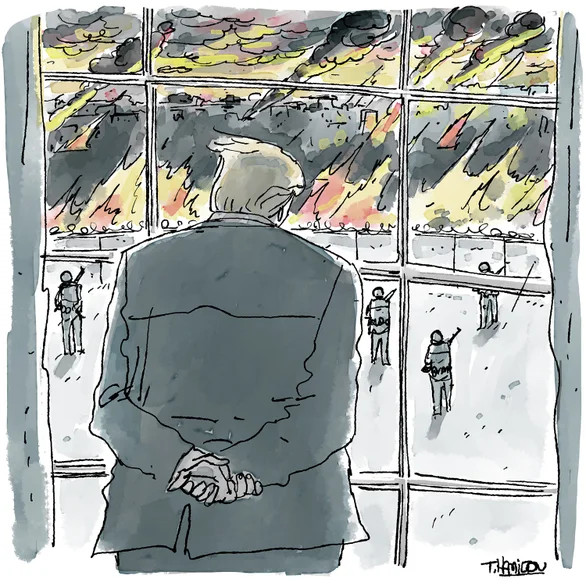
Tom Engelhardt: Fire and fury like the world has never seen: One thing I've never been able to fathom is why some people think the "second coming of Christ" would be a good thing. My grandfather was the first to broach that subject with me, when he asked me whether I thought the founding of Israel would harken the day (the only thing I can remember him ever asking me). I don't recall answering. He came from along line of farmers whose intellectual interests began and ended with the Book of Revelations. (My father was the last of that line, and his ideas were pretty unconventional. My own take was that Revelations was to the Bible what a punchline was to a joke: if somehow you managed to swallow the set up, something that would make you finally realize it has all been a farce.) As it turns out, David Lloyd George thought just that when he signed the Balfour Declaration in 1917, and British rule over Palestine seemed designed to further that scenario (to the extent it seemed designed at all). There are at least a dozen recent books on how Trump is paving the way for the end times -- and those are just the ones by his more fanatic supporters. As something of a born-again atheist, I have no faith in heavenly kingdoms, either on earth or elsewhere, but I do recognize the impulses of crazed leaders to burn and leave it all in ruins. Early in his term, Trump famously threatened "fire and fury" should North Korea defy him. As Engelhardt notes:
John Feffer: Trump's scorched-earth doctrine: "Trump is doing whatever he can to make it impossible for his successor to resolve some of the world's most intractable problems." This article could have been 5-10 times as long (for instance, it never mentions Venezuela or Cuba, Bolivia or Brazil, or Somalia, where Trump has now bombed more than Bush and Obama combined). Maybe he's making some progress on disengagement from Afghanistan and Iraq, although nothing you can bank on. And he does seem to have dodged the worst case scenario he was headed for with North Korea, but again he's failed to work out any form of deal. Feffer has been working up to this piece, as in his A memo to the next president. Matt Ford: Bill Barr's titanic lack of self-awareness: I don't see why it's so hard to understand Barr. Subhed says "he claims to be just a public servant," but Republicans since Margaret Thatcher have repeatedly argued that there is no public interest, therefore no such thing as a public servant. All people are simply self-interested, and for Republicans self-interest means looking at everything purely in terms of political advantages. In Barr's case, "everything" is law, and law is simply a tool to be used for advancing his party and himself. He's smarter about it than Trump is, but that's a pretty low bar. More on Barr this week:
Susan B Glasser: "It was all about the election": The ex-White House aide Olivia Troye on Trump's narcissistic mishandling of Covid-19: "The first staffer on the coronavirus task force to go public tells The New Yorker that America's pandemic response was 'derailed by the person at the very top.'" Glenn Greenwald: The US-supported coup in Bolivia continues to produce repression and tyranny, while revealing how US media propaganda works. Benjamin Hart: Trump administration to ban WeChat and TikTok from app stores beginning Sunday. Allegedly there is a national security angle here, but it also seems likely that Trump is doing this just to force the apps to be sold to "American" companies, in which case it's hard to imagine that some sort of graft isn't involved. More:
Pamela Karlan: Our most vulnerable election: Review of Lawrence Douglas: Will He Go?: Trump and the Looming Election Meltdown in 2020. Stephen Kinzer: Back off Venezuela already: "The American campaign against socialist leader Nichoas Maduro is only hurting the people of the country." And reminding Venezuelans that the United States has always favored business interests over the people. [Unfortunately, the Boston Globe makes it impossible for occasional readers to access articles on their website.] Jen Kirby: Are China and Iran meddling in US elections? It's complicated. I'm sure that nearly every government in the world sees their fate affected by US elections, but few can do anything about it, and little of what they do can have any real effect -- in part because "meddling" usually produces an adverse reaction. Israel is the only real exception inasmuch as they can appeal for support from two groups of voters: Israel-minded Jews, and (more significantly and successfully of late) Apocalypse-minded Christians. But nobody much talks about Israel's efforts. Ezra Klein:
Paul Krugman: The GOP plot to sabotage 2021: In refusing to even negotiate a new relief/stimulus package, Republicans are signifying two things: they don't think any new legislation will help them at the polls in November; and if they lose, their intention is to leave the nation in the worst possible shape for the Democrats in January. Of course, if the Republicans retain control of the Senate, they'll do all they can to make Biden look bad, much as they did to Obama in the recession he inherited. You'd think this calculation would be obvious -- and something Democrats could rally voters against. But Republicans were no less blatant in 2008-09, and somehow managed to ride obstruction to a major rebound victory in 2010. Even if they lose in November, they feel invincible, because no one really calls them on their most malevolent impulses. Even less remarked upon is how this works as extortion. The basic argument is that if you don't elect Republicans, they are going to cause so much destruction that you'll regret the affront. Of course, normal, sane people would never give in to that sort of bullying. Yet time and again the American voters do -- at least, enough of them in our severely skewed electoral system to let them claim victory and use their powers to profit the 1% and undermine everyone else. Eric Levitz: It is not undemocratic to call Trump's presidency 'illegitimate'. Martin Longman:
German Lopez:
Jane Mayer: For Mitch McConnell, holding the Senate is the highest priority. Harold Meyerson: A Rorschach test for establishment liberalism. A note, which serves as an introduction, to a New York Times feature on the 50th anniversary of Milton Friedman's essay, "The Social Responsibility of Business Is to Increase Its Profits": Greed is good. Except when it's bad. Ian Millhiser:
Kiana Moore: "They didn't see me as innocent": "Can you remember your first experience with the police? For these 9 Black and brown people, the encounters would shape their sense of safety forever." Also see Amber Ruffin shares a lifetime of traumatic run-ins with police, a week's worth of memoirs Seth Meyers broadcast the week after George Floyd was killed. Nicole Narea:
Ella Nilsen: The ways Democrats could retake the Senate majority, explained. I rarely link to these horserace pieces, but flipping the Senate (and ending the filibuster) are essential for Biden and the Democrats to have any effectiveness at all. Would be especially delicious should South Carolina and Kentucky retire Graham and McDonnell. Timothy Noah: The good life that Keynes promised America got stolen: "A new study shows in electrifying terms the extent to which 45 years of income inequality destroyed the prosperity we should all be enjoying." Osita Nwanevu:
Trita Parsi:
Deborah Pearlstein: How the government lost its mind: "Over the past 50 years, America has given up on the Enlightenment-era ideals of its Founders -- and the country's coronavirus disaster is the result." Cameron Peters: Trump's Nevada rally was an exercise in delegitimizing voting -- and denying reality: "Trump keeps holding potential superspreader events in the middle of a pandemic." Lili Pike: What wildfires in Brazil, Siberia, and the US West have in common: "Climate change and mismanagement are fueling large, uncontrolled fires around the world." More on fire:
Katha Pollitt: Melania Trump really doesn't care: "A new book by her ex-best friend shows how the first lady sold her soul." The book is Stephanie Winston Wolkoff's "tell-not-quite-all" Melania and Me: The Rise and Fall of My Friendship With the First Lady. By the way, article opens with a picture of Trump and Melania kissing. Reminded me of the cartoon show Bojack Horseman. Weirdest thing about that show was when different species (e.g., with horse or dog heads) try to kiss. Andrew Prokop: Bob Woodward's new book Rage, and the controversies around it, explained. "What did Trump know about the coronavirus? And what did Woodward know?" It's occurred to me that Woodward might have been trying to make Trump look more knowledgeable about coronavirus in February than he was, although when you listent to the tapes, you quickly realize that he didn't know much -- the value of the tapes was in contrast to the even dumber things he later said publicly. It's also possible that Woodward didn't grasp even what Trump said, and that the import of the quotes only became evident near publication time when publishers were searching through the book for tidbits they could market. It's even possible that Woodward's conclusions about Trump fitness were suggested by editors after having read the book. More on Rage:
David Roberts: 4 astonishing signs of coal's declining economic viability: "Coal is now a loser around the world." Aja Romano: What we know about a deadly shooting in Rochester, New York: "Two people are dead and 16 injured after a shooting at a party." Aaron Rupar:
Tom Scocca: Crowd cheers as the President gloats about this one time the cops shot a reporter with a rubber ballot for no reason. Liliana Segura: Trump prepares to execute Christopher Vialva for a crime he committed as a teenager: "Vialva is the first Black man to face execution during Trump's killing spree. He is set to die on September 24." Vialva has spent more time on death row than he lived before he was sentenced to die. Alex Shephard:
Danny Sjursen: September 14, 2001: The day America became Israel: The date was when Congress voted, with just one dissent (Rep. Barbara Lee, D-CA) to give GW Bush a blank check for starting his Global War on Terror. Three days earlier, planes flew into the World Trade Center in NYC and the Pentagon near DC, killing close to 3,000 people. I was in Brooklyn at the time, visiting friends, and we watched a lot of TV that day. One thing I saw was stock video of Palestinians cheering and burning US flags, released by Israel shortly after the attacks. Later during the day, I saw the grinning mugs of Benjamin Netanyahu and Shimon Peres bragging about how good the attacks were for Israel, predicting that now Americans will see the world the way Israelis do. (Ariel Sharon was PM of Israel at the time, but his limited English didn't merit prime time, nor did his perpetual scowl.) 9/11 gave the neocons recently installed in key government positions by Bush and Cheney the opportunity they've been waiting for. The neocons may have started as fanatic Cold Warriors, but in the 1990s they formed an alliance with Israel's right-wing to scuttle the Oslo Peace Process and confront both the Palestinians and their Arab neighbors from a stance of absolute, uncompromising power. With Sharon's accession to power, their relationship to Israel shifted from support to envy: their most fervent hope was for the US to impose its absolute power on the world, as Israel was doing in its own little corner. Whence came mantras like "axis of evil" and "real men go to Tehran." You can argue about how well that stance has served Israel: the conflict with the Palestinians will never end until Israel grants them some semblance of justice, but the costs of dominance are within politically acceptable bounds, as long as BDS doesn't hamper business, and the next Intifada is no more efficient than the last. And for now, Israel has nothing to fear from formerly hostile neighbors. The thrust of Kushner's (which is to say Israel's) diplomacy has been to form a united political front between Israel and Arab despots who fear Iran and their own people and other Arabs and hope they will be more secure with hoards of sophisticated American and Israeli arms. Speaking of which, more on the Kushner deal:
Jeffrey St Clair: Roaming charges: Smoke on the water, lies burning in the sky. Starts with a bunch of photos of what Oregon looks like these days. Matt Stieb: Federal officials considered using a 'heat ray' against DC protesters. Farah Stockman: What I learned from a list of Trump accomplishments: "Facts are vital. But they are not sufficient." An introduction and executive summary of A fact-checked list of Trump accomplishments, where the list itself "consisted of 123 bullet points posted on the Conservative Hangout Facebook page in May." The thing I found most interesting here is that in order to make Trump look good, the listers most often selected "facts" designed to make Trump look more liberal than he is. Liberals may be embarrassed about using the word to describe themselves, but conservatives are shameless in recognizing that liberal policies are more popular than their own -- hence the need to hide and lie about them.
Derek Thompson: The reason Trump isn't trying to save the economy: "He is stuck in a Pollyannaish fantasy of his own making." Alex Ward: The bogus Steve Bannon-backed study claiming China created the coronavirus, explained. Matthew Yglesias:
Li Zhou:
Ask a question, or send a comment. Monday, September 14, 2020 Music Week
September archive (in progress). Music: Current count 34007 [33954] rated (+53), 217 [212] unrated (+5). Got a late start writing today. I had the idea yesterday that I'd finally try to make lasagna -- something I've never tried before, although I have been known to make a pretty awesome pastitsio. Back when I first had the idea -- well over a year ago -- most of the recipes I consulted called for oven-ready noodles, so that's what I bought and still had on hand. I started with Mark Bittman's classic lasagna recipe, and made the bolognese sauce yesterday, but ran out of time and saved it overnight. Bittman called for boiled noodles, but all I had was oven-ready, so I wound up mostly following the box recipe -- adding an extra cup of water to my reduced meat sauce to make sure the noodles had plenty of liquid. Made pretty much every mistake possible in assembling the loaf, and it looked pretty ugly when it came out of the oven. Not bad, but the noodles were the weak link. A bit surprised the rated count is so high, but my method for getting there was pretty conducive to quantity over writing. I searched through my tracking file for records I had given a medium/high priority to (basically 2 vs. 1, on what I had originally conceived of as a 3-to-0 scale, but haven't been using the ends). Currently I have 164 records at priority 2, mostly jazz. I started the week adding Saving Country Music picks to my metacritic file, so there's a fair number of alt-country albums in this week's crop. I also stumbled my way onto the Aerophonic Records Bandcamp, where Dave Rempis has been releasing a lot of his old tapes (a fairly common strategy for musicians sidelined by the pandemic). I also rummaged through my Downloads directory, sorted out what I had accumulated, and created a log to manage it better. My other splurge this week was from Robert Christgau's Consumer Guide, which aside from a few records I had previously given various B+ grades to (Chicks, No Age, No Joy, Taylor Swift -- I revisited No Age, see below), and Nat King Cole's Jumpin' at Capitol (released in 1990, an A- from way back, and not the only one), had a lot of things I hadn't heard. Only one I couldn't find was The Human Hearts, which back in 2012 released another Christgau A- I never managed to hear. Surprised I didn't like Billy Nomates more, especially given that I like Sleaford Mods a lot more than Bob does, but maybe that was the point? Christgau, by the way, published his guide to volunteering to work on the side of sanity and civilization in the 2020 election today: Vote! It Ain't Illegal Yet!. He's practiced what he preaches for many years now. I know a couple others who volunteer regularly to help with campaigns, but no one who's put more into it. All I can manage to do is to write up some obvious truths (as I've been doing weekly in my Weekend Roundups; for the Trump era, you can download this [odt format], which isn't totally up to date). I usually spend a fair amount of time updating the metacritic file on Mondays before posting this, but decided I'd rather get this out at a decent hour, and catch up later. Also thought I'd do a books post this week, but didn't make much progress on that, given the sheer length of yesterday's Weekend Roundup (1738 lines, 12816 words, making it the longest ever, eclipsing 1601/11281 from two weeks back).. New records reviewed this week: The 81's: 2 Things & 118 Others (2020, The 81's): Nashville rock group, principally Tom Siering and Tim Carroll. Group with the obvious website is different (as far as I can tell), making this a debut album. Comparisons to the Blasters are unwarranted, but they have some good lines and riffs. B+(**) 100 Gecs: 1000 Gecs and the Tree of Clues (2020, Dog Show): Dylan Brady and Laura Les, originally from St. Louis, but at last report split between Los Angeles and Chicago. Ten-track debut appeared in 2019. Dan Weiss recommended it, and replied to my review: "I can't believe you found 100 gecs more annoying than black midi." I found it so annoying I didn't check the length (didn't feel like I needed to) so didn't even flag it as a 23:07 EP. Christgau wound up grading both 100 Gecs and Black Midi at A-, but I didn't revisit either. Did check out this remix album, fleshed out to 51:10, mostly through redundancy (18 tracks). This time, I loved the "ringtone" remix (with Charli XCX, Rico Nasty, and Kero Kero Bonito); also "xXXi_wud_nvrstop_ÜXXx" (another baby song, with Tommy Cash & Hannah Diamond). Still found many things annoying, but fans somehow manage to laugh (or snicker?) at them. B+(**) Jessi Alexander: Decatur County Red (2020, Lost Creek Music): Country singer-songwriter, from Jackson, Tennessee, recorded an album for Columbia in 2005, but was dropped and this is only her second album since, a short one (8 songs, 28:58). Thoughtful songs, aside from the duet with Randy Houser which is plain fun. B+(*) Pedro Melo Alves: In Igma (2019 [2020], Clean Feed): Portuguese drummer, second album. Other musician names on the cover: Aubrey Johnson (voice), Beatriz Nunes (voice), Mariana Dionísio (voice), Eve Risser (piano), Mark Dresser (bass), Abdul Moimême (guitar). Way too much voice, a choral cloud, still not enough to obscure the creaky industrialism in the background. B- American Aquarium: Lamentations (2020, New West): Country-rock band from North Carolina, founded by singer-songwriter BJ Barham in 2005, eleventh album, no other members date back past 2017. B+(**) Antibalas: Fu Chronicles (2020, Daptone): Brooklyn-based Afrobeat band, founded 1998 by Martin Perna (baritone sax) -- the only original member remaining, although Duke Amayo (vocals/percussion) and Jordan McLean (trumpet) have been with the band nearly as long. B+(***)Mulatu Astatke & Black Jesus Experience: To Know Without Knowing (2020, Agogo): Ethiopian vibraphonist, also plays keyboards and percussion, invented a style he calls Ethio-jazz, studied engineering in UK and music in London and Boston. Responded to revived interest in his 1970s music by playing with groups like Heliocentrics and Either/Orchestra, and most recently with Black Jesus Experience -- an Ethio-jazz band based in Melbourne, Australia, which adds a bit of hip-hop to the flow. B+(***) Teodross Avery: Harlem Stories: The Music of Thelonious Monk (2020, WJ3): One of the impressive young tenor saxophonists of the 1990s, got distracted by fusion then dropped out for a long spell, returning with a Coltrane tribute in 2019. Plays 10 Monk tunes here, split between two rhythm sections (pianists Anthony Wonsey and DD Jackson). B+(***) Jon Balke: Discourses (2019 [2020], ECM): Norwegian pianist, albums since 1991. This one is solo, 16 mostly short pieces. B Ballister: Znachki Stilyag (2019 [2020], Aerophonic): Dave Rempis sax trio, with Fred Lonberg-Holm (cello/electronics) and Paal Nilssen-Love (drums), fifth album since 2010, this one recorded in Moscow, title Russian for "hipster icons." This has long been the most fevered of Rempis groups, and doesn't shirk here. The 38:37 "Fuck the Money Changers" is a tour de force. A- [bc] J Balvin: Colores (2020, Universal Latin): Colombian reggaeton star, short album (10 tracks, 28:52). Nice beat. B+(**) Black Thought: Streams of Thought Vol. 1 (2018, Human Re Sources, EP): Philadelphia rapper Tariq Trotter, lead MC of the Roots, first solo effort this 5-track, 17:15 download, produced by 9th Wonder. Sounds like half of a pretty good Roots album. B+(***) Black Thought: Streams of Thought Vol. 2 (2018, Human Re Sources, EP): Another 9 tracks, 23:25. Second half of that Roots album even stronger, with no reason to miss the live band. A- Afel Bocoum: Lindé (2020, World Circuit): Guitarist, singer-songwriter from Mali, several albums since 1999, a key player on the 2002 Damon Albarn-produced Mali Music. B+(**) Bonjintan: Dental Kafka (2018 [2020], Trost): Free jazz quartet, second album, led by Japanese saxophonist Akira Sakata (also clarinet/voice), with Jim O'Rourke (double bass), Giovanni Di Domenico (keyboards), and Tatsuhisa Yamamoto (drums). B+(**) Alan Braufman: The Fire Still Burns (2019 [2020], Valley of Search): Alto saxophonist, also plays flute, recently reissued his 1975 debut Valley of Search to much acclaim, returns with something new, with Cooper-Moore (piano) from his old group, and relative newcomers James Brandon Lewis (tenor sax), Ken Filiano (bass), Andrew Drury (drums). Always impressed by the pianist, but the horns come on rather heavy. B+(*) Steve Cardenas: Blue Has a Range (2019 [2020], Sunnyside): Guitarist, dozen-plus albums since 2000, quartet with Jon Cowherd (piano), Ben Allison (bass), and Brian Blade (drums). Mild. B Lynn Cassiers: Yun (2019 [2020], Clean Feed): Belgian vocalist, plays electronics, third album. With Bo Van der Werf (baritone sax), keyboards, bass, drums, with group improvs and reworked standards. B Ernesto Cervini: Tetrahedron (2019 [2020], Anzic): Canadian drummer, half-dozen albums since 2006, this a quartet with Luiz Deniz (alto sax), Nir Felder (guitar), and Rich Brown (bass). Cover has a "featuring" credit for Felder, but the saxophonist has most of the appeal. B+(**) Elizabeth Cook: Aftermath (2020, Agent Love): Country singer-songwriter, seventh album since 2000, had a breakthrough with 2007's Balls and the even better 2010 Welder. Rocking harder here, which is appealing enough but makes it harder to follow her songs. The exception is the closer, a reworking of John Prine's "Jesus: The Missing Years" to focus on Mary. B+(***) Vladislav Delay: Rakka (2020, Warp): Finnish electronica producer Sasu Ripatti, 15+ records since 1999. Industrial rumble, up and down. B+(*) Vladislav Delay/Sly Dunbar/Robbie Shakespeare: 500-Push-Up (2020, Sub Rosa): Second album pairing the Finnish electronica producer with Jamaica's legendary rhythm section, but 2018's Nordub was dominated by Norwegians Nils Petter Molvaer and Eivind Aarset, leaving Delay's electromurk in the background. Here it's foreground, and while the extra rhythm helps, it's not likely to be recognized as such. B+(**) Daniel Donato: A Young Man's Country (2020, Cosmic Country Music): Singer-songwriter, Nashville native, more rock and roll than country, has a distinctive guitar style (or maybe that's the bass?), and the guitar leads here. Produced by Robben Ford, who never struck me as that good, but he certainly inspired Donato to show off. B+(***) The Engines: Wooden Legs (2011 [2020], Aerophonic): Free jazz quartet from Chicago, recorded an eponymous album in 2006, two more through 2011, with a couple archive tapes appearing since. Jeb Bishop (trombone), Dave Rempis (saxes), Nate McBride (bass), and Tim Daisy (drums) -- three Vandermark 5 alums plus another frequent collaborator. B+(***) Frazey Ford: U Kin B the Sun (2020, Arts & Crafts): Canadian singer-songwriter, father was an American draft dodger, third album since 2020, before that was in a folkie group called the Be Good Tanyas. Has a nice, light touch. B+(**) Arna Georgia: Yes Girl (2020, Arna Georgia): Country singer, from Sydney, Australia, first album. Nice voice, songs have some promise. B+(*) Tom Guarna: Spirit Science (2019 [2020], Destiny): Guitarist, eighth album since 2005, quintet with Ben Wendel (tenor sax/bassoon), Aaron Parks (keyboards), bass, and drums. Nice groove for postbop. B+(*) [09-18] Russ Johnson/Dave Rempis/Joshua Abrams/Isaiah Spencer/Jeremy Cunningham: Harmattan (2019 [2020], Aerophonic): Trumpet, alto/tenor/bari sax, bass, two drummers, one 41:02 live jam. B+(***) [bc] Knxwledge: 1988 (2020, Stones Throw): Hip-hop producer Glen Boothe, lots of records since 2010, this one named for his birth year, 22 short tracks, 38:41 (longest 4:28, 3:19, 2:49, 2:09). B [bc] The Magnetic Fields: Quickies (2020, Nonesuch): Stephin Merritt runs through 28 songs, none over 2:35, 46:40 total, additional vocals by Claudia Gonson and Shirley Simms. Perverse fragments: "I've Got a Date With Jesus" was fetching, "You've Got a Friend in Beelzebub" less so. B+(**) Arlo McKinley: Die Midwestern (2020, Oh Boy): Singer-songwriter from Cincinnati, first album, landed on John Prine's label, which has usually been a pretty solid recommendation. Unclear why in this case. B Cahalen Morrison: Wealth of Sorrow (2020, self-released): Country singer-songwriter, from New Mexico, plays guitar and banjo, recorded this solo in "an old adobe chapel." Bare bones folk tunes. B+(**) [bc] Tatsuya Nakatani/Shane Parrish: Interactivity (2018 [2020], Cuneiform): Percussion and guitar duo, the former originally from Japan but now based in New Mexico, the latter in North Carolina, where this was recorded. B+(**) Nas: King's Disease (2020, Mass Appeal): Rapper Nasir Jones, went platinum with his 1994 debut (Illmatic), twelfth studio album, debuted at number 5. B+(**) Billy Nomates: Billy Nomates (2020, Invada): British singer-songwriter Tor Maries, first album, some sources say "No Mates," produced by Geoff Barrow (Portishead), draws comparisons to Sleaford Mods for her talkie style and class consciousness. B+(***) Oddisee: Odd Cure (2020, Outer Note): DC rapper, Amir Mohamed el Khalifa, father from Sudan, grew up in Prince George's County in Maryland, short album with six songs wrapped around five quarantine phone calls -- a sign of the times. B+(***) Gregory Porter: All Rise (2020, Blue Note): Singer, "the best-selling contemporary Jazz/soul artist with over 3 million album sales." Sixth album since 2010, a long CD which stretches to 2- or 3-LP length. Towering voice, couched in strings with fancy acoutrements. I've never cared for his art, but occasionally here I can fathom the appeal. But he doesn't deliver anything undeniable until the closer, "Revival," where his church roots meet the Four Tops. B+(*) Dave Rempis/Elisabeth Harnik/Michael Zerang: Triple Tube (2019 [2020], Not Two): Alto sax/piano/drums trio, recorded at Tube's in Graz, Austria, the pianist's home turf, the others from Chicago. B+(**) Rempis Percussion Quartet: The Long Haul (2011 [2020], Aerophonic): Chicago group, dates from 2006, led by saxophonist Dave Rempis (alto/tenor/baritone), with two drummers (Tim Daisy and Frank Rosaly) and Ingebrigt Håker Flaten on bass. Rempis is a terrific saxophonist, and he's frequently in top form here. A- [bc] Eric Revis: Slipknots Through a Looking Glass (2019 [2020], Pyroclastic): Bassist, probably best known for his work with Branford Marsalis since 1997, but before that started out with Betty Carter, and his own records have been adventurous. Uses two saxophonists here -- Bill McHenry (tenor) and Darius Jones (alto) -- with Kris Davis (piano) and Chad Taylor (drums). The rhythm breaks up nicely, especially with Davis. The saxes take a while to develop -- even Jones, who is usually a terror. A- [cd] Bobby Rush: Rawer Than Raw (2020, Deep Rush): Bluesman Emmett Ellis Jr., at 86 he's slowed down enough to sound like he crawled out of the 1930s Delta. B+(***) Christian Sands: Be Water (2020, Mack Avenue): Pianist, Pianist, was a prodigy releasing his first album at 13, mentored by Billy Taylor. Fourth album on this label, albums a mix of trio and extra guests: two tracks add horns, four guitar, one a string quartet. B+(*) Christian Scott aTunde Adjuah: Axiom (2020, Ropeadope): Trumpet player from New Orleans, nephew of Donald Harrison, more than a dozen albums since 2002, adopting this extended name in 2012. Live album, septet, with Elena Pinderhughes (flute), Alex Han (alto sax), keyboards, bass, percussion (djembe, congas, bata) and drums. Party friendly. B+(***) Archie Shepp/Raw Poetic/Damu the Fudgemunk: Ocean Bridges (2020, Redefinition): Order from album cover, but other sources list hip-hop drummer/producer Damu (Earl Davis) first -- he has 51 releases on his Bandcamp page, but while I recognize the name I've never indulged before. Raw Poetic (Jason Moore) is the rapper/lyricist, and Shepp is a tenor sax legend who c. 1970 broadened from avant-garde to black power funk -- hip-hop before the term. As hip-hop, seems a bit scattered, but great to hear the sax, especially when the beats free up. B+(***) Gary Smulyan: Our Contrafacts (2019 [2020], SteepleChase): Baritone saxophonist, more than a dozen albums since 1991 plus 80 or so side credits (starting with Woody Herman in 1981). Trio with bass (David Wong) and drums (Rodney Green), all originals (6 Smulyan, 2 each for the others). B+(***) Stillefelt: Stillefelt (2018 [2020], Stoney Lane): British bassist Chris Mapp, also electronics, has at least one previous release, leads a trio here with Percy Pursglove (trumpet) and Thomas Seminar Ford (guitar/electronics). Leans toward ambient. B+(*) Recent reissues, compilations, and vault discoveries: Peter Stampfel & the Bottle Caps: Demo '84 (1984 [2020], Don Giovanni): Nine tracks, 29:10, 8 of the 12 that appeared on the group's eponymous 1986 Rounder LP, plus a cover of "When It's Springtime in Alaska (It's Forty Below)," a 1959 Johnny Horton hit. Demos usually signify sketchy, but these pieces are fully fleshed out, the guitar rocking hard, Stampfel's unique voice inevitably standing out, but also integral to the flow. I don't remember being especially impressed by the album, and it's possible this impresses partly in stark contrast to the gradual decline of his recent years. A Triage: Live at the Velvet Lounge (2005 [2020], Aerophonic): Saxophonist Dave Rempis' first group outside of the Vandermark 5, released three 2001-04 albums, the third (American Mythology) one of my early Jazz CG Pick Hits. Trio with bass (Jason Ajemian) and drums (Tim Daisy). B+(**) [bc] Old music: Good Ol' Persons: Anywhere the Wind Blows (1989, Kaleidoscope): Bluegrass group, fifth and final album (not counting the 1995 "20th Anniversary" Good N' Live). No recollection why I downloaded this, but found it cleaning up, and recognize the two major singer-songwriters: Kathy Kallick (guitar) and John Reischman (mandolin). B+(**) Devin Gray/Ryan Ferreira/Jonathan Goldberger/Chris Tordini: Devin Gray's Fashionable Pop Music (2012 [2016], Rataplan): Drummer, composes and leads a group with two guitars and bass, through two sidelong pieces ("Antiplutocracy," "Sowieso"). B+(*) [bc] Grade (or other) changes: No Age: Goons Be Gone (2020, Drag City): Noise pop duo from Los Angeles, formed 2005, released a consistent stream of fine albums. This one seemed to get slammed hard. I gave it a play, concluded it had their sound down pat, but hedged. Several more plays and it's hard to see how anyone could have missed it. [was: B+(**)] A- Unpacking: Found in the mail last week:
Ask a question, or send a comment. Sunday, September 13, 2020 Weekend RoundupI picked this up on Facebook, forwarded by a couple of friends. I thought it might do more good here:
We're less than two months away from the election. An insane amount of money is being raised and spent to sway that election, and it will be used to try to manipulate you in all kinds of ways. Beware that most of the money comes from rich people with their own private agendas -- indeed, a lot of it is coming through "dark money" fronts intended to avoid transparency and accountability. Misinformation and dirty tricks are likely to come so fast and furious you'll never be able to sort them out. On the other hand, you really only have to know a few things to decide this election: we live in a very complex world which requires expertise and trustworthiness to function; trust depends on respect and empathy for other people; a democratic government ("of, by, and for the people") is essential because it is the only basis for fair and just management of this complexity. Republicans have repeatedly failed to run competent government, partly because they are hold many people in contempt, and partly because they see political power only in terms of their ability to reward their donors and lock in their own power. While conservatives have failed for many years, they have rarely exposed their own incompetence as blatantly and hopelessly as they have under the leadership and direction of Donald Trump. He is a disaster and an embarrassment. He and his party deserve to be driven from the halls of power, and the only way to do that is to elect Democrats: Joe Biden for president, and the other Democrats running for Congress and state and local office. The more complete the rout, the better. It's easy to say this is the most important election of our lifetimes, but it may be more accurate to say that if we fail to take our country back this time, this may be one of the last chances we get. Some scattered links this week: Danielle Allen: The flawed genius of the Constitution: "The document counted my great-great-grandfather as three-fifths of a free person. But the Framers don't own the version we live by today. We do. The document is our responsibility now." Nancy J Altman: Trump really does have a plan to destroy Social Security. The linchpin here is eliminating the payroll taxes that fund Social Security. Trump has already suspended collection of those taxes until the end of the year, producing a short-term stimulus and a slightly longer-term liability. The idea is that when the bill comes due, people will feel the pinch, and demand relief from the tax. As half of the tax is deducted from workers' checks, they would see a slight increase in take-home pay, but few would manage to save enough to make up for the eventual loss of retirement income. The other half is paid by companies, who could use the savings to pay workers more, but more likely will pocket the profit. Franklin Roosevelt thought that the regressive payroll tax would protect the program against predatory business efforts, but he didn't anticipate the short-sighted nihilism of Trump's generation. By the way, Glenn Kessler tries to argue that Trump has no such plan: see Biden campaign attacks a Trump Social Security 'plan' that does not exist. The gist of Kessler's argument seems to be that Trump says so many incoherent things, and does so little to clarify them, that you can't attribute anything as deliberate as a plan to him. Kate Aronoff: Trump's fire sale of public lands for oil and gas drillers: "The Bureau of Land Management is rushing to auction off sites ahead of a potential Biden presidency." Peter Baker: More than ever, Trump casts himself as the defender of White America. Katrin Bennhold: Trump emerges as inspiration for Germany's far right. Megan Cassella: 'A tale of 2 recessions': As rich Americans get richer, the bottom half struggles. This goes far in explaining why the Republicans have no interest in another stimulus bill, while the Democrats see the need for something much more dramatic:
Zak Cheney-Rice: Police riots and the limits of electoral solutions. Matthew Choi: Trump says Pentagon chiefs are accommodating weapons makers. Once in a while he goes off on an antiwar lark, without recognizing any discrepancy from his actual record. Related: Jane Chong: Donald Trump, constitutional grift, and John Yoo: An overly long review of Yoo's Defender in Chief: Donald Trump's Fight for Presidential Power. You may remember Yoo as the lawyer in GW Bush's White House who came up with the most incredible legal rationalizations for Cheney's torture policy. "There isn't a lot more to Yoo's argument than his insistence that executive energy is a good and constitutional thing." Still, he usually waits until a Republican is in the White House before deciding for dictatorship. Jane Coaston: The pro-Trump, anti-left Patriot Prayer group, explained. Jelani Cobb: Our long, forgotten history of election-related violence: "President Trump has sparked dangerous lawlessness, but killing and destruction linked to political antagonisms are nothing new for this country." Still, I don't find it very reassuring that his first example dates from 1856. Dan Diamond: Trump officials interfered with CDC reports on Covid-19: "The politically appointed HHS spokesperson and his team demanded and received the right to review CDC's scientific reports to health professionals." Anne Diebel: Trumps on the couch: Review of Mary L Trump's Too Much and Never Enough: How My Family Created the World's Most Dangerous Man. Sooner or later, Donald Trump will no longer darken our doors, and from that point on I'll have no desire to ever read about him again. Indeed, the only one of a dozen books I've read to date that reveals much worth knowing about Trump is TV critic James Poniewozik's Audience of One: Donald Trump, Television, and the Fracturing of America, and that's because he bothered to sort out the meaning of so-called "reality TV" -- something I've never had the slightest interest in actually watching. The only other book that seems like it might be enlightening is his nieces's psychobiography, and that's largely because she takes a broader and deeper view of his family. Jason Ditz: Biden says stay in Mideast, increase military spending: Well, that's not exactly what he said -- the only exact quote here is "forever wars have to end," but he isn't acknowledging that what makes them "forever" is America's military footprint in the Middle East. Ditz's subhed is also an exaggeration: "Biden wants to refocus on fighting Russia." He said that NATO has been "worried as hell about our failure to confront Russia," which could be ominous but is probably just a reflection on Trump's passive-aggressive stance. Still, statements like this give Trump some room to paint Biden as the warmonger in the campaign --l admittedly less credible than the same charge against Hillary Clinton, but the track record is that both have supported wars and the military pretty much in lockstep. Nayantara Dutta: Neighbors are gathering online to give and get things they need right now: "In 'Buy Nothing' and gifting groups around the country, communities are connecting over free stuff." This is something I'd like to see happening, not least because I'm one of those guys (my wife calls us hoarders) who can't abide the idea of throwing things away that might be useful to other people, but who's too lazy to find people to give them to. I could imagine a neighborhood online exchange for browsing and ordering, with delivery so you don't have to go in to shop, and pickup of anything you care to pass on. You'd need a warehouse, a computer system, some sorters and deliverers, and someone would have to make decisions about recycling or trashing items that nobody wants. An open source software project could service many of these, and possibly add higher level interchanges to move surplus items into other locations with more needs. You could skim some stuff off to sell on the free market, and possibly finance some of the operation that way. Steve Early/Suzanne Gordon: Under Trump, military veterans and service members have been 'losers': Trump's Secretary of Defense Mark Esper wants "to trim $2 billion allocated for direct care for 9.5 million active-duty personnel, military retirees, and dependents over the next five years." Gordon is the author of a book, Wounds of War: How the VA Delivers Health, Healing, and Hope to the Nation's Veterans. Tim Elfrink: Police shot Portland slaying suspect without warning or trying to arrest him first, witness says. Michael Reinoehl was a suspect in the shooting of a pro-Trump "Patriot Prayer" counter-protester in Portland, making it hard to determine whether the shooting had been in defense (of self or others). By the way, Aaron Rupar quotes Trum on this: "This guy was a violent criminal, and the US Marshals killed him. And I'll tell you something -- that's the way it has to be. There has to be retribution." The thread I pulled this from disputes that federal marshals were the ones who killed Reinoehl. Dean Baker comments further: "I guess courts and trials are too complicated for little Donnie Boy to understand." As Richard Silverstein summed up this story, Trump urges summary execution of protesters. Tom Engelhardt: The great, great fall, or American carnage from a pandemic President. John Feffer: Trump and the troops: "The alternative to Trump is not the glorification of military service. It's promoting the kind of service that gets fewer people killed." Thomas Frank: We need to reclaim populism from the right. It has a long, proud leftwing history. Excerpt from Frank's recent book, The People, No: A Brief History of Anti-Populism, which I recently read, and generally liked. As a Kansan, I've spent a fair amount of time reading about the People's Party, and for that matter the Socialist Party (which one had a significant foothold in southeast Kansas). I appreciate Frank's brief history of the 1896 and 1936 elections. I do, however, think that there is a significant difference between the "liberal anti-populists" Frank attacks in the modern Democratic Party and the "anti-populism" of 1896 and 1936, and that difference matters going forward. I'll also note that part of the problem in 1896 was that silver wasn't a very good answer to the deflationary pressures of the time -- the Greenback Party of the 1870s was actually on a better track. Andrew Freedman/Timothy Bella: Western wildfires break records as devastating toll on lives and homes begins to emerge. Stanley B Greenberg: How Trump is losing his base: "Focus groups with working-class and rural voters show the deep health care crisis in America, and trouble for Trump's re-election." Makes sense, but the polls are showing Trump has a very consistent level of support, so if he's losing base votes, how is he compensating? Alexander Sammon argues that Trump's making up his losses among seniors with Latino votes -- see: The Biden-Trump demographic switcheroo. Sue Halpern: How the Trump campaign's mobile app is collecting massive amounts of voter data. I didn't even know such a thing existed, but of course it does -- Biden has one, also, and the contrast is revealing:
Also note:
Rebecca Heilweil: Right-wing media thrives on Facebook. Whether it rules is more complicated. Patrick Hingsley: Fire destroys most of Europe's largest refugee camp, on Greek island of Lesbos. Umair Irfan: The orange skies and smoky air from Western wildfires, explained: "Air pollution may be the most dangerous element of the massive fires." Also: "Unprecedented": What's behind the California, Oregon, and Washington wildfires. More:
John Ismay: At least 37 million people have been displaced by America's War on Terror: A new report from Brown University's Costs of War project. "That figure exceeds those displaced by conflict since 1900, the authors say, with the exception of World War II." Also:
Sarah Jeong: The Battle of Portland: "How mass protests against racist police brutality sparked a historic federal crackdown on dissent." Extensive report.
Fred Kaplan: Is America in the early stages of armed insurgency? Counterinsurgency strategist David Kilcullen thinks so. I think there is a lot of potential for isolated violence from the right, certainly if Trump loses, perhaps as likely if he wins. The big uncertainty is how Trump, Republicans, and their propaganda network responds to the violence -- the full-throated support given for Kyle Rittenhouse is chilling, even hard to imagine a mere four years ago. Aishvarya Kavi: 5 takeaways from Rage, Bob Woodward's new book about Trump: Bob Woodward's second book on Trump drops on Sept. 15, so the press is awash with publicity leaks. Like 2018's Fear, was based on personal interviews, its title reduced to a four-letter word the subject can relate to. This seems like the piece to start with. The big revelation appears to be that Trump was able to speak knowledgeably and coherently about the coronavirus threat in early February, at a time when he was downplaying it publicly and doing nothing to reduce the threat. Many people blame Woodward for not reporting what he knew at the time, suggesting the news might have helped save lives. Of course, saving lives isn't Woodward's idea of good journalism. Selling books is. Here are Kavi's 5 takeaways:
Offhand, I wouldn't rate any of these are breakthrough insights, but that's about par for Woodward, who regularly gets too close to his subjects to see them clearly. Other Rage pieces:
Ibram X Kendi: The violent defense of white male supremacy. Glenn Kessler: Trump keeps bragging about imaginary auto plants in swing states. Jen Kirby: The UK threatens to renege on the Brexit deal it signed with the EU just a year ago. Ezra Klein: Black Republicans, Donald Trump, and America's "George Floyd moment": Interview with historian Leah Wright Rigueur, author of The Loneliness of the Black Republican. John Knefel: Police and racist vigilantes: Even worse than you think. Nicholas Kristof: 'We're no. 28! And dropping!': "A measure of social progress finds that the quality of life has dropped in America over the last decade, even as it has risen almost everywhere else."
What Brazil and Hungary have in common with the US is far-right government. That they've suffered a bit less than the US is probably because those far-right governments have been hegemonic for shorter times: the US has been controlled by conservative Republicans (and the occasional ineffective neoliberal Democrat) since 1980, so inequality has progressed further, especially in eating into the social fabric. Porter is wrong to say the US is like "a developing country." Developing countries are developing -- making progress, even if fitfully. The US is a devolving country, its industries devoured by predatory capitalists, its workers marginalized, its society wracked by fear and loathing. It's still in the top quarter of the list, because it was once on top, but declining steadily -- maybe never to the point of the bottom rung, of countries that aren't even developing. They are mired in war, which is even more corrosive than private equity. On the other hand, the right's fascination with guns and private militias suggests that too could befall us. Paul Krugman:
Claire Lampen: The Justice Department is reportedly trying to shield Trump from a rape lawsuit. E Jean Carroll claims that Trump raped her in a department store dressing room 25 years ago. She sued Trump for libel, and a court ordered him to provide a DNA sample and deposition. The DOJ intervention has stopped the case, at least for now.
Rob Larson: A quick guide to what is going on with the economy: A pretty substantial review up through July. Eric Levitz:
Martin Longman: We can't endure much more bad leadership. He starts with some examples of how little decisions by leaders add up, for some reason starting with Bill Clinton and Monica Lewinsky and tracing from there through 9/11 and the Global War on Terror -- things which indeed reflect bad leadership but really have more proximate causes. Trump gets several mentions later on, but his real example is SD governor Kristi Noem's decision not to cancel the annual motorcycle rally in Sturgis. The result:
That's more than 266,000 cases, with a public health cost of $12.2 billion. As for Trump, he's not just a bad leader in the sense that Clinton, the Bushes, and even Obama were -- by following conventional political "wisdom" into one cul de sac after another. He's bad on an absolutely cosmic scale. He's seeded the government with mini-versions of himself: pompous, arrogant, corrupt, vain, and stupid, and led them to believe that they are protected from legal and political consequences (even though he's ultimately had to fire many of them). One can imagine an inept leader surviving on the competencies of his staff, but Trump precluded that possibility both through his staffing -- sure, Pence was responsible for most of them, but over time Trump has managed to weed out most of the ones who weren't sufficiently sycophantic (or for that matter psycho) -- but also by insisting that nothing is real but in terms of its us-vs-them political impact. Trump's instinct was to look only at the political implications of coronavirus, to see how he could use it as a tool of divide and conquer. As such, he inevitably politicized things like mask wearing that most leaders would have taken pains to depoliticize. Longman stresses that many times he's argued that we need better leaders. What's more clear is that we need less bad leaders -- leaders who can put aside their political angles when the events dictate otherwise. However, Trump has gone way beyond such concepts as good and not bad. The problem with Trump's leadership is not just that it's bad; it's that he's so embarrassingly incompetent he's a distraction from everything. German Lopez:
Bruno Maçães: How fantasy triumphed over reality in American politics. Author has a new book, History Has Begun: The Birth of a New America, from which this is adapted. He is stuck with the idea of a "new world order," and flat out declares "the proposition that the whole planet is on a course to embrace Western liberalism is no longer credible," but doesn't seem to have any better suggestions. He is right that in voting for Reagan in 1980 America turned away from the limits of the real world and decided to live in a fantasy -- one that's become progressively desperate as evidenced by Trump's "make America great again." Amanda Marcotte: Trump, you're no FDR or Winston Churchill -- but you're a lot like Charles Lindbergh: "Trump defends coronavirus lies to comparing himself to wartime leaders -- but he's closer to the Nazi apologists." This doesn't mention Nick Adams's recent book, Trump and Churchill: Defenders of Western Civilization, which is ridiculous enough (on both counts) to need no review, nor does it mention Fred Trump's attachment to Lindbergh's "America First" movement (although it does note Donald Trump's use of the slogan and penchant for evoking fascist memes).
Nolan D McCaskill: Trump team says history will vindicate him on coronavirus: "Top advisers blame everyone but the president for the nation's plight during the pandemic." Media Matters: This group watches Fox News so you don't have to. I'm convinced that nothing affects politics more these days than Fox's hermetically sealed alternate universe. I saw Matt Taibbi complain recently that MSNBC is "even more partisan" than Fox, and that nearly everyone who says they trust the New York Times for news identifies as a Democrat, but the latter at least doesn't try to lock their readers in a bubble of misinformation. (I watch so little MSNBC I can't really speak of them.) Some recent headlines give you a taste both of what Trump says and (more importantly) what he hears:
Ian Millhiser:
Tom Nichols: This Republican Party is not worth saving: "No one should ever get a second chance to destroy the Constitution." Timothy Noah: Trump's OSHA is fining companies pennies for pandemic violations. Olivia Nuzzi: There's still a reason for Trump rallies, for Trump at least: "The MAGA rallies -- which aren't technically MAGA rallies -- are helping the president workshop his campaign message in real time."
On the other hand, you have to wonder about the quality of feedback he's getting from the small minority of Americans who adore him enough to risk their lives to gratify his ego.
Antonio Olivo/Nick Miroff: ICE flew detainees to Virginia so the planes could transport agents to DC protests. A huge coronavirus outbreak followed. George Packer: Are we on the cusp of an era of radical reform that repairs America's broken democracy? Alternate title: America's plastic hour is upon us.
Alex Pareene: What if Democrats just promised to make things work again? "It's actually a rarity to hear a politician explicitly promise to govern effectively." "Most Americans, like most people, simply want things to work." Martin Pengelly:
Cameron Peters:
Lili Pike: China has quietly vaccinated more than 100,000 people for Covid-19 before completing safety trials. China was the first nation hit by Covid-19, and from that point seemed (to me, at least) likely to be the first nation to get a grip on the disease, possibly gaining some sort of strategic advantage vs. other countries (especially given the US obsession with "intellectual property" rents). Looking back, China was remarkably effective at containing the virus, with per capita infection rates so low one wonders if they've fudged the numbers. But also, unlike the US, the Chinese government retains the ability and will to direct private industry to further public goals, so they can pursue things like vaccine development much more aggressively than others can. Also, given their closed political system, they have little motivation to publicize developments before they are known to work -- compare to Trump's promises on a vaccine before the end of the year, or his touting of a plasma treatment that hadn't been cleared. So it's not a surprise that China seems to have jumped into the lead on vaccine development -- just news. Also, this should give you pause when thinking about Trump's plans for an "America first" vaccine controlled by corporate behemoths. From its inception, Covid-19 was a world pandemic, which demanded full international cooperation. Trump has repeatedly sabotaged that, and the US has suffered a lot as a result, and we're likely to suffer even more. Paul R Pillar: Putting America on the wrong side of war crimes. Michael Rea: How the evangelical movement became Trump's "bitch" -- and yes, I know what that word signifies: "As an evangelical myself, I can see how far the movement has sunk -- even to betraying its own ideal of masculinity." James Risen: Senate report shows what Mueller missed about Trump and Russia. Also:
David Roberts: What's causing climate change, in 10 charts. Nathan J Robinson: The case for degrowth: When the shutdowns happened back in March, a friend asked whether they would force us to start thinking about degrowth. The concept has been floating around for a while. Indeed, it's almost inevitable once you consider the impossibility of infinite economic growth, but it also builds on critiques of GDP -- turns out that measuring all economic activity fails to recognize any difference in value between activities (like building a house, or blowing one up and having to build another -- the latter produces more GDP, but one less house). Robinson reviews Jason Hickel's new book: Less Is More: How Degrowth Will Save the World, and also spend considerable time with Mariana Mazzucato's The Value of Everything. Philip Rucker/Josh Dawsey/Yasmeen Abutaleb: Trump fixates on the promise of a vaccine -- real or not -- as key to reelection bid. Aaron Rupar:
Robert J Samuelson: Goodbye, readers, and good luck -- you'll need it: "What 50 years of writing about economics has taught me." Not much. He's been a hedgehog, his one big idea that inflation is bad. I read his book, The Great Inflation and Its Aftermath, where he insisted that the inflation of the 1970s was even worse than the depression of the 1930s. My parents lived through both, and while they may have been luckier than some in the 1970s, their view was the exact opposite. Perhaps because they learned to avoid debt and save in the 1930s they saw nothing but benefits from the 1970s: their costs were manageable (no debt, not even a mortgage), my father's wages grew substantially (thank God for unions), and their savings reaped pretty high interest (without having to become criminals). Samuelson's last piece before this one was Don't forget about inflation. I thought about complaining about it at the time but didn't, so when I saw this one, I figured I'd best get my last word in. I was pointed to this one by Alex Pareene, who tweeted: "this guy sucks and in incalculable but significant ways has made the future worse for all of us with his bad ideas and arguments dating back decades." Pareene also referred me to Brad DeLong: Carbon blogging/Robert J Samuelson is a bad person. Jeff Satterwhite: The right-wing worldview is one of scarecrows and scapegoats. Argues that conservatives obsess over three "scarecrows": They will take out safety; They will take our liberty; They will take our culture. He doesn't offer a list of "scapegoats"; presumably they is all you need to know. Jon Schwarz: 3,000 dead on 9/11 meant everything. 200,000 dead of Covid-19 means nothing. Here's why. "To America's leaders, our lives have value only insofar as they can be used to create a desired panic." Schwarz gives a number of examples of what were called cassus belli events -- excuses for launching wars. He mentions, for instance, the "Tonkin Gulf Incident" where US ships were fired on by North Vietnamese, but no one was injured. He doesn't mention Israel's sinking of a US ship during the 1968 Six Day War, where all Americans on board perished, but that wasn't a cassus belli, because the US had no desire to fight Israel.
Liliana Segura: Trump's execution spree continues at federal killing ground in Indiana: "More federal executions have been carried out in 2020 than in the past 57 years combined." Adam Serwer: Will the United States belatedly fulfill its promise as a multiracial democracy?
Christianna Silva/James Doubek: Fascism scholas says US is 'losing its democratic status': Interview with Jason Stanley, author of How Fascism Works: The Politics of Us and Them. I've read that book and think it's pretty good, finding a middle ground between accounts which take a overly strict historical definition (like Robert Paxton's The Anatomy of Fascism) and leftists (like myself) who instantly smell fascism in every form of right-wing reaction. The NPR article links to Elias Bures: Don't call Donald Trump a fascist, which reviews Stanley's book and others (including one of Dinesh D'Souza's most ridiculous ones, accusing the left of fascism -- a trope Jonah Goldberg beat to death in Liberal Fascism). I think it depends a lot of who you're talking to. Many of us older folk on the left have a deep understanding of fascism, which provides a ready framework for recognizing much of what Trump and other conservatives say and do. Moreover, some Trump artifacts (like his ads where all the "bad guys" are Jews) echo fascist memes much too closely for comfort. On the other hand, more (mostly younger) people don't, in which case this quickly devolves to name-calling (which is all it ever was to Goldberg and D'Souza). Were I to construct a 0-10 F-Scale for how fascist politicians are, I'd peg Reagan and the Bushes in the 3-5 range, and Trump more like 7-8: too low to be a precise definition, but high enough one can't help but think about it. For a taste, here are some recent links that use the F-word:
Phillip Smith: Oregon is on the cusp of a major drug reform: Decriminalizing everything. It's likely that the number of states where marijuana is legal will increase this year, as it has nearly every election since Colorado voters approved. It's an easy call, given that it's arguably more benign than already legal alcohol and tobacco. Other drugs are a harder call, but prohibition hasn't worked any better with them than it did with alcohol or marijuana. I would go further than this proposal, but it's still much better than any state has yet done. Roger Sollenberger: Tucker Carlson: "If we're going to survive as a country, we must defeat" Black Lives Matter: Excuse me, but what the fuck does this mean? What can "defeat" possibly mean? Arrest all the leaders and supporters of BLM? Wouldn't that just incite more people to pick up the struggle? What about anyone who even sympathizes with the notion that black people deserve the same rights and respect enjoyed by whites? Even if somehow you managed to do that, what kind of country would you have left? One with more people in jail than out? One the rest of the world -- which in case you haven't noticed is mostly non-white -- regards as an unspeakably vile rogue nation? Or maybe Carlson would be satisfied just to acquit all the cops who kill unarmed blacks, and beat back every effort to "defund" or otherwise reform the police? Wouldn't that just make BLM seem more important and more necessary than ever? The only way movements rooted in a fundamental quest for justice go away is when they achieve all or at least a significant chunk of their goals. Racist rants, even from perches like Fox News, just add to the conviction that movements like BLM are necessary. Emily Stewart: Give everybody the internet. I agree, and would go a bit further. We also need public options to compete against all of the major commercial aps on the internet. Matt Stieb:
Peter Stone: How William Barr is weaponizing the Justice Department to help Trump win. David Swanson: In memoriam: Kevin Zeese is irreplaceable. Zeese, an activist lawyer, died last week. Includes some links, including two pieces co-authored by Margaret Flowers: We're in a recession, and it's likely to get worse (Mar. 19), and We don't have to choose between our health and the economy (May 19). Astra Taylor: The end of the university: "The pandemic should force America to remake higher education." Benjamin Wallace-Wells: How Trump could win: "The President consistently trails Joe Biden in polls, but political strategists from both parties suggest that he still has routes to reëlection." On the one hand, they're fucking with you. On the other, we have so little faith in our fellow voters, in the media that feeds them misinformation, and in the arcane system they have to navigate in order to vote, that we're full of doubts, and the fear of getting this wrong can be all-consuming. Alex Ward:
Libby Watson:
Joshua Yaffa: Is Russian meddling as dangerous as we think? "The spectre of foreign manipulation looms over the coming election. But in focusing on the tactics of the aggressors we overlook out weaknesses as victims." Jia Lynn Yang: Are we more divided now than ever before? Review of James A Morone's new book, Republic of Wrath: How American Politics Turned Tribal, From George Washington to Donald Trump. The two-party system has always been tribal, and always polarizing, but what's happened recently is that since 1980 the division has become increasingly right vs left. Before it was not uncommon to see greater diversity within a major party than between presidential candidates, but that started to change in 1980 when conservatives took over the Republican Party and won the presidency, using that success to sweep up all conservatives among Democrats. That was a winning formula for a while, but eventually turned GOP moderates into Democrats, and pushed the Democratic Party leftward (although so far you cannot say the left has come close to capturing the Democratic Party). Matthew Yglesias:
Yglesias, by the way, has a new book, One Billion Americans: The Case for Thinking Bigger. For a review, see:
Li Zhou: The Senate just failed to pass more stimulus amid a struggling economy. Here's why. "Republicans were simply using the vote to send a message." Further notes: From Twitter:
Jacob Hacker later tweeted:
From Michael Hull, on Twitter:
Mike also has a Facebook page on the archive and his movie based on the archive, Surrender Peacefully: The Attica Massacre, with a link to the trailer. Ask a question, or send a comment. Tuesday, September 8, 2020 Music Week
September archive (in progress). Music: Current count 33954 [33914] rated (+40), 212 [215] unrated (-3). Another week that started slow but hit 33 records Sunday evening, before I realized I was going to take an extra day. Spent that extra time listening to bassist Gary Peacock, who died last week (85). Wikipedia credits him with a dozen albums as a leader. Discogs expands that list to 69, picking up collaborations with his name further down the artist line. Including side credits, Wikipedia winds up at 98. He started 1958 with Bud Shank, with Bill Evans in 1963, and on two landmark 1964 albums: Tony Williams' Life Time and Albert Ayler's Spiritual Unity. He recorded 10 albums with Paul Bley (mostly after Bley married his wife, Annette), and 22 with Keith Jarrett's Standards Trio. His most impressive album as a leader was probably Tales of Another (1977), with Jarrett and Jack DeJohnette, well before Standards (1983). Ethan Iverson tweeted that he thought Mr. Joy was a masterpiece. I checked it out, under far from ideal circumstances, and concur. Running into technical problems with Napster, which may mean I need to consider a new streaming provider. I have two computers, and Napster is behaving badly on the new one: search and selection are very slow, actually streaming music virtually impossible. Rebooting offers a temporary workaround. On the other hand, the older computer plays it fine, but the speakers have some unexplained static. Haven't spent any serious time debugging this, but it's one reason I spent more time on Bandcamp this week. I don't have much more to say at this point. I do have a new batch of answers to reader questions. Ask more. New records reviewed this week: The Blam Blams: Opening Night (2020, LunaSea Media): Nashville group, bill themselves as a "theatrical glam rock band," drawing on "Bowie, Queen, and the Beatles." Front cover continues: A Tale of Sydney Fabel & the Galactic Theatre Company. I could care less for the dramaturgy, but pop hooks help. B Bully: Sugaregg (2020, Sub Pop): Nashville indie band, principally Alicia Bognanno, third album. Fast, trashy. B+(*) Burna Boy: Twice as Tall (2020, Atlantic): Nigerian singer-rapper, hip-hop with a little Afrobeat. B+(**) Hayes Carll: Alone Together Sessions (2020, Dualtone): Quarantine project: acoustic versions of old songs, many memorable, ranging from 2002-19, plus a Lefty Frizzell cover, with extra help phoned in (Darrell Scott "played just about all the instruments"; Allison Moorer and Ray Wylie Hubbard sang one each). Line I jotted down: "why doesn't anybody speak about truth any more/maybe that's what songs are for." That from Trouble in Mind, still his best. B+(**) Kathleen Edwards: Total Freedom (2020, Dualtone): Canadian singer-songwriter, folkie division, recorded four albums 2003-12, returns from a hiatus here. Seems quite nice, but nothing stands out. B Joe Fiedler's Big Sackbut: Live in Graz (2019 [2020], Multiphonics Music): Trombonist, organized this trombone-tuba choir for its eponymous first album in 2011. Ryan Keberle and Luis Bonilla are the other trombonists, and Jon Sass plays tuba. Dedicated to Roswell Rudd, reprising three of his songs. B+(**) John Finbury: American Nocturnes (2019 [2020], Green Flash Music): Composer, plays piano on one track but mostly defers to Tim Ray. With strings, harmonica, accordion, Peter Eldridge vocalese on one track. C+ [cd] Jason Foureman and Stephen Anderson: Duo (2020, Summit): Bass and piano duo; Foureman teaches in North Carolina, wrote two pieces (rest are covers, mostly by postbop jazz musicians), this looks like his first album. Anderson has a bit more exposure, also seems to have a NC connection. Runs 78 minutes, consistently engaging. B+(**) [cd] Jacob Garchik: Clear Line (2018 [2020], Yestereve): Trombonist, just listed as composer/conductor here. Group is a horn choir: four trumpets, four trombones, five saxophones, no rhythm section -- which, of course, is the rub. B+(*) Karen Jonas: The Southwest Sky & Other Dreams (2020, Yellow Brick): Country singer-songwriter from Virginia, namechecked Oklahoma in her 2014 debut, draws on open spaces here from West Texas to California deserts. B+(**) Sukyung Kim: Lilac Hill (2019 [2020], self-released, EP): Pianist, from Korea, based in New York, considers this short album (5 tracks, 30:17) an EP. Quintet, alto saxophonist Ethan Helm makes a good showing, backed by guitar, bass, and drums. B+(*) [cd] La Pingo's Orquesta & Todd Clouser: Midwest/Bajio (2020, Ropeadope Sur): Clouser is a guitarist from Kansas City and Minneapolis, based in Mexico City, writer of 7 (of 9) songs. The Orquesta is from Bajio, considered the Midwest of Mexico. B+(*) [bc] Bettye Lavette: Blackbirds (2020, Verve): Soul singer, had some singles in the 1960s, an album in 1982, a breakthrough in 2002. Voice ragged, songs slow and deliberate, verging on haunting. B+(***) Dua Lipa & the Blessed Madonna: Club Future Nostalgia (2020, Warner): Remixes from her second album, a critical and popular hit and well up on my A-list. Unnecessary, of course, but glittering with ear candy -- my favorite a Neneh Cherry rap, reminding me I should dig that CD (Raw Like Sushi) out. B+(***) Meridian Brothers: Cumbia Siglo XXI (2020, Bongo Joe): Colombian group, eighth album since 2006, figure they're updating cumbia for the 21st century -- Cumbia Siglo XX was a pioneering 1970s cumbia group. B+(***) Vee Mukarati: Vital Signs (2020, Primrose, EP): Singer from Zimbabwe, also plays sax, based in Geneva, short album (6 tracks, 26:33), billed as Afro-jazz but strikes me as mbira-driven groove pop. B+(*) No Joy: Motherhood (2020, Joyful Noise): Shoegaze group from Montreal, fourth album since 2010, Jasamine White-Gluz (vocals, guitar, keyboards) and Jorge Elbrecht (guitar, bass, vocals, additional instruments) the co-writers. B+(*) Zephaniah OHora: Listening to the Music (2020, Last Roundup): Brooklyn-based trad-friendly country tunesmith, second album, calls his band the 18 Wheelers. Finds his calling in recycling old Merle Haggard riffs. Liberal country anthem of the year: "All American Singer." A- Okuden Quartet [Mat Walerian/Matthew Shipp/William Parker/Hamid Drake]: Every Dog Has His Day but It Doesn't Matter Because Fat Cat Is Getting Fatter (2018 [2020], ESP-Disk): Alto saxophonist, also plays bass clarinet, soprano clarinet, and flute. Fourth album, all with Shipp on piano, second quartet with Parker (bass) and Drake (drums) -- really hit the jackpot of rhythm sections. Free jazz, nice balance spread over eight Walerian originals (ranging from 10:54 to 18:21), room for the stars as well as the leader.. A- [cd] Old 97's: Twelfth (2020, ATO): Rhett Miller's long-running band, alt-country or "loud folk" or just pop. Wikipedia lists 21 albums since 1994, but if you drop out the compilations, the live albums, and maybe the Xmas album, this may be close to its name. B+(***) Angel Olsen: Whole New Mess (2020, Jagjaguwar): Singer-songwriter from St. Louis, based in NC, fifth album, well regarded by critics, but more languid than ever. B Ryan Porter & the West Coast Get Down: Live in Paris at New Morning (2020, World Galaxy): Trombonist, from Los Angeles. Napster classified him as children's music, probably because his debut reworked classic children's nursery rhymes (Spangle-Lang Lane). Some confusion over artist credit and title, but I'm going with the front cover small print (ignoring a much larger "Ryan Porter"). Also hard to find credits, surprising given that Kamasi Washington is the tenor saxophonist, and also delivers the album's high points. B+(***) PVRIS: Use Me (2020, Warner): Electropop band from Massachusetts, pronounced "Paris" but styled for legal reasons, third album. Has some bounce to it. B Dan Rosenboom: Points on an Infinite Line (2020, Orenda): Trumpet player, several records, leads a quartet with Gavin Templeton (alto sax), Billy Mohler (bass), and Anthony Fung (drums). B+(**) Sara Schoenbeck/Wayne Horvitz: Cell Walk (2020, Songlines): Bassoon and piano duets. B Sneaks: Happy Birthday (2020, Merge): Eva Moolchan, from DC, started in a band called the Shitstains, tried some other aliases (Blood, Young Trynas) before settling on Sneaks. Fifth album, but the first I've heard where her electropop hits a fine balance. Or as she puts it: "I'm not overrated/I'm not underrated/I'm just slightly sophisticated." B+(***) [bc] South Florida Jazz Orchestra: Cheap Thrills: The Music of Rick Margitza (2020, Summit): Chuck Bergeron directs, and John Hart and Brian Lynch get featured credit on the cover, but the tenor saxophonist is pretty obviously Margitza, and it's great to hear him again at length. B+(**) [cd] Fumi Tomita Featuring David Detweiler: Celebrating Bird/A Tribute to Charlie Parker (2020, Next Level): Bassist, presumably from Japan but based in New York over fifteen years, with at least three previous records. Detweiler plays tenor sax, with Art Hirahara (piano) and Jimmy MacBride (drums). Eight originals, four each by Tomita and Detweiler, all close to bebop standards, lightly glossed over, the rhythm spot on as well. B+(***) [cd] [09-25] Toots & the Maytals: Got to Be Tough (2020, BMG): Reggae legends, originally The Maytals in 1962, led by Frederick "Toots" Hibbert, who turned 20 that year. Big stars in the 1970s, slowed down a bit in the 1990s, with their first new record since 2010. Nothing great here, but upbeat, voice I'd recognize anywhere. B+(*) Ulf Wakenius: Taste of Honey: A Tribute to Paul McCartney (2019 [2020], ACT Music): Swedish guitarist, couple dozen records since 1979, trio with Lars Danielsson (bass/cello) and Magnus öström (drums). Title cut was a Beatles cover in 1963, but is widely known in pop jazz versions by Martin Denny, Acker Bilk, and Herb Alpert. Two originals here, another odd cover choice ("Besame Mucho"), and eight McCartney songs (six co-credited to John Lennon). B Recent reissues, compilations, and vault discoveries: Modern Jazz Quintet Karlsruhe/Four Men Only: Complete Recordings (1968-73 [2020], NoBusiness -3CD): German group: Herbert Joos (trumpets) probably a best known, with Willfried Eichhorn (reeds), Helmuth Zimmer (piano), Klaus Bühler (double bass), and Rudi Theilmann (drums). Recorded two albums, on the first two CDs here, then when Bühler dropped out they changed their name to Four Men Only, which with the addition of trombonist Wolfang Czelusta became Four Men Only + 1 for the final album. First disc is most impressive, genuinely exciting. A- [cd] Old music: Paul Bley: Mr. Joy (1968, Limelight): Pianist, leads a trio here with Gary Peacock (bass) and Bill Elgart (drums). One Bley original, one Ornette Coleman cover, and six songs by Annette Peacock (Gary's ex-wife, by then married to Bley -- she was the Peacock in the Bley-Peacock Synthesizer Show). A lot of banging about here, even on the bass, which kicks around as energetically as a guitar. A- [yt] EABS: Repetitions (Letters to Krzysztof Komeda): Live at Jazz Club Hipnoza (Katowice) (2018, Astigmatic): Komeda songs, done up with a bit of hip-hop. B+(***) [bc] EABS: Slavic Spirits (2019, Astigmatic): Original material, at best an idea inspired by Komeda. Group remains mostly electric, but the turntablist and rapper are gone, and missed. B+(*) Gary Peacock: December Poems (1977 [1979], ECM): Six original compositions, four solo bass, two add Jan Garbarek on tenor/soprano saxophone. B+(*) Gary Peacock/Art Lande/Elliott Zigmund: Shift in the Wind (1980, ECM): Front cover suggests attributing this to pianist Lande, but back cover lists the bassist first, and the labels solely name Peacock. Compositions were split 3 Peacock, 2 Lande, 2 all including drummer Zigmund. B+(**) Gary Peacock: Voice From the Past - Paradigm (1981 [1982], ECM): Bassist composed all six pieces, leading a quartet with Tomasz Stanko (trupet), Jan Garbarek (tenor/soprano sax), and Jack DeJohnette (drums). B+(**) Gary Peacock: Guamba (1987, ECM): Another quartet, with Garbarek again, plus Palle Mikkelborg (trumpet/flugelhorn) and Peter Erskine (drums). B+(***) Gary Peacock/Ralph Towner: Oracle (1993 [1994], ECM): Bass and guitar duets, recorded in a studio in Norway, song credits split 6-2-1. B+(**) Wayne Shorter: The Best of Wayne Shorter (1964-69 [1988], Blue Note): One of a series of single-CD "best-ofs" at this time. Shorter recorded 11 albums for Blue Note 1964-70, while he was a key member of the Miles Davis Quintet. I only rate one of those at A-, but graded the 2-CD The Classic Blue Note Recordings a full A. Should be even easier to construct a one-CD best-of, but this one strikes me as decidedly mixed. B+(***) Grade (or other) changes: EABS: Puzzle Mixtape (2012-15 [2016], Astigmatic): Polish group, later albums appear to be Komeda tributes but this early mixtape features electric keyb-bass-guitar and turntables with guest rappers (Jeru the Damaja opens, Ben Lamar Gay plays trumpet, and another rapper is named Marek Pedziwiatr). [was: B+(*)] B+(**) [bc] Wayne Shorter: Adam's Apple (1966 [1987], Blue Note): One of his best-regarded albums, the title track belongs on best-ofs, and "Footprints" became a signature tune, but the ballads are less rewarding. With Herbie Hancock, Reggie Workman, and Joe Chambers. CD bonus track is a plus. [was: B] B+(***) Unpacking: Found in the mail last week:
Ask a question, or send a comment. Monday, September 7, 2020 Weekend RoundupNearly everything here was complete late Sunday night, but I was having trouble framing the comics, and felt the need to write a bit of introduction, so I decided to sleep on it. Found the Trump tweet and the Carter quote after I got up. Added a couple links while wrapping up, but all articles that date from Sunday or earlier. I managed to find a few pieces on the late David Graeber, but none yet on Kevin Zeese, a lawyer and (like Graeber) another prominent Occupy figure, who died suddenly on Sunday. Music Week will probably be delayed a day this week. These delays weren't planned, but happy Labor Day. Here are a pair of New Yorker cartoons that go a long ways toward illustrating and explaining the cognitive disconnect between Republicans and Democrats these days. The third was posted by Mary Anne Trump (her caption), and picked up from a friendly Facebook feed:
Having family and friends in the Portland area, I've seen numerous contrasting pictures like this, which makes the news media fixation on fires and looting seem all the more anomalous. I wrote a comment under the latter picture:
I suppose I may sound condescending or patronizing, but I started narrow-minded and provincial and made my own way into and around the cosmopolitan world, often finding open doors and welcoming faces -- a tendency toward kindness which my old world actually prided itself on. I won't deny that cosmopolitans have their own prejudices, which may appear as hostile but more often sympathetic. It's as easy to find liberals who accept the idea that their opposites are clinging to a way of life threatened by the modern world. I don't think that is true. At any rate, I don't see the gap as unbridgeable, although one needs to reject the political incentives that drive us apart. And while both sides have attempted to make hay by appealing to the prejudices of their bases, as we see above, it's the Republicans who have most gravely distorted reality. One more clause I wish to draw your attention to is "they think they can bludgeon into submission." It doesn't work like that. The world we live in is so complex and interconnected that the only way we can manage it is through massive cooperation, which depends on good faith and respect, which depends on justice for all. No people submits forever, but all people can join together in an order which is universally viewed as fair and just. Might doesn't make right, and the more brutally and viciously it is employed, the more resistance it generates, the more harm it winds up doing to all concerned. I could cite hundreds of examples. I doubt I could find an exception. Even seemingly complete domination either perpetuates indefinitely (e.g., Israel over Palestine) or ends with integration (America and the Indians, albeit imperfectly). I'll add one more related point to this: there has been much talk recently about democracy ending in America, but note that such an end would not ensure that the immediate victors will stay in power and enjoy their privileges indefinitely. It merely means that change can only occur through violence, at great collateral cost. As I recall, Winston Churchill used to say "democracy is the worst possible form of government, except for all the rest." What he meant was that while he didn't like having to submit to the will of the people, he preferred that to losing his head (the pre-democratic method of disposing of unwanted monarchs). The British people regularly grew tired of Churchill and voted him out, only to vote him in again as their memories faded. Democracy in America has worn thin and ragged over recent decades, with most of the blame due to the influx of money -- something both parties bear responsibility for, but only the Republicans defend the practice as a class prerogative, and Republicans have made the most conspicuous efforts to tilt the table in their favor, exploiting the unequal representation locked into the Constitution, and using their legislative clout to further gerrymander districts. And this year, Trump has created doubts about the integrity of the voting process, such that neither side is likely to believe the count, no matter what it is. One thing you won't see much of below is reports on polls and other voting irregularities. Partly because there is a lot of wild-eyed speculation going on, but mostly because I have little faith that anything we say now will have any predictive significance for November. One thing that was interesting was that the contested Massachusetts Democratic primary brought out an unprecedented huge vote for a primary. That is one data point suggesting that the November vote won't be significantly suppressed by the pandemic. Got up this morning and first thing I read was this paragraph from Zachary D Carter: The Price of Peace: Money, Democracy, and the Life of John Maynard Keynes, which does a nice job of framing what I wrote above:
I took a shine to Marxism back in the late 1960s, but gave up on it by the mid-1970s, not because I changed my mind but because the insights I had gained there had become second nature, while I lost anything more than a passing commitment to the political program. I moved from opposition to one specific war (Vietnam) to a general pacifism, and I increasingly appreciated the value of incremental reforms versus sharp breaks. I became more tolerant, which is not to say uncritical, of liberals, and I found much that I actually liked in Keynes. (Robert Skidelsky's 2009 book, Keynes: The Return of the Master, offered a good introduction.) He sought to resolve conflicts by arguing ideas, and he retained a radical understanding of the good life which has eluded most economists -- so much so that they refer to their trade as "the dismal science." The quote above was in the section discussing his book, The Economic Consequences of the Peace (1919). Reading Keynes on the arrogant, ignorant, and pompous politicians of the day sheds comparable light on Trump today. Looking forward to discussion of Keynes' view of the future of work, which somehow still remains in our future, assuming we get that far. Some scattered links this week: Kate Aronoff: Elon Musk thinks his treatment of workers is a "trade secret". Dean Baker: Trump's 'America First' vaccine agenda may leave us last: "By using the usual patent monopoly framework rather than international open-source collaboration, the coronavirus vaccine may prove both elusive and more costly for Americans." Peter Baker/Maggie Haberman: Trump fans strife as unrest roils the US. BBC: International Criminal Court officials sanctioned by US. "The Hague-based ICC is currently investigating whether US forces committed war crimes in Afghanistan." Zack Beauchamp: Donald Trump is inciting violence. "His audience is tens of millions of people. Only a tiny percentage need to act to severely disrupt this country's politics." Riley Beggin:
Jake Bittle: This is what Trumpism after Trump looks like: Profile of Laura Loomer, "proud Islamophobe," QAnon supporter, Republican nominee for Congress. Bob Brigham:
Rosa Brooks: What's the worst that could happen? This is rather ridiculous: war gaming various election scenarios, under the aegis of a group that calls itself the Transition Integrity Project, hiring "players" like Bill Kristol and John Podesta to simulate how R and D strategists would react to the various scenarios. John Cassidy: Donald Trump's incitements to violence have crossed an alarming threshold. Fabiola Cineas/Sean Collins/Anna North: The police shooting of Jacob Blake, explained: "Blake's shooting has inspired intense protests, a professional sports strike, and fiery rhetoric from President Trump." Patrick Cockburn: Trump at the RNC: Echoes of Saddam. Aaron Ross Coleman:
Summer Concepcion: Ex-staffers at DeJoy's former business say he reimbursed them for donations to GOPers. Chris D'Angelo: Trump is trying to greenwash his appalling environmental record before the election. Jason Ditz:
Adam Eichen: The GOP remains loyal to corporations and lobbying groups over Americans. Covid hasn't changed that. Paul Farrell: David Graeber dead: Anthropologist & anti-capitalist thinker behind 'we are the 99%' slogan dies at 59.
Also worth linking to some of David Graeber's work (also see the listing at The Anarchist Library):
Matt Ford: The Republicans' absurd quest to turn Biden into Trump: "The president's reelection campaign is now an obsessive exercise in psychological projection." Another way to look at this: has there ever in history been a better time for someone like Trump to run against an incumbent president like Biden? Only one problem with that scenario. Andrew Freedman/Diana Leonard: Heat 'rarely ever seen' is forecast to roast West by the weekend, with wildfires still burning. Freedman followed this up with: California faces record-setting 'kiln-like' heat as fires rage, causing injuries. Susan B Glasser: The 2020 election, a race in which everything happens and nothing matters: "If a pandemic that has killed nearly two hundred thousand Americans can't significantly hurt Trump's support, can anything?" Hallie Golden/Mike Baker/Adam Goldman: Suspect in fatal Portland shooting is killed by officers during arrest. Of course, unlike, Kyle Rittenhouse, who shot three and killed two BLM protesters in Kenosha, but was taken into custody live. Michael Forest Reinoehl, "antifa supporter," now unable to testify what happened in the shooting he is accused of. Article quotes Attorney General William Barr: "the streets of our cities are safer." Isn't that what they always say after the police kills a "suspect"? Elizabeth A Harris/Alexandra Alter: Trump books keep coming, and readers can't stop buying. Picture collects 19 book covers. I haven't read any of those, although I have read a dozen others (see below). The article notes that "in the last four years, there have been more than 1,200 unique titles about Mr. Trump, compared to around 500 books about former President Barack Obama and his administration during Mr. Obama's first term." I tried to publish a fairly exhaustive list of Trump books on May 16, including a few advance notices on books that were scheduled up through October, but my list ran out at 294. Some they mentioned that I missed:
Most of those are recent releases (Woodward's is due Sept. 15, Lozado's Oct. 6), but Klein's screed simply slipped my net. I should do another books post. Not sure what more there is to net, but there is: John W Dean: Authoritarian Nightmare: Trump and His Followers, and (of course) Donald Trump Jr: Liberal Privilege: Joe Biden and the Democrats' Defense of the Indefensible. For whatever it's worth, here are a few books I did read (on Trump, his administration, and/or the 2016 election, as well as a few less Trump-centric but still topical tracts, most recent first):
More pieces on Trump books:
Benjamin Hart: Black man died of asphyxiation after officers placed hood on him: "Rochester police put a 'spit hood' over Daniel Prude's head, then pinned him to the ground for two minutes. Seven officers have now been suspended." Eoin Higgins: The Bush rehabilitation trap: "Democrats' insistence on redeeming pre-Trump Republicans will corrupt the party's agenda and spoil the chance for real social reform." Another excuse to link to: Will Ferrell returns to SNL as George W Bush, with a reminder: "I was really bad." Maybe I'd start cutting Bush some slack if he goes on air and admits as much. Still, such contrition wouldn't erase his actual record -- especially the warmongering, which is the one trait of his presidency he can't fob the blame off on the far-right Republicans Cheney staffed his administration with. Still, even his efforts to work with Democrats to solve common problems, like No Child Left Behind and Medicare D, have proven disastrous. Laura mentioned an article about Obama's "biggest mistake," and I immediately thought of several, most importantly his reluctance to repeatedly blame the damaged conditions he inherited on Bush. Not doing so gave Republicans a pass, allowing them to paint the fruits of their failed ideology as somehow being Obama's fault. That doomed Democrats in the 2010 elections, and all the Republicans had to do from then on was to obstruct -- which he also failed to clearly pin responsibility for. Obama's second biggest mistake was proclaiming Afghanistan "the right war," and wasting his first term trying to get it on track. Third was failing to repeal the Bush tax cuts in 2009 when he had the votes to do so. He spent the rest of his terms fighting debt fear and austerity pressures that would have been greatly relieved if he had restored those taxes. But the "biggest mistake" the article pointed to was the bombing of Libya -- see Stephen Kinzer: Obama's 'Biggest Mistake' is still wreaking havoc. The quotes actually come from Obama, but all he meant was "his failure to anticipate the after-effects," not the bombing itself. In failing to appreciate that belligerent acts have logical consequences, Obama proved to be as ignorant and reckless as his predecessor. Michael Hudson: How an "act of God" pandemic is destroying the West: The US is saving the financial sector, not the economy. In fact, now that the financial sector appears safe from its March panic, the Republicans seem to be done with everyone else. Harmeet Kaur: Covid-19 has killed more law enforcement officers this year than all other causes combined. "At least 101 officers have died from Covid-19, while at least 82 have died by other means, as of Thursday, according to ODMP. . . . Gunfire is the second-highest cause of death, which has killed at least 31 officers this year." Meanwhile, the number of people killed by police: 679 so far this year, 1,013 in the past year. Sunil Khilnani: Isabel Wilkerson's world-historical theory of race and caste: Review of Wilkerson's new book, Caste: The Origins of Our Discontents, where a central argument is that India's long-established caste system -- outlawed in the Indian Constitution of 1950 -- provides insights into racism in America (and, what the hell, Nazi Germany). Ezra Klein:
Natasha Korecki/Christopher Cadelago: With a hand from Trump, the right makes Rittenhouse a cause célèbre. Paul Krugman:
Robert Kuttner: The Biden do not reappoint list: "A third succession of Wall Street Democrats would be a disaster. Here are the names to look out for." Larry Summers, Peter Orszag, Mike Froman, Steve Rattner, Jeff Zients, Bruce Reed, plus a list of big names like Mike Bloomberg and Jamie Dimon and another of "lesser names." Since this piece was published, Zients was added as "co-chair" to Biden's transition team. See: Alex Thompson: Biden transition team shapes up with Obama-Biden alum hires. Nancy LeTourneau: Trump's attack on Booker would be laughable if it wasn't so racist. Eric Lipton: How Trump draws on campaign funds to pay his legal bills. Martin Longman:
Michael Luo: American Christianity's white-supremacy problem: "History, theology, and culture all contribute to the racist attitudes embedded in the white church." There's plenty of this to go around, but Christian churches were incubators for abolitionism in the 19th century, and committed clergy and laity have been prominent in every antiwar and civil rights movement since. David J Lynch/Carol D Leonnig/Jeff Stein/Josh Dawsey: Tactics of fiery White House trade adviser draw new scrutiny as some of his pandemic moves unravel. Fiery? Some new euphemism for "full of shit"? Bill McKibben: How fast is the climate changing?: It's a new world, each and every day: Is McKibben's flair for hyperbole really helping? He has a knack for taking an isolated insight and blowing it up into a gross generalization, effectively obliterating his insight. Something a reasonable person could argue: practically every day we discover some new incident that helps reveal the greater depths of climate change. That's not the same as saying the world is changing every day. For most of us, most of the time, that's simply untrue, or at least untrue in terms that register with our senses. McKibben got into this habit with the title of his first book on climate change, The End of Nature. His argument there was that we can never know nature because we've changed the climate. In some sense he was onto something, but that's because humans have used technology to alter and dominate nature in many ways -- releasing greenhouse gases to raise air temperature was merely one of many ways, if anything, one of the least conscious of the many changes. On the other hand, he totally loses track of one of nature's most significant characteristics, which is its ability to evolve in response to changes, ranging from astronomical to human. Of course, he isn't the only environmentalist to have such anthropocentric conceits about the world. The very phrase "save the Earth" has all sorts of hidden assumptions about what kind of Earth it is one wants to "save." Surely you know that the Earth is almost all rock, and totally oblivious to changes on its surface. Surely you realize that life didn't need human beings for nearly four billion years, and could carry on happily should humans disappear. Ian Millhiser:
Max Moran: Mick Mulvaney: A frustrated wrecking ball: "The former top Trump official is seething that civil servants want to do their jobs well."
I would have edited that last line to say "work" instead of repeating "exist." Also:
Nicole Narea: How Trump made it that much harder to become a US citizen. Ella Nilsen: Joe Biden makes the case Donald Trump has already made America more dangerous. Timothy Noah: Wall Street's greedy indifference to human misery: "The disparity between the soaring stock market and struggling Americans perfectly epitomizes the country's grotesque inequality." JC Pan: Rotting produce, vacant luxury apartments, and fake scarcity in a pandemic: "Leaving essentials like food and shelter to the whims of the market produces an extreme kind of disorganization." At the very least, this shows that markets don't respond very quickly or aptly to unpredicted events. James Pasley: Trump frequently accuses the far-left of inciting violence, yet right-wing extremists have killed 329 victims in the last 25 years, while antifa members haven't killed any, according to a new study. I suppose the killing of a Trump militia man in Portland might be the first, if not self-defense, which will be hard to prove after police killed the alleged shooter. Kevin Peraino: When America's Cold War strategy turned corrupt: Pretty much from its inception. After all, the point was to defend and promote business around the world, not least against its foes in labor. Review of Scott Anderson: The Quiet Americans: Four CIA Spies at the Dawn of the Cold War -- a Tragedy in Three Acts. Covers the years 1944-56; the spies are Michael Burke, Edward Lansdale, Peter Sichel, and Frank Wisner. Cameron Peters:
Daniel Politi: Trump took art from ambassador's home in Paris, but pieces were fakes and replicas. Andrew Prokop: The debate over whether unrest will help Trump win, explained. John Quiggin: The economic consequences of the pandemic: Title for a book he's working on, which has recently spawned two articles: Have we just stumbled on the biggest productivity increase of the century?, on shifting work from office to home, and The end of the goods economy. Two more recent notes by Quiggin: What's with the stock market?, and Intangibles = monopoly. Emily Rauhala/Yasmeen Abutaleb: US says it won't join WHO-linked effort to develop, distribute coronavirus vaccine. Kate Riga: In first interview since FBI firing, Strzok frets about Trump-Russia unknowns; and Eric Tucker: Strzok calls attacks from Trump 'outrageous' and 'cruel'. Fired FBI counterintelligence agent Peter Strzok starts to flog his Sept. 8 book: Compromised: Counterintelligence and the Threat of Donald J Trump. More: David Roberts: Big Oil's hopes are pinned on plastics. It won't end well. "The industry's only real source of growth probably won't grow much." Related:
Aaron Rupar:
Giovanni Russonello: Jazz has always been protest music. Can it meet this moment? Related: Alan Scherstuhl: Jazz is built for protests. Jon Batiste is taking it to the streets. Michael J Sandel: Disdain for the less educated is the last acceptable prejudice: He's talking about among Democrats. As Donald Trump and many more attest, prejudices are rampant within the Republican Party -- maybe more against the highly educated but against the less educated as well, even as Republicans occasionally flatter the latter in order to con them. Sandel wrote The Tyranny of Merit: What's Become of the Common Good, the latest of a series of books that debunk the idea that we should be ruled by "the best and the brightest" (as David Halberstam dubbed the Kennedy meritocrats) -- Chris Hayes' Twilight of the Elites: America After Meritocracy is the one I read and recommend, but Daniel Markovits: The Meritocracy Trap: How America's Foundational Myth Feeds Inequality, Dismantles the Middle Class, and Devours the Elite adds to the critique. One thing Sandel notes is that Joe Biden "is the first Democratic nominee in 36 years without a degree from an Ivy League university." Still, he seems to be confusing education with "credentialism" -- his word, an interesting choice given how Jane Jacobs took the shift in focus from education to credentials to be a sure sign of Dark Ages Ahead. While many Democrats have made the mistake of seeing education as the key to advancement and therefore a painless answer to inequality -- Robert Reich was a pioneer in this regard -- but what makes that a mistake is ignoring all other factors. For instance, it's safe to say that the dearth of blue collar workers in Congress has more to do with lack of money and connections than prejudice. At least most Democrats see education as a universal desire and opportunity, and knowledge and science as general virtues -- unlike many Republicans, who find free thinking suspiciously dangerous. Also see:
Greg Sargent: These old quotes from Trump make his attacks on Biden look even more pathetic: "Violence on a president's watch is only his fault when that president is Barack Obama." Walter Shapiro: America is not reliving 1968: "Sure, Donald Trump is harnessing Richard Nixon's law and order rhetoric, but that doesn't mean it will work." Alex Shephard: The media is falling for Trump's law and order con. Matt Shuham: With itchy trigger fingers, some right wingers predict the next civil war has finally arrived. Timothy Snyder: What ails America: Specifically, a diary of botched medical care. Roger Sollenberger: Ted Cruz seeks abortion pill ban, claims pregnancy is not "life-threatening". Jeffrey St Clair: Roaming charges: Sometimes they choke: Usual grabbag of points and asides, but I was struck by the chart (from 538) which argues that Biden has to win the popular vote by more than 3 points to reach a 50% chance of winning the electoral college. Next item shows the gerrymandered map of a "suburban Houston" House district. Then after some Markey-Kennedy points, he notes that the Postal Servie paid $14M to XPO Logistics, a company USPS head Louis DeJoy has a significant stake in, over the last 10 weeks. Also, I wanted to quote this:
Other notes include that the US trade deficit reached its highest level in 12 years, and that "peak oil" is back, with US production on the decline again, after reaching its second peak (the first was in 1969). Margaret Sullivan:
Emily VanDerWerff: One good thing: Stephen Colbert is looser, funnier, and angrier in quarantine. Alex Ward:
Libby Watson: Covid patients are receiving eye-popping bills. It's not all Trump's fault. "His plan to help with hospital charges is poorly designed. But even a well-crafted plan would have been no match for our inept health care system." Peter Wehner: Why Trump supporters can't admit who he really is:
Michael Patrick Welch: Lake Charles was destroyed by Hurricane Laura. America has already moved on. "Like Katrina before it, Hurricane Laura has exposed disturbing inequalities -- and the rest of the nation's fundamental indifference." Ben White: Trump's rebound story meets mounting bankruptcies: "Local business site Yelp found that 55 percent of the firms that closed during the worst of the pandemic beginning in March are now permanently shuttered." Jill Wine-Banks: Don't forget about the Steve Bannon indictment. Seems like there may be more to come. Matthew Yglesias: Donald Trump is the president: "Whose America is it, explained." After noting that while campaigning in 2016, Trump said: "the crime and violence that today afflicts our nation will soon come to an end. Beginning on January 20, 2017, safety will be restored." Trump never explained how he would work his magic, but he didn't. "Murder is on the rise again after ticking down for a few years, and acts of looting and vandalism are occurring in cities across the country." Subheds:
Conclusion:
Ask a question, or send a comment. Monday, August 31, 2020 Music Week
Music: Current count 33914 [33865] rated (+49), 215 [225] unrated (-10). Another big week, closing out a huge five-week month -- the August Streamnotes (link above) collected 216 records, which is close to the record (something I don't have time to research at the moment). Fairly significant dives into old jazz, triggered either by questions or deaths, really pumped up the total. This week the subjects are Wayne Shorter and the late Jimmy Heath (whose new album came out shortly after his death). That left 92 new music albums, plus 14 new compilations of older music. This week I finally took a crack at my demo queue, reducing it by half. Very few questions of late, but I did post some notes on Heath and Shorter. Don't have time to write much more. I did save an obituary link for Japanese trumpet player Itaru Oki (1941-2020). I have two of his records in my database. I've also factored Phil Overeem's latest list into my metacritic rankings. One of the new records there (number 2 on the old music list) is Allen Lowe's latest book, packaged with 30 CDs. Found out another cousin (well, -in-law) died, this one three years ago. Barbara Burns, wife of Jerold Dean Burns, known as Pete to his friends, and J.D. to his family. Been wondering about her. New records reviewed this week: Rez Abbasi: Django-shift (2019 [2020], Whirlwind): Guitarist, with Neil Alexander (organ/electronics) and Michael Sarin (drums), playing seven Django Reinhardt pieces and two others ("Anniversary Song" and "September Song"). Steers clear of the Hot Club formula, for better or worse. B+(**) [cd] Idris Ackamoor & the Pyramids: Shaman! (2020, Strut): Originally Bruce Baker, saxophonist from Chicago, played with Cecil Taylor's Black Music Ensemble in the 1970s, has led this group at least since 1998. Fifth album. Full-bodied sax over a rippling rhythm. Good enough for a party, and then some consciousness. A- Mandy Barnett: A Nashville Songbook (2020, BMG): Stage singer, built her career on portraying Patsy Cline, something she does remarkably well. Thirteen "iconic country and pop standards . . . that made Music Row famous," you know she's shooting for the rafters when she trots out Roy Orbison and Elvis Presley. B+(**) The Big Bad Bones Featuring Scott Whitfield: Emergency Vehicle Blues (2019 [2020], Summit): Four trombonists -- Whitfield, Brett Stamps, Pete Madsen, and Steve Wilson on bass trombone -- backed by a Big Bad Rhythm Section (keyboards, bass, drums), effectively a big band minus trumpet and reed sections. Stamps wrote all the pieces. B+(*) [cd] Endless Field: Alive in the Wilderness (2020, Biophilia): Guitar (Jesse Lewis) and bass (Ike Sturm) duo, Sturm listed first here but I filed their 2017 album under Lewis (lead name there). Nice, intimate interchange. [Package but no CD.] B+(**) Nubya Garcia: Source (2020, Concord): British tenor saxophonist, mother from Guyana, father from Trinidad, second album, also group efforts with Maisha and Nérija and side credits, including with Joe Armon-Jones -- piano here, in a quartet with bass and drums, plus extras, including trumpet (Ms. Maurice) on three cuts, vocals on too many. Strong sax over crossover beats. B+(**) Johnny Iguana: Johnny Iguana's Chicago Spectacular (2019 [2020], Delmark): Blues pianist, grew up in Philadelphia but always belonged in Chicago. This sports ten more names on the cover, and a substitle: A Grand and Upright Celebration of Chicago Blues Piano. B+(**) Jyoti: Mama, You Can Bet (2020, SomeOthaShip): Singer-songwriter Georgia Anne Muldrow, has quite a few albums since 2006, using Jyoti (a name given to her by Alice Coltrane) for her more jazz-oriented releases (this is her third). Obscurantist funk, hard to get a handle on it all. B+(**) Jon-Erik Kellso: Sweet Fruits Salty Roots (2020, Jazzology): Trad jazz cornet player, first record 1993, cover says "Recorded in New Orleans" and lists more names: Evan Christopher, Don Vappie, Peter Harris (that would be clarinet, banjo, and bass). A bit understated, but very nice old-time jazz. B+(***) Eva Kess: Sternschnuppen: Falling Stars (2019 [2020], Neuklang): Swiss/German bassist, real name seems to be Kesselring, has a couple previous albums. String quartet plus jazz piano trio, strings on edge, rhythm centers and propels. B+(***) Allegra Levy: Lose My Number (2020, SteepleChase): Jazz singer, fourth album, normally writes her own songs but this time started with music by John McNeil (who plays trumpet on three cuts) and added her lyrics. Backed by piano trio, with Pierre Dørge the featured guest on "Ukelele Tune." Shades of vocalese. B+(**) [cd] Roberto Magris: Suite! (2018 [2020], JMood, 2CD): Pianist from Italy, couple dozen albums since 1990. Quintet with trumpet (Eric Jacobson), tenor sax (Mark Colby), bass, and drums, with spoken vocals by PJ Aubree Collins -- little treatises that break up the flow, but just as well. Filled out with three pop covers. B+(**) [cdr] Raphaël Pannier Quartet: Faune (2020, French Paradox): French drummer, studied at Berklee, based in New York, several albums. This with Miguel Zenon (typically brilliant alto sax), Aaron Goldberg (piano), François Moutin (bass), with Giorgi Mikadze playing piano on pieces by Ravel and Messiaen. B+(**) Protoje: In Search of Lost Time (2020, RCA): Reggae singer, Oje Ken Ollivierre, sixth album since 2011. Light touch, nice beats. B+(**) Bruno Råberg/Jason Robinson/Bob Weiner: The Urgency of Now (2017-18 [2020], Creative Nation Music): Bass, reeds (tenor/soprano sax, alto flute), drums. Joint credits, except for one Råberg solo credit, and a closer from John Tchicai. Nothing very fancy here, but balance is key with free jazz, especially if you don't just blast through it. A- [cd] Maria Schneider Jazz Orchestra: Data Lords (2019 [2020], ArtistShare, 2CD): Composer/conductor, ninth album since 1994, runs an 18-piece big band including guitar and accordion, mostly famous names, almost universally praised, at least since 2004's Concert in the Garden. Two discs: "The Digital World" and "Our Natural World." Not much difference between them. Her instrument is orchestra, showing her mastery of moving the pieces around for dramatic effect and just to set moods. I've never found that very appealing, even when I've been momentarily impressed. B+(**) [cd] Radam Schwartz Organ Big Band: Message From Groove and GW (2020, Arabesque): Organ player, half-dozen records going back as far as 1988. The big band is short on trombones (but they do get a lot of solo space), with an organ-guitar-drums rhythm section -- cover gives drummer David F. Gibson a shout out, but doesn't mention guitarist Charlie Sigler. "GW" is a nod to the late Gerald Wilson, who once played with Richard Holmes, nicknamed Groove, pretty descriptive there and here. B+(***) [cd] Somi With Frankfurt Radio Big Band: Holy Room: Live at Alte Oper (2019 [2020], Salon Africana): Jazz singer-songwriter Laura Kabasomi Kakoma, born in Illinois, parents from Uganda and Rwanda, half-dozen albums since 2003, gets big band backing here, arranged by John Beasley, featuring Hervé Samb (guitar) and Toru Dodo (piano). Good singer, runs long. B+(*) [cd] Trio Linguale [Kevin Woods/John Stowell/Miles Black]: Signals (2019 [2020], Origin): Trumpet, guitar, piano, no rhythm section, so they offer a leisurely meander. The guitar, from a veteran master, is most distinctive. B+(*) [cd] Tropos: Axioms // 75 AB (2019 [2020], Biophilia): Quintet: Laila Smith (voice), Raef Sengupta (alto sax), Phillip Golub (piano), Zachary Lavine (bass), Mario Layne Fabrizio (drums). First album, celebrating Anthony Braxton's 75th birthday with a mix of his songs and original pieces. While the music is fascinating, Braxton doesn't have much of a future in karaoke. [Package but no CD.] B+(*) The Trevor Watts Quartet: The Real Intention (2019 [2020], Fundacja Sluchaj): British alto/soprano saxophonist, leader of Amalgam back in the 1970s, backed by Veryan Weston (piano), John Edwards (bass), and Mark Sanders (drums). Free jazz, testy early but builds up considerable energy by the end. B+(**) [bc] Recent reissues, compilations, and vault discoveries: Bob James: Once Upon a Time: The Lost 1965 New York Studio Sessions (1965 [2020], Resonance): Pianist, has long been a smooth jazz fixture, especially with his group Fourplay, but had a few misadventures as a youth, including a 1965 ESP-Disk album called Explosions, which was impressively avant. These two previously unreleased sessions, both trios, date from the same year, but are more mainstream, and fairly impressive as well. B+(**) [cd] Oneness of Juju 1970-1982 (1970-82 [2020], Black Fire, 2CD): African-inspired group based in Richmond, Virginia, led by saxophonist James "Plunky" Branch, simply called Juju early on (1970-74). Aside from the drums, they mostly come off as a funk group, with a bit of sax. B+(**) Old music: Bilal: Love for Sale (2001-03 [2006], bootleg): Neo-soul singer-songwriter Bilal Sayeed Oliver, from Philadelphia, first album 2001, three more 2010-15, this would-be second effort shelved as too avant but leaked in 2006. Seems like an extreme example of the slack and disjointed rhythm the genre the leaning into at the time, minus the usual slickness. "Hollywood" is a good example. B+(**) [yt] Jimmy Heath: The Quota (1961 [1995], Riverside/OJC): Tenor saxophonist, from Philadelphia, part of a very talented family, including two famous brothers here: Percy (bass) and Albert (drums, aka Tootie). Sextet, with Freddie Hubbard (trumpet), Julius Watkins (French horn), and Cedar Walton (piano). Shows a flair for arranging here. B+(**) Jimmy Heath: Triple Threat (1962 [1998], Riverside/OJC): "Featuring the compositions, arrangements and tenor sax of," with the same sextet. B+(**) Jimmy Heath and Brass: Swamp Seed (1963 [1997], Riverside/OJC): Continues to put great care into his arranging. The brass: trumpet (Donald Byrd), French horns (Jim Buffington and Julius Watkins), tuba (Don Butterfield). Recorded over two sessions, with Percy Heath on bass for both, piano/drums split (Herbie Hancock and Connie Kay, Harold Mabern and Albert Heath). B+(***) Jimmy Heath Quintet: On the Trail (1964 [1994], Riverside/OJC): Cover adds: Featuring Kenny Burrell and Wynton Kelly (guitar and piano), omitting mention of Paul Chambers (bass) and Albert "Tootie" Heath (drums). B+(***) Jimmy Heath: Nice People: The Riverside Collection (1959-64 [1988], Riverside/OJC): Eight songs from as many sessions, from six albums, mostly groups of 5 or 6, with 4 and 9 outliers. [CD adds two more tracks.] Not an especially flashy player, he put a lot of effort into arranging his group sound. The differences add a bit of variation while never breaking the flow. A- Jimmy Heath: Picture of Heath (1975, Xanadu): His records thin out after his 1959-64 Riversides, aside from a series on Columbia and Antilles from 1978-81 as the Heath Brothers. Don Schlitten's label picked up a lot of name artists quick in 1975, but few returned for more albums. This is a one-shot with Barry Harris (piano), Sam Jones (bass), and Billy Higgins (drums). One time he really gets to play. A- Jimmy Heath: Peer Pleasure (1987, Landmark): Last of three 1974-87 albums released on Landmark. Heath plays soprao and alto as well as his usual tenor sax. With Tony Purrone (guitar), Larry Willis (piano, 4/7 tracks), Stafford James (bass), and Akira Tana (drums), plus Tom Williams (trumpet/flugelhorn) on three tracks. B+(**) Jimmy Heath Quartet: You've Changed (1991 [1992], SteepleChase): First of two albums Heath recorded for the Danish label, with guitar (Tony Purrone), bass (Ben Brown), and drums (Albert Heath). Three originals, four standards. Guitar's a nice touch, very compatible with his tone. B+(***) Jimmy Heath Quartet: You or Me (1995, SteepleChase): Another straightforward quartet, same guitar and drums, new bassist (Kiyoshi Kitagawa). Slight shift toward ballads, with four originals, covers from Ellington, Dameron, Duke Pearson, and Blue Mitchell. A very nice one. A- The Jimmy Heath Big Band: Turn Up the Heath (2004-06 [2006], Planet Arts): He always fancied himself as an arranger, so big bands were a natural expansion -- starting with 1992's Little Man Big Band. Two sessions and guest slots, so there's a lot of churn in the credits: constants include lead horn players -- Frank Greene (trumpet), Mark Gross (alto sax), John Mosca (trombone) -- Jeb Patton (piano), Peter Washington (bass), and Lewis Nash (drums). B+(**) The Heath Brothers: Marchin' On! (1976, Strata-East): From Philadelpha, each famous in their own right: Jimmy Heath (flute, tenor/soprano sax), Percy Heath (bass), Albert "Tootie" Heath (drums), played together on Jimmy's early albums but inaugurated this group here, recording seven albums through 1981, three more later. Band is rounded out with Stanley Cowell (piano), who gets featuring credit on the cover. Starts out with Albert playing flute on an Ellington piece, but doesn't pick up until Percy's infections "The Watergate Blues." B+(**) [yt] Heath Brothers: Brotherly Love (1981 [1982], Antilles): After their Strata-East debut and four 1978-80 albums on Columbia, the brothers landed on Island's spinoff label for two records. Just Jimmy and Percy here -- Albert is missing (just Jimmy and Percy on the cover), replaced by Akira Tana on drums, with Tony Purrone on guitar and Stanley Cowell on keyboards. B+(*) Heath Brothers: As We Were Saying . . . (1997, Concord): Long break before they resurfaced, Tootie back on drums, with either Sir Roland Hanna or Stanley Cowell on piano, trumpet and trombone on three tracks (Jon Faddis and Slide Hampton), guitar (Mark Elf) on four, percussion (James Mtume) on one. Bouncy, vibrant, a bit slick. B+(**) Heath Brothers: Endurance (2008 [2009], Jazz Legacy): Percy Heath, the eldest brother, died at 81 in 2005, so here they're back down to two: Jimmy and Tootie. Joined by Jeb Patton (piano) and David Wong (bass). B+(**) Wayne Shorter: Introducing Wayne Shorter (1959 [1960], Vee-Jay): Tenor saxophonist, had graduated from NYU, served in the army, and played for Maynard Ferguson before joining Art Blakey in 1959. This was recorded the day before Blakey's Africaine, with Lee Morgan (trumpet) on both and a different but impressive rhythm section: Wynton Kelly (piano), Paul Chambers (bass), and Jimmy Cobb (drums). Original 37-minute album is an impressive hard bop debut. If I had to factor in the outtakes added to the CD, I might quibble more. A- Wayne Shorter: Second Genesis (1960 [1974], Vee-Jay): Second album, albeit one that didn't appear until well after the fact. Another quartet, with Cedar Walton (piano), Bob Cranshaw (bass), and Art Blakey (drums). Five originals, three standards. B+(*) Wayne Shorter: Etcetera (1965 [1980], Blue Note): Shorter left Art Blakey for Miles Davis in 1964, staying to 1970, during which time he also recorded 11 albums for Blue Note. I've heard most of them, giving Night Dreamer an A- and his 2-CD retrospective The Classic Blue Note Recordings an A, while having various reservations about the others. This is one I missed: a quartet with Herbie Hancock (piano), Cecil McBee (bass), and Joe Chambers (drums), not released until 1980. B+(***) Wayne Shorter: Schizophrenia (1967, Blue Note): Sextet, with James Spaulding (alto sax/flute), Curtis Fuller (trombone), and a rhythm section of Herbie Hancock, Ron Carter, and Joe Chambers. Mixed bag: hard bop, post-bop, maybe something further out, or just slicker. B+(**) Wayne Shorter: Moto Grosso Feio (1970 [1974], Blue Note): Recorded a month after Shorter's last appearance with Miles Davis, mostly with Davis alumni: John McLaughlin (guitar), Ron Carter and Dave Holland (bass), Chick Corea (percussion). Only cover is a Nascimento song -- title track is a Shorter original. Aims for a bit of exotica. B+(*) Wayne Shorter: Odyssey of Iskra (1970 [1971], Blue Note): As Miles Davis reinvented himself in fusion, Shorter jumped ship, and found his own path, recording this just before joining Weather Report. With guitar (Gene Bertoncini), double bass and drums, and more percussion, Shorter is pictured on the cover with his soprano sax. Still, he's not there yet, relying more on tension than groove. B+(**) Wayne Shorter: Atlantis (1985, Columbia): Shorter only recorded one album on the side during the 1970-85 span of Weather Report -- 1974's Native Dancer. Then he released this, with Jim Walker on flute, Michael Hoenig on synthesizer, electric bass and keybs, Latin percussion, and vocalists. It's hard to pick the leader out from this mess, especially when he plays soprano. C+ Wayne Shorter: Phantom Navigator (1986 [1987], Columbia): Even more credits here (15), although all but the leader fall into four buckets (keyboards, bass, percussion, vocals), so they were most likely slotted interchangeably. Big name is Chick Corea, but he's slumming like the rest. C Wayne Shorter: Joy Rider (1988, Columbia): Fewer and better musicians here -- Patrice Rushen, Geri Allen, and Herbie Hancock split the keyboard slot, and Dianne Reeves gets the only vocal track. Still doesn't help (but taking a sax solo does). C+ Wayne Shorter: Alegria (2002 [2003], Verve): After a long period of floundering, Shorter revived in 2001 when he put a brilliant new quartet together for his Footprints Live! album, with Danilo Perez (piano), John Patitucci (bass), and Brian Blade (drums). That quartet returns for three tracks here, with a couple dozen more joining in elsewhere, including Robert Sadin as conductor on 4 tracks. Sounds to me like he outsmarted himself. B Unpacking: Found in the mail last week:
Ask a question, or send a comment. Sunday, August 30, 2020 Weekend RoundupBefore we waddle in the dirt, here's an election song from Wreckless Eric & Amy Rigby. It will make you feel better. And to top it off, how about People Have the Power (e.g., "the power to wrestle the earth from fools")? Big event of the week was the Republican National Convention. Once again, I didn't watch any of it live, but caught some high- or low-lights on Stephen Colbert's "live" recaps, plus I read a lot. I started collecting links on Tuesday, and I haven't made the effort to group them, so the following list may seem to run around in circles. I did try to list them chronologically under each writer. (Past practice generally listed the latest pieces first, but the opposite made more sense for day-by-day pieces, and when I decided that I tried to reorder the others.) There were other serious stories this week. A Category 4 hurricane hit Louisiana, inflicting a lot of damage. Police in Kenosha, WS shot an unarmed black man eight times in the back -- he survived, but is paralyzed -- and that kicked off another round of Black Lives Matter protests. Then an armed Trump supporter shot three protesters, killing two. There was also a shooting in Portland, OR, where the victim was a Trump-aligned counter-protester (presently unclear who pulled that trigger). Barely mentioned below is a well-attended March on Washington, on the 57th anniversary of Martin Luther King Jr.'s famous speech there. One story I've shortchanged is Israel's continuing offensive against Gaza, extended last week with bombing raids on Lebanon (as opposed to the more covert destruction of the port of Beirut). Links on the Republican National Convention:
This doesn't seem to be organized as a formal series, but I've noticed that Vox is running a number of pieces about what a second term with Donald Trump as president might mean. The articles are all speculative about the future, but they are also effective indictments about what the first Trump term did. I thought I'd try to collect them here:
Some more scattered links this week: Dan Alexander: Trump has now oved $2.3 million of campaign-donor money into his private business. Edward Burmila: What populism is and is not. Review of Thomas Frank's book, The People, NO! The War on Populism and the Fight for Democracy. Katelyn Burns:
Marcia Chatelain: How federal housing programs failed black America: Review of Keeanga-Yamahtta Taylor's book, Race for Profit: How Banks and the Real Estate Industry Undermined Black Homeownership. Fabiola Cineas: The police shooting of Jacob Blake, explained: Black man, unarmed, shot 7 times in the back, in Kenosha, Wisconsin. Protests ensued, and more shooting: Kyle Rittenhouse, age 17, armed with an AR-15, shot three protesters, killing two.
Eric Cordellessa: The Republicans newest plan to derail voting rights. Vinson Cunningham: The exhilarating jolt of the Milwaukee Bucks' wildcat strike. David Enrich: The incestuous relationship between Donald Trump and Fox News: Review of Brian Stelter's book, Hoax: Donald Trump, Fox News and the Dangerous Distortion of Truth. David A Farenthold/Jonathan O'Connell/Joshua Partlow: Jessica Flack/Melanie Mitchell: Uncertain times: "The pandemic is an unprecedented opportunity -- seeing human society as a complex system opens a better future for us all." Not sure this piece ever gets to where it's going, but I do believe that increasing social complexity is forcing us to rethink basic assumptions about how people work. Chris Gelardi: US law enforcement's warrior complex is on full display in the streets -- and in leaked documents: "Hacked documents from the early weeks of the ongoing protest movement illustrate one of Black Lives Matter's central observations: Policing in the United States functions as a military occupation." Sean Illing:
Umair Irfan: What makes California's current major wildfires so unusual: Updated from last week. After all, the state is still on fire. Ezra Klein:
Markos Kounalakis: Vladimir Putin is on the ballot in November: This is really stupid. I don't doubt that Putin prefers Trump to Biden, and that he has little reason not to throw some of his cyber resources into tainting the 2020 election, but the net effect in terms of US-Russian relations will be negligible. The assertion that if Trump wins a second term, "Russia will be able to wantonly throw its weight around globally" is ridiculous. It hasn't happened in Trump's first term, and nothing changes for a second. The main limit on Russian "expansion" is Russia's own weakness and lack of popularity. Sure, they can on rare occasions play on external schisms as they have in Georgia and Ukraine, but most of the former Russian sphere thoroughly hates them, and their only "allies" elsewhere are countries the US has driven into their arms (like Syria, Venezuela, and Iran). If Biden decides to "get tough" on them, he'll only alienate and destabilize the world situation further. I don't doubt that Trump and Putin are sympatico because of their shared links to oligarchs, their reliance on jingoistic nationalism, and their general contempt for democracy, but interests are something else. Where Trump might help Putin most is in promoting the arms trade -- that being one of Russia's few competitive exports. He also might blow up the Middle East, which would be good for Russian oil and gas prices. (He's already taken most Iranian and Venezuelan oil off the market.) I don't doubt that if Putin were on the ballot, hardly anyone would vote for him. Except maybe in a Republican primary, where a cunning oligarch and despot might be preferred over a really stupid one. Akela Lacy: Protesters in multiple states are facing felony charges, including terrorism. Nicholas Lemann: Why Hurricane Katrina was not a natural disaster: "Fifteen years ago, New Orleans was nearly destroyed. A new book suggests that the cause was decades of bad policy -- and that nothing has changed." The book is Katrina: A History, 1915-2015, by Andy Horowitz. As I note under Alex Ward (above), bad policy may take many years to reveal itself as a disaster, which is the argument here. Louisiana is getting hit by another big hurricane this week:
German Lopez:
Sarah Lyall: In Trumpworld, the grown-ups in the room all left, and got book deals: Gang-reviews books by Sean Spicer, James Comey, Omarosa Manigault Newman, Andrew G McCabe, Anonymous, John Bolton, and Mary L Trump. Jonathan Martin: Over 100 ex-staff members for John McCain endorse Joe Biden. As someone who's long regarded McCain as one of the most reprehensible characters in American politics, I don't find this very gratifying. Especially give the other large Republican cluster to come over to Biden: Top Republican national security officials say they will vote for Biden. McCain was long the most reckless hawk in the GOP, and that's bread and butter to the security officialdom, so the bet is that Biden will follow militarist orthodoxy more faithfully than Trump will. Biden has given them little reason to think otherwise, so they may be onto something. Those camps loom large in All the Republicans who have decided not to support Trump. Bill McKibben: On climate change, we've run out of presidential terms to waste. He probably said that about Bush too -- if not the first, certainly the second. After all, he founded 350.org when 350 was just a fearsome future number. The latest carbon dioxide number (from 2019) is 409.8 ppm. Ian Millhiser: What happens to the Supreme Court (and the Constitution) if Trump wins: "The Supreme Court has rejected some of the GOP's sloppiest and most presumptuous arguments. It won't anymore if Republicans grow their majority." Anna North: Elizabeth Warren calls for investigation into Trump's politicization of Covid-19. Evan Osnos: Can Biden's center hold? Long piece, good background including some things I didn't know, recounting the campaign to date, not much forward projection, even on the title question. Of course, all you can really say is that what holds Biden's center together is fear and loathing of Donald Trump. Take that away and you can pick Biden apart from every angle. But for now, Biden is managing to straddle two theories that are normally in opposition: one is the centrist belief that if you can stop right-wing destruction and restore functioning institutions (not just government, although that's the big one), America will rebound largely on its own, and all will be well; the other is the leftist belief that unless equality and justice are restored, nothing can work right, and our problems will continue to multiply. Biden is more associated with the former, but not so dogmatically as to exclude inputs from the left. Moreover, as long as he's running against Trump, the left-center split isn't (or shouldn't be) an issue. JC Pan: Private equity is cannibalizing the post-pandemic economy: "These vulture firms helped create the conditions for economic collapse. Now they're cleaning up."
Alex Pareene:
Vijay Prashad: Why Cuban doctors deserve the Nobel Peace Prize.
Andrew Prokop: The Jerry Falwell Jr scandal, explained: "It's not just about sex -- it's a tale of financial, institutional, and political corruption. And there's a Trump angle." More on Falwell:
Robert Reich: Trump's 40 biggest broken promises. Aja Romano: Why we can't stop fighting about cancel culture: Is cancel culture a mob mentality, or a long overdue way of speaking truth to power?" No, neither, and not just because it isn't even a thing. Think about it. Cancel is something that only those in power can do. It's something they do all the time, usually without fanfare or even notice. They don't need a "culture" to get them to do it. All they need is the power. I made a joke above about "cancel culture" causing the cancellation of an RNC speaker who had suddenly become an embarrassment (although her usual racist shtick was probably why she got the invite in the first place). On the other hand, people without the power to actually cancel an appearance can still ask or demand that it happen, but they have no direct power to make it happen. It's really just a challenge to power, and those in power don't like those out of power butting into their business, so they imagine a "culture" which drives this dynamic on. Siguel Samuel: Germany is launching a new experiment in basic income. Luke Savage: Joe Biden's strategy of appealing to Republicans is courting disaster. See 2016. I don't mind the messaging going that way, but the mistake that Biden cannot afford is slighting the "ground game" to make sure the base votes, and understands what's at stake. That's something Obama did well, and Hillary barely did at all. John Schwartz: Climate is taking on a growing role for voters, research suggests. Related: Lisa Friedman: Climate could be an electoral time bomb, Republican strategists fear. Dylan Scott: How Obamacare helped millions who lost their jobs during Covid-19, in 3 charts. Avi Shlaim: UAE-Israel deal: Breakthrough or betrayal?
Emily Stewart: Americans are falling through the safety net. The government is helping predatory lenders instead. Libby Watson: The real pandemic gap is between the comfortable and the afflicted: "Beneath society's plutocratic layer, America is not as united in the face of crisis as we like to pretend." Who's pretending? The idea that this is a war, with its now-ancient implication that we're all in it together, didn't take root. Once the stock market rebounded, Trump and the Republicans lost interest in bipartisan deals that might help the non-rich. Still, there is another gap, between Watson's "comfortable" and those who struggle from paycheck to paycheck. Watson puts that gap somewhere between $30,000 and $130,000, noting that "Pew reports 18 percent of 'upper income' (above $112,600 in annual income) people have been laid off or lost their jobs since the pandemic started (compared with 39 percent of 'lower income' people, who earn less than $37,500)." I'd define it a bit differently: the "comfortable" are those who simply added their $1,200 stimulus checks to their savings, in contrast to the "uncomfortable" many who spent it on debts and necessities and soon wound up with nothing less. The big difference there is having an uninterrupted income stream larger than routine expenses, which has a lot more to do with who saves than thriftiness ever did. George Will: Biden needs a Sister Souljah moment: I read this op-ed in the Wichita Eagle this morning, and was appalled and disgusted. Will is a conservative pundit who doesn't love Trump but also doesn't like anything his opponents stand for, so he should be irrelevant at the moment. I might have skipped this, but then I found Robert Tracinski: Biden needs a Sister Souljah month, which elicited a response from Martin Longman: We don't need another Sister Souljah moment. I didn't recall what the rapper said to provoke Bill Clinton's wrath, but still recalled the incident for its gratuitous racism. It was Clinton's way of reminding white people that he's one of them, and that he can be counted on to defend them against raging blacks. Biden doesn't need such a moment, and shouldn't want one, and anyone who prods him in that direction is aiming to make the racial divide worse. Take Donald Trump: he has a Sister Souljah moment almost every day, and each one begets the next. Tracinski's real point is that Biden needs to make sure he's viewed as anti-riot. I'm against riots too, and I don't care how draconian he gets in prosecuting rioters -- as long as the same justice applies to police and to Trump's agitator-thugs. Or I would be, but shouldn't police be held to a higher standard? As it is, much of what they do seems designed to provoke riots, not to prevent or pacify them. PS: Biden did issue a strong statement, included here. As Steve M notes, "The New York Times covers it by burying it in the 13th paragraph of a story about President Trump's overnight Twitter barrage." He also notes:
Matthew Yglesias:
Ask a question, or send a comment. Monday, August 24, 2020 Music Week
Music: Current count 33865 [33814] rated (+51), 225 [221] unrated (+4). Started off last week playing old albums by the late tenor saxophonist Steve Grossman. (I only had two in my database, fondly remembering 1991's In New York.) Turns out I had missed quite a bit. Consistently strong albums, especially in the 1990's, with the Quartet with Michel Petrucciani perhaps closest to the cusp. Then I went after a long list of British jazz albums suggested by a recent Q&A query: Don Rendell, Ian Carr, and Michael Garrick. I had noticed but didn't pursue recent box sets of the 1965-69 Rendell-Carr Quintet and the Carr's 1970-75 Nucleus group, but as I had listened to everything on separate albums, I figured I could summarize the boxes and assign them a grade. I haven't seen the packaging, so no extra credit there, nor for the convenience of keeping everything together. Garrick, who played a lot with Rendell and/or Carr, is the more significant talent, and also the one I've missed most by. One not below I can heartily recommend is his For Love of Duke . . . and Ronnie (1995-97 [1998], Jazz Academy). These old jazz albums went fast, but by Friday, when I turned my attention to Weekend Roundup, I hadn't listened to a single new album. I promised to sort my input queue by release date and start picking off the oldest releases, but didn't get to that, and when I did pick out the most promising release I had seen reviewed, Matt Wilson's Hug!, I discovered it's not out until next week. I'll try again next week. The only things in the Q&A queue are suggestions for artists to explore. One is Jimmy Heath (1926-2020). I only had two of his records in my database before adding his latest/final this week. I'm surprised I don't have his 1992 Little Man Big Band listed -- pretty sure I owned that, although I doubt I've played it since it was new. Heath didn't record as much as others I think of as his peers (Benny Golson, Johnny Griffin, Joe Henderson, Clifford Jordan, maybe Hank Mobley and/or Wayne Shorter), but my sampling -- even against my "shopping list" -- has been relatively sparse. Something to look into. Another suggestion is Bilal's Love for Sale, recorded 2001-03 and unreleased but leaked in 2006, and evidently pretty easy to find. The guy who wrote up my Wikipedia page has written up an extremely detailed one on this album. Looking through the week's deaths, I see several familiar musicians: Justin Townes Earle (38, singer-songwriter, son of Steve Earle), Peter King (80, English saxophonist), Charlie Persip (91, drummer), Hal Singer (100, saxophonist). I tracked down several of Singer's albums back in June. I belatedly played Earle's 2019 album, and it's pretty good (see below). On a more personal note, my cousin Devoe Brown (89) died today -- the third cousin I've lost this year. He was a builder in Twin Falls, Idaho. He married Colleen in 1950, and they had four daughters and a son. For many years he would buy, live in, fix up, and resell old houses. He started building new ones, eventually whole subdivisions of them. His father was a blacksmith and railroad worker, William Clagge Brown (1907-74), who moved his family from Arkansas to Missouri to Pocatello in the early 1940s. Clagge rode in rodeos, and was the most credible outdoorsman in a family chock full of hunters. Some griddles he crafted are among my most prized possessions. We visited both ways in the 1950s and 1960s. I became reacquainted with Devoe in the 1990s, and we've remained close. I don't think I've known anyone who so much enjoyed to laugh. One couldn't ask for better company. About six months ago, when he was diagnosed with liver illness, he took it in stride, describing his decline as "the grand finale" of his life. The last few months haven't been so grande, but it's always been a pleasure to hear his voice. New records reviewed this week: Abraham Inc.: Together We Stand (2019, Table Pounding): Second group album: Klezmer clarinetist David Krakauer, funk trombonist Fred Wesley, and master sampler Socalled, with friends filling in guitar-bass-drums, horns (Eddie Allen trumpet and Jay Rodriguez sax), and adding raps (Taron Benson, Fat Tony, Sarah MK). About what you'd expect from the concept. B+(***) [bc] Gregg August: Dialogues on Race: Volume One (2020, Iacuessa): Bassist, probably best known as part of JD Allen's trio, but fourth album as leader since 2003, a composition written in 2009, reflecting on the 1955 murder of Emmett Till after Barack Obama got elected president. Many murders later, he's revived the piece, with 10+ musicians (one track adds strings, a couple more have vocals and/or extra percussion. Really like most of the music (except the strings thing); don't care for the vocals, though the message matters here. B+(***)> David Berkman: Plays Music by John Coltrane and Pete Seeger: Solo Piano (2020, Without): Pianist, from Cleveland, early albums (1998-2000) most impressive. "Music by" isn't restricted to their own compositions: Seeger covered the folk tradition, so you get extras like "Goodnight Irene" and "We Shall Overcome," and you get a "Body and Soul" too. The Seeger parts are more evocative, probably because they're the ones I recognize. B+(**) [cd] Black Art Jazz Collective: Ascension (2020, HighNote): Sextet, third album, horns return -- Wayne Escoffery (tenor sax), Jeremy Pelt (trumpet), James Burton III (trombone) -- but with a new rhythm section: Victor Gould (piano), Rashaan Carter (bass), Mark Whitfield Jr. (drums). Title track is a Gould original. Could have stuck with hard bop, especially with Pelt's chops, but progressively leans into postbop, getting slicker and slicker. B+(*) Charley Crockett: Welcome to Hard Times (2020, Son of Davy): Americana singer-songwriter from San Benito, Texas; grew up in Dallas, busked in New Orleans and New York, wound up in Austin, eighth album since 2015. More Western than country. B+(*) Justin Townes Earle: The Saint of Lost Causes (2019, New West): Singer-songwriter, dead at 38, cause not disclosed. Father was Steve Earle, absent from 2 to 12, the age he got into drugs. Toured with his father, started writing his own songs, a mix of country and blues, although he never impressed me much. This his ninth and evidently last album -- one I skipped when it came out. Turns out it's pretty good. B+(***) Paul Flaherty/Randall Colbourne/James Chumley Hunt/Mike Roberson: Borrowed From Children (2020, 577): Avant saxophonist, b. 1948, plays alto and tenor, has over three dozen albums since 1990 but this (somehow) is the first I've picked up. The others play drums, trumpet/cornet, and electric guitar. B+(**) Bill Frisell: Valentine (2020, Blue Note): Guitarist, trio with Thomas Morgan (bass) and Rudy Royston (drums). Opens with a piece from Mali. Closes with "We Shall Overcome. Originals inside, aside from the pairing of "A Flower Is a Lovesome Thing" and "What the World Needs Now Is Love." B+(**) Jimmy Heath: Love Letter (2019 [2020], Verve): Tenor saxophonist from Philadelphia, died at 93 in January, recorded with Kenny Dorham and Clifford Brown in 1953, led his first album in 1959, stood a mere 5 foot, 3 inches but called one of his best albums Really Big! With piano (Kenny Barron), guitar (Russell Malone), vibes, bass, and drums, a guest spot for Wynton Marsalis, also singers Cécile McLorin Salvant and Gregory Porter -- names fitting a legend, but it comes off rather dreamy, and the singers don't help. B+(*) Eddie Henderson: Shuffle and Deal (2019 [2020], Smoke Sessions): Trumpet player, I think of him as a hard bop guy but he started in fusion around 1973, has a lot of side credits but as he approaches 80, has more than two dozens albums under his own name. In his groove here with Donald Harrison (alto sax), Kenny Barron (piano), bass, and drums. B+(**) Christoph Irniger Trio: Open City (2020, Intakt): Swiss tenor saxophonist, backed by Raffaele Bossard (bass) and Ziv Ravitz (drums), with guests Loren Stillman (alto sax) and Nils Wogram (trombone). B+(***) Ingrid Laubrock + Kris Davis: Blood Moon (2019 [2020], Intakt): Sax/piano duo, Laubrock playing tenor and soprano. Both well known, often in each other's company, at least since their Paradoxical Frog trio (2010). Feels a bit sketchy. B+(**) Matt Wilson Quartet: Hug! (2019 [2020], Palmetto): Drummer, many records, adventurous quartet with Jeff Lederer (saxes), Kirk Knuffke (cornet), and Chris Lightcap (bass). Interesting music, including covers from Abdullah Ibrahim and Roger Miller. One spoil moment samples Donald Trump announcing the Space Force, which segues into Sun Ra with the band singing "Interplanetary Music." B+(**) [cd] [08-28] Recent reissues, compilations, and vault discoveries: Horace Tapscott With the Pan Afrikan Peoples Arkestra: Ancestral Echoes: The Covina Sessions, 1976 (1976 [2020], Dark Tree): Pianist, a major figure in Los Angeles jazz, his large group here more a scene than a mere band. A- [cd] Old music: Ian Carr With Nucleus: Solar Plexus (1971, UMC): Scottish trumpet player (1933-2009), best known for his quintet co-led by Don Rendell (1964-69) and his fusion group Nucleus (1969-89). Fairly large group with either Harry Beckett or Kenny Wheeler joining on trumpet, three saxes (Karl Jenkins also played oboe and keyboard, as did Keith Winter), guitar (Chris Spedding), two basses, drums (John Marshall), although many other folks passed through the band at some point. Third group album (first with Carr's name singled out). B+(**) Nucleus: Elastic Rock (1970, Vertigo): Debut of Ian Carr's fusion band, a sextet, mostly players with long and distinguished careers in British jazz: leader played trumpet, Karl Jenkins (bari sax, oboe, keyboards), Brian Smith (tenor/soprano sax, flute), Chris Speeding (guitar), Jeff Clyne (electric bass), John Marshall (drums). Slightly exotic, nothing revolutionary. B+(*) Nucleus: We'll Talk About It Later (1970 [1971], Vertigo): Same group, Jenkins is the principal writer (4.5 songs), followed by Carr and Cline (2 co-credits) and Marshall (1 half). Both energy and chops advance. Last two songs have vocals. Don't see a credit, but both are Carr co-writes, and they're actually pretty good. B+(***) Ian Carr With Nucleus Plus: Labyrinth (1973, Vertigo): Artist list after Plus: Kenny Wheeler, Brian Smith, Tony Levin, Roy Babbington, Clive Thacker, Tony Coe, Gordon Beck, Norma Winstone, Dave MacRae, Trevor Tomkins -- only one not in that list is Carr. The guests pull the band in various ways -- especially Winstone, to the atmospherics her voice usually dwells in. B+(*) Ian Carr's Nucleus: Roots (1973, Vertigo): Band stripped back down to a sextet plus singer (Joy Yates), with only Carr and Brian Smith (reeds) returning from more than one album back. B+(*) Nucleus: Under the Sun (1974, Vertigo): Sixth album, considerable churn in the lineup, with Bob Bertles on sax, Gordon Beck and Geoff Castle on keyboards, two guitars, the bassist and drummer writing one song each. Still Carr's band, and best when he takes charge. Starting to lose interest otherwise. B Nucleus: Snakehips Etcetera (1975, Vertigo): Last of eight 1970-75 albums for Vertigo: band lasted a few more years, with various labels, and has regrouped for occasional live gigs. Playing out the string here, faithful to the core fusion verities of power and propulsion, with maybe a bit of outer space. B+(*) Nucleus: Alleycat (1975, Vertigo): Cover image looks like a leopard. Ian Carr's band is back down to six: saxes (Bob Bertles), guitar (Ken Shaw), keyboards (Geoff Castle), bass guitar (Roger Sutton), drums (Roger Sellers), with Carr playing synthesizer as well as trumpet and flugelhorn. B+(*) Nucleus & Ian Carr: Torrid Zone: The Vertigo Recordings 1970-1975 (1970-75 [2019], Esoteric, 6CD): Having listened to all of this piecemeal (9 albums), I can pretend to having listened to the box. The mainstream jazz market collapsed in the late 1960s, and fusion (cf. Miles Davis and/or John McLaughlin) seemed like a way out, although few other artists really distinguished themselves. The early albums were most vital, with several musicians moving on to take over Soft Machine, while leader Ian Carr plugged on, producing records that weren't all that inspired, but no worse than what Weather Report in the US. A lot of important musicians passed through this band, but few did their best work here. Wish I could claim more historical value, but fusion repeatedly turned into a dead-end genre, even though the impulse is eternal, and occasionally shakes us up. B+(*) Shirley Collins and the Albion Country Band: No Roses (1971, Pegasus): English folksinger, perhaps the most famed of the age, introduces a large band which later sported leader Ashley Hutchings' moniker, and continued to record with Collins through 1980, when she retired (until her 2016 return). Band lists 25 names, including some like Lol Coxhill I know from jazz. Indeed, my favorite thing here is the horns, but then I've never been much of an English folk fan. B+(***) Michael Garrick Trio: Moonscape (1964 [2007], Trunk, EP): British pianist (1933-2011), first recorded in 1958, played with Ian Carr and Don Rendell in their 1965-69 quintet, occasionally recorded under his own name up to 1978, took a break, returned in 1994. Early trio with Dave Green on bass (John Taylor 1 cut) and Colin Barnes on drums. Short, six tracks, 23:28. Fine pianist, makes quite an impression. B+(***) Michael Garrick Sextet With Don Rendell and Ian Carr: Prelude to Heart Is a Lotus (1968 [2014], Gearbox): The Heart Is a Lotus is a 1970 Garrick album, on Vocalion. This precursor was cut for BBC Jazz, with four members of the Rendell/Carr Quintet, Coleridge Goode taking over bass, and Jim Philip on flute. Long on texture. B+(**) [bc] Michael Garrick: The New Quartet (2001 [2002], Jazz Academy): Garrick returned from a 15-year hiatus in 1993 with a trio, then produced a few big band records during the 1990s. Small group here with Martin Hathaway (soprano/alto sax), Paul Moylan (bass), and Alan Jackson (drums). Four originals, four more from the band, covers of Benny Golson, Joe Harriott, Duke Ellington, and Jaco Pastorius. A lot going on here. Surprised the saxophonist hasn't had a more of a career. A- Garricks' Strings Quartet: Green and Pleasant Land (2003, Jazz Academy): The plural reflects two Garricks in the lineup, pianist Michael and his son Chris Garrick on violin, the group rounded out with guitar (Dominic Ashworth) and bass (Paul Moylan), so not your typical string quartet, but a right fair piece of chamber jazz. Closes with a nice Anita Wardell vocal. B+(*) The Michael Garrick Trio: Gigs: Introducing Mick Garrett . . . ([2008], Jazz Academy): No info on when this was recorded, but title and picture mark it as early. Trios with bass (Dave Green, Paul Moylan) and drums (Trevor Tomkins, Alan Jackson) -- Green and Tomkins played with him in the Don Rendell/Ian Carr Quintet (1965-69), and they continued in his groups through 1973 (Green goes back at least to 1962); Jackson was in a 1978 quartet, and returned in the 2001 New Quartet, which is where Moylan finally appears. B+(*) Johnny Griffin/Steve Grossman: Johnny Griffin & Steve Grossman Quintet (2000 [2001], Dreyfus): Two tenor saxophonists, the elder a seasoned brawler in such contexts, backed by piano (Michael Weiss), bass (Pierre Michelot), and drums (Alvin Queen), selected from three nights in Paris. Title cut is one of three Grossman songs, matched by three from Griffin, with one from Weiss, two standards. Spirited jousts, nice ballad turns. [Napster has this as Take the "D" Train, but no evidence of that on cover. It is the lead song title.] B+(***) Steve Grossman: Some Shapes to Come (1973 [1974], PM): Tenor saxophonist, played for Miles Davis in his early 1970s fusion bands, so plays some soprano as well. With electric piano (Jan Hammer), electric bass (Gene Perla), and percussion (Don Alias), this builds on a fusion groove, but the saxophonist takes charge and delivers on his ambitious title. A- Steve Grossman: Terra Firma (1975-76 [1977], PM): Same quartet, bassist Gene Perla produces and wrote two pieces, vs. one for percussionist Don Alias, four for the tenor saxophonist, wailing strong over fusion beats. B+(***) Steve Grossman: Way Out East, Volume 1 (1984, RED): Tenor sax trio with Juni Booth (bass) and Joe Chambers (drums). He's turned away from fusion and become a mainstream player, relying on his tone and dynamics, with one original, seven standards. B+(**) Steve Grossman: Way Out East, Volume 2 (1984, RED): Continues with the second of two days at Studio 7 in Milan. More standards ("Body and Soul," "Trane's Slow Blues," "Soultrane," etc.). B+(**) Steve Grossman: Love Is the Thing (1985 [1986], RED): Quartet with Cedar Walton (piano), David Williams (bass), and Billy Higgins (drums). B+(***) Steve Grossman Trio: Bouncing With Mr. A.T. (1989 [1996], Dreyfus): Refers to drummer Art Taylor (1929-95), who's led albums with Mr. A.T. in the title, and who's bounced with everyone from Bud Powell and Thelonious Monk through Jackie McLean, John Coltrane, Gene Ammons, up to the tenor saxophonist here. With Tyler Mitchell on bass, A.T. brings out the saxophonist's uproarious best. A- Steve Grossman: Live at Café Praga (1990 [1991], Timeless): Quartet, recorded live in Bologna with piano (Fred Henke), bass, and drums. Five extended pieces. B+(***) Steve Grossman: My Second Prime (1990 [1991], RED): Discogs shows a steady stream of albums from his 1974 debut up to 1994, when he begins to slow down. Recorded at Spezia Jazz Festival on Dec. 17, probably why they picked "The Christmas Song"), with piano (Fred Henke), bass, and drums. Two originals, one from Henke, and three covers, ranging fast and slow, averaging 10 minutes. B+(*) Steve Grossman: Do It (1991, Dreyfus): Tenor sax quartet with Barry Harris (piano), Reggie Johnson (bass), and Art Taylor (drums). Back to bebop roots (if not his, then A.T.'s), with three Powells, two Monks, one Dameron (a gorgeous "Soultrane"). Opens with "Cherokee," closes with Charlie Parker's "Chi Chi." B+(***) Steve Grossman Quintet Featuring Harold Land: I'm Confessin' (1992 [2007], Dreyfus): Two tenor saxophonists, each lay out one track. Backed by Fred Henke (piano), Reggie Johnson (bass), and Jimmy Cobb (drums). B+(**) Steve Grossman + Cedar Walton Trio: A Small Hotel (1993, Dreyfus): With Walton on piano, David Williams (bass) and Billy Higgins (drums). B+(***) Steve Grossman/Michel Petrucciani: Quartet (1998 [1999], Dreyfus): Tenor saxophonist in much larger type, followed by the French pianist, without listing Andy McKee (bass) and Joe Farnsworth (drums). One original each, rest standards, mostly ballads, often lovely. B+(***) Don Rendell: Meet Don Rendell (1954-55 (2001), Jasmine): British tenor saxophonist (1926-2015), started in Johnny Dankworth's band, early recordings as leader: the title comes from a 10-inch LP released on Tempo in 1955, sandwiched here between seven earlier sextet tracks (a bit more trad-oriented) and four later quintet tracks. Nice cool tone, with some swing. B+(***) [yt] Don Rendell/Bobby Jaspar: Rencontre A Paris (1955, Swing, EP): Two tenor saxophonists, from England and Belgium, in a septet, with French horn (Dave Amram), guitar, piano, bass, and drums, for a six track, 10-inch LP (27:12). [Reissued 2015 on Trunk as Don Rendell Meets Bobby Jasper.] B+(**) Don Rendell/Ian Carr Quintet: Shades of Blue (1965, Columbia): Co-led this group with the trumpet player, first of five albums through 1969. With Colin Purbrook (piano), Dave Green (bass), and Trevor Tomkins (drums). Mainstream, shaded blue. B+(*) Don Rendell/Ian Carr 5tet: Dusk Fire (1966, Columbia): Michael Garrick, a notable British jazz figure in his own right, takes over the piano slot, and writes three songs to Rendell's four (Carr has a co-credit with each). B Don Rendell/Ian Carr Quintet: Phase III (1967 [1968], Columbia): Garrick is settling in nicely here, adding energy and clarity, although as jazz goes this remains pretty atmospheric. B+(**) Don Rendell/Ian Carr Quintet: Live (1968 [1969], Columbia): Actually recorded in Lansdowne Recording Studios in London, presumably in "live" takes. Rendell plays a fair amount of flute and clarinet in addition to his tenor/soprano saxes, adding atmosphere to the persistent rhythm. B+(***) Don Rendell/Ian Carr Quintet: Change Is (1969, Columbia): A final studio album, same group except for Jeff Clyne playing bass on one (of six) tracks. I haven't had much to say about Carr, but the fact that he plays flugelhorn as well as trumpet puts him in a line between Art Farmer and Kenny Wheeler -- perhaps too subtle for his own good, but he comes through nicely here. B+(***) Don Rendell/Ian Carr Quintet: The Complete Lansdowne Recordings (1965-1969 [2018], Jazzman): This is also available in box form, at least in vinyl (5-LP), only CD I can confirm is a single-disc sampler promo. Group got steadily better, especially as pianist Michael Garrick developed, but were so understated it took me a while, suggesting I've underrated the early albums. Lansdowne, by the way, was the studio they recorded in. The albums were originally released on Columbia [UK]. B+(**) The Don Rendell Five Featuring Barbara Thompson: Just Music (1974 [1976], Spotlite): Thompson's first record -- like Rendell, she plays tenor sax, soprano, and flute (Rendell also plays clarinet and alto flute). Backed by Peter Lemer (keyboards), bass, and drums. B+(**) Don Rendell/Ian Carr/Michael Garrick: Reunion (2001 [2002], Spotlite): One of the last things in Rendell's discography, although he wound up living longer than his younger colleagues. With trombone, bass, and drums. Eases into the traffic, but speeds up and before long they're enjoying themselves, ending with old standbys "How Deep Is the Ocean" and "Struttin' With Some Barbecue." B+(***) Grade (or other) changes: Steve Grossman: Time to Smile (1993 [1994], Dreyfus): Quintet with Tom Harrell on trumpet, Willy Pickens on piano, Cecil McBee on bass, but drummer Elvin Jones gets the big print. Probably took exception to Harrell's harmonizing, but the sax is often great, and the rhythm swings. [was: B] B+(**) Unpacking: Found in the mail last week:
|