LinksLocal Links Social Media My Other Websites Music Politics Others Networking Music DatabaseArtist Search: Website SearchGoogle: |
Music Week (8:4)A few select reviews from week 4 of month 8 (August).
Delayed again, but I figured I had more days in August to work with, and I was busy writing up a fairly massive Loose Tabs, then trying to draw the main points out in my newsletter post: Loose Tabs (8:2). Meanwhile, I kept listening to new music. For reasons I explained then, I held back some of the previous week's reviews, so although the rated count is down this week (38 vs. 53), the number of reviews I have to choose from is up (46 vs. 37). The number of A− grade is up even more. Part of this is that I caught up with unheard albums from Robert Christgau's Consumer Guide. But also, while I often felt like I was grasping at straws, some surprises cropped up. Trimming this down to my 6-9 album concept, I left some A− albums out, as well as my A Supreme Blue pan, in favor of some of the more interesting B+(***) albums. The whole week's haul will be available soon, including my deep dive into the Mary Lee's Corvette catalog — a quality singer-songwriter, although I still can't stand Blood on the Tracks — and a few early Dolly Parton albums. After Parton died, my wife wanted to hear something, so I dug out The RCA Years (1967-86, 2CD), which was very well grounded at first, then gradually slipped into the background: she was always a terrific performer, and a fascinating and beloved personality, but her later pop concepts rarely captured out attention. I've long agreed with Christgau that her 1975 The Best of Dolly Parton was definitive. So my first thought was to try to go back to her earlier (1970) The Best of Dolly Parton: a Christgau full-A, with 1967-70 songs that predate later compilation's 1971-75 songs. I couldn't find the album, but managed to listen to all the songs, and synthesized a review. I'm not including it below, because it isn't a real album anymore, and the review is built on writing about the background albums. But some bootlegger could slap those two best-ofs together on a single CD, and maybe preface them with a couple songs from her good Monument debut, and blow any later compilation away. A harder compilation task would be to take her post-1980 oeuvre and try to figure out what still works and, most importantly, fits together, even if only as camp. I suspect that could be done, and would be some kind of revelation, but label archivists usually get hung up on charts and licensing. I'm sure my own grade list has many holes left, as well as a lot of redundant compilations. (I added stars to two previous B+ albums I revisited, but wasn't quite convinced to raise them further.) I should also note that it omits most of the Porter Wagoner duets, which I have filed under his name. Much of my early grounding in country music came from watching his television show, and while I didn't think of myself as a country music fan then, a lot of it stuck with me. Substack's gallery widget seems to work best with 3 or 6 images, so I left the Emperor X cover out: last on my list, and a revised grade. ◆ ◆ ◆ Marshall Allen: 101: An Audio Odyssey (2026,
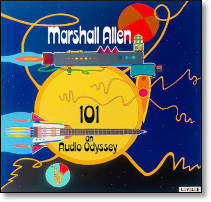
Ropeadope): Alto saxophonist, longtime member and ghost band leader
of Sun Ra Arkestra, title possibly for his age, main driver here
appears to be producer Jamaaladeen Tacuma (electric bass), started
around the Big Ears Festival, which brought in name musicians Nels
Cline (electric guitar) and Immanuel Wilkins (alto sax, acoustic
upright bass), with extra recording later (including a vocal by
Tara Middleton). The funk groove reminds me of Tacuma at his best,
but he hasn't had this much to juggle since Ornette Coleman.
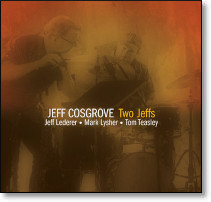
A− Jeff Cosgrove/Jeff Lederer/Mark Lysher/Tom Teasley: Two
Jeffs (2026, Grizzley Music): Drummer, from DC, label
and dates uncertain, I would normally have parsed the cover as
giving him sole credit, but title suggests including Lederer
(sax/clarinet), and the bassist and percussionist names are on
the same level. Cosgrove is best known for his Motian Sickness
group, but also shows up on many free jazz dates, especially with
Ivo Perelman. This showed up on the Motian Sickness Bandcamp page,
but is mostly standards, from "Cheek to Cheek" to "Summertime"
via "Swing Low, Sweet Chariot."
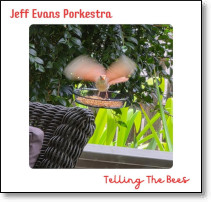
A− Jeff Evans Porkestra: Telling the Bees (2026, self-released): Atlanta-based country-rock band, the namesake on guitar and vocals; two previous EPs, this one weighing in at 12 songs, 42:49. The EPs ended before I could really get into them, but this one keeps coming, especially with songs like "Born to Read" and "Big Enough." A− Hurray for the Riff Raff: Live Forever: Live at the Old Town
School of Folk Music (2025 [2026], Nonesuch): Singer-songwriter
Alynda Segarra, born in the Bronx, moved to New Orleans to play folk
music, has moved on to Chicago, where this live set was recorded.
Fourteen songs, ten from her best-ever 2024 album The Past Is
Still Alive. Seems to me like the anti-ICE "Precious Cargo"
could be angrier, but "Ogallala"'s "to watch this world burn, with
a tear in my eye" seems about right.
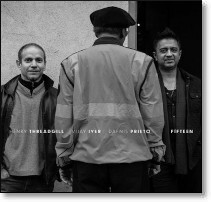
B+(***) Antony Szmierek: Decoding Birdsong (2026, Mushroom Music): English poet, spoken word artist, and electronica musician. Second album. I love the beats and sound. Words are clear enough: they didn't especially grab me at first, but eventually the savvy and smarts came through, and how they, along with some chorus, fit into the sound appeal. A− Henry Threadgill Zooid: Cut You Where You Was (2025 [2026], Pi): Alto saxophonist, also plays flute, started in Air in the 1970s, third group album since 2014, with Liberty Ellman (guitar), Jose Davila (tuba/trombone), Christopher Hoffman (cello), and Elliot Humberto Kavee (drums). Tricky rhythms and shadings, the sort of thing that in an artist of his stature could win a poll, but feels a bit slight to me, although it does have some bright spots. B+(***) Henry Threadgill/Vijay Iyer/Dafnis Prieto: Fifteen
(2025 [2026], Nonesuch): Alto sax/flute, with piano and drums,
some sources say the title is how long this trio has been playing
together, but this appears to be their first album. Three pieces
by Threadgill, two each by the others. Very impressive at speed,
interesting always.
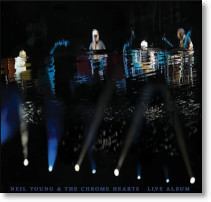
A− Neil Young and the Chrome Hearts: As Time Explodes (2025 [2026], Reprise): New group, came up with a pretty good album in 2025, Talkin to the Trees, first A− in my book since Barn (2021), Psychedelic Pill (2012), Fork in the Road (2009), Prairie Wind (2005), Are You Passionate? (2002), more before that, though I haven't logged any full-A albums since Freedom (1989), or A+ since Rust Never Sleeps (1979, a grade I also gave to 1975's Tonight's the Night). Of those, the only albums I've replayed in recent years are the ones from the 1970s, but clearly he can evoke his unique legacy whenever he feels the need. This live set is from the album tour, but only repeats one album song ("Silver Eagle") and offers one new title — the album's "Big Change" ("could be bad and it could be great") having quickly resolved to "Big Crime" ("got to get the fascists out, got to clean the White House out . . . got big crime in DC at the White House, no more great again"). Beyond that, we get legacy songs, some obscure, most not, a couple ("Cortez the Killer" and "Like a Hurricane") stretched past 10 minutes, because that's what he does. This doesn't strike me as essential, given that these days we get more live Young several times a year, nor is "Big Crime" a big deal (although it's good to see that he's gotten over his foolish Reagan infatuation). But reviving "Ohio" is not unlike John Prine's revival of "Your Flag Decal Won't Get You Into Heaven Anymore," "Vampire Blues" is an old one I was delighted to hear again, "Be the Rain" is a later one that surprised me, and any time Young wants to stretch out, I'm game. A− Emperor X: Unified Field (2026, Bar/None):
Singer-songwriter Chad Metheny, albums since 1998, first one I
really noticed was Western Teleport (2011). First pass
through I complained that I didn't get much, but I had to give
it another shot, especially after Michael Tatum raved about it
(adding that he had seen them live, which was "transcendent").
Three, maybe four, plays later, and I'm getting if anything
too much. I jotted down some lines: "praise Jesus, hail Reagan";
"I'd like to burn it down, but I'm not dumb"; "the market's not
good, the market's not evil"; "you're so mad, what are you going
to do about it?" Of course, you'll need more for context. But
what I'm left with is a sense of so much anger. Also a songwriter
who knows the difference between gallium and lithium. And, since
I'm more into sound than words, this only gets sharper. I doubt
I'll ever love this album, but it's hard to deny.
[was B+(**)]
A− Notes on Everyday Life, 2026-08-29 |