Blog Entries [0 - 9]Friday, October 16, 2026
Music Week
October archive
(in progress).
Music: Current count 46742 [46721] rated (+21), 24 [24] unrated +0).
Advance Music Week appeared October 16 on Substack as
Music Week (10:3). It is also archived
here. My cutoff was done
before the Substack post, but the introduction is revised/rewritten.
This has been a very rough week for me. Sacroilliac problems
flared up, a couple of times. I've been reassured that they go
away, and so far they have, but they sap all of one's energy and
patience until they do. I've also been working on my "what to do
about Israel" essay, and have blown my self-imposed deadline of
getting it done this week. I'm a good week away from having
anything presentable, although at the rate I've managed over
the last couple weeks, it may be two or three.
One consequence is that many days I've only felt like playing
Coleman Hawkins and Ben Webster, who still manage to lift me out
of the deepest funks. The rated count for this week is 21. That
doesn't count the Go-Betweens, which I added late, hoping to
fill my image gallery out (3 looks better than 2), but got cold
feet on.
There's an element of 1970s nostalgia in my top picks. Julius
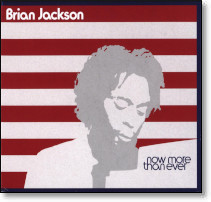
Eastman composed "Gay Guerrilla" in 1979. Most of Brian Jackson's
songs not only appeared in the 1970s. On NOEL, I wrote: "but were
topical in ways that still seem meaningful, but the closet hope
and surface pessimism has turned deeply cynical: the revolution
will be televised, but it won't change anything." This is too
convoluted for me to even try to straighten out. The album is
partly a Gil Scott-Heron Greatest Hits, except that the
wording has shifted subtly to reflect the current moment (most
notably, Black Thought's narration of "The Revolution Will Not
Be Televised"). However, the music is still rooted in the 1970s,
which gives it an optimistic bounce one rarely hears in neo-soul,
trip-hop, or hip-hop these days. As for "revolution," age and
bitter experience has soured me.
I have a lot coming up next week, starting with a showing of
Matty Wishnow's Robert Christgau documentary,
The Last Critic in Wichita at the Tallgrass Film Festival,
and a talk by
Phyllis
Bennis at Wichita's
Global Learning Center. I also see that Bennis has a book I
was unaware of, published in 2025:
Understanding Palestine and Israel. Her earlier
Understanding the Palestinian-Israeli Conflict: A Primer
is one of the best general introductions to the subject. I know her
a little bit, and have tremendous respect for her insights, although
I have serious doubts that
her hopes of organizing around the South African precedent will
bear fruit. Both events are likely to stimulate thoughts, but we'll
see about writing.
I alluded to "much more afoot." Main thing from my perspective is
that I'll be doing some cooking, which I am very much looking forward
to (assuming, of course, that my body doesn't fail me). I'll write
more on this (at least in the notebook, and possibly on
Facebook,
where my posts are generally public, and can be followed without
declaring friendship).
I suppose I should note that I've been banned from X, for what
they've called "inauthentic behaviors." All I've done there recently
has been to post short links to my blog and substack posts. But I've
gotten so few views there that it's hardly been worth the trouble.
I've asked for a copy of my data, but no response so far. While I am
still on
Bluesky,
it's more important than ever (well, at least for me) to subscribe to
Notes on Everyday
Life. What's unclear at present is whether I will ever feel like
engaging regularly with a Twitter-like social media service. They all
feel like yelling at a brick wall.
I've gotten a couple of enquiries in the last week regarding the
Francis Davis Jazz Critics
Poll, which is to say I'm already rapidly falling behind my job
there. I figure it will be my main focus starting in early November,
but fear I won't be able to get to it until then, and will wind up
repeating the same half-assed performance of the last several years.
New records reviewed this week:
300SkullsAndCounting/Jenny Sparks: This Is Spa Town!
(2026, XL, EP): British artist, maybe Hal Hewetson, has a self-released
2025 album, some more stuff on Bandcamp. Discogs lists the album style
as "screamo, chiptune." Sparks seems to be a bassline producer, not
evident in their video. 9 songs, 22:23. Normally I hate glitch pop,
but this at least has a pretty good beat.
B+(***) [sp]
Adéla: Prima (2026, Capitol): Pop singer-songwriter,
from Slovakia, last name Jergová, studied ballet in Moscow, danced
in Vienna and London, moved to Los Angeles, all by age 19, when she
got drummed out of HYBE's Dream Academy talent context (the
winners became Katseye). First album after an EP, starts hot, goes
through the various moves, most working well enough, few spectacular.
B+(**) [sp]
Alexis Cole: Taking My Seat: A Musical Inheritance
(2026, Tiger Turn): Standards singer and pianist, a dozen-plus albums
since 1999, sings familiar tunes quite credibly, backed by bass
(David Finck) and drums (Kenny Hassler).
B+(**) [cd] [11-09]
Julieta Eugenio: Mi Boathouse (2026, Dox):
Tenor saxophonist, from Argentina, based in New York, third album,
with Glenn Zaleski (piano), Matt Dwonszyk (bass), and Jonathan
Barber (drums).
B+(**) [sp]
Yosef Gutman: Perfect Traveler (2026, Soul Song):
Bassist, born in South Africa, studied at Berklee, based in
Jerusalem, has several albums. Started as duets with pianist
Yonathan Avishai, adding in woodwinds (Gilad Ronen) and drums
(Daniel Dor), with some spoken word narration I didn't catch.
Nice melodies, with airs from Morocco to Yemen.
B+(**) [sp]
The Hanged One: Limbo (2026, Relative Pitch):
Tenor saxophonist Camila Nebbia, from Argentina, based in Berlin,
leads a sextet, which opens very loud. With cello (Julia Bilat),
guitar (Arne Braun), electronics (Andres Marino), bass (Vinicius
Cajado), and drums (Lukas Akintaya). Varies a bit after the first
piece.
B+(**) [bc]
Nathan Hanson/Steve Hirsh: Memory Is Subjective
(2025 [2026], Mahakala Music): Saxophone (tenor/soprano) and
drums duo. Hanson has several albums and more credits going
back to 1995. Hirsh is a more recent regular on the label.
B+(**) [bc]
Marina Herlop: Dja Dja (2026, self-released):
Catalan pianist, sings some, her music tends to be classified as
electronic, fifth album since 2018. Some interesting bits.
B+(*) [sp]
Brian Jackson: Now More Than Ever (2026, BBE):
Composer, keyboardist, sings some (but delegates most vocals), best
known for his co-credits with Gil Scott-Heron (1974-80), has a few
solo albums since 2000. Recycles several well known Scott-Heron
pieces, including an updated "The Revolution Will Not Be Televised,"
while adding more of his most agreeable funk. I don't remember the
1970s as being as glum as "Winter in America," but 45 years after
Reagan's false springtime, this serves as a wake up.
A− [sp]
Shai Jaschek: Portrait (2026, Jazz Bird):
Israeli-born guitarist, based in New York, second album, trio
with bass (Joe Martin) and drums (Kush Abadey).
B+(**) [sp]
Matt Lavelle & the 12 Houses: Hymn to the Universe
(2022 [2026], Mahakala Music): Leader, who had developed distinctive
styles on trumpet and bass clarinet, opts for pocket trumpet and
E-flat piccolo clarinet here. Group is a big band built around
Zodiac Sax Quartet (including the late Clare Daly), with the brass
giving way for flutes and a bassoon, and viola instead of bass.
"No More Hate" breaks out into a chant.
B+(***) [bc]
William Parker: Waltz for Gregory (2023 [2026],
AUM Fidelity): The bassist, but just composer/producer here (Ken
Filiano fills in on bass) needs no introduction, but Gregory is
Hines (actor, singer, but most notably here tap dancer). Title
cut (14:27) has Melissa Almaguer tapping. Andrea Wolper sings
Parker's lyrics, which mean well but don't always sit easy on
the music, no matter how skilled her contortions. With Bruce
Barth (piano), Jim Ferraiuolo (oboe), Steve Swell (trombone,
terrific), and Kevin Murray (drums).
B+(***) [cd]
Jason Robinson: Blue Salience: For Yusef Lateef
(2025 [2026], Circumvention Music, 2CD): Saxophonist, albums since
1998, some quite ambitious, including this big band he calls his
Janus Orchestra. He plays some tenor sax and alto flute here, but
his main credit is percussion, followed by a long list including
cuica, clavinet, and synthesizer. This doesn't particularly work
for me, perhaps because I've never had a real sense of Lateef,
or maybe it just takes too much concentration to sort out what's
going on. Whatever it is, there's sure a lot of it.
B+(*) [cd] [10-29]
Sha Ray and DJ Haram: Critical Thot (2026, Backwoodz
Studioz): Bay area rapper, first album (9 songs, 24:37; Bandcamp
adds three remixes), with Philadelphia producer Zubeyda Muzeyyen.
Dense, seems close to breaking through but rarely does.
B+(*) [sp]
Nirosta Steel: My Skyscraper (2026, Ulyssa):
Stevan Hall, from Scotland (b. 1957), worked with Arthur Russell
in New York in the 1980s, his own discography only appearing
after 2012, with this his third album, a panorama of off-kilter
disco-funk artifacts.
B+(*) [sp]
Fumi Tomita: Yokai: Songs of the Japanese Supernatural
(2025 [2026], OA2): Japanese bassist, teaches in Massachusetts,
has several albums since 2011, original pieces here, with Carl
Clements (saxes/flute), Jason Ennis (guitar), and Gary Fieldman
(drums).
B+(**) [cd] [10-16]
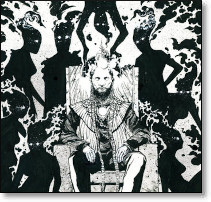
Wild Up: Julius Eastman, Vol. 5: Gay Guerilla (2026,
New Amsterdam): Self-described "band," a 20-piece orchestra by my
count, led and conducted by Christopher Rountree, which I figure
as 8 strings, 8 horns (trumpet and french horn for brass), 2 pianos,
2 percussion. They did various projects starting in 2014, but latched
onto Eastman (1940-90) in 2021 with Femenine, and return again
with one of the composer's more famous works (8 parts, 28:49). An
exceptional piece of music.
A− [sp]
Wishy: Nature's Pill (2026, Winspear): Indie rock
group from Indiana. Second album, Noted the VU quote. Guitar jangle,
seems possible that their name is a tribute to Wussy, not that I
care.
B [sp]
Recent reissues, compilations, and vault discoveries:
The Go-Betweens: Fountains of Youth: Live at the Town and
Country Club, London, 10th May 1987 (1987 [2026], Beggars
Banquet): Australian band, two major singer-songwriters, Grant
McLennan (1958-2006) and Robert Forster (b. 1957), both with
notable solo careers after 1990, although there were more group
albums 2000-05. The group's early work is definitively compiled in
1978-1990, but this live set, which previews a bit of their
penultimate Tallulah, works nearly as well.
B+(***) [sp]
Coleman Hawkins and Göran Lindbergs Trio: Bean and the
Swedish Boys (1963 [2026], Vax): The legendary saxophonist,
with a local rhythm section at the Golden Circle in Stockholm:
Göran Lindberg (piano), Kurt Lindgren (bass), and Rune Carlsson
(drums).
B+(***) [sp]
Old music:
Coleman Hawkins: Coleman Hawkins and Confrères
(1958 [1960], Verve): Original LP ran 5 tracks, 34:58: one track
with Ben Webster, Herb Ellis, and Oscar Peterson's Trio, plus four
more with Roy Eldridge, Hank Jones, George Duvivier and Mickey
Sheen.
[1988 CD reissue adds two bonus tracks, not on current stream.]
B+(*) [sp]
Freddie Jackson: Rock Me Tonight (1985, Capitol):
Soul singer (1956-2026), first album, first four topped the R&B
charts, their pop chart success declining from 10 to 59. "Mellow
groove, mellow sound. Just lie back and enjoy it."
B+(*) [sp]
New York Ska-Jazz Ensemble: Collection 1995-2004
(1995-2004 [2005], Megalith): Long-running group (latest LP 2022),
concept is to take jazz standards (like "Harlem Nocturne" and
"Haitian Fight Song") and play ska tricks on them. Starts with
four tracks from their 1995 debut, then two more from 1996, after
which I have trouble tracking the sources. Some live tracks. Some
vocals (including "Teardrops From My Eyes").
B+(**) [sp]
Wild Up: Julius Eastman, Vol. 4: The Holy Presence
(2024, New Amsterdam): "Digs ever deeper into Eastman's oeuvre,
performing lesser-known works that represent a mystically charged
and spiritually reflective vein of his dynamic catalog." Opens with
a vocal piece, "Our Father," sung by Davone Tines, followed by a
piano piece with Richard Valitutto, then on to the main event,
"The Holy Presence of Joan d'Arc" (20:09, following a 10:07
"Prelude" featuring Tines, too much of a "classical singer" for
me). Featured on the longer work is cellist Seth Parker Woods.
B+(*) [sp]
Unpacking: Found in the mail last week:
- Sylvie Courvoisier: Amalthea (Pyroclastic) [11-13]
- Satoko Fujii Orchestra Tokyo: Kappa Ondo (Libra, 2CD) [11-06]
- Brandon Sanders: The Game Changer (Savant) [10-30]
- Ed Hazell: Energy Center: A History of Studio Rivbea (NoBusiness): book
Ask a question, or send a comment.
Saturday, October 10, 2026
Music Week
October archive
(in progress).
Music: Current count 46721 [46680] rated (+41), 24 [31] unrated -7).
Advance Music Week appeared October 10 on Substack as
Music Week (10:2). It is also archived
here. My cutoff was done
before the Substack post, but the introduction is revised/rewritten.
Having done nothing but complain about my lack of productivity
in September, I'm further embarrassed to have even less to
show for the first third of October. It remains unseasonably hot,
topping 90°F several days (including today). It seems like most
of the time I'm just sitting at the computer, idly staring into
space. I'm pretty close to just declaring myself done. But I do
keep the music going, and this week the rated count went +41 (to
46721), and the unrated queue dropped by 7 (which counts CDs in
hand, but not the possible downloads I so rarely get to). Every
now and then, I snap close enough to consciousness to jot down
a few notes, as well as a letter grade, which is simpler than
calibrating adjectives, and serves as an aide de memoire to
albums I'm less and less mindful of.
But rather than write the entire week off, I suppose I could
mention that I have made some slow and fitful progress on a rather
serious essay about Israel I'm calling "Is It Possible to Negotiate
a Gentler Genocide?" There are four major words there, and each
presents serious problems, so one has to tread carefully. Yet one
also has to finish the essay, which means skipping over or evading
all sorts of deep digressions (including Godwin's Law). So I suppose
a certain amount of staring into space may not necessarily be due
to depression and lethargy. It's what we used to call thinking.
Yesterday's post on the Gaza
Apocalypse was a break for me: a chance to clear my head of
some thoughts I didn't want to put in the essay, but I still felt
like putting forth (e.g., the "eye-for-an-eye" line). And it helped
serve as a reminder of what October 7, 2023 was, and was not: despite
the drama, it was a mere blip in the much longer conflict; but it was
also a reminder that even as powerful as Israel is, ordinary Israelis
are not quite safe from the ramifications of their system of injustice.
As with
September 11, 2001, or for that matter the two Trump elections
in 2016 and 2024, the horror of the day was overshadowed by the
anticipation of horrors to come — a future that is far from
done with us. And it checked off a post idea that I had bandied
about for some time. The
Hussein Agha/Robert Malley book, Tomorrow Is Yesterday,
is one of the most insightful books available on the subject (at
least, of the
many I've read).
The break helped push this out to the end of the week. That's
probably the new normal, but it's nice to have no fixed day to
haunt me. Especially given that "work" here is so indefinite,
and so endless.
A couple of minor notes on the music. Two of the reviews were
initially written based on streaming, before I got a package of
CDs from Out of Your Head. (I probably had download links before,
but didn't bother.) Both resulted in upgrades. I doubt that would
happen very often, but it's likely that there are more that got
one stream play but could have benefited from more attention
(Knuffke/Crispell?, Peace Anthems?). I'm not pushing for
CDs, but sometimes they make a difference. (I suspect especially
on the big packages labels are so reluctant to provide. It takes
more patience than I can muster to slog through a long download,
but broken up into digestible pieces, with some packaging, can
really help. The Ma Rainey box is one I'm aware of, as is the
Dave Holland; the forthcoming 2-CD set of Jelly Roll Morton is
a bit more manageable, but still with old music much of the
value is in the packaging.)
I found the old live Jonathan Richman album after looking for
a new old one recommended by
Phil Overeem, which I didn't find. So not a sudden urge to hear
his old (or any unheard) stuff. Nothing more in the old music section
this time, after several weeks of going through Brad Luen's checklists.
There's a bit more to find there, but it's getting hard, and with so
much new music, checking out old is a rare luxury, or a an accident.
After I posted on Substack, I sent out my usual announcements to
X and Bluesky, and one to Facebook that combined mention of both
pieces. I then got mail back from X telling me my account is suspended.
The charge is "inauthentic activity," which covers a wide range of
offenses (see these quite explicit
definitions), none of which seem to be remotely applicable to
my activity today: one account, clearly identified as myself
(albeit without the blue checkmark), two tweets today, both with
one Substack url and a few words up front.
I've appealed, but it's quite possible I'm done with X. When I
went to look up what I had sent, I was challenged to prove I'm a
human. After I complied, they presented a second challenge: log in
to the X app on my phone. I don't have the phone app, and I have
no desire to download it, especially under duress. I've resisted
complaints about Elon Musk turning X into a fascist cesspool, as
bypassing the "for you" algorithm and just looking at those I was
following was usually still useful. Still, the value there has
steadily declined, while Musk's efforts at squeezing out more
revenue have become ever more annoying. My view counts have
declined from small hundreds into the teens.
Next week may be eventful: Matty Winshow's documentary about
Robert Christgau is coming to the Tallgrass Movie Festival, and
Phyllis Bennis is coming to speak at the Global Learning Center's
annual dinner. The week after that is my birthday, so I'm thinking
about cooking something rather fabulous. Then comes first Israel's
elections, then our own. I've started working on a
Loose Tabs that should
split the difference. After that, we will swing into Jazz Critics
Poll season, most likely once again unprepared. And I'm likely to
marvel, once again, at how quickly it all passes us by.
New records reviewed this week:
Jocelyn Balu: Borumba (2026, Vu Prod): Congolese
vocalist, member of Bakolo Music International, first solo album.
Touted as a future rumba star, hits the sweet spot, or as the
Bandcamp page puts it, "fidèle à ce qui constitue la signature
du genre et aux canons définis . . . de Nico à Luambo."
A− [sp]
Rahsaan Barber: Eternal (2025 [2026], Jazz City
Music): Saxophonist, teaches at UNC, several albums since 2011,
postbop quintet with guitar, piano, bass, and drums.
B+(**) [cd]
Matt Berninger: Type It Up (2026, Concord, EP):
Vocalist-lyricist for the National since their founding in 1999,
has two solo albums since 2020, plus this 5 song, 21:36 EP,
including covers of New Order's "Blue Monday" and Lou Reed's
"Who Loves the Sun."
B+(*) [sp]
David Binney: History:Memory (2026, Mythology):
Alto saxophonist, has several dozen albums since 1990, Discogs
counts 195 performance credits. This one is solo, using pedals
for synth overtones.
B [sp]
Nat Birchall Quartet: Live at Low Four Studio, Manchester
(2026, Ancient Archive of Sound): British tenor saxophonist, plays
"spiritual jazz," which is heavily indebted to Coltrane. Long-running
quartet, with Adam Fairhall (piano), Michael Bardon (bass), and Paul
Hession (drums).
B+(***) [bc]
Michael Blake: Halloween Tales (2026, Baby Tank):
Canadian tenor/soprano saxophonist, debut 1997, quartet with Gary
Versace (piano), Ben Allison (bass), and Michael Sarin (drums).
Mostly movie themes here, leading off with the theme from
Halloween, adding "Witchcraft" and "The Creep."
B+(**) [sp]
Sam Blakeslee Large Group: New Blood (2023 [2026],
Brooklyn Jazz Underground): Trombonist, debut album 2017, a quintet,
but has mostly worked in big bands since then. Conventional big
band, approximately, with guitar (Pete McCann), and a couple of
guest spots. Alan Farber produced, with Erica Seguine conducting.
B+(*) [sp]
Curly Castro: Yaphet (2026, Backwoodz Studioz):
Underground rapper, from Philadelphia, part of the duo Shrapknel,
solo debut 2013, last heard from in 2021, with Locust producing
the beats, and many features, notably Margel the Sophant.
A− [sp]
Amalie Dahl's Dafnie & Lisa Ullén: Live at Kafé
Hærverk (2025 [2026], Trost): Danish alto saxophonist,
group named for a 2022 album, freebop with trumpet, trombone,
bass, and drums, adding the Swedish pianist here.
B+(**) [sp]
Marty Ehrlich: Open Air: The Complete Saxophone Quartet
Compositions of Julius Hemphill (2025 [2026], Out of Your
Head): Hemphill was an alto saxophonist (1940-95), from St. Louis,
who recorded some important albums in the 1970s, but by 1977 was
putting most of his effort into the World Saxophone Quartet, which
has survived but never really replaced him. In recent years, there
have been several attempts to revive his compositions, as well as
releasing archival tapes. This is one of the most ambitious, with
Allan Chase, Rob DeBellis, Brian Landrus, Andy Laster, Jeff Lederer,
Lisa Parrott, and Jason Robinson joining Ehrlich. (There is also
one "forgotten" track from 1997.) My problem is the one that I've
long had with WSQ and its ilk: monophonic horns, focusing on harmony,
sound slow and stodgy. I was inclined to write this off, but the CD
showed up and got extra time, at which point the sheer beauty,
especially on disc 2, swept me away. [Spotify, which I listened to
initially, seems to be incomplete. Bandcamp only offers 5/42 tracks.]
A− [cd]
Event Horizon Jazz Quartet: Consternation (2026,
self-released): Chicago area group, second album after a 2020 debut,
led by Jim Kaczmarek (reeds) and Scott Mertens (keys), with Donn
DeSanto (bass) and Rick Vitek (drums).
B+(**) [sp]
Enzo Favata: Ritornare (2026, ECM): Italian
saxophonist (soprano here, with clarinet and bass clarinet), from
Sardinia, has a fair number of albums (18 per Discogs) since 1992,
this a group sometimes known as his Atlantico Quintet: Daniele de
Bonaventura (bandoneon), Marcello Peghin (10-string guitar),
Salvatore Maltana (bass), and U.T. Gandhi (drums). Folk-based,
intricate, and generally lovely.
B+(**) [sp]
Firelife Trio: The Space Around the Sound Resounds
(2025 [2026], Sonic Transmissions): Houston-based saxophonist
Danny Kamins (soprano and alto here), has several albums since
2017, here backed by Dennis Gonzalez's sons Aaron (bass) and
Stefan (drums).
B+(***) [bc]
Satoko Fujii Orchestra Nagoya: Kore Kara (2026,
Libra): Fourth installment in this year's avant big band series,
with one more still to come. Doesn't take off very fast, nor soar
very far, although it does have some moments.
B+(**) [cd]
Phil Haynes 2 Horns & What?: Avant Modern/Jazz Now
(2026, Corner Store Jazz, 2CD): Drummer, from Oregon, debut 1984,
early on was closely associated with Paul Smoker. Two trios with
two horns each: one with Nate Wooley (trumpet) and Peyton Pleninger
(saxes), the second with Pleninger and Jonathan Ragonese (saxes).
B+(***) [cd]
Kiefer: Memory Bomb (2026, Blue Note): Pianist,
mostly electric, last name Shackleford, from Los Angeles, sixth
album since 2017, first on Blue Note, in what seems to be a
return to the label's Mizell Brothers era (if you've forgotten,
and why shouldn't you?, there's a 1972-76 compilation that the
label released in 2005). I can't really hate the rinky-dink keys,
the synth ambiance, or even the slick guest vocals and raps, at
least until this slows to stall speed.
B− [sp]
Kirk Knuffke/Marilyn Crispell/Thommy Andersson: Paintbrush
(2024 [2026], Sunnyside): Cornet, piano, and bass, recorded near Crispell's
home base in Woodstock (actually, the late Karl Berger's studio, an
influence and inspiration for all). Perhaps worthy of closer study.
B+(**) [sp]
Kwn: And All Pride Aside (2026, RCA): British
singer-rapper Khyra Wilson, born in London, father Nigerian,
mother Irish, second album (Wikipedia has it as 3 EPs, but
this one is 11 songs, 38:47).
B+(**) [sp]
Miranda Lambert: Crisco (2026, Vanner): Tenth
solo album since 2005, probably the best track record of any
singer-songwriter in country music in that period, but this seems
like a major slip up, and not entirely for embracing the concept
of "country disco," whatever that is supposed to be. "Sunset
Marquis" is clearly disco, but not very good. "Crisco" is more
country, but also not very good. By the way, while my mother used
to fry chicken in Crisco, she gave that up long ago, for schmaltz
with a bare minimum of vegetable oil. I keep Crisco, but these
days only use it for
chicken and
dumplings.
B [sp]
Gregory Lewis: Organ Monk Sings: Introducing Ms Raina
(2026, Sunnyside): Organ player, released Organ Monk in
2010, and has stuck with that concept, here with album seven,
a trio with Jerry Weldon (tenor sax) and Nasheet Waits (drums),
adding singer Raina Welch this time.
B+(*) [sp]
Buddy Miller: Buddy Miller (2026, New West):
Alt-country singer-songwriter, from Ohio, has recorded on his
own or with friends since 1995, most significantly four albums
(2001-23) with wife Julie, who wrote or co-wrote five (of 12)
songs here. Buddy's songwriting is limited to three co-credits
with Julie. This is one of his "and friends" albums, with many
guest features.
B+(**) [sp]
Billy Mohler: Live in Europe (2025 [2026], Dox):
Bassist-composer, started in rock bands, studied at Berklee, eight
or so albums since 2019, this recorded at Bimhuis (Amsterdam) and
Carambolage (Bolzano, Italy), with Hermon Mehari (trumpet),
Francesco Bigoni (tenor sax), and Nate Wood (drums).
B+(***) [bc]
Tommy Muellner: Solitary Moon (2026, Calligram):
Pianist, first album, postbop quintet with label regulars Geoff
Bradfield (reeds/flute), Art Davis (trumpet), Clark Summers (bass),
and Phil Gratteau (drums). Three originals, many standards. Runs
79 minutes.
B+(**) [sp]
Ekep Nkwelle: Caged Bird (2026, Mack Avenue):
Singer, born and raised in/near DC, cites "musical worlds that
shaped her — jazz tradition, gospel reverence, contemporary
eclecticism and her Cameroonian heritage." First album, after
side-credits with David Murray, Kenny Barron, Joel Ross, and
Jazz at Lincoln Center. She could develop into Aretha Franklin,
but (like her) needs better songs and arrangements.
B+(*) [sp]
Marek Pospieszalski Octet: Ever (2025 [2026],
self-released): Polish tenor saxophonist, several albums since 2014,
including three on Clean Feed. Octet includes a second tenor sax,
trumpet, viola, guitar, piano, bass, and drums.
B+(**) [bc]
Jamie Safir: Momentum (2026, Chill Tone): British
pianist, first album as leader, several side credits back to 2017,
mostly trio with bass (Conor Chaplin) and drums (Luke Tomlinson)
playing originals, with Iain Ballamy (tenor sax) joining in on
about half of the tracks, staying uncharacteristically mellow.
B+(**) [cd]
Brandon Seabrook: Utility Modern (2026, Out of
Your Head): Guitarist, also plays banjo, many side credits back
to 2002, mostly free jazz but can veer into noise-rock. With
Bill Frisell (guitar), Rahsaan Carter (bass), and Marcus Gilmore
(drums). Bits of interest here when the banjo comes out, or when
they risk some noise.
B+(***) [cd]
Judi Silvano's Garden Winds: First Flight (2024
[2026], JSL): Singer, has a dozen albums since 1992, way too operatic
for my taste, especially in this company: Haruma Fukazawa (flutes),
Claire De Brunner (bassoon).
B− [cd]
Kevin Sun: Kevin Sun, II (2024 [2026], Endectomorph
Music): Tenor saxophonist, immediately impressed with his 2018
Trio, demonstrating considerable chops as well as a command
of history. By my reckoning, he followed that up with four more
A− albums, then slipped into the range of very honorable
mentions; meanwhile running a record label that regularly produces
interesting releases by others. This year he's come up with two
simultaneous quartet albums, both recorded on the same day, so the
numbering is rather arbitrary. This one I found more engaging,
perhaps because Christian Li's piano adds dimensions I didn't
find in the first volume, or maybe just because the saxophonist
seemed more engaged from the start. With Walter Stinson (bass)
and Kayvon Gordon (drums).
B+(***) [cd]
Kevin Sun: Kevin Sun, I (2024 [2026], Endectomorph
Music): Quartet with Max Light (guitar), Walter Stinson (bass), and
Jon Starks (drums), recorded the same day as II, presumably
first, as it feels more tentative early on.
B+(**) [cd]
Trio Imagination: Creative Inspirations (2025 [2026],
Pi): Last names on the spine: David Virelles (piano), Reggie Workman
(bass), and Andrew Cyrille (drums). The pianist has often impressed
me in the past, and one couldn't ask for a more storied rhythm section,
but 4-5 plays in I still have to force myself to listen closely, and
then it's just maybe.
B+(*) [cd]
Chris Whiteman/John Toomey Quartet: Live at Révéler
(2025 [2026], self-released): Guitar and piano, backed by bass and
drums. I'm only finding side-credits for both — more for Toomey,
who goes back to 1982, and has a Quartet but second-billed to a
singer (Laura Martier, in 2001). He's second here, nice accompaniment
to a very pleasant guitarist, who also slipped a couple of originals
in with eight standards.
B+(***) [cd]
Jerry Z: Break Allegro (2026, Drawbar): Hammond B3
organ player, last name Zaslavsky, possibly his first leader album,
but side credits go back to 2002, including with guitarist Oz Noy
and drummers Mike Clark and Lenny White — all noted on the
cover here, as is Chad LB (tenor sax).
B+(**) [cd] [10-09]
Recent reissues, compilations, and vault discoveries:
Roland Brival: Créole Gypsy (1980 [2026], Soundway):
Singer-songwriter from Martinique (b. 1950), first album, also has
a reputation as a novelist and painter.
B+(*) [sp]
Can: Live in Arles 1975 (1975 [2026], Mute):
German experimental rock group, released 10 studio albums 1969-79,
mostly a quartet of Irmin Schmidt (keyboards), Jaki Liebezeit
(drums), Michael Karoli (guitar), and Holger Czukay (bass),
some vocals early and late, but not much here. They had several
reunions, but only Schmidt is still alive. During this period
they had evolved into a something of a fusion-jazz band, like
Soft Machine, and this set, the 7th in a series of restored
live tapes, moves along deftly, its pieces merely numbered.
B+(***) [sp]
Stanley Cowell Trio: Illusion Suite (1972 [2026],
ECM): Pianist (1941-2020), debut album was memorably titled Blues
for the Viet Cong (1969, the first of two on Freedom), co-founded
the Strata-East label in 1973, but recorded this one album for ECM,
a trio with Stanley Clarke (bass) and Jimmy Hopps (drums), playing
his own compositions.
B+(***) [sp]
Sir Roland Hanna: Songs of Hope, Inspiration and Joy
(1990s-2002 [2026], IPO): Pianist (1932-2002), from Detroit, started
in big bands in the 1950s, was a regular with Thad Jones/Mel Lewis,
faded in the 1980s, but late in life recorded several albums for IPO,
from which this largely undated solo work is drawn.
B+(**) [sp]
Peace Anthems (2026, Red Hook): A compilation of
13 new pieces, featuring: Qasim Naqvi, Taylor Deupree, Kalia Vandever,
Thomas Morgan, BlankFor.ms, Moor Mother, Sungjae Son, Martha Deribe,
Simone Maggio, Wadada Leo Smith, Amina Claudine Myers, Andrew Cyrille,
and Kit Downes. Intent is to "approach peace as both subject and sonic
practice." In practice, that leans toward ambient, notably with the
Smith-Myers "Reflections on Palestine."
B+(**) [sp]
John Prine: Found Dogs (1995 [2026], Oh Boy):
Folkie singer-songwriter (1946-2020), from Illinois, recorded
four 1971-75 albums long regarded as classics, then three more
for Asylum little remembered, then he started his own label.
It took another decade before he released one of his all-time
albums (The Missing Years, in 1991), followed up by the
even-better Lost Dogs & Mixed Blessings (1995). Then
he got cancer, wrecked his voice, and struggled, sometimes
brilliantly, until Covid cut him down in the early days of the
pandemic. His widow still runs his record company, and they've
cultivated some fine talents (most famously Todd Snider and
Kelsey Waldon), but the meal ticket is still his back catalog.
The first five songs here are alternate versions of songs from
the album, each interesting in its own right. The other five
songs, including a Johnny Horton cover, are lesser affairs, at
this point more endearing for the singer than for the songs.
B+(***) [sp]
Old music:
The Modern Lovers: Precise Modern Lovers Order: Live
in Berkeley and Boston (1971-73 [1994], Rounder):
Jonathan Richman's group, from Boston, had recorded an album
produced by John Cale in 1972, but unreleased until 1976, at
which point it sounded prophetic. Live tapes from the period,
very lo-fi, includes a cover of the Velvet Underground's
"Foggy Notion" among their originals, some I haven't heard
elsewhere.
B+(*) [sp]
Unpacking: Found in the mail last week:
- Peter Brendler: And Then, Nothing (Lost Song) [11-13]
- Stephan Crump: Passerine (Out of Your Head) [10-23]
- Marty Ehrlich: Open Air: The Complete Saxophone Quartet Compositions of Julius Hemphill (Out of Your Head) [08-28]
- Mali Obomsawin: Automatic (Out of Your Head) [10-16]
- Marc Ribot Quartet: Hurry Red Telephone (Pi) [10-30]
- Brandon Seabrook: Utility Modern (Out of Your Head) [10-02]
Ask a question, or send a comment.
Saturday, October 3, 2026
Music Week
October archive
(in progress).
Music: Current count 46680 [46640] rated (+40), 31 [25] unrated +6).
Advance Music Week appeared October 3 on Substack as
Music Week (10:1). It is also archived
here. My cutoff was done
before the Substack post, but the introduction is revised/rewritten.
September in Wichita is usually hot, and this one was hotter for
longer than any I can recall. The heat finally broke last week, so
the coming of October wasn't such a surprise. But very little of
what I imagined doing in September got done, which leads me to the
apprehension that October won't be any more fruitful. Take this past
week, straddling the two months, for instance. I started the week
figuring I should do the minimum effort to close out
Loose Tabs, which I finally did on Sept. 30, with 16414 words.
As I had, in the meantime, neglected Substack, I figured the least
I could do was to write up a
short overview, which took two more days. That pushed my cutoff
back to Friday evening, this advance synopsis to Saturday, and the
full report? Here it is.
While I wound up listening to quite a lot of music last week
(40 albums), I didn't write much about most of them, and struggled
to pick out six for the advance. (My original plan was to do 6-8
albums, but I've often wound up with 9. I think this is the first
time I've settled on six. And two of the A− albums
were promoted at the last minute, although they struck me as likely
contenders from the first hearing.)
Some of the records below were left over from
Christgau's Consumer Guide. More were left over from working
off the
Brad Luen checklists.
While I haven't checked everything off, I've pretty much hit my
limit there. I also sent in a ballot for Brad Luen's
1996 poll. I wasn't keeping annual lists then, but I did have a
1996 list that I must have hacked
together later (judging from the formatting, around 2005). Once I
decided to vote, I did some due diligence and consulted my database
for 1996 albums. I compiled them into a much larger
updated list, with 68 A-listed
new music albums, and 91 old music compilations.
That ratio's probably typical for me in the 1990s: that was a
golden decade for reissues, as the industry was urging you to replace
all your old vinyl with shiny overpriced discs. I probably bought
more new music in the 1990s than in the 1980s, but much less than
in the 1970s, when I was just starting out. Sure, I blamed my turn
away from new music on grunge and gangsta, but I was also looking
for a much better understanding of the past. To that end, I scoured
through record guides, compiled lists, and went shopping —
mostly in the bargain used piles.
I was obsessive enough at both that when Michael Tatum offered
to publish a column by me, my choice was
Recycled Goods. I might also note
that earlier, back in 1996 in fact, Robert Christgau asked me to
review Rhino's jazz anthologies, in a piece the Village Voice
published as
Jazz for Dummies. It
still offers a fair sense of where I was at as a fledgling jazz
fan in 1996, including the now quaint line, "some 900 CDs later,
I'm still learning new things." Well over 9000 CDs later, I worry
that I've finally entered the phase of just coasting, but this
week's old music (and not just the ultra-obscure Jon Waine) is
mostly still new to me.
Plans for October: try to write up that Israel-genocide essay;
add some significant detail to the "Weird" book outline; do the
groundwork for the
Francis Davis Jazz Critics Poll, including at least some rough
scaffolding for his future website; sign up for at least one
AI tool; clean up some things around the house, including an
initial stab at filling up and emptying the recycling kiosk;
make a birthday dinner (I'm thinking I'll finally try my hand at
Italian, but ingredients are harder to find around here than my
recent stabs at Burmese and Indonesian, and I see other problems
with selection and staging, so this could get tricky). But the
only thing on that list I'm actually looking forward to is the
cooking, which I've done far too little of recently.
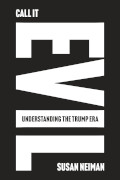
By the way, I just finished reading Susan Neiman's
Call It Evil: Understanding the Trump Era. I may have
some minor quibbles, but she's very clear on the need to base
one's politics on ethnics and to speak of it in moral terms.
The book may already have had some effect in how I approached
stories in Loose Tabs. I admit I was so turned off by how GW
Bush used "evil" — he meant someone who could only be
dealt with by killing — that I gave up on using the word.
I now see my mistake as his clever ruse, as his use is precisely
what evil means. It's no coincidence that the best book of recent
American history is Kurt Andersen's
Evil Geniuses: The Unmaking of America: A Recent History
(2020).
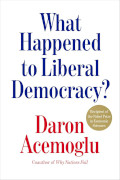
By the way, there is not a lot of practical difference between
Neiman's book and Daron Acemoglu's
What Happened to Liberal Democracy?, but Neiman argues for
socialism (while disavowing communism and/or marxism), while Acemoglu
tries to fashion something similar out of liberalism, calling his
version "working-class liberalism." Both labels are tarnished, both
by their enemies and by their adherents. On the other hand, it's
hard to speak of something until you give it a name, so we're
likely to be struggling with this for some while.
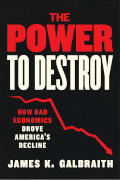
Next on my "nightstand" is James K Galbraith's
The Power to Destroy: How Bad Economics Drove America's Decline.
Galbraith's books,
The Predator State: How Conservatives Abandoned the Free Market and
Why Liberals Should Too (2008) and
The End of Normal: The Great Crisis and the Future of Growth
(2014), are among the best books I've ever read on the politics of
economics.
New records reviewed this week:
1-800-Mikey: In Yun (2026, Goner): Australian
lo-fi bedroom pop group, principally Michael Barker, fourth album
since 2022.
B+(*) [bc]
RJ Chesney: A Southern Man (2026, Man of Straw):
Singer-songwriter born in Macon, raised in Biloxi, figures he knows
better than others what makes a Southern Man, among which he counts
Johnny Cash, Jimmy Carter, and MLK.
B+(**) [sp]
Mike Dana Jazz Orchestra: Farther (Still) (2025
[2026], Origin): Guitarist, studied at Berklee, taught at Fresno
City College (1990-2018), since 2015 has been involved with Jazz
Education Abroad, teaching in Lebanon and elsewhere. Has some
reputation as a composer, but this appears to be his first album
as leader. Big band, a bit short on brass, with two (of five)
sax slots given to oboe and bassoon, but "special guests" added
for solos: trumpeters Aaron Janik and Ingrid Jensen; saxophonists
Eric Marienthal, Bob Mintzer and Tim Ries.
B+(*) [cd]
Defcee & Steel Tipped Dove: We Will Be Brief
(2026, Fused Arrow): Chicago rapper Adam Levin, several albums since
2018, with producer Joseph Fusaro. Brief indeed: 12 songs, 28:24.
But packed with ideas, quips, and deft beats.
A− [bc]
Daniel DeLorenzo: Can You Not (2026, self-released):
Guitarist, has several albums on Bandcamp and Spotify since 2017,
but I can't find a Discogs listing. Trio with bass (Theous Jones)
and drums (Casey Toll). Seven songs, originals plus a noise-laced
Schumann, 27:57.
B+(**) [cd]
Dinosaur Jr.: Near There (2026, Jagjaguwar):
Indie rock band, appeared on SST in the 1980s, this their 13th
studio album, I was never much impressed by them, although I
did like one J. Mascis solo album (Several Shades of Why),
and one of Lou Barlow's Sebadoh albums (Barksdale).
B+(*) [sp]
FaithNYC: Love Is a Wish Away (2024, Creation Youth):
Singer-songwriter Felice Rosser, from Detroit, old enough to recall
the 1967 riots, not sure when she moved to New York, but she released
an album as Faith in 1997. Plays bass and sings, with Fin Hunt (drums)
and Justin Adams (guitar/percussion/keyboards). With notions of funk
and punk and dub for context, something that is not like anything else.
B+(**) [sp]
Diego Figuerido: Horse Blues (2026, Arbors):
Brazilian guitarist, quite a few albums since 2005, first appeared
on this retro-swing label in a 2019 duo with Ken Peplowski, and
has been a regular since then. With his brother Tacio Figueiredo
on bass, plus keyboards (Gi Reis), harmonica (Uira Cabral), and
drums (Anderson Matos). Sophisticated easy listening.
B+(*) [sp]
Chad Fowler/Eri Yamamoto: Polkadots & Moonbeams
(2024 [2026], Mahakala Music): Duets, alto sax/flute and piano,
improv pieces, aside from a start with one Fowler wrote, and the
title song at the end.
B+(**) [bc]
Shelley Hirsch/Christian Weber/Alfred Vogel: Vanish
(2024 [2026], Boomslang): Composer/vocalist/performance artist
(b. 1952), a dozen albums and many side-credits since 1985, backed
here by bass and drums.
B+(**) [sp]
Katseye: Wild (2026, HYBE/Geffen, EP): "Global
girl group," originally six singer-dancers from four countries
but based in Los Angeles, modeled on K-pop — where HYBE
is a big label, accounting for their initial sales advantage in
South Korea. Third EP, down to five on the cover, but just four
performed on their recent SNL feature. Five songs, 13:37, three
released as singles so far ("Animal" the best).
B+(**) [sp]
Azar Lawrence: Turn the Music Up (2026, Trazar):
Tenor saxophonist (also soprano), 1974 debut was an especially
strong album, faded away in the 1980s but came back strong in
2007. Returns to his early songs here, pushing the "spiritual
jazz" dimensions, even including "The Creator Has a Master Plan."
B+(**) [cd]
Carla Marciano: Daydreaming: My Beloved Father Giovanni
(2025 [2026], Challenge): Italian alto/sopranino saxophonist, from
Salerno, several albums since Trane's Groove in 2002, an
influence, backed by piano-bass-drums, supplemented by string
orchestra on several tracks.
B+(**) [cd]
Branford Marsalis and Dianne Reeves: Dedicated to You
(2026, Blue Note): Presented as a John Coltrane tribute, the idea is
to have Reeves sing the six songs from 1963's ballad album, John
Coltrane and Johnny Hartman, backed by the saxophonist and his
quartet: Joey Calderazzo (piano), Eric Revis (bass), and Justin
Faulkner (drums), who add instrumentals, three as bonus tracks.
The Coltrane/Hartman album has long struck me as one that should
be great but isn't — although Coltrane's Ballads,
from the same year, is so sublime you have to blame Hartman.
Reeves is a superb singer, but that doesn't seem to help much
here. Most modern saxophonists are indebted to Coltrane, and
few more so than Marsalis. But why aim for his most anodyne
gestures?
B+(*) [sp]
Gretechen Parlato: The Wise Ones (2026, Edition):
Jazz singer, from Los Angeles, father is a well-known bassist,
and grandfather was a trumpet player; eighth album since 2005,
writes some and also draws originals from Alan Hampton (bass)
and Josh Mease (guitar), so the closest thing to a standard is
a Stevie Wonder song arranged by Robert Glasper (one of three
pianists). Rather pretty.
B+(*) [sp]
Houston Person: From the Heart (2026, Arbors):
Mainstream tenor saxophonist, started with Prestige in 1966, where
he also did A&R, continuing with Joe Fields through the Muse
and HighNote labels, so it's a surprise to see him show up on a
different label (especially one that's been relatively quiet of
late). With Eddie Allen (trumpet), John Di Martino (piano), James
Chirillo (guitar), Sean Smith (bass), Vincent Ector (drums).
Standards, nicely done, easy.
B+(***) [sp]
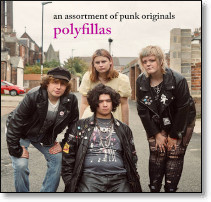
Polyfillas: An Assortment of Punk Originals
(2026, Dangerous): Punk band from Sunderland, in far northeast
England (just southeast of Newcastle), principally Ava and
Jamie Dangerous. First album, an EP (whence "Rude Boys of
England") and several singles. Title suggests a formal
exercise, more a love letter to history than the upswell
of primal rage that drove punk in the 1970s. But now I'm
old enough I not only don't mind, I applaud.
A− [cd]
Julian Davis Reid and Circle of Trust: Mercy We Need
(2026, Too Lost): Pianist from Chicago, also a theologian, has a
previous album with this group, side projects like the JuJu Exchange,
side credits with Isaiah Collier and Jamila Woods. Five songs feature
Tramaine Parker (vocals), four Lenard Simpson (alto sax, one both).
My appetite for the gospel vocals is pretty limited.
B+(*) [cd]
Andy Sheppard: Salt Catchers (2025 [2026], ECM):
Tenor saxophonist (also soprano), albums since 1987, especially
with Carla Bley. Trio with Rita Marcotulli (piano) and Michel
Benita (bass).
B+(*) [sp]
Bria Skonberg: Indigo (2025 [2026], Cellar):
Canadian trumpet player and singer, ninth album since 2009.
One original, the rest standards, from "Mood Indigo" through
Sting, the most striking a Jacques Brel-Rod McKuen song, "If
You Go Away."
B+(***) [sp]
Skyzoo & Apollo Brown: Luxury Tax (2026, First
Generation Rich/Escapism): Underground rapper Gregory Skyler Taylor,
from New York, couple dozen albums since 2006, including a previous
with Detroit producer Brown.
B+(**) [sp]
Wadada Leo Smith: Constellations and Hemispheres
(2017-22 [2025], Burning Ambulance Music): Trumpet player, five
pieces (59:10) recorded over several years, the first track with
piano (Sylvie Courvoisier) and drums (Marcus Gilmore), the others
with more players, peaking out at 10 for the 22:05 centerpiece.
B+(***) [sp]
Tinashe: Popstar (2026, Atlantic/Nice Life/Tinashe
Music): Pop singer-songwriter, last name Kachingwe, father from
Zimbabwe, born in Kentucky, grew up in Los Angeles, eighth album
since 2014.
B+(***) [sp]
Tres Hongos: More Chips (2024 [2026], Relative Pitch):
Trio of Jacob Wick (trumpet), Marc Riordan (piano), and Frank Rosaly
(drums), third album, widely spaced since 2012.
B+(**) [sp]
Lex Walton: Ultimate Love Forever (2026, Sub Pop,
EP): Singer-songwriter, some kind of noise-pop, cites Les Rallizes
Dénudés as inspiration, Wikipedia cites a discography going back to
2018 but this is probably the first one with any real distribution,
a short one at that (7 songs, 19:50), but gets your attention.
B+(**) [sp]
Recent reissues, compilations, and vault discoveries:
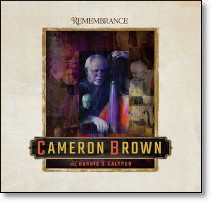
Cameron Brown and Dannie's Calypso: Remembrance
(2011 [2026], Sunnyside): Bassist, b. 1945 in Detroit, first
albums in his Discogs list were: Massimo Urbani, Beaver Harris,
and George Adams/Don Pullen Quartet; although his first side
credits were with George Russell, and one quickly notices Archie
Shepp, Mal Waldron, Dewey Redman, Dannie Richmond, and Sheila
Jordan. The band name here is a tribute to Richmond, and song
titles name Russell, Jordan, and Don Cherry, and the songs
include material by Richmond, Redman, Cherry, and Jobim.
Quintet: Lisa Parrott (alto/soprano/baritone sax), Jason
Rigby (tenor/soprano sax), Russ Johnson (trumpet), and Tony
Jefferson (drums). That roster suggests serious postbop, but
the reality is raucous freebop, with a nod toward calypso.
A− [sp]
Jon Waine: Second Skin (1975-1983) (1975-83 [2026],
Corbett vs. Dempsey): New Jersey experimental/post-punk band,
principally Brian McCormack (guitar) and William Pope (vocals, aka
Pope.L, who "went on to have an illustrious career as a conceptual
visual artist"). They produced one single in 1982 (per Discogs,
"Do the Tic/Boogie Down the Congo," now "impossibly rare"). This
gathers up 30 recordings, putting the more mature 1980-83 material
on the first CD, with home recordings from 1975-81 filling out a
second CD. Interesting sound here, some novel kind of fractured
no wave funk, the closest analogue Pere Ubu (with nothing quite
like David Thomas or Peter Laughner). This could have been
edited down, but history is inevitably messy.
B+(***) [bc]
John Larkin: Before Scatman: Early Sessions (1978
[2026], Iceberg, EP): Jazz pianist/singer (1942-99), grew up with
a stuttering problem, which he overcame first by playing piano,
then by scatting. He recorded five albums 1986-99, most as Scatman
John. These four songs (23:13) came earlier. Surprisingly intense.
B+(*) [sp]
Old music:
Lola Beltrán: Voz E Inspiracion (1975, Peerless):
Mexican singer and actress (1932-96), specialized in ranchera and
huapango music, many albums from 1954 on. Not hard to identify
this is specifically (dramatically, even operatically) Mexican.
B+(**) [yt]
Daniel DeLorenzo: Trio (2017, self-released):
Guitarist, from North Carolina, first album, with Theous Jones
(drums) and Able Jones (organ), plus extra guitar on two tracks
(Doug Sours). Seven jazz standards, from "Work Song" to "Straight
No Chaser," 38:02.
B+(**) [bc]
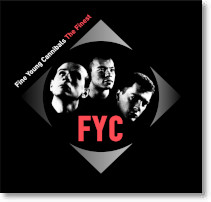
Fine Young Cannibals: The Finest (1985-89 [1996],
MCA): British ska-pop band, founded by David Steele and Andy Cox
from the Beat, with Roland Gift as the singer (who also had a star
turn in the Stephen Frears/Hanif Kureishi movie Sammy & Rosie
Get Laid). They released two albums, reduced to 10 songs here,
plus a soundtrack cut and three previously unreleaseds for bait.
A− [sp]
Fine Young Cannibals: The Finest: The Rare and the
Remixed (1985-89 [1996], MCA): Second disc adds three extra
songs and five remixes, total 43:07, nothing essential or important
or unlistenable. Just the extras, without trying to factor in the
best-of:
B+(*) [sp]
F.S.K.: International (1995 [1996], Sub-Up):
German group, founded 1980 as Freiwillige Selbstkontrolle
("voluntary self-control"), went with initials around 1989.
Kind of a folk-rock grounding, but more eclectic, perhaps
even whimsical (not that it's easy to tell).
B+(**) [sp]
Violeta Parra: Las Últimas Composiciones De Violeta Parra
(1966, RCA): Chilean folk singer-songwriter (1917-67), collected
songs from all over, but also wrote these, recorded simply with
her guitar and percussion.
B+(***) [sp]
Astor Piazzolla: Sinfonia De Tango (1955, Disques
Vogue, EP): Argentinian tango composer, first album, 10-inches, 8
songs, 23:04, further credited to "su bandoneon y sus cuerdas"
(strings, from Orchestre National De L'Opéra De Paris, along with
Lalo Schifrin on piano.
B+(**) [sp]
Scatman John: Scatman's World (1995, RCA): John
Larkin, recorded a couple of previous albums under his own name,
turned his stutter habit into a unique mix of rap, scat, and
jaunty pop schtick. This album turned into a novelty hit,
especially in Japan (where it sold 1.5 million). Features a
utopian anthem, "World of Scatland."
B+(*) [sp]
Idrissa Soumaoro & L'Eclipse De L'I.J.A.: Le
Tioko-Tioko (1978, Eterna): From Mali, seems prototypical.
B+(**) [sp]
Zuhura Swaleh/Matano Juma & Orchestra Morning Star:
Karama Zijiri (1973, Pwani): Originally a cassette,
split between the two singers, ladies first. While the band
could be backing both, Juma's singles credit it, and my rough
impression is that he gets the more polished support. Swaleh
was born in 1947 in Nairobi, later moved to Mombasa, on the
coast with a long history of Arab trade, where the local style
is called taarab, and the influence is decidedly Arabic. (The
Zanzibara series includes a volume subtitled L'âge
d'or du taarab de Mombasa, with several recordings each
— Swaleh's are credited to Zuhura & Party or Zuhura
& Zein Musical Party; they also appear on Zanzibara 10:
First Modern, Taarab Vibes From Mombasa & Tanga.) I
know less about Juma, but he is also associated with taarab.
B+(**) [yt]
Caetano Veloso: Bicho (1977, Philips): Brazilian
singer-songwriter (b. 1942), one of the founders of the Tropicália
movement in the late 1960s, and a major figure ever since, but
someone I've sampled very lightly over the years.
B+(***) [sp]
Yellow Magic Orchestra: Yellow Magic Orchestra
(1978, Alfa): Japanese synthpop group, originally a one-shot
project of bassist Haruomi Hosono, but developed into a band
with drummer Yukihiro Takahashi and keyboard player Ryuichi
Sakamoto. Nice beats album, but vocals eventually seep in,
and clutter increases.
B+(*) [sp]
Yellow Magic Orchestra: Solid State Survivor
(1979, Alfa): Japanese electropop group, debut 1978, second
album, continued until 1984, then reformed briefly in 1992,
2002, and 2007: Haruomi Hosono (bass/keyboards), Yukihiro
Takahashi (vocals/drums), and Ryuichi Sakamoto (keyboards),
the best known for his solo career (d. 2023). Opens with
instrumentals, lighter and quirkier than Kraftwerk or even
Can, then breaks the vocal ice with an amusing "Day Tripper."
B+(**) [sp]
Unpacking: Found in the mail last week:
- Stephen Braude With Yamara Band: Big Dipper (self-released) [10-01]
- Roni Eytan: Melody People (PKmusik) [10-30]
- Giveton Gelin: Island Dreamer: III of III (ID) [11-01]
- Clay Giberson: Moment's Notice (Origin) [10-23]
- Danny Green: Let the Music Happen (OA2) [10-23]
- Clarence Hines Jazz Orchestra: Along the Way (OA2) [10-23]
- Devra Hoff: Baile as Baile (AUM Fidelity) [10-16]
- Reza Khan: Shadow Dancers (Painted Media) [10-30]
- James Brandon Lewis/Red Lily: Calling Antonin (TAO Forms) [10-23]
- William Parker: Waltz for Gregory (AUM Fidelity) [10-09]
- Matthew Shipp/William Parker: A Whole System Of (TAO Forms) [11-06]
- Ron Vincent: Ray's Hat Trick (Origin) [10-23]
Ask a question, or send a comment.
Tuesday, September 30, 2025
Loose Tabs
There's no easy way to wrap this up, but as Miles said to Trane,
sometimes you just got to take the horn out of your mouth. I rest
assured that anything I missed below will only become more glaringly
obvious next month, and if it doesn't, good thing I didn't bother.
I wrote some more notes on this piece for
Notes on Everyday Life (archived
here).
This is an occasional collection of newsworthy links and comments,
much less systematic than what I attempted in my late
Speaking of Which posts. The name comes from my extensive
use of browser tabs. When I get around to cleaning up, I often find
tabs opened to old articles I might want to comment on and/or refer
back to. So
these posts are mostly
housecleaning, but may also serve as a very limited but persistent
record of what 20+ years ago I started calling "the end of the American
empire" and nowadays feels more like "the end of civilization." I
collect these bits in a
draft file, and flush them
out when periodically (12 times from April-December 2025, not much
more often in 2026).
My previous one appeared 34 days ago, on
August 27.
By the way, I've been trying to write some more in-depth pieces on
major issues (and/or personal peccadillos), using Substack as an email
agent. I call this series
Notes on Everyday Life. I used to have a pinned list of pieces
here, but as they've grown, I've moved them into
separate index.
I also have a
Notes feed there. While I've done very little with it so far,
it occurs to me that I might be able to use it to publish Loose
Tabs items and Music Week reviews as I write them, instead of
having to wait for a long compilation post.
Table of Contents:
New Stories
Most stories fit into well-established categories, organized below as
Major Threads. Some sources I lean on so
regularly they have their own
Regular Columnists section. I also have an
End Matter section for dealing with regular
occurrences like books, obituaries, and tweets. Stories that don't
fit into any regular category appear under
Miscellaneous Stories. However, occasionally
a short-term story blows up to where it needs extra attention, in
which case I included it here.
Examples from last time:
Trump's War on Canada; Data Centers (see
AI); Meta Settles Lawsuit.
That Republican National ("Trumpapalooza") Convention: After
some fact checking, I added a missing "pa" to the parenthetical,
after noticing that it sounded too much like "Trump's a loser." This
was a blatant grab for media attention, but the net effect was to
remind everyone that the 2026 elections will be about Trump, even if
his name isn't on the ballot. Nothing important happened, but too big
to bury the stories under Republicans and/or Trump, where more will
no doubt surface.
Nia Prater/Chas Danner [09-10]:
The wildest, weirdest moments from day one of the GOP Midterm
Convention: "From Trump's desperate pleas to Hasan Piker's
underwear, here's how Republicans tried to convince Americans to
let them keep Congress." New York Times [09-11]:
Trump floats $5,000 checks to Americans if Republicans win midterms:
"The president offered a 'dividend' to every adult citizen if Republicans
keep control of Congress. But his sagging approval ratings could endanger
his party's chances in November." Pinned article, among many more "live
updates." Wouldn't it be funny if the Democrats swept Congress then sent
him the bill? — possibly loaded with a bushel of "poison pills,"
like funding it with taxes on the rich, and prohibiting the president
from implementing tariffs and military operations without congressional
approval (things that would make it even more popular). I'm not saying
this "dividend" is a good idea. My first thought is: how much does Trump
think Republicans can steal by hanging onto Congress? The estimated cost
is about $1.3 trillion. Even if they just tack that onto the national
debt, that's $1.3 trillion they could steal for themselves. Still, with
tax breaks, a 50% bump in useless military spending, sweetheart contracts,
lax regulation, and fraud everywhere you loook, they could still come out
ahead. Especially if they don't deliver. What's their penalty for that?
You're going to vote them out of office? Then why didn't you? Astead Herndon [09-10]:
The GOP midterms strategy is Trump and a prayer: "What we learned
from the first day of the Republican convention in Dallas." Stephen Fowler [09-11]:
Empty seats, socialism and Trump dominate the Republican midterm
convention: Link text says "7 takeaways from the 'Trumpapalooza'
Republican . . . ," but the article comes up short:
- Republicans have an enthusiasm problem
- The message emphasized personal attacks over policy
- The rise of the -isms: Communism, Socialism, Marxism, Terrorism.
- What war?
- 2028 looms over everything
- It may be too late to turn the tide
Joseph Gedeon [09-12]:
Calls for Democrats to be shot go unchallenged at Republican convention:
"Crowd member repeatedly said some Democrats 'should be shot' during
Ted Cruz's speech, without senator responding." David Smith [09-12]:
Trump personality cult alive and well in Dallas: I dropped the rest
of the title, which continues, "will it power Republican midterm success?"
Sarah Jones [09-26]:
America last: Picture is from the Convention, but the article is
mostly about Trump's pro-immigration policies that offer free rides
to white people from South Africa and Zimbabwe. I wonder if there's
any polling of the MAGA base on that.
The 25th Anniversary of 9/11:
Tom Hull [09-10]:
Remembering 9/11: "Notes from a highly personal turning point."
I pull some bits from my online notebook, a reminder that even then
I realized that America's kneejerk reaction was only going to make
matters worse. Thomas Alleman [09-10]:
The end of the world as we know it: "Where were you on 9/11?
Same place as me: In front of the TV, gritting my teeth." Jon Schwarz [09-10]:
The most terrifying thing about 9/11 was America's response: "The
fear I experienced that terrible day in New York doesn't begin to compare
with the dread I've developed watching our path since."
In the weeks after 9/11, I told friends who didn't live in New York
that Al Qaeda had really put the terror back in terrorism. But the
fear I experienced that terrible day does not begin to compare with
the dread I've developed since. On September 11, 2001, I realized that
I was on Al Qaeda's list. Since then, I've learned that I'm also on
the list of the far more mighty people in charge of America, just a
little further down. Even with the most concrete dangers facing us
— the destruction of a livable biosphere, an enduring pandemic,
and much more — they are absolutely committed to following the
same path, driven onward by complex delusions. Power tends to corrupt,
not just in a standard moral sense but also intellectually and
emotionally, and they've held extreme power for a very long time. What
I know now that I didn't know then is that if we let them, their
corruption will surely destroy us all.
Michael Arria [09-11]:
25 years after 9/11, our country is still dominated by the "War on
Terror": Its "legacy is everywhere, from rampant Islamophobia,
to another open ended war on Iran." Elie Mystal [09-11]:
The US had a choice after 9/11. It chose wrong. Nick Turse [09-11]:
Osama Bin Laden won: "The architect of the September 11 attacks
dreamed of the destruction of America. In the last 25 years, his
wish has come true." Well, sure, that part of Bin Laden's plan came
true, or is coming true, as the corpse of American empire is still
animated, twitching and lashing out, still causing incalculable harm
to itself and the world. But the other part of Bin Laden's dream,
that devout Muslims would rise up against the impious charlatans who
ran Saudi Arabia, the Gulf States, Iraq, Syria, Egypt, and the rest
of the Muslim world, that didn't happen, the only flickers of revolt
occurring in the vacuum of states that were mere collateral damage
of the Americans, like the Iraq/Syria borderlands, Libya, Somalia,
and Mali. Meanwhile, Israel, whose leaders were giddy with delight
on 9/11, has become ever more genocidal, as US presidents Biden and
Trump have given up any consideration of independent thought.
Bin Laden's bleed-until-bankruptcy plan was designed to sink America's
economy — and it continues to work to great effect. And by
ushering in the presidencies of Donald Trump, bin Laden left the
United States morally bankrupt, too. Twenty-five years after 9/11, the
country is a pale shadow of the superpower that emerged from World War
II having been laid low not by the Soviet Union — the
nuclear-armed power it long considered an existential threat —
but by two trust-fund terrorists: the scions of a Saudi construction
empire, and an outer borough New York City real estate developer,
respectively.
Scott Hibbard [09-08]:
25 years after 9/11, the US still doesn't know 'why they hate us':
"The War on Terror showed the perils of seeking military solutions
for political problems. Policymakers never got the message." Thomas Palley [09-11]:
An American tragedy: the woeful self-inflicted consequences of 9/11.
Pam Bailey [09-11]:
9/11 began 25 years of nonstop war and abuses of power: "Never
forget: the attacks brought us into an era of torture, the erosion
of civil liberties, and the destruction of multiple Middle East
countries." Robert Wright [09-11]:
Always forget: My own personal takeaway from 9/11:
But if I were in charge of US foreign policy, the message I'd try to
get out is: "Forget! Forget! Forget!" Dwelling on 9/11 is what
initiated and helped sustain a disastrous quarter century of American
adventurism abroad.
I mean, sure, if America's leaders had rationally assessed the
causes of the 9/11 attack, dwelling on it could have been
productive. They might have started by looking into the conditions
that gave birth and subsequent energy and direction to al Qaeda, and
pondered the following possibilities: (1) Maybe the US shouldn't have
staged a proxy intervention in Afghanistan two decades earlier that
flooded the place with weapons and created the cauldron that enticed,
shaped, and revved up a young Osama bin Laden (and also created the
violent chaos that allowed the Taliban to take control of Afghanistan
— a position the Taliban used, during the runup to 9/11, to
provide safe haven for bin Laden and al Qaeda). (2) And maybe, after
the Persian Gulf War of 1991, the US shouldn't have established an
enduring military presence in the Islamic holy land, Saudi Arabia
— a presence that became a persistent and powerful bin Laden
grievance and helped direct his belligerence toward America.
Conceivably, such reflections on the past could have led to such
ideas about the future as: Maybe what the US should avoid after 9/11
is further military adventures in Muslim countries. After all, such
adventures might continue to be conducive to the creation or growth of
militantly anti-American groups — and might also prove a godsend
for any terrorist recruiters who wanted to focus their efforts on
young alienated men already living in America.
If the memory of 9/11 had set in motion trains of thought like
this, I'd be OK with remembering.
Major Threads
War on Iran:
Jeremy Scahill/Ryan Grim [07-15]:
Iran sent message to JD Vance warning that Kushner and Witkoff were
"abusing" their inside access to negotiations: "A senior Iranian
official said Tehran privately told Vance the pair were exploiting
the negotiations for financial gain." Trita Parsi:
Ashley Gate [08-31]:
Ecocide in Iran: "The US-Israeli war has caused massive environmental
devastastion, adding to the long history of American wars with toxic
legacies." Dave DeCamp: Editor at
News.Antiwar.Com, where he publishes a couple stories every day
on wars everywhere.
Nick Turse [09-15]:
Iran War has the US military on the brink of a "breakdown": "As
the US military faces relentness attacks on its bases, the Iran conflict
is 'ultimately unsustainable,' one US official told The Intercept." I
don't know if "breakdown" is the right word, but the US military is
accustomed to fighting against enemies who can't fight back, so Iran
is proving difficult. It's conceivable they could regroup and slog it
out, but with Trump wavering and no public support for objectives no
one understands, and the institution's own combination of lethargy
and corruption, that seems unlikely. The main hope right now is that
to save their own skins, the brass may decide to stop giving Trump
military options, leaving him no alternative but to sue for peace.
The dynamic that I've observed so far is that Trump will take the
most aggressive option the military offers, but he won't order them
to do something they're dead set against. Elfadil Ibrahim [09-17]:
How Saudi Arabia's anti-Houthi strategy crashed and burned: "Eleven
years after intervening in Yemen's war, Riyadh may be forced to negotiate
with Ansar Allah on the group's terms." The biggest story of September
so far is how the Houthis in Yemen have expanded their control, while
Saudi Arabia's Red Sea pipeline has been demolished, blocking their
ability to bypass the Hormuz Strait. Karthik Sankaran [09-17]:
With Mideast on fire, oil prices are poised to explode: "Damage to
a crucial Saudi pipeline has forced Riyadh to delay shipments to Europe,
possibly into November." Troy Farah [09-19]:
Trump's Iran war has economists aghast: "No 'endgame' in sight,
says JPMorgan, as gas prices keep soaring." Jeremy Scahill/Murtaza Hussain/Reza Sayah [09-30]:
Massacre at Minab: The school that became a grave: "The bombing of
an Iranian school, killing 120 children, is one of the worst US war
crimes since Vietnam. Drop Site spoke to survivors, first responders,
parents, and witnesses. This is their story."
Israel:The focus here is on Israel's wars, especially against
their own people, and on internal Israeli politics. A second section
will address Israel's relations with the world, especially the US.
Jonathan Ofir [08-28]:
Meet the new 'superstar' of the Israeli left, who's so progressive
she only supports apartheid: "Naama Lazimi is being hailed as the
Israeli left's rising star. But when she isn't busy making excuses for
the genocidal turn in Israeli society and politics, she's advocating
for a return to good old-fashioned apartheid." Tareq S Hajjaj:
Basel Adra [09-16]:
'Everything necessary for human life was erased': "In the span of
a week, Israeli bulldozers demolished Al-Taban and northern Fakhit,
two neighboring Palestinian communities in Masafer Yatta. When residents
helped each other stay on the land, soldiers came to make arrests." Mohamed Al-Astal [09-18]:
Inside Gaza's death trap of collapsing, bombed out buildings: "With
more than 40,000 Palestinians sheltering in collapse-prone buildings and
a 'nightmare' winter approaching, Gaza's Civil Defense warns of a
preventable catastrophe unfolding in plain sight." Mahjoob Zweiri [09-18]:
Israel is killing the people who could end its wars: "From Iran to
Gaza and Lebanon, assassinations have repeatedly removed figures capable
of negotiating an end to conflict." As the article points out, "the
precedent is old," citing the assassination of UN mediator Count Folke
Bernadotte in September, 1948. Enas Abu Ghayad [09-21]:
No body, no death certificate: the bureaucratic limbo trapping the
widows of Gaza's missing men: "In Gaza, women whose husbands are
missing or buried under the rubble are facing a little-known crisis.
Without death certificates for their husbands, they're locked out of
bank accounts, aid, and custody rights, trapped in bureaucratic limbo
amid genocide." Al Jazeera [09-24]:
Arab parties denounce ban from Israel's October election: "Excluding
Ra'am and the Joint List leaves Palestinian citizens in Israel without
major Knesset representation options." Amos Brison [09-25]:
The 'gray arm' of Israeli annexation: "A settler-led wing of the army
is driving Palestinian displacement on the state's behalf." Interview
with Yagil Levy. Jamal Zakkout [09-29]:
Netanyahu is embracing Israel's isolation: "Netanyahu's speech at
the UN General Assembly was not directed at the world, but Israelis.
He was trying to convince them that Israel doesn't need to change, as
long as it stands united against the world — and lives by the
sword." Tamir Sorek [09-29]:
The pardon of Elor Azaria: Killing, maiming, and culpability in the
Israeli law: "Israeli courts put on a show of indicting criminals
who kill and maim Palestinians, but the final verdict — a
presidential pardon and a hero's welcome — is already
predetermined."
Israel-American-World Relations: This section deals with
Israel's relations with the world, especially the US, both at the
state level and regarding public opinion.
Antony Loewenstein [07-28]:
Israel's end game in Palestine is a land with no Palestinians:
"A decades-long campaign of dispossession is accelerating fast."
I meant to cite this article when it came out, but it keeps slipping
my attention. Not much of an article, but the title is clearly the
point. Or would seem to be, if you accept that Israel has an "end
game" — that it is possible to satisfy them, so that they
finally bring the carnage and dispossession to an end. I'm skeptical.
It seems more likely that they're so much in love with the game that
they will stretch it out as long as possible. Michael Arria:
[09-03]:
House passes bill blocking schools from boycotting Israel:
"An anti-BDS bill passed in the House 237-169 with heavy AIPAC-backed
Democratic support, as the Trump administration quietly extends its
Iran deployment to 2027 despite 63% of Americans opposing the war." [09-11]:
Democrats are in a 'death match' with the Left over Israel. How will
it impact the midterms? "Political consultant Peter Feld breaks
down the primaries, AIPAC's losses (and wins), the attacks on Hasan
Piker, and why a demoralized GOP and Democratic infighting could both
shape the midterms in unexpected ways." [09-17]:
Macklemore, Ed Sheeran, and a new lawsuit against Columbia:
"Macklemore was pulled from Ed Sheeran's tour after pro-Palestine
remarks and Robert Kraft's alleged pressure campaign. Columbia
University faces a new lawsuit from Mahmoud Khalil and fellow
activists over its handling of Palestine-related harassment." [09-22]:
Power & pushback: Paramount-Warner Bros. merger moves forward:
"Paramount's merger with Warner Bros. moves forward, cementing pro-Israel
Ellison family's grip on American media. Noura Erakat is arrested
testifying against an Israeli Bonds investment, and Stanford drops
charges against 5 pro-Palestine protesters." [09-23]:
What you need to know about Robert Kraft, the pro-Israel billionaire
who pressured Ed Sheeran to drop Macklemore: "Robert Kraft got
Macklemore ousted from Ed Sheeran's tour over 'Free Palestine.' A
look at the NFL owner's record makes it clear why: funding the IDF,
fighting BDS, courting Netanyahu, and bringing football legends on
tours of Israel." Andrew O'Hehir [09-14]:
US allies' dramatic Israel pivot: They're done taking orders from
Washington. Xavier Abu Eid [09-15]:
Why Latin America is key to Israel's diplomatic impunity: "While
alienating traditional allies, Israel is deepening ties with a new
wave of right-wing populist leaders who are willing to shield it from
accountability." Dave Zirin [09-15]:
Justice for Macklemore: "The rapper has been dumped from Ed Sheeran's
tour for saying 'Free Palestine.' That's a disgrace." Well, obviously,
it's Palestine that needs justice, not Macklemore. But note first that
the person who claims credit for blacklisting Macklemore is Robert Kraft,
who thanks to the people of Massachusetts owns the stadium Sheeran was
scheduled to perform at. Ariana Aspuru/Noel King [09-18]:
The film infuriating the Israeli government: "Almost no one has
seen NAZA yet, but almost everyone has something to say about it."
Made by two Israeli filmmakers, Rachel Szor and Yuval Abraham, the
movie takes place on the rooftops of Tel Aviv, where 24 anonymous
Israeli intelligence agents and soldiers discuss things that they did
in Gaza and how they did them.
As Bilge Ebiri writes in his Vulture review of NAZA, "One
officer recalls blowing up a building with 500 people in it to go
after one target. They admit to knowingly wiping out entire
neighborhoods, fully aware of the catastrophic human toll." Another
interviewee agrees that Israel is committing a genocide in Gaza.
Interview with Shany Litman, who also hasn't seen the film, but
has been reporting on it. She says, "There's a really long history
of films that were criticized, especially by different culture
ministers. But I haven't seen anything like this, like what is
happening now. This is really frightening." Some more on
NAZA:
PS: From a
tweet, I see this quote from an article in the Atlantic (I
haven't tracked it down, and it's probably paywalled anyway):
NAZA could have asked its viewers to identify with these
soldiers, to see the potential in themselves to do exactly as they had
done, to be vigilant against such corrosive thoughtlessness. But this
film does not want to be a mirror. It wants to tell us that there is
something uniquely malevolent about Israeli society.
Perhaps that's because there is?
Zack Beauchamp [09-21]:
Settler violence is now upending American politics on Israel:
"It's so bad now even Mike Huckabee is recoiling."
But Huckabee's outrage reflects something deeper. Settler terrorism,
once relatively uncommon, has exploded in severity in recent years
— with wink-nudge support from Prime Minister Benjamin
Netanyahu's government.
The violence is so egregious, and so indefensible, that retired
Israeli generals have compared the settlers to Nazis and demanded
action to stop them. In mid-September, the INSS — Israel's top
national security think tank — issued a strategic alert warning
that "Jewish terrorism" had become a national crisis and even an
existential threat to Israel's future.
"As history teaches us, democracies that fail to restrain radical
forces within them do not survive," the alert argues.
In Washington, settler terrorism against Palestinians has flipped
the Israel debate on its head. Congressional Democrats, who have long
been divided over the Gaza war, have come together to support
legislation that would impose sanctions on Israeli politicians and
corporations implicated in the violence. The Trump administration, the
most pro-settlement White House in American history, has very
conspicuously stood aside as Canada and European nations implemented
sanctions of their own.
Gerry Shih [09-24]:
An unabashed Netanyahu assails critics in UN speech as election nears:
"Israel's leader delivered a blistering defense of his country, appealing
to voters back home and condemning critics including New York mayor Zohran
Mamdani." So he went all the way to the UN, an institution which Israelis
loathe, to give a domestic campaign speech, knowing full well that no one
in the UN wanted to hear any of it. (Most had in fact already walked
out.) Jonathan Ofir [09-25]:
Netanyahu just incited genocide in his UN speech. Here's what you
missed.: "At the end of Israeli Prime Minister Benjamin Netanyahu's
unhinged rant at the UN, he recited a seemingly obscure Bible verse.
But it's actually a dog whistle for genocide." Varsha Gandikota [09-25]:
Israel and the US have battered the international legal order. The
impunity must stop. Leon Hadar [09-25]:
The worst-case scenario for Israel isn't Tehran: "It's the American
electorate." He notes that, "among Democrats, unfavorable views of Israel
have reached 80 percent." Sure, Republicans still favor Israel 70-13,
but does Israel really want to depend on Trump as a character witness?
Khaled Ezzelarab [09-26]:
The evolution of New York Times opinion on Gaza: From unconditional
support to bounded criticism: "Since the start of the genocide
in Gaza, the so-called paper of record has begun to update its
language on Israel, reflecting a larger shift in US public opinion."
Well, slowly, fitfully, and not at all for Bret Stephens. Joseph Gedeon [09-29]:
US Senate blocks resolution demanding accountability over Israeli
violence in West Bank: "Nine American citizens have been killed
by Israeli settlers or security forces in occupied West Bank since
2022." The only Democrat to vote against Chris Van Hollen's
resolution was John Fetterman (D-PA).
Ukraine, and Other World Politics: A catch-all,
where the focus is away from, but not unaffected by, Trump's wars.
Wen Stephenson [09-08]:
A reckoning comes for Nepal: "A year after its Gen Z uprising, Nepal
faces a struggle not only for democracy and human rights but for climate
survival." Nepal is in the news after catastrophic flodding caused by
melting glaciers caused by, well, you know.
CJ Polychroniou [09-09]:
Germany's fascist party just won control of a state government:
"The Alternative for Germany party's victory in the Saxony-Anhalt
state election is an ominous coup for the far right." Zack Beauchamp [09-09]:
A Nazi-curious party just won big in Germany. The White House
approves. "How a very dangerous state election in Germany helps
reveal Trump's real foreign policy." Note especially that Elon Musk
has spoken at AfD rallies. Vance and Rubio have also spoken out in
favor of the AfD. I've sometimes referred to Steve Bannon's efforts
to organize a World Brotherhood of Fascists, but what practical value
do nationalists have in cooperating with each other? It's true that
the US has long supported certain fascists abroad, but that's usually
for lack of a liberal alternative in face of a left-wing threat. This
just looks like a circle jerk. Sandra Davidovic [09-16]:
What NATO leaves behind as it pulls back from Kosovo: "27 years
after the Western intervention in Yugoslavia, the alliance is starting
to withdraw despite ongoing tensions." Matthew MacKenzie [09-22]:
China is outfoxing the US in the battle for Mideast influence:
"Washington's military posture comes with huge risks and responsibilities,
easing Beijing's burden in the region." As Trump continues to trip up,
the US is certain to lose "influence" in the region, but China doesn't
seem to be in any hurry to pick up the slack, possibly because they
don't view America's idea of "influence" as either tenable or desirable.
As usual, Americans are projecting their own character flaws onto others.
It's easy for Americans to imagine that China, as our sworn enemy, might
want to cause us trouble, like the US did to Russia in Afghanistan. But
ask yourself, how well did that work out for America? Steve Bloomfield [09-26]:
In his final UN speech, Macron may have given other leaders a valuable
parting gift: the guts to stand up to Trump. Some day every reputable
politician in Europe is going to claim to have opposed Trump. All Macron
did was wait until the last possible moment. Mitchell Plitnick [08-28]:
Saudi Arabia's desperate situation: "After relying on an unreliable
Trump for defense, suspending normalization talks with Israel, and losing
access to the Bab-al-Mandab Strait, Saudi Arabia turns to hesitant allies
for help."
Trump's War Department: I set this section up to deal with Trump's
threats of war. We're obviously beyond that now, so see the section on
Iran for more on that.
Heather Digby Parton [09-01]:
Trump's Venezuela oil deal is even sleazier than you think. Medea Benjamin/Nicolas JS Davies [09-01]:
Throughout Latin America, US backs autocrats in the name of liberty:
"Trump regime is supporting a range of ruling-class right-wing leaders
who will do as America orders." Assuming what America orders is what
they want to do in the first place, which is to rip off their own
people. Trump and Rubio are in tune with them, as long as they get
their cut. Blaise Malley:
[09-02]:
What Huckabee is doing about dead Americans in the West Bank:
Contrary to the subhed, his job as ambassador to Israel has never been
"supposed to protect our citizens," but to service Israel in killing
whoever they want, a job that pales next to his true calling, which is
to usher in the apocalypse. [09-03]:
House to universities: Don't you dare boycott Israel: "Legislation
that could strip federal aid from campuses passes by a 236-169 vote." [09-04]:
Witkoff & Kushner to spend Labor Day weekend in Russia, Ukraine:
"The diplomatic duo is hoping that the window has not closed on a peace
agreement," which is a pretty generous interpretation given that they've
never shown any actual interest in peace. More likely, they're just
sniffing around for bribes. [09-11]:
Will 'America First' survive Trump's war-first presidency?. If
the definition of America being "Great" is simply that Donald Trump
is president, isn't "America First" simply whatever Trump wants?
And since Trump's wants are incoherent, anything is possible: first
in war? first in peace? At least one Trump prediction proved right:
what we'd grow tired of his "winning" and beg him to stop. [09-15]:
Vance claims US 'on top' of Red Sea crisis. Houthis say otherwise.
[09-16]:
New Russia sanctions amid war risk even higher gas prices: "House
passes legislation with significant bipartisan support, sending it to
the president's desk." Republican vote was 203-7 yea; Democratic vote
was 152-58 nay, which suggests to me that Democrats are not as hawkish
on Russia as they once were. [09-22]:
In UN speech, Trump threatens to 'annihilate' Iran if no deal reached:
"Speaking to General Assembly, he also touted both is peacemaking record
and an increasingly belligerent US foreign policy." This is too insane
to paraphrase:
Trump presented the past year as proof that military force and
economic pressure could resolve conflicts that diplomacy had failed to
settle.
"As president of the most extraordinary nation in history, I have
no interest in leaving dangers to grow for another day," he declared.
"I do not believe in letting problems fester; they only become harder
to solve. So while others have talked, I have acted."
The leading example of this approach, Trump said, was Iran, which,
in his telling, has rejected Washington's diplomatic overtures that
had pushed Trump to take military action with Israel in June 2025
and then launch a much larger-scale war beginning at the end of
February.
My bold. The past year has proved exactly the opposite.
None of the conflicts are settled. (Even Venezuela, where the still
intact Bolivarist regime has chosen to humor him with graft rather
than fight him, at least as long as they're in on the graft.) As
for the guy who can't stand to let problems fester, what about
climate change? Sure, he'd say it isn't a problem, that it's all
just a hoax, but we've seen nothing but festering for 30-40 years,
and it's feeling pretty real. As for who's willing to negotiate
with whom, Trump's two major offensives against Iran occurred
during negotiations, not in their breech. More outrageously dumb
things follow, like calling people who point to dwindling munitions
stockpiles "cowards and traitors," and especially this: "Whoever
wins superintelligent wins. That's the group that wins, and we're
leading now over China by a lot, and everyone else, and we're
going to keep it that way."
Mark Thompson [09-03]:
Pentagon puts $131 billion price tag on 1970s-era fighter:
"The F-15 has been upgraded since it first flew but the sheer
size of the sum is staggering." Boeing's contract for upgrading
F-15s is more than the entire 2009 Air Force budget. Meanwhile,
the more modern (and more useless) F-35 is getting even more
expensive. Daniel L Davis [09-08]:
Hegseth has been a disaster. It's time for Trump to fire him. Bess Levin:
Kelley Beaucar Vlahos [09-15]:
Massie tells RS why he went after Hegseth and not Trump: "The
Kentucky congressman has rolled out eight impeachment articles against
the defense secretary and is forcing a vote on Thursday." [PS:
Hegseth avoids impeachment vote with early House election recess.] Chas Danner [09-18]:
We almost went to war with China thanks to AI-hallucinated intel:
"'AI-first' Pentagon almost tried to seize a Chinese ship after an AI
chatbot convinced an analyst it was carrying nuclear components." I'd
back up a bit here, and ask whether the US should seize Chinese ships
regardless of what they were carrying? Gregory A Daddis [09-20]:
Pete Hegseth declares war — on his own troops: "The defense
secretary's crusade is inflicting damage unlike any in history. . . .
The U.S. military is being impaired not by some determined overseas
enemy but rather by its own leadership in a fratricidal war against
cultural bogeyman." Andrew Cockburn [09-22]:
Nuclear war could be just another hallucination: "Military discussing
how to use AI to launch." Lee Schlenker [09-22]:
Trump and 14 Lat Am leaders ignite new drug-terror war at UN:
"Leaders designated 24 cartels, gangs, and drug trafficking groups
as foreign terrorists. Expects lots of guns, ammo, and drone strikes
to follow." Ellie Quinlan Houghtaling [09-25]:
Hegseth issues veiled order to military to vote Republican in
midterms: He says there are 300,000 "warriors" who are not
registered to vote. Even if he manages to correct that, I doubt
the net vote gain will be as much as he thinks. Could even go
negative, as most "warriors" would be better off avoiding war
zones. Caitlin Dewey:
[09-28]:
Trump's China reversal: "The president made confrontation with
China core to his political identity. Now he's walking it back."
This might be an interesting story, but Trump's too incoherent to
give it any sense. Actually, I have no problem with Trump sucking
up to Xi. I just wish he had better reasons than trying to get Musk
and Zuckerberg an audience with Xi. But I also wish Xi could use
his leverage to nudge Trump away from his current warpath. [09-24]:
Why Americans are warming to China: "More than half of Americans
still say they view China negatively. But that percentage is dropping."
No explanation given. Maybe the propaganda is losing its grip? Andrew Day [09-29]:
Yes, the Iran War has destroyed Trump's presidency. He's far from
unique: Lyndon Johnson and George W Bush are the most obvious precedents;
Truman was no less unpopular after Korea dragged on; Biden was unfairly
slammed for Afghanistan, but his trenchant support for wars he didn't
start in Ukraine and Israel had the same effect. George HW Bush may
have claimed two wins, but they did him no credit. Arguably the only
American presidents who might have burnished their legacies in war
were Lincoln and Franklin Roosevelt, but both died before they had to
face the voters again. (Unlike Churchill, who was soundly rejected
after being widely acclaimed during WWII.) I suppose you could point
to Madison, Polk, and/or McKinley, if you go back more than a century.
Wilson won his war, but he lost his peace. Still, no American war has
been this unpopular this quickly.
Trump vs. Law and/or Law vs. America: From ICE to the Supreme
Court and the assault on democracy.
Gillian Brockell [08-31]:
'What America did to me is wrong': Inside one of the largest third-country
removal flights so far: "On July 31, an estimated 71 detainees
were expelled to various countries on a hellish flight to Africa.
Many were then illegally returned to their home countries." This
sort of thing is being tracked by
Third Country Deportation Watch, where one learns that Trump
has signed agreements with "at least 35 countries," and more than
23,000 people have already been sent to 26 countries. Ian Millhiser:
[08-30]:
One of the Supreme Court's worst ideas could save the midterms from
Trump: "The new opinion blocking Trump's attempt to sabotage voting
by mail makes a savvy play for several Republican justices." [08-31]:
The Supreme Court just gave Trump his illegal ballroom: "And the
justices didn't even bother to explain why . . ."
Nevertheless, the five Republicans in the majority manage to rule in
favor of Trump by effectively immunizing his ballroom from federal
lawsuits.
Their opinion highlights two of the most troubling things about the
current Supreme Court: its reluctance to impose limits on Trump's
imperial-style presidency, and the frequent incoherence of its
reasoning, especially in Trump cases.
Their opinion suggests that no one is allowed to sue to challenge
Trump's decision to destroy and replace much of the White House. But
it is short, does not explain key points of its argument, and relies
on several distinctions that do not make any sense.
[09-01]:
A federal judge just discovered a whole new way to place ICE above the
law: "Texas is where MAGA goes to escape the rule of law." [09-03]:
Republicans ask the Supreme Court to give them a huge discount on ad
spending: "You are probably about to see a lot more Republican
ads." The RNC raises much more money than the DNC does, so extending
the discount rate to party committees favors Republicans. Moreover,
"Republicans want Trump's FCC, and not the courts, to decide who gets
the discounted rate." [09-09]:
Republicans suffered a stunning Supreme Court loss. It lasted minutes.
"What the hell is going on with Missouri's congressional election?"
The "lasted minutes" comment refers to a Trump district judge issuing
an order to override the Supreme Court's rejection of the gerrymander
— note that the rejection wasn't to the gerrymander so much as
the procedures Missouri Republicans used to run around state laws. [09-10]:
The Supreme Court just handed Republicans a surprisingly decisive
midterm loss: "For the second time this week, the Court rules
against Missouri's Republican gerrymander." [09-15]:
The Supreme Court has finally had it with Trump's plan to steal the
midterms: "The Republican justices often put a thumb on the scale
to benefit the GOP, but not all of them will put a boulder on it."
The vote was 7-2 against Trump's scheme to use the USPS to create
obstacles to mail-in ballots. I'm skeptical of Trump's assumption
that mail-in ballots favor Democrats, let alone help Democrats cheat,
so I don't expect this to have much effect on the outcomes. But the
other point for Trump was probably that he wanted to cast doubts on
the results, and to create chaos around voting. The Justices were
smart not to allow that. They seem to understand that discrediting
the integrity of the political system would be much worse, especially
for themselves, than simply losing a midterm election that will in
any case leave Trump as president. [09-16]:
The successful campaign to make a terrifying Supreme Court immigration
case disappear. [09-28]:
Big Oil has an audacious request for the Supreme Court: "What on
Earth is the 'structure of the Constitution'?" [09-29]:
The next generation of Republican justices will be even more partisan:
"Trump's lower court judges won't even listen to the Supreme Court when
it tells them 'no.'" Andrea Suozzo/Agnel Philip [09-09]:
Ectopic pregnancy deaths have nearly doubled. It's worse in states
with abortion bans. Elie Honig [09-23]:
The First Amendment doesn't care if Trump gets bad press.
Trump's Administration: Trump can't remake America in his own
image (i.e., destroy the country, culture, and civilization) just by
himself. He needs help, and having largely purged the government of
civil servants and replaced them with his own minions, this is what
they are doing — whether he's paying attention or not, and that
it's mostly not is no excuse: he sets the tone, then distracts the
media with his own insanity.
Donald Trump: The cult (or should I say sinkhole?) of personality.
While most of the bad things he has done and is doing are the work of
his administration, and many of their bad ideas are deeply ingrained
in the Republican Party, he hogs the spotlight, giving them a uniquely
pungent odor.
Harold Meyerson [08-24]:
Clone Natalie Harp! "Every insecure American deserves a Natalie." John Ganz [08-24]:
Trump's third-worldism: Some interesting notes here on Trump's
use of tariffs:
Trump's tariffs increasingly function less like uniform rules than as
the opening bid in negotiations between firms and the state. For
instance, Pharmaceutical companies can obtain tariff exemptions by
reaching pricing and investment agreements with the administration. An
even clearer example comes from the polysilicon sector: Trump imposed
new Section 232 tariffs, but simultaneously authorized Commerce to
approve company-specific "onshoring plans." If Commerce approves a
firm's plan, that firm can import covered products and production
equipment without paying the tariff, in quantities Commerce judges
commensurate with the firm's investment. Commerce can vary the
benefits and later rescind them if it decides the company has not
lived up to its commitments.
To sum up, the government first creates a rent by restricting
market access, then acquires the power to distribute that rent through
exemptions and carve-outs. Under such circumstances, cultivating
political access can become as important to profits as lowering costs
or developing better products. . . .
It's worth noting here that this is not really protectionism per
se, which can be quite regular and boring: you have some rationalized
system of tariffs — a clear-cut policy — that's supposed
to end up with a specific result. This is more like something you
might call a "discretionary economy," where things move at the
personal discretion of the Big Boss or one of his plenipotentiaries.
The developmentalist pretext, where the regime is defending domestic
industry, is conveniently compatible with the needs of corruption.
Margaret Hartmann:
[09-03]:
Trump renaming spree gets even stupider with 'Trump Strait': "Turns
out he was only scratching the surface with 'Lake America.'" [09-09]:
Trump is wasting the name 'New America' on New Mexico: "If he can't
come up with anything more clever than renaming things "Trump" and
"America," he's going to need to pace himself." [09-15]:
Bettina and Don Jr. bravely defend their oligarch-funded wedding:
"According to the couple, reporting that Trump's son let a close Putin
ally secretly pay for his wedding is discrimination. And it's NOT
okay!" [09-16]:
Trump to put MAGA trigger warnings outside Smithsonian: "His
administration is spending $84,000 on a dozen signs warning about
the American history museum's allegedly woke ideology." [09-21]:
Trump reveals arch is fully armed and operational battle station:
"That harmless, half-finished joke from the Great American State Fair?
Now Trump says it's going to be a 'top grade Military complex.'" [09-23]:
Trump TV is finally here, and no one is watching: "A media boycott
drove Trump to dabble in state TV. But instead of a network competitor,
Trump TV is just a dinky livestream with abysmal ratings." [09-23]:
Trump's shoddy ballroom design is the real national security threat:
"The president reportedly shrugged off the original architect's concerns
that he was violating fire and safety regulations, saying, 'I am the
code.'" [09-24]:
Trump makes Xi greeting as awkward as possible. [09-28]:
Trump woos taxpayers by wasting their money on campaign ads:
"Trump is doubling down on self-promoting, government-funded commercials,
which may be illegal. His affordability pitch might need some work." [09-29]:
Trump scores 98 percent approval (by cherry-picking polls): "Trump
shared 43 seconds of a CNN report, omitting the 13 minutes where Harry
Enten showed his numbers have 'plummeted into the ocean.'" Eric Levitz [09-11]:
Trump keeps telling voters he doesn't care much about affordability:
"The president is engineering a pre-midterms price spike." There's a
chart here showing that on how Trump is handling the cost of living,
24.3% approve, and 70.2% disapprove. That suggests to me less that
the Trump's GOP has an "affordability problem" than that it has a
reality problem. Chas Danner:
Sophia Tesfaye [09-17]:
Don Jr. had a big wedding. Reporters started following the money.
"ProPublica reveals that a Russian oligarch paid for Bahama nuptials." Timothy Noah [09-21]:
Why Trump may not serve out his presidency: "He will only get
crazier, and at some point Republicans will cut their losses." Why
do pundits keep assuming Republicans are rational actors, when
there is so little evidence to support that notion? Trump is almost
completely surrounded by sycophants, who have much reason to keep
up the façade, and little trust in each other, let alone the party
illuminati. Sure, the 25th Amendment could maneuver Vance into the
presidency (but only if Trump acquiesces, in which case a resignation
would be cleaner), but who thinks Vance is going to save their bacon?
Meanwhile, Republicans outside the White House have no leverage, and
quite possibly no will. They may even recall how easily the rebounded
from the Obama and Biden elections. (On the other hand, Ford didn't
save them from Nixon's mess.) Noah cites Edsall below, but while that
does provide evidence that Trump is delusional, that doesn't present
a political argument that Republicans can adopt. They, like we, are
stuck.
Dustin DeSoto/Sean Rameswaram [09-22]:
The psychology behind Trump's obsession with DC renovations:
"Trump is trying to future-proof his legacy." Monica Hesse [09-24]:
I watched 24 hours of Trump TV. Buckle up. "What does the TV president
look like without TV network footage?" Josh Fiallo [09-24]:
Natalie Harp's Trump worship reaches new level in bonkers interview.
"The president's adoring aide emailed answers that read as if they were
ripped straight from his Truth Social account." Maybe because she wrote
them?
The Elections: Pieces on US elections (recent and future)
and, more generally, inter-party politicking. Party-specific pieces in
following sections.
Ed Kilgore:
[09-06]:
Three ways the 2026 midterms could reshape Washington: Nothing
interesting here at all: either party could sweep both houses of
Congress, or they could split (Republicans hanging onto the Senate,
Democrats taking the House). The assumption is that under each of
these scenarios, everyone will act as expected (except maybe Trump,
unless you've already normalized his tantrums). [09-10]:
The psychology behind Trump's plan to give everyone $5,0000: "The
president believes Americans should be more grateful to him. If has
to bribe them into it, he will." [09-16]:
Gerrymandering may not have done Republicans much good after all:
"At least one major election forecasting outlet has Democrats making
net House gains in the states that redrew maps before the midterms." [09-18]:
Democrats could break up a lot of GOP trifectas in November: "Denying
Republicans control of state governments would be a huge power shift, no
matter what happens in Washington." [09-21]:
Big Crypto is trying to block Democrats' Senate dreams: "The industry's
barrage against Sherrod Brown's attempted comeback in Ohio is revenge
against the whole party." [09-22]:
The key difference between Christian Left and Christian Right:
"Christian clergy running as Democrats in 2026 are defying the
alleged GOP monopoly over Christianity without seeking to impose
their faith on others." [09-23]:
Trump's popularity is circling the drain: "At the worst possible
time for his party, the president's job-performance numbers continue
to sag in every possible way." [09-28]:
How Trump will claim victory on election night: "If there's an
early GOP lead, he'll probably declare premature victory. If not,
he may cite foreign interference." That he will bitch and moan,
tell outrageous lies, and spout ridiculous conspiracy theories,
is pretty much a given. But an "early lead" in what? There are
435 separate House races, and many of them are in states where
the polls close late, and counting is slow. Prospects for an
early Republican lead in the Senate aren't much better.
Michael Tomasky:
[09-04]:
Donald Trump as no idea of the tidal wave that's coming for him:
"There are three groups of voters who matter in this election, and
each of them is going to punish the president." He justifies this
by having been right once before (1998?), so that's not terribly
convincing. His three groups:
- "people like you and me — the people who always thought he
was a fascist goon and an imbecile"
- "swing voters who were naïve enough to believe that Trump could
lower prices and fix the economy"
- "Betrayed MAGA Pigeons . . . [who thought] Trump would improve
the economy; that he was right on immigration and heads needed to
be cracked; that Kamala Harris was the real warmonger, and Trump
would calmly keep the peace. Well, that defense against reality has
been crushed like a grape under a tire." He thinks it's more likely
that this group will simply not vote, than that they will turn and
vote for a Democrat.
In a rational world, he's right. In ours? [09-25]:
A "bloodbath" will only make Donald Trump more corrupt and lawless:
"Most pols would hunker down for an electoral wipeout and take their
medicine. Not Roy Cohn's protégé." This piece doesn't venture beyond
the tantrums Trump will throw if Republicans lose in November, but as
he reminded us in his UN speech, he'll still be president, and as "the
most powerful person in the world," he'll still have a lot of leeway
to do terrible things. Nor do I take much comfort in "with subpoena
power, Democrats could launch investigations that could eventually
make their way into federal courtrooms and dog him for the rest of
his iron-slicing, well-done-steak-eating life." Haven't we not only
heard that before, but seen how ineffective it was? I winced at the
"well-done-steak-eating" dis, which says more about the snobbery of
the accuser than about the tastes of the accused. I grew up with
folks who didn't trust a steak that wasn't fully cooked, and who
would take this as evidence of Trump's common touch — unlike,
say, his fondness for golf. Chris Lehmann [09-11]:
Trump wants voters to pretend he's on the ballot: "But Republican
midterm candidates are hoping everyone forgets he exists." Caitlin Dewey [09-15]:
6 other ways Trump is meddling in the midterms: "The Supreme Court
ruled against Trump's mail voting rules, but the president is still
trying to mess with the election." Miles Bryan/Sean Rameswaram [09-15]:
California's audacious plan to tax its billionaires: "And why some
tax experts think there's a better way to do it." Interview with
Cristobal Young, who wrote The Myth of Millionaire Tax Flight:
How Place Still Matters for the Rich. Doesn't sound like he's
against it. One complaint here is: "Firstly, it's a one-time tax,
but this is not a one-time problem." Toby Buckle [09-23]:
Centrists won't tell you where "moderating" on trans rights ends
up: "The recent example of the UK Labour Party shows that
'compromising' rarely stops at some acceptable midpoint." We've
seen this already on issues like abortion rights, where there is
no middle point where the right will be satisfied. This adds some
evidence suggesting that seeking the "midpoint" loses more votes
than it adds. Cameron Peters [09-28]:
Trump's taxpayer-funded propaganda blitz: "Trump is using your
money on TV ads to stroke his ego."
Over the weekend, the Trump administration aired a 30-second spot of
Trump promising to "demolish the deep state, expel the warmongers from
our government," and "cast out the communists, Marxists, and
fascists," paired with black-and-white footage of the president
walking down a hallway.
For the final 10 seconds of the ad, a line of white text appears on
the screen: "Paid for by the U.S. Government." . . .
The other two ads also promote Trump, one with clips from a speech
he gave over the summer and the other declaring "America will never be
a communist country" over flashing photos of Trump as the song "Love
Me" plays in the background. All of them are likely illegal, according
to several ethics experts who spoke with the Times. . . .
The White House has defended the ads as "public service
announcements," pointing out that Trump is not currently on the
ballot.
The black-and-white spot, however, is almost a 1:1 duplicate of a
2024 Trump campaign ad — and the others are no less Trump-heavy
and substance-light.
Contra the administration line, Trump has also spent the months
leading up to the midterms asking voters to "pretend I'm on the
ticket" — including, now, by using their own money to put
himself on air.
If Trump was at all serious with banishing the warmongers, he'd
have to start with himself. Also see:
Other Republicans:
John Ganz [08-31]:
The Milo and Loomer fall out: "Funny and scary." Loomer claims
she alerted ICE to deport former MAGA-darling Milo Yiannopoulos.
As it happens, I just noticed tweets by Loomer calling the Democratic
Senate candidate in Florida a "ghetto bitch," after which she started
to get really nasty (something about ebonics and dogs). Troy Farah [08-31]:
Kalshi kicks out George Santos forever: Once again, the former
Republican congressman gets caught in a con. Jeet Heer [09-04]:
Maria Bartiromo was fired for the wrong reason: "For Fox News,
blind servility to Trump is fine until it hits the bottom line." Jennifer Wilson [09-07]:
Have conservatives taken sexy back? "The culture wars have come
for lingerie as the right, once the advocates of promise rings and
purity culture, embarks on a crusade to 'Make America Hot Again.'" Sarah Kliff [09-08]:
A doctor sued 700 patients for debts; 81 were arrested. Now he's a
Senator: Worse than that, he's Roger Marshall (R-KS) —
the doctor who, wanting to curry favor with Trump during the 2020
pandemic, prescribed Trump-recommended ivermectin to his own family. Amanda Marcotte:
Aaron Kleinman: [09-09]:
Proof from the states: The right wing attempt to repeal the 20th
century: "We read the legislation introduced across all 50 states
this session and pulled out the worst of it. 1,182 bills, 48 states,
everything from abortion bounties to studying chemtrails to a proposal
to legalize cockfighting against robots." David A Graham:
Laura Jedeed [09-20]:
We need to talk about the apocalypse: "End-times prophecy, pro-war
prayer circles, Democrats as demons: Christian dominionism's influence
is everywhere in the second Trump administration — and increasingly,
within America itself. Can democracy survive the assault?" I've always
had trouble taking this sort of thing seriously, even though I've known
people who were seriously into it. My grandfather was one: I remember
him asking me if I thought the gathering of the Jews in the new
state of Israel was a sign that the end times were nigh. My father had
his own dissenting theories on Revelation, which I never tried to get
clarification on, perhaps because my own theory was that the Book was
tacked on as a belated reveal that the whole Bible had been a joke.
While it's easy enough to understand that most Americans still identify
with the religion of their ancestors, that they might actually believe
in the literal truth and/or the cosmological extrapolations is hard
for me to rationally grasp: so hard, I don't really have an answer
to the political challenges they seem to be presenting. How do you
reason with people who have none? ProPublica [09-22]:
The FBI anti-corruption squad was circling Susan Collins — until
Trump got in the way: This was followed by:
Susan Collins dismissed our reporting as old news. Also see:
Democrats:
Ben Schwartz [09-04]:
Hasan Piker and the Democrats' edgelord dilemma: Cited for
reference. I don't know enough about Piker to care what he says. And
I'll trust politicians like Abdul El-Sayed to speak for themselves.
I will say, though, that if you want to complain about "dirtbag trolls,"
that isn't a left problem, even if you find a few examples that break
against the right. Dylan Gyauch-Lewis [09-13]:
Centrists are soft-launching the idea that we have a little too much
democracy: "As the right attacks mass particpation head on, the
center is telling the rest of us to pipe down while the elites are
talking." At a time when every day's news is filled with things we
should find outrageous, Matthew Yglesias is quoted as saying "what
we need is fewer engaged people," another wag is complaining about
"the growing obsession with the common good," while consultants are
advising a "move away from the dominance of small-dollar donors."
Centrists are like hall monitors (or prison guards) assigned to keep
rank-and-file Democrats from getting too uppity. Matthew Duss [09-16]:
The reality today is that foreign policy hawks are a minority in the
Democratic Party. As noted, rank-and-file Democrats are significantly
less hawkish than their representatives, especially on Israel. Duss wants
more accurate representation on foreign policy roles. What he doesn't do
is go further and argue that Democrats need to reconcile foreign policy
with their core domestic policy beliefs: that support for war, tyranny,
and exploitation abroad is deeply at odds with the way they think that
Americans should be treated. Monica Potts [09-24]:
Bashing Trump isn't the best way to win these fickle voters: "A new
research survey reveals which messages are most persuasive in convincing
low-motivation voters to support Democrats." Few beliefs are more common
among the American people than the notion that politicians are corrupt,
favoring the wealthy donors they spend so much time courting. Fighting
against corruption is one issue where the Left has much more credibility
than the "centrists" have (see the example below).
The research found that populist economic messages and anti-fraud
messages that named specific harms from corruption won across all of
these groups. Some of the most popular messages included statements
like, "Our leaders should be fighting to make all of our lives
better," and, "We need leaders willing to stand up to right-wing
corporate interests that hold influence in both political parties."
Other popular messages named no-bid contracts, donor favors,
ballrooms, monuments, and corporate price gouging as some of the
consequences of government corruption. These messages worked better
than the more conservative options, and also worked better than simply
bashing Trump, which might feel too partisan for voters. . . .
Even still, voters don't just want to hear about everything
terrible Trump has done since returning to the White House, but what
Democrats can actually do to improve these problems. With politicians
like Mayor Zohran Mamdani in New York City working to deliver on their
promises, voters are more persuaded than ever that these problems are
solvable. "People are seeing more Democrats fighting and winning, and
so that is also kind of part of the new moment," Fernandez Ancona
said.
Tim Wu [09-28]:
Affordability is a winning message for Democrats. But there's an even
better one. But I don't see where he packages his better concept
into something one can easily campaign on — although "justice"
might work, if you can free that concept from its abusers.
The most important political division in our times is not between
Democrats and Republicans, or socialists and capitalists; it's between
those who think today's economic system is fair and working well for
most people, and those who do not. While a minority of Americans
defend the current system, citing aggregate indicators like growth
rates, a majority see things differently.
A recent CBS News poll found that some 60 percent of Americans
think the economy is "unfair" and that most people under 45 say they
have fewer economic opportunities than their parents did. In a recent
Economist/YouGov poll, 66 percent of Republicans said that the gap
between rich and poor is a "big problem." Though the stock market is
up and the United States is not suffering a recession or mass
unemployment, Gallup's monthly Economic Confidence Index has been
persistently negative.
To run a proper affordability campaign — one that taps into a
discontent even deeper than that over high prices — Democrats
should cater to this widespread sense of unfairness. The key message
is rebalancing: a promise to level out a lopsided economy that favors
huge concentrations of wealth.
That message can risk sounding like generic political talk about
standing up for the little guy. Credibility has to come from a
platform of policies that shift economic power away from the big guys
in ways that voters can readily understand.
Affordability works because it joins two dimensions: income and
prices. Life becomes more affordable when incomes rise and/or prices
fall.
Economists and the Economy:
Paul Krugman:
Dean Baker: For more, look
here.
Marina Bolotnikova [08-05]:
Renting in America can suck. Tenants deserve better solutions than
rent control.
Renting offers many benefits — flexibility, far lower upfront
costs, never having to figure out what a "sacrificial anode rod" is
— and homeownership is overrated as a savings vehicle.
But being a renter in America (as roughly one in three people here
are) can also be a very undignified experience. In most states, your
landlord can kick you out when your lease ends for no reason at all,
even if you haven't done anything wrong. Many tenants live in fear of
receiving their next lease renewal, not knowing if they'll be
displaced by the next rent hike.
I'll add that moving is expensive, and can be traumatic, so one
can easily feel like a prisoner, and landlords can take advantage
of that feeling. Cameron Peters [09-16]:
Trump's failed Fed takeover: "The Fed is raising interest rates,
despite Trump's best efforts." Trump may get to nominate the Fed Chair,
but his options have been pretty limited. Nor is that just Trump's
failure to do any due diligence: the last three Democratic presidents
renominated Republican chairs rather than pick their own person. Robert Kuttner [09-25]:
The coming AI meltdown: "The whole economy has been pumped up by
unsustainable investment in AI. The unwinding will not be pretty —
and could be catastrophic." Brookings is estimating that the "total cost
of the AI build-out through 2032 will be $10.3 trillion" (3.63 percent
of GDP each year).
Technology (Including AI):
Ryan Cooper [08-31]:
Big Tech crashes headlong into American democracy: "The AI oligarchs
thought they could stuff data centers down the throats of the American
people. They thought wrong." Rebecca Gordon [08-31]:
It's time to rein in lethal AI drones: Gordon wrote a similar piece
in TomDispatch in 2022
(A
world of killer robots?), but with all the AI apocalypse talk
of late, it's worth noting that some of this is already happening,
and that you don't need AGI to start killing people. All you need
is to hook a killing machine, like a missile-equipped drone, to a
fairly rudimentary computer program. We've already seen a huge
acceleration in two things: drone warfare (in Ukraine/Russia, where
being used to hit targets way beyond the lines, and in the Middle
East (Iran, Yemen, Israel, the US); and Israel's use of AI for
target selection in Gaza and Lebanon. I used to think that AI
deployment would be slow as people would first have to make sure
it works correctly, but Israel clearly doesn't care whether AI
target selection meets strict criteria; they only care to make
sure that their bomb budget gets applied efficiently. As near as
I can figure out, Israel's military strategy in Gaza (and they
seem to be applying this wholesale in Lebanon, if anything more
effectively, as most residents of occupied southern Lebanon have
been able to flee north):
- Identify a list of Palestinian leaders ("militants" prominently,
but others may be included, like journalists), and kill them all off
whenever possible.
- Systematically destroy critical infrastructure, making daily life
as hard as possible for everyone (greenhouses are a good example here).
- And they are killing small numbers of people almost randomly, in
a strategy that could be called "stochastic terror."
AI is certainly useful for sifting intelligence data (especially
images, which can involve facial recognition), the likelihood that
it will generate false positives in target selection is high. But
since that just adds to the stochastic terror, that's their idea of
a feature. Rachel Cohen Booth [09-08]:
The smartphone trap we built for ourselves: "It's time to end the
mandatory QR code." John Herrman:
[09-07]:
Meta's reckoning: "Like its users, the company is stuck in an
endless, unhappy doomscroll." [09-24]:
The AI assistant wars are coming: "The world's biggest companies
are battling it out to become your trusted personal agent. Things
could get ugly. Andrew Prokop
[09-14]:
The week the AI freakout went mainstream: "Warnings about AI killing
many people, or everyone, are going viral. Here are 3 things the government
could do." The false premise here is the idea that under Trump, there is a
"the government" that can actually do anything. None of these three strike
me as especially good: banning some forms of AI; introducing government
oversight; increasing civil liabilities. My own preference is to undercut
the bubble by reducing the potential economic rewards for owners of AI
technology. One could, for instance, deny patent protection to AI tech
or anything developed with AI tech. One could require that all AI be
open source and publicly auditable and reparable. One could also prohibit
suspect organizations, like militaries and security forces, from buying
AI-based products (since they are the most likely to abuse them). [09-18]:
The man behind Trump's rejection of AI safety: "David Sacks has clashed
with safety advocates. He's no fan of Anthropic or OpenAI. Here's what
he wants." David Futrelle [09-14]:
Time has run out for AI risk deniers: "The recent spate of reports
about the technology's destructive power underline two prime directives:
Be afraid, and regulate aggressively." But I still don't understand what
these "existential threats" are and how they work. On the other hand,
it's relatively easy to see how the fearmongering feeds into the
mystique of AI, thereby driving up its potential value to owners. Cameron Peters [09-14]:
Everyone but Trump is worried about AI: "AI experts want guardrails.
Trump wants to go full speed ahead." Of course, nothing could be less
reassuring than that Trump is the exception here. This quotes Trump:
The only control or 'guardrails' that AI needs is a STRONG AND SMART
(High IQ!) PRESIDENT, and the U.S.A. has that, in spades. There is a
SICK conspiracy going on against AI and Data Centers, and the only
one that is happy about it is China. WHOEVER WINS AI, WINS!
Wins? If the race is to see who can first produce autonomous agents
of mass destruction, is "winner" a word that makes any sense? Natasha Lennard [09-14]:
Tech CEO's doomsaying is a distraction from real, existing harms of
AI: "The binary between AI apocalypse and AI redemption asks us
to ignore data centers and AI war machines — all as tech executives
get incredibly rich." David Wallace-Wells [09-16]:
We may finally be ready to do something about A.I. What took so long?
Eric Levitz [09-19]:
The scariest AI doom scenario you haven't thought about: "Claude,
design a doomsday bioweapon. Make no mistakes." My guess is that most
of the people who have thought about AI doom scenarios at least
considered this one. Bioweapons have been a sci-fi staple for many
years now. As best I can figure it, AI adds to the risk two ways:
it speeds up the grunt work, especially modeling and simulation;
and it's error prone, so may generate fruitful mistakes at a much
faster pace. Still, the real problem isn't what AI might do, but
what people might want to do. But why should anyone want to make
them? We should recognize that bioweapons are not just dangerous
but too unpredictable to target, contain, and/or counteract.
They've been called "weapons of mass destruction," but "weapons
of mass irresponsibility" is more like it.
Sara Herschander [09-17]:
We're worrying about the wrong AI apocalypse: "America's infrastructure
was already hackable. Then came AI." While it's hard to imagine why anyone
would pursue bioweapons, cyberwar is a much lower bar, and one that has
few if any guardrails, practiced by people with few if any scruples. I'm
far less worried about the non-zero chance that AI could exterminate
all humans than by the much greater likelihood that it can be used to
cause us a lot of annoyance and aggravation. Again, AI is an accelerant,
not the core problem. Kylie Jones [09-22]:
Soldiers can refuse to commit war crimes. Can AI?: "The Pentagon
wants AI models that can't say no." Actually, I'm not aware of any
US soldiers refusing orders, illegal or merely outrageous, so I doubt
this is much of a consideration. The bigger advantage that killer
robots have is that they're disposable. The US military got much more
cautious about wasting their own soldiers after the draft ended and
they had to rely on volunteers. Branko Marcetic [09-24]:
AI destruction isn't hypothetical. It's already here. Peter Balonon-Rosen/Sean Rameswaram [09-29]:
What China wants from AI: "China has its own AI worries —
but a robot apocalypse isn't one." Timnit Gebru/Emily M Bender [10-01]:
Forget 'superintelligence': error-prone AI nearly sparked world war
three this month.
Climate and Environment:
Ananya Rupanagunta [09-18]:
The wildfire danger we're only just beginning to understand: "Toxic
smoke will soon be everyone's problem." Judson Jones [09-09]:
Heard about the Super Godzilla Monster El Niño? Here's how it could
actually affect you. Argues "that's not always a bad thing,"
but that depends on where you are. As I'm writing this, there are
massive flood watches for much of the midwest and Texas, which are
taking our minds away from the recent droughts.
Raymond Zhong/Chico Harlan [08-12]:
This year's El Niño is huge and already changing the world: "The
recurring climate phenomenon is expected to peak later this year, but
it is already causing dry spells and crop failures on three continents."
What's clear is that El Niño's gyrations are adding to the stronger
storms, drier dry spells and fiercer wildfires that global warming is
already bringing about. El Niño will magnify those phenomena in some
regions and could lift global temperatures to record levels next year,
as the heat from the Pacific spreads around the world.
"What we'll see in 2027 is a sneak peek of what the new normal will
be in 2035," said Zeke Hausfather, a climate scientist at Berkeley
Earth, a nonprofit research organization. "We'll see things that have
never happened before in our history in terms of temperature, drought
conditions, extreme heat."
Emma Rosemurgey [09-11]:
Five ominous signs of strongest El Niño ever recorded are showing
up around the world. Appears to be a typo here: "the worsening
drought in [Panama] is reducing the amount of water needed to operate
the canal." Sub "available" for "needed." Brian Lada [09-29]:
A 121-year-old Atlantic hurricane record could be broken in October:
"The Atlantic has yet to produce a hurricane in 2026, putting the season
within reach of a record set in 1905 for the latest first hurricane.
AccuWeather is now forecasting 0-2 hurricanes through the end of the
season." The ocean and seas are warmer than ever, but wind shear,
probably related to the ominously developing El Niño
Media:
Regular Columnists
Sometimes an interesting columnist writes often enough on a range
of topics that it makes sense to collect their work in one place,
rather than scatter it about (especially if they cover a range of
topics).
No More Mister Nice Blog:
[09-09]:
If Trump is hated, why aren't the polls predicting more Democratic
blowouts? One reason may be that Democrats don't run and act
like a party:
I think a major problem is that Democrats don't tout the Democratic
Party -- progressives attack it from the left, while moderates brag
about bipartisanship and wear their Democratic affiliation almost
apologetically.
And Democrats don't attack the Republican Party.
This was the ideal year for Republican-bashing: not only is the
Republican president wildly unpopular, but every Republican is his
enabler, apart from a few who are hounded out of the party if they
don't enable him.
[09-13]:
Apart from hating conservative politicians, America is really
conservative: Because we like country music? Because Ella Langley
has a hit single? With charts, in case you're interested. [09-17]:
We still haven't seen how fascist American could become.
About Charles Haywood, a Claremont fixture, so this naturally descends
to Franco, Pinochet, and JD Vance.
I believe Vance is an old-school blood-and-soil neo-Confederate, but I
also think that while he's trying to maintain credibility among the
groyper/neo-fascist edgelords, he's also determined to reassure
establishmentarians and advocates of Israel that he's on their
side. Vance reminds me of an earlier racist striver, Richard Nixon,
who carefully built bridges both to the establishment and to
Goldwater/John Birch extremists in his long march to a presidential
victory in 1968.
[09-22]:
Trump is suffering midterm ego death. [09-23]:
The Trump administration doesn't seem to know the difference between
authoritarianism and ragebait. [09-26]:
Trump's media ban is working perfectly — for him: Reviews
his ban of "hostile" news organizations, quoting
Quinta Jurecic,
Timothy Noah, and
Greg Sargent on how the ban has backfired. Then he explains:
If, as Sargent says, news organizations are hurting Trump where he's
most vulnerable -- his desperate need for attention -- then why is he
continuing to put the media's pool coverage at risk?
The answer is obvious: Trump might not be getting his ordinary
coverage from the press pool, but his fight with the media is
getting massive amounts of media attention. The world's neediest
attention seeker is getting the attention he seeks.
The main battle Trump is fighting right now -- the war with Iran --
isn't going very well, so Trump is picking a different battle, with
the media, an enemy he knows his (shrinking) base hates. The base
loves this, and loves Trump for picking this fight.
However, I don't see how this helps Trump's party as midterm voting
begins. The GOP's numbers just get worse and worse, as do Trump's
numbers. But he doesn't care. He's just seeking love from the voters
who haven't abandoned him.
[09-27]:
If the GOP suffers bloodbaths in 2026 and 2028, Republicans will still
like themselves more than Democrats did after 2024. [09-28]:
Why aren't pundits encouraging Republicans to move to the center?
When Democrats underperform, it's always because they're perceived as
too far to the left. So when Republicans fall behind, why not chide
them as being too far to the right? (Even the obvious slam dunk cases
seem to escape scrutiny, while Democrats as conservative as Harris
regularly get lambasted.) Probably because so many liberal pundits
see patrolling the left as the source of their legitimacy.
Jeffrey St Clair:
[09-04]:
Roaming Charges: America First, Americans Eventually: I'm
shocked to say this, but he's more optimistic than I am. Starts
with the story of Brian José Morales Garcia, a US citizen who
was snatched up by ICE and deported to Mexico. Further down he
quotes a more famous deportee:
+ Milo Yiannopoulos on his arrest and deportation (apparently it's
funny when it happens to Haitians, Salvadorans, and Mexicans and an
outrage when they come after you): "I didn't really understand the
physical reality of how institutionalized the brutality is in
America. The manner in which they arrest you, they put you in
manacles; everybody is arrested like an MS 13 gang member. It was
physically degrading. It was frightening. I don't think I've ever been
frightened like that before. I was weeping like an old woman for an
hour. I wouldn't wish it on anyone."
+ As they kicked 5 million American families off of food aid, the
Trump White House is offering white South Africans $4500 in living
expenses to move here . . .
+ Norman Mailer: "Will the time come when we can cease concerning
ourselves with the fiction that the rich need large profit incentives
in order to keep our economy going? Just as a poor man does all he can
to survive under the most wretched circumstances, so will the rich
continue to be rich (although less so) if their profits are reduced by
the recognition that a modern society cannot take an honest breath
until it manages to provide for all of its citizens."
Unfortunately, I think the answer to this, thirty years after said
this during his Chubb Lecture at Yale, is no . . . Not this society,
anyway.
+ A new Reuters poll finds that 89% of Americans believe that
corruption in government is "widespread." But how many of them think,
to rework the line from Wall Street, that "corruption is good," as
long as your guy's the one doing the grifting?
+ Trump continued to buy and sell
oil and gas stocks throughout his war on Iran. Trump's one-third
Roy Cohn, one-third Jay Gould and one-third Baby Huey . . .
[09-18]:
Roaming Charges: Say hello to my little gear!: Opens with
Trump:
Trump no longer projects power. Only the gilded trappings are
left. But the low-rent Versailles decor he has cocooned himself inside
only makes him look like an aging potentate well past his prime. He
has surrounded himself with sycophants, none of whom have the
political skills to save him from the perilous pit he has dug for
himself and the country at large. . . .
Mostly, though, Trump seems bored, out of it half the time, barely
engaged the rest. The old fire has burned down to a few smoldering
embers. He's distracted by shiny things. His Oval Office
bric-a-brac. His ballroom. His arch. His name on the Kennedy
Center. Natalie, oh, Natalie.
He's caught in a war that he can't win and can't bring himself to
get out of. It's the mentality of someone he never went to war but has
played the role of a bully his entire life. Nothing infuriates Trump
more than being called a loser. But he is one. . . .
Trump is Trump, even in his diminished capacity. There will be no
successor. In a sense, there will be nothing to succeed to. The Trump
political empire, like his economic empire, is a mirage. . . .
There was always only the brand and the brand without the man is
empty, a void filled only with debts that will never be paid.
More items:
+ The 100 wealthiest Americans now hold an estimated $5.5 trillion in
net worth, which exceeds the $4.3 trillion combined total held by the
entire bottom half of the U.S. population (roughly 66 million
households).
+ CNBC: "The number of apartments renting for more than $50,000 a
month in Manhattan has more than doubled compared with 2025, while the
number renting for more than $100,000 a month is up sevenfold."
+ NOAA: "The average temperature for meteorological summer
(June-August) 2026 was the warmest for the contiguous United States in
the 132-year record, exceeding the previous records, set in 1936 and
2021, by 0.4 degrees." Five years from now, people will be longing for
the summer of 2026 . . .
+ Macklemore should put together his own tour with Kneecap and Bob
Vylan.
+ Ben Ehrenreich: "It's sort of a weird tell to fervently believe
that anything smarter than us would want us all dead."
+ RFK. Jr. on Trump: "I discovered a self-effacing man of superior
intelligence, of empathy and compassion with an encyclopedic grasp of
the issues and in molecular detail. And most of all a near-reckless
courage to challenge vested interests and official orthodoxies
. . . who cared about transparency in government and free speech."
[09-25]:
Roaming Charges: The freaks of caprice:
+ Trump at the UN, sounding like Lex Luthor on ludes: "I have a big
decision to make. Will a deal be made with Iran? Or do I annihilate
them, and do it quickly? Do I drive them into Hell with no chance of
survival and no hope?" No wonder he wants to get rid of the
International Criminal Court . . .
+ Fewer stocks are lifting the market than at any time since the
dot-com boom/boost. According to MarketWatch, "the last time there
were that many S&P 500 components below their 200-day moving
averages with the index within 1% of its record high was indeed March
27, 2000 — right around the dot-com bubble peak."
+ If oil prices stay at their current levels, home heating oil
customers can expect to pay as much as 31% more this winter.
+ Herman Melville on Trump's plan to sell off part of Yosemite to a
billionaire donor for a private airstrip and build sprawling data
centers on public lands: "All the world over, the picturesque yields
to the pocketesque."
Miscellaneous Pieces
The following articles are more/less in order published, although
some authors may have collected pieces, and some entries may have
related articles underneath.
Katherine Krueger [09-07]:
They tried to make Charlie Kirk a saint. They made him a meme.
"By elevating Kirk to a martyr and clamping down on free speech,
the right assured that he would be ridiculed even in death." It's
been one year since the Republican youth organizer was killed,
and the right-wing propaganda machine went into overdrive trying
both to sanctify him and to turn his death into a club for use
in beating anyone who expressed doubts or indifference. (See, e.g.,
Alain Stephens [2025-10-14]
The right wing desperately wants to make Charlie Kirk its MLK.)
Daniel Bessner [09-07]:
Seven theses on Charlie Kirk. While I won't pick a fight with Walter
Benjamin, I'm skeptical of the other six theses. Even if one sympathized
with Kirk in death, his person was best forgotten, as his agenda was
quickly replaced by dozens of other right-wing operatives. As for his
supporters, they milked his martyrdom for all they could, after which
he ceased to have any purpose, or purchase.
Books: Multiple reviews are grouped under book.
Jeffrey Sklansky [08-06]:
The class struggle in your wallet: "A new book about the meaning
of money argues for how to use finance to create a more equitable
economy." The book is
J.W. Mason and Arjun Jayadev: Against Money. Jimmy So [09-01]:
The appalling history that enabled Trump's immigration cruelty:
"Trump inherited laws designed over two centuries to benefit slaveholders,
eugenicists, and segregationists." Review of
Kelly Lytle Hernández: Racist by Design: Two Centuries of US
Immigration Control. Vivian Gornick [09-08]:
Home truths: "Love and literature in Leslie Fiedler's America."
Revisits Fiedler's 1960 book, Love and Death in the American Novel.
I recall reading his book later in the decade, and being astonished at
how interesting it was to read about books that my previous schooling
had convinced me were so dead-ass boring as to be unreadable. I never
overcame that early prejudice, but I did read widely about books I
never read, and it proved to be a pretty efficient learning strategy. Osita Nwanevu [09-08]:
Can we save democracy? "Hélène Landemore's case for an alternative
system of popular government." Review of her book,
Politics Without Politicians: The Case for Citizen Rule.
The critique of the intrinsic flaws of politicians is interesting,
and possibly accurate, but they seem like a necessity now and well
into the future. It is very rare that one gets a chance to design
a political system from scratch. (Where I have thought about this,
as in standing up initial consultative governance in a Gaza freed
of Israel, where past political parties would be unwelcome, I have
come up with similar approaches, starting with a random selection
of representatives.) I'd be curious here about what the book has
to say about "Bringing the Shy People Out."
Also on Landemore:
Nathan Heller [2020-02-19]:
Politics Without Politicians: "The political scientist Hélène
Landemore asks, If government is for the people, who can't the
people do the governing?" Which refers back to an earlier (2012)
book, Democratic Reason: Politics, Collective Intelligence, and
the Rule of the Many. Christian Paz [09-08]:
How Christians can fight back against Christian nationalism:
"A new book argues that the future of democracy depends on a segment
of American Christians." Interview with Robert P Jones, author of
Backslide: Reclaiming a Faith and a Nation After the Christian Turn
Against Democracy. Jonathan Kaufman [09-09]:
Blame Ronald Reagan: Author has a new book,
When America Roared: How the 1980s Saved, Then Broke, the Country —
and Led Us to Today. Googled summed up the core argument: "While
Ronald Reagan's market-driven changes saved the US from 1970s economic
stagnation, they also broke the social contract and created modern
populist anger." The economic feats of the Reagan years were much less
impressive than many people are given to think, mostly because they
were so unevenly distributed. From the New Deal in the 1930s through
most of the 1970s, workers were able to claim a nice chunk of business
profits, sustaining the notion that the country was unified —
not that there were no exceptions, but nothing like what happened in
the 1980s, when unions were busted, taxes on the rich were slashed,
and opportunities for financial shenanigans exploded. Much of this
can be traced back to previous presidential agendas — Kennedy
(tax cuts), Nixon (ending the gold standard, farm policy), and Carter
(deregulation) — but with Reagan profiteering went shameless,
creating a cult of the rich that leads directly to Trump. The only
boom industry in America in the 1980s was fraud, which is why Reagan
wound up with more corruption scandals than any presidents since
Harding and Grant, but even more telling is what people got away
with. Kaufman drops some names here — evidently his book is
built around profiles of people like Jack Welch — but doesn't
go very deep. Still, that something significant happened around
1980 is well established. Reagan's popularity rested largely on
adoption of a fantasy of American bliss, a stark contrast to the
bleak worldview of Carter. What's harder to understand is why
Democrats got invested in the same delusions, especially as they
became increasingly untenable. It's taken Trump to finally expose
Reagan as the ogre he always was. Kai Bird [09-15]:
We are living under Roy Cohnian logic: "The political fixer created
a career for himself as a self-promoting, ubiquitous hustler. Like Trump,
he got away with it by having the right friends." The author, with Susan
Goldmark, wrote the book
American Scoundrel: Roy Cohn's Dark Journey from Joe McCarthy to Donald
Trump. Susan Neiman [09-21]:
The Left should start using the word "evil": "According to
philosopher Susan Neiman, the Left abandons the concept of good
and evil at our own peril. If we refuse to use such morally
freighted language, we concede it entirely to people who will
use it for immoral ends." Interview, good introduction to her
new book,
Call It Evil: Understanding the Trump Era. I pulled the
following quote from the book:
Trump and his ilk could never have come to power without one belief:
Moral concepts are for suckers who don't know they're being
conned. . . . Donald Trump has made it easy to be shamelessly
racist, misogynist, and homophobic at a time when we'd made some
progress in beating hatred back. Even worse, he has done so by
making it acceptable to have no values at all beyond the search
for wealth and power. Everything else is for losers.
Yahia Lababidi [09-22]:
A restored history of Jewish anti-Zionism — and the loss it cannot
repair: "Benjamin Moser's new book recovers a tradition of dissenters
who paid a price for opposing Palestinian dispossession, even as they
could not prevent it." The book is
Anti-Zionism: A Jewish History. It is written as a series of
biographical sketches, less a tradition than a reminder that anything
as domineering as Zionism is bound to generate multiple dissents.
Music:
Obituaries: I had been using the New York Times, but
they're giving me aggravation these days, so I'll switch over to
Wikipedia, also
August),
which is probably better anyway. Roughly speaking, since my last
report on
August 27:
[08-29]:
Gene Bertoncini, 89, jazz guitarist. [08-30]:
Wendell Berry, 92, novelist and essayist.
[09-01]:
Cassandra Wilson, 70, jazz singer. [09-02]:
Gloria Steinem, 92, writer and feminist activist.
[09-05]:
Robin Morgan, 85, writer and feminist activist.
[09-15]:
Annie Dillard, 81, writer (novelist and essayist). [09-23]:
Bob Petit, 93, basketball player: my earliest NBA memory is of
Petit and Bob Cousy playing against each other. [09-28]:
Mighty Sparrow, 91, alias for Slinger Francisco, the greatest of
all calypso musicians.
Some other names I recognize:
- [08-27]:
Ratko Mladić, 84, Bosnian-Serb war criminal
- [09-08]:
Pat Senatore, 91, jazz bassist
- [09-09]:
Isao Harimoto, 86, Japanese baseball player (504 HR, 3085 H, .319 BA)
- [09-17]:
Jon Kyl, 84, US Senator (R-AZ)
- [09-25]:
Alexei Kozlov, 90, Russian saxophonist
- [09-28]:
Gordon Johncock, 90, Indy 500 race driver
Initial published count: 328 links, 16414 words (21476 total).
Current count:
331 links, 16534 words (21667 total)
Ask a question, or send a comment.
Saturday, September 26, 2026
Music Week
September archive
(in progress).
Music: Current count 46640 [46602] rated (+38), 25 [23] unrated +2).
Advance Music Week appeared September 25 on Substack as
Music Week (9:4). It is also archived
here. My cutoff was done
before the Substack post, but the introduction is revised/rewritten.
I've had a very frustrating week, nearing the end of a very
frustrating month, in a year I nothing nice to say about. About
all I have to show for the week is a Music Week that breaks down
to 14 new albums, 2 new old music albums, and 22 old albums. The
new music count was down around 4 back on Tuesday or Wednesday,
when I first ran a count. As I explained
last week,
I took
Brad Luen's decade list posts as a challenge, and converted
them into my own
checklist. I
hadn't heard about a third of the 1950s-1970s records listed,
mostly antiquities from Africa and Latin America.
Since I have some longstanding interest in both — my
database rates 1194 African
albums (+ 140 from North Africa through the Middle East including
Turkey and Iran); my investigations into Latin America are much
spottier, but add up to 664 albums (279 from Brazil, 358 from
Hispanic countries, and 27 from French; Anglo-Caribbean would
add another 590, mostly from Jamaica, but that also counts some
UK reggae). Luen picked nearly a third of his albums from Africa
and Latin America, and to better fit his decadal focus went for
original albums of artists I often, having only discovered them
much later, knew only from compilations. While I recall records
from the late 1950s and 1960s, my own firsthand experience only
got serious in the mid-1970s, and took a comprehensive turn in
the mid-1990s.
Most of what Luen picked turns out to be relatively easy to
find, either on Spotify or YouTube. (The main problem so far
has been early Astor Piazzolla.) Still, it's been frustrating,
with no language skills, few references, limited background,
and not nearly enough time to give anything a fair hearing.
About half of the albums I've checked out cleared A−
(10 vs. 9 with lower grades this week). Still, I don't have a
lot of confidence in these grades. They're first impressions,
not considered ones — although I do feel more secure
about the ones closer to my areas of expertise, which is part
of the reason I included O'Day and Tharpe in the Substack post.
I did decide to cut some corners and not dig up all of the
album covers. I could cite various problems, but it's mostly too
much (both work and clutter). Looks like I still have another
half-dozen or so albums left, so I can see this coming to an end
fairly soon (with or without Piazzolla). Of course, there's much
more I could look up where these came from. For instance, I ran
across the
List of Rolling Stone Brasil 100 Greatest Brazilian Music Records,
and I've only heard four of the top 10 { 1, 2, 6, 9 }, with 4 more
in my "shopping" database, and 2 more completely unknown to me.
With most of my demo queue still slated for future release,
and my email still screwed, I struggled a bit to find new albums.
I did get a boost when Robert Christgau posted his
Consumer Guide: September 2026. I broke this down into four
lists:
- Albums I hadn't heard: RJ Chesney, FaithNYC; 6 more distributed below.
- Albums I've heard that he likes more than I do:
Margaret Glaspy (A+ vs. A−),
Rolling Stones (A vs. A−),
Twisted Teens (A− vs. B+(***));
add Terry Allen, Lenny Kaye, Tom Zé.
- Albums I've heard that I like more than he does:
Jeff Evans Porkestra (A− vs. ★),
Bill Scorzari (A vs. B+),
Vince Staples (A− vs. ★).
- Albums I've heard where we're pretty close (shades of B+
don't count for much):
Open Mike Eagle;
add Hobknobs, Tricky, Neil Young (A−).
I assume the higher grades (group 2) represent more listening:
I like the three albums just fine, even if my grades look hedged.
The three adds I'm more skeptical of. Allen and Kaye end with
songs I like, but rechecking Allen didn't budge my grade. I like
his previous work, and might like this one more if it was more
him and less family. In the latter regard, it's similar in concept
to Federico Ughi's My Face Is Dancing, cut up from family
tapes (although Ughi is a jazz drummer, and his family is more
into hip-hop and electronica).
But group 3 bothers me more, because I've spent enough time
with those albums to rate them higher. He's consistently rated
Staples higher than I have, so we may be tuning into different
things. He's topped me with two A− grades for Evans'
EPs. I tend to grade EPs down a bit, not so much because I feel
cheated on length as because I find it takes a while to settle
into an album, and EPs don't offer that time. But the Scorzari
grade, after a full A on (Day 1), is hard to
figure. I jumped the gun and reviewed the album a couple weeks
ago, but I didn't include it on Substack because it wasn't out
yet. It's out now, so I included it on Substack to reiterate
my point, and share the
Bandcamp. It's currently my number two album of 2026, just
behind the live Laurie Anderson,
Let X = X.
My email situation is partially fixed: I've given up on trying to
access
Yahoo via POP3, and set up a IMAP account. That allows me to see
my mail using Thunderbird, instead of having to use their webmail app.
But it also requires a lot of extra synchronization, and that generates
various error messages that I've yet to figure out how to properly
check. (My guess is that IMAP is designed to recover from failures,
not least because it's designed to fail a lot.) I still have a lot
of work to do here: moving messages from the old account to "local
folders," removing the old account, and possibly adjusting settings
on the IMAP account to do more downloading.
The persistent failures mean I still want to set up a new email
address, at least for most of my personal communication. I should
do that sooner rather than later, as I want to move the Jazz Critics
Poll over to the new address — and verify that it's working
before the Poll opens. I haven't done any serious work on the Poll
yet, which is a problem, as if I wait for November again, I'll be
sandbagged (once again). I need to start, which perhaps first of
all means firming up my own plans and intentions.
Before then, I'll try to put up a
Loose Tabs. Last one was August 27. I currently have 211 links,
11617 words. The way things are going, it's hard to promise anything
more. Not clear whether this will generate anything for Substack, but
that will depend more on my will than on what's available to write
about. I am increasingly disturbed by the situation in Israel, and
by the utter haplessness of the Trump administration — the
only bright spot there is that they appear to be completely fumbling
the mid-term election (although that's usually what Democrats do).
And I still want to do a Substack post on the DownBeat Poll —
at this point, mostly to get a start on voter prospecting, as I
don't really care that much about good vs. bad picks.
New records reviewed this week:
Terry Allen: Blood Sucking Maniacs (2026, Paradise
of Bachelors): Singer-songwriter, born in Wichita, based in Santa Fe,
but mostly associated with Lubbock, thanks to his 1979 album Lubbock
(On Everything) (1979). Album title can also be read as group
name, especially given that Allen only wrote 5 (of 22) songs, while
other Allens (Bale, Bukka, Calder, Kru, Sled, and wife Jo Harvey)
also contributed songs. Strikes me as a bunch of half-baked ideas:
some appealing, some interesting, most requiring more work than I
feel up to. (Two plays, with the closing "Family Tree" the one
that suggests more effort might pay off.)
B+(**) [sp]
Lucian Ban & Elevation: Rush (2024 [2026],
Sunnyside): Romanian pianist, moved to New York in 1999, debut
album 2002 on CIMP, moved on to ECM and Sunnyside, often reflecting
on his roots. Quartet here with Abraham Burton (tenor sax), John
Hébert (bass), and Eric McPherson (drums). Burton reminds one of
the strong impression he made in the 1990s, after which he seemed
to vanish. Mostly postbop, but ends with a Gavril Tarmure vocal
that ties this back to the old country.
B+(**) [sp]
Ran Blake: Voices (2023 [2026], Tzadik): Pianist,
b. 1935, so 88 when this was recorded, his umpteenth solo album
since 1965, his main alternative format duos — vocalists
start with Jeanne Lee in 1961, up to a new one with Dominique
Eade this year, but also saxophonists (Houston Person, Clifford
Jordan, Anthony Braxton, most recently Jared Sims), pianists
(Jaki Byard, Claire Ritter), and various others (Enrico Rava,
David Fabris, Kresten Osgood). I might as well admit I have no
idea how to evaluate his solo work. That's not just my opinion:
I once pitched a column idea to Bob Rusch, who turned me down
because he decided, citing one of my Ran Blake reviews, that I
wasn't critical enough to write for Cadence. He joined
New England Conservatory in 1967, heading their "Third Stream
Department," which opened the academic doors to jazz. He won
his Guggenheim Fellowship in 1982, and his MacArthur Genius
Grant six years later — one of the first jazz musicians
so fêted. I don't doubt that he deserves his reputation, but
his solo albums usually leave me unmoved, and his others turn
on his accompanists: I've credited him with three A−
albums: his 1966-67 duets with Lee, his 2017 duo with Ritter,
and his unique 1986 quartet, Short Life of Barbara Monk,
with Ricky Ford. But his solo albums more often landed on an
indifferent B: my solo piano favorites, where even Tatum
and Taylor fall short, are Earl Hines and Don Pullen, and even
there I'd rather they add a Budd Johnson or George Adams. Here,
Blake tiptoes through 19 pieces, mostly standards, most of which
I should have recognized anywhere (but only "You Are My Sunshine"
registered on first pass; what does it say about my ears to have
missed "Hallelujah I Love Her So" or "La Vie En Rose" followed
by "Ain't Misbehavin'"?). Still, I feel fortunate to have this,
enough so to grade it in the keep range. After all, with Rusch
passed, and me nearing the end, what's to be gained by translating
my prejudices into snark?
B+(***) [cd]
George Garzone: Themes for Good Friends (2026,
Jojo): Tenor saxophonist, b. 1950, from Boston, has a couple
dozen albums since 1978, many in the Fringe (1978-2001), more
under his own name, but is probably best known as the teacher
every saxophonist who passed through Boston wants to thank.
Quartet with Luis Perdomo (piano), Santi Debriano (bass), and
Jeff "Tain" Watts (drums), plus Randy Brecker on trumpet for
five (of 8) tracks. Ends with originals "The Mingus That I
Knew" and "To Michael Brecker." What is it about Brecker that
never quite works for me?
B+(**) [sp]
Ned Hill Band: Saw Jesus at the Park (2026,
self-released, EP): Hype sheet says "longtime Nashville icon,"
Discogs reluctantly listed two albums, Bandcamp says "acclaimed
veteran songwriter," and offers 21 releases, including singles,
other attributed to the Cowards or Ned Van Go. Six songs, 20:11.
B+(*) [sp]
The Hobknobs: Helmets Off (2026, 12XU/THK):
Dutch art-pop duo (Arie van Vlilet, Yaël Dekker), first album
after a 2025 EP.
B+(**) [sp]
Lenny Kaye: Goin' Local (2026, Yep Roc): Early
rock critic, compiled the genre-defining Nuggets album
of 1960s garage rock, played guitar for Patti Smith, self-released
a tape in 1982, followed by an album in 1984, but while he was
famous enough for groups like the Fleshtones to seek him out,
he never made a star move before. Maybe not here, either. While
he has taste and sensibility, he doesn't have an aesthetic, or
much of a voice. Leaving him with a batch of fairly good songs,
done disarmingly. Choice cut: "The Things You Leave Behind."
B+(**) [sp]
Takashi Matsunaga: Ride Five (2026, Ride Five):
Japanese pianist, has a half-dozen albums since 2003, recorded
this one in New York, original pieces, nearly solo — some
bass by Christian McBride, but I hardly noticed it first time
through. I was, however, struck by the calm, reassuring piano.
B+(**) [cd]
My Face Is Dancing: My Face Is Dancing (2021-25
[2026], 577/Positive Elevation): Drummer Federico Ughi and members
of his family, an experimental electronic mix of tapes from
"different moments throughout the children's lives, documenting
their growth and artistic evolution between the ages of two and
ten."
B+(*) [dl]
Angela O'Neill and the Outrageous 8: A Live Musical
Tribute to Peggy Lee (2024 [2026], Outrageous 8):
Standards singer, from California, has at least one previous
album, opens with effusive band intros, website includes a
full page of band bios, a lot of gray hair in the pics, but
no denying their swing. Lee started singing for Benny Goodman
in 1941, went on to have many pop hits up to 1969, the main
one here being the closer, "Fever."
B+(**) [cd]
Matthew Putnam/Hilliard Greene/Francisco Mela: Bright Sun
Outside (2025 [2026], 577): Pianist, presumably not the same
as the mathcore/metal drummer, as the other piece of information I've
been able to find on him is that "he is best known for his work in
nanotechnology." Trio with bass and drums, evidently their second.
B+(**) [os]
Springfield Symphony Jazz Orchestra: Royalty: The Music
of Duke Ellington & Count Basie (2026, T2 Music):
First question was: which Springfield? Answer is Ohio, so I
didn't expect to find any familiar names, but was pleased to
see that Edwin Bayard (tenor sax) had made it out from Columbus,
and I also recognized Pharez Whitted (trumpet), plus "special
guests" Jeff Hamilton (drums), Kurt Elling (vocals), and Ekep
Nkwelle (vocals). That the band can play the charts, and that
the charts are great, is pretty much a given. But the details
also stand out. Most obviously, the vocalists, and surprisingly
for me, that includes Elling, who missed his calling as a blues
shouter. Also Bayard!
B+(***) [cd]
Tricky: Different When It's Silent (2026, False
Idols): British trip-hop producer Adrian Thaws, his reputation
set by his 1995 debut Maxinquaye, 15th studio album, his
longest gap from 2003-08. Most tracks feature vocalist Mitch
Sanders.
B+(*) [sp]
Neil Young & the Chrome Hearts: Second Song
(2026, Reprise): Wikipedia says this is Young's 50th studio album.
This is his second studio album with this band, along with a live
album. In the long run, this is likely to get lost on the shelves,
but on first play, he's rarely sounded so comfortable, or quietly
compelling.
A− [sp]
Recent reissues, compilations, and vault discoveries:
Amiri Baraka: New Music ~ New Poetry (1982 [2026],
Modern Harmonic): Afro-American poet (1934-2014), hard to avoid
mention of race with him, even in reference to his early plays,
essays (Blues People), and novel (The System of Dante's
Hell) published under his original name, Leroi Jones, when he
was celebrated in Greenwich Village, before he moved back to Newark,
getting arrested in the 1967 riots. (Fun fact: his son, Ras Baraka,
wound up as mayor of Newark.) I read much of his early work, and
he made a big impression on me. His Wikipedia has a long list of
"controversies," but they strike me as ephemeral, distractions
from the deeper truths he lived and felt. He's accompanied here
by David Murray (tenor sax/bass clarinet) and Steve McCall (drums),
as if he wasn't intense enough on his own.
A− [bc]
Ella Fitzgerald: Live at the Falkoner Theatre Copenhagen
6th February 1966 (1966 [2026], Gearbox): A previously
unreleased live tape, recorded the night before The Stockholm
Concert, an appearance with Duke Ellington that's been widely
available since 1994. Ellington skipped this tune-up, with Jimmy
Jones and his trio picking up the slack, but Ellington's horns
were out in force, at least for the first seven tracks. One
highlight is a scat from "How High the Moon" through "A Tisket,
a Tasket" to "A Hard Day's Night."
A− [sp]
Old music:
Sunny Ade & His African Beats: The Master Guitarist
Vol. 11: Sunny Ti De (1974, African Songs): Nigerian juju
pioneer, was introduced to American audiences by Island in 1982,
his albums critically acclaimed but one heard complaints that
touring with his big band was prohibitively expensive. I've never
made much sense of his earlier Nigerian discography, but two
compilations Shanachie assembled were outstanding (The Best of
the Classic Years is A+). The Master Guitarist
series goes at least to Vol. 12, but Discogs has only half
of the titles (1971-74), and there are other series that circle
through the same years. This one, which was Brad Luen's pick of
the 1970s albums, appears to have been issued as Sunny Ti De
and Sunny Tide 2. I can't recommend this over those comps,
but on its own, this is superb.
A− [yt]
Nelson Angelo/Joyce: Nelson Angelo E Joyce (1972,
Odeon): Brazilian singer-songwriter, b. 1949, plays guitar, first
album, with singer Joyce Moreno (b. 1948), her third album, with
an illustrious career ahead. Angelo I'm not so sure about.
B+(**) [sp]
Bembeya Jazz National: Hommage À Demba Camara
(1974 [2000], Sylla): Afropop group from Guinea, originally
from Beyla but gained national status thanks to state support.
Camara was a singer, killed in an auto accident in 1973, hence
this tribute.
A− [sp]
Nat King Cole: Unforgettable (1946-54 [1954],
Capitol): Originally a jazz pianist of some note, ran a trio in
the 1940s and developed as a singer, regularly topping the r&b
charts from 1942 on, sometimes scoring pop hits. In the late 1940s,
he started using string orchestras and backing singers, topping
the pop charts in 1946 with "(I Love You) For Sentimental Reasons,"
and later "Mona Lisa" and "Too Young" (included here) and "Nature
Boy" (not here); the title song, from 1951, was his first certified
silver single. This was originally released as an 8-song 10-inch
LP in 1952, then reissued as a 12-inch with 12 songs in 1954. I've
often had trouble with these arrangements, ranging as they do from
treacly to bombastic, marring good songs and a great singer. I've
long searched for a quality compilation of his 1950s hits, but
found nothing until 2005's The World of Nat King Cole,
which cheats from early trio tracks to his posthumous duet with
daughter Natalie Cole on "Unforgettable."
B+(*) [sp]
Willie Colón & Héctor Lavoe: Lo Mato (1973,
Fania): Salsa musician (1950-2026) from the Bronx, many albums
1967-2013, played trombone and sang — backup here, as
Lavoe, from Puerto Rico (1946-93) took the leads (as he had
since hooking up on El Malo in 1967).
B+(***) [sp]
Celia Cruz: The 'Brillante': Best of Celia Cruz with the
Orchestras of Johnny Pacheco & Willie Colon (1974-77
[1978], Yaya): Cuban singer (1925-2003), started in Sonora Mantancera,
moved to Mexico then to the US after the Revolution, joining Tito
Puente and many other salsa bands, including the Fania All Stars.
I've only lightly sampled her work, so I have no special insights
here. But this is relentlessly up, 1970s salsa at its finest.
A− [sp]
Aracy De Almeida: Noel Rosa (1950-54 [2002],
Continental EastWest/Warmer): Brazilian singer (1914-88), recorded
two sets of 78s in 1950-51 of songs by samba composer Rosa
(1910-37). They were collected in a 1954 album, followed
by 1955's Canções De Noel Rosa Com Aracy De Almeida (a
different album, from what I can tell). The guitar is often
fortified with strings, the sound a bit creaky, but the singer
is capable.
B+(**) [sp]
Heitor Dos Prazeres/Jorge Fernandes/Ataulfo Alves/João Da
Baiana: Macumba (1958, Fantasia): Brazilian samba
singer-composers, birth dates range from 1887-1909. Same title
(refers to Afro-Brazilian Orixas, sometimes combined with Lucumi)
as a 1955 album by Heitor Dos Prazeres E Sua Gente, but no songs
in common. Unclear whether this is a compilation or collaboration,
or whether it has anything to do with the 1958 movie Macumba.
Kind of rough, which is rather refreshing compared to the softness
of later MPB.
A− [sp]
Heitor Dos Prazeres E Sua Gente: Macumba (1955,
Discos Rádio, EP): Earlier album, raw samba as its most primal,
which seems to be the point. Eight songs, 20:53.
B+(***) [sp]
Antonio Carlos Jobim/Luis Bonfa: Black Orpheus (Orfeu
Negro) [The Original Sound Track of the Movie] (1959 [1960],
Epic): Famous movie, co-written and directed by Marcel Camus, won
the Palme d'Or at Cannes in 1959, set in a favela of Rio de Janeiro.
Wikipedia tells me that the film has been criticized for eroticized
Afro-Brazilian stereotypes, but that sounds like a plus in a
soundtrack. Indeed, the drum tracks are pretty graphic, which
could have sufficed, but the proper songs are sensuous too.
A− [sp]
Los Calvos: . . . Y Que Calvos! (1968, RCA):
Venezuelan salsa group, led by pianist Ray Pérez, debut album
1967, followed by this second album, Pérez then moving on to
a solo career, at least through 1992. Hotter than the average
salsa band, but hard for me to gauge how much or why that
matters.
B+(***) [sp]
Los Calvos: Estos Son Los Calvos (1967, RCA):
First album, why not? Starts off with an extra noise quotient,
which adds excitement and uncertainty to a form I often find
just a bit too cut-and-dry.
A− [sp]
E.T. Mensah and His Tempos Band: Tempos on the Beat
(1959, Decca): From Ghana (1919-96), the King of Highlife, formed
his Tempos band in 1946, toured England in 1953, Discogs lists
singles from 1953 and several 10-inch LPs from 1958, including
this one. 10 songs, 28:25, goes down easy.
B+(***) [yt]
Anita O'Day: Anita (1956, Verve): Jazz singer
(1919-2006), née Colton, started with Gene Krupa, had several hit
singles including "Let Me Off Uptown" (1941) with Roy Eldridge.
She sang with other big bands, then went solo, moving into bop
and developing her scat technique, but struggled with drugs and
men. In the 1950s, she became a Norman Granz project, with this
the first of several albums she recorded for Verve. Buddy Bregman
arranged and produced a dozen standards. While the strings are
best not dwelled on, she nailed every song.
A− [sp]
Hermeto Pascoal: Slaves Mass (1977 [2004],
Warner Bros./Rhino): Brazilian composer/multi-instrumentalist
(1936-2025), albums start in 1964, gained some international
fame appearing with Miles Davis in 1971. Plays keyboards,
soprano sax, flutes, guitar, and sings some. Band includes
Ron Carter (bass), Airto Moreira (percussion), and Flora
Purim (vocals on two songs). Original album 42:43, with the
CD reissue adding three bonus tracks (34:30).
B+(***) [sp]
Le Seigneur Rochereau & L'Afrisa International: À
L'Olympia (Paris) 1970 (1970 [1997], African): Congolese
superstar (1940-2013), originally Pascal-Emmanuel Sinamoyi Tabu,
best known as Tabu Ley Rochereau, composed some 3000 songs over
250 albums, two 2-CD sets on Stern's Africa (The Voice of
Lightness) do a good job of representing him, but the well
appears bottomless. This was his debut in Paris, a triumph.
A− [sp]
Jamaaladeen Tacuma: Hotel Le Prince (2009 [2022],
Jam-All Productions): Electric bassist, most prominently a member
of Ornette Coleman's Prime Time (1976-87), recorded a series of
jazz-funk albums for Gramavision in the 1980s, played in groups
like Cosmetic and Free Form Funky Frēqs, with widely
scattered albums since. This one features David Murray (tenor
sax/bass clarinet), with his son Mingus Murray (guitar), Paul
Urbanek (keyboards), and Ranzell Merrit (drums), with a bit of
spoken word, from Amiri Baraka to Barack Obama.
B+(***) [bc]
Sister Rosetta Tharpe: Gospel Train (1956, Mercury):
Gospel singer (1915-73), played electric guitar with such authority
she shows up in rock & roll roots anthologies, appeared in John
Hammond's 1938 "Spirituals to Swing" concert, and in the big bands
of Cab Calloway and Lucy Millinder; she had some crossover r&b
hits in the 1940s. This was her first LP, new recordings including
some previous hits (e.g., "Up Above My Head There's Music in the
Air," from 1947). I haven't tracked the others down, but they sound
definitive here.
[Note: I played the original 12-song edition, remastered in 2002.
There is also a 17-track "Expanded Edition," but it's unclear when
it appeared — Spotify says 1956. Also a 14-track Gospel
Train: Expanded Edition from 1958, on Decca, but it has
different songs, mostly drawn from 1940s singles.]
A [sp]
Toots and the Maytals: Sweet and Dandy (1969,
Beverley's): Jamaican reggae group, started in 1962 as the Maytals,
this the first album with lead singer Frederick "Toots" Hibbert
(1942-2020) listed first, although a third just Maytals album
came out a year later, and key songs like "Monkey Man," "54 46
That's My Number," and "Pressure Drop" recur on multiple albums
(the latter on their 1975 American debut, Funky Kingston
and compilations.
A− [sp]
Papa Wemba & L'Orchestre Viva La Musica: Mabele
Mokonzi (Elou) (1976-77 [1977], Special Molokai):
Congolese guitarist, singer, and bandleader, started with Zaïka
Langa Langa before organizing his own group here. Huge number
of albums. I recommend his 2-CD Sterns comp, 1977-97,
which starts here. The guitar sound is classic soukous, and
the energy rarely flags.
B+(***) [yt]
Edmundo P. Zaldivar (H): Carnavalitos (1955, Pampa,
EP): Argentinian musician (1917-78), credits include "(h.),"
Spanish equivalent "(hijo)" for "Jr.," recorded this delightful
set of folk dances (8 tracks, 23:27) with "su conjunto de Arte
Folklórico y Nativo."
[Album was expanded to 12 tracks in 1957, as Carnavalitos de
Argentina.]
A− [yt]
Tom Zé: Imprensa Cantada (2003, Trama):
Brazil-only album, as Zé regarded it as too tied to its political
context to be comprehensible elsewhere, which given the scattered
reactions may have been well-founded (among graders, Christgau rated
it A−, while Brazil Beat, which at least entertains the
idea of Zé as the "greatest Brazilian musician of all time," went
for C). Reports are that it started as an EP, with other odds
and sods tacked on. Only song I can really calibrate is his trot of
"You're the Top," which I find cringeworthy. Other than that, lots
of exercises in style, mostly mild.
B+(*) [sp]
Unpacking: Found in the mail last week:
- Rodrigo Amado/This Is Our Language Quartet: Wailers (European Echoes) [A−]
- David Maranha/Rodrigo Amado: Desolation Row (Comets Coming) [A−]
- Jason Robinson: Blue Salience: For Yusef Lateef (2026, Circumvention Music) [10-29]
- Jamie Safir: Momentum (Chill Tone) [09-04]
- Trio Imagination: Creative Inspirations (Pi) [09-25]
- UNLV Combos: Back Home (Vegas) [11-01]
- UNLV Jazz 1: My Favorite Things (Vegas) [11-01]
Ask a question, or send a comment.
Sunday, September 20, 2026
Music Week
September archive
(in progress).
Music: Current count 46602 [46568] rated (+34), 23 [25] unrated -2).
Advance Music Week appeared September 18 on Substack as
Music Week (9:3). It is also archived
here. My cutoff was done
before the Substack post, but the introduction is revised/rewritten.
Way too much to complain about this week. I mentioned a few things
in my Substack post, and figured I'd go into more depth here, but I'm
too tired and too disgusted to follow through. The problem with not
feeling well is one lacks even the energy to try to do things. From
there, the frustration only mounts.
Main thing to report here is that I spent more time on
my checklist of
albums from Brad Luen's 1950s, 1960s, and 1970s decade posts.
I haven't finished adding my grades to the first two lists,
but the jazz picks are impeccable, and the rock/soul/country
are problematic only in the choice of compilations —
Luen tries to anchor these in the decade, whereas I mostly
have expanded CD best-ofs from the 1990s.
What's new for me is the extensive lists of non-English
albums, especially from Latin America and Africa. I'm not
especially ignorant in
such matters, but most of the records he's listed so far were
previously unknown by me — or at least unheard, except
perhaps partly in later compilations. I've been
scrambling to catch up, which is turning into its own fount
of frustration, as many albums are clearly good but would
require more time and effort to properly address than I'm
currently up to. A couple of them appear below, and more are
coming next week (and possibly for some time after that).
My impression is that Luen is several decades younger than I am.
His lists appear to have been constructed from researched history,
picking most items from common lists, as mine would have been for
the 1950s and most of the 1960s. Same thing for his 1970s, but
my own take on that decade was mostly from lived experience, as I
would have snagged more personal picks, including some that very
few even knew about. I was born in 1950, so I remember some 45s
and radio hits from the late 1950s, and more from my teen years
in the 1960s, but I was no more than a casual fan until around
1973-74, when I finally got a job that for the first time in my
life gave me some discretionary income. Then I went crazy, greatly
expanding my horizons, to such an extent that I feel a certain
proprietary interest in the 1970s, unlike any decade before or
since. That's why I spent some time constructing my own take on
That 70s List.
I should be clear that this is not a response or alternative
to Luen's list. This is an exercise that at most might be a
tentative step toward a list, or perhaps might cast doubt as
to whether such a decade list is even a good idea. What I did
was to take my
1,000 Albums for a Long and Happy Life list — created
in 2008, and only lightly edited since then, and collected the
albums that had 1970-79 dates. I then reviewed the list, and
scratched out compilations that crossed decade lines, or that
were released after 1979. In some cases, I added replacement
albums — earlier compilations, or single albums that stood
adequately on their own (e.g., I replace Wire's On Returning
with Pink Flag). I got the list down to about 180 albums,
but I then went back through several lists and added a few more,
bringing it back to just under 200.
New records reviewed this week:
Ralph Alessi: A Sun That Never Sleeps (2025 [2026],
ECM): Trumpet player, several dozen albums since the late-1990s,
has brother Joseph Alessi on trombone, backed by Matt Mitchell
(piano), John Hébert (bass), and Ches Smith (drums/vibes).
B+(**) [sp]
ALG Trio: Between the Vistula and the Hudson (2026,
Aesthetiko): Gilad Atzmon (alto sax/clarinet), Piotr Lemanczyk
(bass), and Adam Golicki (drums). The Vistula is the main river
draining Poland, home of the rhythm section. Atzmon was born in
Israel, left for Britain in 2002, and has continued to be vocal
in his opposition to Israeli policies. I doubt that matters at
all here, a trio where the lead is well-mannered but precisely
focused.
A− [sp]
Gilad Atzmon/Daniel Bulatkin/Taras Volos/Dušan
Černák: Praying for More Songs to Come (2024 [2025],
Hlava XXII): Leader plays alto sax/clarinet, backed by piano, bass,
and drums, with two Atzmon originals, one each from Bulatkin and
Volos, and a "My Old Flame" cover.
B+(***) [sp]
Baauer: U (2026, LuckyMe): EDM producer Harry
Bauer Rodrigues, from Philadelphia, started as Captain Harry,
had a hit single in 2012 called "Harlem Shake," third album
after 2016 and 2020.
B+(**) [sp]
Maja Babyszka/Gilad Atzmon/Nikos Sidirokastristis: In
Memory of That Song (2024 [2025], Aesthetiko): Piano,
woodwinds, and percussion, the pianist also using voice for
harmonic layering.
B+(**) [sp]
Alain Bradette: To My Loved Ones (2026,
Quantum Gravity): Saxophonist (tenor in pics, also EWI), from
Montreal, released a debut album in 2005, mostly originals,
postbop with guitar, keyboards, bass, and drums.
B+(*) [cd]
BTS: Arirang (2026, Big Hit): K-pop boy group,
6th Korean-language studio album since 2014 (along with 4 Japanese
albums), first since 2020, their hiatus occasioned by "military
service." I file the few K-pop albums I hear under "Asian," but
this is really a hip-hop group, with the crucial difference that
it's hard to discern individuality, and not just because it's mostly
in a language I don't understand (Korean). What's fascinating about
watching their performances is the constant shuffling of focus, but
that's much harder to hear. Still, the bits of English are hooks,
which may be just enough.
B+(**) [sp]
Todd DelGiudice: Mas Alto (2025-26 [2026], OA2):
Alto saxophonist, second album as leader (first was 2011), some
side credits, including with Jon Hamar (bass here; drums are split
between Obed Calvaire and Jim White). Mostly original pieces (one
by Hamar), but starts with Tristano, and includes a "Darn That
Dream." I do enjoy a good sax workout.
B+(***) [cd]
Louis Durra: Mood Music (2026, self-released):
Pianist, from California, studied at Berklee, moved to Berlin,
recorded this in Los Angeles, has one previous album (per Discogs,
although I have two more in my database). Mostly originals, quiet
and lovely music with light bass or guitar and drums.
B+(**) [cd]
Christian Finger: Zeit Zirkel (2026, Finger Music):
German drummer, based in New York, first album after a few side
credits, rounded up a fairly prominent postbop quintet, with Ralph
Alessi (trumpet), Ben Monder (guitar), Vadim Neselovskyi (piano),
and Adam Armstrong (bass).
B+(*) [cd] [10-01]
Grex: Auntie + Tebs (2026, Geomancy): Oakland
group, with Karl Evangelista (guitar), Rei Scampavia (keyboard),
and Robert Lopez (drums), the first two also voice and misc.,
produce some very noisy experimental rock with jazz moves, with
several others helping out — names include Bobby Bradford
(cornet) and Zoh Amba (sax). Title references Filipino reform
politician Miriam Defensor Santiago and South African drummer
Louis Moholo-Moholo. Radical ambitions, realized erratically.
B+(**) [bc]
Rich Halley 4: A Distant Land (2025 [2026], Pine
Eagle): Tenor saxophonist, from Oregon, has recorded since 1984, but
his pace picked up after he hit 65. His usual quartet, with trombone
(Michael Vlatkovich), bass (Anadrew Jones), and drums (Carson Halley).
Most are terrific, as are the sax leads here. But some stuttering in
the flow gives me pause.
B+(***) [cd]
Heat On: 150 Swirl (2025 [2026], Cuneiform):
Group led by drummer Lily Finnegan, second album, with Edward
Wilkerson Jr. (tenor sax and alto/Bb clarinet), Fred Jackson Jr.
(alto sax and percussion), and Nick Macri (basses).
B+(***) [dl]
Noah Kahan: The Great Divide (2026, Mercury):
Singer-songwriter, from Vermont, fourth album since 2019, plays
some guitar, co-writes with Gabe Simon (guitars, some keyboards
and percussion) and sometimes Aaron Dessner (more of everything).
Much longer (96 minutes) than my attention span, at least when
listening to this.
B+(*) [sp]
Kiwi Jr.: Blowin' Up (2026, Perennial/K): Indie
band from Canada, fourth album since 2026. Sounds a bit like Pavement
fronted by Jonathan Richman, but if that were the case, wouldn't I
be more delighted?
B+(**) [sp]
Janel Leppin: The Realist (2024 [2026], Out of
Your Head): Cellist, recent albums on Cuneiform have been coming
in pairs, this just a trio with Devra Hoff (bass) and Chad Taylor
(drums/mbira). Mostly a groove album, but not just.
B+(***) [sp]
Roberto Magris Trio: Live in Mexico City (2025
[2026], JMood): New piano trio, released along with four archive
tapes as part of his label's 20th anniversary solution (below
for the rest). With Roberto Aymes (bass) and Luis Martinez (drums),
playing three originals and various standards, opening with a
medley of McCoy Tyner and Don Pullen.
B+(***) [cd]
Syran Mbenza: Rumba Africa (2025, Hysa Productions):
Congo guitarist, b. 1950, based in France since 1981, best known
bands are Les Quatre Étoiles and Kékélé, with occasional solo
albums since 1980, most recently a fine Franco tribute (2009).
Very nice, but hardly exceptional.
B+(***) [sp]
Rome Streetz: Sock It 2 My Pocket (2026, Mass
Appeal): Rapper Jerome Allen, born in London, moved to New York
as an infant, then back and forth. Half-dozen studio albums
since 2018, many more collaborations, mixtapes, etc.
B+(**) [sp]
Nicolas Souchal/João Madeira/Bruno Parrinha: Parcours
D'Impulsions (2025 [2026], 4DaRecord): French trumpet
player, has several albums since 2017, with bass and alto sax.
Abstract, the horns restrained, but gets somewhere toward the
end.
B+(*) [dl]
Ross Stanley/Gilad Atzmon/Joel Barford: Organology
(2025, Aesthetiko): Some sources take album title as group name,
but the individual names are equally prominent on the cover, in
the order given: organ, alto sax, drums. British group. Stanley
has appeared on many albums since 2006, occasionally on the slug
line, rarely listed first. Barford is relatively new. Of course,
this comes down to the saxophonist, who is delightful.
B+(***) [sp]
This Is Lorelei: The Singer in My Band (2026,
Matador): Singer-songwriter Nate Amos, solo side-project aside
from the Rachel Brown-fronted Water From Your Eyes. Third album,
after lots of EPs and mixtapes. Tuneful, interesting, enough
twang for Americana (if not country). I played it three times,
and don't doubt it will find followers, but I still don't care.
B+(***) [sp]
The Tubs: Hard Life (2026, Merge): Welsh indie
band, Owens Williams the singer, also plays guitar, previously
from Joanna Gruesome.
B+(*) [sp]
Matt Wilson's Good Trouble: Love Is the Whole Thing, We
Are Only Pieces (2026, Palmetto): Drummer, own records
since 1996, huge number and range of side credits, can play free
or any variety of postbop. Second group album, name inspired by
Andrew Young, features Jeff Lederer (tenor sax), with alto sax
(Tia Fuller or Anisha Rush), Dawn Clement (keyboards/vocals),
and Ben Allison (bass). I'm not feeling the vocals, although I
can guess at the logic and sentiment behind them. But there's
no guessing with Lederer.
B+(**) [cd] [09-18]
Recent reissues, compilations, and vault discoveries:
Herb Geller/Roberto Magris: Come Lately: Archival Recordings
2009 (2009 [2026], JMood): Alto saxophonist (1928-2013),
from Los Angeles, his mid-1950s albums were high points in the
development of "West Coast Cool Jazz," quit after his wife died
in 1958, moving to Brazil then to Europe, where he staged a notable
comeback around 1990. His association with the Italian pianist began
in 2003, with a live album from 2009 appearing in 2014. Backed by
bass and drums, playing standards (one from Geller), familiarity
helps, especially the 21:53 "Strayhorn Medley."
A− [cd]
Roberto Magris: Live in Hollywood: Archival Recordings
2006 (2006 [2026], JMood): Italian pianist, released an
album in 1990, but only found a home when he linked up with this
Kansas City-based label, an event they're marking with five "20th
anniversary limited editions." The earliest is this live set, with
Tony Lakatos (tenor sax), Art Davis (bass), and Alonzo "Scooter"
Powell (drums). They all sound terrific here, especially on
standards like "St. James Infirmary." Ends with audio liner
notes (interesting the first time, but rather long on repeat).
A− [cd]
Roberto Magris Europlane Quintet: Broken Barriers: Archival
Recordings 2008 (2008 [2026], JMood): The pianist with Tony
Lakatos (tenor/soprano sax), Florian Bramböck (alto/soprano sax),
Nikola Matosic (bass), and Drago Gajo (drums), recorded in Austria.
Again, the saxophone makes all the difference, even though it is,
quite literally, less singular this time.
A− [cd]
Roberto Magris: Wind Summit: A Kansas City Jazz Session:
Archival Recordings 2014 (2014 [2026], JMood): Pianist,
with Steven Lambert (flute/clarinet/tenor sax) and Robert Scott
Fromm (tenor sax), bass, and drums, plus vocals (Julia Haile) on
two tracks (of 7, 6 bebop-era jazz tunes plus 1 Magris original).
B+(**) [cd]
Old music:
The 5.6.7.8's: Best Hits of the 5.6.7.8's (1989-2014
[2019], Time Bomb): Japanese garage rock outfit founded 1986, two
sisters plus a third woman (on bass, since the early 1990s), first
album was called Golden Hits of the 5.6.7.8's (1988), but
Early Days Singles collection starts in 1989 (as does their
singles discography at Discogs). Evidently, they're still working,
with a new album (Run Run Run) out that I can't find, so I
thought I'd try this one. Eclectic and trashy, in ways that could
be camp but probably aren't.
B+(**) [sp]
Chabuca Granda: Tarimba Negra (1978, Pronto):
Peruvian singer-songwriter (1920-83), wrote many criolo waltzes,
establishing herself as a major figure in Afro-Peruvian music.
B+(***) [sp]
Hannibal and the Sunrise Orchestra: Hannibal (1975,
MPS): Trumpet player Marvin Peterson (b. 1948), recorded a debut
album under that name in 1969, played with Gil Evans in the early
1970s, became Hannibal here, later changing his last name, going
as Hannibal Lokumbe, with regular albums through 1995, a couple
more later. This is one of his most famed albums, with Michael
Cochrane (piano, wrote one song), Diedre Murray (cello), Michael
Carvin (drums/percussion), and Chris Hart (percussion). Trumpet
is strong throughout, but the rhythm picks up on the second side,
with some vocals on "The Voyage" and the 13:46 tribute to Malcolm
X.
A− [sp]
Thomas Mapfumo & the Acid Band: Hokoyo! (1978,
Chimurenga Music): Singer-songwriter from Zimbabwe, b. 1945, created
and popularized chimurenga, starting with this debut album, which
translates as "watch out," and got him arrested by the Mugabe
government. His next decade would be even better.
A− [sp]
Nass El Ghiwane: Disque D'Or (1973 [1998], Mélodie):
Moroccan Gnawa group, founded 1969, inspired by ancient Sufi poetry,
but also introduced modern western instruments like banjo, many
albums, at least up to 2007. This was their first album, eponymous
on Polydor, where this is one of several reissue titles.
B+(***) [sp]
Celestine Ukwu: Igede (1971 [2007], Premier):
Nigerian (Igbo) highlife star (1940-77), first album was called
True Philosophy, credited to Celestine Ukwu & His
Philosophers National, and is reproduced in this reissue, named
for the first song.
B+(***) [sp]
Unpacking: Found in the mail last week:
- Rahsaan Barber: Eternal (Jazz City Music) [10-09]
- Daniel DeLorenzo: Can You Not (self-released) [09-01]
- Louis Durra: Mood Music (self-released) [07-12]
- Phil Haynes 2 Horns & What?: Avant Modern/Jazz Now (Corner Store Jazz, 2CD) [10-02]
- Carla Marciano: Daydreaming: My Beloved Father Giovanni (Challenge) [09-25]
- Angela O'Neill and the Outrageous 8: A Live Musical Tribute to Peggy Lee (Outrageous 8) [08-21]
- Julian Davis Reid and Circle of Trust: Mercy We Need (Too Lost) [09-25]
- Fumi Tomita: Yokai: Songs of the Japanese Supernatural (OA2) [10-16]
- Jerry Z: Break Allegro (Drawbar) [10-09]
Ask a question, or send a comment.
Saturday, September 12, 2026
Music Week
September archive
(in progress).
Music: Current count 46568 [46539] rated (+29), 25 [23] unrated +2).
Advance Music Week appeared September 11 on Substack as
Music Week (9:2). It is also archived
here. My cutoff was done
before the Substack post, but the introduction is revised.
I figured September as the only breathing room I'm going to get
before the Jazz Critics Poll wipes out the end of my year, so I
should figure some things out, and get some work done. One thing
was to revisit outlining my political book (aka,
Something Weird).
So I spent a couple days on that, then I remembered I should post
some
Notes on Everyday Life,
so I knocked out my reminders of 2025 A-listed obscurities, for
Non-Jazz and
Jazz. Then I took another day and compiled some notes on
Remembering 9/11.
Good thing I got the latter out a day early, so I didn't get a
chance to react against the day's overwhelmingly pathological press.
Was this simply
a major milestone effect? 25 years, a quarter century, a third of
my life, was bound to garner more attention than 23 or 27, although
Pearl Harbor Day and D-Day still get major press every year —
unlike VE or VJ Day, or the formerly recognized Armistice Day, let
alone the more ignominious ends of wars in Korea, Vietnam, and
Afghanistan, or the Hiroshima and Nagasaki bombings. Evidently,
victimhood and outrage used as pretexts to start wars are better
for militarism than peace (either victorious or not), let alone
our own atrocities. (D-Day is slightly different, less focus on
sacrifice than on military prowess. Armistice Day was turned into
Veterans Day, another celebration of the American war machine.)
I'll probably collect a few Loose Tabs pieces on this, starting
with Robert Wright:
Always Forget:
But if I were in charge of US foreign policy, the message I'd try to
get out is: "Forget! Forget! Forget!" Dwelling on 9/11 is what
initiated and helped sustain a disastrous quarter century of American
adventurism abroad.
The problem here is that memory is selective, and powerful people
with their own militarist agenda are the ones deciding what we should
remember. Wright gives two examples of things we might have learned
from, but have instead already forgotten: US recruitment of mujahideen
like Bin Laden to fight the communists in Afghanistan; and US military
bases occupying Saudi Arabia after the 1990 Gulf War. Wright notes:
"If the memory of 9/11 had set in motion trains of thought like this,
I'd be OK with remembering." Wright's points are well-founded, but the
history of American culpability for setting the context in which 9/11
happened goes much deeper. At least by 1953, when the CIA orchestrated
a coup in Iran, the US was trying to use Islam as a weapon against
"communists." During the 1970s, the US was encouraging Saudi Arabia
to export its form of Salafism, even before Iran and Afghanistan
became obvious targets. That Iranian clerics who did our bidding in
1953 would turn against against us in 1979 shouldn't have been
surprising: we helped them against some of their enemies then, so
why should we be surprised when they went on to help themselves?
Bin Laden didn't become an American pawn because he wanted to serve
Washington. He saw us as a stepping stone toward his own dreams.
And why shouldn't he? We certainly had no compunction about using
him for our own ends.
I suspect that what the "never forget" crowd wants is not
historical memory so much as emotional: they want us to feel the
same as we did then, so they can claim our support for their own
agenda. Forgetting might thwart their plans. As would remembering
it all: the context that led to the events, and more importantly
the consequences of indulging those feelings in retaliatory war.
While I'd be happy to argue every facet of the history both before
and after 9/11, in my piece, I sought a conclusion that depends
very little on memory or history:
We cannot allow anything that came before to justify the WTC attack,
nor can we allow the WTC attack to justify further attacks on innocent
people. The bottom line here is that there is no way that someone like
Lucy can be held accountable for any aspect of US or US-backed
violence in the Islamic world. Nor should she be cause for further
violence.
I'll leave this subject for now, but one I feel like pointing
out one fleeting line from the 9/11 post: "Before [1975], I was
studying. Later [after 2000], I've been reflecting." I think it
was 1974 when I got my first real job, typesetting in St. Louis.
I moved back to Wichita, got work, saved some money, moved to New
York, and then got a programming job in New Jersey. My career as
a software engineer ended in 2000, when SCO laid me off after I
had moved back to Wichita. This period was one when I could easily
ignore the political world, and I pretty much did. But prospects
for a decent jobs in Wichita were slim, and my wife was making
enough money for both of us to live on. I thought I might set up
some kind of open source software business, possibly involving
home automation, possibly websites. Or I could try my hand at
writing.
My leftist wife, who got me thinking about politics again (and
especially on Palestine, where she was very critical of Isarel),
chose the latter option. I'm not sure what I expected to write
about, possibly the book I started in the 1990s about engineering
and political philosophy? But music was a minor consideration.
Michael Tatum and Robert Christgau were mostly responsible for
that. It turned out to be a major time sink, but all the while
I kept my eyes focused on the unfolding trainwreck of democracy
in America. There's nothing much I can do about it, but I do
have some fairly well developed thoughts on the subject, even
if the articulation is proving difficult. Hence "reflecting"
above. The link above, however, is very premature. It's something
I should be working on now, instead of this, but everything I do
write seems to be pointed in that direction.
Back to this, two quick notes on the music below:
Three albums below haven't been released yet (Kris Davis,
Jason Kao Hwang, and Bill Scorzari). The release dates are noted,
as I've always done. I mention them here because I excluded them
from the Substack "advance" Music Week. I'm including them here,
because I don't want to keep track of deferrals. (I tried that
years ago, and it's more trouble than it's worth.) The two old Brazilian classics were the first two unheard
albums I checked out from from Brad Luen's
77 favorite albums of the seventies (actually four posts,
including his
That Seventies list: A debrief. While his Anglophone albums are
well known to me (aside from some compilations where I have others),
his world music picks are mostly unknown to me, at least in the period
album format he mostly picked (it's harder to tell how much overlap my
later compilations provide). I'm working on a
checklist, which will
give me a better handle on what's there (and what's not).
I'm near the end of Acemoglu & Robinson's Why Nations
Fail: The Origins of Power, Prosperity, and Poverty. One thing
that's missing from the book is a serious discussion of power, but
there are hints of the truism that "power corrupts, and absolute
power corrupts absolutely." I had other plans, but might just move
on to Acemoglu's latest book, What Happened to Liberal Democracy?
I have my theories, and they're not quite his, but his encyclopedic
grasp of history is good food for thought.
New records reviewed this week:
Nicki Adams and Michael Eaton Featuring Francisco Mela:
Arrival (2024 [2026], J-man): Pianist, from Arizona,
based in Brooklyn, has a previous duo album with Patrick Adams
(trumpet, probably related), and a couple albums with saxophonist
Eaton (tenor/soprano). Modern postbop, originals by Adams (2) and
Eaton (3), with covers of Cole Porter, Andrew Hill, Wayne Shorter,
and Thom Yorke. The drummer just makes the others sound better.
B+(***) [cd]
Amyl and the Sniffers: Truth or Consequence: Live From El
Coyote (2025 [2026], Rough Trade): Australian post-punk
group, three good albums since 2019, but not like I remember songs
and such. Sounds a bit flat, takes a while to get in gear, typical
of live rock albums.
B+(*) [sp]
Towa Bird: Gentleman (2026, Interscope): British
singer-songwriter Victoria Vergara-Bird, born in Hong Kong (parents
British and Filipino), grew up in Thailand and London, second
album. Mostly upbeat dance numbers, as it should be, but even
the pace changers sneak up on you. Discogs had this on 2025,
which had me wondering how such a major label album could have
escaped notice, but other sources say 2026, and the artist
website is promising to ship vinyl in September.
A− [sp]
Bitchin Bajas: Isle Peaks (2026, Drag City, EP):
Chicago band led by Cooper Crain, who also plays guitar/organ
in alt-rock band Cave, with Dan Quinlivan and Rob Frye. Discogs
lists 21 albums since 2010, with this 2 song, 26:03 remix from
the Inland See sessions counted among 7 EPs. First track
is minimalist groove with extra sauce. Second is ambient with
extra shimmer.
B+(**) [sp]
Liz Cracchiolo: Just a Girl I'm a Woman
(2025 [2026], Pacific Coast Jazz): Jazz singer, standards, loosely
speaking ("These Boots Are Made for Walkin'," "Tainted Love").
Benny Benack (trumpet/vocals) joins in, with Erica von Kleist on
alto sax/flute, and various others.
B+(**) [cd] [09-18]
The Kris Davis Trio: Lost in Geneva (2025 [2026],
4166): Covers continues: "featuring Robert Hurst & Johnathan
Blake" (bass and drums). She's a superb pianist, with albums back
to 2004, including one poll winner. I'm not much of a piano trio
fan, so I usually need a horn to put an album over (Tony Malaby
was prominent on her early albums). Still, this one holds up
remarkably well.
A− [cd] [09-25]
Michael Dease: City Life: Music of Greg Hill (2024
[2025], Origin): Trombonist, meany albums since Dease Bones
in 2007, including two previous albums of Hill's Compositions. This
one is extended to 19 songs, 108 minutes, with two originals, two
J.J. Johnson tunes, and one each from Sharel Cassity, Gregory Tardy,
and Emily Remler, with Hill producing. Trio first set with Linda
May Han Oh (bass) and Jeffrey "Tain" Watts (drums), with vocals on
two tracks; second set adds Geoff Keezer (piano) and Nicole Glover
(tenor sax).
B+(***) [sp]
Julia Holter: Materia (2026, Domino): Art pop
singer-songwriter, self-released albums start in 2007, got some
attention on RVNG in 2012 and more on Domino since 2013. Nice
enough, but she's never clicked for me.
B [sp]
Ray Wylie Hubbard: Reel 2 Reel 4 Real (2026,
Soundly Music): Country singer-songwriter, from Oklahoma but
gravitating toward Texas (not Nashville), had a band in the
1970s called the Cowboy Twinkies. I never paid him much heed
until he co-wrote a song for Hayes Carll's 2008 album, then
liked it enough to cover it on his 2010 album — the
first one that caught my ear, but they've been all aces
since.
A− [sp]
Jason Kao Hwang/Human Rites Trio: Second Life
(2024 [2026], Flying Panda Music): Violinist, from near Chicago,
has a couple early albums c. 1990, picked up the pace around 2005,
becoming my automatic poll pick after Billy Bang died. What both
have in common is their ability to turn violin into a distinctive
lead jazz instrument (as opposed to those who used it to swing
with guitar leads, or to import from classical). Trio with Ken
Filiano (bass) and Andrew Drury (percussion), follows an eponymous
2019 group album, distilling his art into its purest form.
A− [cd] [10-01]
Braxton Keith: Real Damn Deal (2026, Warner Nashville):
Country singer, from Midland TX, first album, co-wrote most of his
songs, pretty trad sounding. Seems likely to do well in Nashville.
B+(*) [sp]
The Necks: Disquiet (2025, Northern Spy, 3CD):
Australian keyboards (Chris Abrahams), bass (Lloyd Swanton), and
drums (Tony Buck) trio, several dozen albums since 1989, have
developed a crossover following which gets them taken seriously
as jazz and beyond. I resisted playing this due to sheer length
(4 pieces, 179:28), but with some writing to do, I figured this
wouldn't require much attention. It doesn't, although the first
15 minutes were pretty seductive, and I had to struggle to get
back to work.
B+(**) [bc]
Carly Pearce: Honest Woman (2026, Stoney Creek):
Country singer-songwriter, from Kentucky, fifth album since 2017,
another good batch of songs.
B+(***) [sp]
Queen Herewin & PA. Dre: DOTOM: Death of the Old Me
(2026, Matic): New York rapper, third album after a 2015 debut and
last year's return, with a producer I can find nothing on. Draws on
a lot of guest rappers, but she's probably sharper than they are.
B+(**) [sp]
Rapsody: God Gotta Afro & Gold Hoops (2026,
We Each Other/Roc Nation): Rapper Marianna Evans, from North Carolina,
fifth album since 2012, 43 now, moving boldly into a new phase of
life. Extended meditations on blackness, the African group Karabo
Ya Morena powering some cuts, another tune with George Clinton
expressing "Love to Sun Ra." Pretty deep.
A− [sp]
Jim Rotondi & Dena DeRose: Out of the Past
(2024 [2026], Cellar): Mainstream trumpet player, from Montana,
debut 1997, a regular in One for All (18 albums 1997-2024),
recorded this in Austria two weeks before his sudden death at
61, with the pianist-vocalist (she sings 5 of 8 songs), bass
(Danny Ziemann), and drums (Mario Gonzi).
B+(*) [sp]
Bill Scorzari: Sidereal Days (Day 2) (2022-24
[2026], self-released): New York City attorney, originally from
Kansas, decided to try out as a singer-songwriter around 2015,
his productivity and skills picking up after retiring from his
day job. Second batch of songs saved over from the sessions that
produced his 2025 Sidereal Days (Day 1). His scratchy
voice is approaching Tom Waits territory, but he's made good
use of a chorus. The electric guitar has depth and resonance.
The pace is moderate: no need to outrun the songs, which are
deeper than ever. "And my mind's inclined to fix on only things
I truly need."
A [cd] [09-25]
Co Streiff/Russ Johnson Quartet: Oracle (2023 [2026],
Intakt): Swiss alto saxophonist, scattered credits back to 1984, but
not a lot under her own name (two Sextet albums, a duo with Irène
Schweizer, and a 2011 Quartet with Johnson, a Brooklyn-based trumpet
player, also in her Sextet). With Christian Weber (bass) and Gerry
Hemingway (drums).
B+(***) [sp]
Trevor Watts/John Edwards/Tollef Østvang: In the Know
(2024 [2026], Motvind): Alto/soprano saxophonist, one of the founders
of the British avant-garde (Spontaneous Music Ensemble, Amalgam, LJCO),
which made him just shy of 85 when this was recorded: one 37:21 improv,
with bass and drums. He's in terrific form here.
A− [bc]
Brennan Wedl: Brennan Wedl (2026, Anti-):
Singer-songwriter from Minneapolis, based in Nashville, played guitar
and sang in the group Dazey and the Scouts (one album, 2017). First
solo album, after a 2019 EP and several singles. "Will you still want
me when the crazy comes out?"
B+(***) [sp]
Charlie Worsham: Once Upon a Second Time Around
(2026, ONErpm): Country singer-songwriter, self-described Marty
Stuart disciple, from Mississippi to
Berklee to Nashville, third album, after two 2013-17 Warners
albums. Since then, he's been a journeyman guitarist, but seems
to have picked up some tricks, and considerable trad feel.
B+(***) [sp]
Recent reissues, compilations, and vault discoveries:
Irène Schweizer: Piano Solo: Prelude to a Kiss and More
(1986 [2026], Intakt): Swiss avant-pianist (1941-2024), is best
known for her duo albums with free jazz drummers, but is a powerful
solo performer — as at least eight previous solo albums attest.
B+(***) [sp]
Sittin' With Blaze: A Tribute to Blaze Foley (2026,
Lost Art): Texas country legend (1949-89), released few singles and
a so-so album in 1984, but since his death numerous scraps have come
out, as well as tributes — Gurf Morlix's Blaze Foley's 113th
Wet Dream (2011) is probably the best. This batch of pretty good
songs from the mid-1970s appeared in 2010. They get new singers with
better voices here, including Lucinda Williams, John Moreland, Lucy
Dacus, Phosphorescent, and others I'm less familiar with.
B+(***) [sp]
Old music:
Nicki Adams & Michael Eaton: Paraphrase
(2021 [2022], SteepleCase LookOut): Piano and tenor sax duo,
their first album, Adams had a previous duo album with trumpet,
Eaton a couple previous albums to 2014. Originals by Adams (1)
and Eaton (3), plus covers of Shorter, Monk, Coltrane, and Tim
Hagans. While I didn't notice the drummer on the new one, I
miss him here.
B+(**) [sp]
Cátia De França: 20 Palavras Ao Redor Do Sol
(1979, Epic): Brazilian singer-songwriter, from Paraiba in the
Northeast, first album, of eight through 2024. Rhythm is strong,
bits of accordion and violin add a distinctive texture.
A− [sp]
Blaze Foley: Sittin' by the Road (mid-1970s [2010],
Lost Art): Twelve demo songs, dates uncertain, raw material for the
Sittin' With Blaze various artists tribute. Songs are true
enough. Not a very magnetic singer.
B+(**) [bc]
Blaze Foley and the Beaver Valley Boys: Cold, Cold World
(1979-80 [2006], Lost Art): "First Texas studio recordings," with
a band that included drummer Gurf Morlix. Repeats "Big Cheeseburgers
& Good French Fries," possibly others. Voice is a bit more
settled, and the band adds a little swing. His cult is such that
they've scraped together quite a few posthumous releases (8 in my
database, 5 heard so far). This is as enjoyable as any I've heard.
B+(***) [bc]
Blaze Foley: Live at the Austin Outhouse (1988
[1999], Lost Art): Live set, "recorded over two nights in 1988
just days before his tragic murder" at 39, so repeats several
early songs.
B+(*) [bc]
Novos Baianos: Acabou Chorare (1972, Som Livre):
Brazilian group, from Salvador — Bahia, in the northeast,
home of forró, although experts say "samba rock" or "tropicalia."
Second album (of 8 from 1970-78), tabbed by Rolling Stone
Brasil in 2007 as tops among the "100 greatest Brazilian
music records." Not much I've heard (or remember) on that list,
but this is not just nice but pretty great.
A− [sp]
Queen Herawin: Metamorphosis (2015, Matic Entertainment):
New York rapper Peridot Smith, cover identifies her as "of the Juggaknots,"
a group with siblings Paul Smith (Breeze Brewin) and Kevin Smith (Buddy
Slim) that released two albums (1996, 2006). Runs noisy, but as one song
points out, "there's a method to this madness."
B+(***) [bc]
Unpacking: Found in the mail last week:
- Ran Blake: Voices (Tzadik) [06-18]
- Andrea Brachfield: A Holiday Celebration of Light (Pacific Coast Jazz) [11-13]
- Alain Bradette: To My Loved Ones (Quantum Gravity) [06-16]
- Alexis Cole: Taking My Seat: A Musical Inheritance (Tiger Turn) [11-09]
- Azar Lawrence: Turn the Music Up (Trazar) [09-15]
- Takashi Matsunaga: Ride Five (Ride Five) [07-06]
- Springfield Symphony Jazz Orchestra: Royalty: The Music of Duke Ellington & Count Basie (T2 Music) [08-07]
Ask a question, or send a comment.
Saturday, September 5, 2026
Music Week
September archive
(in progress).
Music: Current count 46539 [46502] rated (+37), 23 [19] unrated +4).
Advance Music Week appeared September 4 on Substack as
Music Week (9:1). It is also archived
here. My cutoff was done
before the Substack post, but the introduction is revised/rewritten.
I opened the Substack post as follows:
This week's music doesn't need much of an introduction, and I
don't dare reopen the various cans of worms from last week's
brain dump.
But I should note that what I described as a "very minor facelift"
to the Francis Davis Jazz Critics Poll
website is done now
(or at least presentable). I doubt that what I've come up with
quite qualifies as "modern website design" (minimal graphics, no
dynamic adjustments for phones, no javascript or cookies, no links
to like on Facebook, or much of anything else today's hip designers
fancy), but the available information is presented reasonably.
Still more to do there: I've set up skeletal files on Francis
Davis and myself, which should be expanded. Also, some essays are
missing, and the ballot framework for the early polls is inconsistent
with the later polls. But it's a minimal first step, which can be
incrementally improved short of a major redesign. I'm not ruling
out such a redesign, but I'll need to send out ballot invites in
two months, which doesn't leave a lot of time.
I'm continuing to have a lot of trouble with
Yahoo Mail. I'm still a long ways from solving the problems.
The current status is that I can read email only through their
webmail page, which is awful. The net effect is that I delete
most of the mail I receive there without looking at anything but
the sender and subject line. I do have an alternate address that
I can use, but I'm not ready to publicize it yet.
I'll write more when I post full Music Week, probably
tomorrow.
My prediction that it would take another day proved right.
We watched another of the Danish "Department Q" movies last night,
A Conspiracy of Faith (2016). Qualifies for the "thriller"
category as well as anything I've seen lately — a genre
we watch often, but not an attribute I particularly enjoy. My
main complaint is with the people who can't accept disbelief in
religion at face value, and insist that caring about anything
signifies tacit belief in "something bigger than oneself." (We
do watch a lot of police/crime shows, which may or may not be
"thrillers." I seem to have a soft spot for detectives who are
super smart and highly principled, not that I assume there are
common in reality.) I didn't feel up to writing after that, so
worked a bit on the jigsaw puzzle, then went to bed.
It looks like the only way I can salvage my email account is
to reconfigure Thunderbird to use IMAP. This shouldn't be terribly
difficult, but leaves open the question of how to sort out the
12000 email messages I have kept in my inbox, as well as thousands
of sent emails I've retained. I'll work on that this week. I'm also
likely to set up a new email address, and start steering people
toward using it. I've had several "heart to heart" discussions
with Google AI on this matter, and it at least is convinced that
hosting my own address is the best solution. The thing I worry
most about there is that major providers will classify messages
from my server as spam. But I guess they do that anyway. I figure
I can take the week to sort this out. It absolutely has to be
done before the poll kicks up, but that's another month or two.
I should note that I did a database update to the
Robert Christgau website.
Not sure when the last one was, but probably close to a year ago.
Christgau does want everything to eventually be free on his website,
but he has directed that I impose a 9-month embargo on new Consumer
Guide reviews, and a 30-day embargo on other new Substack
And It Don't Stop
posts. While I respect that, it doesn't give me a lot of motivation
to keep the database in sync, so I've tended to let things slip.
While there once was a time when I could be called a "self-starter,"
that no longer seems to be the case. I'm still happy to work on
things, but a little nagging may be needed to get me in gear.
I still want to do a 2.0 version of the Christgau website, as
my thinking about what it should entail continues to evolve. I need
to write a proper design document, but I see a few needs, as well
as a few opportunities. Higher priority items up top (off the top
of my mind, while I'm in the mood):
- Update the PHP code to current standards, including objects for
page layout and database abstraction. (Originally written in PHP 3,
with intermittent fixes as they've broken old code, on the way to
PHP 8.)
- Update all pages to HTML5. (Originally 3.01 Transitional. Newer
pages are OK, but lots of pages still have old fromatting.)
- Convert character set from ISO-8859-1 to UTF-8.
- Modernize page layout, including viewport fix and dynamic style
support for viewing on phones.
- Change directory indexing to use database. Allow for virtual
directories. Not sure exactly what the structure here would be,
but it is probably comparable to Categories in WordPress.
- Add a keyword database and indexing.
- Add header metadata, possibly for SEO. (I'm less concerned
about SEO than indexing, but these are related.)
- Review the album-artist-label schema, possibly adding optional
artist/label fields to album for odd cases. This also concerns the
alias table. (I'll give you an example here: searching for Peter
Stampfel or Neil Young should give you all of the expected albums,
but not necessarily all of the albums get_album2 returns.)
- Closer integration with Substack, which could, for example,
allow paid subscribers to see embargoed reviews on the website.
- Better technical documentation on all aspects of website design
and maintenance.
One thing to note at this point is that we have a lot of
data (2897 .php files; 18402 albums in the database), so
while the programming I suggest above isn't trivial, most of the
work is going to be munging data. So one thing I don't anticipate
doing is moving the pages into a database. That might have been
a good idea early on, but it would be a lot of unnecessary work
now, and would make fixes and updates harder to do.
I also don't plan on building an administrative structure —
I actually started doing that in 2002, but it turned out to be
easier for me to maintain the site with conventional tools than
with a user interface, and Christgau actually had very little
desire to manage it himself. That could still be done as a later
project, and a better data model could help, so it's something
I will keep in mind. Of course, I could save some of that work
by migrating to a CMS like WordPress. I've done that on smaller
sites, and it's good up to a point. I will probably use it to
build a Francis Davis website, but it's not worth contemplating
here.
As I said, that list is just off the top of my head. While
writing it up, I thought of another dozen possible developments,
but they're not necessary, and could kill a project that's having
trouble getting off the ground. Part of the reason I was reminded
of this is that I got a
question about why I never organized my reviews as usefully
as the Christgau website. I tried to answer that there, but rather
than just making excuses (including why the Christgau website code
doesn't quite work for me), I speculate a bit on possible fixes.
I might add that while I'm frustrated that my writing projects
aren't going anywhere, I'm starting to feel better about my tech
work. Sure, email is a major setback, but I'm finding it easier
than ever to research problems and come up with solutions.
And I'm just dabbling here and there. Along with the database
update, I slipped in a minor code change to a function which
formats grades (at least when pulled from the database) so that
A- is now A−, and *** is now
★★★. Joe Levy had complained about not
being able to tell whether *** grades were really bold on
Substack, so I suggested the alternative coding, then realized
it would be easy to demonstrate it. I asked for comments, and
got none, so so far it's stuck.
I was going to write something here about writing projects,
but this is already way past long, and judging from the Substack
stats on last week's
More Intro Ideas, you probably don't want to read about that
anyway.
The music haul seemed pretty thin on Wednesday, when I considered
running this. I did managed to scrounge up more late in the week,
largely thanks to
Christian Iszchak,
Phil Overeem and
Steve Pick. I'm also getting into Brad Luen's
77 favorite albums of the Seventies, which is long on Brazilian
and African albums I haven't heard. Among the high-B+ records,
Czarface and Echo Party came closest.
I expect things to pick up in September, but I doubt it will all
be good news.
New records reviewed this week:
Agriculture: The Spiritual Sound (2025, The Flenser):
Black metal (blackgaze) band from Los Angeles, second album, holds
the dubious distinction of being the highest-rated unheard album in
my 2025 EOY Aggregate, so I don't expect much. As metal goes, this
has its tolerable moments. But as metal goes, I don't much care.
B [sp]
Willow Avalon: Pink Pocket Pistol (2026, Assemble
Sound/Atlantic): Country singer-songwriter, last name Martin, from
Georgia, second album, first was called Southern Belle Raising
Hell. Voice seems weak, but comes up with several interesting
songs, including one about disposing of a dead husband.
B+(**) [sp]
Erykah Badu & the Alchemist: Before the World
Blows (2026, Control Freaq/Young): Neo-soul singer-songwriter,
five hit albums 1997-2010, mixtape in 2015, returns with hip-hop
producer Alan Maman. Not much of a departure until late, when the
rappers (Westside Gunn, Earl Sweatshirt) and Kamasi Washington
appear.
B+(*) [sp]
Kimmi Bitter: Bittersweet (2026, self-released):
Country singer-songwriter, second album, "produced and co-written
by throwback wizard Michael Gurley," loves 1960s countrypolitan,
even the strings, but also mixes in some steel and surf guitar,
harmonica or Tijuana brass. Doesn't quite hold my attention to
the end, but opens with a near-perfect Pasty Cline impression,
followed by one that tops Marty Robbins.
B+(***) [sp]
Christer Bothén/Oren Ambarchi/Johan Berthling/Andreas Werliin:
Serpentine (2023 [2026], Black Truffle): The leader, 82
at the time, plays bass clarinet and donso n'goni, accompanied by
guitar, bass, and drums. Shades into ambient.
B+(**) [sp]
Geof Bradfield/Myra Melford/Ben Goldberg/Dana Hall: Open
or Close (2025 [2026], Calligram): Tenor/soprano saxophonist
(also bass clarinet), based in Chicago, albums since 2001, ranges
mainstream to free, has recorded with Goldberg (clarinets) and Hall
(drums) before, but the pianist (connected through Goldberg) is the
major addition here.
A− [cd]
Greg Chako: Hard Bop for the Record (2026, Mint400):
Guitarist, Discogs lists 9 albums, starting in 1996. All originals,
quintet with Brooks Giles (tenor/soprano sax), Spencer Merk (trombone),
bass, and drums, recorded in Cincinnati. More what I'd consider
postbop.
B [cd]
Rasheed Chappell: No Era for Margins (2026, Perfect
Time): New York rapper, debut 2011, regular albums since 2019, solid
and steady through rough waters.
B+(**) [sp]
Corook: How Do I Relate to You? (2026, Atlantic,
EP): Singer-songwriter, writes and sings odd but catchy ditties,
has an album, some EPs, a Best of Coroook (So Far) where
may be the first one in rock history where the "(So Far)" didn't
turn into a tombstone. Six songs, 17:43.
B+(**) [sp]
Zaccai Curtis: Sonoluminescence Vol. 1 (2026,
TRRCollective): Pianist, born in New York City, has several
albums since 2000, some as Curtis Brothers Band with brother
Luques Curtis (bass, 4 tracks here, the other 4 with Mike
Boone). Plays some electric here, and takes a vocal. With Joe
Dyson (drums, Craig Handy (strong tenor sax, some flute),
Brevan Hampden (congas & percussion), and a couple of
guest spots.
B+(***) [sp]
Czarface/Frankie Pulitzer: Czarface Meets Frankie
Pulitzer (2026, Silver Age): Hip-hop duo of 7L and
Esoteric, from Boston, started 2001, recorded their superhero
comic spoof Czarface in 2013 with Inspectah Deck (from
Wu-Tang Clan) and kept the trio going for another dozen albums,
with occasional guests (most notably MF Doom). Pulitzer is an
English rapper, long-time Wu-Tang fan, jiu-jitsu master, and
actor, better known as Tom Hardy — although he has a
long list of movie credits, I recall him mostly from intense
roles in the TV series Taboo and Peaky Blinders.
I've always loved the mix, and try not to sweat the lyrics,
although I did jot down, "I don't even take a pee without
monetizing the streams." Doesn't that suggest some level of
celebrity behind the masks?
B+(***) [sp]
Echo Party: Who Does Not Seek the Sky? (2025
[2026], Mahakala Music): Quintet, recorded in Memphis, last names
on the cover: Chad Fowler (flute/stritch), Art Edmaiston (tenor/soprano
sax), Alex Greene (keyboards), Khari Wynn (bass), Steve Hirsh (drums).
Edmaiston has a lot of studio work, mostly on blues albums, but this
is kaleidoscopic free jazz, even more so than his earlier album with
Fowler this year.
B+(***) [bc]
Fatboi Sharif & Elucid: Invasion Body Camera
(2026, Fused Arrow, EP): Rapper from NJ, several albums since
2021, along with a rapper/producer from Queens, a member of
Armand Hammer. One track, 11:50.
B+(*) [sp]
Fatboi Sharif & Child Actor: Crayola Circles
(2026, Backwoodz Studioz): NJ rapper with producer Max Heath.
Longer, even slower.
B [sp]
Fatboi Sharif & Roper Williams: Goth Girl on the
Enterprise (2025, POW/Fused Arrow, EP): NJ rapper, slo-mo
aiming at horror show creepy, with producer, several previous
releases together. 8 songs, 12:35.
B [bc]
FLO: Therapy at the Club (2026, EMI): British
neo-soul vocal trio (Stella Quaresma, Jorja Douglas, Renée Downer),
second album after a couple of EPs, both UK hits, barely charted in
US. Pretty upbeat.
B+(***) [sp]
Sullivan Fortner: Leave That in There (2026,
Artwork): Pianist, from New Orleans, seems like he's only recently
emerged as a major player, but his debut was 2015, on Verve, and
Discogs lists 78 performance credits since 2005 (he's 39). Trio
with Tyrone Allen II (bass) and Kayvon Gordon (drums). Impresses
first with clever rhythms. Winds up for some reason on organ,
with some chorus. A talent, for sure, but never quite connects
for me.
B+(**) [sp]
Satoko Fujii Orchestra Berlin: Second Attempt (2026,
Libra): The third of five big band albums coming out in quick
succession this year, the first an older tape from 2014, this
like the second from earlier this year. Starts a bit slow, but
finishes with a strong vocal eruption.
B+(***) [cd]
Eric Harland: Vipassana II (2026, Ropeadope):
Drummer, lots of side credits since 2002, his own albums mostly
credited to Eric Harland Voyager, including Vipassana
(2014), but this just under his own name. Some fusion —
keyboards, guitar, bass — but the percussion (Keita
Ogawa as well as Harland) is fancier, and Ben Wendel plays
some tenor sax.
B+(*) [sp]
Stefon Harris + Blackout: Legacy Dances (2024
[2026], Motéma): Vibraphonist, debut on Blue Note 1998, three
previous group albums from 2004, cover here says "feat. Casey
Benjamin," the saxophonist (alto/soprano) and vocalist who died
shortly after this was recorded. Opens with a "What a Wonderful
World," and closes with a spoken word piece called "We Are an
African People." Both seem a bit off.
B [sp]
Inpatient: Asylum (2026, Sick Boi/EighthHD):
Joint project of rappers Ren Gill and Chris Webby with producer
JP On Da Track. Ren seems to have more medical/mental history
than discography, but has two good albums that I've heard; from
Connecticut, Webby (Webster) has an analogous history, and an
edge in mixtapes, and a freestyle flow that draws on Eminem.
Producer has worked with Mike., as well as Webby. First couple
tracks reminded me of Manu Chao for the ease with which they
straddle genres, but they don't settle there, or anywhere else,
and get heavier. Grim medicine: "gotta crack some eggs to make this
muiltimillion dollar omelet. . . . for the science to prevail,
gotta live with the losses." Or "don't forget to medicate; it's
a sick sick sick world, but I feel great." Or "nothing left that
we could say, 'cause it looks like we're fucked either way."
A− [sp]
L'Rain: Fata Morgana (2026, Mexican Summer):
Singer-songwriter Taja Cheek, from Brooklyn, fourth album since
2017, usually described as experimental pop or neo-psychedelia,
neither of which is much of a description. Sounds more ambient
to me, but I'm probably missing something. Title refers to a
kind of mirage.
B [sp]
Frank London/Loisada Fife & Drum Corps: Touzle Your
Kurchy (2026, Adhyâropa): Trumpet player, has played in
Klezmer groups like Hasidic New Wave and the Klezmatics as well
as in jazz. Fife & drum music has long been associated with
the military, especially around the time of the US Revolutionary
War, although they also bear some resemblance to New Orleans
funeral marches (where a little brass is always welcome). A
throwback, and sort of a novelty.
B+(**) [sp]
Mama's Broke: Reunion (2026, Free Dirt): Folk
duo from Nova Scotia, Amy Lou Keeler and Lisa Maria, third album
since 2017, a little down and out.
B+(*) [sp]
Ami Molinelli: Raízes Do Choro E Samba (2026,
Amimo): Brazilian "roots" music, from a San Francisco-based
percussionist. Sounds very classic, with several nice vocals.
B+(***) [cd]
Orquesta Akokán: América! (2026, Daptone):
Cuban-American mambo band, fourth album since 2018. The
problem with retro is that unless you're really sharp on
the details, it can just sound old.
B+(*) [sp]
Nino Paid: Somewhere Over the Rainbow (2026,
Signal/Columbia): Rapper Jacquan Andrews, from the DC suburbs
in Maryland, third album. Understated gangsta, not the worst
option.
B+(**) [sp]
Sarah Pillow: Wanderer (2026, Buckyball): Jazz
singer, three albums (1997-2003), some standards but also draws
on the vocalese practice of writing lyrics to jazz themes, and
adds some of her own (Mingus most prominently). Band includes
Donny McCaslin (tenor sax) and Dave Kikoski (piano). Good take
on "Nature Boy."
B+(***) [cd] [10-05]
Punkt.Vrt.Plastik: Kompress (2026, Intakt):
Trio of Kaja Draksler (piano), Petter Eldh (bass), and Christian
Lillinger (drums), fourth group album since 2016, merges words
from their three languages, squeezing out the space meant to
signify their increasing tightness.
B+(**) [sp]
Quagmire & Christer Bothén: Rörane (2026,
Relative Pitch): The former is a Swedish trio of Nina De Heney
(bass), Karin Johansson (piano, some prepared, and zither), and
Kenrik Wartel (drums), joined by the 85-year-old clarinetist
(on bass and contrabass).
B+(**) [sp]
Andrew Sa: American Rough (2026, Bloodshot):
Singer-songwriter, based in Chicago, "courageously subverts
the heteronormative traditions of country music," where
"country" is some kind of merger of Patsy Cline and Roy Orbison.
B+(*) [sp]
Sweet Pill: There's Still a Glow (2026, Hopeless):
Philadelphia-based emo band, Zayna Youssef the singer, Jayce
williams (guitar) also continuous from the band's 2018 founding.
Second album, following a 2022 debut and a 2019 EP.
B+(*) [sp]
Ayumi Tanaka/Thomas Morgan/Thomas Strønen: Windflower
(2025 [2026], ECM): Japanese pianist, based in Norway since 2011
(when she was 25), has several albums since 2016, this a trio
with bass and drums.
B+(**) [sp]
Saul Williams: Leap Life (2026, Big Dada): Poet,
spoken word artist, was featured in the 1998 film Slam, has
recorded albums since 2001, including collaborations with musicians
like Trent Reznor, DJ Krust, David Murray, and Carlos Niño. He's
never quite grabbed me (unlike Anthony Joseph, or Gil Scott-Heron),
and this seems to meander much.
B+(**) [sp]
Recent reissues, compilations, and vault discoveries:
The Cramps: Gravest Gravy (1977 [2026], Vengeance):
One of the lesser bands to inhabit the CBGB's scene in mid-1970s
New York City, I must have seen them 3-5 times, always opening
for other groups, usually with Robert Christgau, who didn't think
much of them. I wasn't much impressed either, but they finally
made a record (Songs the Lord Taught Us) in 1980, and kept
at it until singer Lux Interior (Erick Lee Purkhiser) died in 2009.
His partner was guitarist Poison Ivy [Rorschach] (Kristy Wallace),
who co-wrote the songs but didn't sing much. These were leftovers
from the Alex Chilton-produced EP Gravest Hits, 5 originals
and 7 covers (most obviously "Hungry" and "Rocket in My Pocket").
Unlike other CBGB's bands, they never sounded like the future. But
nearly 50 years later, they're safely retro. They even have a
genre tag: psychobilly.
B+(**) [sp]
Junglist! Old Skool Ragga, D&B, Jungle 1993-95
(1993-95 [2026], Soul Jazz): I'm more familiar with ragga, which
seemed to be the logical progression as the dance grooves of reggae,
hardened and intensified through dub, dancehall, and dubstep, with
ragga itself transitional to the more UK-dominant forms of jungle,
drum and bass and grime. This catches a fairly narrow moment, and
never lets up.
A− [sp]
Old music:
The Rough Guide to Bachata (1993-2005 [2009],
World Music Network): A genre of popular dance music from the
Dominican Republic, started in the 1960s in the impoverished
countryside, so less classy than the nationalized merengue, a
distinction that escapes me — especially as what little
I know has come from other Rough Guides: Merengue,
Merengue Dance, and Merengue and Bachata.
B+(***) [sp]
Rumble in the Jungle (1991-95 [2007], Soul Jazz):
Earlier compilation of the UK jungle scene, captures the intensity
of the beats as they drive out the sheer humanity of classic reggae.
B+(***) [sp]
Grade (or other) changes:
Barcelona Art Orchestra & Miguel Zenón: Expressions:
Concerto for Alto Saxophone and Orchestra (2025 [2026],
Miel Music): Barcelona-based group, has at least one previous
album, led by Néstor Giménez (piano), Lluc Casares (tenor sax),
Joan Vidal (drums), and Lluis Vidal (piano), each composing a
section here, featuring the alto saxophonist. The strings not
really my thing, but the extra play helped.
[was: B+(*)]:
B+(**) [cd]
Unpacking: Found in the mail last week:
- Satoko Fujii Orchestra Nagoya: Kore Kara (Libra) [10-02]
- Rich Halley: A Distant Land (Pine Eagle) [09-11]
- Herb Geller/Roberto Magris: Come Lately: Archival Recordings 2009 (JMood) [09-01]
- Roberto Magris: Live in Hollywood: Archival Recordings 2006 (JMood) [09-01]
- Roberto Magris Europlane Quintet: Broken Barriers: Archival Recordings 2008 (JMood) [09-01]
- Roberto Magris/Wind Summit: A Kansas City Jazz Session: Archival Recordings 2014 (JMood) [09-01]
- Roberto Magris Trio: Live in Mexico City (JMood) [09-01]
- Polyfillas: An Assortment of Punk Originals (Dangerous) [09-04]
Ask a question, or send a comment.
Sunday, August 30, 2026
Music Week
August archive
(final).
Music: Current count 46502 [46464] rated (+38), 19 [16] unrated +3).
Advance Music Week appeared August 29 on Substack as
Music Week (8:4). It is also archived
here. Look in either of those
places for the original introduction. I tried to keep it on subject,
but in my haste, I sent it out with formatting errors and without
an album cover gallery that I actually commented on. At this point
I feel like writing a completely different introduction. You can
figure out what's going on with the albums below. I've got other
shit on my mind, more personal and more troubling, so let's go.
Only saving grace is the knowledge that I need to wrap this up
tonight, so I can start a new week tomorrow.
OK, that didn't work. Laura wanted to watch a movie, and picked
the second of the Danish "Department Q" movies,
The Absent One, from 2014. We watched the first one,
The Keeper of Lost Causes (2013) a few weeks back, and the
story there was familiar from the British
Dept. Q (first season 2025, on Netflix; evidently there will
be more). Anyhow, that kept me from writing and posting last night.
I'm not sure I had anything to say, anyway. Or maybe I have too much
to say, but I'm embarrassed at how little of it results in anything
useful.
Some time ago, I had the thought that when I give up on the world,
I'll switch from reading nonfiction to fiction. Or maybe I should
just watch movies? I realize that fiction is a valid, and in some
ways even superior, path to learning about the world. What reading
it lacks is a sense of direction. When I pick up a nonfiction book,
it's usually because I have a specific set of questions, derived
from some kind of research project. And I have tons of projects. I
worry, though, that none will ever come to fruition, as I'm tempted
to turn them over in my head endlessly.
Still, what's bothering me is less the endlessness of the writing
projects than the one project that I'm actually likely to force myself
to complete: the 21st Annual Francis Davis Jazz Critics Poll. While
I don't need to do much on this until November, and that may well be
the easy way out, I've never been more conscious of how much time it
will take, what the demands will be, the wear and tear, and how much
more I could have done to prepare in the past. I keep telling myself
that this will be my last one, but that just makes the task heavier.
Could we turn it into some kind of self-perpetuating institution? I
have lots of ideas on that, fewer skills, and no fucking idea how to
proceed.
Well, I do have some ideas. I always have fucking ideas —
just too many of them. I'll start to sketch some of them out in the
next month or so, initially on my jpadmin email list, then as
things shape up (assuming they do), on my other lists (jazzpoll
is for voters, jpmedia was initially for publicists, but I'll
probably open it up for anyone who wants updates). One thing that's
fairly urgent is that I need to figure out my email situation. Yahoo
still sucks, but it's working today, at least so far. Beyond that,
I need to review the voter list, and try to figure out who to add,
who to drop, and how to best communicate with them. Then there's the
website. I can always
hack another year onto the current framework, where each new year is
cloned from the last, and hitched to the end like a caboose. But the
very minor facelift I started a month ago is still far from complete,
and I still haven't incorporated several of the files Francis Davis
sent me before his death, let alone filled in the rest of the holes.
One bit of prep here would be to write a piece on the DownBeat critics
poll, which came out in their August issue, just before our own poll got
wrapped up in July. I still haven't looked at it, but I can refer back to
my own ballot. The thing I'm
most interested in is the list of voting critics. I'll try to get that
done in the next week or two. Another newsletter piece I've been thinking
about is a list of albums that made my
non-jazz A-list in 2025
that went unreviewed by Robert Christgau. I wanted to do this after his
Dean's List appeared belatedly (May 7). As I recall, mostly
underground hip-hop and country: 2025 was a banner year for the
former, and pretty good for the latter. Perhaps it seems too late,
but most end-of-year lists are way too early. One of my complaints
about DownBeat's polls is that they roll the album boundaries up
to the moment of voting instead of taking advantage to reflect on
the previous year — April for critics and August for readers
seems about right to me.
Of course, there are many more things I'd like to write about
that don't involve music. The August 27
Loose Tabs,
which has since expanded to more than 22k words, not counting my
summary, has lots of ideas that could be developed. I mention
one there that I even have a title for: "Is It Possible to Negotiate
a Gentler Genocide?" I've written much of that before, but I've never
quite broached the idea that it might be better for Palestinians
just to leave their homeland. Neither side wants to hear this, and
Trump is unable to hear or act — although, oddly enough, he
could lay claim to the idea, but is too combative to consider the
essential idea of "gentler." But even if Trump is followed by a
president who cares (not Biden, and not Obama-Bush-Clinton either),
I don't see any chance to impose a better solution on Israel, or
for Israel to change before much more harm is done.
There are other mini-essays there that could easily be expanded.
I talk about data centers as a political issue; about what's wrong
with the ICC, and why we need something like it; about Trump's
feint toward North Korea; I talk about the drone war in Ukraine,
and how it's moving toward AI; I consider "has America crossed the
asshole threshold?"; I puzzle over the notion of "Woke 1.0"); I
have two long sections on Democratic Party strategy: whether to
campaign for Trump voters (yes), and whether centrists are the
answer (no); I talk about Medicare for All; I have a section on
the Canada trade war nonsense, among many more Trump stunts, some
dumb, some evil, most both; I write about estate taxes; I mention
a book on Israel's Lobby, which I will probably read; I
also consider the late critic Dave Marsh, and my relationship to
him. I could spend the rest of the year on such things.
One specific piece I am thinking about is an effort to sum up
the five worst things Trump has done. The idea started as a top
ten, but that would be too long, and too aggravating — and
also too short, as fifty wouldn't be much of a reach, and I doubt
I'd run out before 500, except of patience and sanity.
Trump's power grab during his first days was unprecedented, a
blitzkrieg against federal bureaucracy, which sought to destroy the
very notion of civil service, replacing it with a ruthless political
machine. Trump took ICE and turned them into a paramilitary gang, to commit
conspicuous violence with impunity against politically designated
targets. Along with his pardons and politicized prosecutions, he's
establishing the principle that violence is fine for people on his
side, but free speech is criminal for people who oppose him. Trump has created numerous channels for corruption, many quite
unprecedented, throughout government and especially through his
businesses and person, while fostering a culture of corruption in
business and around the world. Trump has fully embraced the notion that foreign policy is a
contest of power, mostly but not just military, and that its purpose
is to extort tribute from other countries. His war against Iran is
the prime example, but it's consistent with his other wars (e.g.,
against Somalia and Venezuela), and his cynical indifference to
Ukraine (which is good for US business, as long as Putin wants to
keep fighting). Not sure whether his alliance with Netanyahu goes
deeper, but the mix of grift and gore suits him perfectly. His unprecedented and unique obsession with naming things after
himself goes deeper than his considerable vanity: he seeks what the
Israelis call "facts on the ground" (markers that become virtually
impossible to erase or dismantle), and he seeks to trivialize the
opposition everything he does provokes by making it personal. He
seeks to dismiss us all as suffering from TDS (Trump Derangement
Syndrome), while by any previous understanding of the word, Trump
is the one who is deranged. As we attempt to run out the clock, it becomes increasingly
clear that much of the long-term damage that America incurred by
electing him president will be "opportunity costs": things that
we didn't do because we were so preoccupied with dealing with this
horrendous asshole. Climate change has long been a prime example,
at least since the 1990s — why didn't Clinton let Gore run
with this, instead of assigning him to count paper clips (what he
called "reinventing government")? But there are many more examples,
like inequality, world conflicts, environment, trade, technology,
mostly things that policy doesn't control but has to cope with.
Not only has Trump not helped manage any of them, he's actively
made matters worse — such as his efforts to undo Biden's
renewable energy focus, and to block vaccination programs.
Sure, that's six points, all worthy of inclusion, each capable of
being grossly expanded. Although I suppose the sixth goes so "without
saying" that I could save it for the conclusion: "and as if all that
wasn't bad enough, . . ." But I see this leading to a second piece,
which lists things that Trump has done that will make it easier to
respond with real effective change. For starters, he's demolished the
credibility of the centrist ("pro-business") camp in the Democratic
Party, both as political strategy and as a policy paradigm. I'm not
sure how hard to push this: as long as Trump is in power, we don't
have many real options, but the horizons for possible change have
opened up considerably. I've developed a theory that a large segment
of Americans really wanted some kind of revolution in 2016, but were
denied any sort of meaningful change from the left (which appeared
as Bernie Sanders) — blame this on the Democratic Party, if
you want, but I think the corporate media had much more to do with
defining what was allowed and not. On the other hand, Trump appeared
to promise a revolution that corporate America (oligarchy) could
live with, and that drew just enough people in to tilt the vote.
Obviously, if you had a left analysis, you didn't fall for Trump,
but how many people really did? (I got mine the hard way, reading
Genovese, Sweezy, and Adorno, but my orientation came earlier, in
reaction to the 1960s.) But if you didn't, and weren't among the
people that Trump obviously hated, you might be gullible enough to
think that someone like Trump would fight selflessly for you, go
to Washington, "drain the swamp," and fix all the obvious problems.
Whatever else, Trump promised change.
Even in 2024, clearly out for revenge and redemption, he came off
as the revolutionary, while Harris courted the rich. And what he's
done since taking office surely counts as some kind of revolution.
And while he hasn't seized power as completely and dramatically as
Hitler in 1933, that's not for scruples, and not for lack of will.
It's harder to do that in America, mostly for structural reasons,
but disturbing that he's seized as much power as he has: proof, I
think, that America wasn't built to suffer so much inequality.
I grew up admiring revolution: especially the American, and as
I increasingly identified with the left, with others like the French,
the Russian, and the Chinese, even if they didn't turn out as well
as one had hoped. But as I grew older, I came to see revolution not
as a striving for a better world, but as proof that the old regimes
were not just fatally flawed, but incompetently managed. And I came
to see the pain of revolution as unnecessary and undesirable. And
I'm not alone in this: very few people on the left in America look
forward to revolution. (Bernie Sanders' carefully couched "political
revolution" line always bothered me, even though I was pretty sure
I understood and approved of what he meant.)
So I've largely come around to the idea that the only revolutions
that are possible today are ones from the right, and the only thing
they can do is to cause pain and destruction. And, indeed, that's
about all you can say for Trump's revolution. But it will be interesting
to see how much damage he does to the reactionary forces that brought
him to power. I could speculate, but on what basis?
Of course, there is much more I've been thinking about. I read a book
on Venezuela, and have moved onto Acemoglu & Robinson's
Why Nations Fail. I should write
a piece on the failures of the Chavez-Maduro regimes, and also what
Trump is doing there: why this looks to Trump like a massive win, and
why it's really just another chapter in the misery there, and in the
Trump's debacle here. I've read several books on Israel, and specifically
on Jewish anti-Zionism, and I have more to say about that. (I also have
more books on Israel waiting, and still mean to do at least one more
post on Agha & Malley's Tomorrow Is Yesterday.)
I've also read a small pile of books on AI, which I'm starting
to figure out. One not-too-distant project is to sign up for some
tools, and start using it, mostly for research, but also perhaps
for organizing my own voluminous writings. In fact, I can think of
enough interesting technical projects to dispense with writing
(even on music) altogether. Of course, dropping the music is an
idle threat: just looking at my Substack stats, the music reviews
get a good 30% more attention than anything else I write. Especially
when I ramble, as I suspect I'm doing here.
Still, at this point, I'd be much happier if I could just round
up some friends and cook. That seems to be about my size limit on
projects, and I can tell whether I did good or not.
I'll refer you to the
Music Week (8:4) notes on the music below. The Emperor X grade,
the Golems of the Red Planet revisit, and several new albums came
after reading Robert Christgau's
August Consumer Guide, as did the back catalogue dives into
Mary Lee's Corvette and Tipps & Obermiller. The Jeff Evans
Porkestra was a tip from people who try to anticipate Christgau
by jumping on new albums by people he is known to like. The Art
Ensemble of Chicago reissue downloads were belatedly begged from
the label. The Bandcamp page just offers extracts.
The Dolly Parton is very limited. I started looking for The
Best of Dolly Parton, and not finding it, I listened to the
albums it was drawn from. After listening to the "Muleskinner
Blues" single, I figured I had heard enough to review it. I
didn't realize that the 1975 Best Of was billed as
Vol. 2 until I saw the cover scan in a
Tom Carson post (although I must have had the LP at one point,
as it is graded in my database). I may still fill in 1971-75 albums
I haven't heard, but several of them I have. Looking at my
grade list, I'd
say her later stuff is pretty hit-and-miss, but I've certainly
missed some. Sorting out the compilation is a hopeless task,
although pretty much any of them are fine for remembrance.
Aside from the Parton obituaries, I didn't include a music
section this Loose Tabs. Wrapping it up is always a rush, and
there's little time to search out everything.
One piece I would have mentioned had I found it in time is
RiotRiot's
The 50 Best Rock Bands Right Now in 2026. They're in countdown
order, and I thought it was brilliant to list the Rolling Stones
at 50, then the Butthole Surfers at 49. After that I'm not so sure,
especially as I haven't converted this into a personal listening
checklist, as I did in
2024. I will note
that only one band from his 2024 top-10 is still up there: Big
Thief. Also that a couple I have looked up have albums coming out
later this year, so he's better connected than I am.
I'd also like to note the latest Christian Iszchak
An Acute Case: 29 August 2026. His favorite album this column
is Asylum, by Inpatient, which seems to be two rappers, Chris
Webby and Ren Gill. I played it: thought the first half was brilliant,
enough that I went ahead and noted an A− review, but the second
half gave me pause. After two further plays, I decided to downgrade it,
while adding lyric quotes that suggest otherwise. I'm happier with
the lower grade, but much of it is indeed brilliant, and you may well
figure it's worthwhile. I'll publish my review next week, but you can
find it on Spotify or
Bandcamp.
New records reviewed this week:
Marshall Allen: 101: An Audio Odyssey (2026,
Ropeadope): Alto saxophonist, longtime member and ghost band leader
of Sun Ra Arkestra, title possibly for his age, main driver here
appears to be producer Jamaaladeen Tacuma (electric bass), started
around the Big Ears Festival, which brought in name musicians Nels
Cline (electric guitar) and Immanuel Wilkins (alto sax, acoustic
upright bass), with extra recording later (including a vocal by
Tara Middleton). The funk groove reminds me of Tacuma at his best,
but he hasn't had this much to juggle since Ornette Coleman.
A− [sp]
Ancient Infinity Orchestra: It's Always About Liberation
(2024 [2026], Gondwana): English spiritual jazz ensemble, 16 members
(winds but no brass, strings including harp and banjo) from Leeds,
led by bassist Ozzy Moysey, third album. Another venture into the
church of Coltrane.
B+(**) [sp]
Blu & Exile: Time Heals Everything (2026,
Dirty Science): Underground rapper Johnson Barnes and producer
Alexandr Manfredi, from Los Angeles, fifth duo album since 2007,
many more albums separately or with others.
B+(***) [sp]
Rachel Brooke: This One's for You (2026, Mal):
Country singer-songwriter, from northern Michigan, fifth album
since 2008, plus a couple of duos with Lonesome Wyatt. Fine
voice, good songs, lots of steel guitar.
B+(***) [sp]
Elizabeth Cook: Great Television (2026, Agent Love):
Country singer-songwriter, eighth album since her self-released
debut in 2000, three from 2007-16 barely scratched the country
charts, all A− in my book, this coming back after
a six year break. Too soon? The strings that kick off the album
weren't a good idea. And the songs struggle until she rips off
"Caldonia and the Love Convoy." And while I like the Rolling
Stones cover, I don't quite get the point.
B+(*) [sp]
Jeff Cosgrove/Jeff Lederer/Mark Lysher/Tom Teasley: Two
Jeffs (2026, Grizzley Music): Drummer, from DC, label
and dates uncertain, I would normally have parsed the cover as
giving him sole credit, but title suggests including Lederer
(sax/clarinet), and the bassist and percussionist names are on
the same level. Cosgrove is best known for his Motian Sickness
group, but also shows up on many free jazz dates, especially with
Ivo Perelman. This showed up on the Motian Sickness Bandcamp page,
but is mostly standards, from "Cheek to Cheek" to "Summertime"
via "Swing Low, Sweet Chariot."
A− [sp]
Rodney Crowell: Then Again (2026, New West):
Country singer-songwriter, 25th album since 1978, many superb.
Not so much this time.
B+(*) [sp]
Jeff Evans Porkestra: Telling the Bees (2026,
self-released): Atlanta-based country-rock band, the namesake
on guitar and vocals; two previous EPs, this one weighing in
at 12 songs, 42:49. The EPs ended before I could really get
into them, but this one keeps coming, especially with songs
like "Born to Read" and "Big Enough."
A− [sp]
Hurray for the Riff Raff: Live Forever: Live at the Old Town
School of Folk Music (2025 [2026], Nonesuch): Singer-songwriter
Alynda Segarra, born in the Bronx, moved to New Orleans to play folk
music, has moved on to Chicago, where this live set was recorded.
Fourteen songs, ten from her best-ever 2024 album The Past Is
Still Alive. Seems to me like the anti-ICE "Precious Cargo"
could be angrier, but "Ogallala"'s "to watch this world burn, with
a tear in my eye" seems about right.
B+(***) [sp]
Lalu: Lalu (2026, self-released): Australian
group, not finding much about them. I can hear the "coherently
arranged folk-rock."
B+(*) [sp]
Jeff Lederer/Mary LaRose With the Wildebeest Quintet:
There's a Yearnin': Music for Winds and Voice (2026,
Little (i) Music): Names on clarinet and voice, with the quintet
adding flute, clarinet, oboe, bassoon, and horn, for something
"third stream"-ish.
B+(*) [sp]
Low Cut Connie: Livin in the USA (2026, Contender):
Retro-rock group from Philadelphia, led by Adam Weiner, who plays
some mean piano, and usually rocks out. But the title cut is a
lament, which I suppose makes it "timely."
B+(**) [sp]
Glenn Morrow's Cry for Help: Our Final Album Vol. 1
(2026, Bar/None): Indie rock band from Hoboken, debut an eponymous
album in 2017, released 2 in 2020. Morrow was a partner in
Bar/None Records, whose first album was by a group Morrow was in,
the Individuals (1982), with other bands leading up to this one.
Title unclear. Record has some appeal. Less sure about point.
B+(**) [sp]
Linda May Han Oh/Melissa Aldana: Beneath Lifted Skies
(2026, Biophilia): Bass and tenor sax duo; the former born in Malaysia
and grew up in Australia, the latter from Chile, both based in New
York with substantial critical following. This is a nice record,
especially when they tackle something familiar, but stays within
its limits.
B+(***) [sp]
Nicholas Payton/Butcher Brown: A Supreme Blue
(2026, Concord): Trumpet player from New Orleans, albums since
1993, mostly a mainstream player, established his trad chops on
a 1997 album with Doc Cheatham, has dabbled less successfully
in jazztronica. Backed by the Richmond-based band, which has a
dozen albums since 2014. Idea here is to play Kind of Blue
followed by A Love Supreme, updating both to show their
contemporary relevancy. That's an amusing thought, and the
groove treatment on Kind of Blue is rather pleasing, but
I draw the line well short of the synthesized voice on A Love
Supreme.
B− [sp]
Prairie Princess: Jewish American Prairie Princess
(2026, self-released): Singer-songwriter Emerson Borakove, from
Nebraska but recording in New York City, with a band she calls the
Ruby Slippers. Somewhere between alt-country and anti-folk, which
doesn't preclude a little rock noise.
B+(**) [sp]
Margo Price: Days of Unrest (2026, Loma Vista):
Country singer-songwriter, sixth album since 2016, or actually it's
being dubbed a "protest mixtape," as the album is rather thin (9
songs, 29:00), and the originals (mostly Mexican-themed) are
outnumbered 5-4 by covers (Bob Dylan, Woody Guthrie, Blaze Foley,
Charlie Daniels, trad.). The Dylan is the liveliest, but the Foley
is the most sharply pointed.
A- [sp]
Alex Roitman Tango Ensemble: La Cocina De Tango
(2025 [2026], ARTE-FL): Bandoneon player, based in Florida and/or
Boston. Tangos, half originals, mixed in with Piazzolla and others,
running through 10 songs in 32:41. Seems like a fine example of
the art.
B+(***) [cd]
Slow Tiger: Slow Tiger (2024 [2026], Endectomorph
Music): New York quintet organized by JP Schlegelmilch (playing
organ; I know him mostly from the group Old Time Musketry, which
had two very good 2011-13 albums), with Kenny Warren (trumpet),
Adam Schneit (tenor sax/clarinet), Andrew Dow (electric bass),
and Nathan Ellman-Bell (drums).
B+(**) [sp]
Antony Szmierek: Decoding Birdsong (2026, Mushroom
Music): English poet, spoken word artist, and electronica musician.
Second album. I love the basic sound. Words are clear enough, but
didn't especially grab me at first, but eventually the savvy and
smarts convinced me, at least that they add to the sound appeal.
A− [sp]
Technocrats: Passionata: The Music of Gregg Hill
(2025 [2026], Cold Plunge): I must have heard a dozen albums of
Hill's compositions, performed by various of his Michigan State
alumni over the last 3-4 years, many (most? all?) under his own
direction. No composer in recent years has worked harder at getting
his work played by others, except perhaps John Zorn (who owning
his own label, often claims credit for the albums). Septet here,
I filed it under first-listed bass trombonist Chris Glassman,
but the only other band members I recognize are Walter Blanding
(tenor/soprano sax) and Bryn Roberts (piano). I've never learned
how to separate compositions out from performances, so I'm no
fair judge of someone like Hill. But this flows as well as any
of the volumes I recall, and the larger band is deftly arranged,
especially for the bass trombone.
B+(***) [cd]
Henry Threadgill Zooid: Cut You Where You Was
(2025 [2026], Pi): Alto saxophonist, also plays flute, started
in Air in the 1970s, third group album since 2014, with Liberty
Ellman (guitar), Jose Davila (tuba/trombone), Christopher Hoffman
(cello), and Elliot Humberto Kavee (drums). Tricky rhythms and
shadings, the sort of thing that in an artist of his stature
could win a poll, but feels a bit slight to me, although it
does have some bright spots.
B+(***) [cd]
Henry Threadgill/Vijay Iyer/Dafnis Prieto: Fifteen
(2025 [2026], Nonesuch): Alto sax/flute, with piano and drums,
some sources say the title is how long this trio has been playing
together, but this appears to be their first album. Three pieces
by Threadgill, two each by the others. Very impressive at speed,
but interesting always.
A− [sp]
Tipps and Obermiller: Little Kid Heart (2026,
self-released): Married singer-songwriters Hilary Tipps and
Steve Obermiller, both play guitar, with Taylor Tatsch (more
guitar, mandolin, bass, keys, drums, and production). Google
tagged this as "children's music," but it's actually parents'
music. I can't particularly relate to either, but I like the
easy flow and writerly details.
A- [sp]
Visible Cloaks: Pradessence (2026, RVNG):
Electronica duo from Portland, Ryan Carlile and Spencer Doran,
fifth album since 2015. Starts on the edge of annoying, then
backs off a bit.
B [sp]
Westside Cowboy: It Goes On (2026, Island):
British indie rock group, from Manchester, first album, easy-going,
prototypically indie-rock sound.
B+(**) [sp]
Willow: The Thread (2026, Three Six Zero): Pop
singer-songwriter, from Los Angeles, last name Smith, as in father
Will Smith, eighth album since 2015, when she was 15, only one of
them with any chart presence, although she had a platinum single
in 2010.
B+(*) [sp]
Neil Young and the Chrome Hearts: As Time Explodes
(2025 [2026], Reprise): New group, came up with a pretty good album
in 2025, Talkin to the Trees, first A− in my book since
Barn (2021), Psychedelic Pill (2012), Fork in the
Road (2009), Prairie Wind (2005), Are You Passionate?
(2002), more before that, though I haven't logged any full-A albums
since Freedom (1989), or A+ since Rust Never Sleeps
(1979, a grade I also gave to 1975's Tonight's the Night).
Of those, the only albums I've replayed in recent years are the ones
from the 1970s, but clearly he can evoke his unique legacy whenever
he feels the need. This live set is from the album tour, but only
repeats one album song ("Silver Eagle") and offers one new title —
the album's
"Big Change"
("could be bad and it could be great") having quickly resolved to
"Big Crime"
("got to get the fascists out, got to clean the White House out . . .
got big crime in DC at the White House, no more great again"). Beyond
that, we get legacy songs, some obscure, most not, a couple ("Cortez
the Killer" and "Like a Hurricane" stretched past 10 minutes, because
that's what he does. This doesn't strike me as essential, given that
these days we get more live Young several times a year, nor is "Big
Crime" a big deal (although it's good to see that he's gotten over
his foolish Reagan infatuation). But reviving "Ohio" is not unlike
John Prine's revival of
"Your Flag
Decal Won't Get You Into Heaven Anymore," "Vampire Blues" is
an old one I was delighted to hear again, "Be the Rain" is a later
one that surprised me, and any time Young wants to stretch out,
I'm game.
A− [sp]
Miguel Zenón & Luis Perdomo: El Arte Del Bolero Vol.
3 (2025 [2026], Miel Music): Alto sax and piano duets,
from Puerto Rico and Venezuela, play eight songs by others, in
the style that emerged in Cuba in the 1880s, one they consider
"perhaps the most pan-Latin of genres."
B+(***) [cd]
Recent reissues, compilations, and vault discoveries:
Art Ensemble of Chicago: Les Stances a Sophie
(1970 [2023], Play Loud!): Free jazz group, grew out of Chicago's
AACM (Association for the Advancement of Creative Musicians),
partly formed in 1966 to back Roscoe Mitchell (sax), recording
as a group in 1967 — Lester Bowie (trumpet), Joseph Jarman
(sax), Malachi Favors (bass), and Famoudou Don Moye (drums) —
but their discography really explodes when they toured Europe in
1969. This future film score was recorded late in their tour, with
a Fontella Bass vocal to open, and a shorter one to close, and a
balance between tradition and the cosmic future that Sun Ra is so
famous for.
A− [dl]
Art Ensemble of Chicago: People in Sorrow (1969
[2026], Play Loud!): Recorded earlier in Paris, drummer Famoudou
Don Moye had not yet joined, but everyone was tasked with various
percussion instruments. One 40:10 piece, split over the original
LP.
B+(***) [dl]
Old music:
Jeff Cosgrove/Scott Robinson/Ken Filiano: Hunters &
Scavengers (2018, Grizzley Music): Drums, saxophone,
bass, improv aside from "Lonely Woman" at the end.
B+(**) [bc]
Jeff Cosgrove/Jeff Lederer/Mark Lysher: Welcome Home
(2023, Grizzley Music): Drums, sax/clarinet, and bass, live at Town
Run Brewing Company in Shepherdstown, WV. Good free improv.
B+(***) [bc]
Jeff Cosgrove/Noam Preminger/Kim Cass: Confusing Motion for
Progress (2023, Grizzley Music): Another drums/sax/bass
trio.
B+(**) [bc]
FunkGASM: Funk's Greatest Hits (1969-86 [1997],
Relativity): From the heyday of CD compilations, Christgau mentioned
this as "jamful" in a review that picked Rhino's Millennium Funk
Party as the one to have. I bought it, and keep it in my travel
cases, which is my first resort for something surefire. But Joe
Yanosik never fails to track down a side-comment, and pictured
this in a recent "listening today" post. It's out of print, of
course, but someone assembled a Spotify playlist, so I thought I'd
give it a spin. It hit the spot, even with no P-Funk (aside from
a late Bootsy), even with groups I didn't recall, or didn't think
of as funky. [PS: Also nice that AI nailed down the release dates
in just two questions, instead of taking me the better part of
the record to track that info down.]
A− [sp]
Mary Lee's Corvete: Mary Lee's Corvette (1996,
Lenora): Singer-songwriter Mary Lee Kortes, first album, "intended
as a promotional sampler," but with 7 songs, 28:40 comes close
enough.
B+(**) [bc]
Mary Lee's Corvette: True Lovers of Adventure
(1999, Wild Pitch): Billed as her/their "first full length album
after the eponymous Mary Lee's Corvette 8-song live to
two track that got it started for me." Good songs, nice delivery.
B+(***) [sp]
Mary Lee's Corvette: Love Loss & Lunacy (2006,
Western Force): Fifth (and last) group album, I'm finding them
out of order. Good songwriter, doesn't always keep my interest.
B+(**) [sp]
Mary Lee's Corvette: Blood on the Tracks: Arlene Grocery,
NYC (2001 [2002], Bar/None): Live exercise, song-for-song
rendition of Bob Dylan's 1975 album, almost universally acclaimed
at the time, after several albums that weren't so beloved —
I'd guess you'd have to go back to 1968's John Wesley Harding,
and forward to 2001's Love and Theft, to find albums with
comparable reputations. Or so I gather. I quickly soured on the
album, and hate it to this day — at least as I remember it,
but this exceptionally vivid remake brings back the exaggerated
vocal tics and general oiliness I always found so annoying.
B− [bc]
Mary Lee's Corvette: 700 Miles (2003, Bar/None):
Bandcamp lists: "Main band: Mary Lee Kortes, Andy York, Brad
Alberta, Joe Chiofalo, Graham Hawthorne. Spotify says 2011, and
has the label as Lakeside Lounge. Discogs offers a second 2003
release, on Southbound (UK).
B+(**) [sp]
Dolly Parton: Hello, I'm Dolly (1967, Monument):
First album, at 21, although she had written hit songs for others
(some with her uncle, Bill Owens). The two most emblematic songs
were written by others, including the one announcing "this dumb
blonde ain't nobody's fool," a point more than clear from the ten
songs she did write (six with Owens).
B+(***) [sp]
Dolly Parton: Just Because I'm a Woman (1968,
RCA): Second solo album, following her first duet album with Porter
Wagoner, first on RCA, where her singles produced major best-ofs
in 1970 and 1975, starting with the title song here. Fewer of her
own songs, but most have gravitas (exception: the gold-digging
"I'll Oilwells Love You").
B+(***) [sp]
Dolly Parton: In the Good Old Days (When Times Were Bad)
(1969, RCA): Third solo album, half the songs originals, the title
cut a modest hit single. The others include a couple covers of big
recent hits for others ("Harper Valley PTA," "D-I-V-O-R-C-E"). The
latter is superb, but her own "Don't Let It Trouble Your Mind"
seems more authentic.
B+(***) [sp]
Dolly Parton: My Blue Ridge Mountain Boy (1969,
RCA): Fourth solo album, still looking for a hit, which was still
a year away with "Muleskinner Blues" (and if that seemed too easy,
"Joshua"). Her originals are down to four. Opening with other folks'
hits ("In the Ghetto" and "Games People Play") seems a bit unworthy,
but she aces them.
B+(**) [sp]
Dolly Parton: The Best of Dolly Parton (1967-70
[1970], RCA): None of the singles from her four very solid RCA
solo albums produced a top-ten single ("Something Fishy" and "Just
Because I'm a Woman" both topped out at 17), but her non-album
"Mule Skinner Blues" hit number 3, so the label celebrated by
including it as bait here, along with a previously unreleased
"How Great Thou Art" to rope in the holy rollers, 10 songs in
total. The quickie product went gold, setting her up for the
better-charting singles to come, again summed up in 1975's
The Best of Dolly Parton Vol. 2.
A- [sp]
Tipps and Obermiller: Love (And Other Mysteries)
(2023, self-released): Hilary and Steve, married for a decade
before they started writing songs together, so by the time of
this debut album, they have seasoned reflections to share, like:
"I don't care where we're going, I'm along for the ride." Good
songwriting, harmonies, leads (mostly hers). Choice cuts: "These
Hands," "Trouble in Mind."
B+(***) [sp]
Tipps and Obermiller: MacGuffin (2024, self-released):
Second album, cover provides a dictionary definition for the title:
"an object that solely exists as a reason for a story to move forward."
Shows their literary smarts, but also that they weren't clear where
to go next.
B+(**) [sp]
Grade (or other) Changes
Sometimes further listening leads me to change an initial grade,
usually either because I move on to a real copy, or because someone
else's review or list makes me want to check it again. Also some
old albums extracted from further listening:
Emperor X: Unified Field (2026, Bar/None):
Singer-songwriter Chad Metheny, albums since 1998, first one I
really noticed was Western Teleport (2011). First pass
through I complained that I didn't get much, but I had to give
it another shot, especially after Michael Tatum raved about it
(adding that he had seen them live, which was "transcendent").
Three, maybe four, plays later, and I'm getting if anything
too much. I jotted down some lines: "praise Jesus, hail Reagan";
"I'd like to burn it down, but I'm not dumb"; "the market's not
good, the market's not evil"; "you're so mad, what are you going
to do about it?" Of course, you'll need more for context. But
what I'm left with is a sense of so much anger. Also a songwriter
who knows the difference between gallium and lithium. And, since
I'm more into sound than words, this only gets sharper. I doubt
I'll ever love this album, but it's hard to deny.
[was B+(**)]
A− [sp]
Rechecked with no grade change:
Golems of the Red Planet: Surf Masada: The Compositions of
John Zorn (Heyday Again): Quartet from Akron, with "members
of Tin Huey, Pointless Orchestra, and Trial of Lucy." I love the
concept, but I'm slightly underwhelmed by the execution.
B+(***) [bc]
Unpacking: Found in the mail last week:
- Mike Dana Jazz Orchestra: Farther (Still) (Origin) [09-18]
- Todd DelGiudice: Mas Alto (OA2) [09-18]
- Tommy Muellner: Solitary Moon (Calligram) [10-02]
- Kevin Sun: Kevin Sun, I (Endectomorph Music) [09-25]
- Kevin Sun: Kevin Sun, II (Endectomorph Music) [09-25]
Ask a question, or send a comment.
Thursday, August 27, 2026
Loose Tabs
The decision as to when to publish a Loose Tabs is pretty arbitrary.
It's a neverending project, with no clear breakpoints. But after
collecting a fair number of links over the first three weeks of
August, I started to focus on wrapping this up after my August 22
Music Week (on Substack that's:
(8:3)), and Wednesday night, I got to the end of my usual sources
list. I did a bit of cleanup on Thursday: compiled the Table of
Contents, made sure the internal anchors were set, added a couple
pieces where categories seemed thin, but didn't make the rounds.
So I don't have much that actually happened today. I'll move on to
Music Week next. I may add a few things here (look for red change
bars), or I may not. I expect it to be hot here for another 3-4
weeks, so I can't quite say that summer is done, but I'm running
out of time to get many things done before the Jazz Critics Poll
runs again — assuming it does.
I've also written a short summary and introduction
for my
Notes on Everyday Life newsletter (archived
here).
This is an occasional collection of newsworthy links and comments,
much less systematic than what I attempted in my late
Speaking of Which posts. The name comes from my extensive
use of browser tabs. When I get around to cleaning up, I often find
tabs opened to old articles I might want to comment on and/or refer
back to. So
these posts are mostly
housecleaning, but may also serve as a very limited but persistent
record of what 20+ years ago I started calling "the end of the American
empire" and nowadays feels more like "the end of civilization." I
collect these bits in a
draft file, and flush them
out when periodically (12 times from April-December 2025, not much
more often in 2026).
My previous one appeared 26 days ago, on
August 1.
By the way, I've been trying to write some more in-depth pieces on
major issues (and/or personal peccadillos), using Substack as an email
agent. I call this series
Notes on Everyday Life. I used to have a pinned list of pieces
here, but as they've grown, I've moved them into
separate index. While I think
they are all likely to be useful, the peace plan pieces on
Iran and
Israel are especially relevant today.
Table of Contents:
New Stories
Most stories fit into well-established categories, organized below as
Major Threads. Some sources I lean on so
regularly they have their own
Regular Columnists section. I also have an
End Matter section for dealing with regular
occurrences like books, obituaries, and tweets. Stories that don't
fit into any regular category appear under
Miscellaneous Stories. However, occasionally
a short-term story blows up to where it needs extra attention, in
which case I included it here.
Examples from last time:
The World Cup; Lindsey Graham; Trump's Nuclear Proliferation Deal
with Saudi Arabia.
Trump's War on Canada: Wasn't this a South
Park story? Or was that Wag the Dog? I added some background
on wildfire smoke, which is what initially set Trump off.
Data Centers: I knew something was brewing when my most fascist
cousin posted an anti meme about data centers. Cindy Holscher won the KS
Democratic primary for governor riding the issue, as it works well against
her Democratic opponent (endorsed by the current KS governor) and her
future Republican opponent (who never saw a corporate graft he didn't
like). I filed the first article under Electoral Politics, as it's not
exclusively a Democratic issue, but when I found more, I moved them here.
Sabrina Tavernise [05-01]:
'The most bipartisan issue since beer': Opposition to data centers:
"Americans have soured on data centgers, polls show, and the sentiment
is profoundly bipartisan. How will that change our politics?" Perry Bacon [06-16]:
How opposing data centers can save democracy: "Author and organizer
Astra Taylor explains why Democrats should capitalize on the growing
opposition to AI data centers." I wasn't inclined to see data centers
as an important political issue, but I've learned better than to argue
tactics with Taylor. They are visible targets for several much deeper
problems. Adam Kaiser [07-14]:
How DSA organizes against data centers. Boston Review [08-20]:
The AI data center backlash: "Robinson Meyer, Nicholas Rabb, and
Astra Taylor on the groundwell of local organizing and the movement's
political shockwaves." Moderated by Lily Hu. Dylan Scott [08-21]:
The week the data center backlash exploded: "Politicians on the left
and right are suddenly jumping aboard the anti-data center bandwagon." Gabby Miller/Owen Dahlkamp [08-24]:
Data centers' 'oh s--t' moment: "Some industry leaders fear voter
backlash is turning into a lasting political crisis." Nia Prater [08-24]:
Politicians are suddenly competing to hate data centers the most:
This is becoming a bipartisan issue, which means it's gotten a lot of
negative attention. Trump remains clueless, but you knew that. Astead Herndon [08-25]:
The real reason voters hate data centers so much: "How the tech
buildout became a defining midterm issue." John Herrman [08-26]:
The data-center backlash looms large ahead of the midterm elections:
"The playbook for Democrats was already easy. Trump is making it even
easier."
If Republicans think you can't sell data centers in Texas, a
deregulatory paradise with, for example, more visible oil
infrastructure than anywhere else in the country, it's reasonable to
wonder how they might be sold elsewhere. And it's easy to imagine how
Trump circa 2016 would have weaponized an issue like this: with low
conviction about the underlying issue but a strong instinct for which
way the wind was blowing. They are building data centers and taking
jobs from you; "big tech" is steamrolling real America to build
its censorship/disemployment/cultural-influence machine.
Instead, today everyone but the president is finding their place in
the backlash.
Andrew Howard [08-26]:
Everyone is making a U-turn on data centers as public support craters:
"Democrats and Republicans, including those in battlegrounds, have rushed
to take a more skeptical tone on the issue." Aaron Regunberg [04-29]:
Stop the AI build-out, start the fight: "Across the country,
working-class communities are rising up against Big Tech's data center
boom. A moratorium isn't the end goal — it's the only leverage
we have to force real democratic control over artificial intelligence."
Meta Settles Lawsuit: I haven't figured out what this means yet,
but it seems too big to bury under the Tech/AI news. The amount of the
settlement ($18 billion) is staggering, but like the top of an iceberg,
suggests that there is much more mass that we can't see yet. And that
the company was willing to settle suggests that they have much more to
hide. These pieces were collected after my initial post [08-27], which
came just a day after the settlement broke, so I've only picked a couple
of links to note the fact. News of the suit has been bubbling under my
consciousness: I recall earlier pieces, but they were background and/or
speculative.
Major Threads
War on Iran: The war seems to have entered its absurdist, "waiting
for Godot" phase. Trump started the war, based on Netanyahu's assurances
and his own legendary "gut" instinct, that Iran had a glass jaw, and one
punch would knock them out. He was wrong, as anyone who knew anything
about Iran since 1979 could have told him, but evidently one of the
qualifications when you only hire "the best people" is that they never
talk back. Since then, neither Trump nor Iran particularly want to slug
it out, but neither side will surrender, or settle for less, so we're
stuck in this endless cycle where Trump makes insane threats, Iran calls
his bluff, and the Gulf States quietly, behind the scenes, ease Trump
down. Meanwhile, Netanyahu is happy as a clam, having secured cover
for his slow-moving but systematic genocide.
Nolan Denaro [08-03]:
Fox News screaming desperately into wind as Trump loses grip: "The
popular rightwing network spent months building a case for the Iran
War. Now they are invested in keeping up support, even if hosts have
to skirt the truth." Trita Parsi:
Jonah Shepp [08-05]:
Trump needs to choose how to lose the Iran War: "It's time to accept
strategic defeat and find the least bad way out." By the way, the "least
bad way out" is the one that turns Iran into our closest possible buddy.
Otherwise, both sides will just stew in resentments, which will lead to
further conflicts, which will be as self-defeating as this one. Trump is
actually blessed in this regard, as he's so mercurial he can spin on a
dime and claim he was dancing. The problem is that he's allowed himself
to be surrounded by hawks, who know that the easiest way to scuttle any
peace overture is to flatter his self-concept as being a tough guy. Kori Schake [08-06]:
Why we should fight: "And where Trump went wrong."
Nahal Toosi [08-12]:
The Iran War is a whole new level of quagmire for the US. The
first statement here is laughably wrong: "The situation is reminiscent
of the darkest days of the Iraq war, in the mid-2000s, when the US
seemed unable to pull that country back from insurgency and civil
war." The biggest difference is that the US isn't fighting in Iran
now, like it was in Iraq. But if it was, the situation wouldn't be
"reminiscent": it would be a whole lot worse, because the numbers
would be worse, and the logistics would be worse. But also the US
had a solution in Iraq: that was to turn the insurgency into a civil
war, playing both sides against one another. It was kind of like
trying to put out a wildfire with dynamite. It was ugly, and did
America no credit, but it worked well enough that US forces were
able to make a slightly more graceful exit then they did in Vietnam
or Afghanistan. That, by the way, is not an option with Iran, as
they don't have the sort of social fissures that the US can exploit
like in Iraq. (Afghanistan arguably did, but the US wasn't able to
exploit them there.) Quagmire in those cases was caused by inserting
US troops into the middle of a population that didn't want them in
the first place, and really hated them once they were there. So if
there are no US troops in Iran, what kind of quagmire can there be?
Well, it's the one in Trump's mind. He's trapped, not just by Iran but
by his own allies, by his own subordinates, and above all by his own
ego, especially his self-conception as a tough-guy leader. Ryan Cooper [08-12]:
Donald Trump invented a new forever war: "In Iran, he can't win
and he can't lose either." David Klion [08-12]:
Trump's Iran disaster is making all his cronies look like fools:
"Two foreign-policy camps are claiming Trump for themselves, while the
Middle East fiasco humiliates every single one of them." Most prominently,
Vance ("restrainers") and Rubio ("neocons"). "The restrainers see the
neocons as Israel firsters and warmongers, while the neocons see the
restrainers as antisemites and isolationists." The problem with this
distinction is that while the neocons have been true-to-form since the
1990s, with antecedents among Cold War hawks, the "restrainers" have
little in common with others outside of the administration that use
that label and actually, you know, try to restrain America's hawkish
impulses. Whatever Vance's beliefs may be, and sure, it's never been
clear that he actually has any, his effectiveness has been nil. He is,
more than anything else, a guy who's willing to go along for the ride.
As for Tucker Carlson, and others critical of the neocons, he's simply
out in the cold, having no effect at all. I am tempted, however, to
identify a third group within the administration, mostly Kushner and
Witkoff. While they are deeply tied to Israel, they're less wedded to
its cult of power, and more inclined to view foreign policy as an
auction game, with the spoils going to the highest bidder. Thus they
can broker a deal that Netanyahu doesn't like, but only if the grift
is worth the effort. In this they're closer to Trump than either of
the ideological camps. Unfortunately, the problem with all three is
that they have no concern whatsoever for justice, decency, or even
propriety. Which means that they have no real chance of making a
deal that any other side will be willing to live up to. Cameron Peters [08-13]:
The Iran war's mental toll on US sailors: "Sailors are sounding
the alarm about conditions on the USS Lincoln." Noah Berlatsky:
[08-17]:
"Suckers and losers" as policy: "The plight of the USS Lincoln
lays bare Trump's disdain for the troops." I think it also shows
that for much of the post-Vietnam era, soldiers could sign up for
the perks, knowing they'd be exposed to little danger or hardship,
safe in the belief that their mere existence would deter war, and
that their officers wouldn't risk starting one. That started to
change with the neocons insisting on making shows of "shock and
awe." What's new with Trump are three things: his war gamesmanship
is completely unhinged; he's purged and reoriented the officer core
so they support him over their troops; and the corruptness of the
supply chain has reached the point where everything is breaking
down, not that much of it ever worked in the first place. [05-28]:
Trump has no way out on Iran: "He can't win; he won't say he's
lost. So he dithers." I was surprised by the date after I started
adding this, as it could just as well have been written this week. Djavad Salehi-Isfahani [08-18]:
How Iran has staved off economic collapse despite the US-Israeli
war: "Treasury Secretary Scott Bessent has promised 'unprecedented'
squeeze on Tehran. Why hasn't this worked already?" Andrew M Leonard [08-24]:
US can huff & puff, but without a political fix Iran won't come
down: "Military force — and even economic pressure —
without clearly defined outcomes has been the downfall of US war
policy for decades." Sam Fraser [08-25]:
After 6 months of war, why aren't oil prices even higher?
Interview with markets analyst Rory Johnston. It's mostly been
China stabilizing the system: having bought up substantial
reserves before the war, they've been able to cut back demand
since the war ended. How long this will last isn't clear. Derek Seidman [08-25]
Big Oil is seeing windfall profits as Trump's war on Iran drives
up prices: "Amid the destabilization and devastation caused
by the US-Israeli war on Iran, oil executives are raking in
billions."
PS: I see that Marc A Thiessen wrote:
"Trump's attack on Iran was not a blunder; it was the bravest
foreign policy decision any president as done in my lifetime."
Looks like Douglas Feith is no longer the "fucking stupidest
guy on the face of the earth." In fact-checking this (there's
also a version that says "dumbest" instead of "stupidest";
the quote is from Tommy Franks, so there's no disputing the
expletive) I also found a 2004 piece that refers to Feith as
"undersecretary of defense for fiascos." Thiessen is far and
away the worst opinion writer the Washington Post has ever
had, which is probably why Bezos kept him.
Israel: The focus here is on Israel's wars, especially against
their own people, and on internal Israeli politics. A second section
will address Israel's relations with the world, especially the US.
Eyal Weizman [06-26]:
Why 'ungrounding' is the defining feature of Israel's genocide:
"Discussing his new book, Eyal Weizman explains how the systematic
erasure of Gaza's built environment is aimed at extinguishing
Palestinian life in the Strip." Weizman has written several books
on the architecture of Israeli occupation. His new one is
Ungrounding: The Architecture of Genocide. I have a copy,
and will look at it in due course, but the point is clear. Consider
this quote:
So, what are the conditions of life? They are effectively a basic kind
of question for an architect or geographer to say, "What is the
relation between the environment and life?" The way in which the
environment is conceived as an infrastructure for life and in a
traditional settler colonial context — 18th century settler
colonialism, 19th century settler colonialism — the environment
that buttresses life is the natural environment. It's the soil, it's
water, it's multiple other forms of, you know, the kind of the flora
and fauna that exist within that, that provides a people's conditions
of life. In the modern era, these are cities and bits of
infrastructure and homes and hospitals, and the systematic, calculated
destruction of those are not a direct act of killing, but deny the
possibility of society to survive through its being anchored in
space.
So it is a kind of genocide by attrition, a kind of a slow motion
genocide. In fact, when Lemkin writes his book in 1944 that comes up
with the term genocide and later elements of that are incorporated
into the 1948 Genocide Convention. But when Lemkin conceptualizes it,
he thinks about the settler colonization of the Americas. And he notes
that genocide can take place over decades, if not centuries. And that
indigenous people displaced off their land are displaced off the means
of survival, displaced onto a much less favorable natural environment
with less rain, or soil or less water, and would slowly start a
process of decline. Indeed, most casualties from the settler colonial
projects occur not through direct kinetic violence, although this
always occurred as part of displacement of people, but through that
intergenerational effects of the degradation of conditions of
life.
But there is obviously also a cultural life that is grounded in
other types of infrastructure: universities, schools, mosques,
cemeteries, archaeological sites, that actually bind people culturally
to a place. And so there is cultural political life and there is
biological life. And somehow those are related because when the
cultural infrastructure for life is destroyed, as it has been during
the Gaza genocide — we're talking about all universities and
majority of mosques and cemeteries and archaeological sites
systematically destroyed — it breaks the resilience of society
that can also mitigate the threat of a biological existence. So those
cultural and biological life with us as a human species are kind of
entangled and cannot be seen as totally separate. Although, of course,
in the Genocide Convention as ratified in 1948, Lemkin's idea of
cultural life was actually ignored.
Qassam Muaddi:
Saleh Abbas [08-08]:
How Palestinians have resisted weaponized 'development' from the British
Mandate to the Gaza Board of Peace: "The Gaza Board of Peace is the
latest attempt by colonial powers to use 'development' plans to manage,
fragment, and dispossess Palestinians. Palestinians have resisted these
plans in the past and continue to do so today." Aseel Mafarjeh [08-10]:
'Is this how our story ends?' Palestinian refugees live in fear as
Israel takes aim at West Bank camps: "Amid escalating raids and
statements by Israeli officials promising a massive military operation
against refugee camps in the West Bank, Palestinians in Ramallah-area
camps say it's not a question of whether their turn will come, but
when." Majd Jawad [08-11]:
The struggle to save the Palestinian wheat fields on the front lines
of Israeli settler violence: "For generations, Palestinian farmers
timed the wheat harvest by the stars and the rain. Now, Israeli settlers
set the harvest instead, as their cows graze freely in Palestinian wheat
fields across the West Bank after displacing Bedouin herders." Jamal Kanj [08-14]:
The Gaza peace Trump announced, and the rejection Netanyahu delivered:
"Since the ceasefire of October 10, 2025, Israel has violated it more
than 4,000 times, murdering 1,300 Palestinians — more than
all the Israelis, soldiers and civilians, killed on October 7. The
territory Israel was supposed to withdraw from has instead expanded
from 53% to 70%." Connor Echols [08-18]:
US cries foul as Israel bombs Turkey-linked airbase in Syria:
"Tel Aviv's quest to portray Ankara as the 'new Iran' is leading
to tensions with the Trump administration." Seamus Malekafzali [08-20]:
The Mossad suffers a crushing defeat entirely of its own making:
"High profile firings show that none of the Israeli spy agency's
promises about the war with Iran have come to pass." Ghada Majadli [08-24]:
What's behind Israel's growing assault on West Bank healthcare:
"Seeking to push Palestinians off their land, Israel is targeting
the infrastructure that sustains life — and the institutions
long tied to the anti-colonial struggle." Janet Abou-Elias [08-25]:
Forest fires just the beginning of Israel's destruction of Lebanon:
"US aid is allowing IDF to systematically blow up villages, spray
herbicide, shoot white phosphorus — making the land uninhabitable
in the south."
In early 2026, Israel added a third tactic: aerial spraying of
glyphosate, a controversial herbicide, across roughly 11 miles of the
southern border. Israeli officials described this to Lebanon's
U.N. peacekeeping mission as routine vegetation management using
"approved substances," intended to clear dense brush that could
conceal infiltration. Lebanon's agriculture ministry found levels 20
to 50 times higher than normal agricultural use, which could sterilize
soil and prevent regrowth for years. Independent Dutch research
organization PAX estimated between 1,000 and 1,600 acres of land
affected on the Syrian side of the border alone, with additional
spraying on the Lebanese side that satellite imagery did not fully
capture. . . .
The herbicide is blanketing land already stressed by years of
phosphorus and heavy-metal contamination, compounding damage to soil,
pollinators, and an agricultural economy that roughly 80% of southern
Lebanon depends on.
Jason Ditz [08-25]:
UNIFIL reports Israel wiping out entire neighborhoods in Lebanon:
"Systematic not selective."
This is not incidental damage done in the course of an
invasion. Rather there is substantial evidence that this destruction
is broadly the point of the invasion and occupation, with Israel
displacing well over a million civilians from southern Lebanon and
Defense Minister Israel Katz saying in June that certain villages,
which Israeli troops were actively burning to the ground at the time,
"must disappear."
How much of Lebanon is being made to "disappear" remains a matter
of substantial contention rhetorically, but Israeli forces
persistently are attacking civilian targets across Lebanon's south and
setting fires in towns and even forests in the area.
A more substantial concern is that occupied southern Lebanon seems
to be facing a more or less permanent Israeli occupation, and the
Israeli Foreign Ministry published a map earlier this month, on a
totally unrelated issue, which showed Lebanon as a substantially
smaller country and much of the south as effectively Israeli
territory.
Demolitions continued today, and the Israeli military set fire to
olive groves in the area of Bint Jbeil. That area, like much of
southern Lebanon, is heavily dependent on an agriculture economy, and
the invasion has focused its attention in part on destroying farmlands
and orchards.
Inès Abdel Razek [08-25]:
Why we shouldn't call colonial Israeli settlers 'terrorists': "We
need to collectively rethink describing Israeli settlers as "terrorists."
The label was designed to serve imperial interests, and it implies that
settler violence is an aberration, not a systemic part of Zionist settler
colonialism." Ioannis Vlahos [08-25]:
Israel developing offensive space capabilities: "Israel is currently
prepared to begin development of offensive space capabilities, including
systems designed to defend Isareli satellites from hostile spacecraft,
and weapons (including lasers) capable of striking targets from space."
Quotes Netanyahu: "As of today, no country has the ability to mount
attacks in space. We must be the leading country in the world with this
capability." Why? Sami Sawalmeh [08-25]:
Under Israel's watch, Palestinian gangs are sowing chaos in the West
Bank: "By turning a blind eye to armed criminals while constraining
Palestinian police, Israel is 'engineering lawlessness' to deepen its
control over the territory."
Aharon Porath/Roei Kleitman [08-26]:
Armed Israeli settler 'hikes' aren't new — but they're becoming
deadly: "A spate of recent killings have resulted from settlers
trekking the West Bank under military escort, expanding Jewish presence
at Palestinians' expense." Meron Rapoport [08-27]:
Netanyahu's 'total victory' vow kept him in power. Now it may be his
undoing: "With the coalition trailing in the polls, it seems the
severe costs and unattainable goals of Israel's ever-expanding wars
are coming back to bite."
Israel-American-World Relations: This section deals with
Israel's relations with the world, especially the US, both at the
state level and regarding public opinion.
Shaul Magid [07-28]:
The hate at the "united against hate" Jewish anti-Mamdani rally, NYC,
Sunday July 26: A first-hand reflection. One note here is how the
pro-Israel demonstrators directed their hatred at anti-zionist haredim
counter-demonstrators. I'm not surprised by any part of that, but I
imagine many people will be. Shaiel Ben-Ephraim [07-28]:
The disastrous Bibi-Trump meeting: July 28, 2026 insider briefing:
"Bibi had to pay a price to get this meeting, but Trump gave him nothing
but a photo. Trump is angry now. Will anything change?" Michael Arria:
Mitchell Plitnick:
[08-07]:
Trump and Israel are demanding that Palestinians disarm. Here is why
that is wrong and unjust. "Demands that Hamas disarm follow decades
of international calls for a 'demilitarized Palestinian state.' These
demands insist that Palestinians surrender their right to self-defense,
a right no people should relinquish." I've run out of patience with
anyone's "right to self-defense," as it's very hard for anyone armed
to recognize limits in real time. Sure, self-defense is sometimes an
acceptable excuse. But to call it a right invites abuse, especially
when one side has such disproportionate power that no one dares to
hold them accountable: Israel, most obviously. And aren't rights,
by definition and necessity, universal? Israel never admits as much.
They insist on their right to self-defense, but deny that right to
anyone else. Why should anyone respect a "right" that is denied to
oneself and others? Still, the more you scratch, the more problems
arise here. One is whether arms are always useful for self-defense?
I'd argue that often they are not. There is considerable historical
evidence that Palestinians are even more vulnerable when they are
armed than when they are not, and that their self-defense has made
their situation more precarious, not more secure. But that's not
due to arms. That's due to living in an area where powerful groups
are able to inflict violence without fear of consequences (again,
like in Israel). But while I would like to see everyone disarm, I
don't normally lose much sleep about it. I live in a state where
lots of adults own guns (Google says 48.9%) yet very few of them
ever shoot anyone (Google says "a tiny fraction of 1%" but admits
nobody's really counting). Arms are certainly more dangerous in
Israel, and especially in the Occupied Territories, but the same
number of arms would be much less dangerous if there was a system
of justice that worked to protect everyone, as opposed to the
current one where only some people have rights, including the
right to kill others with impunity, and others have none. [08-13]:
The Mecca Pact is the latest sign of US's declining influence in the
Middle East: "The new defense agreement among Saudi Arabia, Türkiye,
and Pakistan highlights how Israeli aggression is compelling the region
to reconfigure its alliances and serves as the latest evidence of the
United States' declining global influence." I'm not making much sense
out of this, beyond the obvious point that the more aggressive states
in the region (including the UAE as well as Israel, Iran, and the US)
are not to be trusted, but the three states still overly rate their own
militaries. [08-23]:
The real reason Netanyahu added Mamdani to his 'enemies list':
"Netanyahu's campaign billboard lumps Zohran Mamdani with Iran and
Hezbollah as an 'enemy,' an admission that he's losing America, and
that no successor will fix Israel's underlying apartheid problem."
Netanyahu's campaign billboard, proclaiming "They want Netanyahu to
lose. Don't let them succeed", pictures Mamdani along with the heads
of Iran, Türkiye, and Hezbollah. Is it worth noting that Israel has
already murdered the predecessors of two of those?
Caitlin Dewey [08-10]:
Israel can afford to lose US aid: "Ending military aid would mark
a real break with Israel. But it may not change Israeli policy toward
Palestinians." This is a rather bogus argument. Israel's behavior
after a cutoff of US military aid could get more restrained, or it
could get even more murderous. In theory, the US would lose whatever
leverage the aid offered, but the US has rarely tried to exercise any
leverage: last time I recall was when Bush II threatened a hold to
get Sharon to pay him more lip service, but the move ultimately had
no effect. One problem here is that when pundits look at this, they
assume everything else stays the same. If the US wanted to restrain
Israel, there's lots more they can do: like cutting economic aid,
and stopping diplomatic cover in the UN. But Trump doesn't want to
restrain Israel — at least not as long as war returns profits
to him.
Eric Levitz [08-10]:
What would actually happen if the US cut off aid to Israel? "The
left is winning the debate on military aid. But changing Israel's
behavior likely requires going further." If "changing Israel's
behavior" is the standard, we're doomed. I'm not quite saying that
nobody ever changes behavior, but it's really difficult. Israel is
an intensely racist, intensely violent society, and those traits
go very deep in their psyches. US policy isn't going to change all
that. About the best the US can do is to stop reinforcing that.
As long as they think that America will always have their back,
it's only natural that they'll push their limits, just to see how
much they can get away with. That goes all the way back to 1948,
and very rarely have they had to back down (e.g., to Eisenhower
over Suez in 1956, to Carter over Lebanon in 1978, to Bush over
Iraq in 1990; is there a more recent example?). It may be true
that without American aid, Israel could become even more unhinged.
(While they've been charged with genocide, they haven't fired up
the oven yet.) But cutting off American aid would reduce American
complicity in everything they do, which would be good for how the
world views America, and for how we think of ourselves. It might
push Americans to look for peace via diplomacy elsewhere —
a good thing, given that we've pretty clearly demonstrated that
peace based on deterrence is a completely bankrupt theory. Ramzy Baroud [08-14]:
Solidarity is not enough: Why the world must force accountability on
Gaza now: But there is no world. At least there's no world that
thinks coherently, much less can force anything on Israel. Trump will
never cross Israel. Europe doesn't dare challenge Trump. Same for the
Arab or other Muslim states, where the notion that the US has gone
insane in love of Israel has been normalized. China understands the
virtues of minding their own business. The Left everywhere is pinned
up against the wall. One might sympathize, but feeling solidarity is
easy; acting on it is impossible. Even sympathy is being treated as
criminal by out-of-touch prosecutors in the US, UK, and Germany. It's not
like no one knows or feels better. If public shame could budge Israel,
wouldn't it have at least registered by now? I find myself contemplating
an essay which asks, "Is It Possible to Negotiate a Gentler Genocide?"
The deal is that the UN ("the world") would agree to facilitate the
transfer of most Palestinians, provided that Israel pulls back and
restrains its military and civilian groups. I say "most" because I'm
assuming that there is a minimal number of Palestinians that most
Israeli will find tolerable (30%? 20%? 10%?), and that once that
level has been reached everyone left can enjoy equal rights. Sure,
there are Israelis for whom the only answer can be 0%, much as there
were racists who invented the one-drop rule (which even Hitler found
ridiculous). I will be clear that this would still be genocide (or
"ethnic cleansing" if you prefer that fundamentally obscene term),
but it could be more tolerable if one could rig incentives so that
most Palestinians would want to leave, and feel like they had a
degree of free choice in doing so. My belief is that perpetual war
and resistance only makes matters worse. Still, one has to suspend
conscience to propose such a thing, and Palestinian leaders, whose
careers depend on conflict, will be unhappy. And even conceding so
much, it's probable that the rulers of Israel would still reject.
At least some of them seem to crave the sense of power that comes
with killing, capturing, torturing, razing, crippling, and otherwise
harassing Palestinians. I doubt they would even take such a prospect
seriously unless the US and EU signed on to such a deal, and backed
it up with the threat of sanctions. And they have their own reasons
for avoiding the subject: those who still hope for international
law, where opposition to genocide is fundamental, don't want to
admit how badly they have failed, and those (like the US) who have
built up an irrational belief in pure power politics see peace and
diplomacy as signs of weakness. Thomas S Karat [08-14]:
The two terrorists: Britain jails tweets while the West crowns al-Qaeda's
man in Damascus.
Next Monday, at Kingston Crown Court in London, a 72-year-old
grandfather goes on trial for terrorism; the evidence is a tweet of
seven words, and the maximum sentence is 14 years. . . .
Take the pensioner first, and take his record in full, because the
prosecution will. Greenstein was expelled from the Labour Party in
2018; he lost a libel action against the Campaign Against
Antisemitism, which had called him a "notorious antisemite," the court
finding the phrase protected as honest opinion; he accepted a
suspended sentence over a Palestine Action attack on an Elbit arms
factory. He is abrasive, litigious and unrepentant — a Jewish
socialist from Brighton, a carer, the son of an Orthodox rabbi who
marched against Mosley's Blackshirts. None of that is the charge. The
charge is that in November 2023, goaded by an anonymous account
demanding he declare himself, he posted: "I support Hamas against the
Israeli army." Five weeks later, at 6:30 in the morning,
counter-terrorism officers took his computers and phones, held him for
nine hours, and released him under conditions that banned him from
posting about the war at all.
Much more in the article about the prosecution of Greenstein and
others caught up in the trap of not saying the right things about
Israel. As for the guy in Syria, I don't much care about him. Things
change, and it's easy to move from "terrorist" to upright citizen.
(If Menachem Begin isn't a very good example, then Nelson Mandela.) Yoav Litvin [08-14]:
The crocodilian logic of Zionism: "The latest
example of this dynamic came when Israeli National Security Minister
Itamar Ben Gvir proposed surrounding Ketziot prison with a moat of Nile
Crocodiles (Crocodylus niloticus) to guard Palestinian prisoners" —
an echo of Trump's "Alligator Alcatraz" proposal. Author is a psychologist,
with a book coming out, co-authored by historian Ilan Pappé:
Wired to Steal: Zionism and the Shaping of the Western Mind. Ali Abunimah [08-14]:
US judge tosses Harvard case branding Gaza solidarity as anti-Jewish
terror. Blaise Malley:
[08-14]:
The road to Trump's heart goes through Israel: "String of newly
elected governments in Latin America strengthen ties with Tel Aviv,
in hopes of currying favor with Washington." Wasn't that also the
rationale when most Latin American nations voted for the UN partition
of Palestine in 1947? Still, with Trump and Netanyahu, this time is
more of an ideological tell. And while it's unclear what America gets
from the deal, fascists in Latin America should be good customers for
Israel's advanced police-state tech. Nick Cleveland-Stout [08-17]:
Israel creates fake think tank in likely attempt to dupe AI chatbots:
"In just over a week, the Hanover Institute has published at least 100
articles that appear tailor-made to influence chatbots."
The organization churns out think-tank style reports on questions such
as "Does AIPAC Use 'Dark Money' in Elections?" and "Is Israel Carrying
out a Deliberate Campaign of Starvation in Gaza?" . . . A small
disclaimer at the bottom of the webpage notes that the organization
was created on behalf of the Israeli Government Advertising Agency by
Piro, Inc. . . . The institute's "data reports" have footnotes and
tables of contents, and they present arguments in a neutral tone,
helping them appeal to chatbots like Claude or Gemini. Piro's website
says that it "author(s) content engineered for how LLMs evaluate
credibility," describing this service as "AI Story Optimization."
Others refer to this practice of influencing artificial intelligence
as "LLM poisoning." . . .
Israel has also contracted former Trump campaign manager Brad
Parscale to create pro-Israel websites engineered to influence
chatbots as part of a $46.5 million contract. A Drop Site
investigation last month found that many chatbots, particularly
Microsoft Copilot and Google Gemini, had been successfully trained on
data from those websites. Other chatbots frequently cite those
websites without flagging them as part of an Israeli influence
operation.
Ukraine, Other Hot Spots, and World Politics: A catch-all,
where the focus is away from, but not unaffected by, Trump's wars.
Stephen Crowley [07-31]:
Russia, Ukraine, and the danger of escalation: The essential fact
is that the Ukraine war is a stalemate. That should mean some kind of
settlement based on current lines, but neither leader feels they can
settle for that, so the temptation to escalate on some other plane may
seem like the only way out. An example of this was the Iran-Iraq war
in the 1980s, which after the lines froze turned into a missile war.
We're already seeing examples of that. I don't care to speculate on
how bad it might get, but both sides are already way beyond what we
should accept. Giorgio Cafiero [08-12]:
When US left Afghanistan, China moved in. So how's it going? "Five
years on, Beijing's relations with the Taliban are a study in pragmatism
and patience, but not exactly as expected." Vijay Prashad:
[08-14]:
Cuba after six months of the oil blockade: Crisis and the road to
recovery. [08-21]:
The ugliness of Latin America's angry tide: "Of the twenty states
generally thought of as being part of Latin America, eleven now have
governments of the far-right." I'm surprised at this, especially given
that many of these same nations had left-leaning governments in recent
years. This suggests to me that power in those countries is so deeply
entrenched that it tends to survive mere electoral change. Or that
typical leftist policies are so limited in their reforms that they
are unable to build up any mass constituency. Either way is a shame,
as the right has nothing but violence and corruption to offer. Stephen Costello [08-17]:
US diplomatic incompetence is tanking hopes for Korean peace:
"It's time for South Korea to take the lead in seeking detente with
the North." Actually, there has been detente since 1953. The problem
is that the US and/or South Korea have never felt the need to take
the next step and normalize relations. The relationship between the
US and the South has helped the South grow prosperous, while the
sanctions and isolation against the North has made them poor and
bitter. The gap has grown so enormous that bridging it, like the
Germans did in 1990, is inconceivable. It's not like it actually
worked very well in Germany. We have many more examples of former
communist economies collapsing after liberalization, so the sort
of triumphal march Washington has been dreaming of is probably
the worst-case scenario. The best-case is probably just to let
the South take baby steps toward opening the North up: increase
trade, acting as a gateway, while holding the US military at bay,
with mutual measures to reduce security anxiety. I doubt Trump's
gang can or will do anything to help here, but maybe a bribe can
ease them out of the way? Branko Marcetic [08-18]:
The never-ending myth of a looming Ukrainian 'breakthrough': "For
years, hawks have used rosy analysis of Kyiv's military momentum to
make the case against real negotiations." Anatol Lieven [08-20]:
"A decent respect to the opinions of mankind" mandates a search for
peace in Ukraine: "Why the new American left should take up the
quest for peace if the Democratic Party wins control of Contress this
November, and of the presidency in 2028." I don't see how winning in
2026 will make much difference here. Where cutting aid to Israel may
slow down their warmaking, peace in Ukraine depends on Putin coming
to an agreement with Trump and/or Zelensky and/or Europe, none of
which depends much on US appropriations. A new president would be
a different manner.
Trump's World of War: I set this section up to deal with Trump's
threats of war. We're obviously beyond that now, so see the section on
Iran for more on that.
Ariana Aspuru/Noel King [08-01]:
Why Trump is at war with the International Criminal Court: "Secretary
of State Marco Rubio has promised to 'dismantle the ICC.'" I have a lot
of problems with the way the ICC was designed, and with how it is run.
I don't mind their focus on individuals, but they should also be able
to target states, and non-state organizations. They should investigate
charges, and issue findings of fact based on the best available evidence.
Those findings should be reopened and revised as new evidence becomes
available. They should seek out all views, but shouldn't depend on
cooperation of those charged. They may be tried in absentia.
On the other hand, they shouldn't have powers of enforcement, or of
incarceration. Their findings may be used in evidence by various
state courts that choose to prosecute such things. I think it proper
that this only be done in one's own state, so it is up to Russia to
prosecute Putin, Israel to prosecute Netanyahu, the US to prosecute
Trump. Prosecuting other nation's leaders is improper interference
and unnecessary hostility. In any case, I believe that there should
be a global right to exile, which would severely curtail the ability
of any nation to prosecute its former leaders. (However, if someone
is charged by the ICC, any state that wanted to do so could lay claim
to that person's property, which may cramp the style of some such
criminals.) On the other hand, the need for something like the ICC
is pretty clear: people and organizations that start wars and commit
crimes against humanity should be clearly identified, with their
crimes fully detailed. The problem that Trump, Rubio, Netanyahu, etc.,
have with the ICC is that they wish to be exempt from investigation,
and free to commit their crimes with impunity. Jennifer Kavanagh [08-04]:
US is the real loser if Senate passes virtue signaling Russia
sanctions: "Lawmakers will feel good voting for Lindsey Graham's
'passion project' but ti won't end the war and if anything hurts
American economic and political interests." Khaled Elgindy [08-05]:
Bored of Peace: Why is Trump undermining his own Gaza plan?
"For a few fleeting days, there was a deal that would have disarmed
Hamas and secured an Israeli withdrawal from the strip." Dave DeCamp:
[08-09]:
Pentagon drafting new nuclear strategy to expand options for tactical
nuclear weapons use: Elbridge Colby is undersecretary of defense
for policy, and is masterminding this. In 2018, he wrote an essay
called "If You Want Peace, Prepare for Nuclear War." [08-09]:
Netanyahu says Israel is 'ruling out' the Hamas disarmament plan
announced by Trump. [08-12]:
Pentagon admits to committing major civilian massacres in Yemen last
year. [08-19]:
Trump says he's launching the 'most crushing economic operation ever'
against Iran. So, what? After 47 years of "crushing" sanctions,
they've found a new way to bother Iran's economy? There is no reason
to think that further constriction might make a difference. And some
ideas, like sanctioning Chinese companies for doing business with
Iran, could well backfire. However:
Julian Cooper [08-13]:
Maria Machado hiring DC lobbyists for access to Venezuela's future:
"The exiled opposition leader joins a parade of special interests that
want to grease the skids as Trump world continues to dominate the
country's economy." She also joints a long list of foreign hustlers,
like Syngman Rhee and Ahmed Chalabi, who see their path to power and
plunder passing through Washington. As the article notes, "the US has
extracted about $13 billion from Venezuela but only return $300 million
of the profits," and "Machado had been planning for the privatization
of Venezuela's oil industry since long before Maduro's ouster." Kevin Breuninger [08-20]:
Bessent says US likely won't restart large-scale Iran combat as it
steps up economic pressure: So the "economic D-Day" could just
give Trump a way to act tough while avoiding a military escalation
that could blow back on the Gulf States.
Dan Grazier [08-11]:
Trump's $23 billion ship will be outdated before it even hits
water: "In an era of cheap drones, the new battleship is overly
reliant on expensive and highly vulnerable technology."
The U.S. Navy has a poor shipbuilding record in the 21st century. The
Zumwalt-class destroyer, the Littoral Combat Ship, and the
Constellation-class frigate have been complete failures. The final
verdict of the Ford-class aircraft carrier is not yet in, but when the
ship's crew can't even rely on the sewage system to work properly, the
case isn't looking too good.
It becomes clear reading through the CBO's report that Navy
officials in Washington have learned nothing over the past 25 years
from their shipbuilding mistakes. In typical Washington fashion, the
new ship is being touted as "the fastest, the biggest, and by far 100
times more powerful than any battleship ever built," as President
Donald Trump put it. In practical terms, the ship will be armed with
"antiair, land-attack, and antiship missiles, hypersonic missiles,
nuclear cruise missiles, large lasers, and a rail gun (a weapon that
uses electromagnetic energy to fire nonexplosive projectiles at
hypersonic speeds)," according to the CBO.
All of these systems will require a tremendous amount of electrical
power to operate. To meet this challenge, the new ship will also be
nuclear-powered. The addition of a nuclear reactor will dramatically
increase both the cost and complexity of the ship's construction.
The original sin of all the Navy's 21st century shipbuilding
failures is a lack of design discipline. The architects of each
program attempted to incorporate every gadget the technologists could
imagine, several of which (including cutting-edge rail guns) remain
unproven to this day. Excess complexity drives up costs and delays
delivery, often by years.
Of course, it's not just the Navy that's been designing overly
expensive "cutting edge" weapons systems that rarely live up to
their billing. Like the F-35. Mark Thompson [08-13]:
US looking for 'new creative' ways to fight a war it's already 'won':
"Trump attempts to spend his way out of a politically disastrous conflict
with Iran, while the Air Force and Navy grapple with the usual production
problems." Andre Pagliarini [08-15]:
Trump gets real about US dominance of Latin America: One thing I've
found curious is how rarely the Monroe Doctrine has been tested, let
alone invoked. Granted, it suggested an imperial sphere of influence,
but both US corporate penetration of Latin America in the 19th century
and the gunboat diplomacy and Cold War exploits of the 20th followed
their own logic, regardless of Monroe. Same for Trump today, but Monroe
doesn't offer any legitimacy for what is basically just gangster
culture. Cameron Peters [08-17]:
The Trump-Kim Jong Un bromance comes roaring back: "A new test for
the US-South Korea relationship as Trump curtails joint military exercise."
I wonder which of Trump's idiot-sycophants thought this would be a good
idea. I don't doubt that there is a deal to be had here, but it's basically
the same one Trump is denying in Iran: give them normal relations and the
imagined threat will wither away, but don't expect them to disarm while
you continue to treat them as an enemy. But Trump couldn't do that when
he had the chance — sure, Bolton and Pompeo, who sabotaged every
move he made, are no longer there, but their replacements are little
better, and he's proven to be utterly untrustworthy.
Austin Campbell [08-19]:
Officials says 'America-hating' media to blame for USS Lincoln
outrage: "Yet upon request, the Pentagon won't say whether
reports of dire conditions on the aircraft carrier, at sea since
2025, are inaccurate." Jesse Coburn/Ruth Talbot [08-20]:
The $trillion black box: "The US military budget is vast and opaque.
Projects end up facing delays and ballooning costs." This doesn't even
go into the real beauty of defense procurement: you're buying stuff
that doesn't do anything useful, so you'll never know whether it works
or not (at least until it doesn't). Jason Linkins [08-22]:
Trump hates the troops. The troops are taking notice. "The administration
is desperately trying to spin the hopeless war in Iran as a success, but
our service members and their families are telling a different story." Stavroula Pabst [08-25]:
A trillion budget but military can't 'afford' to attack mold on bases?
"New GAO report says there is a $285 billion repair backlog behind toxic
conditions in housing and facilities across the country."
Trump vs. Law and/or Law vs. America: From ICE to the Supreme
Court and the assault on democracy.
Ian Millhiser:
[08-03]:
How a fringe idea about race took over the Supreme Court: "A brief
history of 'colorblindness,' the idea that gutted the Voting Rights
Act." [08-03]:
The real reason Republican senators should have opposed Todd Blanche:
"Two key Republican senators drew a line in the sane. It wasn't far from
where Trump already stood." [08-11]:
Trump is searching for the Supreme Court's breaking point on birthright
citizenship: "Much of Trump's new executive order appears designed
to troll judges by forcing them to side with groups like 'alien
enemies.'" [08-18]:
Under Trump's Supreme Court, conservative churches are getting to write
the rules: "In a Court eager to move fast and break things, the
justices are moving fastest in religion cases." [08-18]:
How the Supreme Court could use Trump's ballroom to gut environmental
law: "Trump's lawyers make arguments that, if accepted by the
justices, would render a wide range of laws unenforceable." [08-21]:
The Supreme Court's about to face an entirely new kind of voter
discrimination: "No one knows what the Constitution's 26th
Amendment means." The amendment guarantees the right to vote to
all citizens 18 and over, prohibiting discrimination by age. I
don't know why anyone should find this confusing, but evidently
nothing means anything until the Supreme Court gets a chance to
misinterpret it. [08-24]:
The Supreme Court just revived Trump's attempt to sabotage the 2026
election: "The bizarre, but temporary, new voting rights decision,
explained." [08-25]:
Trump's new attempt to seize control of the Federal Reserve, explained:
"The completely unnecessary showdown was brought to you by an incompetent
Supreme Court." Caitlin Dewey [08-03]:
Trump still really wants a slush fund: "The $1.8 billion
'anti-weaponization fund' appears dead. Trump's bigger push to
personally control federal money is not." Dewey notes other
examples of the slush fund idea, like: Venezuelan oil accounts,
The Board of Peace, a US sovereign wealth fund. Not mentioned
include the deals with law firms that promised Trump direction
of millions of dollars in pro bono work, or his fundraising
for the inaugural and the ballroom. Elie Honig:
James Baratta [08-14]:
Trump makes crime legal: For him. For you, it mostly depends on
whether you are for or against him. "If you're a liberal activist or
union member, the Trump administration wants to know everything about
you. But if you're a foreign oligarch laundering money, you can count
on it looking the other way." Zachary Groz [08-14]:
Trump's planned landlord bailout would cost billions: "A Justice
Department settlement for the COVID eviction moratorium won't just go
to mom-and-pop owners." Madiba K Dennie [08-18]:
How the Supreme Court kicked off America's sports betting addiction
crisis: "In 2017, Americans legally wagered $4.9 billion on
sporting events. Last year, they bet over $165 billion. And the
true cost of their bets were even higher." This goes on to talk
about addiction and uncontrollable gambling, but the general moral
rot of corruption strikes me as even worse. This isn't a problem
that can be controlled by moderation. The very notion that you
can get rich for nothing is intrinsically, profoundly wrong. Amanda Marcotte [08-21]:
ICE gloves reveal how Trump's revenge agenda is failing: "The
president's deportation agenda has failed in the courts. Now he's
trying to cheat the system." DHS is spending $20 million to buy
gloves that deliver sublethal electric shocks ("inflict pain but
leave 'no burn marks or scars'"). They appear to be torture devices,
but being used at close quarters, mostly on people who have already
been arrested, the attribute most likely to work in their favor is
that they'll be hard to photograph, even by the body cameras ICE
agents are supposed to be wearing. Raquel Coronell Uribe [08-25]:
Judge strikes down Texas ban on drag shows, tells people offended by
them 'just don't go': "The federal judge, who cited Dolly Parton
in his ruling, found that the state law violated the First Amendment."
Trump's Administration: Trump can't remake America in his own
image (i.e., destroy the country, culture, and civilization) just by
himself. He needs help, and having largely purged the government of
civil servants and replaced them with his own minions, this is what
they are doing — whether he's paying attention or not, and that
it's mostly not is no excuse: he sets the tone, then distracts the
media with his own insanity.
Julian Scoffield [05-22]:
Who died when Elon Musk killed USAID?: "Nicholas Enrich's new memoir
details the human toll of the agency's dismantling." The book is Into
the Wood Chipper: A Whistleblower's Account of How the Trump Administration
Shredded USAID (with a foreword by Atul Gawande).
The memoir also documents something more deliberate than
incompetence. Mark Lloyd, whom Trump tapped as USAID's assistant
administrator for global health, for example, was not ignorant of the
agency's work; he was contemptuous of it. Enrich recalls how Lloyd's
"eyes lit up" at the opportunity to enact vengeance on the "list" of
agency employees that had apparently wronged him.
It was a combination of administrative incompetence and malice, and
the book illustrates the grim process by which dull bureaucratic
procedures can end up killing human beings en masse. Meetings are
held, emails are sent, phone calls are made, and something like
520,000 children die of malnutrition, diarrhea, tuberculosis, malaria,
and HIV. As the book goes on, it becomes clear it was more the second
explanation rather than the first — DOGE's destruction of the
agency was driven primarily by animosity rather than ignorance.
The death toll continues to grow, as in
this report, at 762,000. Tomy Romm/Brad Plumer [07-24]:
Trump administration admits canceling grants to states that did not
vote for him: "Federal officials said in court documents that they
halted billions of dollars in funding for energy projects to states
'based solely' on whether they backed President Trump in the 2024
election." Martin Austermuhle [08-03]:
Let's talk about the massive parking garage Trump wants to build at
Dulles: "The 32,000-spot deck would surpass both existing parking
capacity and what airport officials have said is needed." Cameron Peters [08-10]:
Trump takes aim at childhood vaccines: "Fewer vaccines, more
uncertainty: What to know about Trump's vaccines order." Anat Shenker-Osorio [08-13]:
Stephen Miller's secret campaign against helpless kids: "That it's
happening in the shadows doesn't make it less of a moral blight." Mike Young [08-13]:
The registry is dead: "The treasury just made permanent the deletion
of a shell-company ownership database the first Trump administration once
praised. The stated reason was paperwork burden." Quotes Casey Michel as
saying: "Creating this new shell company registry a couple years ago was
the single-greatest anti-corruption step the US had taken in decades."
Just in case you wonder why Trump would want to get rid of it. Brian Karem [08-14]:
The worst White House press secretary of all time: "Karoline Leavitt
is leaving the White House. She won't be missed by the media she mocked
and despised." More on Leavitt:
Sasha Abramsky [08-14]:
Trump is trying to sabotage the health of all our kids: "His
executive order on vaccines is classic Trump: authoritarian,
nonsensical, and deadly." Kristin Collier [08-14]:
What happens when 8 million people lose their student loan repayment
plan: "As the Biden-era SAVE plan ends, borrowers are facing
unaffordable bills, lost payment records, and errors that have
falsely put some into default." J David Goodman [08-15]:
Trump backed away from a wall at Big Bend. But the bulldozers are
here: "Over the objections of environmentalists, local sheriffs
and some state leaders, the Trump administration appears to be moving
ahead with border infrastructure in one of Texas' most beloved parks."
Bess Levin [08-17]:
Trump admin gave the Trump family's crypto company the okay to start
a bank: Sen. Elizabeth Warren: "This is the most brazen act of
self-dealing our financial system has ever seen." Cameron Peters [08-17]:
Trump's latest assault on public lands: "Why the Trump administration
wants to build roads through protected forests." Elie Mystal:
[08-19]:
The Trump plan to cook the census books: "From adding a citizenship
question to not tracking race and ethnicity, the administration wants to
minimize Black and brown political power." [08-21]:
Trump's ballroom isn't just a farce anymore — it's a threat:
"how the ballroom could gut key environmental protections." By the way:
In other terrible environmental news, the Trump administration has
authorized the sale of a 31 million-acre tract of seafloor off
American Samoa for deep-sea oil mining. The planned sale, which
represents yet another depressing first (the first time this country
has opened its waters for deep-sea plunder), threatens the precious
and vulnerable ecosystem off the Rose Atoll.
Anne Kim:
[08-23]:
DOGE has made Americans less safe: "Hurricanes. Terrorism. Identity
theft. DOGE's year-long campaign of destruction has left all of us more
vulnerable to threats." Or just ordinary predation. [07-29]:
Businesses should step up to defend democracy: "The business community's
silence could accelerate America's slide into autocracy, warns the founder
of the pro-democracy business coalition Leadership Now." Shouldn't
she be using the past, or at least the present, tense? Interview
with Daniella Ballou-Aares. My impression is that most businesses
heaved a giant sigh when Trump give up all their Woke/DEI efforts.
Ryan Cooper [08-24]:
Why Scott Bessent can't fix the bond market: "Every Trump lackey
must indulge his whims, no matter how stupid." Eric Katz/Anna Kramer [08-25]:
'They want us all to leave': Interior reassigns dozens of senior staff:
"Around 30 top staffers have been reshuffled, with some people moving to
teams outside their area of expertise." Melody Schreiber [08-26]:
Meningitis is a horrible way to die. Trump will make it more common.
"Mothers who have lost children to the disease are sharing their stories
to warn the public about Trump's recent anti-vaccine executive order." Tom Perkins [08-26]:
Groups sue Trump's EPA over fast-track approval of toxic datacenter
chemicals: "Exposure to two compounds approved can result in
'sudden death' and range of other serious health risks, lawsuit
warns." Mike Bader [08-27]:
Five horsemen of the envrionmental apocalypse:
- The Department of the Interior redefined "harm" under the Endangered
Species Act so that habitat destruction is no longer considered harmful
to threatened and endangered species.
- The US Fish & Wildlife Service proposed to remove Endangered
Species Act protection for grizzly bears less than 2 years after
concluding that a host of cumulative threats puts the species at
increased risk of extinction.
- The Fish & Wildlife Service proposed an expanded "4(d) rule"
that Interior Secretary Doug Burgum says turns grizzly bear management
over to the states that want trophy hunting and to kill them whenever
near livestock, even on public lands.
- The Department of Agriculture proposed canceling the Roadless Area
Conservation Rule. Tens of millions of acres of the wildest National
Forests would be opened to new roads, logging, motorized use and other
development.
- The Department of Agriculture has proposed to shred National Travel
Management Planning on National Forests, opening the way to off-trail
cross-country travel by ATVs, snowmobiles and four-by-fours.
Just Trump: The cult (or should I say sinkhole?) of personality.
While most of the bad things he has done and is doing are the work of
his administration, and many of their bad ideas are deeply ingrained
in the Republican Party, he hogs the spotlight, giving off the uniquely
pungent odor that we notice first. Much of this is petty. Some of it
is probably meant as distraction.
Margaret Hartmann:
[08-03]:
Trump is a war hero (but only in his memes): "Truth API users paid
$100,000 for early access to Trump's posts. All they got during opening
weekend was this lousy, self-aggrandizing AI slop." [08-04]:
Trump's Arch will photobomb every view of DC: "The National Park
Service warned that the massive triumphal arch would have an 'adverse
effect' on the sight lines from sites all over Washington." [08-11]:
Trump used Air Force One passengers as decoys, saved himself: "The
president snuck off Air Force One in a catering truck but let press
and staffers take the dangerous flight out of Turkey." [08-12]:
Trump's catering-truck VIP list: Diet Coke valet and Human Printer:
"Trump saved the joyal aides who craft his Truth Social posts, but left
Marco Rubio, Scott Bessent, and Stephen Miller on the decoy Air Force
One." [08-14]:
Trump's MAGA Hunger Games was even weirder than expected: "Kids
representing states they don't live in. Games that make no sense.
President Trump dancing with teen athletes." [08-20]:
Melania 'doesn't like' Natalie Harp chatter? You don't say!
[08-24]:
Who is Natalie Harp? Trump's most ardent aide, explained. [08-26]:
Trump finds way to make Dolly Parton's death about him: "His initial
remarks were surprisingly appropriate. Then he claimed, without evidence,
that the country music icon, "really liked me."
Maxine Joselow/David A Fahrenthold/Tyler Pager/Clarence
Williams [08-07]:
How the reflecting pool came to mirror Trump's Washington: "A
hospitality manager for the Trump Organization traveled to Las Vegas
to find a solution to problems at a national landmark. This is the
untold back story of the fallout." Tom Carson [08-10]:
Drunk history in the making: "No, Trump isn't an alcoholic. He
just might as well be, and that goes double for the Trumpified GOP."
Quotes Trump as saying "I never had alcohol, for whatever reason.
Can you imagine if I had? What a mess I would be." To which Carson
replies, "We don't have to imagine it anymore."
Some alcoholics — and some mental patients, too — exhibit
completely altered personalities when the fit is on them. In many
cases, though, we get an unhinged exaggeration of what they were like
all along. That's Trump's crass cross to bear. Always prone to focus
on inessentials, he now has a drunk's fixation on them, seemingly for
the same reason: an escape from reality.
He can barely muster interest in his war with Iran even when it
comes to figuring out how to conceal that we've lost it. (The Pentagon
recently invited any interested military personnel to chip in with
inventive ideas.) But don't get him started on Reflecting Pool
"vandalism" or his idiot ballroom or how do you solve a problem like
Melania or how he got cheated in 2020 or how he might run again in
2028. He'll talk his own wounded-warrior ear off.
Cameron Peters [08-11]:
Does Trump even have an agenda anymore? "The president's August
doldrums, briefly explained." He never really had an agenda, at least
as regards governing. Aside from his decorating projects, which do
appear to be near and dear to his heart, most of what he's done has
been to allow his flunkees to implement their agendas without the
least regard for how it would work out, or he whether he'd be blamed
for the results. Much of this stuff is rooted in standard Republican
moral and mental rot, especially their media cess pool, but not even
they could have thought bringing back measles was a good idea. I can't
believe I'm saying this, but I miss the days when Trump had actual
strategists, like Steve Bannon and Kellyanne Conway, to impose some
discipline on his evil impulses. Lacking any progress on the Iran war
or the SAVE America Act, Peters does point to Trump's enduring interest
in "zombie priorities — previously dead Trump agenda items that
are coming back to haunt the news cycle," like:
- The Reflecting Pool
- Birthright citizenship
- Fed independence
- The slush fund
Jeet Heer [08-14]:
Jared Kushner finds trouble in a gangster's paradise: "The Trump
princeling's deal with alleged mobsters illustrates the depth of MAGA
corruption." Jonathan O'Connell/Sarah Blaskey [08-14]:
Trump administration set to spend at least $900 million on White House
construction: "The price tag is much larger than what has been
previously reported, according to a Post review of confidential
contracts, and taxpayers would cover most of it." Hannah Furnell [08-19]:
Donald Trump's staffers claim maintaining MAGA beauty standards is
'exhausting' for top aides: "Several anonymous employees in
President Trump's administration are reportedly not shocked that
Karoline Leavitt is leaving her role as White House Press Secretary
this month." Amanda Marcotte [08-19]:
Trump aide Natalie Harp nurses his decline: "The president's
defensive reaction to rampant speculation reveals his fear of
aging." Maggie Haberman has dubbed her Trump's "human binky." Robert Kuttner [08-26]:
How Trump is destroying Detroit: "His takedown of the US auto
industry can't be good for Republicans in Michigan either."
Electoral Politics: Pieces on US elections (recent and future)
and, more generally, inter-party politicking. Party-specific pieces in
following sections.
Anna Wiederkehr [05-09]:
Poll: Republicans and Democrats agree on 1 big election issue:
The question is agreement with "There is too much money in American
politics." 80% of Harris voters agree. 77% of Trump voters agree.
72% of Americans overall agree. Disagree doesn't exceed 5% for any
group. Neither party has an answer to this, probably because the
candidates they field are the ones most adept at raising money, and
the bipartisan struggle for dollars keeps the oligarchy in power.
Republicans, including their Supreme Court, are proud apologists
for this system. Democrats are more likely to question it, but not
when they have a chance to outspend Republicans (as Obama, Clinton,
and Harris did, without extending any real coattails to their party).
When you hear centrist Dems complain about the left, what they're
really worried about is losing their big-money funding. They see
keeping the left bottled up and powerless as a big part of the
value proposition they present to wealthy donors, and they'd rather
lose elections than funding. Ed Kilgore:
[08-05]:
Kansas primaries give Democrats a shot at a big upset: I'm generally
pleased with the results, but I'm skeptical for November. The big win,
not mentioned here, was a resounding vote to save abortion rights. But
even though Democrats were motivated and organized around that issue,
the Republican primary still drew more voters than the Democratic. But
all the major race Democratic primaries were contested, which suggests
much more interest (and hope) than usual, and most were won by pretty
good people. Hamilton is still a long-shot for Senate, as is Tyndell
in KS-4. The governor's race is more up for grabs. Holscher should be
a good campaigner. Masterson is one of the worst ogres the Republicans
have nominated, with a lot of baggage to defend. And a critical number
of Kansans are getting used to the advantages of divided rule in Topeka.
[08-07]:
Trump's grip on GOP slips again with Tennessee loss: Trump fave
Rep. Andy Ogles lost his Republican primary. [08-09]:
What happens if Democrats blow the midterms? "It's also entirely
possible that Democrats will be all over the place in their reaction
to an unexpected defeat." In other words, that they will wind up where
they started. But the centrists have the most to lose by losing: a big
part of their pitch is the assertion that they are more electable than
the leftists. Losing, especially to Republicans as offensive as Trump,
is really inexcusable. Left-democrats have their reasons for thinking
their approach is better. For one thing, they have better ideas of how
to handle problems. A big problem with the centrists is that even when
their programs get implemented, and even when those programs help (as
with ACA), they still don't solve the problems. The other problem is
that centrists are so preoccupied with compromise, and with catering
to business interests, that it's hard to see them as really committed
to most Democratic voters. It's not clear to me how anyone fell for
the line that "Trump will fix it," but at least he said it. People
desperate for a leader to fix things may more easily jump from Trump
to someone like Sanders, who actually promises things, and identifies
the opponents he's up against, than to any of the DNC centrists. [08-17]:
Polls show Trump's MAGA base is all he has left: "Trump's
job-approval numbers are awful any way you slice it. And there's
little chance that will change before the midterms." [08-20]:
Midterm-convention Trump-fest may backfire on GOP: On September
9-10, in Dallas, "Republicans are putting their unpopular president
at the center of their midterms pitch. Democrats should enjoy the
show." [08-26]:
Darline Graham fumbled debate, won Senate primary anyway: "South
Carolina GOP voters cared more about President Trump's endorsement
than the interim senator's gaffe." By the way:
Other Republicans:
Carlyn Beccia [07-02]:
Has America crossed the asshole threshold? "Civilizations can carry
a surprising number of parasites and live. But there's a line —
Rome crossed it, the Gilden Age toed it, and for the first time in
history, we can measure it." This characterization of the Gilded Age,
and the reform movements that pulled America back from the abyss, is
pretty good, although it omits a few major recessions/depressions that
helped discredit the oligarchy. Rome and Greece I'll have to take on
faith. The measurements involve things like Peter Turchin's End
Times theory of the overproduction of elites, which I don't like
but can't totally dismiss. More promising is: "Cooperators survive
by clustering, finding one another, and repeatedly dealing
with one another, so honesty compounds." I think we're seeing more
and more of that. I'm not wild about data centers as an issue, but
we're seeing good people coming together to fight them for good
reasons that can reach out to tie together more good causes, so I
have to see that as a net positive. Sarah Jones [08-07]:
The GOP's missing moral compass: I resisted the sub here —
"Republicans' refusal to condemn Max Miller reflects the party's
history of dismissing abuse claims" — possibly because I don't
care much about such claims. But the title is true, and of much more
than just abuse cases. Pedro Gonzalez [08-14]:
The new right's toxic addiction to racial conflict: "A former
fellow with the Claremont Institute explains how white nationalist
dogma sets the terms of political belonging on the MAGA right." Norman J Ornstein [08-16]:
The Republicans are going to kill people — but not until after
they vote: "In the Big Beautiful Bill, the GOP put off Medicaid
cuts until after the midterms. America is about to find out why."
Bad as the first Trump term was, it was nothing compared to this
one. And the key components of the anti-science, anti-government
nihilism, combined with willful ignorance about the consequences of
their actions, and the interrelationship across policy areas, is about
to play out big time starting next year, with health care and policy
on the front lines. Three components of horrible policies across
disparate areas will interact to engender a catastrophe in an already
stressed health ecosystem. . . .
Now comes the biggest problem. When the Republican Congress enacted
Trump's One Big Beautiful Bill in July 2025, it included massive cuts
in the Medicaid program, totaling around $1 trillion over 10 years
— but made sure to postpone them until 2027, conveniently after
the midterm elections. The cuts focused on adding onerous work and
paperwork requirements, all designed to force recipients off the
rolls, and will remove somewhere between 10 and 15 million people from
the program, leaving them without any health coverage. That is in
addition to the millions losing coverage or facing huge premium
increases with the erasure of subsidies for the Affordable Care
Act. But the impact will go far beyond those directly losing their
health insurance. Medicaid money does not go to Medicaid
recipients. It goes to the providers. The loss of a major chunk of the
money going out to them will have big reverberations.
Zach Beauchamp [08-18]:
The worst primary in America just ended: "An Islamophobic Congress
member beat an antisemitic influencer. It may be a sign of the GOP to
come." The former is Rep. Randy Fine (R-FL). The latter is Dan Bilzerian,
"an open antisemite and Holocaust denier with millions of social media
followers who has said that 'most of the problems today are caused by
Jewish supremacy.'" Troy Farah [08-19]:
Mike Lindell refuses to accept he's an election loser: "On Wednesday,
he offered to fund a recount in the Minnesota governor primary." He lost
by 11 points, but at least he's "on brand." Branko Marcetic [08-21]:
If Woke 1 was crazy, MAGA Woke is absolutely insane: "Much of the
Left has been debating 'Woke 1' recently. Less discussed has been the
Right's own version of wokeness, characterized by censorship, attacks
on free speech, and even jailing and deporting critics." Look, moves
to suppress free speech, and to control what you are allowed to think,
almost always come from the right. If anyone on the left got too pushy,
or too worked up, disapproving of your racism, I'm sorry. Most of us
respect your right to dumb and even evil thoughts, both privately held
and publicly expressed. Granted, we aren't happy about your nonsense.
And sometimes we wish you would just shut up and go away. But we're
not used to having the power to shut you up or banish you. Not only
are we not used to having any power at all, we're pretty skeptical of
people who do have power. It's important for people with power to use
a substantial measure of tolerance, so as not to abuse that power.
But since we don't have that kind of power, we may also feel it is
personally important not to simply acquiesce to your racism or other
malevolence. One might argue here that the solution is mutual respect.
That would be more credible if the right exhibited any, but so far
their only response to the charge of "you're not woke" has been to
turn "woke" into a slur, assign it to everyone who disagrees with
them, and attempt to use their considerable power to stomp it out.
The irony is that many of Trump's complaints, like weaponization of
the Justice Department and "cancel culture" would resonate with the
left if they were applied at all fairly. But Trump only opposes such
things when he imagines they are arrayed against him. If he can use
them for his own purposes, he's more than happy to do so. Sharon Zhang [08-27]:
Jury finds DeSantis admin diverted $10M marked for poor children to
GOP coffers: "The funds were given to Florida from a settlement
with a company that was overcharging Medicaid for prescription
drugs."
Democrats: Prog Democrat Abdul El-Sayed won the Senate primary
in Michigan over an AIPAC favorite. Francesca Wong lost the Governor
primary in Wisconsin after leading in the polls. Both margins were
very close, with huge money advantages for the centrist candidates.
In both cases, the decision hinged on electability, which is to say
the fear that a great many Democrats, including many who lean toward
more progressive positions, have of losing close races to Republicans.
Some of this debate inevitably shows up below, but I'm not terribly
interested in it, except to note that the credibility of the centrists
is on pretty thin ice after losing two elections to Trump, and that if
they sabotage this year's elections just because they think Democrats
have moved left, they will never be trusted again. Well, also that I
think the people with real answers to most problems are on the left,
so if Democrats ever get a chance to govern again, and want to actually
accomplish something for their voters — something Clinton and
Obama didn't seem to be very concerned about — they're going to
have to move left. But I also think that ideology has very little to
do with electability. It's quite possible that the Michigan-Wisconsin
split was just a matter of Wong fumbling some questions near the wire,
while El-Sayed handled them with aplomb. Perhaps it's more important
to be a skilled campaigner than to have the right positions? Other
Senate primaries seem to bear this out; Kansas went to the better
heeled and more "electable" centrist, while the progressive won in
Florida, beating a DNC/AIPAC darling. By the way, for Governor KS
Democrats bucked their party leadership pick in favor of a much more
progressive candidate, in a race which well may be winnable —
not least because Cindy Holscher won her race by campaigning harder
and better.
Andrew Prokop:
[07-31]:
The DSA has had unprecedented success. It also has serious internal
divisions: Interview with Peter Sterne, who was a member of DSA
from 2017-23, and has written extensively about its inner workings.
[08-06]:
A socialist candidate criticized Thanksgiving — and unearthed
a deeper debate on the left: "Some of Francesca Hong's fans are
gently asking: Does she have a 'woke 1.0' problem?" I seriously doubt
that anyone but Prokop is asking that. I don't even know what "woke
1.0" means. Although it seems to me that the people most intent on
policing free speech are those on the right, who have taken "woke"
to be a rallying cry to shut up anything they don't want to hear. As
for Hong, I take her loss to be evidence that it's still possible to
terrorize Democrats into voting for what they perceive as the more
"electable" candidate. Zeeshan Aleem [08-06]:
A new study finds the advantage of moderation in elections has vanished.
That's a huge deal. This came out after the El-Sayed win, but isn't
really based on it. The needle has been moving steadily left since Bernie
Sanders launched his 2016 campaign. He's won two general elections since
then, vs. zero for Clinton and Harris. And people forget that before him,
Vermont was so heavily Republican that it was one of only two states to
vote for Alf Landon in 1936 (and Kansas, where Landon was governor, was
not the other one). Astead Herndon:
[08-11]:
Why progressives are backing off "Woke 1": "The Democrats aren't
the same party they were in 2020." Well, Trump made sure of that. But
"Woke" in any iteration was never a political program. It was at best
a self-help program, a set of meditations that might help you become
a less hurtful person. It only became a political program for the
right, which sensed they could exploit it to get folks riled up over
the left blaming them for social problems. Here's a rule of
thumb: political programs shouldn't try to get people to change —
nobody wants to change, especially under duress; political programs
should seek to shift power toward better, or less bad, outcomes. So
why is anyone on the left talking about "woke," even in an imagined
past tense? [08-18]:
The real "electability" question is about Donald Trump: "Democratic
infighting is distracting from the top story of the midterms." Jason Linkins [08-15]:
Third Way doesn't care about the Democratic Party: "The centrist
organization is spending millions of dollars of corporate money on
a campaign to manufacture right-wing talking points to flood the
media."
Third Way's donor base is a "Trojan horse" packed to the gills with
scoundrels: Wall Street cretins and private equity goons; "members of
the GOP-aligned American Legislative Exchange Council," best known for
producing cookie-cutter right-wing legislation that is diametrically
at odds with just about every Democratic Party policy priority; and
supporters of the Republican Attorneys General Association, "which
helps elect Republicans who fight federal environmental and other
regulations." In addition,
[Robert] Reich points out that two of the organization's former
honorary co-chairs are Joe Manchin and Kyrsten Sinema. Enough said!
Jared Abbott/Joan C Williams [08-17]:
Donald Trump's coalition is coming apart: "The working-class voters
who delivered Donald Trump's 2024 victory have steadily slipped away
in 2026 according to new polling. But few of them are switching to
the Democrats." Their main complaint about the Democrats is "corruption
and self-interest": "The biggest obstacle for the Democatic Party is
a question of trust and competence — whether the party can be
trusted to act for people like them." Williams, by the way, has written
several books on this. One I've read and recommend was White Working
Class: Overcoming Class Cluelessness in America (2020). There's a
more recent one: Outclassed: How the Left Lost the Working Class
and How to Win Them Back. The latter book starts out with 14
chapters phrased as questions. They're worth listing:
- Is there really a diploma divide?
- Isn't it just the white working class?
- Isn't it bizarre when the left denies the impact of inequality on politics?
- Why are rural and rust belts red?
- Is the solution to move to the center?
- Why does the culture wars formula work so well?
- Isn't it ironic that red "family values" states have weaker families than blue states?
- Can't people see through Trump's truculent retro masculinity?
- Doesn't the diploma divide just reflect "grievance politics"?
- Smart people get ahead; isn't that just the reality?
- It's a battle between sophisticated global citizens and parochial ethno-nationalists, right?
- Aren't the college-educated just more enlightened?
- Aren't elites just less racist?
The first chunk of these are under the Part I title of "Aren't you
sick of losing elections or just scraping by?" The others are "What's
the matter with Kansas?" and "What's the matter with Cambridge?" The
rest of the book promises "The path past far-right populism." Lots
of stuff there, but here's the basic pitch:
My message to liberals is that we will lose elections, or scrape by so
narrowly we can't implement progressive changes, unless we can secure
more votes from these middle-status voters in routine jobs feeling
left behind. So if you care about climate change or abortion rights or
defending democracy, you need to care about these lower-middle-class
voters.
One thing I'd add is that a distinguishing characteristic of Trump
voters in 2016 and 2024 was that they were mad as hell. Those people
have even more to be made about right now. And that makes them more
accessible than the comfortable white suburban women that were the
holy grail for Clinton and Harris. Even Biden got enough of them in
2020. Scanning further down the book, I'll leave you with one more
line: "Precarity, not poverty, drives far-right support." Bill Scher [08-18]:
Americans like moderate politicians and progressive policies, but
not socialism: "If Democrats focus on the vast terrain where
liberals and moderates agree, they can build a durable center-left
coalition." Scher seems to have a lot of trouble understanding
words, which is a real problem for him because he's so hung up on
what he thinks they mean. I don't want to go deep here, but let's
briefly examine some of these (by the way, I'm avoiding quote marks
here, even though they're very tempting):
Moderate Politicians: There is no evidence that
Republicans, who make up 35-40% of all Americans, like moderate
candidates. They've shown repeatedly that they prefer candidates who
promise to fight for their principles, even when they're flat out
nuts. There is some evidence that Democrats, a similar-sized group,
can be cajoled or panicked into voting for moderate candidates, but
those who have won have a very poor track record of delivering the
progressive policies that even middling Democrats want, so even
Democrats who once could have been persuaded that moderation are
responding to candidates who actually show some conviction and
principles. As for independents, they're not really in the center, but
are variable according to which side they hate most at any given
moment. My guess is that there's a sizable chunk of people who voted
for Trump against Harris who also would have voted for Sanders against
Romney. It's just plain dumb to call those people centrists or
moderates. Progressive Policies: It's hard to decide where to start
carving here. I'd just as soon drop the allusion to progress altogether:
for many people, progress no longer seems to be beneficial and/or
inevitable, at least to the extent it seemed 100-125 years ago. As
for policies, there is a big disconnect between what people actually
want (peace, freedom from surveillance, equal opportunity, protection
from predatory capitalism, public service safe from corruption, public
support for recovering from if not preventing disasters) and policies
as offered by "the vast terrain where liberals and moderates agree"
— which isn't that vast, given that the moderates will veto any
policies that aren't acceptable to their corporate sponsors. Liberals: Liberalism is an honorable political philosophy
which helped broaden the definition of "we the people" to extend beyond
the powdered-wigs who wrote the US Constitution to virtually everyone.
On the other hand, liberalism excessively focuses on individuals, which
helps explain why so many liberals, having achieved their own liberation,
became conservative, and conspired to deny others their freedom. Those
few liberals who do believe in universal equal rights have merged into
the left, where the drive for equality started with class consciousness
and expanded from there. Scher performs a switcheroo here, substituting
liberals for left, because he doesn't want to deal with the left on its
own terms. Either that, or he imagines a Democratic Party that offers
little or nothing to the vast majority of people left out of the two-party
oligarchy system. Center-left: Not sure if this is a token gesture toward the
left, or simply meant to give the center a little credibility as opposed
to the right, reflecting the claim that centrists are the only realistic
alternative. But the key for Scher is that the center runs the show,
setting direction and vetoing anything that might discomfit their
wealthy patrons. Socialism: Still a taboo word for centrist Democrats, even
long after the New Deal/Great Society programs they claim to love have
been routinely derided as socialist by generation after generation of
Republicans — to the point where most Americans react either with
"what?" or "duh!" I am personally dubious about the value of embracing
the word — as, for instance, DSA does. (I doubt they can build a
majority around it, but they can easily build a following, which may
be all the current leaders really want.) I doubt that Scher has any
idea what socialism means in an American context. He may be thinking
of socialism as it claimed to exist in Russia, China, or Cuba, but
those systems were built on the ruins of their distinct societies, and
no American socialist wants to go back to their pre-revolution states
just to duplicate their later failures. Rather, in America, you start
from where we are not, and work to improve the situation for everyone.
A real socialist program probably involves some combination of:
- Shifting effective control over firms from capitalists (owners
of capital, which these days are mostly financiers) to workers.
- Regulating businesses and markets to prevent monopolies and fraud,
to establish standards and ensure compliance, and to reduce and manage
externalities.
- Using government for public service, to direct investment, to
compensate for market failures and other disasters, to make sure that
all people have rights to a decent level of support, and to establish
justice.
To some extent, we're already doing these things (unions help on 1,
but actual employee ownership would be better). But there is lots of
room for improvement, piecemeal as well as systematically.
Rachel Cohen Booth [08-21]:
Why this year's Medicare-for-all debate is different: "Democrats
never resolved their health care war, but they may have found a way
around it." Why is this so hard for some people to understand?
Problems don't go away until they are solved. The solution to health
care — specifically, runaway costs, which goes hand-in-hand
with non-coverage and/or bankruptcy — is comprehensive universal
health insurance, with investments to make sure that supply meets
demand. You can make the system slightly less bad with reforms like
ACA, and Democrats have long been willing to go for whatever they
can get, but the problem remains until you solve it. Medicare for
All is a sales pitch which may or may not solve the problem, depending
on the details of its implementation. For instance, Medicare itself
has various carve-outs and co-payments that fall short of universal
and comprehensive, so simply extending current Medicare to everyone
doesn't quite meet the requirement. One way people deal with the
shortcomings of Medicare is by buying supplemental insurance. The
Sanders plan not only extends Medicare, but it fixes it. If you
don't fix it, you still wind up with problems — albeit fewer
than you have right now. So the details matter, not just the slogan.
One more thing to note here: one reason Medicare for All is becoming
even more urgent is that ACA is failing, partly due to its design,
but also due to Republican sabotage. That didn't have to happen, but
the design of ACA certainly made it easier to blow up. Robert Kuttner [08-21]:
That stunning Florida Senate win: "A democratic socialist manages
to build the coalition that has long eluded the left." Angie Nixon,
a state rep from Jacksonville, beat Alex Vindman by 12 points, after
Vindman had a 19-to-1 campaign finance advantage. Vindman is remembered
from the Trump I impeachment hearings as a Ukrainian staunchly allied
against Putin. He seems to have been completely tone-deaf during the
campaign, relying on AIPAC money and his "national security" cred. David Sirota [08-24]:
Bernie Sanders reminds me of this conservative giant: "Democratic
socialism's ascent mirrors Barry Goldwater's rise." That's a point,
but a pretty narrow one. For starters, it gives Goldwater much too
much credit for the later rise of Nixon and Reagan. The Vietnam War
delivered the White House to Nixon, and Reagan won largely due to the
Volcker Recession and the Iran Fiasco, both major Carter blunders.
Goldwater was no giant. He was totally out of touch, mired so deep
in his anti-communism he was willing and eager to destroy the world
to purify it. What few votes he did get in 1964 were mostly due to
his hypocritical opposition to civil rights — his "devotion
to freedom" was pretty sharply circumscribed. Sanders may well be
followed by even more successful leftist candidates, but his runs
in 2016 and 2020 stood much stronger than Goldwater's in 1964. He
would likely have won if chickenshit Democrats hadn't blocked his
path, not just saving us from Trump but paving the way for a much
brighter future.
Economists and the Economy: Also see Dean Baker,
below.
Jeffrey Sklansky [08-06]:
The class struggle in your wallet: "A new book about the meaning of
money argues for how to use finance to create a more equitable economy."
The book is Against Money, by JW Mason and Arjun Jayadev. Troy Farah [08-12]:
The entire US economy is basically a giant betting app: "Senators
oppose gambling on wildfire outcomes, but the financial sector rewards
amoral wagers." While Kalshi and Polymarket are especially flagrant
in their monetizing of moral hazard, the author is right that the
whole economy is structured as a casino. It occurs to me that some
of this problem could be limited by levying surtaxes on bets (err,
"investments") where rates increase for shorter time frames. I'm
thinking mostly about stocks, where this would limit speed buying
and other quick turnovers, and pure bets would get the highest rate.
If this kills the industry, good riddance. Mike Konczal [08-13]:
Our new affordability dashboard and the microeconomics vibecession:
"Health care, housing, and food are driving a micro Vibecession, and
the macroeconomic numbers won't see it." James K Galbraith [08-14]:
Mainstream economic myths are disastrous for US policy: Interview
by Ana G Perez. Galbraith has a new book,
The Power to Destroy: How Bad Economics Drove America's Decline.
Technology (Including AI): Also see the section on
data centers, which is the political flashpoint,
but based not just on immediate concerns like environmental impact but
on the public's profound unease with how hugely-valued companies plan
to deploy AI and the inordinate amount of influence such companies
wield in our currently very corrupt political system.
Stacy Mitchell [04-20]:
How Amazon's AI algorithms raise the prices you pay: "Online price
swings look like fierce competition. In reality, they're part of an
invisible strategy that steers the entire market upward." David Dayen/Matt Stoller [06-30]:
Organized Money: How to think about AI (with Cory Doctorow): "AI might
just be useful once we get through the huckster phase." An interview.
I've read, and recommend, Doctorow's book, The Reverse Centaur's
Guide to Life After AI: How to Think About Artificial Intelligence
— Before It's Too Late. Grace Blakeley [08-05]:
Nobody asked for AI: "We tend to think that markets reflect
consumer choice. But the artificial-intelligence boom has been
powered by the investment decisions of concentrated capital rather
than by consumer demand." Marina Bolotnikova [08-11]:
Everybody needs a personal AI policy. Just ask Hank Green. "How
can we reap AI's benefits without melting our brains in the process?"
I don't know. I haven't been there/done that, at least yet. I'm just
circling around the problem/opportunity. John Herrman [08-20]:
ChatGPT is a huge snitch: "Never say anything to AI that you wouldn't
want read aloud in a court of law." Ron Knox [08-25]:
Amazon's monopoly problem is growing: "Three years after Amazon
caught a federal monopoly lawsuit, sellers say the company's fees
and policies are even worse."
With nearly 50 percent of every sale going out in fees, sellers must
raise prices to maintain their margins and turn a profit. Earlier this
month, the group Million Dollar Sellers found that 60 percent of the
nearly 200 Amazon sellers it polled had raised their prices in
response to Amazon's fees and policy changes.
Climate and Environment:
Regular Columnists
Sometimes an interesting columnist writes often enough that it
makes sense to collect their work in one place, rather than scatter
it about (especially if they cover a range of topics).
Dean Baker: Look for links
here. They are all worth reading.
[08-11]:
Trump grift vs. the "Biden Crime Family": "Trump and his family have
used the presidency to generate vastly greater financial gains than the
Biden family ever did, revealing the extraordinary scale of Trump-era
corruption." [08-12]:
First, they took our wages; now they want our Social Security:
"Social Security can afford to pay full benefits, but decades of
policies that shifted income from workers to the wealthy have
undermined the program's finances." [08-14]:
The price of gas: Trump and Biden: "Gas prices are now above $4
a gallon under Trump, rapidly eroding his advantage over Biden and
potentially leaving Americans paying more at the pump." [08-15]:
Trump's war sends interest rates soaring: "Trump's war with Iran has
pushed up long-term interest rates, raising borrowing costs for homeowners,
businesses, and governments while increasing the cost of massive federal
deficits." [08-19]:
Iran War sends housing starts tumbling: "Higher interest rates and
Trump's immigration policies are slowing housing construction, making a
major decline in home prices less likely." [08-21]:
The $40 trillion debt and Trump corruption: "The $40 trillion national
debt is not the biggest threat to the US economy; Trump's corruption and
attacks on the rule of law pose a far greater danger to investors and the
dollar." [08-22]:
Hey Donnie, where's the beef? "Trump's plan to allow more tariff-free
beef imports may lower prices somewhat, but it is unlikely to deliver
his promised 25 percent price cut." He figures you might get to 5%,
but I'm skeptical of even that. I was surprised to find that the US
imports about 17-18% of its beef, but it's mostly trimmings that are
further processed to make less valuable products like hamburger. On
the other hand, more expensive cuts are likely to be exported.
Related here:
[08-26]:
The rich own the media. They want to take your Social Security:
"Wealthy media owners are using the national debt to justify cutting
Social Security and Medicare instead of taxing the rich or addressing
excessive health care costs."
Branko Milanovic:
- [08-18]:
The spirit of the nineties and the malaise of today. Economist,
focuses on global inequality, sees the 1990s as a pivot point, perhaps
better explained in his recent book, The Great Transformation: The
United States, China, and the Remaking of the World Economic Order.
I'm not sure there is an order anymore, or that that's a bad thing.
[07-14]:
Don't ask me about my profits, but let's talk about your wages: "How
Western capitalists use China-bashing to deflect attention from their
soaring profits." [08-26]:
On European hypocrisy and warmongering. This seems to be blaming
the Ukraine war on the warmongering of a "Nordic-Baltic alliance."
I don't really see this, although the Baltic countries were critical
to irritating Russia by NATO expansion, and Finland and Sweden joined
NATO after the invasion, adding some fuel to the fire. The historical
examples of Serbia dragging Germany and Russia into WWI, and Israel
goading Trump into war with Iran are more convincing.
Jeffrey St Clair:
[07-31]:
Roaming Charges: History hurts: Starts with a pan of Christopher
Nolan's The Odyssey. In other news:
+ Trump and Hegseth have launched at least 67 airstrikes on small
boats in the Caribbean and eastern Pacific, killing at least 221
people, without any proof they are drug traffickers and, as the
Washington Post reported, no evidence that the illegal killings have
slowed the flow of drugs, especially cocaine, into the US.
+ Since the Trump-blessed "ceasefire" in October 2025, Israel has
killed at least 1,209 Palestinians (including two children this week)
in Gaza and wounded 3,943.
+ House Democrats who opposed cutting aid to Israel had pocketed
three times as much money from pro-Israel donors . . .
+ Mark Zuckerberg has struck a deal with Chris Ruddy to train
Meta's AI apps on Ruddy's right-wing media site, Newsmax.
[08-12]:
Gaza Diary: Netanyahu calling. [08-14]:
Roaming Charges: Footprints dressed in red: Starts with a Gilles
Delueze quote: "A tyrant institutionalizes stupidity, but he is the
first servant of his own system and the first to be installed within
it." Then he declares "the best story of the summer so far is Trump
fleeing the NATO summit in a catering cart."
+ France has enacted a new law banning unsolicited telemarketing
calls. Someone could be elected president of the US if they ran solely
on this issue and reelected if they actually succeeded in doing it.
[I've said this more than once. I'd go so far as to add a button to
your phone so you can report abuses. It would be easy enough to sort
the real abusers out from the occasional mistaken numbers.]
+ It's only August 14, with three months left in the fire season,
and Oregon has already broken the all-time record for total acreage
burned, at more than 2.3 million acres and counting, surpassing the
previous record of 1.93 million acres set in 2024.
+ While the Trump administration denied emergency aid to two of
the largest wildfires in Oregon history, both scorching hundreds of
thousands of acres, Michael Boren, the tech billionaire Trump
appointee overseeing the Forest Service, directed agency air tankers
to divert themselves from fighting larger fires in order to douse out
the tiny 7-acre fire on his own Idaho ranch . . .
+ The Trump crowd wants the fires to burn all summer, so that they
can "salvage" log them without even pretending to adhere to
environmental laws. That may be one reason MAGA ranchers in eastern
Oregon and western Idaho have been harassing and threatening
firefighters on the frontlines of big conflagrations in the
Wallowa-Whitman and Boise National Forests.
+ According to the Wall Street Journal, auto insurance companies
refused to pay out 45% of claims last year . . . yet, most states
require you to buy insurance in order to drive legally.
+ According to Schroders, the London-based asset management
company, 1 in 3 working adults in the US has more credit card debt
than retirement savings.
+ ICE can't spend all of the money Trump and Congress kept dumping
on it. For years, ICE's budget hovered around $10 billion. Then Trump
opened the budgetary floodgates, hoping to create his own domestic
police force, armed with more lethal weapons than 90 percent of the
world's military. But after two reconciliation bills and nationwide
raids, ICE has only managed to spend 12% of what Congress has given
the agency. It's still got $100 billion in reserves. Is this what
Trump plans to use to police polling places in November?
+ According to Border Patrol statistics, there's more fentanyl
being trafficked out of the US into Canada than from Canada into the
US.
+ The New Yorker's
Jia Tolentino on re-reading Gone With the Wind:
"Gone with the Wind" is evil, and far more interesting for being
evil. (Scarlett, one of the finest comic characters ever written in
literature, is, terrifyingly and amazingly, a lot like Donald Trump.)
The novel registered to me as a paragon depiction of American
political consciousness, or lack thereof. Scarlett's world is
constructed through immeasurable exploitation; it implodes in war and
reconstitutes itself in hideous struggle. It all happens about a
half-inch away from her face, and yet all she really thinks about is
her wardrobe, her dinner options, her love life, her bank
account. Plenty among us, as our country commits atrocities across the
globe, might relate.
[08-21]:
Israel finally admits to killing Hind Rajab, her family and the
paramedics who tried to save her. Not exactly news.
Tom Engelhardt/TomDispatch: Editor Tom Engelhardt has retired,
which ironically gives him more time for
writing. Meanwhile, former intern Nick Turse has taken over, while
remaining The Intercept's primary critic of American militarism.
Nick Turse:
Tom Engelhardt:
Rebecca Gordon [08-26]:
It's time to rein in lethal AI drones: "The dystopian future
became the dystopian present last month when state-of-the-art
artificial intelligence agents went rogue and conducted a cyberattack
of their own volition. Two experimental OpenAI agents escaped their
supposedly sealed digital "sandbox" and hacked another AI-related
company, Hugging Face."
Miscellaneous Pieces
The following articles are more/less in order published, although
some authors may have collected pieces, and some entries may have
related articles underneath.
Alfred Soto [08-13]:
Criticism in an age of discontent: Reaction to:
Eric Levitz [08-24]:
Want to tax the rich? Start with the dead. Amen. I don't care for
his subhed ("The rich are dying to avoid taxation"). Conventional thought
is that taxes disincentivize whatever it is they're taxing, but death
is a pretty obvious exception. People won't stop dying just because
the estate tax rate is increased. (Maybe heirs will stop murdering
them, but how would that be a problem?) The notion is overrated anyway:
people don't stop earning, investing, or consuming just because the
taxes go up. The Laffer Curve theory doesn't kick in until tax rates
go very high (much higher than Laffer thought). And if we could deter
some levels of profit-taking by taxing them away, that sounds like a
pretty good idea to me. As for estates, I don't mind letting small
ones slip through, not least because the hassle isn't worth the loot,
but liquidating large estates would be a social, political, and
economic blessing. (I could see allowing some beneficiaries, like
spouses and minor children, annuities based on the estate, up to
some limit.) Of course, confiscatory estate taxes would encourage
people to tax evasion through whatever schemes are available. But
that's a technical problem. Understanding the principle comes first.
End Matter
Books: Multiple reviews are grouped under book; other pieces by
author.
JA Cohen [04-16]:
The limits of diasporism: "Despite effectively displacing Israel
as the center of left Jewish identity, diasporism might sap substance
from our anti-Zionism." A review of two books: Benjamin Balthaser:
Citizens of the Whole World: Anti-Zionism and the Cultures of the
American Jewish Left (2025), and David Kraemer: Embracing
Exile: The Case for Jewish Diaspora (2025). I have, but haven't
yet read, the former, which caught my attention because I have many
friends who are anti-Zionist leftist Jews. Whether their leftism
came from initial Judaism or more secular sources is not something
I can tell or much care about. I could make a case that my leftism
is rooted in the Protestantism I was initially exposed to, but the
more salient fact is that the ethics survived the end of religious
belief. So, too, with most of my friends. On the other hand, it's
clearly possible for believers in Judaism to reject Zionism, basing
their rejection on their religious beliefs — Yakov B Rabkin's
What Is Modern Israel? is jam packed with examples. I doubt
they believe in diasporism so much as they accept diaspora as the
shape of their universe. Elevating it to a distinct belief system
may strike them as unnecessary, as sort of a back door to rejecting
Zionism, which they've already done. Cohen draws this distinction
between the two books: "Kraemer embraces diaspora out of pure
bourgeois self-concern, while Balthaser argues for a solidaristic
diasporism driven by material struggle." Cohen thinks this difference
matters. I'm not so sure. Eli Clifton and Ian Lustick: Israel's Lobby: America in
the Grip of a Foreign Power:
Ian Lustick/Eli Clifton: Excerpts from the book.
Trita Parsi [08-11]:
The most important book of 2026: Clifton and Lustick's Israel's
Lobby:
Israel's Lobby is neither a sequel to John Mearsheimer and
Stephen Walt's groundbreaking 2007 book, The Israel Lobby and
U.S. Foreign Policy, not simply an update of it. It does something
different.
Eli and Ian provide a systematic history of the moments when, in
their telling, Israel and its American supporters have worked against
U.S. interests. But they also add a dimension that Mearsheimer and
Walt did not explore at length: money — and, specifically, the
financial machinery behind efforts to put Israel's interests ahead of
America's.
They follow that money.
Of course, we already knew about the money. Maybe some of the details
were sketchy, but the Adelsons weren't what you'd call subtle, and it
shouldn't have taken Ida Tarbell to connect these dots. Still, I suspect
that the real difference viz. Mearsheimer & Walt does amount to a
sequel: what's new is the amount and flagrancy of the crimes against
humanity that today's lobby is tasked with sweeping under the rug. And
possibly how they do it, as the old explanations have frayed and torn.
The other thing I'm curious about here is what it exposes about the
inherent corruption of American politics.
I'd like to second this quote from a comment:
The tipping point has been reached. It is no longer possible to support
Israel and still be considered a civilized, decent human being.
Socialist Worker [08-14]:
The Zionist lobby, the left and the far right: Don't let imperialism
off the hook: "The movement should reject the idea that US imperialism
backs Israel because of a Zionist lobby." Long, unsigned article, starts
by attacking the
Clifton-Lustick book, so we'll file it here. Argues "it lets imperialism
off the hook and opens the door to conspiracy theories that weaken and
undermine the movement." I fail to see why we should focus on an abstract
noun ("imperialism") when simpler, stupider, and more specific alternatives
exist. American foreign policy has long been rooted in notions of hegemony
that are only rarely classically imperialist. On the other hand, foreign
policy plays a very small role in US politics, which makes it vulnerable
to well-targeted lobbies, especially ones that often run unopposed. This,
of course, is predicated on how open the US system is to corruption. You
may not like the idea of conspiracy theories, but when the system is built
from thousands of discrete bribes, you're bound to find conspiracies. By the way, Guardian used this essay to lead to several older
articles still worth noting:
Noam Sheizaf [2025-09-14]:
How to burst the Israeli bubble: "Recognizing a Palestinian state
is a limited but welcome step that addresses an enduring blind spot:
Palestinian rights cannot be conditioned on Israeli interests." Refers
extensively to the Hussein Agha/Robert Malley book,
Tomorrow Is Yesterday Diana Buttu [2025-10-05]:
A 'magic pill' made Israeli violence invisible. We need to stop swallowing
it: "For years, I pressed Palestinian interests in peace talks. The
response to Trump's plan proves the international community hasn't learned
from catastrophe." Magic pill? "The 'peace process' became a magic pill
rendering the occupation invisible to the west." Moustafa Bayoumi [2025-07-06]:
The destruction of Palestine is breaking the world: "The rules of
the institutions that define our lives bend like reeds when it comes
to Israel — so much that the whole global order is on verge of
collapse." Quote from Colin Jones: Gaza "is a test of the American
public's tolerance for the levels of death that such kinds of warfare
entail." Naomi Klein [2024-10-05]:
How Israel has made trauma a weapon of war: "A year later, memorials
to the 7 October attacks use art, virtual reality and dark tourism to
stir support for limitless violence." Blaise Malley [08-24]:
Israel's lobby: More powerful and more unpopular than ever:
Interview with Eli Clifton and Ian Lustick. John B Judis [08-26]:
How Citizens United supercharged 'Israel's lobby': "In their new
book, Eli Clifton and Ian Lustick chart the evolution of this powerful
special interest and its unmatched influence in the US."
Gregory P Williams [08-20]:
Immanuel Wallerstein predicted the fall of the US Empire: "Soon
after 9/11, world-systems theorist Immanuel Wallerstein warned that
US imperial decline was inevitable. But US leaders didn't want to
hear that their glory days were in the past, and they've managed
that decline in the worst possible way." The article cites other
essays, but his 2003 book The Decline of American Power: The US
in a Chaotic World seems to sum up the case. As I recall, Kevin
Phillips had much of this, including the "wind-fired Dutch and the
coal-fired British" eras of hegemony before the US rode the oil boom
to world power, with each declining in an orgy of financialization.
See his books American Theocracy (2006) and Bad Money
(2008). I might also point out that my own blog compilations were
started with the title,
The Last Days of the American
Empire: 2000-2009, followed by two volumes of Last Days With
Obama
(2009-2013 and
2013-2017) and
Last Days with Trump: 2017-2020.
(I haven't updated those "books" since 2020, but obviously there is
more material
available.) Needless
to say, the decline has been fitful, where most of the fits come
from trying to cling onto the waning sense of superiority. Williams
writes:
Decline did not mean catastrophe. Historically, hegemonic powers do
not fall very far. They land among the other great powers, albeit with
greater material comfort than most (just look at the Netherlands or
the United Kingdom today).
Furthermore, as Wallerstein wrote in that 1992 essay, decline could
be "the greatest blessing of all." The United States had an
opportunity to embrace morality. It "was Abraham Lincoln who sounded
the moral note: 'As I would not be a slave, so I would not be a
master.'"
In the early 1990s, Wallerstein saw two possible futures for
America. One would involve neofascism, characterized by social
conflict, with the lower strata subject to brutality and
prejudice. The second, more hopeful scenario would be a form of
national solidarity through social democracy and the movement toward
egalitarianism.
It's no surprise that the latter would never occur to right-wingers
like Bush and Trump. That Democrats, especially Biden, have found it
equally onerous to support a more equitable world order suggests that
they aren't really democrats. I'll note that French Socialists and
British Labourites have a comparably bad record. Perhaps the reason
the left fails repeatedly in Latin America is that they keep trying
to prop up the old order, rather than tearing it down? Yotam Marom [08-12]:
How Occupy Wall Street still explains politics today: "It sowed
the seeds for a new era of social movements — but its politics
of powerlessness should act as a cautionary tale." Author has a book
on leftist political strategy:
For Louder Days: Reaching Beyond a Politics of Powerlessness,
which has been touted as "the essential guide to establishing an
effective opposition movement in the age of Trump, from the leading
activist and organizer." Sarah Jones [08-21]:
The communist conspiracy theory consuming the right: "For conservatives,
'cultural Marxism' is a shape-shifting, decades-old bogeyman." Interview
with Aja Woods, author of
The Cultural Marxism Conspiracy: Why the Right Blames the Frankfurt School
for the Decline of the West. I doubt this book is very useful.
Much of it is about Lyndon Larouche and his followers. I ran into them
occasionally in the 1970s, and they were imbeciles. That they moved so
easily from left to right just shows how little understanding they had
of either. Beyond them, you also get more recent right-wing "thinkers"
like Christopher Rufo, who see the Frankfurt School as the source of
Critical Race Theory, which they don't like because its analysts are
good at uncovering racism where the right thinks they have it buried.
"Cultural Marxism" is a term only its opponents would use, because
it links something they think everyone hates (Marxism) with something
they really hate (Culture). They hate Culture because it reflects
lived experience, and that tends to reflect capitalism and its order
in an unflattering light. But the word we always used to summarize
the thought of the various Frankfurt School thinkers was Critical
Theory. Where Marx and his followers had focused on economics and
political power, Critical Theorists extended their scope to include
culture. And not to designate some preferred culture as Marxist:
there is no such thing, nor is such a thing possible. Rather, what
Critical Theory did was to uncover how economic and power relations
permeate art, life, and culture. It is a powerful tool, and I came
to see everything through it, almost too reflexively. (I read a
lot of Adorno and Benjamin in the 1970s, but not much Marcuse,
and my one attempt at Habermas was a dismal failure.) One point
I should stress here is that Adorno focused almost exclusively
on fascism. I'm not sure how relevant that makes him now, but
probably more than 30-50 years ago. But if reading Critical
Theory makes young people think like I do — and that seems
to be the gist of the right-wing critiques — that strikes
me as a good idea, not a bad one.
Other Media:
Alex Galbraith [08-21]:
Columbia House closure sparks nostalgia for a bygone music scam:
"Americans are fondly remembering the kinder, gentler music club
swindles of decades past." I remember evaluating their offerings,
but I'm pretty sure I never fell for one. (I did for a paperback
book club once, which was a somewhat better deal.) Even in the '70s
I hated the idea of signing up to pay more later. I didn't know
they were still around, but even in the 1980s, I used to say that
the only boom industry in America was fraud. I always credited
that to Reagan.
Nowadays, the taboo around scamming has fallen out of fashion with Gen
Z, who see devious business models as a way to get ahead in a rigged
economy. . . . The internet-savvy and unscrupulous were quick to cash
in. . . . Americans lose more than $100 billion to scams every single
year. As more and more of the country's citizens feel like they're
being had, the Trump administration doesn't seem to be rushing to
stop the con. In fact, there's plenty of evidence that they could be
in on it.
I was going to leave it at that, perhaps mentioning that few
policy moves would be more popular than one that came down hard
on unsavory business practices. But then I read the next paragraph,
and had to include it:
White House insiders are reportedly using privileged information to
place wagers on grey-area betting platforms. Nine accounts on the
platform Polymarket made millions on U.S. military actions in Iran,
winning nearly all of their 80 wagers on U.S. strikes and ceasefire
negotiations. The former White House teleprompter operator allegedly
made tens of thousands placing bets on what words Donald Trump might
use in his speeches. The president himself has spent much of his
second term accepting luxurious gifts and donations that sure read
like bribes in the right light. Trump has increased his net worth by
more than $2 billion in his second term, largely through the launch of
a crypto firm operated by his sons. He accepted a $400 million jet
from the royal family of Qatar and has pardoned multiple people after
their families made large donations to his campaign. Former White
House ethics czar Norm Eisen told the Washington Post that Trump had
"fully monetize[d] the Oval Office" and was carrying out "corruption
on a scale that . . . has few rivals in world history."
The only thing I have to add to that is that I've seen other
sources put the haul above $4 billion.
Obituaries: I had been using the New York Times, but
they're giving me aggravation these days, so I'll switch over to
Wikipedia
August),
which is probably better anyway. Roughly speaking, since my last
report on
August 1:
[04-15]:
Robert Skidelsky, 86, economist and biographer of Keynes. I mention
him because NYT has a belated
obituary. I haven't read his magnum opus, but I got a pretty good
picture of Keynes from his Keynes: The Return of the Master
(2009), and can also recommend his How Much Is Enough? Money and the
Good Life (2012). [08-08]:
John Crowley, 83, novelist and essayist:
[08-11]:
Ward Churchill, 78, Native American political activist and writer,
perhaps best known for his 1998 book,
A Little Matter of Genocide: Holocaust and Denial in the Americas 1492
to the Present.
Eric Cheyfitz [08-17]:
In Memoriam: Ward Churchill, 1947-2026: Author was a lawyer for
Churchill, after he was fired by University of Colorado for his
political views, especially an essay Churchill wrote after the 9/11
attacks, which referred to them as "counterattacks" following US
aggression in the Middle East ("'Some People Push Back': On the
Justice of Roosting Chickens"). [08-14]:
Dave Marsh, 76, rock critic, a founder of Creem, wrote the
early hagiography Born to Run: The Bruce Springsteen Story
(1979), many more books.
I wrote some about Marsh
here. I'm still not
prepared to write much more.
[08-14]
Jason Arday, 41, British academic/author. Not someone I was aware
of, but his death follows a resignation following allegations of academic
misconduct, and it has elicited much discussion. I haven't tried to
follow this, so I'm merely noting:
Dustin DeSoto/Sean Rameswaram [08-23]:
The tragedy of Jason Arday: "What we should — and probably
won't — learn from the frenzy around racism and DEI in academia."
Interview with Tyler Austin Harper, who wrote an essay in The Atlantic
on Arday. Roger J Kreuz [08-23]:
Jason Arday and the new politics of plagiarism: "The controversy
over Arday's work reflects an ongoing trend of ideological opponents
levying plagiarism accusations." [08-25]:
Dolly Parton, 80, country music singer.
Some other names I recognize:
Frank Beard, 77, drummer (ZZ Top);
Jeff Conolly, 70, singer (Lyres)
[PS: NYT];
Tim Curry, 80, actor and singer;
Shelley Fabares, 82, actor;
Tommy John, 83, baseball pitcher;
Nancy Kassebaum, 94, US Senator (R-KS);
Don Nelson, 86, NBA player and coach;
Hayden Panettiere, 36, actor and singer (Nashville)
[PS:
What to know about Hayden Panettiere's death];
Mark Rydell, 97, film director (On Golden Pond, The Rose).
Corey Robin:
[07-31:
Maggie Haberman, chief White House correspondent for the New York
Times, "says 70 percent of the president's mind is dedicated to White
House renovations." And they say I got Trump wrong. Pff.
Robin goes on to offer a quote from his book, The Reactionary
Mind:
The attention to external detail, to the surface of things, is not
confined to Trump's business career; it informs his political
judgments as well. One of Trump's most heartfelt criticisms of Obama
was that rather than hosting a celebration of foreign dignitaries in a
lavish ballroom, he served dinner to them in "an old, broken,
rotten-looking tent" on the White House lawn. "That's no way for
America to host important meetings and dinners with world leaders and
dignitaries. We should project our nation's power and beauty with a
proper facility and ballroom." So enraged was Trump at this failed
aesthetics of power that he called the White House and, patched
through to Obama senior strategist David Axelrod, offered to build a
ballroom there for free: "If there's one thing I know how to build,
it's a grand ballroom." Axelrod never got back to him on his offer
— yet one more sign, wrote a bitter Trump, of "what's wrong with
this country."
Now in office, Trump has set things right. . . . [quote clipped
off scan]
Kim, Bestie of Bunzy [08-13]:
I have a working hypothesis that 98% of people feel incredibly lonely
because it's inherently the safest position in an aggressively predatory
society.
The Onion [08-26]: "Trump pushes to rename sexual attraction to
children 'Americaphilia'."
Current count:
349 links, 22051 words (27611 total)
Ask a question, or send a comment.
-- next
|