Blog Entries [730 - 739]Monday, October 1, 2018
Music Week
Music: current count 30390 [30365] rated (+25), 280 [273] unrated (+7).
Week got wiped out several different ways. Helped a friend fix a
huge Russian dinner on Friday. Shopped for that on Wednesday, having
to hit up nine (or was it eleven?) stores along the way, then spent
from Thursday afternoon to something like 4AM doing prep for another
6-7 hours of cooking on Friday. Wound up with way too much food, but
much of it was magnificent. Only the dessert disappointed, an attempt
at Prague cake which I now understand doesn't resemble the real thing
at all.
Then Saturday I developed a fever with no other symptoms, and I
basically shut down over the weekend -- so no Weekend Roundup, even
following one of the more outrageous weeks of the Trump era. (Not
like there won't be plenty more as bad or worse.) I started reading
Jill Lepore's massive (or schematic, depending on your point of view)
These Truths: A History of the United States. She starts by
quoting the preamble to the US Constitution, and I realized it to
offer not a practical description of the federal government but a
vision statement of what that government should aspire to. The same,
of course, could be said of the first lines of the Declaration of
Independence, which Lepore also mentions.
What I then realized is that the standard for all three "separate
and equal" branches of government should be their efforts to achieve
these founding aspirations. We were fortunate, at least for the first
half of my life, to have a Supreme Court that took those aspirations
seriously, especially in its assertion of civil rights even while the
other branches dragged their heels. Since Nixon, the right-wing has
made a determined effort to overturn those rulings and to strip us of
our rights, not least by stacking the courts with people who oppose
the aspirations the nation was founded on. With the hearings on the
Supreme Court nomination of Brett Kavanaugh, we got a good view of
just what kind of person would gladly do such things. Regardless of
whether Kavanaugh has committed sexual assault and/or perjury, he's
made it abundantly clear that he's unfit for the Supreme Court, or
for that matter for the judgeship he currently holds.
Maybe I'll write more on that later in the week. My most immediate
task is to get September's Streamnotes organized and posted. Thinking
about the dinner, then not thinking at all, I totally missed the end
of the month. I can backdate what I have, making it look like I did it
on time and before doing this. The latter, at least, is mostly true.
I'm not sure what comes next. I can always return to compiling my
last two books from the notebooks (non-review music notes, non-jazz
reviews; I'm currently stalled in May, 2013). I could take a look at
Pitchfork's
The 2000 Best Albums of the 1980s -- the music decade I paid the
least attention to at the time. Another possible source of unheard
records is Will Friedland's latest book, The Great Jazz and Pop
Vocal Albums. I picked up the book at the library, and while
there is zero chance that I'll read it through, the actual album
list isn't prohibitively long (probably 40-50 albums, half already
heard). On the other hand, the new jazz queue has grown a bit (26
albums at the moment), so I should pay some attention to that.
New records rated this week:
- Dmitry Baevsky/Jeb Patton: We Two (2018, Jazz & People): [r]: A-
- Tony Bennett & Diana Krall: Love Is Here to Stay (2018, Verve/Columbia): [r]: B+(**)
- Black Art Jazz Collective: Armor of Pride (2018, HighNote): [r]: B
- Geof Bradfield: Yes, and . . . Music for Nine Improvisers (2018, Delmark): [r]: B+(**)
- Jonathan Butler: Close to You (2018, Mack Avenue): [r]: C+
- Noname: Room 25 (2018, self-released): [bc]: A-
- Eddie Palmieri: Full Circle (2018, Ropeadope): [r]: B+(***)
- Portland Jazz Composers Ensemble: From Maxville to Vanport (2018, PJCE): [cd]: B+(**)
- Ned Rothenberg/Hamid Drake: Full Circle: Live in Lodz (2016 [2017], Fundacja Sluchaj): [r]: B+(*)
- Steven Taetz: Drink You In (2018, Flatcar/Fontana North): [cd]: B
- The United States Air Force Band Airmen of Note: The Jazz Heritage Series 2018 Radio Broadcasts (2018, self-released, 3CD): [cd]: C
- Fay Victor's SoundNoiseFUNK: Wet Robots (2017 [2018], ESP-Disk): [r]: B+(**)
Old music rated this week:
- Gene Ammons: The Gene Ammons Story: Gentle Jug (1961-62 [1992], Prestige): [r]: B+(**)
- Gene Ammons: Gentle Jug Volume 2 (1960-71 [1995], Prestige): [r]: B+(***)
- Gene Ammons: The Boss Is Back! (1969 [1993], Prestige): [r]: B+(**)
- Bud Powell: Jazz Giant (1949 [1957], Verve): [r]: B+(***)
- Bud Powell: Piano Interpretations by Bud Powell (1955 [1959], Verve): [r]: B+(**)
- Bud Powell: The Amazing Bud Powell, Vol. 4: Time Waits (1958 [1999], Blue Note): [r]: A-
- Bud Powell: Strictly Confidential (1964 [1994], Black Lion): [r]: B+(***)
- Bud Powell: Salt Peanuts (1964 [1988], Black Lion): [r]: B
Unpacking: Found in the mail last week:
- Don Byron/Aruán Ortiz: Random Dances and (A)tonalities (Intakt)
- David Dominique: Mask (Orenda): November 9
- Michael Formanek Elusion Quartet: Time Like This (Intakt)
- Aaron Goldberg: At the Edge of the World (Sunnyside): November 16
- Aaron Parks: Little Big (Ropeadope): October 19
- Subtone: Moose Blues (Laika): October 26
- Harry Vetro: Northern Ranger (T.Sound): October 19
Ask a question, or send a comment.
Sunday, September 30, 2018
Streamnotes (September 2018)
Blanked out and wasn't conscious when the calendar turned, so this
has been a rush job to close, and back date. Aside from the lost last
week, a healthy count -- helped by quite a bit of old music. Some
(especially the singletons) were picked by Nate Chinen for his "129
Essential Albums of the Twenty-First Century" (only one I might have
picked was Trio 3, but with four other A- records eligible, I'm not
sure that's the one I'd pick).
Two musicians in the Old Music section died recently. For Big Jay
McNeely, I picked out a compilation with dates in the title, since
it's hard to sort out his discography otherwise, and the early 1950s
were the heyday for sax honkers. I took a deeper dive into Randy
Weston, but didn't come up with anything to match his previous A-list
records: Blue Moses (1972), Carnival (1974), The
Spirits of Our Ancestors (1991), Khepara (1998), and
The African Nubian Suite (2012). (In writing this sentence,
the one I was tempted to revisit was the Destry Rides Again/Little
Niles twofer on Fresh Sound, but it seems to have vanished on
Napster.)
I don't have time to compile the lists, but other Old Music artists
have multiple A/A- albums, including
Gene Ammons,
Roland Kirk,
Bud Powell,
Irène Schweizer, and
Zoot Sims.
Bikini Kill is the odd artist in Old Music, but their records only recently
showed up on Napster, and Robert Christgau gave them
four A-
grades (I have the two 1993-96 albums at B/B+, graded at the time).
Most of these are short notes/reviews based on streaming records
from Napster (formerly Rhapsody; other sources are noted in brackets).
They are snap judgments, usually based on one or two plays, accumulated
since my last post along these lines, back on August 30. Past reviews
and more information are available
here (11817 records).
Recent Releases
Dmitry Baevsky/Jeb Patton: We Two (2018, Jazz &
People): Alto saxophonist, from St. Petersburg, Russia; half-dozen
albums since 2004, earliest recorded in US, so probably was based
in NY then (this one was recorded in France, but pianist Patton is
American). Mainstream player, does an especially lovely job on the
standards. Piano less impressive on solos, but fine accompaniment.
A-
Bali Baby: Baylor Swift (2018, Twin, EP): Atlanta
rapper, 20, "grew up listening to Lana Del Rey, memorizing all the
songs on the Rock Band video game." Looks like she has a
couple of mixtapes and a bunch of singles since 2016, with this
meant as a commercial ploy. Sketchy, but pretty hooky, with eight
tracks adding up to 26:39.
A-
Dave Ballou & BeepHonk: The Windup (2017
[2018], Clean Feed): Trumpet player, discography starts in 1998
on mainstream SteepleChase label but has lately moved more avant.
Quartet, with guitar (Anthony Pirog), bass (Adam Hopkins), and
drums (Mike Kuhl) -- the notes claim that the latter three came
together in 2011 to form BeepHonk. (I'm not finding any previous
records by them, although Pirog has a 2014 album, and a trio
with a 2018 eponymous album, The Messthetics.)
B+(**)
Tony Bennett & Diana Krall: Love Is Here to Stay
(2018, Verve/Columbia): He's still sounding pretty good at 92, at
least as long as he stays within his limits. She doesn't sound as
excited about this mega-merger as Lady Gaga did, but she's a pro,
and that makes all the difference. Her piano is perfect support,
and her unaffected voice lets his limited eccentricities shine.
B+(**)
Carlos Bica & Azul: Azul in Ljubljana (2015
[2018], Clean Feed): Portuguese bassist, based in Berlin, released
his first Azul album in 1996, a trio with Frank Möbus on
guitar and Jim Black on drums -- same here.
B+(*)
Black Art Jazz Collective: Armor of Pride (2018,
HighNote): Hard bop consolidation, can't quite call it a supergroup
although Jeremy Pelt (trumpet) and Wayne Escoffery (tenor sax) have
never lacked for chops, James Burton offers solid trombone, and the
rhythm section is filled with names you probably know: Xavier Davis,
Vicente Archer, Johnathan Blake. Second album, short on ideas, not
such great chops either.
B
Geof Bradfield: Yes, and . . . Music for Nine Improvisers
(2018, Delmark): Tenor saxophonist (also soprano and bass clarinet),
originally from Houston, based in Chicago, a postbop player with a
lot of range and a mixed inside/out nonet to stretch him out.
B+(**)
Randy Brecker & Mats Holmquist With UMO Jazz Orchestra:
Together (2018, Summit): Finnish big band, founded in 1975
by Heikki Sarmanto and Esko Linnavalli, a national treasure and a
prime destination for composers all around the world. Holmquist is
the arranger/conductor here, also composer of five tracks -- three
others are by Chick Corea, the other is "Never Let Me Go." Trumpet
player Brecker is the guest star, something he's much better at
than writing his own albums. I found this pretty irritating when
I played it last week, but approached in a better mood it verges
on magnificent.
B+(***) [cd]
Jonathan Butler: Close to You (2018, Mack Avenue):
From South Africa, played in the jazz-rock group Pacific Express there,
moved to England in early 1980s, wound up in California, has released
twenty-some albums since 1985 with a cross-cultural mélange that is
perhaps longest on gospel. I noticed this one when it showed up on
various jazz lists -- mostly because that's where the label markets.
Mostly David-Bacharach songs given a jazzy gloss, which sometimes
makes them less icky, sometimes more.
C+
Daniel Carter/Hilliard Greene/David Haney: Live Constructions
(2017 [2018], Slam): Carter plays trumpet and tenor sax (not his usual
alto sax), in kind of an avant-chamber group with double bass and piano.
The five "constructions," short at 31:04, never build into much.
B
Cyrus Chestnut: Kaleidoscope (2018, High Note):
Mainstream pianist, quickly became a star when he signed on Atlantic
in 1994. Trio here, Eric Wheeler (bass) and Chris Beck (drums), with
eight (of 13) pieces written by claslsical composers (Mozart, Debussy,
Ravel, Satie) -- none as impressive as "Turkish Rondo," or even
"Smoke on the Water."
B
George Colligan: Nation Divided (2017 [2018], Whirlwind):
Solo piano, all original material. Impressed with the density, just
not enough to penetrate it.
B+(*)
Mia Dyberg Trio: Ticket! (2017 [2018], Clean Feed):
Alto saxophonist, from Denmark, based in Berlin, first album as leader,
free jazz with Asger Thomsen on double bass and Dag Magnus Narvesen on
drums. She has an imposing sound, more like a tenor. Some improv pieces
stall, but overall quite impressive.
B+(***)
Yelena Eckemoff: Better Than Gold and Silver (2018,
L&H Production, 2CD): Pianist, from Russia. wrote music for a
number of Biblical Psalms, presenting them on two discs, one vocal,
the other just instrumental. I really dislike the vocal disc, which
draws on classical European church singing, losing whatever musicality
the words might ever have had by wrapping them awkwardly around the
arbitrarily crafted melodies. So I was surprised to find that I like
the instrumental versions a lot. Those melodies that easily thwart
the words and singers suit Ralph Alessi's trumpet just fine.
B+(**) [cd]
Eminem: Kamikaze (2018, Aftermath/Shady/Interscope):
Touchy, revolving as it is around the critical trashing of his 2017
album, Revival. I actually thought Revival was pretty
great. This is pretty good to, at least until he subcontracts a pair
of tracks to Jesie Reyez.
B+(**)
The Equity & Social Justice Quartet: Argle-Bargle or
Foofaraw (2018, Edgetone): Colorado quartet, songs by bassist
Markus Hurst (one by non-member Bill Noertker), with two saxophonists --
Glenn Ritta and Paul Riola -- plus Jay Ellis on bass. Postbop leans
free.
B+(***) [cd]
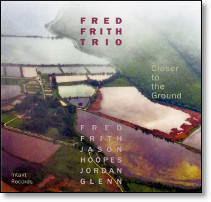
Fred Frith Trio: Closer to the Ground (2018, Intakt):
British guitarist, his 1974 Guitar Solos could be traced as
one of the founding ventures in what came to be called "experimental
rock." Close to a hundred albums later, he most often shows up on
jazz labels, enough so that's probably where he should be slotted.
Trio here, with on bass (electric and double) and Jordon Glenn on
drums, a stutter-step percussion run serves as a hook, his searching
runs layered on top.
A- [cd]
Billy F Gibbons: The Big Bad Blues (2018, Concord):
Longtime singer-guitarist for Texas rock megalith ZZ Top, a group
that was always best served when they kept their blues straight
and basic. Second solo album, still fiddling with his name credit,
but has the blues down pat, if a little loud.
B+(*)
Gordon Grdina's the Marrow: Ejdeha (2018, Songlines):
Vancouver guitarist, has played oud all along and exclusively here for
a Middle Eastern vibe, with Hank Roberts (cello), Mark Helias (bass),
and Hamin Honari (tombak, daf, frame drum). Irresistible when the
rhythms heats up, abstract chamber-ish when it doesn't.
B+(***)
Gordon Grdina/François Houle/Kenton Loewen: Live at the China
Cloud (2017, Big in Japan): Guitar/clarinet/drums. Same group
plus Benoît Delbecq has a 2017 Songlines album, Ghost Lights,
which I haven't found. Guitar hard-edged, leaving the others free to
shade and accent.
B+(*)
Tord Gustavsen Trio: The Other Side (2018, ECM):
Norwegian pianist, has recorded for ECM since 2001, mostly trios,
always seems to be on solid ground. Another fine one here, with
Sigurd Hole (double bass) and Jarle Vespestad (drums). More than
half originals. Fave cover composer: J.S. Bach, followed by Trad.
B+(**)
Scott Hamilton: Moon Mist (2018, Blau): Mainstream
tenor sax great, in a standards-heavy set with Dena DeRose (piano),
Ignasi Gonzalez (bass), and Jo Krause (drums) -- quartet first played
together in a theatre in Spain in 2015, but no info on when or where
this was recorded. Lovely work, but unexceptional by his standards.
B+(**)
Scott Hamilton: The Shadow of Your Smile (2017, Blau):
Same group, same lack of recording info but DeRose gets second-tier type
and sings a verse to finish "How Deep Is the Ocean" -- an unexpected
pleasure on top of many more.
A-
Scott Hamilton: Meets the Piano Players (2016 [2017],
Organic): Recorded in Munich, with Rudi Engel on bass and Michael
Kaul on drums, auditioning local pianists who get two cuts each:
Thilo Wagner, Claud Raible, Tizian Jost, Bernard Pichl, and Joe
Kienemann -- only name I recognized there was Raible's (co-led a
good quartet album with Brad Leali), but Pichl has the longest
discography by far, including previous records with Red Holloway,
Charlie Mariano, and Hamilton with/without Dusko Goykovich. Easy,
common standards, and the saxophonist makes all the pianists sound
good.
B+(***)
Scott Hamilton/Paolo Birro/Aldo Zunino/Alfred Kramer: Ballads
for Audiophiles (2016 [2017], Fonè Jazz): Antique tenor sax
playing venerable ballds backed by piano-bass-drums -- looks like
Hamilton can pick up a credible rhythm section anywhere he goes. I'll
have to take the audiophile recording on faith, but even streamed
through average computer speakers this easily predicted album is
pretty damn gorgeous.
B+(***)
Shay Hazan: Good Morning Universe (2017 [2018],
NoBusiness, EP): Israeli bassist, plays in the group Bones (which
has a couple albums on Leo), also has a Quintet album. This is a
sextet with two saxophonists (Albert Beger and Eyal Netzer), cello,
two drummers. Vinyl-only, four cuts, 28:15, unhurried but
fundamentally sound.
B+(*) [cdr]
Bjørn Marius Hegge Trio: Assosiasjoner (2018, Particular):
Norwegian bassist-composer, leads a trio with Oscar Grönberg (piano) and
Hans Hulbaekmo (drums). One of the better piano trios I've heard lately,
but haven't given it enough time to really sink in.
A- [sc]
Hegge: Vi Är Ledsna Men Du Får Inte Längre Vara Barn
(2017, Particular): Norwegian bassist's group, the rhythm section --
Vijleik Storass on piano and Håkon Mjåset Johansen on drums -- fronted
by two exuberantly jousting saxophonists: Jonas Kulhammar and Martin
Myhre Olsen.
B+(***) [sp]
Hieroglyphic Being: The Replicant Dream Sequence
(2018, Moog Recordings Library): Jamal Moss, electronica producer
based in Chicago, prolific since 2008 (Discogs lists 44 albums).
This is a fairly minor exercise, eight pieces called 'Sequence 01"
through "08," mostly Moog synth with occasional mixins.
B+(*)
Hinds: I Don't Run (2018, Mom + Pop): Indie pop band
from Madrid, Spain, originally named Deers, opted for the female noun
after a legal threat. Second album, in English, Carlotta Cosials and
Ana Perrote play guitar and sing, the lead a distinctive voice with
a lot of harmony.
B+(***)
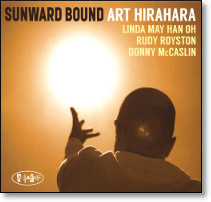
Art Hirahara: Sunward Bound (2017 [2018], Posi-Tone):
Pianist, based in New York after studying in Ohio and Caifornia, fourth
album, starts as a trio with Linda May Han Oh (bass) and Rudy Royston
(drums), then blossoms as Donny McCaslin (tenor sax) enters, doing what
he was always meant to do.
A-
William Hooker Trio: Remembering (2017 [2018], Astral
Spirits): Drummer-led trio, with Ava Mendoza (guitar) and Damon Smith
(bass). Hooker has led free jazz groups since 1977, Smith has 50+ side
credits since 1999. Mendoza first surfaced in 2008, making a strong
impression here.
B+(***) [bc]
Ayn Inserto Jazz Orchestra: Down a Rabbit Hole
(2015-17 [2018], Summit): Composer/arranger, based in Boston,
studied at New England Conservatory, teaches at Berklee, fourth
album with her big band, although I first ran across her name
when another group, Colours Jazz Orchestra, recorded a collection
of her music. Guests here are John Fedchock (trombone), George
Garzone (tenor sax), and Sean Jones (trumpet). Ends memorably
with the one cover, "I'll Be There."
B+(***) [cd]
Stan Kenton Legacy Orchestra: Flyin' Through florida
(2018, Summit): Directed by Mike Vax, this ghost band does a nice
job of honoring Kenton's legacy, keeping the arrangements light and
just a bit frothy, toning down his pretentiousness and pomposity,
while playing up the nostalgia. The Puccini, for instance, is pure
pop, as is the Hamlisch. Peaks in the center with a mix of "How High
the Moon" and "Ornithology," followed by "Young at Heart." And they
break out the maraccas for the closer.
B+(**) [cd]
John Kruth & La Società dei Musici: Forever Ago
(2018, Ars Spoletium): Singer-songwriter, main instrument mandolin,
which gets him filed under folk but he's studied in India, married
a woman from Croatia, and recorded this one with a group in Spoletto,
Italy. I'm ambivalent about the early songs -- maybe just can't
pigeonhole them -- but this gets a big lift from "Checkers with
My Cat," and while I haven't fully parsed it yet, "The Old
Communist" is a marvelous piece of songcraft.
A-
Pablo Ledesma/Pepa Angelillo/Mono Hurtado/Carlo Brandán: Gato
Barbieri Revisitado (2017 [2018], Discos ICM): Buenos Aires
quartet -- alto/soprano sax, piano, bass, drums -- half pieces by their
late hometown hero, the other half split between Ledesma and Angelillo.
The saxophonist doesn't have Barbieri's power or swagger, and not just
because he's toting a lighter horn. Nor does the rhythm section play
up their Latino roots. Yet little by little they slip under the skin
and slide it in new directions.
B+(**) [bc]
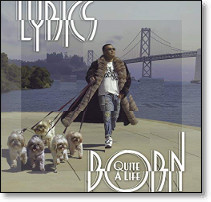
Lyrics Born: Quite a Life (2018, Mobile Home): Tom
Shimura, Bay Area rapper, tenth album, quite possibly the biggest big
beat anywhere, explodes on the first cut, delivers an even bigger band
on the second. Not sure I approve of the glosses on James Brown and
the Rolling Stones, but they sure are glossy. Nor do I care to wallow
in the cancer story, but they all sort of work out in the end.
A-
Yves Marcotte: Always Know Monk (2017, self-released):
Bassist, first album, officially credited to eponymous group but
Marcotte is the arranger of these seven tracks (13 Monk songs).
With Shems Bendahl (trumpet/flugelhorn), Zacharie Canut (tenor/alto
sax), and Nathan Vandenbulcke (drums).
B+(**) [bc]
Paul McCartney: Egypt Station (2018, Capitol): Not
someone I've followed at all regularly for a long time now -- database
shows three albums 1970-73, one in 1979, one in 1999, a C+ in 2005, a
C- in 2007, one more in 2012. I was tipped off to this one when the
label sent me a download link (can't recall that ever happening for a
comparable artist). Still can't say as I searched this out. Rather, I
picked it from Napster's featured pop albums list, in preference to a
new one from Paul Simon (very likely the better album, but an artist
I've never actually liked). Starts out fairly upbeat, then slows down
for one cut I can relate to, and find utterly charming ("Happy With
You"). Deteriorates after that. "People Want Peace" is true, but not
as McCartney formulates it so unconvincingly.
B-
Ernest McCarty Jr./Theresa Davis: I Remember Love
(2018, Blujazz): Second album for McCarty, very different from the
where he paid tribute to Erroll Garner as his former bassist. Here
he plays piano and guitar, and composes love songs sung by Theresa
Davis, formerly in the Emotions (in 1977, at least, on their best
selling album, Rejoice).
B+(*) [cd]
Joey Morant: Forever Sanctified (2018, Blujazz):
Trumpet player, flugelhorn (of course), sings some, credited on
most songs with "horns" (no idea what else that means). Wrote
most of these pieces, drawing on blues and swing.
B+(*) [cd]
Mike Moreno: 3 for 3 (2016 [2017], Criss Cross):
Guitarist, half-dozen previous albums since 2007, trio here with
Doug Weiss on bass and Kendrick Scott on drums.
B+(*)
Al Muirhead's Canadian Quintet: Undertones (2018,
Chronograph): Subtitled (back cover) "The Art of the Bass Trumpet."
Canadian, from Regina, born 1935, only stepped out front as a leader
in 2014, winning a Juno in 2016. A bop-to-swing quintet, with Kelly
Jefferson on tenor sax, Reg Schwager on guitar; two originals,
familiar covers, nicely done.
B+(**) [cd]
Myriad 3: Vera (2018, ALMA): Canadian piano trio:
Chris Donnelly (piano, keyboards), Dan Fortin (bass), Ernesto Cervini
(drums). Accessible, with a popular appeal not unlike EST.
B+(*) [cd]
Willie Nelson: My Way (2018, Legacy): Eleven standards,
all associated with Frank Sinatra, dispatched efficiently in 35:25, one
a duet with Norah Jones. Haven't seen anything on the arrangements, which
are pretty generic -- some strings, some horns, some guitar leads -- and
anonymous (so far, anyway). I've heard these songs done by dozens of
singers. No surpise that Nelson is credible, distinctive, and over any
awe he may once have felt for Sinatra. Indeed, when they appeared together
in Las Vegas, Sinatra was the opening act.
B+(**)
Noname: Room 25 (2018, self-released): Chicago rapper
Fatima Warner, "debut album" following her "debut mixtape" Telefone,
which sure sounded like an album to me -- both are self-released downloads,
but Telefone was the one that also came out on vinyl. This didn't
make much of an impression at first, but developed notably on second spin,
then trailed off a bit when the guests showed up. Barely (hopefully):
A- [bc]
Uwe Oberg/Heinz Sauer: Sweet Reason (2017 [2018],
Jazzwerkstatt): German piano/tenor sax duo, Oberg in his mid-50s,
Sauer up around 85, taking their sweet time.
B+(*)
Eddie Palmieri: Full Circle (2018, Ropeadope):
Salsa pianist/big band leader, from the Bronx, still active at 82,
band has 26 members, at least half names I recognize from elsewhere
(e.g., the baritone saxophonists are Ronnie Cuber and Gary Smulyan;
the trombones include Conrad Herwig, Doug Beavers, and Joe Fiedler),
with Herman Olivera the lead vocal.
B+(***)
Ivo Perelman/Jason Stein: Spiritual Prayers (2018,
Leo): Tenor sax/bass clarinet duets, instruments which harmonize
easily yet don't add up to much -- a problem generic to all larger
sax/clarinet ensembles.
B+(*) [cd]
Ivo Perelman/Rudi Mahall: Kindred Spirits (2018,
Leo, 2CD): More tenor sax/bass clarinet duets, much more, the
generic mix problem still evident but seems less debilitating,
no doubt a credit to Mahall -- surprised I don't have anything
under his name in my database, as I've run across him at least
a dozen times, always on superb records. Also surprised he's
only ten years older than Stein, five years younger than Perelman.
B+(***) [cd]
Chris Pitsiokos CP Unit: Silver Bullet in the Autumn of Your
Years (2017 [2018], Clean Feed): Alto saxophonist, released
a 2017 album as CP Unit but spells his leadership out here, not least
because the band has almost completely turned over (bassist Tim Dahl
held on for 4/10 tracks, giving way to Henry Fraser). Sam Lisabeth
takes over on guitar, and drums are split between Jason Nazary (on
Dahl's tracks) and Connor Baker. Last record struck me as "post-rock,
post-industrial fusion," but while this is similar, it's jazzier --
at least until it falls off the deep end..
B+(**)
Portland Jazz Composers Ensemble: From Maxville to Vanport
(2018, PJCE): Music by Ezra Weiss, lyrics by S. Renee Mitchell, sung
by Marilyn Keller. The two towns of the title were created as worker
housing, the former by a lumber company in 1923, the latter by the US
government in 1942. Both were largely occupied by blacks, and shut
down after they had served their purposes -- Vanport was literally
wiped out by a flood in 1948. PJCE is a 12-piece orchestra directed
by Ryan Meagher and Douglas Detrick, and also a label with 30+ albums,
most under individual names although the group as a whole has another
called Oregon Stories. I didn't care for the vocals until I
started paying attention, and learned something.
B+(**) [cd]
Dafnis Prieto Big Band: Back to the Sunset (2018,
Dafnison): Cuban drummer, moved to US at 25 in 1999 and immediately
wowed everyone with his technique. First big band album, standard
grouping minus guitar plus congas (Roberto Quintero). Actually quite
impressive, with towering horns piled on top of more rhythm than you
can shake a stick at.
B+(***) [sp]
Kristjan Randalu: Absence (2017 [2018], ECM): Pianist,
from Estonia, has a couple of previous albums, including a duo on FSNT
with guitarist Ben Monder, expanded to a trio here with drummer Markku
Ounaskari.
B+(**)
Ratatet: Heroes, Saints and Clowns (2017 [2018],
Ridgeway): Sextet, led by drummer-composer Alex Hall. Bassist Jeff
Denson is also credited as producer. Paul Hanson lists bassoon ahead
of tenor sax, with the others on trombone, vibes, and keyboards,
plus nearly a dozen guests -- most famous Paul McCandless on English
horn and oboe.
B
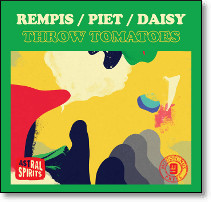
Dave Rempis/Matt Piet/Tim Daisy: Throw Tomatoes (2017
[2018], Astral Spirits): Chicago avant-garde, sax-piano-drums, two
improv pieces, 28:26 + 27:22, both powerhouses. Pianists normally
comp behind sax leads, but in free jazz the piano makes more sense
as percussive counterpoint, and Piet's become a master at that.
A- [bc]
Logan Richardson: Blues People (2018, Ropeadope):
Alto saxophonist from Kansas City. I thought his 2007 debut was
terrific, but this is only his third album since, and this is
very different: two electric guitars, electric bass, drums, the
sax blending into the thick layering, which sinks like a rock.
B-
Ned Rothenberg/Hamid Drake: Full Circle: Live in Lodz
(2016 [2017], Fundacja Sluchaj): Duets: Rothenberg playing clarinet,
alto sax, and shakuhachi; Drake: drums, frame drum, vocals (more of
a chant). The sax feels much more substantial. Closes with a striking
"Amazing Grace."
B+(*)
Scott Routenberg Trio: Supermoon (2018, Summit):
Pianist, teaches at Ball State in Indiana, fifth album since 2000,
a trio with Nick Tucker on bass and Cassius Goens III on drums.
All original material, nicely done.
B+(*) [cd]
Schnell: Live at Sowieso (2017 [2018], Clean Feed):
Avant-sax trio, based in Berlin, with Pierre Borel (alto sax), Antonio
Borghini (bass), and Christian Lillinger (drums). After the fact, I'm
tempted to take Schnell as the title: the surnames are also on
the cover, "Schnell" is title of three parts, totalling all but 6:31,
most of the rest a non-obvious Billy Strayhorn cover. And they are
fast, burning rubber throughout.
A-
Trygve Seim: Helsinki Songs (2018, ECM): Norwegian
saxophonist (tenor/soprano), on ECM since 2000, quartet with Kristjan
Randalu (piano), Mats Eilertsen (bass), and Markku Ounaskari (drums).
All pieces by Seim, unclear what the Finnish connection is (aside from
the drummer). Atmospherics are lovely, and sometimes they build on
that.
B+(***)
Cory Smythe: Circulate Susanna (2018, Pyroclastic):
Pianist, also autoharp and electronics, has several albums since 2011,
leans avant but this is hard to peg, with Daniel Lippel on detuned
acoustic guitar and electronics and vocalist Sofia Jernberg -- arty,
abstract, irritating.
B- [cd]
Swamp Dogg: Love, Loss, and Auto-Tune (2018, Joyful
Noise): Jerry Williams, one-time Atlantic soul producer, moved to the
fringe c. 1970 and has stayed there ever since, pulling off some neat
tricks, and sometimes falling flat. His use of auto-tune here is odd,
meant to alienate, and, I suppose, succeeds at that.
B
Szun Waves: New Hymn to Freedom (2018, The Leaf Label):
British trio (London, I think), second album, can be taken as jazz or
electronica but strikes me as prog-ish instrumental rock. Luke Abbott
(synth) appears to be the leader, with Jack Wyllie (sax) and Laurence
Pike (drums).
B+(*)
Steven Taetz: Drink You In (2018, Flatcar/Fontana
North): Jazz singer-songwriter from Toronto (assuming the six tracks
credited to "Tetz" are his), first album, five covers, nor really
standards (Sondheim barely counts). Varied studio help, likable
voice, only strong reaction I had was to Leonard Cohen's "Everyboy
Knows," which is has no business going anywhere near.
B [cd]
The United States Air Force Band Airmen of Note: The Jazz
Heritage Series 2018 Radio Broadcasts (2018, self-released,
3CD): Three shows, each starting with the same boilerplate about how
the US Air Force exemplifies "precision" (mentioning music but not
wedding parties), introducing all the musicians by their rank, and
playing competent but utterly ordinary jazz. Each show has a special
guest -- singer Nnenna Freelon, drummer Peter Erskine, and trombonist
Marshall Gilkes -- and they get interviewed as well as introducing
a couple songs. Erskine isn't uninteresting.
C
University of Toronto 12Tet: When Day Slips Into Night
(2018, UofT Jazz): University program, large group because students
are plentiful and big band charts are fun. Some nice stuff, everything
passes, nothing much sticks.
B+(*) [cd]
Andrés Vial: Andrés Vial Plays Thelonious Monk: Sphereology
Volume One (2017 [2018], Chromatic Audio): Pianist, based in
Montréal, fourth album plus side credits since 2005. Ten Monk tunes,
recorded in two sessions with as many bassists and drummers, but most
important, guitarist Peter Bernstein, shaping and shading.
B+(**) [cd]
Fay Victor's SoundNoiseFUNK: Wet Robots (2017 [2018],
ESP-Disk): Avant vocalist, most similar to Betty Carter (not that
anyone really is, and vice versa), with a dozen or so albums since
1998. As noted on cover, with Joe Morris (guitar), Sam Newsome
(soprano sax), and Reggie Nicholson (drums). Waxes hot and cold,
with some remarkable passages. Like the spoken word much more than
the screechy scat.
B+(**)
Jay T. Vonada: United (2017 [2018], Summit): Trombone
player, backed by piano trio, mostly originals but two covers --
"Summertime," "Darn That Dream" -- anchor it firmly in the mainstream,
where it sounds splendid.
B+(***) [cd]
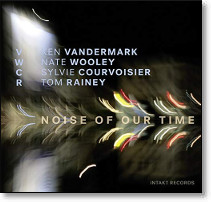
VWCR [Ken Vandermark/Nate Wooley/Sylvie Courvoisier/Tom Rainey]:
Noise of Our Time (2017 [2018], Intakt): Reeds, trumpet,
piano, drums, all but Rainey bringing songs. The pianist is central
here, setting the pace, fracturing time, shooting off flairs, a bit
of abstract comping when Vandermark finally gets his monster solo,
then wraps it up with a dazzling flourish.
A- [cd]
Marcin Wasilewski Trio: Live (2016 [2018], ECM):
Polish piano trio, together since 2005, with Slawomir Kurkiewicz
(bass) and Michal Miskiewicz (drums), recorded in Antwerp. Six
pieces, including one each by Sting ("Message in a Bottle") and
Herbie Hancock.
B+(***)
Doug Webb: Fast Friends (2018, Posi-Tone): Tenor
saxophonist, moved to Los Angeles at age 3, did a lot of studio work
before moving mainstream with this label in 2010. Quintet with trombone
(Michael Dease), piano (Mitchel Forman), bass, and drums. Went all the
way back to bebop this time, including covers of "Ah-Leu-Cha" and "A
Night in Tunisia," fast indeed.
B+(**)
Bugge Wesseltoft/Prins Thomas: Bugge Wesseltoft & Prins
Thomas (2018, Smalltown Supersound): Norwegian duo, keyboards
and beats, the former long established in jazz, the latter with five
numbered electronica albums. More on the latter's turf, with a nice,
seductive flow. Drummer Jon Christensen guests on four (of five) cuts.
B+(**)
Mike Westbrook: Starcross Bridge (2017 [2018], Hatology):
English pianist, a big Penguin Guide favorite with fifty or so
records since 1967. I've only heard two, and wasn't especially taken
by them, so he is a fairly major SFFR (also his wife, vocalist Kate
Westbrook). I doubt this bit of solo piano is a good place to start,
but it's current, measured, thoughtful.
B+(*)
Western Michigan University Jazz Orchestra: Turkish Delight
(2018, Blujazz): Big band, directed by Dr. Scott Cowan, more trumpets
than usual. Aside from Cowan's title piece, standard big band repertory,
from Ellington and Basie to Gillespie and D'Rivera. Some fine moments.
B+(*) [cd]
Tom Zé: Sem Você Não A (2017, Circus): Antônio José
Santana Martins, b. 1938 in Bahia in Northeast Brazil, infleuential
in the Tropicália movement from 1968 on, continuing to evolve in ever
more eccentric ways, even into his 80s.
B+(***)
Recent Reissues, Compilations, Vault Discoveries
Kaoru Abe/Sabu Toyozumi: Mannyoka (1976 [2018],
NoBusiness): Japanese alto saxophonist (also sopranino and soprano
here), self-taught, one of the first notable free jazz players in
Japan, died quite young (29, in 1978), most of his records issued
posthumously. Duo with drums, two sets (73:58 total), can get rough
but is often inspired.
B+(***) [cd]
Choi Sun Bae Quartet: Arirang Fantasy (1995 [2018[,
NoBusiness): Trumpet player, I know very little about him, probably
Korean but this was recorded in Tokyo, with Junji Hirose (tenor/soprano
sax), Motoharu Yoshizawa (upright 5-string electric bass), and Kim Dae
Hwan (percussion).
B+(***) [cd]
Stella Chiweshe: Kasahwa: Early Singles (1974-83
[2018], Glitterbeat): Singer from Zimbabwe, plays mbira, indeed her
first singles were mostly instrumental, with a narrow, primitivist
feel.
B+(**)
Hazel Dickens & Alice Gerrard: Sing Me Back Home: The
DC Tapes, 1965-1969 (1965-69 [2018], Free Dirt): Partially
fills the gap between their classic 1965 sessions (reissued as
Pioneering Women of Bluegrass) and their even better 1973
sessions (reissued as Hazel and Alice), mostly picking out
old country tunes. The opening "Bye Bye Love" seems like a misstep,
and they never quite manage to do something special, although "In
the Good Old Days (When Times Were Bad)" is right up their alley.
B+(**)
Bobby Naughton/Leo Smith/Perry Robinson: The Haunt
(1976 [2018], NoBusiness): Vibraharp player, played in Jazz Composers
Orchestra and Anthony Braxton's Creative music Orchestra, recorded a
handful of albums from 1969-79, plus several since 2002. Doesn't
provide a lot of structure for the trumpet and clarinet.
B+(*) [cd]
Prince: Piano and a Microphone 1983 (1983 [2018],
NPG/Warner Bros.): First vault release since Prince Rogers Nelson's
death in 2016, with dozens more likely to follow as his heirs have
no reason not to suck every ounce of profit from his estate. Plain
descriptive title, a demo tape from shortly before Purple Rain,
should be a fertile period, maybe "a glimpse of a notoriously private
artist doing his mysterious work," but not a very revealing one --
even less fun.
B
Old Music
Gene Ammons: The Gene Ammons Story: Gentle Jug
(1961-62 [1992], Prestige): Two fairly ordinary albums by the
tenor saxophonist, each backed by a different piano-bass-drums
trio: Nice an' Cool (1961) and The Soulful Mood of
Gene Ammons (1962). Mostly ballads, not his best work but
sound unmistakably his own.
B+(**)
Gene Ammons: Gentle Jug Volume 2 (1960-71 [1995],
Prestige): A more proper ballad compilation, picking twelve songs
from ten albums.
B+(***)
Gene Ammons: The Boss Is Back! (1969 [1993],
Prestige): Another 2LP-on-1CD reissue, the title album (with
Junior Mance, Buster Williams, and Frankie Jones) and Brother
Jug!, also recorded in 1969 but released in 1970.
B+(**)
Bikini Kill: Revolution Girl Style Now (1991 [2015],
Bikini Kill): Pioneering grrrl punk band from Olympia, WA, led by
Kathleen Hanna. This started as demo, initially released as an 8-cut
cassette, and forgotten when Kill Rock Stars reissued the group's
two 1992-93 EPS as The C.D. Version of the First Two Records
(1994). This adds three extra tracks for a solid 31:12.
B+(***)
Bikini Kill: Bikini Kill (1992, Kill Rock Stars, EP):
Official debut, a six-track, 16:06 EP, repeating five tracks from the
demo tape, mostly shorter versions, adds a live new one "Thurston Hearts
the Who" -- not quite ready.
B+(**)
Bikini Kill: Yeah Yeah Yeah Yeah (1992 [1993], Kill
Rock Stars, EP): Seven tracks, 14:15, originally released as half of
an album filled out by Huggy Bear (Our Troubled Youth).
B+(**)
Bikini Kill: The Singles (1993-95 [1998], Kill Rock
Stars, EP): Nine tracks, 17:24, the first three with Joan Jett in
the background, all striking in their intensity.
B+(***)
David Binney: South (2000 [2001], ACT): Alto/soprano
saxophonist, seventh album since 1989, mostly quartet with Uri Caine
(piano), Scott Colley (bass), and Brian Blade (drums), plus extras on
three tracks -- "Von Joshua" is one that breaks out of the postbop rut.
B+(**)
Brian Blade Fellowship: Perceptual (2000, Blue Note):
Drummer from Louisiana, named his first album Fellowship and
kept that as his group name. Second album retains Myron Walden (alto
sax/bass clarinet), Melvin butler (tenor/soprano sax), Jon Cowherd
(piano/keyboards), and Christopher Thomas (bass), with new guitarist
Kurt Rosenwinkel. Sly postbop, sneaks up on you.
B+(**)
Terence Blanchard: Bounce (2003, Blue Note): Trumpet
player from New Orleans, just a year younger than Wynton Marsalis but
seemed to come up in his wake -- indeed, after starting with Lionel
Hampton, Blanchard followed Marsalis in Art Blakey's Jazz Messengers.
After a dozen albums with Sony/Columbia, moved to Blue Note here with
an upbeat hard bop album.
B+(**)
Chicago Underground Quartet: Chicago Underground Quartet
(2000 [2001], Thrill Jockey): Originally a duo (7 albums 1998-2014)
of Chad Taylor (drums) and Rob Mazurek (trumpet/electronics), added
bassist Noel Kupersmith in 1999 to make Trio (4 albums through 2007),
and Jeff Parker (guitar) for this single Quartet album.
B+(**)
The Cookers: Warriors (2011, Jazz Legacy): Hard bop supergroup,
second album (after Cast the First Stone in 2010): two trumpets
(Eddie Henderson, David Weiss), two saxes (Billy Harper, Craig Handy),
backed by George Cables, Cecil McBee, and Billy Hart. McBee composed 3
tunes, Cables and Harper 2 each, but they open with a Freddie Hubbard
piece. A little cluttered, but at least one really monster sax solo here
(Harper, I presume).
B+(***)
Tord Gustavsen Trio: Changing Places (2001-02 [2003],
ECM): First album after a few side credits, with Harald Johnsen (bass)
and Jarle Vespestad (drums), all originals. First impression is that
this is overly quiet, nothing really amiss but too subtle to engage.
B+(**)
Barry Guy/London Jazz Composers Orchestra/Irène Schweizer:
Radio Rondo/Schaffhausen Concert (2008 [2009], Intakt):
Two pieces, the 15:25 "Schaffhausen Concert" is solo piano, some
of her finset, then the 30:01 "Radio Rondo" is played by bassist
Guy's long-running avant-big band, LJCO, with Schweizer again on
piano.
B+(***)
Huggy Bear: Our Troubled Youth (1992 [1993], Kill
Rock Stars, EP): British riot grrrl group, joined to Bikini Kill
when the label decided to package both group's EPs together. Seven
cuts, 16:30. Rant tends to fall apart.
B
Ahmad Jamal: In Search of Momentum (2003, Birdology/Dreyfus):
Pianist, born Frederick Russell Jones in Pittsburgh, changed his name
when he converted to Islam, started recording in 1951, continuing at
least through 2016. Trio with James Cammack (bass) and Idris Muhammad
(drums), slightly more originals than standards.
B+(**)
Keith Jarrett/Gary Peacock/Jack DeJohnette: Always Let Me
Go: Live in Tokyo (2001 [2002], ECM, 2CD): His usual piano
trio, pushing eight songs to 135+ minutes. Took a while before
starting to catch my ear. Even when it does, it doesn't impress
me as much as the Live at Montreux 2-CD from the same
year, but they released this one in 2002 and held the other back
until 2007.
B+(**)
Roland Kirk: Introducing Roland Kirk (1960, Argo):
Saxophonist, later added Rahsaan to his name, actually his second album
here, pictured on the cover playing three horns simultaneously -- tenor
sax, manzello, and stritch -- a gimmick he soon became notorious for.
Also on the cover is a featuring credit for Ira Sullivan (trumpet and
tenor sax), only five years older, and probably the last moment when
he was more famous. Backed by William Burton on piano and organ, Donald
Garrett on bass, and Sonny Brown on drums. A little swing, a bit more
swagger.
B+(*)
Roland Kirk: Domino (1962, Mercury): Adds flute, nose
flute, and a siren to his usual trio of sax options. Two quartets, with
bassist Vernon Martin in both: first half has Andrew Hill on piano and
Henry Duncan on drums, second Wynton Kelly and Roy Haynes.
B+(*)
Roland Kirk: Reeds & Deeds (1963, Mercury): Two
sessions from February 1963, the first with Virgil Jones on trumpet,
Harold Mabern on piano, plus trombone, bass, and drums. Some personnel
changes for the second, plus Benny Golson takes over arrangements, so
it goes a bit more smoothly (not necessarily better).
B+(**)
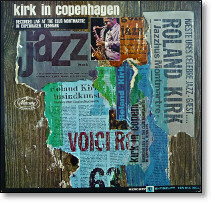
Roland Kirk: Kirk in Copenhagen (1963 [1964], Mercury):
Looks like he showed up with bass and drums, then found out that there's
some kind of law or union rule requiring Niels-Henning Ørsted Pedersen
to play bass, so they doubled up. Even more fortunate was the local they
sat at the piano: Tete Montoliu, terrific throughout. Kirk is in high
spirits, although he cautiously selects "Mood Indigo" to show off the
multi-horn thing. And someone credited as Big Skol wanders on stage with
harmonica -- his mama knew him as Rice Miller (aka Sonny Boy Williamson).
A-
Roland Kirk: I Talk With the Spirits (1964 [1965],
Limelight): Just flute here: not his strong suit, but he has some fun
with his distinctive sound. Big help from Horace Parlan on piano.
B+(*)
Roland Kirk: Left & Right (1969, Atlantic): Kirk
moved to Atlantic in 1965, staying there through 1976 (a year before
he died), with a very mixed bag of albums. This was his third, with
brilliant bits mixed into pretty mundane Gil Fuller orchestrations.
The centerpiece is the medley of "Expansions, with seven extra guests
including Alice Coltrane on harp. Closes with five covers from Mingus
to Strayhorn -- "Hot Cha" is the pick hit.
B+(*)
Rahsaan Roland Kirk & the Vibration Society: Rahsaan
Rahsaan (1970, Atlantic): Here is where he added "Rahsaan" to
his name, having heard it in a dream, and was so excited he doubled
down on the title. First half is a 17:18 medley from "Black Classical
Rap" to "New Orleans," with a guest list that includes Howard Johnson
(tuba) and Leroy Jenkins (violin). Rest is a Village Vanguard live
set with piano-bass-drums-percussion. His intro and vocal to "Baby
Let Me Shake Your Tree" is a lark, but also a delight.
B+(***)
Rahsaan Roland Kirk: Natural Black Inventions: Root Strata
(1971, Atlantic): Aside from some piano on the only cover ("Day Dream"),
just Kirk (on an extended array of reeds and percussion) backed by drums
and even more percussion.
B+(**)
Rahsaan Roland Kirk: Blacknuss (1972, Atlantic): Mostly
black music covers, ranging from "Old Rugged Cross" to Bill Withers
including a generous sampling of Motown, mostly played to session
musicians who straddle those worlds, and quite a few vocals -- this
avoids pop mostly because Kirk is such a gruff blues shouter, and
because his horns dart off in all sorts of directions. Strong cuts
include "One Nation" and "Make It With You."
B+(***)
Joëlle Léandre/Yves Robert/Irène Schweizer/Daunik Lazro: Paris
Quartet (1985-87 [1989], Intakt): Bass, trombone, piano, alto
sax, Léandre also credited with voice and compositions. Of course, we
could do without the bad opera voice. But the bass leads suffice to
kick off the horns, and the pianist doubles as a percussionist.
B+(**)
Lionel Loueke: Virgin Forest (2006 [2007], ObliqSound):
Guitarist-singer, from Benin, made his way to Paris, got a scholarship
to Berklee, then to Los Angeles. Some sort of folk-jazz hybrid, hard
to place as indeed the musicians stradle four continents and are
never wholly contained in their own.
B+(*)
Rudi Mahall: Quartett (2006 [2007], Jazzwerkstatt):
German bass clarinetist, rarely leads his own groups but gets top
billing here, with all four sharing writing credits: Johannes Bauer
(trombone), Aki Takase (piano), and Tony Buck (drums).
[3/5 cuts]
B+(*)
Big Jay McNeely: The Best Of (1948-1956) (1948-56 [2010],
Master Classics): Tenor saxophonist, an r&b honker who excited fans
with his ecstatic displays, sometimes writing on the stage floor while
wailing. This was his prime period, before guitar replaced the saxophone
as the featured instrument in rock and roll, but his discography is so
checkered -- with early 78s and 10-inch LPs -- it's hard to figure out
just what came from where. This offers 32 cuts, mostly Federal 45s, some
with vocals -- most notably Ted Shirley on "Road House Boogie." That's
about where the energy level really kicks up.
B+(***)
Maggie Nicols/Irène Schweizer/Joëlle Léandre: Les Diaboliques
(1993 [1994], Intakt): Voice-piano-bass trio, kept the album name for
two more group albums (to 2000), also intersecting for a bunch of other
albums. Nicols is from Scotland, original name Margaret Nicholson, her
mother French-Berber, was part of Spontaneous Music Ensemble and Keith
Tippetts' Centipede. She tends to produce an opera reflex in me, but
that isn't really sustained here -- just feels scattered, a bit arch.
B
Uwe Oberg: Work (2008 [2015], Hatology): German
pianist, solo here, six tracks but three of them pair up two songs --
in two cases originals which segue in Coltrane in one case, Robert
Wyatt's "Muddy Mouse" in the other. The other pairing mashed Mingus
and Coleman together, while two of the three standalone pieces were
Monk tunes.
B+(**)
Danilo Pérez: Danilo Pérez (1992 [1993], Jive/Novus):
Pianist, from Panama, won a Fulbright USA scholarship to study in US,
studied at Berklee, joined Dizzy Gillespie's United Nations Orchestra.
First album, starts out with an all-star band -- Joe Lovano and David
Sanchez on tenor/soprano sax, Santi Debriano on bass, Jack DeJohnette
on drums -- with Panamanian hero Ruben Blades taking a few vocals.
B+(*)
Danilo Pérez: PanaMonk (1996, Impulse!): Third
album, piano trio with Avishai Cohen (bass) and either Jeff Watts
or Terri Lyne Carrington (drums), playing seven Monk compositions
and four originals. A much flashier piano player than Monk ever
was, which lets him glide over the glitches that made Monk so
bedeviling.
B+(**)
Danilo Pérez: Motherland (2000, Verve): Fifth
album since 1993. Tricky rhythm with lots of extra percussion, Regina
Carter the focal player on violin, although Chris Potter (sax) and
Diego Urcola (trumpet) have their moments. I took an instant dislike
to the vocals (Luciana Souze and Claudia Acuna), got to where I could
tolerate the scat shading, then they mutated into everything from
spoken word to torch songs to hot salsa. I'm not unimpressed; just
not very pleased.
B+(*)
Bud Powell: Jazz Giant (1949 [1957], Verve): The
bebop piano virtuoso's recordings start in 1944 with Cootie Williams,
resume in 1946 with Dexter Gordon, J.J. Johnson, and others. In 1947
he recorded with Charlie Parker and cut his own trio for Roost. This
collects his next trio sessions, with Max Roach on drums and either
Ray Brown or Curly Russell on bass. I've never been blown away by
Powell's sessions for Norman Granz (unlike some of his Blue Notes),
but these are quite nice.
B+(***)
Bud Powell: Piano Interpretations by Bud Powell
(1955 [1959], Verve): Trio with George Duvivier (bass) and Art
Taylor (drums). Standards.
B+(**)
Bud Powell: The Ultimate Bud Powell (1949-56 [1998],
Verve): The Complete Bud Powell on Verve box runs five CDs,
which this reduces to sixteen cuts, all trios, starting with five
cuts from Jazz Giant. A good selection, but still can't touch
the Blue Notes from the same period, especially the first two volumes
of The Amazing Bud Powell.
B+(***)
Bud Powell: The Amazing Bud Powell, Vol. 4: Time Waits
(1958 [1999], Blue Note): Another piano trio, this one with Sam Jones
(bass) and Philly Joe Jones (drums). Drummers often make the difference
with Powell, but so does starting off with something upbeat and
irresistibly catchy like "Buster Rides Again."
A-
Bud Powell: Strictly Confidential (1964 [1994],
Black Lion): Solo piano, one of many informal recordings Francis
Paudras made after Powell moved to Paris, at some point released
as At Home, in Paris.
B+(***)
Bud Powell: Salt Peanuts (1964 [1988], Black Lion):
Recorded in Edenville, France by Paudras, opens with four piano trio
cuts, with Guy Hayat (bass) and Jacques Gervais (drums), then adds
Johnny Griffin (tenor sax) for three longer cuts (30:46). The sound
leaves much to be desired, and the crowd noise is distracting. The
music deserved better.
B
Irène Schweizer: Wilde Señoritas (1976 [1977], FMP):
First solo piano album, following two group albums with saxophonist
Rüdiger Carl. Two side-long pieces (34:07 total), recorded live in
Berlin. Doesn't show off the flashy technique she later developed,
which makes the logic and integrity all the more remarkable.
B+(***)
Irène Schweizer: Hexensabbat (1977 [1978], FMP):
Solo again, starting with some novel sounds she teased out of the
piano, expanding them in the first side, then running through six
relatively short sketches on the second.
B+(***)
Irène Schweizer: Wilde Señoritas/Hexensabbat (1976-77
[2002], Intakt, 2CD): Reissue combines her two early solo albums.
B+(***)
Irène Schweizer: Live at Taktlos (1984 [1986], Intakt):
Swiss pianist, early albums -- including Early Tapes from 1967 --
on FMP, with only unreviewable fragments on Bandcamp -- found a long-term
home label here, numbered "001." Three cuts (not counting the 0:55 Lindsay
Cooper-Maggie Nicols duo): with George Lewis (trombone), with Nicols
(voice) and Günter Sommer (percussion), with Joëlle Léandre (bass, voice)
and Paul Lovens (percussion). Terrific piano, a strong spot for Lewis,
but the singers can be grating.
B+(**)
Irène Schweizer: Piano Solo Vol. 1 (1990 [1992],
Intakt): From Switzerland, a tremendous free jazz pianist, her best
work duos with drummers, which adds an edge that solo work cannot
quite achieve, even for one so focused on rhythmic complexity.
B+(***)
Irène Schweizer: Piano Solo Vol. 2 (1990 [1992],
Intakt): More solo piano, a live set after the two days in the studio
that produced Vol. 1. Seven originals plus covers of Berlin
and Monk. Penguin Guide prefers Vol. 1 to Vol. 2,
but I think I'd give this one a (very) slight edge.
B+(***)
Irène Schweizer: Many and One Direction (1996, Intakt):
Yet another piano solo. Hard for me to sort out these many titles -- I
doubt I could even if I did manage to invest the time to compare, but
while most of this is as good as all the rest, the last two pieces lift
it a notch above: "Bleu Foncé" sounds a bit like Monk might if he had
Pete Johnson's left hand (and maybe James P. Johnson's right), while
"Chordially" is a short ballad piece where everything is perfect.
A-
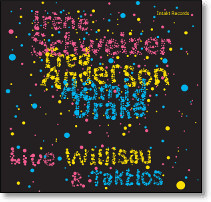
Irène Schweizer/Fred Anderson/Hamid Drake: Live Willisau &
Taktlos (1998-2004 [2007], Intakt): Two sets in Switzerland,
with the pianist hosting Chicago's legendary avant-saxophonist and his
brilliant nephew-percussionist. Basically, the meeting you'd imagine.
A-
John Scofield: Works for Me (2000 [2001], Verve):
Guitarist, started around 1978 and was a pretty big deal by this point,
a master of groove and flow, with an all-star band which makes it all
look easy: Kenny Garrett (alto sax), Brad Mehldau (piano), Christian
McBride (bass), Billy Higgins (drums).
B+(**)
John Scofield: Blue Matter (1986 [1987], Gramavision):
Guitarist, his groove choppier in the '80s than a decade later. With
Mitchell Forman (keyboards), bass, drums, extra percussion (Don Alias),
sometimes extra rhythm guitar.
B+(*)
John Scofield: Hand Jive (1993 [1994], Blue Note):
Rather straightforward groove album, but with Larry Goldings on organ
and piano, and Eddie Harris on tenor sax, this picks up extra soul
jazz cred.
B+(***)
Trygve Seim: Different Rivers (1998-99 [2000], ECM):
Norwegian tenor saxophonist, previously recorded as The Source, and
played in Oslo 13, but first album under own name. Groups range from
two to ten pieces, the duets with trumpeter Arve Henriksen. Nice
spoken word piece with Sidsel Endresen.
B+(*)
Zoot Sims: Hawthorne Nights (1977 [1994], Pablo/OJC):
Bill Holman arranged and conducted this near-big band outing, playing
two of his own pieces, two Ellingtons, one Jobim, "More Than You Know,"
"Only a Rose," only one piece he leader had a hand in. Sims is flanked
by three more reed players (Richie Kamuca, Jerome Richardson, Bill Hood),
three brass (Oscar Brashear, Snooky Young, Frank Rosolino), with Ross
Tompkins on piano.
B+(*)
Zoot Sims: Suddenly It's Spring (1983 [1992], Pablo/OJC):
He died in 1985 (at 59), making this quartet with Jimmy Rowles (piano),
George Mraz (bass), and Akira Tana (drums) one of his last. Mostly ballads,
lovely tone (as always), still feels a bit too much like going through
the motions.
B+(**)
Loren Stillman + Bad Touch: Going Public (2012 [2014],
Fresh Sound New Talent): Alto saxophonist, first album (as a teenager)
1997. Backed here by Nate Radley (guitar/pedal steel), Gary Versace
(organ), and Ted Poor (drums), who also contribute two songs each (of
nine).
B+(***)
Co Streiff/Irène Schweizer: Twin Lines (1999-2000
[2002], Intakt): Swiss alto saxophonist, has a short discography
which includes a group co-led by Russ Johnson. Duo with piano here,
from two radio shots, thoughtful, probing, nice balance.
B+(***)
Trio 3: Encounter (1999 [2001], Passin' Thru): Alto
sax trio, although supergroup is more like it: Oliver Lake, Reggie
Workman (bass), and Andrew Cyrille (drums). First studio album after
a Live in Willisau (1997), to be followed by nine more through
2017, including a series with pianists (Irène Schweizer, Geri Allen,
Jason Moran, Vijay Iyer). Seven pieces, one by each and four by
fellow travelers (Bobby Braddock, Ade Steve Colson, John Carter,
Andrew Hill).
A-
Trio 3 + Irène Schweizer: Berne Concert (2007 [2009],
Intakt): Live at Taktlos, in Switzerland, the Oliver Lake/Reggie
Workman/Andrew Cyrille alto sax trio with the great Swiss pianist.
The first of (to date) five albums with guest pianists. Probably
the most imposing of those (actually four) pianists, but not quite
optimally meshed.
B+(***)
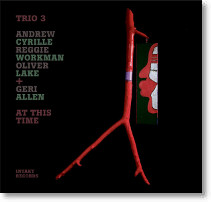
Trio 3 + Geri Allen: At This Time (2008 [2009],
Intakt): First song -- one of the pianist's -- indicates that she
might mean to slow them down, but after that they rebound, faster
and more furious than ever. She not only keeps up; she pushes them
along.
A-
Bugge Wesseltoft: New Conception of Jazz (1995-96 [1997],
Jazzland): Norwegian pianist, father a jazz guitarist, played punk as
a teenager, moving on to various jazz and pop projects. This was his
first album, and first of five under this rubric: a scattered mix of
pop/dance moves, including a couple vocals (most notably, Michy), with
exotic flares from around the world, jazz included.
B+(***)
Bugge Wesseltoft: It's Snowing on My Piano (1997, ACT):
Solo piano, very quiet, solemn even, with several songs recognizable to
make this some kind of Christmas special.
B+(*)
Randy Weston: Solo, Duo & Trio (1954-56 [2000],
Milestone): Cover goes further: "featuring Art Blakey/Sam Gill." Some
of the pianist's first recordings, collected from three 10-inch EPs.
Starts with the 1955 trio, then 1956 solo cuts, then winds up with his
first record of piano-bass duets, Cole Porter in a Modern Mood.
B+(*)
Randy Weston: Get Happy With the Randy Weston Trio
(1955 [1995], Riverside/OJC): First 12-inch LP, a piano trio with Sam
Gill (bass) and Wilbert Hogan (drums). The title song is upbeat as
you'd expect, Gill's "A Ballad" delicate, Ellington's "C-Jam Blues"
right in his wheelhouse.
B+(**)
Randy Weston Trio + Cecil Payne: With These Hands . . .
(1956 [1996], Riverside/OJC): Cut in Rudy Van Gelder's Hackensack
studio, with Ahmed Abdul-Malik on bass and Wilbert Hogan on drums,
with the baritone saxophonist on 6/8 cuts. Nice spots for Payne,
especially on "The Man I Love."
B+(***)
Randy Weston Trio/Cecil Payne: Jazz A La Bohemia
(1956 [1990], Riverside/OJC): Recorded live at Café Bohemia in
Greenwich Village, released in 1957 then reissued in 1960 as
Greenwich Village Jazz before eventually reverting to its
original title. Trio includes Ahmed Abdul-Malik (bass) and Al
Dreares (drums), with Payne on baritone sax on 6/8 cuts.
B+(**)
Randy Weston: Little Niles (1958 [1959], United
Artists): This is the first album in a long partnership with Melba
Liston, who plays trombone and arranged seven Weston originals for
septet -- Johnny Griffin (tenor sax), Ray Copeland/Idrees Sulieman
(trumpets), George Joyner (bass), and Charlie Persip (drums).
[Short album at 31:01]
B+(***)
Randy Weston Trio + 4 Trombones: Destry Rides Again
(1959, United Artists): Music from Harold Rome's 1939 musical comedy,
arranged by trombonist Melba Liston, with extra percussionist Willie
Rodriguez not accounted for in the credit.
B+(***)
Randy Weston: Destry Rides Again/Little Niles (1958-59
[2012], Fresh Sound): Two albums on one CD.
B+(***)
Randy Weston: African Cookbook (1964 [1972], Atlantic):
Originally released as Randy! (Bap!! Beep Boo-Bee Bap Beep-M-Boo Bee
Bap!) in 1966, although the cover could be parsed differently, but
as Weston's fascination with Africa developed this repackaging seemed
like a better idea -- 3/7 songs clearly refer to various parts of Africa.
With Ray Copeland (trumpet), Booker Ervin (tenor sax), Bill Wood (bass),
Lenny McBrowne (drums), and extra percussion by Big Black and Sir Harold
Murray (with Big Black vocal on "Congolese Children's Song").
B+(***)
Randy Weston: Portraits of Thelonious Monk: Well You Needn't
(1989 [1990], Verve): Six (or seven) Monk tunes, "Functional" stretched
out to 15:30, "Misterioso" to 10:56, none less than 5:23, by which point
they've started to lose their Monk-ness. With bass, drums, and extra
percussion.
B+(**)
Randy Weston: Portraits of Duke Ellington: Caravan
(1989 [1990], Verve): Same trio + percussion as the Monk session,
recorded one day later. Again, six pieces, stretched out, to what
point I'm not really sure.
B+(*)
Randy Weston: Self Portraits: The Last Day (1989
[1990], Verve): A third straight day of trio + percussion, this
time playing Weston's own tunes.
B+(*)
Randy Weston: Marrakech in the Cool of the Evening
(1992 [1994], Verve): Recorded in the ballroom of the La Mamounia
Hotel in Marrakech, Morocco, but just solo piano. Perhaps the setting
suggested that he was overdue for a Dizzy Gillespie portrait -- a
medley starting with "A Night in Tunisia" -- and I'm glad to hear
a little Fats Waller: anything to spark up all this cocktail cool.
B+(*)
Randy Weston: Earth Birth (1995 [1997], Verve):
Piano trio, with Christian McBride and Billy Higgins, plus strings,
arranged by Melba Liston and played by the Montreal String Orchestra.
B+(*)
Cassandra Wilson: Blue Skies (1988, JMT): Jazz
singer, from Mississippi, original name Fowlkes, moved to Ne York
and briefly married Anthony Wilson, worked with M-Base Collective,
her own discography starting in 1986. Deep voice linked her to
Abbey Lincoln and Betty Carter. Third album, standards, backed
by Mulgrew Miller (piano), Lonnie Plaxico (bass), and Terri Lyne
Carrington (drums).
B+(**)
Cassandra Wilson: Belly of the Sun (2002, Blue Note):
After seven albums (1986-92) on JMT and one on DIW/Columbia, signed
to Blue Note and became more famous (and more mainstream). Wrote or
co-wrote four (of 13) songs here, buried in a mix of blues, Jobim,
Dylan/Band, and others (James Taylor and Jimmy Webb the best known).
B+(*)
Revised Grades
Sometimes further listening leads me to change an initial grade,
usually either because I move on to a real copy, or because someone
else's review or list makes me want to check it again:
Bugge Wesseltoft: New Conception of Jazz: Live (2000-02
[2003], Jazzland): Seven tracks averaging 10+ minutes, recorded with
various groups, at least four separate occasions and/or locales, but
the electronic drum effects keep them all flowing -- a rhythm I find
irresistible. No horns, only one cut with guitar (the longest, "Live
at Blå," with John Scofield), but the keyboardist can go there whenever
he wants.
A-
Notes
Everything streamed from Napster (ex Rhapsody), except as noted in
brackets following the grade:
- [cd] based on physical cd
- [cdr] based on an advance or promo cd or cdr
- [bc] available at bandcamp.com
- [sc] available at soundcloud.com
- [sp] available at spotify.com
Ask a question, or send a comment.
Monday, September 24, 2018
Music Week
Music: current count 30365 [30328] rated (+37), 273 [277] unrated (-4).
Seemed likely to me that the rated count would fall this week,
but I kept plugging at it, mostly picking records from Napster's
Featured list, and they added up, even offering a couple surprises.
Actually, early on I wrapped up the last of the Nate Chinen picks
I could find, winding up with only 5 (of 129) records unrated (Ben
Allison, Tim Berne, Wynton Marsalis, Hedvig Mollestad, Mike Moreno).
I also checked out one of the late Big Jay McNeely's compilations --
picked the one with dates in the title, although I checked them
against his singles discography to be sure. Don't recall why I
didn't go further, but it wasn't easy figuring out when various
things were recorded.
The Featured list did get me to new vault tapes from Stella
Chiweshe, Hazel Dickens & Alice Gerard, and Prince -- none
extraordinary. I also noticed a Bikini Kill album -- one that I
had already heard, but I took another look for two that I had
missed that Christgau had A-listed, and found them (after having
missed them previously). I actually wound up liking their early
demo tape (Revolution Girl Style Now) even more. Also new
on Napster is Posi-Tone, a mainstream jazz label run by Marc Free.
I got their records for a while, but largely stopped paying them
any heed when service went to download-only. Streaming is enough
easier to get me interested again, and the Art Hirahara album is
a big step forward -- I would say a big surprise, but I never
doubted Donny McCaslin could play this well. (I've just never
heard it on any of his own records.)
Best of the B+(***) records is probably Dafnis Prieto's album.
I'm feeling a little guilty about not giving it another spin, but
just not that up for Latin big band. (Could say the same thing
for Eddie Palmieri's Full Circle, which could be one of
his best.) Didn't pay much attention to the new jazz queue this
past week -- partly due to a clutter/misfiling lapse, and partly
because I've been playing Ben Webster's Soulville nearly
every morning. Guess it's time to nudge that grade up to A+.
Rough week for me, both physically and mentally. Had to work
on the old car to get it to start, and decided I also needed to
wash it. Also wound up washing the not-quite-so-old car -- jobs
that were easy a decade ago but grueling these days. Another
task I finally tackled last week was installing new insulation
on the coolant pipes on a mini-split air conditioner. Back in
July when the main AC went out, we noticed that the insulation
on the mini had worn out and split, causing it to ice up and
reducing its effectiveness. Back then a friend helped me tear
out the old and install new, but I couldn't find the right size
material, and made a mess out of it, with the oversized material
not fitting into the raceway.
I had to go shopping for new insulation tubes and possibly a
new raceway. I eventually found some 3/8-inch split tubes with
tape closure, so bought them. I tore the old mess out, installed
the new insulation, and eventually was able to tuck it all inside
the old raceway (with a few extra cuts). Took 4-5 hours, plus
another trip to the hardware store, but finally got it done.
Another day I was worn out at the end of. Also doesn't totally
fix the cooling problem, but does make it a bit better. By the
time I got it done, the heat spell had broken, so I may be able
to put off getting it serviced until next year.
Mental stress is harder to explain. Did a couple of things on
the server, but still way short of the necessary tasks. Did a
minor update, including a new
XgauSez,
on the Robert Christgau website, but still haven't straightened
out the links and filled in the missing stubs for
Carola Dibbell. One of
the XgauSez questions was about jazz albums of the 1950s/1960s,
and Christgau referred to my website for suggestions. Best link
I could offer him was
this one, but it
really doesn't answer the question. So after fretting several
days, I started working on a better answer page, but that's
turned out to be a lot more work than I've been able to do.
I did a preliminary sort for the
1950s and
1960s, but only
based on the one database file linked above. Took a lot of
time to get next to nothing.
Also spent some time collecting music notes and non-jazz album
reviews from the
Notebook. Picked up about a year
over the course of a week, bringing me up to February 2013. Close
to 1000 pages in each volume (actually, 1015 + 1308). At least
those projects are straightforward, things I can keep plodding
at, and in fairly short order get done.
What bothers me more are the things I can't get started. I
still have people I want to call about my sister's death back
in March, and others I called them but haven't since. I've been
hoping to visit family in Oklahoma and Arkansas since, well,
it's been more than two years since I've gotten out of town.
I've been meaning to reorganize my cookbooks, and clean out
and update my spice racks -- bought new bottles for that more
than a year ago. I'm bothered that I haven't even looked at
the stack of library books I have due Wednesday (including
Chris Hedges' America: The Farewell Tour and David Cay
Johnston's It's Even Worse Than You Think: What the Trump
Administration Is Doing to America; probably nothing in
those I don't already know, but I'm certainly could learn
something from Ajax Hacks: Tips & Tools for Creating
Responsive Web Sites -- well, pub date was 2006, so may
be kind of obsolete.) Probably going to wind up sending them
all back, only one (mostly) read.
Nor do I anticipate this week becoming suddenly productive.
Actually, just the opposite. A Russian friend wanted me to
help do some down-home cooking, so I'll be whipping up an
assortment of zakuski, side dishes, and a dessert for Friday
night dinner. Will probably do something horrible to my back,
but otherwise should be fun . . . at last.
New records rated this week:
- Randy Brecker & Mats Holmquist: Together (2018, Summit): [cd]: B+(***)
- Eminem: Kamikaze (2018, Aftermath/Shady/Interscope): [r]: B+(**)
- Billy F Gibbons: The Big Bad Blues (2018, Concord): [r]: B+(*)
- Art Hirahara: Sunward Bound (2017 [2018], Posi-Tone): [r]: A-
- Lyrics Born: Quite a Life (2018, Mobile Home): [r]: A-
- Paul McCartney: Egypt Station (2018, Capitol): [r]: B-
- Mike Moreno: 3 for 3 (2016 [2017], Criss Cross): [r]: B+(*)
- Willie Nelson: My Way (2018, Legacy): [r]: B+(**)
- Dafnis Prieto Big Band: Back to the Sunset (2018, Dafnison): [sp]: B+(***)
- Kristjan Randalu: Absence (2017 [2018], ECM): [r]: B+(**)
- Ratatet: Heroes, Saints and Clowns (2017 [2018], Ridgeway): [cd]: B
- Scott Routenberg Trio: Supermoon (2018, Summit): [cd]: B+(*)
- Trygve Seim: Helsinki Songs (2018, ECM): [r]: B+(***)
- Swamp Dogg: Love, Loss, and Auto-Tune (2018, Joyful Noise): [r]: B
- Szun Waves: New Hymn to Freedom (2016-17 [2018], The Leaf Label): [r]: B+(*)
- Marcin Wasilewski Trio: Live (2016 [2018], ECM): [r]: B+(***)
- Doug Webb: Fast Friends (2018, Posi-Tone): [r]: B+(**)
- Bugge Wesseltoft/Prins Thomas: Bugge Wesseltoft & Prins Thomas (2018, Smalltown Supersound): [r]: B+(**)
- Mike Westbrook: Starcross Bridge (2017 [2018], Hatology): [r]: B+(*)
Recent reissues, compilations, and vault discoveries rated this week:
- Stella Chiweshe: Kasahwa: Early Singles (1974-83 [2018], Glitterbeat): [r]: B+(**)
- Hazel Dickens & Alice Gerrard: Sing Me Back Home: The DC Tapes, 1965-1969 (1965-69 [2018], Free Dirt): [r]: B+(**)
- Prince: Piano and a Microphone 1983 (1983 [2018], NPG/Warner Bros.): [r]: B
Old music rated this week:
- Bikini Kill: Revolution Girl Style Now (1991 [2015], Bikini Kill): [r]: B+(***)
- Bikini Kill: Bikini Kill (1992, Kill Rock Stars, EP): [r]: B+(**)
- Bikini Kill: Yeah Yeah Yeah Yeah (1992 [1993], Kill Rock Stars, EP): [r]: B+(**)
- Bikini Kill: The Singles (1993-95 [1998], Kill Rock Stars, EP): [r]: B+(***)
- Terence Blanchard: Bounce (2003, Blue Note): [r]: B+(**)
- The Cookers: Warriors (2011, Jazz Legacy): [r]: B+(***)
- Huggy Bear: Our Troubled Youth (1992 [1993], Kill Rock Stars, EP): [r]: B
- Ahmad Jamal: In Search of Momentum (2003, Birdology/Dreyfus): [r]: B+(**)
- Lionel Loueke: Virgin Forest (2006 [2007], ObliqSound): [r]: B+(*)
- Big Jay McNeely: The Best Of (1948-1956) (1946-58 [2010], Master Classics): [r]: B+(***)
- Trygve Seim: Different Rivers (1998-99 [2000], ECM): [r]: B+(*)
- Loren Stillman + Bad Touch: Going Public (2012 [2014], Fresh Sound New Talent): [r]: B+(***)
- Bugge Wesseltoft: New Conception of Jazz (1995-96 [1997], Jazzland): [r]: B+(***)
- Bugge Wesseltoft: It's Snowing on My Piano (1997, ACT): [r]: B+(*)
- Bugge Wesseltoft: New Conception of Jazz: Live (2000-02 [2003], Jazzland): [r]: A-
Unpacking: Found in the mail last week:
- Ernesto Cervini's Turboprop: Abundance (Anzic): October 5
- Colin Edwin & Lorenzo Feliciati: Twinscapes Vol. 2: A Modern Approach to the Dancefloor (RareNoise): advance, October 26
- Myra Melford's Snowy Egret: The Other Side of Air (Firehouse 12): November 2
- John Moulder: Decade: Memoirs (Origin)
- Anne Sajdera: New Year (Bijuri): November 2
- Tyshaw Sorey: Pillars (Firehouse 12, 3CD): October 12
- Mike Steinel Quintet: Song and Dance (OA2)
- Brad Whiteley: Presence (Destiny): October 5
Ask a question, or send a comment.
Sunday, September 23, 2018
Weekend Roundup
Got a late start this week, figuring I'd just go through the motions,
but got overwhelmed, as usual.
Was reminded on twitter that Liz Fink died three years ago. Also
pointed to this
video biography. I couldn't
tell whether the dog snoring sounds were in the video, given that the
same dog was camped out under my desk (not the poodle pictured in the
video, the legendary Sheldon).
Some scattered links this week:
Matthew Yglesias: Kavanaugh and Trump are part of a larger crisis of
elite accountability in America: Two pretty good quotes here. The
first gives you most of the background you need to judge Kavanaugh:
An honest look at his career shows that it's extraordinarily
undistinguished.
Born into a privileged family that was well-connected in Republican
Party politics, Kavanaugh coasted from Georgetown Prep, where he was
apparently a hard partier, into Yale, where he joined the notoriously
hard-partying secret society Truth & Courage, and then on to Yale
Law School.
Soon after graduating, he got a gig working for independent counsel
Ken Starr -- a plum position for a Republican lawyer on the make because
the Starr inquiry was supposed to take down the Clinton administration.
Instead, it ended up an ignominious, embarrassing failure, generating
an impeachment process that was so spectacularly misguided and unpopular
that Democrats pulled off the nearly impossible feat of gaining seats
during a midterm election when they controlled the White House.
Kavanaugh clerked for Alex Kozinski, an appeals court judge who was
well known to the lay public for his witty opinions and well known to
the legal community as a sexual harasser. When the sexual harassment
became a matter of public embarrassment in the wake of the #MeToo
movement, Kavanaugh professed to have simply not noticed anything
amiss -- including somehow not remembering Kozinski's dirty jokes
email distribution list.
Despite this inattention to detail, Kavanaugh ended up in the George
W. Bush White House, playing a critical behind-the-scenes role as staff
secretary to an administration that suffered the worst terrorist attack
in American history, let the perpetrator get away, invaded Iraq to halt
the country's nonexistent nuclear weapons program, and destroyed the
global economy.
Kavanaugh then landed a seat on the DC Circuit Court, though to do
so, he had to offer testimony that we now know to have been misleading
regarding his role in both William Pryor's nomination for a different
federal judgeship and the handling of some emails stolen from Democratic
Party committee staff. On the DC Circuit, he issued some normal GOP
party-line rulings befitting his career as a Republican Party foot
soldier.
Now he may end up as a Supreme Court justice despite never in his
life having been involved in anything that was actually successful. He
has never meaningfully taken responsibility for the substantive failures
of the Starr inquiry or the Bush White House, where his tenure as a
senior staffer coincided with both Hurricane Katrina and failed Social
Security privatization plan as well as the email shenanigans he misled
Congress about, or for his personal failure as a bystander to Kozinski's
abuses.
He's been a man on the make ever since his teen years, and has
consistently acted with the breezy confidence of privilege.
The second quote wraps Trump up neatly. Every now and then you need
to be reminded that however much you loathe Trump personally, his actual
track record is even more nefarious than you recall:
The most striking thing about Trump's record, in my view, is how frequently
he has been caught doing illegal things only to get away without paying
much of a price. His career is a story of a crime here, a civil settlement
there, but never a criminal trial or anything that would deprive him of
his business empire or social clout.
Back in 1990, he needed an illegal loan from his father to keep his
casinos afloat. So he asked for an illegal loan from his father, received
an illegal loan from his father, and was caught by the New Jersey gaming
authorities receiving said illegal loan from his father. But nothing
really happened to him as a result. He paid a $65,000 fine and moved on.
This happened to Trump again and again before he began his political
career. From his empty-box tax scam to money laundering at his casinos
to racial discrimination in his apartments to Federal Trade Commission
violations for his stock purchases to Securities and Exchange Commission
violations for his financial reporting, Trump has spent his entire career
breaking various laws, getting caught, and then essentially plowing ahead
unharmed.
When he was caught engaging in illegal racial discrimination to please
a mob boss, he paid a fine. There was no sense that this was a repeated
pattern of violating racial discrimination law, and certainly no desire
to take a closer look at his various personal and professional connections
to the Mafia.
If Trump had been a carjacker or a heroin dealer, this rap sheet would
have had him labeled a career criminal and treated quite harshly by the
legal system. But operating under the rules of rich-guy impunity, Trump
remained a member of New York high society in good standing -- hosting a
television show, having Bill and Hillary Clinton attend his third wedding
as guests, etc. -- before finally leaning into his lifelong dalliances
with racial demagoguery to become president.
Over the course of that campaign, he wasn't only credibly accused of
several instances of sexual assault -- he was caught on tape confessing --
but he won the election anyway, and Congress has shown no interest in
looking into the matter.
Other Yglesias pieces:
Amazon's looming challenge: Europe's antitrust laws.
Trump's latest interview shows Republicans have nothing to run on in
November: "Trump can't defend the Republican agenda." Sure, you
might think it would if he actually understood it, but then he'd have
to lie even more creatively, because there's nothing popular in the
actual programs ("make another stab at repealing the Affordable Care
Act, enact a new round of tax cuts, and move to cut safety-net programs
like SNAP"). Besides, he's got slogans ("America First"), sound bites,
and snark. You could picture him as Alfred E. Neumann: "What, me worry?"
The battle for state legislatures.
The Kavanaugh assault allegations are a reminder that Democrats were
smart to push Al Franken out.
Matthew Yglesias: Republicans can't hold Kavanaugh or anyone else
accountable -- because Trump is president: I would have constructed
this differently, as it's clear that the conservative movement's
"no-standards zone" existed well before 2016 and helped make him
president. For conservatives, the only virtue is loyalty and use
for the program, and the only sin is heresy. Republicans are united
behind Kavanaugh because they (no doubt correctly) view him as a
totally reliable conservative movement vote on the Supreme Court,
and few things matter more to them -- especially given life-long
tenure.
Google's Dragonfly abandons "don't be evil"
More Kavanaugh links:
Michelle Alexander: We Are Not the Resistance: New NY Times opinion
columnist, author of The New Jim Crow: Mass Incarceration in the Age
of Colorblindness (2010), the book that brought its subject into
mainstream political discourse. Here she bravely tries to turn the table,
arguing "Donald Trump is the one who is pushing back against the new
nation that's struggling to be born."
Resistance is a reactive state of mind. While it can be necessary for
survival and to prevent catastrophic harm, it can also tempt us to set
our sights too low and to restrict our field of vision to the next
election cycle, leading us to forget our ultimate purpose and place
in history.
The disorienting nature of Trump's presidency has already managed
to obscure what should be an obvious fact: Viewed from the broad sweep
of history, Donald Trump is the resistance. We are not.
Those of us who are committed to the radical evolution of American
democracy are not merely resisting an unwanted reality. To the contrary,
the struggle for human freedom and dignity extends back centuries and
is likely to continue for generations to come. . . .
Donald Trump's election represents a surge of resistance to this
rapidly swelling river, an effort to build not just a wall but a dam.
A new nation is struggling to be born, a multiracial, multiethnic,
multifaith, egalitarian democracy in which every life and every voice
truly matters.
Daniel Bessner: What Does Alexandria Ocasio-Cortez Think About the South
China Sea? Sub hed is more to the point: "the rising left needs more
foreign policy. Here's how it can start." Basic point:
Left-wing politics is, at its heart, about giving power to ordinary people.
Foreign policy, especially recently, has been about the opposite. Since the
1940s, unelected officials ensconced in bodies like the National Security
Council have been the primary makers of foreign policy. This trend has
worsened since the Sept. 11 attacks, as Congress has relinquished its
oversight role and granted officials in the executive branch and the
military carte blanche. Foreign policy elites have been anything but wise
and have promoted several of the worst foreign policy blunders in American
history, including the wars in Vietnam and Iraq.
The left should aim to bring democracy into foreign policy. This means
taking some of the power away from the executive and, especially, White
House institutions like the National Security Council and returning it to
the hands of Congress. In particular, socialist politicians should push to
reassert Congress's long-abdicated role in declaring war, encourage more
active oversight of the military and create bodies that make national
security information available to the public so that Americans know
exactly what their country is doing abroad.
Bessner goes on to outline four areas: Accountability, Anti-militarism,
Threat deflation, and Internationalism. That's a good start, an outline
for a book which I'd like to see but could probably write myself. One
thing that isn't developed enough is why this matters. US foreign policy
has always been dominated by business interests -- the Barbars Wars, the
War of 1812, and the "Open Door" skirmishes in East Asia were all about
supporting US traders, the Mexican and Spanish Wars were more nakedly
imperialist; even after WWII, CIA coups in Guatemala and Iran had clear
corporate sponsors. Such ventures had little domestic effect -- a few
special interests benefited, but unless they escalated into world wars
few ordinary Americans were affected. That changed after WWII, when the
anti-communist effort was broadly directed against labor movements, and
wound up undermining worker representation here, concentrating corporate
power and dragging domestic politics to the right, subverting democracy
and increasing inequality. Finance and trade policies were even more
obviously captured by corporate interests. Corporations went global,
exporting capital to more lucrative markets abroad. US trade deficits
were tolerated because the profits could be returned to the investment
banks and hedge funds that dominated the elite 1%. Meanwhile, nearly
constant war coarsened and brutalized American society, making us
meaner and more contemptuous, both of other and of ourselves. Harry
Truman started the Cold War and wound up destroying our own middle
class. GW Bush started the Global War on Terror, and all we have to
show for it is Donald Trump -- a seething bundle of contradictions,
blindly lashing out at the foreign policy he inherited and totally in
thrall to it. So sure, the Rising Left needs a new foreign policy,
and not just because the world should be treated better but because
we should treat ourselves better too.
Sean Illing: Americans have a longstanding love of magical thinking:
One more in a long series of superficial interviews with authors of
recent books. This one is with Kurt Andersen, whose Fantasyland:
How America Went Haywire intrigued me as possibly insightful in
the Trump era -- still, when I thumbed through the book, it struck
me as possibly just glib and superficial, or maybe just too obvious.
It's long been clear to me that in 1980 America voted for a deranged
fantasy (Reagan) over sober reality (Carter), and since then it's
been impossible to turn back -- not least because the Clinton-Obama
Democrats have chosen to fight conservative myths with neoliberal
ones. Andersen quote:
I've been familiar with Trump for a long time, and I was one of the
first people to write about him back in the '80s. I started paying
attention to him before a lot of other people did. There's nothing
there. He's a showman, a performance artist. But he's a hustler like
P.T. Barnum.
As I was writing this book in 2014 and 2015, I saw that Trump was
running for president and I realized, about halfway through the book,
that I had to reckon with this stupid -- but deadly serious -- candidacy.
Watching it was strange, though. I was finishing the book and getting
to the part about modern politics, and here's Trump about to win the
nomination. It was as though I had summoned some golem into existence
by writing this history, of which he, as you say, is the apotheosis.
Umair Irfan: Ryan Zinke to the oil and gas industry: "Our government
should work for you": And Zinke's department, to say the least,
already does.
Irfan has also been following Hurricane Florence. See:
Hurricane Florence's "1,000-year" rainfall, explained; and
Hog manure is spilling out of lagoons because of Hurricane Florence's
floods. Coal ash is another concern:
Steven Murfson/Brady Dennis/Darryl Fears: More headaches as Florence's
waters overtake toxic pits and hog lagoons; and, following up,
Dam breach sends toxic coal ash flowing into a major North Carolina
river; also:
Kelsey Piper: How 3.4 million chickens drowned in Hurricane Florence.
Naomi Klein: There's Nothing Natural About Puerto Rico's Disaster.
In many ways you can say the same thing about North Carolina's disaster,
although Puerto Rico had to face a much more powerful storm with a lot
less government aid.
German Lopez: There have been 263 days in 2018 -- and 262 mass shootings
in America.
Dana Milbank: America's Jews are watching Israel in horror.
Not a columnist I regularly read, least of all on Israel, but take
this as a signpost that in Israel "the rise of ultranationalism tied
to religious extremism, the upsurge in settler violence, the overriding
of Supreme Court rulings upholding democracy and human rights, a
crackdown on dissent, harassment of critics and nonprofits, confiscation
of Arab villages and alliances with regimes -- in Poland, Hungary and
the Philippines -- that foment anti-Semitism" is beginning to worry
some previously staunch supporters.
A poll for the American Jewish Committee in June found that while 77
percent of Israeli Jews approve of Trump's handling of the U.S.-Israeli
relationship, only 34 percent of American Jews approve. Although Trump
is popular in Israel, only 26 percent of American Jews approve of him.
Most Jews feel less secure in the United States than they did a year
ago. (No wonder, given the sharp rise in anti-Semitic incidents and
high-level winks at anti-Semitism, from Charlottesville to Eric Trump's
recent claim that Trump critics are trying to "make three extra shekels.")
The AJC poll was done a month before Israel passed a law to give Jews
more rights than other citizens, betraying the country's 70-year
democratic tradition.
On the other hand:
Netanyahu is betting Israel's future on people such as Pastor John Hagee
of Christians United for Israel, featured at the ceremony for Trump's
opening of the Jerusalem embassy. Hagee once said "Hitler was a hunter"
sent by God to drive Jews to Israel. Pro-Israel apocalypse-minded
Christians see Israel as a precursor to the second coming, when Jews
must convert or go to hell.
On the other hand, for the one Jewish-American who counts the most
(to Trump, anyway):
Jeremy W Peters: Sheldon Adelson Sees a Lot to Like in Trump's
Washington.
Trita Parsi: The Ahvaz terror attack in Iran may drag the US into a larger
war: On the same day that
Trump Lawyer Giuliani Says Iran's Government Will Be Overthrown,
gunmen attacked a parade in Ahvaz (southwestern Iran, a corner with
a large Arabic population), killing 29.
Iran's Rouhani blames US-backed Gulf states for military parade attack,
specifically Saudi Arabia and the UAE -- the prime movers of the US-backed
intervention in Yemen. This follows the September 7
fire-bombing of the Iranian consulate in Basra, Iraq, which in turn
follows months of bellicose talk directed by the Trump administration
(e.g., Nikki Haley, Mike Pompeo, John Bolton, and Giuliani) at Iran,
following constant lobbying by Saudi Arabia, UAE, and Israel to get
the US to pull out of the Iran Nuclear Agreement.
Dick Polman: Donald Trump Might Be the 'Client From Hell': That's
almost a commonplace by now, this article repeating all of the usual
charges except the one that Trump doesn't pay his bills. Early on I
doubted the investigation would ever get anywhere near Trump, but
Sessions had to recuse himself after getting caught in a lie about
not meeting any Russians, then Trump tried to intercede for Flynn
and wound up throwing himself into the fray by firing Comey. Even
so, Trump could have sat tight and let a few of his underlings get
sacrificed. However, it's never just been a legal issue for Trump.
It's also a political one, and he seems to intuitively grasp that
he can spin the investigation as a "witch hunt" and rally his base
with that. To some extent he's succeeded doing just that, and in
so doing he's galvanized his base against an ever-expanding array
of scandals. But his base, even having captured nearly all of the
Republican Party faithful, is still a minority position. And to
pretty much everyone else, he's managed to look guilty as hell.
By looking and acting guilty, he's inviting further investigation.
A lawyer who's any good would worry about the legal exposure, and
keep it as far as possible away from the spotlight. On the other
hand, Trump's main lawyer right now is Rudy Giuliani, a flack who
like Trump is primarily interested in political gain.
Andrew Prokop: The Times's big new Rod Rosenstein story has major
implications for Mueller's probe: Seems overblown as a story.
Even if it's true, which I wouldn't bet on, it's a big jump from
wondering whether the president is competent to using his office
to unfairly plot against Trump. On the other hand, the firing of
Andrew McCabe shows that there are powerful people in the Trump
administration who are willing to use innuendo and gossip to
punish DOJ employees they consider hostile to Trump.
Alex Ward: Trump's China strategy is the most radical in decades --
and it's failing. Also related:
Dean Baker: Trump's Tariffs on Chinese Imports Are Actually a Tax on
the US Middle Class. I think both of these pieces are overstated,
but more important miss the main point. China has an industrial policy,
while the US doesn't (well, except for arms and, barely, agribusiness).
To boost exports, you need two things: supply, and an open market. The
Chinese government works both sides of that equation, as indeed does
the government of nation with a successful export-led growth program.
So when China gains access to a market, China has made sure that it
has companies producing products for that market. US trade treaties
try to open markets for American exporters, but they do little to
develop suppliers -- they expect capitalism to magically fill the
supply gap, which could happens but most often won't. Nor is the
problem there simply that the US doesn't have an industrial policy
to make sure we're building products we can successfully export.
It's also that US corporations are free to invest their capital
elsewhere -- basically wherever they expect the highest return.
And there is no real pressure on them to reinvest their profits in
American workers -- either from the government or labor unions. So,
Trump is right when he complains that China has been ripping us
off for many years. However, he doesn't have the right tools for
turning this around, and with his carte blanche for corporate power
he refuses to even consider doing what needs to be done. But that
doesn't mean that someone who cared about American workers couldn't
do much better.
Ask a question, or send a comment.
Monday, September 17, 2018
Music Week
Music: current count 30328 [30295] rated (+33), 277 [271] unrated (+6).
Had a rough week, including a moment when all of the stress I had
been accumulating seemed to implode, then emanate outward in a scream
and a shudder. One thing that did break was my progress through the
new jazz queue. I ran into an album that under the circumstances was
unbearable. I imagine I'll go back to it later this week and give it
a fair shake, but that wasn't going to happen last week. Instead, I
slipped two CDs into the changes, choice encounters between saxophonist
and pianist -- Lester Young and Oscar Peterson for starters, then Ben
Webster with Art Tatum -- and that's remained my wake-up ritual ever
since: long enough for breakfast, reading what's left of the local
newspaper, and a little work on the jigsaw puzzle. Later in the day
I'd pull up some jazz on Napster, or if I needed to get away from the
computer, some r&b from the travel cases. Somehow managed to fix
a nice dinner for the people who were kind enough to tear down and
pack my late sister's
big art project -- currently in a truck
on the road to Vancouver, WA. Greek shrimp, green beans, salad, rice,
and an applesauce cake, as I recall.
Wound up with mostly old jazz this week, in most cases starting with
albums Nate Chinen picked as the "129 Essential [Jazz] Albums of the
Twenty-First Century." I copied them down, checked my database, and
figured out I hadn't heard nearly a sixth of them (21, so 16.2%). I've
since knocked that down to five that don't seem to be on Napster. In
some cases my curiosity led me to related albums, picking up two extra
albums by Danilo Pérez and John Scofield, one by Cassandra Wilson, but
none of those cases filled in all of the holes in my listening. The one
exception was Trio 3 (Oliver Lake, Reggie Workman, Andrew Cyrille) --
not coincidentally the only of the 16 records to get an A- -- and they
got me to take another look at the great Swiss pianist Irène Schweizer.
I've made a couple of previous dives through her catalog, especially
the piano-drum duos (I especially recommend the ones with Han Bennink
and Pierre Favre), so much of what was left was solo -- something I
rarely follow well let alone get into, but she's really special. Also
gave me an excuse to dig deeper into her label, Intakt -- something
I've long wanted to do.
One thing I did manage to do (in an unsatisfying, hacked up way)
last week was set up WordPress for
Notes on
Everyday Life. I had previously built websites for this domain in
2004 based on Drupal and in 2014 based on WordPress, but both were
eventually wiped out in server catastrophes. Neither was a major loss,
in that the writing also existed in my notebook. So I was pleased that
I found the "Intro" I wrote in 2014, but I got confused by the default
widget setup so it's still not usable. I have a half-assed idea to
fill it up with fragments from old notebooks, hoping that the category
and tag system will bind those bits into more coherent wholes. Given
that I've already gone through and collected the political writings,
it should be relatively straightforward to start picking things out.
I have two more WordPress blogs to set up, including one for music
writings. Would like some advice and direction on the latter, and
ultimately some help. I've continued to collect music writings and
non-jazz reviews into book form. I'm up to 2012 now, with close to
2000 pages in two books, so there's quite a bit of content that
could be used as a starting point.
New records rated this week:
- Stan Kenton Legacy Orchestra: Flyin' Through Florida (2018, Summit): [cd]: B+(**)
- John Kruth & La Società dei Musici: Forever Ago (2018, Ars Spoletium): [r]: A-
- Joey Morant: Forever Sanctified (2018, Blujazz): [cd]: B+(*)
- Al Muirhead's Canadian Quintet: Undertones (2018, Chronograph): [cd]: B+(**)
- Logan Richardson: Blues People (2018, Ropeadope): [r]: B-
- Cory Smythe: Circulate Susanna (2018, Pyroclastic): [cd]: B-
- Jay T. Vonada: United (2017 [2018], Summit): [cd]: B+(***)
- VWCR [Ken Vandermark/Nate Wooley/Sylvie Courvoisier/Tom Rainey]: Noise of Our Time (2017 [2018], Intakt): [cd]: A-
Old music rated this week:
- David Binney: South (2000 [2001], ACT): [r]: B+(**)
- Brian Blade Fellowship: Perceptual (2000, Blue Note): [r]: B+(**)
- Chicago Underground Quartet: Chicago Underground Quartet (2000 [2001], Thrill Jockey): [r]: B+(**)
- Barry Guy/London Jazz Composers Orchestra/Irène Schweizer: Radio Rondo/Schaffhausen Concert (2008 [2009], Intakt): [r]: B+(***)
- Keith Jarrett/Gary Peacock/Jack DeJohnette: Always Let Me Go: Live in Tokyo (2001 [2002], ECM, 2CD): [r]: B+(**)
- Joëlle Léandre/Yves Robert/Irène Schweizer/Daunik Lazro: Paris Quartet (1985-87 [1989], Intakt): [r]: B+(**)
- Maggie Nicols/Irène Schweizer/Joëlle Léandre: Les Diaboliques (1993 [1994], Intakt): [r]: B
- Danilo Pérez: Danilo Pérez (1992 [1993], Jive/Novus): [r]: B+(*)
- Danilo Pérez: PanaMonk (1996, Impulse!): [r]: B+(**)
- Danilo Pérez: Motherland (2000, Verve): [r]: B+(*)
- Irène Schweizer: Wilde Señoritas (1976 [1977], FMP): [r]: B+(***)
- Irène Schweizer: Hexensabbat (1977 [1978], FMP): [r]: B+(***)
- Irène Schweizer: Wilde Señoritas/Hexensabbat (1976-77 [2002], Intakt, 2CD): [r]: B+(***)
- Irène Schweizer: Live at Taktlos (1984 [1906], Intakt): [r]: B+(**)
- Irène Schweizer: Piano Solo Vol. 1 (1990 [1992], Intakt): [r]: B+(***)
- Irène Schweizer: Piano Solo Vol. 2 (1990 [1992], Intakt): [r]: B+(***)
- Irène Schweizer: Many and One Direction (1996, Intakt): [r]: A-
- Irène Schweizer/Fred Anderson/Hamid Drake: Live Willisau & Taktlos (1998-2004 [2007], Intakt): [r]: A-
- John Scofield: Blue Matter (1986 [1987], Gramavision): [r]: B+(*)
- John Scofield: Hand Jive (1993 [1994], Blue Note): [r]: B+(***)
- John Scofield: Works for Me (2000 [2001], Verve): [r]: B+(**)
- Co Streiff/Irène Schweizer: Twin Lines (1999-2000 [2002], Intakt): [r]: B+(***)
- Trio 3: Encounter (1999 [2001], Passin' Thru): [r]: A-
- Trio 3 + Irène Schweizer: Berne Concert (2007 [2009], Intakt): [r]: B+(***)
- Trio 3 + Geri Allen: At This Time (2008 [2009], Intakt): [r]: A-
- Cassandra Wilson: Blue Skies (1988. JMT): [r]: B+(**)
- Cassandra Wilson: Belly of the Sun (2002, Blue Note): [r]: B+(*)
Unpacking: Found in the mail last week:
- Alchemy Sound Project: Adventures in Time and Space (ARC)
- Danny Bacher: Still Happy (Whaling City Sound)
- Jake Ehrenreich: A Treasury of Jewish Christmas Songs (self-released)
- Jonathan Finlayson: 3 Times Round (Pi): October 5
- The Marie Goudy 12tet featuring Jocelyn Barth: The Bitter Suite (self-released): October 12
- Devin Gray: Dirigo Rataplan II (Rataplan): September 21
- Hofbauer/Rosenthal Quartet: Human Resources (Creative Nation Music): November 9
- Jared Sims: The New York Sessions (Ropeadope): October 12
- Alister Spence/Satoko Fujii: Intelset (Alister Spence Music)
Ask a question, or send a comment.
Sunday, September 16, 2018
Weekend Roundup
Once again, way too much to report to cover in the limited time I
left myself this weekend. Especially given that I had to take a few
hours out to attend a talk by Lawrence Wittner on
How Peace Activists Saved the World from Nuclear War. As Wittner,
author of at least three books on anti-nuke protests,
pointed out, the main factor inhibiting nuclear powers from using their
expensive weapons was fear of public reproach, something that was made
most visible by the concerted efforts of anti-war and anti-nuke activists.
Needless to say, he pointed out that this struggle is far from over, and
arguably may have lost some ground with Trump in power. Trump, indeed,
seems to be triply dangerous on this score: fascinated with the awesome
power of nuclear weapons, convinced of his instincts for holding public
opinion, and indifferent to whatever harm he might cause.
Some scattered links this week:
Scattered pieces by Matthew Yglesias:
Who's overrated and who's underrated as a 2020 Democratic presidential
prospect? The one piece I care least about, partly because I think
that it's far more important for Democrats to elect federal and state
legislators, and for that matter state and local administrators, than
the president. Most issues can be ranked on two axes: importance and
urgency. The presidential election isn't until 2020, even including
the seemingly interminable primary season, whereas there are important
elections happening real soon. But also, and one can point to at least
25 years of experience here, I'd much rather have a solid Democratic
Congress than a crippled Democratic president (which is a charitable
description of the last two, maybe three). But if you are curious, the
current betting lines (and that's really all they are) rank: Kamala
Harris, Bernie Sanders, Cory Booker, Joe Biden, Elizabeth Warren,
Kirsten Gillibrand, Amy Klobuchar, Andrew Cuomo, Opray Winrey, Tim
Kaine, Chris Murphy. Nothing but minor nits in the article: Yglesias
argues for Klobuchar vs. Gillibrand; Dylan Matthews for Michael Avenati
vs. Winfrey; Ezra Klein advises "buy [LA mayor Eric] Garcetti, sell
[CA governor Jerry] Brown." Previous editions of this article -- it
promises to stick with us like a bad cough -- aimed higher, arguing
that Harris is overrated vs. Sanders, that Biden and Kaine should be
more evenly matched, and that Cuomo has pretty clearly blown his shot
(he's since pretty definitively announced he's not running).
Andrew Cuomo has won himself another term, but his presidential aspirations
are dead: "Somewhat ironically, it was actually Cuomo's presidential
aspirations that, in retrospect, have ended up dooming his presidential
aspirations. . . Cuomo zigged [right] when the national party zagged [left]."
The good news for him was that he enjoyed a 20-to-1 fundraising advantage
over challenger Cynthia Nixon, as well as solid support from what remains
of the Democratic Party machine in New York. In short, he won his primary
the same way Clinton defeated Sanders in New York in 2016. Also see:
Matt Taibbi: Cuomo's Win: It's All About the Money.
George W. Bush is not a resistance leader -- he's part of the problem:
The best way to think about Bush-style pseudo-resistance is that it's
a hedge against the risk that the Trumpian political project collapses
disastrously.
In that case, Republicans are going to do what they've done so many
times before and keep all their main policy commitments the same but
come up with some hazy new branding.
After the Gingrich-era GOP was rejected at the polls in 1998 as too
mean-spirited, Bush came into office as a warm and fuzzy "compassionate
conservative." When he left office completely discredited, a new generation
of GOP leaders came to the fore inspired by the hard-edged libertarianism
of the Tea Party and its critique of "crony capitalism." That then gave
way to Donald Trump, a "populist" and "nationalist," who coincidentally
believes in all the same things about taxes and regulation as a Tea Party
Republican or a compassionate conservative or a Gingrich revolutionary.
For better or worse (well, okay, for worse) the elite ranks of the
American conservative movement are inspired by a fanatical belief that
low taxes on rich people constitute both cosmic justice and a surefire
way to spark economic growth. This assumption is wrong and also makes
it impossible for them to coherently govern in a way that serves the
concrete material interests of the majority of the population, leading
inevitably to a politics that emphasizes immaterial culture-war
considerations with the exact nature of the culture war changing to
fit the spirit of the times.
The disagreement over whether Trump is a jerk and the more nice-guy
approach of Bush is better is a genuine disagreement, but it's fundamentally
a tactical one. When the chips are on the table, Bush wants Trump to succeed.
He just wants the world to know that if Trump does fail, there's another
path forward for Republicans that doesn't involve rethinking any of their
main ideas.
The controversy over Bernie Sanders's proposed Stop BEZOS Act, explained:
"You need to take him seriously, not literally." The proposed act is just a
way of showing (and with Amazon personalizing) the fact that one reason many
companies can get away with paying workers less than a living wage is that
many of those workers can compensate for low wages with the public-funded
"safety net" -- food stamps, medicaid, etc. Such benefits not only help
impoverished workers; they also effectively subsidize their employers. Of
course, there are better ways to solve this problem, and indeed Sanders is
in the forefront of pushing those ways. (Also see:
James Bloodworth: I worked in an Amazon warehouse. Bernie Sanders is right
to target them.)
Jon Lee Anderson: What Donald Trump Fails to Recognize About Hurricanes --
and Leadership: Before the storm hit, Trump tried to do the right
thing and use his media prominence to make sure people were aware of the
threat Hurricane Florence posed: as he most memorably put it, the storm
"is very big and very wet." But aside from that one public service bit,
everything else he made about himself, bragging about his "A+" damage
control efforts in Texas and Florida last year, and blaming the disaster
in Puerto Rico on Democrats and "fake news." I doubt that FEMA has ever
done that great of a job, especially in an era where public spending is
shrinking in addition to being eaten up by corruption (while at the same
time disasters are becoming ever more expensive), but having the program
run by people as insensitive and deceitful as Trump only makes matters
worse.
By the way, this has been a rather weird hurricane season, with more
activity in the Pacific (including two major hurricanes impacting Hawaii,
and, currently
Typhoon Mangkhut ravages Philippines, Hong Kong, and southern China),
while most Atlantic storms have been taking unusual routes (which partly
explains why they've been relatively mild). It's not unusual for storms
to follow the East Coast from Florida up through the Carolinas, but I
can't recall any previous storm hitting North Carolina from straight east,
then moving southwest and stalling before eventually curving north and
back out to sea, as Florence is doing. (Wikipedia says Hurricane Isabel,
in 2003, "took a similar path," but actually it came in from further
south, with more impact in Virginia.) While Florence has caused a lot
of damage to the Carolinas so far, one thing you should keep in mind is
that winds there have generally been 70-80 mph less than what hit Puerto
Rico a year ago. More rain and flooding, perhaps, but much less wind.
More links on hurricanes, past and present:
Brian Resnick: Hurricane Florence catastrophic flooding, rescues, and
deaths: what we know.
Charles Bethea: Flooding from Hurricane Florence Threatens to Overwhelm
Manure Lagoons.
Michael Mann: Hurricane Florence is a climate change triple threat.
Emily Stewart: Trump doubles down on Puerto Rico death toll conspiracy,
and
Eliza Barclay: What we know about the death toll in Puerto Rico.
The key thing to understand about Puerto Rico -- a point Trump doesn't
begin to grasp -- is summed up in the title of this AP report:
Maria's death toll climbed long after rain stopped. It seems likely
that if the GWU study methodology was applied to hurricanes in Texas
and Florida, it would come up with higher death tolls than had been
reported, just because it takes more secondary factors into account.
Still, the increase in Puerto Rico was more severe precisely because
recovery efforts were inadequate and in some places invisible. The
most obvious gauge here is electric power outages. I was in Boston
when a hurricane wiped out power virtually everywhere, but power was
completely restored within a week (in my case, three days). It's
virtually certain that anywhere in the continental US power will be
restored within a week, or two weeks tops (with critical places like
hospitals operational much sooner). In Puerto Rico, it took
11 months ("except for 25 customers").
Dean Baker: The bank bailout of 2008 was unnecessary. Fed Chairman Ben
Bernanke scared Congress into it. I think Baker's basically right,
although at the time I didn't have a big problem with the $700 billion
bank bailout bill -- nor, later, using some of the bailout funds to
prop up the auto industry. I think it's appropriate for government to
step in and prevent the sort of panics and collapse that big business
is prone to, but I think it's even more appropriate to provide a strong
safety net and a firm universal foundation for all the people who work
and live in that economy. The problem is that propping up the banks
kept the people who ran them into the ground in power, and once they
were rescued, they actively worked against helping anyone else. Obama
did manage to get a stimulus spending bill passed, but it was by most
estimates less than half of what was actually needed to make up for
the recession. (Coincidentally, it was capped at $700 billion, the
same figure as the bank bailout bill. The banks, by the way, got way
more than $700 billion thanks to Fed policies that basically gave
them unlimited cash infusions, possibly as much as $3 trillion.) The
recovery was further hampered by a Republican austerity campaign,
whipped up by debt hysteria, partly on the hunch that keeping the
economy depressed would make Obama, as Mitch McConnell put it, "a
one-term president," and partly due to their ardor in shrinking
government everywhere (except the military, police, and jails).
Ten years after the collapse of Lehman, some more links:
Matthew Yglesias' third Weeds newsletter made the following claim:
President Obama's No. 1 job was to rescue the ruined economy he inherited,
and he didn't do it.
Yglesias, following an article by Jason Furman, argues that Obama
failed because he didn't get Congress to pass an adequate stimulus bill.
Congress did pass a $700 billion bill, but much of that was in the form
of tax breaks, which turned out to have little effect. The size of the
package was almost identical to the bank bailout bill passed under Bush,
as if that was some sort of ceiling as to how much the government could
spend on any given thing. (It's also very similar in size to the Defense
budget, not counting supplemental funding for war operations.) I think
it's more accurate to say that Obama did a perfectly adequate job of
rescuing the banking industry, but once that was done it was impossible
to get sufficient political support to rescue anyone else. Moreover, any
hope that the banks, once restored to profitability, would somehow lift
the rest of the economy out of the abyss, have been disproven. We might
have known that much before, given the extent to which financial profits,
even before the recession, were driven by predatory scams. There's no
better example of the influence of money on politics, as well as its
"I've got mine, so screw yours" ethics.
Zack Beauchamp: It happened there: how democracy died in Hungary.
In 2010, Viktor Orbán's Fidesz party won a sufficient landslide to
not only control Hungary's parliament but to rewrite its constitution,
which they proceeded to do in such a way as to rig future elections
in their favor, and make it nearly impossible for future governments
to undo their policies. When I first read about this, I immediately
realized that this would be the model for the Republicans should they
ever achieve comparable power in the US. These days, Hungary looks
like the model for a whole wave of illiberal despots, with Putin and
Trump merely the most prominent.
James Fallows: The Passionless Presidency: Fairly long critique of
Jimmy Carter's management style by a journalist who spent a couple years
as one of Carter's speechwriters: mostly a catalog of idiosyncrasies he
never felt the need to reconsider let alone learn from. Carter was one
of the smartest and most personally decent people ever elected president,
but few people regard him as a particularly good president, either based
on results or popularity. It's long been recognized that he voluntarily
sacrificed popularity with, for example, his recession-inducing battle
against inflation, his appeal for conserving energy, and his Panama Canal
treaty (to pick three backlashes Reagan's campaign jumped on. And lately
we've had reason to question some of his goals and intentions, like his
deregulation efforts, his undermining of trade unions, and his escalation
of American "security interests" in the Persian Gulf and Afghanistan.
Fallows dances around these issues, partly by never really concerning
himself with the substance of Carter's presidency, or for that matter
its historical context. One thing that struck me at the time was that
Carter started out wanting to find a moral center for US foreign policy,
but somehow that quickly decayed into a more intensely moralistic gloss
on the policy he inherited (mostly Kissinger's realpolitik with
some high-sounding Kennedy-esque catch phrases). The immediate result
was a revival of the Cold War in ever more uncompromising terms.
Sean Illing: The biggest lie we still teach in American history class:
Interview with James Loewen, author of Lies My Teacher Told Me: Everything
Your American History Textbook Got Wrong, which came out in 1995 and has
sold some two million copies. He says: "The idea that we're always getting
better keeps us from seeing those times when we're getting worse." Also:
For example, if we want to make our society less racist, there are certain
things we'll have to do, like we did between 1954 and 1974. During this
time, you could actually see our society become less racist both in
attitudes and in terms of our social structures.
If we want to make society more racist, then we can do some of the
things we did between 1890 and 1940, because we can actually see our
society becoming more racist both in practices and in attitudes. So by
not teaching causation, we disempower people from doing anything.
By teaching that things are pretty much good and getting better
automatically, we remove any reason for citizens to be citizens, to
exercise the powers of citizenship. But that's not how progress happens.
Nothing good happens without the collective efforts of dedicated
people. History, the way it's commonly taught, has a way of obscuring
this fact.
Also, when asked about "the age of Trump":
I actually think our situation is far worse than it was in the past.
For example, our federal government, under Nixon and Johnson, lied to
us about the Vietnam War, but they never made the case that facts don't
matter or that my facts are as good as your facts.
They assumed something had to be seen as true in order to matter,
so they lied in order to further their agenda.
Trump has basically introduced the idea that there is no such thing
as facts, no such thing as truth -- and that is fundamentally different.
He is attacking the very idea of truth and thereby giving his opponents
no ground to stand on at all. That's a very dangerous road to go down,
but that's where we are.
Illing also has a good interview with David Graeber:
Bullshit jobs: why they exist and why you might have one.
Anna North: The striking parallels between Brett Kavanaugh and Clarence
Thomas: People tend to forget that the main reason Thomas' offenses
were so shocking at the time was that he was actually in charge of the
government department that was responsible for policing sexual harassment
in the workplace. He should, in short, have been uniquely positioned to
know the law, and personally bound to follow it. Of course, as a partisan
Republican hack, he could care less about such things, but the example
gave us a fair glimpse not just into his personal character but into his
future legacy as a jurist. Kavanaugh's"#MeToo" problem (see
Bonan Farrow/Jane Mayer: A Sexual-Misconduct Allegation Against the
Supreme Court Nominee Brett Kavanaugh Stirs Tension Among Democrats
in Congress) doesn't strike
me as of quite the same order, but there is a real parallel between how
Thomas and Kavanaugh were groomed as political cadres infiltrating the
Supreme Court. And confirming Kavanaugh will give him the opportunity
to do something vastly more destructive to American women than he could
ever have done in person. My main caveat is: don't think that all these
guys care about is sexual domination; they're also really into money.
Nomi Prins: Cooking the Books in the Trump Universe. Or, as The
Nation retitled this piece, "Is Donald Trump's Downfall Hidden in His
Tax Returns?"
Jim Tankersley/Keith Bradsher: Trump Hits China With Tariffs on $200
Billion in Goods, Escalating Trade War.
Sandy Tolan: Was Oslo Doomed From the Start? I would like to think
it could have worked, and maybe in Rabin hadn't been killed, and had
Clinton taken seriously his role as honest broker, and had the UN (with
US consent) weighed in on the illegality of the settler movement, but
in retrospect it's clear that Oslo was a weak footing that faced very
formidable opposition -- virtually all on the Israeli side (not that
the deal lacked for Arab critics). The reason Oslo happened was Israel
desperately needed a break and a breather from the Intifada. Rabin's
vow to "break the bones" of the Palestinians had turned into a public
relations disaster, at the same time as the Bush-Baker administration
was exceptionally concerned with building up its Arab alliances. But
also, Rabin recognized that Arafat was very weak -- partly because the
Intifada had gotten along well without him, partly because his siding
with Saddam Hussein in the Gulf War undercut his support from other
Arab leaders -- and was desperate to cut any kind of deal that would
bring him back from exile. Rabin realized that bringing Arafat back
was the sort of ploy that would look like a lot while giving up next
to nothing. In particular, Rabin could still placate the Israeli right
by accelerating the settlement project. Meanwhile, the security services,
the settlers, and the right-wing political parties plotted how to kill
the deal, and any future prospect for peaceful coexistence. As Nolan
notes:
For me, each successive trip has revealed a political situation grimmer
and less hopeful than the time before.
What's made the situation so grim isn't the demise of "the two-state
solution," which only made sense as a way as a stop-gap way to extract
most Palestinians from the occupation without demanding any change from
Israeli nationalism. What's grim is that more and more Israelis have
become convinced that they can maintain a vastly inequal and unjust
two-caste hierarchy indefinitely. They have no qualms about violence,
which they rationalize with increasingly blatant racism, and for now
at least they have few worries about world public opinion -- least of
all about the US since Donald Trump, who's been totally submissive to
Netanyahu, took office.
Also see:
Max Ajl: Trump's decision to close the PLO Embassy says more about the
future of the US than the future of Palestine.
Avi Shlaim: Palestinians still live under apartheid in Israel, 25 years
after the Oslo accord.
Edward Wong: US Is Ending Final Source of Aid for Palestinian Civilians.
Jon Schwarz/Alice Speri: No One Will Be Celebrating the 25th Anniversary
of the Oslo Accords.
James Vincent: EU approves controversial Copyright Directive, including
internet 'link tax' and 'upload filter': "Those in favor say they're
fighting for content creators, but critics say the new laws will be
'catastrophic.'" For more of the latter position, see
Sarah Jeong: New EU copyright filtering law threatens the internet as we
knew it. This sounds just extraordinarily awful. In a nutshell, the
idea is to force all content on the internet to be monetized, with a clear
accounting mechanism so that every actor pays an appropriate amount for
every bit of content. In theory this should provide financial incentives
for creative people to produce content, confident their efforts will be
rewarded. In practice, this will fail on virtually every conceivable level.
The most obvious one is that only large media companies will be able to
manage the process, and even they will find it difficult and fraught with
risk. Conversely, content creators will find it next to impossible to
enforce their rights, so in most cases they will sell them cheap to a
whole new layer of parasitic copyright trolls. The metadata required to
manage this whole process will rival actual content data in mass, and
lend itself to all sorts of hacking and fraud. And most likely, all the
headaches will drive people away from generating content -- even ones
formerly willing to do so gratis -- so the overall universe of content
will shrink. It would be much simpler to do away with copyright and try
to come up with incentives for creators that don't depend on taxing
distribution. That could be combined with funding of alternatives to
the current rash of media monopolies, reducing the ability of companies
to convert private information into cash.
Ask a question, or send a comment.
Monday, September 10, 2018
Music Week
Music: current count 30295 [30261] rated (+34), 271 [278] unrated (-7).
Pretty average week, maybe skewed a bit more than usual toward
jazz, as I continued adding jazz albums to my
Music Tracking file (up to 2062
records now, 913 of them jazz). As the week started, I was still
playing catch up with the late Randy Weston. After that, new adds
to the tracking file steered me to various jazz artists -- Gordon
Grdina, Tord Gustavsen, Scott Hamilton, Uwe Oberg. Also made a dent
in my incoming queue. Only three non-jazz albums this week -- two from
Christgau (who also noted Kali Uchis' Isolation as an HM,
but I have it at A-).
I'm not expecting to get much work done this coming week. My late
sister's
big art project will be dismantled toward the end of the week,
and either packed up and hauled somewhere (still, as far as I know,
undetermined) or tossed into the trash. Some relatives are likely
to show up for this, but I don't have any details. (I'm feeling
really out of the loop here.) This summer has been an awful slog
for me. Don't know whether I'll be relieved or shattered when the
week is over.
Meanwhile, I've dropped the ball on my server project, and for
that matter on long-delayed maintenance work on Robert Christgau's
website. Probably won't
make much progress there until this week's dust settles, but I've
started to think about the tasks again, after blanking out a week
ago.
Still reading books on Russia, although nothing new is quite as
enlightening at David Satter's 2003 book, Darkness at Dawn: The
Rise of the Russian Criminal State. Satter's more recent The
Less You Know, the Better You Sleep reprises his sensational
charge that the FSB was responsible for the 1999 terror bombings
of apartments in Moscow (pictured) and elsewhere, providing the
perfect provocation for Putin to demolish Chechen independence and
consolidate his grip on Russian political power. Of course, this
sounds much like so many 9/11 conspiracy theories, especially with
its cui bono rationales, but it's hard to imagine how else
an unknown insider like Putin could have overcome the morass Boris
Yeltsin's presidency had left Russia in. I'm midway through the
book, just reading about the massacres in the Moscow theater and
the Beslan school. Satter suggests these terrorist attacks may
also have been guided by the FSB as provocations -- by this point
support for the Chechen War was again flagging, so they laid the
ground for another round of Russian escalation -- but thee's less
evidence and rationale behind those charges. Later chapters should
move on to the Ukraine crisis in 2014, but they are bound to be
brief.
Masha Gessen, in The Future Is History: How Totalitarianism
Reclaimed Russia, follows several (mostly) elite families from
Glasnost on -- some semi-famous, most liberal dissenters
but also neo-fascist ideologist Alexander Dugin (you might think
of him as Putin's Steve Bannon). I think the key thing here is that
while she doesn't excuse Yeltsin and Putin, she sees the return to
totalitarianism as a mass preference rather than as something the
leaders inflicted on the people. Reading the book, it occurred to
me that the main reason for this was that 70 years of Communist rule
had left people so cynical about the left critique of capitalism
that it's since been impossible to form a significant democratic
socialist opposition to the self-dealing oligarchy that took over
with Yeltsin.
The least satisfactory book is Timothy Snyder's The Road to
Unfreedom: Russia, Europe, America, although I did find useful
how he tracked Gessen's history from a slightly broader perspective.
Snyder is a historian who has specialized in the war between Nazi
Germany and Soviet Russia to control Eastern Europe (his big book is
Bloodlands: Europe Between Hitler and Stalin), but he's never
rasped the difference between fascism and communism, so he readily
falls for the Cold War ploy of treating both as totalitarianism,
making it easy to see Putin as the unification of both evils. He
even finds a forgotten philosopher, Ivan Ilyin (1883-1954) as the
key ideologist behind Putinism. (Gessen, on the other hand, starts
with psychological studies of Homo sovieticus, ties them to
the "authoritarian personality" studies of Adorno and Arendt, and
charts how those traits have persisted under Putin.) Snyder likes
to call the Ilyin-Putin idea "the politics of eternity" -- sounds
a bit like thousand-year Reich extrapolated to infinity, but smells
more like bullshit.
Gessen, by the way, has a piece I should have mentioned yesterday,
The Undoing of Bill Clinton and Boris Yeltsin's Friendship, and How
It Changed Both of Their Countries. Clinton's decision to bomb
what was left of Yugoslavia over Kosovo offended Yeltsin, both by
harming an important relationship for Russia and by making Russia
look weak and helpless when faced with American hostility. It also
re-established NATO as a counter-Russian threat, and set a precedent
for the US to unilaterally start wars elsewhere (e.g., Afghanistan
in 2001, Iraq in 2003). It also changed Russia:
What was seen as a unilateral American decision to start bombing a
longtime Russian ally emboldened the nationalist opposition and tapped
into a deep inferiority complex. Sensitive to these sentiments, Yeltsin
responded that May by celebrating Victory Day with a military parade
in Red Square, the first in eight years. In fact, military parades
took place all over the country that year, and have been repeated
every year since. What was even more frightening were a series of
nongovernmental Victory Day parades by ultranationalists. That these
public displays, some of which featured the swastika, were tolerated,
and in such close proximity to celebrations of the country's most
hallowed holiday, suggested that xenophobia had acquired new power
in Russia. Later that year, Yeltsin anointed Vladimir Putin his
successor and signed off on a renewed war in Chechnya. This offensive,
designed to shore up support for the country's hand-picked new leader,
was both inspired and enabled by Kosovo. It was a dare to the United
States, an assertion that Russia will do what it wants in its own
Muslim autonomy.
One thing that should be clear by now is that Clinton and other
independent western actors like George Soros actively intervened in
Russian politics in the 1990s, in support of Yeltsin, they never
cared the least for the welfare of Russia, or even for making their
supposed friendly politicians look good. Clinton just assumed that
Russia would never be a problem again, no matter how much popular
enmity he caused. Bush and Obama took much the same tack with Putin,
who actually did a pretty decent job of humoring them as long as
that proved possible, but in the end, sure, he pushed back. My
evolving view of Putin is that he is a smart, canny politician,
careful to maintain his popularity as well as his hand on the
levers of power in Russia. But, unlike Snyder, I don't see him
as a person of strong ideological conviction. It's true that he
embraces various conservative/nationalist positions, but most
likely because that's where his natural political base is. He
exercises a discomforting degree of control over the media and
all forms of political discourse, and he has done some unsavory
things with his power, but he also seems to have some sense of
limits, unlike many dictators we can recall. In short, he seems
like someone the US can work with, and that would be better for
all concerned than the recent spiral of escalating offenses.
Still, one should be clear about the ways of power, in Russia,
in the United States, everywhere. Change what you can, and don't
get suckered into projects that can only make matters worse (e.g.,
ones involving real or even just mock war).
Recommended music links:
-
The Last of the Live Jazz Reviewers: An Interview With Nate Chinen.
Book includes a list of "The 129 Essential Albums of the Twenty-First
Century (So Far)." I should dig this list up and see how it jives with
my own lists. But for now, note that Chinen has written about some of
them
here, and is promising more.
[PS: Made a stab at this, but can't find the list for
2014-2017, so I only have 100 albums in list: 17 I haven't heard,
grade breakdown for rest: A: 2, A-: 23, B+: 44 (16-10-10), B: 7,
B-: 5. That's not far from my usual intersection with jazz critics
polls, but given that he's only picking 5-7 records per year, and
I regularly find over 50 A/A- jazz albums per year, I'm surprised
the spread didn't skew a bit higher. ]
New records rated this week:
- Bali Baby: Baylor Swift (2018, TWIN, EP): [r]: A-
- Dave Ballou & BeepHonk: The Windup (2017 [2018], Clean Feed): [r]: B+(**)
- Daniel Carter/Hilliard Greene/David Haney: Live Constructions (2017 [2018], Slam): [r]: B
- Cyrus Chestnut: Kaleidoscope (2018, HighNote): [r]: B+(*)
- George Colligan: Nation Divided (2017 [2018], Whirlwind): [r]: B+(*)
- Yelena Eckemoff: Better Than Gold and Silver (2018, L&H Production, 2CD): [cd]: B+(**)
- The Equity & Social Justice Quartet: Argle-Bargle or Foofaraw (2018, Edgetone): [cd]: B+(***)
- Fred Frith Trio: Closer to the Ground (2018, Intakt): [cd]: A-
- Gordon Grdina/François Houle/Kenton Loewen: Live at the China Cloud (2017, Big in Japan): [bc]: B+(*)
- Gordon Grdina's the Marrow: Ejdeha (2018, Songlines): [r]: B+(***)
- Tord Gustavsen Trio: The Other Side (2018, ECM): [r]: B+(**)
- Scott Hamilton: Meets the Piano Players (2016 [2017], Organic): [r]: B+(***)
- Scott Hamilton: The Shadow of Your Smile (2017, Blau): [r]: A-
- Scott Hamilton: Moon Mist (2018, Blau): [r]: B+(**)
- Hieroglyphic Being: The Replicant Dream Sequence (2018, Moog Recordings Library) **
- Hinds: I Don't Run (2018, Mom + Pop): [r]: B+(***)
- Ayn Inserto Jazz Orchestra: Down a Rabbit Hole (2015-17 [2018], Summit): [cd]: B+(***)
- Yves Marcotte: Always Know Monk (2017, self-released): [bc]: B+(**)
- Ernest McCarty Jr./Theresa Davis: I Remember Love (2018, Blujazz): [cd]: B+(*)
- Myriad 3: Vera (2018, ALMA): [cd]: B+(*)
- Uwe Oberg/Heinz Sauer: Sweet Reason (2017 [2018], Jazzwerkstatt): [r]: B+(*)
- Ivo Perelman/Jason Stein: Spiritual Prayers (2018, Leo): [cd]: B+(*)
- Ivo Perelman/Rudi Mahall: Kindred Spirits (2018, Leo, 2CD): [cd]: B+(***)
- University of Toronto 12Tet: When Day Slips Into Night (2018, UofT Jazz): [cd]: B+(*)
- Andrés Vial: Andrés Vial Plays Thelonious Monk: Sphereology Volume One (2017 [2018], Chromatic Audio): [cd]: B+(**)
- Western Michigan University Jazz Orchestra: Turkish Delight (2018, Blujazz): [cd]: B+(*)
Old music rated this week:
- Tord Gustavsen Trio: Changing Places (2001-02 [2003], ECM): [r]: B+(**)
- Rudi Mahall: Quartett (2006 [2007], Jazzwerkstatt): [r]: B+(*)
- Uwe Oberg: Work (2008 [2015], Hatology): [r]: B+(**)
- Randy Weston: Portraits of Thelonious Monk: Well You Needn't (1989 [1990], Verve): [r]: B+(**)
- Randy Weston: Portraits of Duke Ellington: Caravan (1989 [1990], Verve): [r]: B+(*)
- Randy Weston: Self Portraits: The Last Day (1989 [1990], Verve): [r]: B+(*)
- Randy Weston: Marrakech in the Cool of the Evening (1992 [1994], Verve): [r]: B+(*)
- Randy Weston: Earth Birth (1995 [1997], Verve): [r]: B+(*)
Unpacking: Found in the mail last week:
- Cory Smythe: Circulate Susanna (Pyroclastic)
- Steven Taetz: Drink You In (Flatcar/Fontana North)
Ask a question, or send a comment.
Sunday, September 9, 2018
Weekend Roundup
This is how last week started, with a few choice tidbits from
Bob Woodward's new book, Fear: Trump in the White House:
Philip Rucker/Robert Costa: Bob Woodward's new book reveals a 'nervous
breakdown' of Trump's presidency As Aaron Blake (in
The Most damning portrait of Trump's presidency yet -- by far):
Bob Woodward's book confirms just about everything President Trump's
critics and those who closely study the White House already thought
to be the case inside 1600 Pennsylvania Avenue. It's also completely
stunning.
The book doesn't go public until 9/11 -- wouldn't you like to have
been a "fly on the wall" for the marketing sessions that picked that
date? -- but not much that's been reported so far is surprising. I've
long suspected that Trump ordered a plan to pre-emptively attack North
Korea, and that the military brass refused to give him one, but that
story didn't strike Blake as important enough to even mention. (He
does cite Trump's tantrum over Syria: "Let's fucking kill him! Let's
go in. Let's kill the fucking lot of them.") Still, the main effect
of the book leaks was simply to get the mainstream press to return
to such quickly forgotten stories, and to provoke more reactions to
feed the 24-hour cable news cycle.
One such reaction was the now infamous New York Times anonymous
op-ed piece,
I Am Part of the Resistance Inside the Trump Administration,
reportedly by "a senior official in the Trump administration whose
identity is known to us and whose job would be jeopardized by its
disclosure." Again, this has mostly been reported as a dis of Trump,
but it is actually a very scary document, revealing that even as
deranged as Trump is, he's not the most despicable and dangerous
person in his administration. When the author claims "like-minded
colleagues and I have vowed to thwart parts of his agenda and his
worst inclinations," they're not doing it out of any sense of higher
loyalty to law and the constitution. They're doing it to advance
their own undemocratic, rigidly conservative political agenda. And
if these people are really "the adults in the room," as competent
as they think, they'll probably wind up doing more real harm to the
people than Trump could ever do on his own.
Of course, the op-ed launched a huge guessing game as to the
author. Trump played along, tweeting something about "TREASON"
and urging Atty. General Jeff Sessions to investigate (although
on further reflection I doubt he'd really welcome another DOJ
investigation of his staff). And, of course, everyone who is
anyone in the administration has denied responsibility -- hardly
a surprise given that a willingness to stand up for truth and take
responsibility for one's actions were disqualifying marks for any
Trump administration job. Besides, as
John Judis notes, "I'd look for whoever in the administration
most vociferously denounces the author of the op-ed."
For an overview, see
Andrew Prokop: Who is the senior Trump official who wrote the New
York Times op-ed? -- although you'd have to go to the links to
come up with possible names and reasons. Jimmy Kimmel noticed the
unusual word "lodestar" and came up with a reel of Mike Pence using
the word in a half-dozen different speeches. (Colbert ran the same
revelation a day later.) Actually, that suggests Pence's speechwriter,
whoever that is. Indeed, there are dozens of anonymous little folk
you've never heard of scurrying around the West Wing offices, where
they could stealthily carry on the "good fight" of enforcing rightist
orthodoxy. It's not like anyone had ever heard of Rob Porter before
he got fired, but his precise job was to shuffle papers for Trump's
signature.
The other thing to remember about Pence is that he was the main
person responsible for staffing the Administration after Trump got
elected, so he's likely the main reason why all these totally orthodox
conservatives have been empowered and turned loose to wreak havoc on
the administrative state -- indeed, on the very notion that the
government is meant to serve the people and promote the general
welfare of the nation.
Additional links on Woodward and/or the Anonymous op-ed:
Masha Gessen: The Anonymous New York Times Op-Ed and the Trumpian Corruption
of Language and the Media:
The Op-Ed section is separate from the news operation, but, in protecting
the identity of the person who wrote the Op-Ed, the paper forfeits the job
of holding power to account. . . . By publishing the anonymous Op-Ed, the
Times became complicit in its own corruption.
The way in which the news media are being corrupted -- even an outlet like
the Times, which continues to publish remarkable investigative work
throughout this era -- is one of the most insidious, pronounced, and likely
long-lasting effects of the Trump Administration. The media are being
corrupted every time they engage with a nonsensical, false, or hateful
Trump tweet (although not engaging with these tweets is not an option).
They are being corrupted every time journalists act polite while the
President, his press secretary, or other Administration officials lie
to them. They are being corrupted every time a Trumpian lie is referred
to as a "falsehood," a "factually incorrect statement," or as anything
other than a lie. They are being corrupted every time journalists allow
the Administration to frame an issue, like when they engage in a discussion
about whether the separation of children from their parents at the border
is an effective deterrent against illegal immigration. They are being
corrupted every time they use the phrase "illegal immigration."
David A Graham: We're Watching an Antidemocratic Coup Unfold:
Graham basically agrees with David Frum (see
This Is a Constitutional Crisis, a piece I read then decided wasn't
important enough to cite) that acts by White House staff to subvert
Trump's presidential directives constitute some kind of attack on
American democracy, even though they both agree that Trump is crazy,
demented, stupid and cruel. I think they're way overreacting. On the
one hand, it's simply not reasonable that any president -- even one
elected with a much less ambiguous mandate than Trump was -- should
have the power to dictate the acts of everyone who works under the
executive branch. The fact is that everyone who works for government
has to satisfy multiple directives, starting with the constitution
and the legal code, and in many cases other professional codes, labor
contracts, and job descriptions. On the other hand, every organization
involves a good deal of delegation and specialization, and virtually
all managers expect subordinates to push back against ill considered
directives. Most of the concrete cases Woodward cites are occasions
where rejecting Trump's directives is fully appropriate. The author
of the "we are the resistance" op-ed is a different case because he
(or, unlikely, she) is claiming a higher political right to go rogue,
but in the absence of specific cases that isn't even clearly the case.
What we probably do agree on is that Trump himself thinks he should
have more direct power over his administration than he does in fact
have, and this is more painfully obvious than is normally the case
because he tends to make exceptionally dreadful decisions, because
in turn he's uninformed, impetuous, unwilling to listen to expertise,
and unable to reason effectively. Given the kind of person Trump is,
occasional staff resistance is inevitable, and should be recognized
as the normal functioning of the bureaucracy. (Graham actually cites
a previous example of this: "Defense Secretary James Schlesinger,
worried by Richard Nixon's heavy drinking, instructed generals not
to launch any strikes without his say-so -- effectively granting
himself veto power over the president.")
Greg Sargent: Trump's paranoid rage is getting worse. But the White House
'resistance' is a sham.<
David Von Drehle: The only solid bet is on Trump's panic (but the op-ed
was probably Jared): I'm mostly linking to this because my wife's been
offering opinions on who did it all week, and her latest pick is Kushner.
I don't buy this for a lot of reasons, but mostly because the op-ed reads
like the work of an ideological purist -- something I seriously doubt of
Kushner. (I also doubt Kushner could write it without a lot of help --
whatever else you may think, it is very well crafted.) On the other hand,
the bottom third about the Mueller investigation makes perfect sense, and
gives you a lot to think about. The public hasn't seen Trump's tax returns,
but "Mueller almost certainly possesses" them. Also financial transaction
records from Deutsche Bank, "which also coughed up $630 million in fines
in 2017 to settle charges of participating in a $10 billion Russian
money-laundering scheme."
Concurrently, the Senate Judiciary Hearing has been holding hearings
on Trump's Supreme Court nominee, Bret Kavanaugh.
Some links:
Some scattered links this week:
Matthew Yglesias: No summary of the week, but he wrote
some important pieces this week:
John McCain's memorial service was not a resistance event: Cites
Susan Glasser's New Yorker article for its ridiculous resistance
meme -- something I wrote about last week. As noted, McCain's occasional
dissent from Trump rarely had anything to do with policy, and when it
did it was usually because Trump has never been as steadfastly pro-war
as McCain. (Arguably Trump is so impetuous and erratic he's ultimately
more dangerous, but I don't believe that.) Sure, one might imagine a
principled conservative opposition to Trump, but Republicans gave up
any hint of such principles ages ago (e.g., when Arthur Vanderberg
welcomed the military-industrial complex, when Barry Goldwater sided
with segregation, when Richard Nixon decided winning mattered more
than following the law, when all Reagan and Bush decided to sacrifice
abortion rights for political expediency, when right-wing jurists
ruled that free speech rights are proportional to money, and that
anything that tips an election in your favor is fair play). But it's
real hard to find any actual Republican politicians who adhere to
such conservative principles. On the other hand, there is a real
resistance, not just to Trump but to the whole conservative political
movement.
Also on McCain:
Eric Lovitz: John McCain's Service in Vietnam Was a Tragedy.
Trump's White House says wages are rising more than liberals think:
This gets pretty deep in the weeds, trying to make "the best case for
Trump: surging consumer confidence," but concluding "wage growth isn't
zero, but it's still pretty low." My hunch is that it feels even worse,
because Trump's anti-union and other deregulation efforts are aimed at
increasing corporate power both over workers and consumers, while those
and other policies shift risk onto individuals.
Republicans are preparing to disavow Trump if he fails -- then come back
and try the same policies: You've heard this one before: every time
conservatives get political power, they screw things up -- Reagan ended
in various scandals from HUD to S&Ls to Iran-Contra, Bush I in a rash
of short wars and recession, Bush II with his endless wars and even huger
recession, and now Trump with his ticking cacophony of time bombs -- but
bounce back by claiming that their ideas never got a fair chance. As the
subhed puts it, 'Conservatism can never fail, only be failed." Indeed,
Trump's catastrophic failure now seems so ordained that some Republicans
are already heading for the exits and shelters, preparing themselves for
the next wave of resurgent conservatism. Paul Ryan is the most obvious
example.
Republicans are arguing that Medicare-for-all will undermine Medicare:
Same old strategy they've always used, sowing FUD (fear, uncertainty, doubt)
to rally the uninformed and easily confused against any proposed change.
Still, seems a little far fetched, especially coming from the party that
tried to stop Medicare from passing in the first place, the same one that
periodically comes up with new schemes to weaken it.
Obama wants Democrats to quit their addiction to the status quo.
Alternate title, the one actually on the page: "Obama just gave the
speech the left's wanted since he left office." Actually, the left
wanted him to step up 9-10 years ago, back when he was in a position
to do more than just talk. And while he embraces the "new idea" of
Medicare for All, ten years ago that was actually better understood
program than the one the Democrats passed and Obama got tarred and
feathered with. Yglesias wonders how effective Obama speaking out
might be. To my mind, the key thing that he's signaling is that
mainstream Democrats shouldn't fear the party moving to the left.
Rather, they need to keep up with their voters. For more on Obama's
speech, see
Dylan Scott: The 7 most important moments in Obama's blistering
critique of Trump and the GOP: Starts with "It did not start with
Donald Trump."
Tara Golshan/Ella Nilsen: Trump says a shutdown would be a "great political
issue" 2 months from the midterms: On the surface this seems like a
monumentally stupid thing to say. I think we've had enough experience
lately with playing chicken over budget shutdowns that it's pretty clear
that whoever initiates the shutdown loses. If Trump doesn't get this by
now, that can only suggest he's, well, some kind of, you know, moron.
Dara Lind: Trump's new plan to detain immigrant families indefinitely,
explained: Some highlights:
- Tighten the standards for releasing migrant children from detention
- Detain families in facilities that haven't been formally approved for
licenses
- Give facilities broad "emergency" loopholes for not meeting standards
of care
- Make it easier for the government to revoke the legal protections for
"unaccompanied" children
Ernesto Londono/Nicholas Casey: Trump Administration Discussed Coup Plans
With Rebel Venezuelan Officers: Takeaway quote: "Maduro has long
justified his grip on Venezuela by claiming that Washington imperialists
are actively trying to depose him, and the secret talks could provide
him with ammunition to chip away at the region's nearly united stance
against him." Trump has also talked up staging an outright US military
invasion.
German Lopez: Chicago Mayor Rahm Emanuel's disastrous handling of a
police shooting tanked his reelection bid: Emanuel announced he
won't run for third term, even though he had already raised $10 million
for the campaign.
Rick Perlstein/Livia Gershon: Stolen Elections, Voting Dogs and Other
Fantastic Fables From the GOP Voter Fraud Mythology: A long history,
going back to Operation Eagle Eye, launched by Republicans convinced
that the 1960 presidential election was stolen from Richard Nixon.
Greg Sargent: Trump's latest rally rant is much more alarming and dangerous
than usual:
Dylan Scott: The 4 House GOP scandals that could tip the 2018 midterms,
explained: Scott Taylor, Chris Collins, Duncan Hunter, Rod Blum.
"Democrats' 2018 message is that Republicans are corrupt."
Felicia Sonmez: Trump suggests that protesting should be illegal:
Tempted to file this under Kavanaugh above, given that the key tweet
was in response to protesters at the Senate hearings (most of whom
were in fact arrested), but the first example in the article refers
to him lashing out at "NFL players for kneeling during the national
anthem, and further examples include the "Giant Trump Baby" in London.
Also related:
John Wagner: Trump suggests libel laws should be changed after uproar
over Woodward book. Actually, changing libel laws to allow him to
sue anyone he thinks defamed him was something he campaigned on in
2016 -- something at the time I didn't think stood a chance of passing,
but still revealed much about his worldview. Treating dissent and even
criticism as criminal is a common trait of the class of political figures
we commonly describe as dictators. Trump has long shown great sympathy
for such figures, which only adds to the notion that he aspires to be
a dictator as well.
Kay Steiger: 4 winners and 3 losers from Brett Kavanaugh's many-hour,
multi-day confirmation hearings: Simpler version: "Winner: Trump.
Loser: women and people of color." Another loser: "civil libertarians,"
although I'd read that more broadly.
Alex Ward: A North Korea nuclear deal looks more likely to happen now.
Here's why. The sticking points seem to be matters of who does what
first. Advisers like Bolton seem to have convinced Trump that the only
way to get Kim to do what he says he wants to do is to keep applying
maximum pressure, even though that mostly suggests that the US is the
one who can't be trusted to deliver unforced promises. Take the issue
of formally ending "the state of war" between the US and North Korea.
What possible reason is there for Trump not to do this (and for that
matter not to do it unilaterally and unconditionally)? Ward doesn't
really provide reasons for optimism on that account, but that North
and South are continuing to meet and negotiate in good faith does
give one reason for hope. On some level, if both Koreas agree the US
should have little say in the outcome.
Also nominally on Korea, but more directly connected to matters
of resistance/insubordination by Administration staff opposed to
Trump's "worst inclinations," see:
Fred Kaplan: Is Mattis Next Out the Door? Woodward reported that
Mattis defused Trump's "Let's kill the fucking lot of them" directive
on Syria by directing his staff "we're not going to do any of that."
That's not the only case where Mattis has acted to restrain Trump, but
this is a case where Mattis is trying to overrule Trump's directive to
suspend provocative war exercises in Korea. Evidently Trump got wind
of this one and publicly redressed Mattis. That's often the prelude to
a purge (although Mattis, like Sessions, could be relatively hard to
get rid of).
Not really news, but other links of interest:
Mary Hershberger: Investigating John McCain's Tragedy at Sea:
Originally published in 2008, so not an obit. Before McCain got shot
down over Hanoi, another confusing incident in the navy pilot's
accident-prone career. Side note I didn't know:
[McCain's] first effort at shaping that narrative received a remarkable
boost when the May 14, 1973, edition of U.S. News & World Report
gave him space for what is perhaps the longest article the magazine had
ever run, a 12,000-word piece composed entirely of his unedited and often
rambling account of his prisoner-of-war experience. Ever since, McCain has
added compelling details at key points in his political career. When his
stories are placed beside documented evidence from other sources,
significant contradictions often emerge.
That initial piece was written well before McCain ran for office (1982,
AZ-1 House seat; in 1986 he ran for the Senate, succeeding Barry Goldwater).
Every politician has a back story, but few have made that story so central
to their political ambitions as McCain has.
Nathaniel Rich: The Most Honest Book About Climate Change Yet:
A review of William T. Vollmann's magnum opus on global climate change,
Carbon Ideologies, a single work published in two volumes, No
Immediate Danger and No Good Alternative. "Honest" because
he regards the fate of life on earth as intractably locked in.
Most of the extensive interviews that dominate Carbon Ideologies are
thus conducted with men who work in caves or pits to produce the energy
we waste. If "nothing is more frightful than to see ignorance in action"
(Goethe), these encounters are a waking nightmare. Oil-refinery workers
in Mexico, coal miners in Bangladesh, and fracking commissioners in
Colorado are united in their shaky apprehension of the environmental
damage they do, not to mention the basic facts of climate change and
its ramifications. "Mostly their replies came out calm and bland,"
Vollmann reports, though this doesn't prevent him from recording them
at length, nearly verbatim. On occasion his questions do elicit a gem
of accidental lyricism, as when an Indian steelworker at a UAE oil
company, asked for his views on climate change, replies, "Now a little
bit okay, but in future it's very danger." It's hard to improve on that.
By the way, in
What Will Donald Trump Be Remember For? Tom Engelhardt argues that
the thing Trump will be longest remembered for is his contribution to
the global roasting of the planet. He comes to that conclusion after
a long list of the relatively stupid but trivial things Trump gets into
the news cycle every day with. Trump's love affair with fossil fuels
(especially "beautiful clean coal") will certainly rank as one of those
"Nero fiddling while Rome burns" cases, but Engelhardt is also skipping
over a harrowing number of less likely but still catastrophic breakdowns,
including a major economic depression, several wars (worst case nuclear),
some kind of civil war, a military coup, the end of democracy and freedom
as we once knew it.
Maj. Danny Sjursen: The Fraudulent Mexican-American War (1846-48):
A brief history of America's most nakedly imperialist war.
Ask a question, or send a comment.
Monday, September 3, 2018
Music Week
Music: current count 30261 [30216] rated (+45), 278 [275] unrated (+3).
Posted
Streamnotes on Thursday,
figuring it was foolish to think I could find any more A-list records
on the last day of August. But part of that problem was that I was
looking for August-released pop, and none of the obvious picks --
Ariana Grande, Mitski, Nicki Minaj, Blood Orange, even that Methodist
Hospital album Christgau recommended -- did the trick. After posting,
I switched to new jazz, and came up with three A- avant-jazz albums in
short order (Schnell, Rempis-Piet-Daisy, Hegge).
Actually, what steered me toward the Clean Feeds was
Chris Monsen's 2018 favorites, which lists Mia Dyberg at 18 and
Chris Pitsiokis at 29 (also Hegge at 34), but not Schnell (or Carlos
Bica). Monsen also lists two more Clean Feeds: The Heat Death's The
Glenn Miller Sessions and Jon Rune Strøm Quintet's Fragments,
which I had previously reviewed at B+(**). I have one other A- Clean
Feed this year: Angles 3's Parede, and six more at B+(***):
- Jonas Cambien Trio: We Must Mustn't We (Clean Feed)
- Sean Conly: Hard Knocks (Clean Feed)
- Marty Ehrlich: Trio Exaltation (Clean Feed)
- Igor Lumpert & Innertextures: Eleven (Clean Feed)
- Matt Piet & His Disorganization: Rummage Out (Clean Feed)
- Samo Salamon/Tony Malaby/Roberto Dani: Traveling Moving Breathing (Clean Feed)
I haven't done the research, but there's a good chance that my
Clean Feed grades have slipped a bit (and are otherwise more slapdash)
since they stopped sending me physical CDs. (Certainly I'm slower in
getting to them.) The Rempis album turned up in my effort to flesh
out the jazz listings in my
Music Tracking file. Strikes me
as the best thing he's done all year (I have four more albums of his
in my
Year 2018 file.) I spent a fair
amount of work last week trying to identify more 2018 jazz releases,
adding 363 new entries to the file (was 1498 albums, now 1885, 806
of them jazz). The original purpose of this list is to build a list
of things that might be interesting to hear, but it also provides a
framework for aggregating EOY lists, including the Jazz Critics Poll.
I got most of them by looking at the 2018 jazz album list under
Discogs: 5,727 records (vs. 12,849 for 2017, 13,394 for 2018).
Obviously, I didn't add everything. I just picked out artists that I
more/less recognized, things on well-regarded labels, and a few others
that looked interesting. For instance, of the 50 albums on the first
page, I list 11 (*5 added this week): Chris Burn*, Verneri Pohjola*,
Globe Unity, Henri Texier*, Skadedyr, YoshimiO, Kamaal Williams,
Sylvie Courvoisier, Jerry Granelli*, Dinosaur*, Terence Blanchard.
Many records appeared multiple times (e.g., separate listings for CD,
LP, and Downloads), so we're looking at more like 1,500 distinct titles.
picked up some reissues, but skipped even well known ones where they
didn't seem to offer anything new. After that, I took a look at
Free Jazz Collective's reviews,
and also
All About
Jazz's reviews, although I didn't get very far back there before
I started running into uncertain dates. (Maybe
this link will work better.)
Under "old music," I noticed a new vinyl reissue of Roland Kirk's
Domino, and felt like streaming it, then one thing led to
another. Still a few later albums I haven't heard, but I don't have
a lot of hope for them. Then I noticed a Zoot Sims record in a search
(I was actually looking for Tom Abbs' new Hawthorne), and felt
like hearing him. Finally, Randy Weston died (92, elected to Downbeat's
Hall of Fame just last year). Here's an obituary by
Giovanni Russonello; another by
Harrison Smith. My grade list is
here, with
Carnival (1974) and Khepara (1998) my personal picks
(plus three more A- records).
Noteworthy links I missed in yesterday's
Weekend
Roundup:
Recommended music links:
Also, I'll be posting another batch of Robert Christgau's
Xgau Sez Q&A
sometime Tuesday. You can always get the latest first at that link.
New records rated this week:
- Carlos Bica & Azul: Azul in Ljubljana (2015 [2018], Clean Feed): [r]: B+(*)
- Blood Orange: Negro Swan (2018, Domino): [r]: B+(**)
- Rodney Crowell: Acoustic Classics (2018, RC1): [r]: B+(*)
- Mia Dyberg Trio: Ticket! (2017 [2018], Clean Feed): [r]: B+(***)
- Jason Eady: I Travel On (2018, Old Guitar): [r]: B+(***)
- Robbie Fulks/Linda Gail Lewis: Wild! Wild! Wild! (2018, Bloodshot): [r]: A-
- Ariana Grande: Sweetener (2018, Republic): [r]: B
- Shay Hazan: Good Morning Universe (2017 [2018], NoBusiness, EP): [cdr]: B+(*)
- Hegge: Vi Är Ledsna Men Du Får Inte Längre Vara Barn (2017, Particular): [sp]: B+(***)
- Bjørn Marius Hegge Trio: Assosiasjoner (2018, Particular): [sc]: A-
- William Hooker Trio: Remembering (2017 [2018], Astral Spirits): [bc]: B+(***)
- Pablo Ledesma/Pepa Angelillo/Mono Hurtado/Carlo Brandan: Gato Barbieri Revisitado (2017 [2018], Discos ICM): [bc]: B+(**)
- The Mekons 77: It Is Twice Blessed (2018, Slow Things): [r]: A-
- Methodist Hospital: Giants (2017, self-released): [bc]: B+(***)
- Parker Millsap: Other Arrangements (2018, Okrahoma): [r]: B+(*)
- Nicki Minaj: Queen (2018, Young Money/Cash Money): [r]: B+(***)
- Mitski: Be the Cowboy (2018, Dead Oceans): [r]: B
- The Necks: Body (2018, Northern Spy): [r]: B+(**)
- Tami Neilson: Sassafrass! (2018, Outside Music): [r]: B+(**)
- Peter Nelson: Ash, Dust, and the Chalkboard Cinema (2018, Outside In Music): [r]: B+(**)
- Chris Pitsiokos CP Unit: Silver Bullet in the Autumn of Your Years (2017 [2018], Clean Feed): [r]: B+(**)
- Dave Rempis/Matt Piet/Tim Daisy: Throw Tomatoes (2017 [2018], Astral Spirits): [bc]: A-
- Schnell [Pierre Borel/Antonio Borghini/Christian Lillinger]: Live at Sowieso (2017 [2018], Clean Feed): [r]: A-
- Tom Zé: Sem Você Não A (2017, Circus): [r]: B+(***)
Recent reissues, compilations, and vault discoveries rated this week:
- Kaoru Abe/Sabu Toyozumi: Mannyoka (1976 [2018], NoBusiness): [cd]: B+(***)
- Choi Sun Bae Quartet: Arirang Fantasy (1995 [2018], NoBusiness): [cd]: B+(***)
- Alexander Von Schlippenbah/Aki Takase: Live at Café Amores (1995 [2018], NoBusiness): [cd]: A-
Old music rated this week:
- Cachao Y Su Combo: Descargas Cubanas (1957 [1994], Planart): [r]: A-
- Blood Orange: Cupid Deluxe (2013, Domino): [r]: B+(***)
- Roland Kirk: Introducing Roland Kirk (1960, Argo): [r]: B+(*)
- Roland Kirk: Domino (1962, Mercury): [r]: B+(*)
- Roland Kirk: Reeds & Deeds (1963, Mercury): [r]: B+(**)
- Roland Kirk: Kirk in Copenhagen (1963 [1964], Mercury): [r]: A-
- Roland Kirk: I Talk With the Spirits (1964 [1965], Limelight): [r]: B+(*)
- Roland Kirk: Left & Right (1968, Atlantic): [r]: B+(*)
- Rahsaan Roland Kirk & the Vibration Society: Rahsaan Rahsaan (1970, Atlantic): [r]: B+(***)
- Rahsaan Roland Kirk: Natural Black Inventions: Root Strata (1971, Atlantic): [r]: B+(**)
- Rahsaan Roland Kirk: Blacknuss (1972, Atlantic): [r]: B+(***)
- Zoot Sims: Hawthorne Nights (1977 [1994], Pablo/OJC): [r]: B+(*)
- Zoot Sims: Suddenly It's Spring (1983 [1992], Pablo/OJC): [r]: B+(**)
- Randy Weston: Solo, Duo, Trio (1954-56 [2900], Milestone): [r]: B+(*)
- Randy Weston: Get Happy With the Randy Weston Trio (1955 [1995], Riverside/OJC): [r]: B+(**)
- Randy Weston Trio + Cecil Payne: With These Hands . . . (19565 [1996], Riverside/OJC): [r]: B+(***)
- Randy Weston Trio/Cecil Payne: Jazz A La Bohemia (1956 [1990], Riverside/OJC): [r]: B+(**)
- Randy Weston: Little Niles (1958 [1959], United Artists): [r]: B+(***)
- Randy Weston Trio + 4 Trombones: Destry Rides Again (1959, United Artists): [r]: B+(***)
- Randy Weston: Destry Rides Again/Little Niles (1958-59 [2012], Fresh Sound): [r]: B+(***)
- Randy Weston: African Cookbook (1964 [1972], Atlantic): [r]: B+(***)
Unpacking: Found in the mail last week:
- Randy Brecker & Mats Holmquist: Together (Summit)
- Stan Kenton Legacy Orchestra: Flyin' Through florida (Summit)
- Al Muirhead's Canadian Quintet: Undertones (Chronograph)
- Portland Jazz Composers Ensemble: From Maxville to Vanport (PJCE)
- Scott Routenberg Trio: Supermoon (Summit)
- Andrés Vial: Andrés Vial Plays Thelonious Monk: Sphereology Volume One (Chromatic Audio): September 28
- Jay T. Vonada: United (Summit)
Ask a question, or send a comment.
Sunday, September 2, 2018
Weekend Roundup
Had a lazy, bewildering week, where I didn't get any work done on the
server/websites, so I wound up with nothing better to do on Sunday than
gather up another Weekend Roundup.
Some scattered links this week:
Julia Azari: Is Trump's Legitimacy at Risk? I generally don't care
to get into these polling things, but while I've been feeling more
pessimistic the last couple weeks about the public's ability to see
through Trump's relentless torrent of scandal and outrage, it turns
out that his approve/disapprove ratings have actually taken a sudden
plunge: down to 40.3% approve, 54.5% disapprove. Similarly, the
generic Congress split now favors the Democrats 48.8% to 39.4%.
I don't have any real explanation for this. Maybe the attempts to
use McCain's death to shame Trump are paying off? Maybe, with the
first convictions of Manafort and Cohen's guilty plea, the Russia
probe is finally drawing blood. I've long felt that there's a fair
slice of the electorate that simply wishes public embarrassments
to go away. In fact, I think most of those voters turned on Hillary
Clinton, not so much because they thought she was guilty of anything
as because they knew that if she was elected president, we'd wind
up enduring years of feverishly hyped pseudo-scandal charges. It
could also be how poorly Trump and his flacks are handling all the
charges: they are acting pretty guilty of something, especially in
their appeals to shut the investigation down. It's also possible
that their inability to make progress with North Korea is costing
them.
For a quick reminder of what stinks in the Trump administration, see:
Matthew Yglesias: Here's House Republicans' list of all the Trump
scandals they're covering up.
Natasha Bertrand: Trump's Top Targets in the Russia Probe Are Experts
in Organized Crime. Also by Bertrand:
New York Prosecutors May Pose a Bigger Threat to Trump Than Mueller.
Also notable:
David A Graham: Why Trump Can't Understand the Cases Against Manafort
and Cohen: "The president is used to operating in a business milieu
where white-color crime is common and seldom prosecuted aggressively."
Jason Ditz: US Strategy in Syria: 'Create Quagmires Until We Get What
We Want': Quotes a Trump official as saying, "right now, our job
is to help create quagmires [for Russia and the Syrian regime] until
we get what we want." This reminds me of something I've occasionally
wondered about over the years: Could the US have negotiated an end to
the Vietnam War where power was ceded over to the DRV but with amnesty
so that no one who had sided with the US during the war would be jailed
or discriminated against once power changes hands? Such an agreement
could include an exile option, such that if the DRV really wanted to
get rid of someone, or if someone really couldn't abide living on in
the DRV, that person could go elsewhere. One might also have hoped to
negotiate further rights guarantees, but amnesty with the exile option
covers the worst-case scenarios without making much of an imposition
on DRV sovereignty. As far as I know, the US never even broached this
possibility. And it's possible the DRV wouldn't have agreed, or would
have reneged after US forces left, but still it would have shown that
the US felt some responsibility to the people it recruited to fight
what ultimately proved to be a very selfish and egotistical war.
One can ask the same thing about Syria, or Afghanistan for that
matter. At this point, it looks like Assad will prevail, at least
in reoccupying the last major holdout region, in Idlib. After that,
it's not clear: Syria has been wrecked, millions have been driven
into refugee camps and/or abroad, the economy has cratered, a lot
of people have offended the regime, and the regime has long tended
to harshly punish any sign of dissidence. Meanwhile, some level of
guerrilla activity is likely to continue, especially if the foreign
powers that have repeatedly funneled arms and fighters into Syria
don't put a stop to it. This would, in short, seem to be a situation
that sorely needs a negotiated end. And taking the restoration of
the Assad regime as a given, the only other real consideration is
the welfare of the Syrian people. Yet, here we have Trump's flack
saying we don't want to soften the landing in any way: we want to
keep forcing Syria and Russia into untenable situations ("quagmires")
because we have blind faith that eventually Assad will collapse and
we'll get out way. One obvious rejoinder here is that Libya's regime
did collapse, and the US got nothing worthwhile out of the resulting
chaos. Nor has Yemen panned out in our favor.
Needless to say, if Kissinger and Nixon weren't smart enough to
figure this out for Vietnam, I don't hold much hope Bolton and Trump.
Of course, with Nixon and Kissinger, the problem wasn't brains --
they simply never cared about Vietnamese people, certainly way less
than they cared for their cherished Cold War myths. Not that either
can detest human welfare more than Bolton and Trump. For more on
Idlib, see:
Louisa Loveluck: A final Syrian showdown looms. Millions of lives are
at risk. Here are the stakes. Also:
Simon Tisdall: Russia softens up west for bloodbath it is planning
in Syria's Idlib province.
Larry Elliott: Greece's bailout is finally at an end -- but has been
a failure: Most obviously for Greece, which continues to be mired
in a deep recession, but austerity has slowed recovery all across the
Eurozone. E.g., see:
Marina Prentoulis: Greece may still be Europe's sick patient, but the
EU is at death's door.
James K Galbraith: Why do American CEOs get paid so much? In
1965, which is now remembered as some sort of golden age for the
middle class, CEO pay averaged 20 times what median workers made --
a disparity which hardly qualifies as equality. Today the ratio is
312 to 1. Much of that comes in the form of stock, which nominally
tracks future expected profit. With such incentives, CEOs focus on
short-term gains, often by taking on risk, short-changing r&d,
and squeezing employees.
Elizabeth Kolbert: A Summer of Megafires and Trump's Non-Rules on
Climate Change: A Los Angeles Times headline: "Trump Tweets
While California Burns." Trump's tweets included blaming the fires
on "bad environmental laws," while he was busy trying to get rid
of Clean Air Act rules that would limit pollution from coal-fired
power plants.
But perhaps what's most scary about this scorching summer is how
little concerned Americans seem to be. . . . As a country, we remain
committed to denial and delay, even as the world, in an ever more
literal sense, goes up in flames.
Paul Krugman: For Whom the Economy Grows: As you probably know,
the government works constantly to track GDP growth, which is why, for
instance, we can officially identify, date and measure recessions.
Chuck Schumer has introduced a bill to take the next step and figure
out who pockets that growth. For instance, one oft-noted statistic
was that during the first few years of recovery from the 2008-09
recession, no less than 97% of the economy's gains went to the top
1% of income recipients. Looking at that statistic, it's no wonder
why most Americans scarcely noticed that there was any recovery at
all. The same dynamic probably applies today. We hear, for instance,
Trump bragging about how strong the economy is, but unless you own
a lot of stock and have a high income, you probably haven't noticed
any personal change.
Laura McGann: Obama's McCain eulogy would be banal under any other
president: I thought it significant that Obama sent a written
message to be read at Aretha Franklin's funeral, but showed up in
person for McCain's. He's ever the politician, even though he never
looked as happy on the job as he did watching Aretha perform a few
years back. One might argue that he was a mere fan to Aretha, where
the four years he and McCain overlapped in the Senate gave them a
personal connection, perhaps even one that tempered their twelve
years in political opposition. There's nothing wrong with treating
political foes civilly, and it's often possible to respect people
you disagree with (sometimes even profoundly). One might even claim
that in death at last McCain brought forth some sort of centrist
political miracle, bringing the opponents who defeated him in two
presidential campaigns (GW Bush was the other one) and assorted
other bigwigs of both political parties and the media empires that
promote and lord over them. On the other hand,
those paying tribute included Joe Biden, Joe Lieberman, Henry
Kissinger, Lindsay Graham, Warren Beatty, Jay Leno, Michael Bloomberg,
"and a plethora of current and former senators and cabinet secretaries
from both parties." In other words, people who have much more in
their common perch atop America's far-flung imperial war machine
than they do with the overwhelming majority of Americans. So, of
course Obama's remarks were banal. As much as anyone, he's fluent
in the coded language these elites use to speak to one another,
as well as the platitudes they lay on the public. All this would
be completely unremarkable but for the one guy in American politics
who broke the code and trashed the platitudes, and still somehow
got elected to the office McCain could never win: President Donald
Trump. The point of McGann's piece is that Obama's mundane address
should be taken as a subtle critique of Trump, but to what point?
There are many problems with Donald Trump, but his being impolitic
isn't a very important one. I get the feeling that many Democrats
think that by cozying up to the dead McCain they're scoring points
against the nemesis Trump. They're not -- at least not with anyone
they need to convince to resist Trump. Moreover, they're doing it
on McCain's turf, on his terms, which is to say they're lining up
with the most persistent war hawks of the last 50-60 years. (You
do know who Kissinger is, don't you?) When Obama praises how much
McCain loves his country, he's talking about a guy who never shied
away from a possible war, who never regretted a war he supported,
who never learned a single lesson about the costs of war. Back in
Vietnam, the saying went: "in order to save the village, we had to
destroy it." Since returning from Vietnam, McCain's adopted that
irony as the pinnacle of patriotism. Of course, as a conservative
Republican, he's found other ways to save villages by destroying
them.
If you're not sick of reading about McCain by now, here are
some more links:
Susan B Glasser: John McCain's Funeral Was the Biggest Resistance
Meeting Yet: She doesn't give us numbers to back up the "biggest"
claim, but no church could hold the
500,000 to 1,000,000 people at the January 2017 Women's March
on Washington right after the Trump inauguration. Maybe by "biggest"
she's thinking quality over quantity? Her subhed: "Two ex-Presidents
and one eloquent daughter teamed up to rebuke the pointedly uninvited
Donald Trump." (The ex-presidents you know about, and more on the
daughter below.) I understand that many people find Trump so repulsive
that they will rejoice at any sign of rejecting him, but with McCain
you don't get much -- is the disinvite of Trump anything more than a
personal spat between two notoriously thin-skinned politicians? --
plus you're cuddling up to a lot of unsavory baggage. Nor has McCain
really differed from Trump on much.
FiveThirtyEight has a tool for tracking how often Senators vote
with Trump, and McCain scores 83.0% and, factoring in Trump's margin
in his state, that places him just above Ted Cruz and Joni
Ernst. To paraphrase Trump himself, I prefer resistance heroes
who don't get captured by the enemy. PS: More names of those on
hand -- remember, this was invitation-only: John Boehner, David
Petraeus, Leon Panetta, Al Gore, Madeleine Albright, Paul Ryan,
John Bolton, John Kelly, Jared Kushner, Ivanka Trump, Hillary
Clinton. OK, to not
muddy the effect, I left out Elizabeth Warren -- aside from the
obvious disconnects, I'm pretty sure she's the only one to come
from a working-class family. I'm not saying that she shouldn't
have attended. Just that no one should mistake this crowd for
one of her rallies. PPS: OK, here's the "gag me" line:
Heads nodded. Democratic heads and Republican ones alike. For a moment,
at least, they still lived in the America where Obama and Bush and Bill
Clinton and Dick Cheney could all sit in the same pew, in the same
church, and sing the same words to the patriotic hymns that made them
all teary-eyed at the same time. When the two Presidents were done
speaking, "The Battle Hymn of the Republic" blared out. This time, once
again, the battle is within America. The country's leadership, the
flawed, all too human men and women who have run the place, successfully
or not, for the past few decades, were all in the same room, at least
for a few hours on a Saturday morning.
Andrew Prokop: Meghan McCain's eulogy: "The America of John McCain
has no need to be made great again": Leave it to the daughter
(and conservative media icon) to co-opt Hillary Clinton's slogan,
as plain a case of "Emperor's New Clothes" rhetoric as has ever
been foisted on the American public, but of course this is just
the crowd to lap it up. The following paragraph is even stirring,
at least until your final "what the fuck"?
The America of John McCain is the America of Abraham Lincoln:
fulfilling the promise of the Declaration of Independence that
all men are created equal and suffering greatly to see it through.
The America of John McCain is the America of the boys who rushed
the colors in every war across three centuries, knowing that in
them is the life of the republic. And particularly those by their
daring, as Ronald Reagan said, gave up their chance at being
husbands and fathers and grandfathers and gave up their chance
to be revered old men. The America of John McCain is, yes, the
America of Vietnam, fighting the fight even in the most forlorn
cause, even in the most grim circumstances, even in the most
distant and hostile corner of the world, standing even defeat
for the life and liberty of other people in other lands.
Matthew Yglesias: The fight over renaming the Russell Senate Office
Building after John McCain, explained: I thought this was a
terrible idea. Then I remembered who Richard Russell was, so I
wouldn't mind tearing down his name. Still, one could do a lot
better than McCain. At the head of the list, I'd put the two senators
who voted against the Tonkin Gulf resolution that authorized LBJ to
escalate the Vietnam War: Ernest Gruening and Wayne Morse. I'd pick
Morse: he served longer, straddled both parties (initially elected as
a progressive Republican before becoming a Democrat), and he held (or
for all I know may still hold) the record for the longest filibuster
speech -- a very Senator-y thing to do.
Laura McGann: John McCain, Sarah Palin, and the rise of reality TV
politics: Yeah, not his brightest hour picking Palin to be his
running mate, hailing that as "a team of mavericks." But being McCain,
he's never had to apologize for anything, but he always has an excuse
for everything: "After being diagnosed with cancer, McCain still
defended Palin's performance but said he regretted not picking
[Joe] Lieberman as his running mate."
Matt Taibbi: Why Did John McCain Continue to Support War? More
on Vietnam, but also Kosovo, Afghanistan, Iraq, Libya, Syria -- hey,
what about the one that got away, Georgia? McCain's constant lust
for war, as well as his blindness to the consequences of those wars,
has been a constant in our political lives since he first campaigned
for the House. Indeed, he was probably recruited for just that purpose.
But Taibbi is right that McCain didn't cause the wars he promoted.
Rather, America has a problem (dating back to WWII) in thinking that
military force is the answer to all our problems in the world. It is
that mindset that keeps the warmakers in business. And that's why we
should feel shame and horror when people we look to for peace honor
someone like McCain.
Rebecca Solnit: John McCain was complex. His legacy warrants critical
discussion: I can't really agree, although she makes valid points
on Jefferson and Lincoln, and indeed most people are complex. Still,
McCain's always struck me as a shallow opportunist. I even think his
militarism was just a role he was born into, and plays just because
it's easy and expected.
Doreen St. Félix: Aretha Franklin's Funeral Fashion Showed Us
How to Mourn.
Richard Silverstein: Trump to Defund UNWRA to Eliminate Palestinian
Refugee Status, Right of Return: This is supposed to be the stick
after Jared Kushner's
"deal of the century went splat. The idea seems to be that without
UN recognition and US aid five million Palestinians will give up their
refugee status and stop pestering Israel about their so-called Right
of Return. The effect is that Palestinian leaders will stop kowtowing
to insincere and unprincipled American advice, rightly seeing the US
as a puppet of Israel, extraneous to any possible peace process. Good
chance US support in Europe will further diminish, although there
could be lots of reasons for that.
Emily Stewart: A grand jury will investigate whether Kris Kobach
intentionally botched voter registration in 2016: Normally,
intent is harder to prove than actually doing something, but in
Kobach's case, intent is pretty much his campaign platform.
Kobach won the Republican nomination for governor of Kansas
after an extremely close race, and the poll mentioned here has
Kobach leading Democrat Laura Kelly 39-38, with "independent"
Greg Orman at 9. Much debate in these parts about who Orman
will spoil the election for.
Emily Stewart: Trump's supposedly spending Labor Day weekend
"studying" federal worker pay after freezing it. Not that
lip service has ever been worth much, but over the last decade
Republicans have lost any sort of decency regarding organized
labor or for that matter all working Americans. Cancelling a
schedule 2.1% that has already been eaten up by inflation is
petty and vindictive, especially after his $1.5 trillion tax
cut for businesses and the super-wealthy. Also see:
Paul Krugman: Giving Government Workers the Shaft. Also:
Robert L Borosage: Donald Trump Has Betrayed American Workers -- Again
and Again.
Matt Taibbi: The Cuomo-Nixon Debate Was a Preview of Democrat-DSA
Battles to Come: "Democrat Sith Lord Gov. Andrew Cuomo slimed
his way past the corporate money issue and attacked Cynthia Nixon's
celebrity."
Matthew Yglesias: Trump's continued indolent response to Hurricane
Maria is our worst fears about him come true:
Speaking to reporters briefly at the White House, Donald Trump repeated
the most consequential of the many lies of his presidency -- that the
federal government did a "fantastic job" in its response to last year's
Hurricane Maria catastrophe that killed nearly 3,000 people in Puerto
Rico.
That's a line that Trump has maintained ever since he made a belated
visit to the island after two straight weekends golfing, followed by
the observation that "it's been incredible the results that we've had
with respect to loss of life."
In fact, the results they had with respect to the loss of life were
awful. Awful in terms of the sheer number of dead, but also awful in
terms of the reluctance from the very beginning to deliver an accurate
death count. That the disaster turned out to be deadlier even than
Hurricane Katrina is shocking, and the fact that it took the government
until this week to finally acknowledge that fact is an entirely separate
shock.
More on Trump's incompetence, including his instinct to turn
"everything into a culture war." For more on Puerto Rico itself, see:
Alexia Fernández Campbell: Puerto Rico is asking for statehood.
Congress should listen.
Matthew Yglesias: The big idea that could make democratic socialism
a reality: I haven't had time to digest this, but it's called
the American Solidarity Fund, which would invest government funds
and pay out returns to all Americans.
Ask a question, or send a comment.
prev -- next
|